5569
CURRENT TRENDS AND FUTURE RESEARCH DIRECTIONS
FOR INTERACTIVE MUSIC
MAURICIO TORO
Professor, Universidad Eafit, Department of Informatics and Systems, Colombia E-mail: [email protected]
ABSTRACT
In this review, it is explained and compared different software and formalisms used in music interaction: sequencers, computer-assisted improvisation, meta-instruments, score-following, asynchronous dataflow languages, synchronous dataflow languages, process calculi, temporal constraints and interactive scores. Formal approaches have the advantage of providing rigorous semantics of the behavior of the model and proving correctness during execution. The main disadvantage of formal approaches is lack of commercial tools.
Keywords: Interactive Scores, Process Calculi, Temporal Constraints, Score-Following,
Meta-Instruments.
1. INTRODUCTION
Technology has shaped the way on which we compose and produce music: Notably, the invention of microphones, magnetic tapes, amplifiers and computers pushed the development of new music styles in the 20th century. In fact, several artistic domains have been benefiting from such technology developments; for instance,
Experimental music, non-linear music,
Electroacoustic music, and interactive music.
Experimental music is composed in such a way that
ts outcome is often unforeseeable; for instance, it may contain random generated tones, computer-generated content, variable-duration notes and “free” content. It may also include atonal melodies and microtones.
Another domain is non-linear music, in which the scenario is divided in parts whose order can be chosen at execution time. We will use the term “non-linear” music in that sense. Non-linear music exists from many centuries ago; for instance, Mozart’s minuets in which the order of work’s musical material was determined by coin-tosses.
Electroacoustic music was originated by the
incorporation of electronic sound production into compositional practice. It subsumes styles such as
musique concrète (French for concrete music),
Acousmatic music, musique mixte (French for
“mixed” music) and Electronic music. Note that Electroacoustic and Experimental music are not mutually exclusive: a piece can belong to both styles or to a single one, for instance, Experimental
music explores composition with microtones which does not incorporate electronic sounds.
Interactive music deals with the design of scenarios
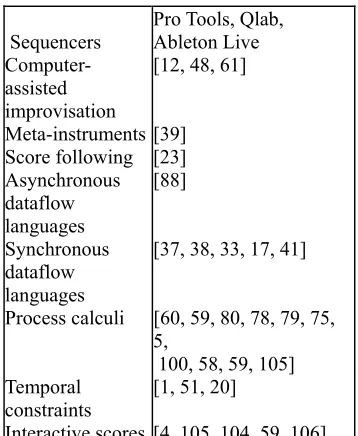
[image:1.612.345.524.511.729.2]where music content and interactive events are handled by computer programs. Examples of such scenarios are music art installations, interactive museum exhibitions, some Electroacoustic music pieces, and some Experimental music pieces. In Table 2, it is presented a literature mapping of the different mathematical models and software that will be presented in this article.
Table 2: Literature Mapping Of Mathematical Models And Software For Music Interaction
Sequencers Pro Tools, Qlab, Ableton Live
Computer-assisted improvisation
[12, 48, 61]
Meta-instruments [39] Score following [23] Asynchronous dataflow languages
[88]
Synchronous dataflow languages
[37, 38, 33, 17, 41]
Process calculi [60, 59, 80, 78, 79, 75, 5,
100, 58, 59, 105] Temporal
constraints [1, 51, 20]
5570 In what follows we briefly explain Experimental music, non-linear music, Electroacoustic music and interactive music. In this thesis we will focus on interactive music. We are interested in Electroacoustic, Experimental and non-linear music that is interactive. In this section, we introduce the problems that arise when designers and composers want to write a score for interactive music, and the problems with existing computer tools to compose and perform interactive music; afterwards, we briefly describe some background concepts and we propose a solution based on the formalism of interactive scores.
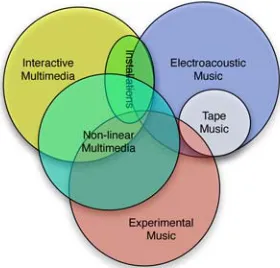
[image:2.612.124.264.418.552.2]In this section we briefly define Experimental music, non-linear music, Electroacoustic music and interactive music. To clarify the classification of these domains, we present a Venn’s diagram in Figure 1: The diagram shows the intersection between the different domains. Figure 1 includes
music art installations, which are an interesting
subset of interactive music; and Tape music, which is a subset of Electroacoustic music that is linear (i.e., parts have a fixed order) and is not interactive.
Figure 1: Intersection Between Electroacoustic Music, Non-Linear Music, Experimental Music And Interactive
Music.
Experimental music.
Nyman argues that, in Experimental music, a score may no longer represent a sound by the means of western music notation [57]: Composers may provide the performer the means of making calculations to determine the nature, timing and spacing of sounds. Composers may indicate temporal areas in which a number of sounds may be placed. Experimental music can span from a
minimum of organization to a minimum of arbitrariness. As an example, Christopher Hobb’s
voicepiece (1967) is written for any number of
vocalists and any length. Nyman argues that, usually, in Experimental music pieces, certain time frames may be chosen at random and filled with sounds.
Nyman argues that an important feature of Experimental music is the diversity of processes available; processes may be relationships between chance and choice. He argues that there are five types of processes: (1) change determination
processes; for instance, when Cage used random
numbers to choose tones, and also when he wrote pieces in which it was required to take information from the telephone directory during performance;
(2) people processes, for instance, the eventuality of
players getting lost or an unknown number of players; (3) contextual processes, such as actions taken on unpredictable conditions within the musicians or the audience; (4) repetition processes, such as unbounded loops; and (5) electronic
processes, difficult to describe because they are not
well formalized.
A characteristic of Experimental music is that, often, the starting and ending times of a piece are unknown. As an example, Nyman argues that in Wolff’s duo II for pianists (1958), the beginning and the ending times are determined in performance by the circumstances of the concert occasion. As another example, Nyman discussed Reich’s
pendulum music (1968). In this piece, microphones
are suspended from the ceiling. The piece begins when the performers swing the microphones and turn on the amplifiers; the piece ends after all microphones come to rest.
Nyman argues that performing Experimental music goes above and beyond performing of Western
music because of all the possibilities that can be
modeled with the five types of processes, and the unknown starting and ending times of a piece, as explained above.
Non-linear music.
Since 1950, computer technology is used to control sound structures; however, there is a long history of non-linear music in western culture. Vickery argues that, in the 20th century, there are examples of non-linear music such as Boulez’s third piano sonata
(1958), and free improvisation with game strategies
5571 the order of work’s musical material was determined by coin-tosses, as we stated before. Vickery has composed some non-linear pieces [115] in the 21st century. As an example, ladders
and snakes (2000) is a piece in which the ladder
processes descend to improvise in a later section, and the snake processes ascend to an earlier section, as a flash back in a film. As another example, splice
(2002) is a piece in which the computer performs
meta-music shaping of the sound made by the musician. Finally, in Vickery’s piece parallel
trajectories (2003), performers have a score map
with different paths from start to end, and they can also choose to stay silent in some parts. As an example, the score is presented in Figure 2.
[image:3.612.160.454.199.300.2]
Figure 2: Score Of Vickery’s Parallel Trajectories (2003). There Are 14 Lines Of Musical Material And Each Of The 9 Players Is Provided With Four Of The Lines. There Are 9 “Modal Points” In The Score In Which The Player May
Choose A Different Line Or Choose To Remain Silent Until The Next Point.
Furthermore, Vickery argues that computer coordination of live musical performance allows for the control and synchronization of the score; for instance, non-linear selection of music material [117]. Music is traditionally linear: left-to-right and top-to-bottom. Computer music offers two main new possibilities according to Vickery: (1) Permutation of large structural blocks of music such as Stockhausen’s momente (1962), and (2) interactive generative processes may be used in real-time. There are some other implications of such a computer-controlled behavior, according to Vickery [117]. As an example, Jason Freeman’s
glimmer (2004) is written for chamber orchestra
and audience participation by waving four-inch LED
sticks. Vickery’s delicious ironies (2002) has also an unpredictable environment for the solo improviser with sample choice, playback speed, duration, volume and pan. As another examples, Vickery recalls Stockhausen’s spectral analysis used in zyklus (1959) and regrain (1959).
According to Vickery, non-linearity allows pieces to have openness of interpretation and openness of
content [116]. Vickery cites some interesting
examples. Game based analysis first used by Xenakis in duel (1959) and strategies (1962), then used by John Zorn in cobra (1984), allows the musician to give commands to games. Richard Teitelbaum, creator of automata (1978), presents an analogy to finite state automata in which a system responds to user actions. The californian group The HUB is a computer network band in which the
musicians and sounds communicate through a network.
Although the many examples that Vickery explained in his articles, he argued towards the urgent need of symbiotic human-machine interactive software to compose non-linear music [116]. In fact, we argue in this section why Vickery’s preoccupation can be extended to non-linear music in general, for instance, in music art installations.
Electroacoustic music.
All Electroacoustic music is made with electronic technology. Some electroacoustic compositions make use of sounds not available in typical acoustic instruments, such as those used in a traditional orchestra. Some Electroacoustic music can be created using non-acoustic technology that exists only in a recorded format (as a fixed medium), and is composed for reception via loudspeakers. The compositional material is not restricted to the inclusion of sonorities derived from musical instruments or voices, nor to elements traditionally thought of as “musical” (e.g., melody, harmony, rhythm and meter), but rather admits any sound, acoustic or synthetic. With the aid of various technologies, such as tape recorders and digital signal processing tools, this material can then be combined, juxtaposed, and transformed, in any conceivable manner 1.
5572 A form of Electroacoustic music, specifically composed for loudspeaker presentation, is
Acousmatic music. Unlike scored music,
compositions that are purely acousmatic exist solely as audio recordings. The term acousmatic
was introduced by Pierre Schaeffer and refers to the listening experience of concrete music in which the audience hears the music from the loudspeakers, without seeing the source of the sound2. In an acousmatic concert, the sound component is produced using pre-recorder media, or generated in real-time using a computer. The work is often
diffused by the composer (if present), but the role of
the interpreter can also be assumed by another musician. The main role of musician is to control
spatialisation. As an example, consider one of
Schaeffer’s earliest work five studies of noises
(1948) made without a computer.
The term concrete music is defined by Schaeffer as an opposition with way musical work usually goes. Instead of notating musical ideas on a paper with the symbols of solfège and entrusting their realization to well-known instruments, the question is to collect concrete sounds, wherever they came from, and to abstract the music values they were potentially containing. According to Pierre Henry, another well-known composer of this style, concrete music was not a study of timbre, it is focused on envelopes and forms3.
A subtype of concrete music, in which sound was registered in magnetic tapes, is called Tape music4.
In such a style, the starting and ending times of all the sounds remain fixed once the composition is over; as opposed, to some pieces of acousmatic
music in which there is real-time sound generated
by computer which order may change.
There is another style subsumed by Electroacoustic music: “Mixed” music, which merges acoustic sounds from traditional instruments played by musicians with electroacoustic sounds (diffused by loudspeakers). As an example, in Manoury’s partita
I (2006) for solo viola and live electronic effects, in
Section VIIC, the composer wrote a note indicating
that the all parts have to be played but in any order. The order is chosen by the musician. This is an example of non-linearity in Electroacoustic music. Another well-known example of “mixed” music is Manoury’s pluton (1988) for piano and live electronics, and Stockhausen’s mikrophonie I
(1964) for tam-tam, microphone and filters.
2 http://en.wikipedia.org/wiki/Acousmatic_music .
3 http://en.wikipedia.org/wiki/Musique\_concr\%C3\%A8te. 4 http://en.wikipedia.org/wiki/Electroacoustic_music\#Tape\_music.
Interactive music.
Interactive music deals with the design of scenarios where music content and interactive events can be handled by computer programs. Designers usually create music content for their scenarios, and then bind them to external interactive events controlled
by Max/MSP or Pure Data (Pd) programs [70, 68].
We recall that examples of interactive music are interactive museum exhibitions and music installations.
music art installations are an artistic genre of
three-dimensional works that are often site-specific and designed to transform the perception of a space. Installations evolved through the use of new and ever-changing technologies: from simple video installations, they expanded to include complex interactive, music and virtual reality environments. Interactive installations were most frequently created and exhibited after 1990s, when artists were particularly interested in using the participation of the audiences to co-author the meaning of the installation5. As an example, there is an interactive installation based on spatial sensing written in Max [119]. Another example is an interactive installation based on probabilistic control [14]. Both installations are non-linear in the sense that the order in which they diffuse video and sound is unforeseen and depends on user interactions. In addition to Max, interactive music scenarios are also designed with commercial sequencers. Commercial sequencers for interactive music are based on a fixed timeline with a very precise script such as Pro Tools6, or a more flexible script using
cue lists, for instance, the theater cue manager
Qlab7. Another software to design such scenarios is
Ableton Live8. Live is often used in Electroacoustic
music and performing arts.
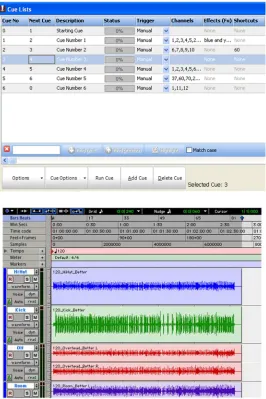
Example 1Figure 3 shows the user interfaces of
cue lists and timeline based sequencers, respectively.
5 http://en.wikipedia.org/wiki/Interactive\_Art
6 http://www.avid.com/US/resources/digi-orientation
7 http://figure53.com/qlab/
5573
[image:5.612.174.440.108.507.2]
Figure 3: Cue-list based Qlab (above) exhibits a list on events and associated actions; it also defines whether and event is triggered by the computer or by the user. Timeline sequencer Protools (below) exhibits a timeline with several sound objects; starting and ending times are fixed and cannot be changed during performance.
Another well-known fixed timeline sequencer is the
Acousmograph which is a software to represent
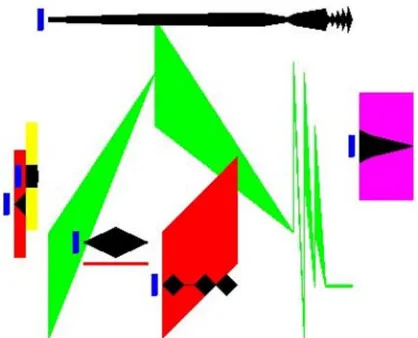
graphically sounds in a composition. In fact, the acousmograph has been used by Pierre Couprie for musicological analysis [25]. It is also worth to note that the acousmograph has been used to represent Gyorgy Ligeti’s artikulation (1958), as shown in Figure 49.
5574
[image:6.612.113.483.73.353.2]
Figure 4: Visual Listening Score Of Gyorgy Ligeti’s Artikulation (1958) Created By Rainer Wehinger Using Acousmograph.
In what follows, we define the fixed timeline and the cue-lists time models, and the problems that have arisen because of the duality between these two time models, among other problems.
2. CURRENT PROBLEMS WITH INTERACTIVE MUSIC SCENARIOS
We have identified seven problems with existing software to design multimedia scenarios: (1) there is no formal model for multimedia interaction, (2) multimedia scenarios have limited reusability and difficulties with the persistence of multimedia scenarios, (3) time models (fixed timeline and cue lists) are temporally unrelated, (4) most multimedia interaction software products provide no hierarchy, (5) the different time scales are unrelated, (6) schedulers for multimedia scenarios are not appropriate for soft real-time, and (7) there is no model to combine temporal relations and conditional branching.
The main problem with interactive music scenarios is that there are two different time models, but existing tools only use one, and tools that allow both, offer both time models temporally unrelated. To understand this problem, we must travel 2500 years back in time. Desainte-Catherine et al. argued that this problem was already discussed by
Parmenides of Elea and Heraclitus of Ephesus long before the invention of computers [28] .
Problems with the time models.
According to Desainte-Catherine et al., what we call today Tape music, that began by editing and mixing sounds in magnetic tapes, is composed in a writing-oriented manner that corresponds to the
arrow metaphor discussed by Parmenides.
Parmenides argued that there are eternal properties and ordered events; for instance, “Socrates was born before he died”. According to Parmenides, timeline goes from past to future. In this paradigm, it is difficult to define changes in the objects in the timeline. In fact, the only changes allowed at performance time of Tape music are in pan, volume, spacialization, among others parameters, but not on the starting and ending time of the sounds nor individual parameters for each sound. In contrast, many pieces of Experimental and Electroacoustic music, are based on real-time sound synthesis. They are usually written in asynchronous
dataflow languages such as Max. According to
Desainte-Catherine et al., interactive music is performance-oriented, and, for that reason, music objects and time representation are quite poor. Performance-oriented software corresponds to the
river metaphor described by Heraclitus: “we never
5575 inference of the events flows is from the future, backwards because events are being “scheduled”. Identity is hard to define in Heraclitus’ paradigm; for that reason, according to Desainte-Catherine et al., we cannot define a permanent environment in asynchronous dataflow languages such as Max/MSP
[70]. Time-stamped data is handled as a queue and there is only available a limited timeline to
schedule the triggering of static events in most asynchronous dataflow languages. Nonetheless, it is worth noticing the effort made my Puckette to include a timeline in Pure Data, as shown in Figure
5 [69].
[image:7.612.203.412.230.399.2]
Figure 5: Writing A Score In Pure Data. Horizontal Axis Represents Time And The Vertical Axis Frequency. Objects Represent Pure Data’s Data Structures. Shapes And Colors Are Chosen By The Composer To Represent The Data
Structures Of The Piece.
The problem of identify is important for both Electroacoustic and Experimental music. One implication is the ownership of Electroacoustic music, as explained by Dahan et al. [26]. According to Nyman, Cardew argued that when we hear on a tape or disk is indeed the same playing, but divorced from its natural context. As an example, Nyman argued that David Tudor (pianist) played Cage’s 4’33” (1952) and people think that Cage’s
4’33” (1952) is a piece for piano, but it is a piece
that can be played by the means of any instrument [57].
Problems with time scales.
In addition to the problem of identity, Schwer discussed another philosophical problem related to linguistics [86], which we believe that it is also related to music: Aristotle argued that between two time instants there is always a time instant. Therefore, the metaphoric timeline seams like the set of real numbers. Nonetheless, according to Schwer, there is a discrete understanding of time in Physics; for instance, in quantic mechanics,
Planck’s time is the smallest measure of time
seconds; in the atomic clock is seconds; however, humans only discriminate at seconds.
In Computer Science, as in Physics, time is also discrete because it is defined by the occurrence of events. For events to occur they have to be observed and this is discrete in nature. In favor of discrete time, the Stoics argued that the set of atomic instants is a discrete structure, thus we can pass from one instant to the next instant, according to Schwer.
5576
Problem with synchronization.
There is another problem derived from the time scales, as we discussed in [103]. The description of a music scenario requires a consistent relationship between the representation of the scenario in the composition environment and the execution. Artistic creation requires a composition of events at different time scales. As an example, it is easy to describe that a video begins when the second string of a guitar arpeggio starts, but how can we achieve it in practice if the beginning of the notes of the arpeggio is controlled by the user?
The problem emerges at runtime. The example given above is very simple, but under high CPU
load, a system interruption at the point of playing the arpeggio and the video can often lead to desynchronization, which is the case with Pure Data and Max. Usually, these eventualities are not considered by developers, as the quality of systems is evaluated according to an average performance. Nonetheless, during performance, it is desired that the system works well even under high CPU load,
which is common when these systems process sound, video and image simultaneously.
The synchronization between the arpeggio and the video must be achieved in every execution. If it does not work for a performance, concert or show, the system performance is not satisfactory. Usually, artists prefer that an event is canceled if the event is not going to be properly synchronized with all the other media. Most users want a system that ensures that the events are either launched as they were defined in the score or they are not produced. Another alternative is based on the synchronization strategies for score following systems proposed by Echeveste et al. [30]. Echeveste’s strategies are designed to define behaviors for the cases in which events are not always properly synchronized with other media due to musician’s mistakes during performance or due to incorrect tempo calculations by the score following system.
Interactive music belongs to the realm of soft real-time. We argue that in soft real-time, the usefulness of a result degrades after its deadline, thereby degrading the system’s quality of service; whereas
in hard real-time missing a deadline is a total
system failure (e.g., flight control systems). It is difficult to ensure determinism in the execution of music processes (e.g., sound, video and 3D images) in the soft real-time realm. Some hard real-time
operating system like RT Linux10 or RedHawk11
10 http://www.windriver.com/index.html
11
http://real-time.ccur.com/concurrent_redhawk_linux.aspx
include priority queues for processes to respect hard real-time constraints; however, in common operating systems, the user does not have this type of control. Note that software like Max and Live do not work on Linux.
Problems with conditional branching.
Another issue arises when we think of non-linear music. When we think about choices based on conditions, we must consider causality. Causal relation is studied by metaphysics. According to Keil, substances are not causes; for instance, “if knife then always wound” is incorrect: An event and a verb are missing [42]. In interactive music, “If note 1 then always note 2” is also incorrect. A causal relation could be “when note 1 starts, then note 2 starts”,“whenever note 1 ends the note 2 ends”, or “when the note 1 gets to a volume peak, then note 2 starts”; however, most tools do not provide this kind of causal relations.
Keil explains that physical systems are described in non-perturbed situations, but such rules may not always apply in real-life situations. As an example, a fire match will not light without oxygen, although a cause of lighting a match is to rub it against a striker. For that reason, when we model non-linear music, we must consider user interactions. We must also consider that these interaction may arrive at any time.
Keil also points out that an event always has different causes susceptible of exceptions because the causes include less than the total state of the universe. For that reason, the causal relation is not transitive; therefore, the flapping of a butterfly’s wing is not the cause of a storm on the other side of the world, according to Keil. As a consequence, we argue that users’ choices should be made over single temporal objects (e.g., sounds or videos), instead of sequences of temporal objects. To choose a sequence of temporal objects, the sequence should be contained in one temporal object. In conclusion, each object must know who was its direct cause. In both figures, there is a mutually exclusive choice between two objects. If a composer wants to write a choice between two sequences of two objects, each two-object sequence must be contained inside a bigger object.
5577 this definition, it is hard to understand scenarios with loops, for instance, when an “instance” of causes an “instance” of , but then such an “instance” of causes another “instance” of in the future. What does this relation means? Are we traveling back to the time when was first executed? Are we creating a new “instance” of and executing it in the future? Are those two “instances” two different events with the same type (or action)? The problem of “time travel” becomes even more difficult when we consider multiple instances of a
temporal object that could be executed simultaneously. We must distinguish between the motive being repeated and the loop itself; we illustrate some cases in Figure 6. The problem gets even harder when we want to synchronize the ending times of motives and loops. In interactive music, synchronization of loops and motives has been extensively studied by Berthaut et al. [18].
[image:9.612.121.487.259.386.2]
Figure 6: Possible Scenarios Synchronizing Motives And Loops. In Case 1, The Loop On The Top Starts The Loop In The Bottom; This Means That The First Repetition Of Motive “A” Starts The First Repetition Of Motive “B”. In Case 2, Every Repetition Of Motive “A” Starts A New Instance Of The Loop On The Bottom. In Case 3, Each Repetition Of
Motive “A” Starts At The Same Time Than Each Repetition Of Motive “B”.
There are some insights in metaphysics on how to solve the problem of having multiple instances of events. Laudisa argues that in neoempirism, leaded by Hume, everything that starts to exist must have a cause for its existence, but all human laws admit exceptions [46]. To formalize such a principle, Laudisa proposes to distinguish between singular
events and event classes: Let x and y be singular
events, the existence of a causal connection means that (1) there are event classes of type X and of type
Y, and (2) x is of type X and y is of type Y.
According to Laudisa’s postulates, we could think about the start event of a temporal object as a class, and each time the temporal object starts, a different singular event that belongs to such a class is launched. Nonetheless, there is still a problem: how to model choices through time, should we consider
a branching time or a linear time? Let us analyze
what computer scientists have to say on this dichotomy.
According to Pratt, there is an analogy: branching time represents local time, and linear time represents global time, in the same way as true concurrency represents local information and false
(or interleaving) concurrency represents global information [67]. In linear time, all choices are made at the beginning, it means that we cannot distinguish between a systems that performs actions
a.b+a.c from a system that performs a.(b+c), where “.” represents sequential composition and “+” represents blind choice. The first system chooses either to execute event a and then event b or event a
and then event c, whereas the second system executes a and then chooses to execute either b or
c.
As an example, Vardi argues that with
computational time logic (CTL), it is possible to
characterize bisimulation of concurrent systems. In terms of complexity of the model-checking problem, using CLT is exponentially easier than
linear-time logic LTL, but in a competitive analysis,
with formulae that can be expressed in both logics, model checkers behave similarly. There is an advantage of linear time: LTL is more intuitive to
describe properties because its specifications describe computations, whereas CTL’s specifications describe trees of computations [114].
5578 music, we believe that linear time is enough because we can consider that all the temporal objects in a scenario are always executed, but some execute silent actions and some execute visible actions, allowing us to express choices. We want to keep the specification of properties simple.
After analyzing the philosophical problems, the Electroacoustic and Experimental music pieces described above, and existing tools and formalisms for music scenarios, we have identified seven problems with existing software to design music scenario: (1) there is no formal model for music interaction, (2) music scenarios have limited reusability and difficulties with their persistence, (3) time models are temporally unrelated, (4) music interaction software products provide no hierarchy, (5) the different time scales are unrelated, (6) schedulers for music scenario tools are not appropriate for soft real-time, and (7) there is no model to combine temporal relations and conditional branching. In what follows we explain each of those problems.
There is no formal model for music interaction.
As we explained before, designers usually create music content for their scenarios, and then bind them to external interactive events controlled by
Max/MSP programs. We advocate a model that
encompasses facilities (1) to design music scenarios having complex temporal relationships among components and (2) to define effective mechanisms for synthesis control based on human gestures. We claim that no such model has been proposed. Such a general model must have formal semantics, as required for automated verification of properties of the scenario that are fundamental to its designers and users. As an example, to verify that temporal objects will be played as expected during performance. In general, we need to prove some property of each execution trace; for instance, that the music motive with notes C-D-E appears in all the
traces of execution (or at least in one). Another example is to state that there is at most one temporal object being executed simultaneously. This property is useful in some theater performances to state that there is at most one curtain being moved at the time because of power constraints. Such properties cannot be verified in applications based on informal specifications, as it is the case for most existing scenarios with interactive controls.
Limited reusability and difficult preservation.
Limited reusability is also a problem caused by the lack of formal semantics: A module made for one
scenario might not work for another one because the program may have dependencies on external parameters that are not stated explicitly. The lack of semantics also makes it difficult to preserve music scenarios because there is usually not a score nor a technology-independent precise way for describing the objects, and the temporal and dataflow relations among them.
Time models are unrelated.
Software to design music scenarios is usually based either on a fixed timeline with a very precise script or a more flexible script using cue lists, as we stated before. A commonly used software to design such scenarios is Live because it allows to use both the fixed timeline and the cue lists, but the two time models are unrelated temporally. In fact, most software products, for instance sequencers, provide only one time model or they are unrelated temporally, as we argued previously.
No hierarchy for temporal objects.
Most software do not provide a hierarchy to represent the temporal objects of the scenario. As an example, using a hierarchy, it is possible to control the start or end of an object by controlling those from its parent. In interactive music, Vickery argues that using a hierarchy is useful to control higher-order parameters of the piece; for instance, to control the volume dynamics instead of the volume of each note [116]. Concentrating on foreground parameters can lead to music that is too superficial as multiple serialism, according to Vickery.
Time scales are unrelated temporally.
The different time scales are often unrelated and cannot be controlled in the same tool. Discrete user
gestures (e.g., clicking the mouse), control events
(e.g., control messages) and sound processing have different sampling frequencies and different computing models. As a consequence of having the time scales unrelated, it is difficult to associate, for instance, a human gesture to both control events and sound processing parameters.
Event schedules are not appropriate for real-time.
5579 common when they process video and 3D graphics in addition to sound.
To solve the problem of scheduling and to write high-performance digital signal processors (DSPs)
for Max and Pd, users often write C++ plugins to model DSPs with loops or independent threads. C++
plugins solve part of the problem, but the control messages –for the input and output of these plugins– are still being scheduled by Max or Pd’s schedulers.
Another solution for the scheduler problem –often used during live performance– is to open one or two instances of Max/MSP or Pd simultaneously,
running different programs on each one. Nonetheless, synchronization is usually done either manually during performance or by using open
sound control (OSC), which adds more complexity
and latency.
No model for conditional branching and temporal relations.
Up to our knowledge, there is not a model for interactive music to represent scores in which is possible to combine complex temporal relations and conditional branching based on conditions over the variables defined in the scenario. In fact, Allombert proposes in [2] an extension with conditional branching to interactive scores, but in such a model he only considers conditional branching and no temporal relations.
3. INTERACTIVE SCORES
In interactive scores, it is possible to specify a variety of relations among temporal objects such as temporal relations, hierarchical relations, harmonic relations, rhythmical constraints and conditional branching. Nonetheless, in this section, we only take into account relations limited to point-to-point temporal relations without disjunction nor inequality (≠) and quantitative temporal relations. We combine qualitative and quantitative temporal relations on the lines of previous independent works by Meiri and Gennary [51, 34].
In what follows, we introduce a mathematic definition of the structure of interactive scores, a formal semantics based on timed event structures, the temporal constraints of a score, and some formal properties such as playability. We also discuss the complexity of the playability problem.
3.1 History of interactive scores
The idea of temporal relations among temporal objects was introduced by Beurivé and Desainte-Catherine in [19]. They found out that relative times are a more efficient representation than
absolute times for music scores. Soon after, they developed Boxes: a software to model a hierarchy and temporal constraints [19]. In fact, Boxes uses Allen’s relations to describe temporal constraints. A few years later, Desainte-Catherine and Brousse came up with the idea of the interactive scores formalism [29].
Another system dealing with a hierarchy of temporal objects is Maquettes of OpenMusic [21]. However, we argue that OpenMusic [22] is a software for composition and is not meant for real-time interaction. Allombert and Desainte-Catherine figured out that the music interaction community needed a software for composition capable of describing a hierarchy of temporal objects and capable of real-time interaction! In 2005, they introduced a new model of interactive scores [7], extending the previous model developed by Desainte-Catherine and Brousse, and following the concepts of Haury’s meta-instrument [39]. This model admits modification of the starting and ending times of the notes of the score during execution.
In Allombert and Desainte-Catherine’s new model, a score is composed by temporal objects, interactive events and temporal relations. This approach does not allow to define interactive user events inside the hierarchy, as we can do it today. They extended Allen’s relations with quantitative relations to express the duration of temporal objects in a similar manner as Mieri did it back in 1995. They introduced the very first notions of temporal reduction: intervals can be reduced if an event is launched before its nominal (expected) time and intervals can be extended if the event is launched after its nominal time; however, the operational semantics of the temporal objects with nominal times, was not very well defined back then. They also introduced a semantics based on Petri nets. Finally, they introduced the environment, control,
output (ECO) machine: an abstract machine to
execute an interactive score in real-time.
5580 constraint satisfaction problem with a cyclic constraint graph, according to Allombert et al. In the extension of interactive scores developed in 2007, Allombert et al. realized that some transformations were needed to the Petri nets to execute them properly. They proposed to collapse two places that occur at the same time in the same place (state). Those transformations inspired what we call in this dissertation the normal form. They also introduced global constraints, but not the details on how to implement them. They also developed an implementation using OpenMusic. The implementation they made in OpenMusic will be the base for the Iscore library, developed one year after.
In 2008, Allombert et al. developed a new extension of interactive scores [9]. They introduced a new kind of temporal relations: linear constraints over durations; for instance, to say that the duration of an object is k times bigger than another. They made an implementation in OpenMusic that only includes flexible-time durations and does not include linear constraints. Examples of their quantitative relations are those involving a proportional or explicit duration; for instance, “the duration of A is one third of the duration of B” or “the duration of A is 3 seconds”. Examples of their qualitative temporal relations are those to represent the precedence between the start and end points of two temporal objects; for instance, “A must be played during B” or “C must be played after D”. They also improved the concept of temporal
reductions: left reductions (chronological) and right
reductions (anti-chronological). Temporal reductions are a mechanism to reduce or stretch the duration of a temporal object when an interactive event is, respectively, delayed or speeded up, while respecting the temporal constraints of the score. It was most likely that they realized at that time that including linear constraints over the duration of the temporal objects will change the complexity of the satisfiability and dispatching of the temporal constraints because they could no longer represent the temporal constraints as a simple temporal problem. Constraints over the durations of temporal objects were never again presented in interactive scores models.
Allombert et al. explored other alternatives to Petri nets as semantics for interactive scores. After reading all the previous extensions of interactive scores, Rueda had in mind that a process calculus based on constraint programming would be more appropriate to represent temporal constraints (and even other constraints, such as harmonic and rhythmical) than Petri nets. Rueda worked with
Allombert, Assayag and Desainte-Catherine to develop a model based on ntcc in 2006 [5]. They used Allen’s relations as temporal relations. There is a disadvantage: The model does not consider the problems that arises when two objects are constraint to start at the same time nor the problems associated to dispatching efficiently a simple temporal problem, as described by Muscettola et al.
[55].
Sarria found another disadvantage with the ntcc model of interactive scores developed by Rueda et al.: time units in ntcc may have different (unpredictable) durations. Sarria extended Allombert’s model in his Ph.D thesis in 2008. He proposed a different approach to cope with real-time issues using his own CCP variant, the real-time
concurrent constraint (rtcc) calculus [85]. Rtcc is
an extension of ntcc capable of modeling time units with fixed duration. This new calculus is capable of interrupting a process when a constraint can be inferred from the store. Rtcc is also capable of delays within a single time unit.
Olarte et al. also extended Rueda’s ntcc model. They extended the model to change the hierarchy of temporal objects during execution [58]. The spirit of such a model is different: they focus on changing the structure of the score during execution to allow the user to “improvise” on a written piece, whereas we are interested on a simpler model that we can execute in real-time. It is worth noticing that it may be also possible to model such changes in the structure during execution using a special kind of Petri nets in which tokens are also nets, introduced by Köhler et al. [43].
Finally, in 2009, Allombert explained in his Ph.D. the results published previously in his models [2]. He also introduced some ideas on how to deal with durations of arbitrary intervals, he introduced music processes that can be associated to temporal objects, and he introduced conditional branching. Conditional branching is the base for some non-linear models in music. Non-non-linear models are used to create openworks. Open works can have openness of interpretation or openness of semantic content, as explained by Vickery [115].
5581
3.2 Interactive Scores Formalism
There are formalisms to model interactive scenarios such as interactive scores. Interactive scores has been a subject of study since the beginning of the century [29]. The first tool for interactive scores is
Boxes, developed by Beurivé [19]. Boxes was
conceived for the composition of Electroacoustic music with temporal relations; however, user interaction was not provided. A recent model of interactive scores [2], that significantly improves user interaction, has inspired two applications:
i-score [4] to compose and perform Electroacoustic
music and Virage [6] to control live performances and interactive exhibitions. We give a further discussion on the history of interactive scores. Scenarios in interactive scores are represented by
temporal objects, temporal relations and interactive
objects. Examples of temporal objects are sounds,
videos and light controls. Temporal objects can be triggered by interactive objects (usually launched by the user) and several temporal objects can be executed simultaneously. A temporal object may contain other temporal objects: this hierarchy allows us to control the start or end of a temporal object by controlling the start or end of its parent. Hierarchy is ever-present in all kinds of music: Music pieces are often hierarchized by movements, parts, motives, measures, among other segmentations.
Temporal relations provide a partial order for the execution of the temporal objects; for instance, temporal relations can be used to express precedence between two objects. As an example of
relative temporal relations, the designer can specify
that a video is played strictly before a light show or between 10 and 15 seconds before. As an example
of absolute temporal relations, the designer can
specify that a loop starts three seconds after the video.
New semantics for interactive scores.
We provide an abstract semantics for interactive scores based on timed event structures. The purpose of such a semantics is (1) to provide an easy, declarative way, to understand the behavior of a score, and (2) a simple theoretical background to specify properties of the system. In constraint programming, we can specify some properties of the scores such as playability. We can also specify those properties in event structures; moreover, the notion of trace, inherent in event structures, is more appropriate than temporal constraints for certain properties. As an example, to specify that a music motive appears in at least one trace of execution.
This study led us to discover that there is no difference between interactive objects and the other temporal objects in the event structures semantics: such a difference can only be observed in the operational semantics. That was the main reason to introduce an operational semantics based on ntcc, on the lines of Allombert et al. [5]. Nonetheless, in Allombert et al.’s models of interactive scores, it was not precisely stated how to execute scores whose temporal object durations are arbitrary integers intervals; for instance, a score in which object a must be executed between two and four time units after object b. Allombert et al.’s models handle flexible-time intervals: {0} to express simultaneity, and (0,∞) and [0,∞) for precedence or for the flexible duration of the objects. Allombert et al.’s models also miss an abstract semantics. We extend the interactive scores formalism with an abstract semantics based on event structures and an operational semantics specified in ntcc, providing (1) a new insight into the interactive scores model; (2) more complex temporal relations to bind objects, including arbitrary sets of integers in the event structures semantics and arbitrary intervals in the operational semantics; and (3) the possibility to verify properties over the execution traces. In order to use arbitrary integer intervals in our operational semantics, we show that several transformations to the event structures semantics are needed to define operational semantics that can dispatch the temporal objects of the score in real-time.
To complete our framework, we also present in this dissertation two extensions of the interactive scores formalism: one for conditional branching and one for signal processing. We also explain the implementation of interactive scores and the implementation of an automatic verification tool for ntcc.
Time conditional branching interactive scores.
Non-linear music pieces are open works. According to Vickery, open works may have openness of interpretation or openness of semantic content [115]. Conditional branching is essential to describe pieces with openness of interpretation.
Conditional branching is commonly used in programming to describe control structures such as
if/else and switch/case. It provides a mechanism to
choose the state of a program based on a condition and its current state. In music interaction, using conditional branching, a designer can create scenarios with loops and choices (as in programming).
5582 take decisions on the performance of the scenario with the degree of freedom that the designer described. The designer can express under which conditions a loop ends; for instance, when the user changes the value of a certain variable, the loop stops; or the system non-deterministically chooses to stop. As an example, the designer can specify a condition to end a loop: When the user changes the value of the variable end to true, the loop stops. The designer can also specify that such choice is made by the system: The system non-deterministically chooses to stop or continue the loop.
We chose event structures because it is a powerful formalism for concurrency that allow us to extend the interactive scores semantics with conditional branching and loops in a very precise and declarative way. Conditional-branching timed interactive scores were introduced in [102, 101]. Such an extension has operational semantics based on ntcc, but it misses an abstract semantics to understand the conflicts among the temporal objects that take place when modeling conditions and choices.
Interactive scores with signal processing.
It is crucial that interactive music software products preserve the macroform and the microform of the scenario. The macroform includes the structure of the scenario (e.g., the tempo and the duration of the scenes, movements, parts and measures). The microform comprises the operations with samples (e.g., micro delays, articulation, intonation, and envelop of the sound).
We propose an extension to the interactive scores formalism for sound synthesis. In this extension, we deal with microstructure and macrostructure of sound, not the structure of image nor other media. In the interactive scenarios we consider, we can deal with streams produced in real-time (e.g., a stream captured from the microphone).
We define a new type of temporal relations meant for high precision; for instance, to express micro delays. We also introduce dataflow relations; for instance, how the audio recorded by a temporal object is transferred to another object to filter it, add a micro delay, and then, send it to another temporal object to be diffused.
We also propose an encoding of the scenario into two models that interact during performance: (1) A model based on the ntcc for concurrency, user interactions and temporal relations, and (2) a model based on Faust for sound processing and micro controls. An advantage of having a formal model for ntcc and Faust interoperation is that we could
prove properties such as playability, and predict the behavior of the system.
The novelty of our approach is using the constraints sent from ntcc to control Faust. We tested our examples in Pd, although they could also be compiled for Max or as a standalone program since both Faust and ntcc can be translated into C++ and Max. In fact, the final goal of our research is to develop a standalone program for interactive scores. Such a program should be general enough to interact with Pure Data, Live, Max/MSP and other
existing software either by passing messages or by generating plugins for those languages.
Execution of interactive scores.
We give operational semantics for interactive scores, but we need to execute those models. The execution must be able to interact with a user in real-time. Since the operational semantics are given in ntcc, we need an interpreter for ntcc capable of real-time interaction and being able to control music objects such as sound, video and lights. There are some interpreters for ntcc, but they are not suitable for real-time interaction [54, 75]. We chose a real-time capable interpreter for ntcc, Ntccrt
[100], to execute our models. Ntccrt is based on
Gecode [90]: state-of-the-art in constraint
propagation. Ntccrt programs can be compiled into standalone programs, or plugins for Pd or Max. Users can use Pd to communicate any object with the Ntccrt plugin. In fact, Ntccrt can control all the available objects for audio processing defined in Pd, although our goal is to use Faust for such tasks. Ntcc belongs to a bigger family of process calculi called concurrent constraint programming (CCP). In
the last decade, there has been a growing interest for CCP models of music interaction [77, 80, 78, 79,
75, 5, 100, 58, 59, 105]12.
Ntcc is not only useful for music semantic interaction, ntcc has also been used in other fields such as modeling molecular biology [76], analyzing biological systems [36] and security protocols [47]. Therefore, advances on the simulation of ntcc models will be useful not only for music interaction, but also for other fields.
Automatic verification.
A disadvantage of ntcc is the lack of automatic verification tools available. This limits the applicability of the verification techniques to small problems. We claim for the urgent need of a verification tool for ntcc. First, because ntcc has been widely used to model reactive systems and
5583 verify properties about them, but the verification had to be done by hand. Second, because there are not many frameworks to model and verify music interaction systems, and ntcc has been proved to be successful in that field.
We developed a bounded-time model checking procedure for ntcc, ntccMC13. The model checker is
based on encoding ntcc processes and constraint
linear-time logic ( CLTL) formulae into
deterministic finite state automata. Examples of
CLTL formulae are “always the constraint pitch=60
can be deduced from the output store”, namely
(pitch=60); and “eventually object a and object b
are launched at the same time”, namely .
Ntcc has been used since its beginnings to prove properties of music interaction systems. Ntcc is a powerful formalism because it allows to simulate the behavior of a model and also to verify properties of the model. As an example, ntcc was used to verify properties of a musicological problem of western-african music [77]. The reader may also look at [78] and [80] for other examples of verification of music interaction systems.
3.3 Structural Definition of the Score
Interactive scores are composed by temporal objects and temporal relations. We consider that all temporal objects have only a start and end point and it is not possible to define intermediate points.
3.3.1 Temporal objects
A temporal object has two point identifiers: to control its starting and ending times. An external action is usually associated to each of them (e.g., turn on the lights, play a video or stop a sound). Some temporal objects are interactive, thus we call them interactive objects.
Definition 1 (Temporal object (TO) ) Let P be a
set of point identifiers. A Temporal object is a tuple
o=〈 sp,ep,Δ〉 , where sp,ep P,sp∈ ≠ep, are called
start and end points, respectively, and Δ N is a set of durations. A temporal object whose duration
Δ={0} is called an interactive object. Functions
sp(o), ep(o) and d(o) return the start, end and duration, respectively, of object o. The set of all temporal objects is T.
3.3.2 Temporal relations
Points p,q P are supposed to be positioned on a timeline. Temporal positions of points could be fully or partially determined. Temporal relations constrain the set of possibilities for these positions. A partial order among points is given by
13 http://sourceforge.net/projects/ntccmc/
quantitative relations; for instance, point q is
executed between four and ten time units after point
p. Qualitative temporal relations can be easily
expressed as quantitative relations; for instance, point-to-point before relation is the interval (0,∞) and point-to-point equal relation is the set {0}, a proposed in [51].
Our quantitative relations are close in spirit to the temporal relations described by Allombert et al.
which contain time intervals [9]. A limitation of Allombert’s interactive scores is that all intervals must be flexible: intervals must have the form (0,∞), [0,∞) or {0}. In Allombert’s thesis [2], the model is extended to general integer intervals, but arbitrary durations cannot be expressed. The durations contained in our temporal relations are usually intervals, but they can be any set of integers.
Definition 2 (Temporal Relation) Let function
give the set of potential time positions for each
point p P. A temporal relation is a tuple 〈 p,Δ,q〉
where Δ N is the set of durations between points
p,q P. We use the notation for temporal
constraints of duration. Temporal positions of p and
q are said to be constrained by ν(q)=ν(p)+Δ. The
set of all temporal relations is R.
Allen’s relations [1] without disjunction, over
discrete time, can be easily expressed as point relations [51]. Furthermore, with point-to-point relations we can express relations that cannot be expressed in Allen’s relations without disjunction; for instance, that the end of a temporal objects is before the end of another temporal object.
Example 3Figure 7 shows how the Allen’s relation
5584
[image:16.612.144.476.128.178.2]
Figure 7: Encoding Of The Allen Relation Overlaps Into Point-To-Point Relations.
3.3.3 Interactive scores
Definition 4 (Interactive Score) An interactive
score is a set of temporal objects equipped with a
set of temporal relations: a tuple 〈 P,O,R , where 〉
P is a set of point identifiers, O T is a set of temporal objects, R (P×P(N)×P) the temporal relations. Set R also includes the relations derived from the duration of temporal objects. For each
o O, 〈 sp(o),d(o),ep(o)〉 ∈R. In addition, a
relation 〈 p,Δ,q〉 ∈R iff
1. p,q are distinct points and ν(q)=ν(p)+Δ;
2. two interactive objects do not occur at the same time; and
3. there is only one temporal relation between the start and end point of a temporal object.
Property 2 takes care of the fact that two interactive points cannot happen at the same time; it means, that they cannot be related with zero-duration temporal relations, not even transitively by the means of other objects. The reason for this constraint is that interactive objects are usually launched by the user of the scenario; therefore, we cannot guarantee that the user will launch them at the same time. This simplifies the model.
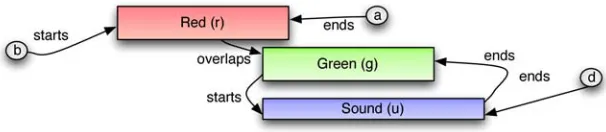
Example 5Figure 8 is an example of a score.
Objects red light, green light and sound produce visible actions at their start and end. Objects a,b are interactive. Temporal relations starts represents a zero-duration between the start points of the two objects they connect. Relations ends represents a zero-duration between the end points of the two objects they connect. Allen’s relation overlaps can be represented by the three point-to-point relations,
as shown in Figure 7.
[image:16.612.156.459.468.534.2]
Figure 8: Example Of An Interactive Score.
Example 6 The Constraints Of The Score In Figure 8 Are Presented In Table 3.
Constraints of duration Explicit temporal relations
ν(ep(r)) ν(sp(r))+d(r)
ν(sp(g))=ν(sp(u))
ν(ep(g)) ν(sp(g))+d(g) ν(ep(a))=ν(ep(r)) ν(ep(a)) ν(sp(a))+{0} ν(sp(g))>ν(sp(r)) ν(ep(b)) ν(sp(b))+{0} ν(ep(g))>ν(ep(r)) ν(ep(d)) ν(sp(d))+{0} ν(sp(g))<ν(ep(r)) ν(ep(u)) ν(sp(u))+d(u) ν(sp(d))=ν(ep(u)) ν(sp(b))=ν(sp(r))
Table 3: Implicit and explicit temporal constraints of the score in Figure 8. Relations “<” and “>” are
[image:16.612.88.437.585.705.2]5585
3.4 Event Structures Semantics
Langerak’s timed event structures (henceforth event
structures) is a mathematical model to represent
systems with non-determinism, real-time and concurrency [13]. Event structures allow to define a partial order among concurrent events. Event structures include a set of labeled events and a
bundle delay relation. The bundle delay relation
establishes which events must happen before some other occurs. Actions can be associated to events. Events are unique, but two events may perform the same action. Events can be defined to be “urgent”.
An urgent event occurs as soon as it is enabled. In
addition to the bundle relation, event structures include a conflict relation establishing events that cannot occur together. Events can also be given
absolute occurrence times.
We recall that interactive scores must have formal semantics, as required for automated verification of properties of the scenario that are fundamental to its designers and users. We also recall that we denote by the functions and R(ε) each component of an event structure ε.
3.4.1 Temporal objects
The events represent the start or end points of a temporal object. An interactive object is represented by a single event. Temporal relations are modeled with event delays. A static temporal object a is
represented by two events (start and end events). The labels of events are pairs (type,o), where
type {startPoint,endPoint,interactiveObject} and
o is the temporal object giving rise to the event.
Example 7Figure 9 shows the encoding of three
temporal objects.
Definition 8 (Temporal object encoding) The
encoding of a temporal object (a) is a function defined by
1. if a=〈 sp,ep,{0} (i.e., 〉 a is an interactive
object), then
2. if a=〈 sp,ep,Δ〉 (i.e., a is a static temporal
object), then eto(a)=〈 E,l, , , ∅ 〉
where and .
The above definition guarantees that there are unique start and end events in the translation of a static temporal object, thus we know that each event is related to a single point.
Definition 9 (Relation between points and
events) Let o be a temporal and the set of points
contained in o, function associates a point identifier to its corresponding event in eto(o).
[image:17.612.103.511.503.566.2]
Figure 9: Encoding Of A Temporal Object And Its Temporal Relations Of Duration. There Are Two For R, Two For G, And A Single One For A. Double Line Arrows Are Just A Visual Notation For The Event Delays That Model The
Duration Of The Temporal Objects.
3.4.2 Temporal relations
Each point-to-point relation is represented by an event delay function.
Definition 10 (Temporal relation encoding) Let
p be a point of temporal object a and q be a point of
temporal object b. The encoding of a temporal
relation r is given by the function . For each
r=〈 p,Δ,q〉 ∈R, the encoding etr(r) is defined by
pe(b,q).
Example 11Figure 10 is the encoding of an
5586
Figure 10: Encoding of two temporal objects, and the overlaps relation between them.
3.4.3 Interactive scores
The encoding of a score is given by adding the event delays from the encoding of the temporal relations to the encoding the temporal objects.
Example 12The encoding of Figure 8 is presented in Figure 11.
Definition 13 (Interactive score encoding) The encoding of an interactive score s=〈 P,O,R is given by 〉
the function that translates interactive scores into event structures. Let , then .
[image:18.612.158.463.361.417.2]
Figure 11: Encoding of the score in Figure 8.8
We shall prove that the temporal constraint of the event structures semantics of a score corresponds to the temporal constraint of the score.
Definition 14 (Temporal constraint of an event
structure) Let ε=〈 E,R,l〉 be an event structure
without conflicts. The temporal constraint of an
event structure tc(ε) is the conjunction of
constraints for each with , where is a finite set of natural numbers.
Given an event structure ε, is a valid trace of ε iff is a solution to tc(ε). The proof proceeds as follows. By the definition of event structures without conflicts, for all 0<i,j≤n: in any trace of ε because ε has no conflicts. By Def. , for each , we have the constraint . Therefore, is a solution to tc(ε).
Proposition 15 (Equivalence of interactive score
constraints and its event traces) Let
s=〈 P,O,R be an interactive score, 〉 ε=es(s) the
encoding of the score, ts(s) the temporal constraint
of the score, and tc(ε) the temporal constraint of ε.
It holds that , where is obtained by replacing each point identifier by its corresponding event in the constraint ts(s), and p is the start or end point of temporal object c O.
We recall that gives the set of potential time
positions for each point p P. We also recall the
notation for temporal constraints:
t+Δ={t'|t'=t+δ,δ Δ}.
The proof above is presented for hierarchical interactive scores in [105].
3.5 Some Properties of the Scenarios