307 | P a g e
IMAGE INTENSIFICATION TECHNIQUE USING
HORIZONTAL SITUATION INDICATOR
Naveen Kumar Mandadi
1, B.Praveen Kumar
2, M.Nagaraju
3,
1,2,3
Assistant Professor, Department of ECE, SRTIST, Nalgonda (India)
ABSTRACT
Image enhancement is an important technology for image processing. A new method of color image
segmentation is proposed in this paper. It’s based HORIZONTAL SITUATION INDICATOR space and has the advantage over
those based on the RGB space. Both the hue and the intensity components are fully utilized. In this paper we
use the HSI color space as an alternative to RGB space. The HSI space considers the image as a combination of
the components: hue, saturation and intensity and Utilized in image processing, the new method has got a good
performance.
In this paper we use the HSI color space as an alternative to RGB space. The HSI space considers the image as a
combination of the components: hue, saturation and intensity. In this paper we propose to design a chromatic filter
in order to obtain improvements in the enhancement of medical images. In image processing systems it is usual
specify colors in a form compatible with the hardware used. The RGB color model, where is computationally
convenient, is not very useful in the specification and color recognition. The human being does not recognize a
color by having an amount of red, green or blue components, but uses attributes perceptual of hue, saturation
and intensity. There are many applications whether on synthesis of the objects or computer graphic images
require precise segmentation. Image enhancement means to enrich the perception of images for human viewers.
The RGB color model, where is computationally convenient, is not very useful in the specification and color
recognition. The human being does not recognize a color by having an amount of red, green or blue components,
but uses attributes perceptual of hue, saturation and intensity.
Keywords: Color Image Segmentation, HSI Space, RGB Space, Color Model
I. INTRODUCTION
308 | P a g e matches human perceptual response to color, i.e., what artists think of as tint, shade, and tone. The color image processing is motivated by two important factors, by a similarity to human vision, fully chromatic,
and second, by the increasing of the information that the chromaticity contributes to the analysis of images. An image with high contrast and brightness is called fine quality image while a poor quality image is identified by low contrast and poorly defined boundaries between the edges. Image enhancement can be considered as transformation of poor quality image into good quality image to make its meaning clearer for human perception or machine analysis. With the consideration of the characteristics of each object composing images in MPEG4, object-based segmentation cannot be ignored. Nowadays, sports programs are among the most popular programs, and there is no doubt that viewers’ interest is concentrated on the athletes. Therefore, demand for Image segmentation of sport scenes is very high in terms of both visual compression and image handling using extracted athletes.
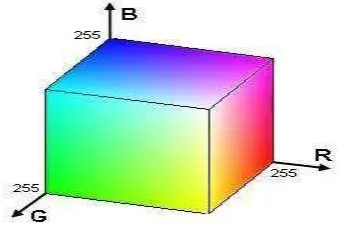
Color spaces provide a method for specifying, ordering and manipulating colors. Usually it is determined by a base of n vectors whose linear combinations generate all elements of the space. There are numerous color spaces among which we can mention the gray scale, which is one dimensional space, the planes RG, GB and BR, which are two-dimensional spaces and the spaces RGB (Red, Green and Blue), HSV (Hue, Saturation , Value), HSI (Hue, Saturation, Intensity) and YIQ, which are three-dimensional spaces [3-4]. There are many algorithms used for image segmentation, and some of them segmented an image based on the object while some can segment automatically. Nowadays, no one can point out which the optimal solution is due to different. A similarity close measure was used to classify the belonging of the pixels, and then used region growing to get the object. Unfortunately, it required a set of markers, and if there is an unknown image, it is hard to differentiate which part should be segmented. In this paper Image segmentation we be introduce using HSI Function. The morphology and color based image segmentation method is proposed. By setting a threshold based on the pixel value of the hue, saturation, and intensity (H, S, I) separately, these color information of the object can represent the parts with the image close to these color information. The character of HSI is used to analyze color because they are the three components of the original color. Sine the hue, saturation, and Intensity are independent of one another, we can use them to process the image separately without worrying the correlation of them. On the other hand, if the character of RGB is used instead, the color of the segmented results will change correspondingly when a few pixel values are changed. In this paper, we propose a new algorithm segmenting color images in HSI space. HIS color representation is compatible with the vision psychology of human eyes, [3] and its three components are relatively independent.
II. EXPERIMENTAL APPROACH
309 | P a g e representation. In the HSI system, the hue of a color is its angle measure on a color wheel. Pure red hues are 0°, pure green hues are 120°, and pure blues are 240°. (Neutral colors--white, gray, and black--are set to 0° for convenience.) Intensity is the overall lightness or brightness of the color, defined numerically as the average of the equivalent RGB values. The HSI definition of saturation is a measure of a color's purity/grayness. Purer
colors have a saturation value closer to 1, while grayer colors have a saturation value closer to 0.
Figure 1. HSI Model
The HSI model defines a color model in terms of its components. This space has the ability to separate the intensity of the intrinsic information of color, which refers to the hue and saturation. This model is suitable for processing images that present lighting changes this is due to the fact that the colors of the environment are distinguishable from each other through the hue component.
Figure 2. RGB model representation
310 | P a g e
Figure 3: HSI model representation, the letters R, Y, G, C, B, M refer to = Red, Yellow, Green,
Cyan, Blue and Magenta respectively.
The spaces that represent the color in terms of hue, saturation and intensity, allow an intuitive description of the colors. The transformation of RGB space to HSI space is the conversion of a Cartesian coordinate system to another in cylindrical coordinates, where the color is specified in terms of hue, saturation and intensity. A good representation of color must use norm or distance to make that the chromatic and achromatic components are independents. The equations that establish the change of coordinates between the components of both color spaces, using the semi-norm max-min, are given by:
Suppose R, G, and B are the red, green, and blue values of a color. The HSI intensity is given by the equation now let m be the minimum value among R, G, and B. The HSI saturation value of a color is given by the equation S = 1 - m/I if I > 0, o
S = 0 If I = 0.
To convert a color's overall hue, H, to an angle measure, use the following equations:
If G ≥ B H = 360 - cos-1[(R - ½G - ½B)/√R² + G² + B² - RG - RB – GB] If B > G
The inverse cosine output is in degrees.
311 | P a g e light intensity, the brightness of the same object surface is not uniform. However, the hue values determined by the reflective property of the object surface are relatively stable. [2] While in some other cases, the color intensities of different objects are more distinguishable among different objects. Our approach is to obtain color information of the target image and boundary extraction separately and simultaneously. We apply the character of HSI to acquire the information of the pixels of the target image. The proposed algorithm for the selective chromatic filter has the following steps:
First we extract the color of interest of the original image using manual selection. The algorithm selects the correspondent color code on the matrix H (a value between zero and one).
Based on the selected color and allowing a range of tones above and below it (color band pass filter), a mask with the image pixels that are within that range is obtained.
Use the hue, saturation and intensity to get color information.
At last, this mask is applied to get darker the pixels which colors are outside the filter passband in the intensity component .
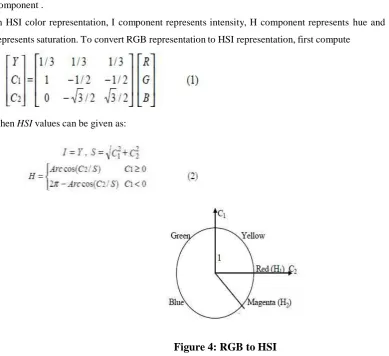
In HSI color representation, I component represents intensity, H component represents hue and S component represents saturation. To convert RGB representation to HSI representation, first compute
Then HSI values can be given as:
Figure 4: RGB to HSI
As shown in the Fig 2.1, in the C1-C2 two-dimensional space, a point on the unit circle corresponds to one color. Starting from C2 axis and going counterclockwise along the unit circle to another point on the unit circle, the positive angle (Î [0,2p)) you experienced is just the hue value of the color. For H1= 0 (red) and H2 = 5p /3
312 | P a g e component. One point worth noticing is that the H component is a value of angle and it displays a special cyclic property.
III. TESTING
To compare the quality of filtering in HSI space with respect to RGB space, we performed the same filtering, but now on each matrix of RGB space, red, green and blue. The final mask results the combination of a logic and function applied to the individual masks obtained. This chromatic filtering is more restrictive in RGB space because there is a high degree of correlation between the RGB components. Hue becomes the attribute of a visual sensation according to which an area appears to be similar to one of the perceived colors: red, yellow, green, and blue, or to a combination of two of them. Intensity becomes the total amount of light passing through a particular area and Saturation becomes the colorfulness of a stimulus relative to its own brightness. Brightness and colorfulness are absolute measures, which usually describe the spectral distribution of light entering the eye, while lightness and Chroma are measured relative to some white point, and are thus often used for descriptions of surface colors, remaining roughly constant even as brightness and colorfulness change with different illumination. Saturation can be defined as either the ratio of colorfulness to brightness or of Chroma to lightness. More precisely, both hue and Chroma in this model are defined with respect to the hexagonal shape of the projection. The Chroma is the proportion of the distance from the origin to the edge of the hexagon. In the lower part of the diagram to the right, this is the ratio of lengths OP/OP′, or alternately the ratio of the radii of the two
hexagons. This ratio is the difference between the largest and smallest values among R, G, or B in a color. To make our definitions easier to write, we’ll define these maximum and minimum component values as M and m, respectively.
313 | P a g e The characters of HSI (hue, saturation, and intensity) are also applied to segment the image. Only the information of the pixels with similar HSI character to the foreground image would be kept. In order to apply the characters of HSI to segment the image, partial images of the foreground image is cut to calculate the average value of the hue, saturation, and intensity, and then the deviation of the HSI value is set to create different ranges of the hue, saturation, and intensity. Afterwards, the HSI value of every pixels of the image is examined. Only the information of the pixel whose HSI value falls in the range will stay. Otherwise, its information will be set to zero. By applying the character of HSI to image segmentation, we can obtain all the information of the pixel whose HSI value is similar to that in foreground images. The approximate color information of pixels and the information of boundaries are acquired. To combine both of the information, we get the union of the results from the above two steps so the result from different methods would be combined. The reason why we get the union of the results instead of the intersection is we only got partial images from the two different methods mentioned above. So only by getting the union of them can we get an image that is more close to the target image which we want to segment out from the entire image.
IV. DISCUSSION AND RESULT
314 | P a g e
RGB Image-HSI Equalized
315 | P a g e
V. CONCLUSION & FUTURE WORK
Due to the clearness of both the foreground and the background images, we have problem extracting only the boundaries of the foreground image. Another limitation of our algorithm is that the appendages of the target image cannot cross over each other. When the appendages of the target image cross over each other, the boundaries of the appendages would make a closure. First of all, an interpolation algorithm needed to be developed. Since the Matlab “edge” command can only extract the approximate boundaries, the interpolation algorithm is necessary to connect the disconnected boundary line segments. Moreover, other than using the character of HSI to extract the image, it will be helpful to use other characters to extract the image so the segmented pixel information of the target image will be more solid.
Even though the character of HSI extracts most of the color information of the target image, it also extracts the pixels in the background image whose HSI value fall in the setting range. Therefore, if we can come up with other character to segment the image, we should be able to remove part of the noise but keep the completeness of the target image in the mean time. In addition, a more powerful algorithm of noise removal needs to be developed. With our current algorithm of noise removal, it does remove most of the noise from the background image. However, it has its own limitation and flaws. Since the dilation is performed in order to connect the disconnected boundary line segments, so the background image surrounding the target image will also be extracted while they actually should be eliminated. This noise relates to the disconnected boundary line segments. Therefore, if we can develop a more powerful interpolation algorithm, we would not have to perform dilation to connect the disconnected boundary line segments and the background image surrounding the target image will not be extracted. Furthermore, the Matlab “edge” command will also extract edge the background image which has clear vision and cannot be eliminated, so a more powerful algorithm of noise removal would improve the accuracy of image segmentation. To reduce the noise in the image we further use fuzzy system in coming days
REFERENCES
[1] González Woods 1992 Digital Image Processing AddisonWesley. [2] Jain 1989 Fundamentals of Digital Image Processing Prentice Hall.
[3] H D Cheng X H Jiang Y Sun Jingli Wang 2001 Color image Segmentation: advances and prospects. Elsevier.
[4] Alain Tremeau, Shoji Tominaga, and Konstantinos N. Plataniotis. Color in image and video
processing: most recent trends and future research directions. 7, January 2008, Journal on Image Video Processing,
316 | P a g e Journal of Physics:ConferenceSeries 332 (2011) 012041.
[7] Monica Subashini.M , Sarat Kumar Sahoo “Brain MR Image Segmentation for Tumor Detection using Artificial Neural Networks” International Journal of Engineering and Technology (IJET).