Cognitive Behavior Therapy for Pediatric Functional
Abdominal Pain: A Randomized Controlled Trial
WHAT’S KNOWN ON THIS SUBJECT: Pediatric functional
abdominal pain is common and costly. Cognitive behavior therapy (CBT) is a promising treatment for these complaints, but solid evidence for its effectiveness is lacking.
WHAT THIS STUDY ADDS: This randomized controlled trial shows that CBT reduces abdominal pain in 60% of children 1 year after
treatment. Six sessions of CBT delivered by trained master’s
students in psychology were equally effective as 6 visits to an experienced pediatrician.
abstract
OBJECTIVE:This randomized controlled trial investigated the effective-ness of a 6-session protocolized cognitive behavior therapy (CBT) com-pared with 6 visits to a pediatrician (intensive medical care; IMC) for the treatment of pediatric functional abdominal pain (FAP).
METHODS:One hundred four children aged 7 to 18 were randomized to CBT or IMC. CBT was delivered primarily by trained master’s degree students in psychology; IMC was delivered by pediatricians or pedi-atric gastroenterologists. Assessments were performed pretreat-ment, posttreatpretreat-ment, and at 6- and 12-month follow-up. Primary outcomes were level of abdominal pain (AP) as reported on questionnaires and diaries. Secondary outcomes were other gastrointestinal complaints, functional disability, other somatic complaints, anxiety, depression, and quality of life.
RESULTS:Both CBT and IMC resulted in a significant decrease in AP (P,.001), but no significant difference was found between the treat-ments in their effectiveness (P..05 for all end points). According to the questionnaire-derived data, 1 year after treatment, 60% of children that received CBT had significantly improved or recovered, versus 56.4% of children receiving IMC, which did not significantly differ (P = .47). These percentages were 65.8% versus 62.8% according to the diary-derived data, which also did not significantly differ (P= .14). Additionally, nearly all secondary outcomes improved after treatment.
CONCLUSIONS:CBT was equally effective as IMC in reducing AP in chil-dren with FAP. More research into the specific working mechanisms of CBT for pediatric FAP is needed.Pediatrics2013;132:e1163–e1172
AUTHORS:Shelley M.C. van der Veek, PhD,aBert H.F. Derkx,
MD, PhD,bMarc A. Benninga, MD, PhD,bFrits Boer, MD,
PhD,aand Else de Haan, PhDa
aDepartment of Child and Adolescent Psychiatry, Academic
Medical Center, Amsterdam, Netherlands; andbEmma Children’s
Hospital Academic Medical Center, Amsterdam, Netherlands
KEY WORDS
functional abdominal pain, cognitive behavior therapy, randomized controlled trial
ABBREVIATIONS
AP—abdominal pain API—Abdominal Pain Index CBT—cognitive behavior therapy FAP—functional abdominal pain IMC—intensive medical care PDS—Pain Duration Score PIS—Pain Intensity Score RCT—randomized controlled trial
Dr van der Veek conducted the study; collected, analyzed, and interpreted the data; and drafted the initial manuscript; Drs Derkx and Benninga conceptualized and designed the study, treated children included in the study, and reviewed and revised the manuscript; Dr Boer conceptualized and designed the study and reviewed and revised the manuscript; Dr De Haan conceptualized and designed the study, treated children included in the study, and reviewed and revised the manuscript; and all authors approved thefinal manuscript as submitted. This trial has been registered with the Netherlands National Trial Register (http://www.trialregister.nl/trialreg/index.asp) (identifier NTR1613).
www.pediatrics.org/cgi/doi/10.1542/peds.2013-0242 doi:10.1542/peds.2013-0242
Accepted for publication Aug 6, 2013
Address correspondence to Shelley M.C. van der Veek, PhD, Department of Child and Family Studies, Leiden University, PO Box 9555, 2300 RB Leiden, Netherlands. E-mail: [email protected] PEDIATRICS (ISSN Numbers: Print, 0031-4005; Online, 1098-4275). Copyright © 2013 by the American Academy of Pediatrics
FINANCIAL DISCLOSURE:The authors have indicated they have nofinancial relationships relevant to this article to disclose.
FUNDING:The current study was funded by the Dutch Digestive Foundation, grant SWO 05-09.
Abdominal pain (AP) is a common complaint in children and adolescents. Most children experience occasional episodes of AP,1,2 which often resolve spontaneously. However, in ∼10% of children in Western countries, the pain does not disappear and becomes chronic,3 affecting daily life signifi -cantly.4,5 An explanatory organic dis-ease is rarely found. Without an organic cause, chronic AP is called
“functional” (FAP). If left untreated, there is a considerable chance that FAP will persist into adulthood or change into other (psycho)pathology.6,7
The effectiveness of psychological therapies for pediatric FAP has been studied in several randomized con-trolled trials (RCTs).8–13Although a re-cent Cochrane review described cognitive behavior therapy (CBT) as a promising psychological treatment, this review also underscored that many RCTs have considerable meth-odological drawbacks such as small sample sizes and high dropout rates.14 Moreover, a well-designed RCT pub-lished after the Cochrane review did not provide unequivocal evidence for the benefit of CBT because it showed CBT to be superior to a control condi-tion but only according to parent re-port of the child’s pain, not according to child-reported pain.8Thus, considering the current state of the literature, it is difficult to draw conclusions on the actual effectiveness of CBT for the treatment of pediatric FAP.
Therefore, we performed a large RCT, investigating the effectiveness of a 6-session CBT protocol compared with 6 visits to a pediatric gastroenterologist. The effects of CBT were compared with this intensified medical care (IMC) control condition and not to (less fre-quent) care as usual because we aimed to control for the therapeutic effect of receiving attention from a health care professional.15In accordance with re-cent recommendations for treatment
trials in pediatric chronic pain,15,16we investigated the impact of the inter-ventions on pain as well as on nonpain outcomes such as other gastrointesti-nal complaints (eg, nausea), functiogastrointesti-nal disability, anxiety, depression, and quality of life. We expected CBT to be superior to IMC on all outcomes.
METHODS
Design and Procedure
The study was a prospective RCT. The study protocol was approved by the ethical committee of the Academic Medical Center Amsterdam. The trial was registered at the Netherlands Na-tional Trial Register, trial number NTR1613.
Children were screened for inclusion by pediatricians of the general pediatric and pediatric gastroenterology out-patient clinics at the Emma Children’s Hospital Academic Medical Center Amsterdam in the Netherlands. Chil-dren who consented to participate re-ceived 2 intake sessions (T1) at De Bascule, an academic center for child and adolescent psychiatry in Amster-dam, during which baseline assess-ments of outcomes took place. At the end of the second intake session, the
first author randomized the children using a computerized randomization program, stratifying by age (2 age groups: 8–12 and 13–17 years) and gender. Children and parents were notified immediately of the results of the randomization. Assessments took place 2 weeks after treatment (T2) and 6 months and 12 months after treat-ment (T3 and T4).
Inclusion Criteria
Children were eligible if they were 7 to 18 years of age and fulfilled the Rome III criteria for pediatric AP-related func-tional gastrointestinal disorders17: (1) AP is main complaint; (2) AP present at least once per week for at least 2
months before diagnosis; (3) no evi-dence of an inflammatory, anatomic, metabolic, or neoplastic process that explains the patient’s symptoms. Pres-ence of an explanatory organic disease was investigated by conducting a phy-sical examination; mapping the medi-cal history of the child; performing laboratory tests on stool, urine, and blood; and performing an ultrasound. Additional criteria were (4) absence of a psychiatric disorder that required treatment before treatment of FAP (eg, psychotic symptoms); (5) Dutch speaking; and (6) AP had to be present during the 2 weeks before inclusion.
Calculation of Sample Size
On the basis of an earlier study,13we expected a 31.8% difference in ef-fectiveness between CBT and IMC. To be able to detect that difference with an 80% power and a 2-sided 5% sig-nificance level, a sample size of 45 participants per group was neces-sary. Therefore, our goal was to in-clude 50 participants per group, given an anticipated dropout rate of 10%.
Interventions
given or medication prescribed (IMC). Subsequently, the results, as described in the pain diary, were discussed with the child and the family.
CBT
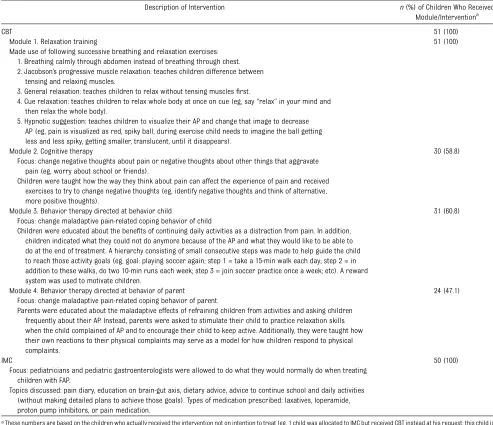
The CBT protocol,19 consisting of 6 sessions of 45 minutes, was based on the protocols used in previous RCTs.10–12 The protocol had 1 standard and 3 optional modules that the therapist could select depending on the needs and problems of the child (see Table 1), allowing tailoring of the protocol to the individual child. This approach reflects
normal practice and is suggested to be more effective than applying a stan-dard protocol to every patient.20 In children 7 to 12 years of age, a parent was present during every session. In children aged.12 years, parents were present during the first, middle, and last session and at the end of every session to reflect on what was dis-cussed with the child. If the module on parental behavior was used (see Ta-ble 1), a parent was present during every session. If parents or children felt the need to visit their referring pediatrician during CBT, they were
allowed to do so; however, none of the participants did.
IMC
Pediatricians educated children and their parents about the complaints, gave dietary advice, gave advice about continuing school and daily activities, and, if indicated, prescribed medication such as laxatives, loperamide, proton pump inhibitors, or pain medication. Contacts lasted ∼20 to 30 minutes. Usually, parents were present during every consult; children .12 years of age were sometimes seen without their
TABLE 1 Content of Interventions Tested in the Current Study
Description of Intervention n(%) of Children Who Received Module/Interventiona
CBT 51 (100)
Module 1. Relaxation training 51 (100) Made use of following successive breathing and relaxation exercises:
1. Breathing calmly through abdomen instead of breathing through chest. 2. Jacobson’s progressive muscle relaxation: teaches children difference between
tensing and relaxing muscles.
3. General relaxation: teaches children to relax without tensing musclesfirst.
4. Cue relaxation: teaches children to relax whole body at once on cue (eg, say“relax”in your mind and then relax the whole body).
5. Hypnotic suggestion: teaches children to visualize their AP and change that image to decrease AP (eg, pain is visualized as red, spiky ball, during exercise child needs to imagine the ball getting less and less spiky, getting smaller, translucent, until it disappears).
Module 2. Cognitive therapy 30 (58.8) Focus: change negative thoughts about pain or negative thoughts about other things that aggravate
pain (eg, worry about school or friends).
Children were taught how the way they think about pain can affect the experience of pain and received exercises to try to change negative thoughts (eg, identify negative thoughts and think of alternative, more positive thoughts).
Module 3. Behavior therapy directed at behavior child 31 (60.8) Focus: change maladaptive pain-related coping behavior of child
Children were educated about the benefits of continuing daily activities as a distraction from pain. In addition, children indicated what they could not do anymore because of the AP and what they would like to be able to do at the end of treatment. A hierarchy consisting of small consecutive steps was made to help guide the child to reach those activity goals (eg, goal: playing soccer again; step 1 = take a 15-min walk each day; step 2 = in addition to these walks, do two 10-min runs each week; step 3 = join soccer practice once a week; etc). A reward system was used to motivate children.
Module 4. Behavior therapy directed at behavior of parent 24 (47.1) Focus: change maladaptive pain-related coping behavior of parent.
Parents were educated about the maladaptive effects of refraining children from activities and asking children frequently about their AP. Instead, parents were asked to stimulate their child to practice relaxation skills when the child complained of AP and to encourage their child to keep active. Additionally, they were taught how their own reactions to their physical complaints may serve as a model for how children respond to physical complaints.
IMC 50 (100)
Focus: pediatricians and pediatric gastroenterologists were allowed to do what they would normally do when treating children with FAP.
Topics discussed: pain diary, education on brain-gut axis, dietary advice, advice to continue school and daily activities (without making detailed plans to achieve those goals). Types of medication prescribed: laxatives, loperamide, proton pump inhibitors, or pain medication.
aThese numbers are based on the children who actually received the intervention not on intention to treat (eg, 1 child was allocated to IMC but received CBT instead at his request; this child is
parents for a maximum of half of the contacts.
Measures
Questionnaires werefilled out by both children and parents. AP was assessed with the Abdominal Pain Index (API),21 which consists of 5 questions that fo-cus on the frequency, duration, and intensity of the AP the child experi-enced in the past 2 weeks. Scores range from 0 to 50.2The API has been shown to have good internal consis-tency.21Gastrointestinal symptoms and other physical symptoms were as-sessed using the validated Dutch ver-sion of the Children’s Somatization Inventory.22–25Six items (nausea/upset
stomach, constipation, loose bowel move-ments or diarrhea, vomiting, feeling bloated or gassy, food making the pa-tient sick) were summed to measure gastrointestinal symptoms; 28 items were summed to measure other phys-ical symptoms. Functional disability was measured with the Functional Disability Inventory, a validated and reliable in-strument.5,26 Anxious and depressive symptoms were measured with the Re-vised Child Anxiety and Depression Scale—short version.27 Two separate scores for anxious and depressive symptoms were calculated. Quality of life was assessed using the KIDSCREEN-27,28an internationally developed and validated instrument. Five aspects of
quality of life were measured: physical well-being, psychological well-being, parent relations and autonomy, social support and peers, and school envi-ronment. Satisfaction with treatment and therapist/doctor was assessed on a scale ranging from 0 (bad) to 10 (ex-cellent).
In addition, childrenfilled out a 1-week pain diary at all assessments, which measured frequency, duration, and in-tensity of AP on a daily basis. Inin-tensity of AP was scored using a Facial Affective Scale18,29ranging from 1 (smiling face, no pain) to 9 (crying face, most intense pain possible). Diary data were entered in SPSS (IBM SPSS Statistics, IBM Cor-poration) by students who were blin-ded to treatment. Using the same coding procedure as Vlieger and col-leagues,18daily intensity scores were recoded as follows: 0 = no pain, 1 = faces 1 to 3, 2 = faces 4 to 6, and 3 = faces 7 to 9. Daily duration scores were recoded as follows: 0 = no pain, 1 = 1 to 30 minutes of pain, 2 = 31 to 120 minutes of pain, and 3 =.120 minutes per day. The recoded daily scores were added for all 7 days of the diary, resulting in a total Pain Intensity and Pain Duration Score (PIS and PDS) with a range of 0 to 21.18
To assess whether any psychiatric di-agnoses were present, we used the validated Anxiety Disorders Interview Schedule for Children,30 a semistruc-tured interview assessing the Diag-nostic and Statistical Manual of Mental Disorders, 4th edition, anxiety disorders and depression. The interview was se-parately administered to parents and children. Children received a diagnosis when either the parent- or the child-interview showed a psychiatric dis-order.
Finally, to assess health care use after treatment, children and parents were asked during follow-up assessments if they had sought any health care after completion of CBT or IMC.
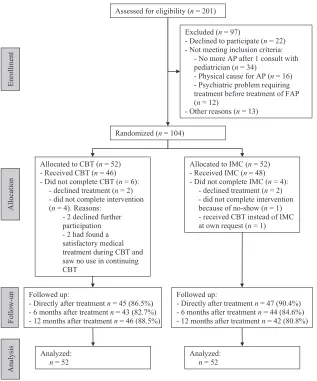
FIGURE 1
Statistical Analyses
The intention-to-treat principle was used for all analyses. To investigate whether both treatments led to a sig-nificant decrease of pain and secondary measures over time, and whether there was a significant difference in effec-tiveness between both treatments, linear mixed-model analyses were per-formed in SPSS 18.0, which make use of every observation for every partic-ipant, irrespective of missing data. In addition to these analyses, we calculated which percentage of children showed a clinically significant improvement af-ter treatment. To calculate these per-centages for the questionnaire-derived data, we used the frequently recom-mended reliable change index.31 This index calculates a critical change score for reliable improvement, based on the baseline SD and Cronbach’sareliability of the instrument used.31For the cur-rent study, children were considered improved if they decreased $9.90 points on the self-reported API (range 0–50); if in addition to this, their level of AP after treatment was closer to the mean of a healthy population than to the mean of the clinical popula-tion, they were considered recovered (Jacobson and Truax’s criterion c31,32). If the AP increased$9.90 points after
treatment, children were considered deteriorated. To compare our results to those of an earlier study perfor-med in our institution,18we addition-ally calculated an index of treatment success based on the pain diaries. Children were considered recov-ered if both their PIS and PDS de-creased.80%; if both PIS and PDS decreased between 30% and 80%, children were considered improved, and if children’s PIS or PDS decreased
,30%, they were considered not im-proved.18
RESULTS
Participant Flow
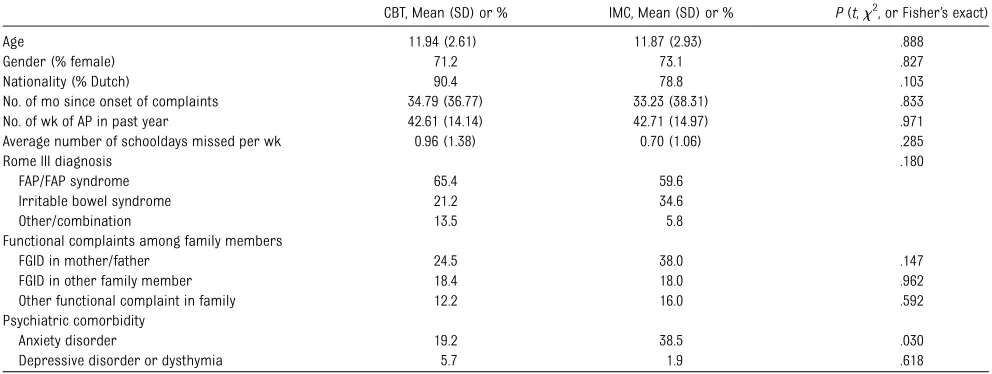
Between April 2007 and April 2010, 201 children were screened for participa-tion in the study. Ninety-four children did not fulfill inclusion and exclusion criteria (Fig 1). One hundred four chil-dren were included and randomized, 52 in each condition. At baseline, no significant differences were found in any of the demographic and clinical characteristics between the 2 groups, except for the presence of comorbid anxiety disorders, which were more prevalent in the IMC group (Table 2). Forty-six children completed CBT, and 48 completed IMC. Data of all 104 included
children were used for analyses. Last follow-up data were gathered in August 2011.
Differences Between Treatment Effectiveness
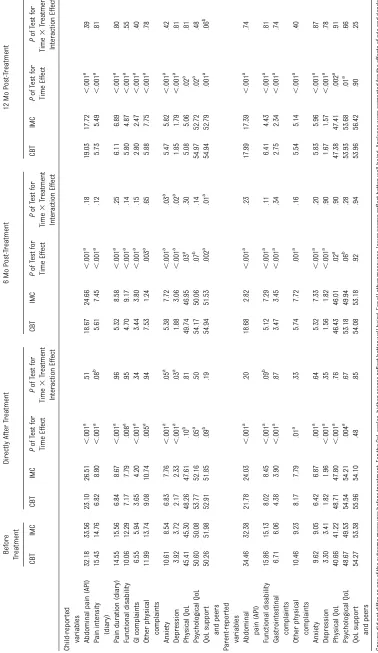
Figure 2 displays the progression of child-reported AP throughout the study. The results of the linear mixed models investigating differences be-tween the 2 treatments, correcting for the effects of age and gender, are dis-played in Table 3. Compared with the scores before treatment, children im-proved on all measures at all time points, except for some of the quality-of-life subscales (parent relations and autonomy and school environment). No significant differences were found be-tween the 2 treatments on any of the time points concerning child- or parent-reported AP, functional disabil-ity, gastrointestinal complaints, other somatic complaints, and 4 of 5 quality-of-life domains. For child-reported anxiety and depression directly after treatment (T2) and at 6-month follow-up (T3), a significant interaction effect between time and treatment indicated that children’s levels of anxiety and depression decreased more after CBT than after IMC. At 12-month follow-up (T4), levels of anxiety and depression in
TABLE 2 Baseline Characteristics of Sample as a Function of Treatment Condition
CBT, Mean (SD) or % IMC, Mean (SD) or % P(t,x2, or Fisher’s exact) Age 11.94 (2.61) 11.87 (2.93) .888 Gender (% female) 71.2 73.1 .827 Nationality (% Dutch) 90.4 78.8 .103 No. of mo since onset of complaints 34.79 (36.77) 33.23 (38.31) .833 No. of wk of AP in past year 42.61 (14.14) 42.71 (14.97) .971 Average number of schooldays missed per wk 0.96 (1.38) 0.70 (1.06) .285
Rome III diagnosis .180
FAP/FAP syndrome 65.4 59.6 Irritable bowel syndrome 21.2 34.6 Other/combination 13.5 5.8 Functional complaints among family members
FGID in mother/father 24.5 38.0 .147 FGID in other family member 18.4 18.0 .962 Other functional complaint in family 12.2 16.0 .592 Psychiatric comorbidity
Anxiety disorder 19.2 38.5 .030
Depressive disorder or dysthymia 5.7 1.9 .618
the IMC-group had dropped to similar levels as those in the CBT-group. For quality of life related to social support and peers, children receiving CBT had improved more at T3 than children re-ceiving IMC. This significant effect de-creased to a nonsignificant trend at T4.
Treatment effectiveness was not infl u-enced by which therapist/doctor or by which specialty (pediatric gastroen-terologist versus pediatrician) de-livered treatment (all Ps of time 3 therapist/doctor interaction ..05). Receiving$1 optional modules did not influence effectiveness of CBT (Pof all time 3 module interaction effects
..05;Pof all Bonferroni corrected post hocttests..05).
Treatment Success
According to the questionnaire data, 31.8% of children in CBTand 29.8% of the children in IMC were recovered or im-proved at T2 (Table 4). These percen-tages increased at T3 and T4 to 51.2% and 60.0% for CBT and to 41.5% and 56.4% for IMC. There were no signifi -cant differences between the con-ditions (P of all Fisher’s exact tests
..05). The improvement/recovery per-centages of the diary data were much higher: 66.6%, 65.0%, and 65.8% for CBT at the 3 end points, and 47.5%, 47.4%, and 62.8% for IMC. These percentages also did not significantly differ (Pof all
x2
tests..05).
Two children in the CBT condition de-teriorated at T2, none at T3, and 4 at T4 (questionnaire data). In the IMC con-dition, 2 children deteriorated at T2 and 2 at T3. Most of these children had a low child-reported API score at baseline (Fig 2). These scores were significantly lower than their parent-reported baseline API scores (mean children = 19.88, mean parents = 30.00, t6 = –
2.530;P= .05).
Adverse Events
No serious adverse events were reported.
Satisfaction With Treatment and Therapist/Doctor
On a scale from 0 (bad) to 10 (excellent), CBT was rated a 7.61 by children and a 7.52 by parents, and the therapist was rated an 8.45 by children and an 8.28 by parents. For IMC, these ratings were 7.74 and 8.57, respectively, as rated by children, and 7.57 and 8.54 as rated by parents. The ratings did not differ between treatments or between therapists/doctors (P of all t tests
..05).
Health Care Use After Completion of Treatment
During the 6 months to thefirst follow-up, 69.4% and 64% of children receiving CBT or IMC, respectively, reported no health care use for FAP. At 12-month
follow-up, this was 60.4% (CBT) and 75.5% (IMC), respectively. None of these percentages significantly differed be-tween treatment groups (P of all x2 tests..05).
DISCUSSION
This RCT shows that 6 weekly sessions of CBTresulted in a significant reduction of AP in.60% of children with FAP up to 1 year after treatment. However, 6 weekly visits to a pediatric gastroen-terologist were equally effective, with 56% of children being improved or re-covered 1 year after treatment. CBT and IMC were also equally effective in in-creasing other gastrointestinal com-plaints, functional disability, other somatic complaints, and physical and psychological quality of life. CBT, how-ever, was more effective than IMC di-rectly after treatment and at 6-month follow-up in decreasing symptoms of anxiety and depression. This advantage of CBT over IMC disappeared at 12-month follow-up. The interventions did not differ with respect to health care consumption after treatment and sat-isfaction with treatment.
In contrast to our hypothesis, CBT was not superior to IMC on most outcomes. However, CBT resulted in similar de-creases in complaints as in earlier studies that did find a difference be-tween CBT and control.8,12In the study by Levy et al,8parents reported a simi-lar decrease in disability, whereas the trial by Robins et al12 showed an equivalent child-reported reduction of disability directly after treatment and at 6- and 12-month follow-up. Moreover, the 60% success rate suggests that the CBT protocol investigated in this study is indeed an effective treatment of pe-diatric FAP. The most likely explanation for the equal effectiveness of CBT and IMC in the current study lies in the more active nature of the IMC control condition used for this study as op-posed to control conditions used in
TABLE 4 Percentage of Patients Recovered and Improved Directly After Treatment and at 6 and 12
Months Follow-up
Directly After Treatment
6-mo Follow-up 12-mo Follow-up CBT IMC CBT IMC CBT IMC Reliable change APIa
Recovered 29.5 25.5 44.2 36.6 51.1 53.8 Improved 2.3 4.3 7.0 4.9 8.9 2.6 Diary (combination of PIS
and PDS score)a
Recovered 41.0 25.0 42.5 28.9 58.5 41.9 Improved 25.6 22.5 22.5 18.4 7.3 20.9
P..05 for allx2comparisons between treatment groups at all time points. anranged from 84 to 91.
other studies.8,12 We purposefully de-signed the control condition to be this active to ensure children in both in-terventions received equal amounts of attention from their therapist/doctor
and would have equal opportunities to build a supportive relationship with their therapist/doctor. After all, it is well known in both the medical and psychological literatures that these
nonspecific treatment factors may ac-count for a considerable part of treat-ment effectiveness.33 For instance, a study in adult irritable bowel syn-drome patients showed that the effect of a placebo treatment was much stronger if it was accompanied by supportive interaction with a practi-tioner.34 Therefore, when considering the equal effectiveness of CBT and IMC, we may conclude that part of this equal effectiveness may indeed be attribut-able to these nonspecific treatment factors of receiving attention from and building a supportive relationship with a health care professional. How-ever, IMC cannot be seen as a pure
“attention-control condition” because specific treatment techniques were also used during IMC that probably contributed to its effectiveness. As such, it remains difficult for this trial to discern how large the effect of these nonspecific treatment factors actually was. It is therefore advised that future trials include a control condition that corrects for attention effects without adding specific treatment elements such as receiving psychoeducation on health behaviors. Additionally, if having a supportive relationship with a thera-pist partly explains the effectiveness of CBT, the question remains what per-centage of the effect is attributable to specific techniques used in CBT. No previous RCTs of CBT for pediatric FAP have tried to unravel the exact mech-anisms through which CBT reaches its effect. Future researchers are encour-aged to investigate these working mechanisms of CBT because this may enable us to improve and tailor the intervention.35–37
It should be noted that the full-blown IMC provided in this study might not be feasible as a treatment of pediatric FAP in daily practice because outside the experimental setting of an RCT, it is questionable whether pediatricians have time to see children with FAP for 6
FIGURE 2
consecutive weeks. In that regard, CBT seems a more feasible treatment and has the potential advantage of being less costly, with, to mention 1 source of expense, salary costs being approxi-mately twice as high for pediatricians compared with psychologists.
Finally, because of the modular nature of the CBT protocol, not every child received the exact same treatment, and therefore, one may question whether the protocol tested can be viewed as 1 comprehensive treatment. However, the use of optional modules was based on empiricalfindings and theory, sup-porting that a multitude of biopsy-chosocial factors are related to the etiology of pediatric FAP and that sub-stantial variation exists in which spe-cific factors contribute to a single patient’s disease progression.17 The advantage of this modular approach is that it is more sensitive to an individ-ual’s needs and may have an advantage over blindly applying the same techni-ques to every patient, which may not be applicable for every patient’s unique combination of complaints. Because the flexibility of the protocol was ex-plicitly part of the treatment approach and every therapist was trained in ap-plying the protocol in this way, we feel that the protocol can indeed be viewed as 1 comprehensive treatment.
There are several limitations to this study. First, there was a notable dif-ference in clinical experience between the doctors delivering IMC and the therapists delivering CBT. However, it has been found that inexperienced therapists, when trained in an in-tervention and receiving supervision, are equally effective as experienced therapists.38Second, even though this study is the second largest RCT per-formed for CBT in pediatric FAP, gen-eralizability might be compromised because sample size was small. Third, effectiveness of CBT might increase if the number of sessions were in-creased. Future studies are needed to investigate what number of sessions is optimal for treatment outcome. Fourth, the diary-derived data showed larger success percentages than the ques-tionnaire data. Future researchers are therefore warned not to rely on just one of both outcomes. Finally, because the current study did not include “no treatment”or a waiting list as control group, it is uncertain to what extent the treatment effects differ from the natu-ral course of FAP within a 1-year time frame. In fact, little is known about the natural course of FAP because only a few longitudinal epidemiologic stud-ies exist with a follow-up period of$1 year. Importantly, Walker and collea-gues found persistence of complaints
in 44.7% of tertiary care outpatients at 5-year follow-up39 and 35.6% at 10-year follow-up.40 In the present patient sample, before study entry, children had experienced pain for
∼3 years, whereas 11.5% experienced AP for more than half of their lives. These numbers suggest that the success rate of 60% found in the cur-rent study surpasses spontaneous remission.
CONCLUSIONS
CBT appears effective in the treatment of children with FAP but is equally ef-fective as an intensified form of medical care delivered by pediatricians or pe-diatric gastroenterologists experi-enced in treating children with functional gastrointestinal disorders. Future studies should focus on unrav-eling the working mechanisms of CBT to improve and tailor the treatment of children with FAP.
ACKNOWLEDGMENTS
We thank Elisabeth Thiadens, Lydia Briët, Annika de Bourgraaf, Rachel Plak, and Martine Schoonenberg for delivering the CBT protocol and Bart Koot, Merit Tabbers, Andrieke Knottnerus, Felix Kreier, Femke van Herrewegen, and Chris de Kruiff for delivering part of the IMC.
REFERENCES
1. Saps M, Seshadri R, Sztainberg M, Schaffer G, Marshall BM, Di Lorenzo C. A prospective school-based study of abdominal pain and other common somatic complaints in children.J Pediatr. 2009;154(3):322–326 2. van der Veek SMC, Derkx HHF, de Haan E,
Benninga MA, Boer F. Abdominal pain in Dutch schoolchildren: relations with phys-ical and psychologphys-ical comorbid com-plaints in children and their parents. J Pediatr Gastroenterol Nutr. 2010;51(4):481– 487
3. Chitkara DK, Rawat DJ, Talley NJ. The epi-demiology of childhood recurrent abdominal
pain in Western countries: a systematic re-view.Am J Gastroenterol. 2005;100(8):1868– 1875
4. Youssef NN, Murphy TG, Langseder AL, Rosh JR. Quality of life for children with func-tional abdominal pain: a comparison study of patients’and parents’ perceptions. Pe-diatrics. 2006;117(1):54–59
5. Claar RL, Walker LS. Functional assessment of pediatric pain patients: psychometric properties of the functional disability in-ventory.Pain. 2006;121(1–2):77–84 6. Gieteling MJ, Bierma-Zeinstra SMA,
Passchier J, Berger MY. Prognosis of
chronic or recurrent abdominal pain in children. J Pediatr Gastroenterol Nutr. 2008;47(3):316–326
9. Duarte MA, Penna FJ, Andrade EMG, Cancela CSP, Neto JCA, Barbosa TF. Treatment of non-organic recurrent abdominal pain: cognitive-behavioral family intervention. J Pediatr Gastroenterol Nutr. 2006;43(1):59–64 10. Sanders MR, Rebgetz M, Morrison M, et al.
Cognitive-behavioral treatment of re-current nonspecific abdominal pain in children: an analysis of generalization, maintenance, and side effects. J Consult Clin Psychol. 1989;57(2):294–300
11. Sanders MR, Shepherd RW, Cleghorn G, Woolford H. The treatment of recurrent abdominal pain in children: a controlled comparison of cognitive-behavioral family intervention and standard pediatric care.J Consult Clin Psychol. 1994;62(2):306–314 12. Robins PM, Smith SM, Glutting JJ, Bishop
CT. A randomized controlled trial of a cog-nitive-behavioral family intervention for pediatric recurrent abdominal pain. J Pediatr Psychol. 2005;30(5):397–408 13. Groß M, Warschburger P. Evaluation of
a cognitive-behavioral pain management program for children with chronic ab-dominal pain: a randomized controlled study [published online ahead of print February 12, 2012]. Int J Behav Med. doi: doi:10.1007/s12529-012-9228-3
14. Huertas-Ceballos A, Logan S, Bennet C, Macarthur C. Psychosocial interventions for recurrent abdominal pain (RAP) and irritable bowel syndrome (IBS) in child-hood. Cochrane Database Syst Rev. 2008; (1):doi:CD003014.pub2
15. Palermo TM, Eccleston C, Lewandowski AS, Williams AC, Morley S. Randomized con-trolled trials of psychological therapies for management of chronic pain in children and adolescents: an updated meta-analytic review.Pain. 2010;148(3):387–397 16. McGrath PJ, Walco GA, Turk DC, et al;
Ped-IMMPACT. Core outcome domains and measures for pediatric acute and chronic/ recurrent pain clinical trials: PedIMMPACT recommendations.J Pain. 2008;9(9):771–783 17. Rasquin A, Di Lorenzo C, Forbes D, et al. Childhood functional gastrointestinal dis-orders: child/adolescent.Gastroenterology. 2006;130(5):1527–1537
18. Vlieger AM, Menko-Frankenhuis C, Wolfkamp SC, Tromp E, Benninga MA. Hypnotherapy for children with functional abdominal pain or
irritable bowel syndrome: a randomized controlled trial.Gastroenterology. 2007;133 (5):1430–1436
19. Thiadens E, De Haan E. Brief cognitive be-havior therapy for children and adoles-cents with medically unexplained abdominal pain [in Dutch]. Kinder-en Jeugdpsychother. 2007;34(1):31–41 20. Weisz JR, Chorpita BF, Palinkas LA, et al;
Research Network on Youth Mental Health. Testing standard and modular designs for psychotherapy treating depression, anxiety, and conduct problems in youth: a random-ized effectiveness trial.Arch Gen Psychia-try. 2012;69(3):274–282
21. Walker LS, Smith CA, Garber J, VanSlyke DA. Development and validation of the pain response inventory for children. Psychol Assess. 1997;9(4):392–405
22. Meesters C, Muris P, Ghys A, Reumerman T, Rooijmans M. The Children’s Somatization Inventory: further evidence for its reliability and validity in a pediatric and a community sample of Dutch children and adolescents. J Pediatr Psychol. 2003;28(6):413–422 23. Walker LS, Greene JW. Children with
re-current abdominal pain and their parents: more somatic complaints, anxiety, and de-pression than other patient families? J Pediatr Psychol. 1989;14(2):231–243 24. Garber J, Walker LS, Zeman J. Somatization
symptoms in a community sample of chil-dren and adolescents: Further validation of the Children’s Somatization Inventory. Psy-chol Assess. 1991;3(4):588–595
25. Ghys A, Meesters C. Dutch Translation of the Children’s Somatization Inventory. Maastricht, Netherlands: Academic Hospital Maastricht, Department of Medical Psy-chology; 1993
26. Walker LS, Greene JW. The functional dis-ability inventory: measuring a neglected dimension of child health status.J Pediatr Psychol. 1991;16(1):39–58
27. Muris P, Meesters C, Schouten E. A brief questionnaire of DSM-IV-defined anxiety and depression symptoms among children. Clin Psychol Psychother. 2002;9(6):430–442 28. The KIDSCREEN Group Europe. The KIDSCREEN Questionnaires—Quality of Life Question-naires for Children and Adolescents. Hand-book. Lengerich, Germany: Pabst Science Publishers; 2006
29. McGrath PA, Seifert CE, Speechley KN, Booth JC, Stitt L, Gibson MC. A new ana-logue scale for assessing children’s pain: an initial validation study.Pain. 1996;64(3): 435–443
30. Silverman WK, Albano AM. ADIS-C. Anxiety Disorders Interview Schedule for DSM-IV. Lisse, Netherlands: Swets & Zeitlinger; 2001 31. Jacobson NS, Truax P. Clinical significance: a statistical approach to defining mean-ingful change in psychotherapy research. J Consult Clin Psychol. 1991;59(1):12–19 32. Lambert MJ, Ogles BM. Using clinical
sig-nificance in psychotherapy outcome re-search: the need for a common procedure and validity data. Psychother Res. 2009;19 (4–5):493–501
33. Horvath AO, Symonds BD. Relation between working alliance and outcome in psycho-therapy: a meta-analysis.J Couns Psychol. 1991;38(2):139–149
34. Kaptchuk TJ, Kelley JM, Conboy LA, et al. Components of placebo effect: randomised controlled trial in patients with irritable bowel syndrome.BMJ. 2008;336(7651):999– 1003
35. Weersing VR, Weisz JR. Mechanisms of ac-tion in youth psychotherapy.J Child Psychol Psychiatry. 2002;43(1):3–29
36. Kraemer HC, Wilson GT, Fairburn CG, Agras WS. Mediators and moderators of treat-ment effects in randomized clinical trials. Arch Gen Psychiatry. 2002;59(10):877–883 37. Nock MK. Conceptual and design essentials
for evaluating mechanisms of change. Al-cohol Clin Exp Res. 2007;31(suppl 10):4s– 12s
38. Öst LG, Karlstedt A, Widén S. The effects of cognitive behavior therapy delivered by students in a psychologist training pro-gram: an effectiveness study. Behav Ther. 2012;43(1):160–173
39. Walker LS, Guite JW, Duke M, Barnard JA, Greene JW. Recurrent abdominal pain: a potential precursor of irritable bowel syndrome in adolescents and young adults. J Pediatr. 1998;132(6):1010–1015
DOI: 10.1542/peds.2013-0242 originally published online October 14, 2013;
2013;132;e1163
Pediatrics
de Haan
Services
Updated Information &
http://pediatrics.aappublications.org/content/132/5/e1163 including high resolution figures, can be found at:
References
http://pediatrics.aappublications.org/content/132/5/e1163#BIBL This article cites 36 articles, 3 of which you can access for free at:
Subspecialty Collections
http://www.aappublications.org/cgi/collection/in_memoriam In Memoriam
http://www.aappublications.org/cgi/collection/chapters_views_news Chapters Views & News
following collection(s):
This article, along with others on similar topics, appears in the
Permissions & Licensing
http://www.aappublications.org/site/misc/Permissions.xhtml in its entirety can be found online at:
Information about reproducing this article in parts (figures, tables) or
Reprints
DOI: 10.1542/peds.2013-0242 originally published online October 14, 2013;
2013;132;e1163
Pediatrics
de Haan
Shelley M.C. van der Veek, Bert H.F. Derkx, Marc A. Benninga, Frits Boer and Else
Randomized Controlled Trial
Cognitive Behavior Therapy for Pediatric Functional Abdominal Pain: A
http://pediatrics.aappublications.org/content/132/5/e1163
located on the World Wide Web at:
The online version of this article, along with updated information and services, is
by the American Academy of Pediatrics. All rights reserved. Print ISSN: 1073-0397.