Chorioamnionitis in the Development
of Cerebral Palsy: A Meta-analysis
and Systematic Review
Zhongjie Shi, MD, PhD, a Lin Ma, MD, b Kehuan Luo, MD, PhD, a Monika Bajaj, MD, a Sanjay Chawla, MD, a Girija Natarajan, MD, a Henrik Hagberg, MD, PhD, c Sidhartha Tan, MDa
abstract
CONTEXT: Chorioamnionitis (CA) has often been linked etiologically to cerebral palsy (CP).
OBJECTIVES: To differentiate association from risk of CA in the development of CP.
DATA SOURCES: PubMed, Cochrane Library, Embase, and bibliographies of original studies were searched by using the keywords (chorioamnionitis) AND ((cerebral palsy) OR brain). STUDY SELECTION: Included studies had to have: (1) controls, (2) criteria for diagnoses, and (3) neurologic follow-up. Studies were categorized based on: (1) finding incidence of CP in a CA population, or risk of CP; and (2) incidence of CA in CP or association with CP.
DATA EXTRACTION: Two reviewers independently verified study inclusion and extracted data.
RESULTS: Seventeen studies (125256 CA patients and 5994722 controls) reported CP in CA. There was significantly increased CP inpreterm histologic chorioamnionitis (HCA; risk ratio [RR] = 1.34, P < .01), but not in clinical CA (CCA). Twenty-two studies (2513 CP patients and 8135 controls) reported CA in CP. There was increased CCA (RR = 1.43, P < .01), but no increase in HCA in preterm CP. Increased HCA was found (RR = 4.26, P < .05), as well as CCA in term/near-term CP (RR = 3.06, P < .01).
CONCLUSIONS: The evidence for a causal or associative role of CA in CP is weak. Preterm HCA may be a risk factor for CP, whereas CCA is not. An association with term and preterm CP was found for CCA, but only with term CP for HCA.
aDepartment of Pediatrics, Children’s Hospital of Michigan, Detroit, Michigan; bDepartment of Obstetrics and Gynecology, Third Affiliated Hospital of Sun Yat-sen University, Guangzhou,
China; and cDepartment of Obstetrics and Gynecology, Perinatal Center, Institute of Clinical Sciences, University of Gothenburg, Göteborg, Sweden
Dr Shi conceptualized and designed the study, carried out the initial analyses, performed statistical analysis, and drafted the initial manuscript; Dr Ma carried out the initial analyses, performed statistical analysis, and reviewed and revised the manuscript; Drs Luo, Bajaj, Chawla, and Natarajan provided technical support, interpreted data, and critically reviewed the manuscript; Dr Hagberg performed statistical analysis, interpreted data, and critically reviewed the manuscript; Dr Tan obtained funding, conceptualized and designed the study, performed statistical analysis, interpreted data, and reviewed and revised the manuscript; and all authors approved the final manuscript as submitted and agree to be accountable for all aspects of the work.
DOI: https:// doi. org/ 10. 1542/ peds. 2016- 3781 Accepted for publication Mar 14, 2017
Address correspondence to Zhongjie Shi, MD, PhD, Department of Pediatrics, Children’s Hospital of Michigan, 550 E Canfield St, Room 111, Detroit, MI 48201. E-mail: [email protected]
PEDIATRICS (ISSN Numbers: Print, 0031-4005; Online, 1098-4275). Copyright © 2017 by the American Academy of Pediatrics
FINANCIAL DISCLOSURE: The authors have indicated they have no financial relationships relevant to this article to disclose.
FUNDING: Supported in part by grant R01 NS081936 from National Institute of Neurological Disorders and Stroke, National Institutes of Health (to Dr Tan). Funded by the National Institutes of Health (NIH).
POTENTIAL CONFLICT OF INTEREST: The authors have indicated they have no potential conflicts of interest to disclose.
To cite: Shi Z, Ma L, Luo K, et al. Chorioamnionitis in the Development of Cerebral Palsy: A Meta-analysis and Systematic Review. Pediatrics. 2017;139(6):e20163781
Cerebral palsy (CP) is the most common motor disability in
childhood, 1 with a reported
prevalence of 1.5 to 4 per 1000
live births.2, 3 The lifetime cost for
all patients with CP is estimated to
be $11.5 billion.4 The etiology of
CP is complex and multifactorial. One of the key pathogenetic mechanisms is perinatal inflammation. Chorioamnionitis (CA) is a common manifestation of perinatal inflammation and is treated aggressively in the peripartum period. For this article, we have used CA interchangeably with the
new nomenclature of “intrauterine
inflammation or infection or both”
(triple-I).5
As a potentially severe condition in pregnancy, clinical CA (CCA) is a syndrome often diagnosed by the presence of maternal fever
(temperature >37.8°C) accompanied
by ≥2 of the following criteria:
(1) uterine tenderness; (2) malodorous vaginal discharge; (3) fetal tachycardia (heart rate >160 beats per minute); (4) maternal tachycardia (heart rate >100 beats per minute); and (5) maternal leukocytosis (leukocyte count
>15000 cells/mm3).6, 7 On the
other hand, histologic CA (HCA) is a pathologic diagnosis requiring acute morphologic criteria of diffuse infiltration of neutrophils into the chorioamniotic membranes. Although HCA is generally considered to represent the presence of
intraamniotic infection, acute HCA
can occur with “sterile intraamniotic
inflammation” in the absence of
detectable microorganisms.8
It has long been held that CA is among the key risk factors of CP, and there have been several meta-analyses and systematic reviews showing either CCA or HCA, or both,
as risk factors for CP.9–12 Some have
grouped preterm and term gestation
cases together for analysis.9, 11 Part
of the confusion for clinicians is that some of the included studies restricted the investigation to culture
results, 13 or made no mention of CP
in CA cases or controls.14 Confusion
also arises from an absence of criteria
for the diagnosis of CA, 15, 16
the imprecise categorization of patients into CCA and HCA, and combined analysis in different
patient cohorts.10 Previous reviews
and meta-analyses have treated
studies employing forward and backward approaches with the same weight, namely, determining the rate of CP in patients with CA (forward) as similar to studies describing how many CP patients had a past history
of CA (backward).9–11 Note that the
terms “forward” and “backward” are
not equivalent to “prospective” and
“retrospective, ” respectively, because
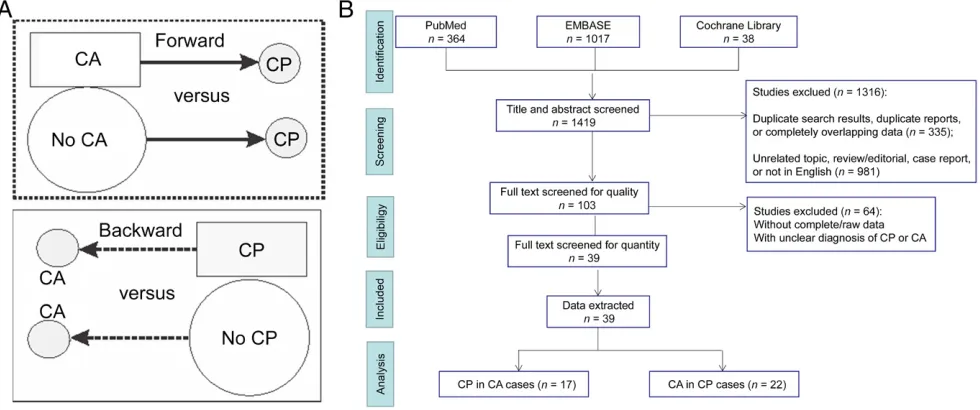
one could use a forward approach in a retrospective cohort study, and a prospective study of HCA would be hard to conduct because of the intrinsic delayed nature of diagnosis. In the forward approach, the rate of CP is compared in a cohort of CA with patients without a diagnosis of CA (Fig 1A). In the backward approach, the rate of CA is compared in a cohort of CP with patients without CP (Fig 1A). In addition to taking into consideration that an updated analysis is required (the previous meta-analyses were some years
ago9–11), this review also focused on
the quality of each enrolled study and whether the studies had ruled out defined postnatal etiologic factors (such as child abuse or other injuries and infections that occurred after birth) that contribute to CP, herein
labeled as “postnatal causes.” This
FIGURE 1
TABLE 1
Characteristics of Enrolled Studies Using a For
ward Approach (CP in CA Cases)
Studies Enrolled Country Study Period wk/g CP/CA, n / N Mor tality Before Dischar ge, n / N Singleton/ Twin CP Diagnosed Age, y
Study Type by Original Authors Study Quality
Notes
CCA preterm Bashir et a
l
25 2016
Canada 1995 – 2007 <1250 g 23/130: 37/437 NA NA 3 Retrospective Good
Bronchopulmonary dysplasia cohor
t
Mendez-Figueroa et al 26 2015 United States
1997 – 2004 23 – 36 9/220: 78/2336 16/220: 99/2336 Both 2 Second RCT Good
Treated with antenatal steroid or MgSO
4
Nasef et a
l
27 2013-1
Canada 2007 – 2008 <30 2/23: 9/96 4/33: 25/146 NA 1.5 Retrospective cohor t Good
HCA + CCA included
Botet et a
l
28 2011
Spain 2004 – 2006 <1500 g 5/103: 11/106 NA Both 2 Case-control Good
Allan et a
l
29 1997 United States
1989 – 1992 600 – 1250 g 10/53: 26/322 NA Both 1.5 Second RCT Good
Gray et a
l
30 1997
Australia 1988 – 1990 24 – 29 1/12: 8/110 4/16: 58/173 Both 2 Cohor t Good
CCA mixed gestation Bear and W
u
31 2016 United States
1991 – 2001 Mixed 642/118 578: 7831/5 899 926 NA NA ≥ 5 Retrospective cohor t Good
Postnatally caused CP excluded
Tr
ø
nnes et a
l
32 2014
Nor way 1967 – 2001 23 – 43 69/4195: 3082/88 125 NA Both
Unknown, possibly >4
Prospective
cohor
t
Fair
CA + fever or sepsis
HCA preterm Huetz et a
l
33 2016
France 2008 – 2011 24 – 34 4/57: 13/219 6/57: 16/219 Singleton 2 Retrospective cohor t Good
Miyazaki et a
l
34 2016
Japan 2003 – 2007 22 – 34 64/661: 101/1522
129/1235: 221/2843
Singleton 3 – 3.5 Retrospective cohor t Good
Miyazaki et a
l
35 2015: 1
Japan 2003 – 2007 22 – 34 21/249: 50/575 32/438: 70/1089 Singleton 3 – 3.5 Retrospective cohor t Good
Antenatal steroid, data included in ref
34
Miyazaki et a
l
35 2015: 2
Japan 2003 – 2007 22 – 34 15/194: 72/906 65/402: 173/1645 Singleton 3 – 3.5 Retrospective cohor t Good
No antenatal steroid, data included in ref
34
Pappas et a
l
36 2014: 1 United States
2006
–
2008
<27
23/473: 23/512
477/910: 423/1014
Both 1.5 – 2 Retrospective cohor t Good
Nasef et a
l
27 2013: 2
Canada 2007 – 2008 <30 2/61: 9/96 15/95: 25/146 NA 1.5 Retrospective cohor t Good
HCA + CCA excluded
Soraisham et a
l
37 2013
Canada 2000 – 2006 <29 25/197: 12/187 46/270: 41/259 Both 2.5 – 3.5 Retrospective cohor t Good Watterber
g et a
l
38
2007: 1
United States
2001 – 2003 500 g – 1 kg 7/55: 8/52 NA Both 1.5 – 2 Second RCT Good
Postnatal saline placebo, ventilated
Watterber
g et a
l
38
2007: 2
United States
2001 – 2003 500 g – 1 kg 7/57: 6/46 NA Both 1.5 – 2 Second RCT Good
Postnatal steroid, ventilated
Polam et a
l
39 2005 United States
1997 – 2000 22 – 29 9/102: 5/75 37/186: 38/251 NA 1 – 2 Case-control Good
Kent et a
l
40 2005: 1
Australia 1996 – 2001 <30 3/9: 1/31 4/14: 8/47 NA 1 – 3 Cohor t Good
No antenatal steroid
Kent et a
l
40 2005: 2
Australia 1996 – 2001 <30 5/49: 5/77 4/58: 8/101 NA 1 – 3 Cohor t Good Antenatal steroid
CCA and HCA preterm Pappas et a
l
36 2014: 2 United States
2006
–
2008
<27
17/209: 23/512
215/466: 423/1014
Both 1.5 – 2 Retrospective cohor t Good
CCA or HCA preterm Fung et a
l
41 2003
Australia
1997
–
2001
<28 or <1000 g
3/12: 5/43 34/105: 74/283 NA 2 Prospective cohor t Good
TABLE 2
Characteristics of Enrolled Studies Using a Backward Approach (CA in CP Cases)
Studies Enrolled Country Study Period wk/g CA/CP Singleton/T win CP Diagnosed Age
Study Type by Original
Authors
Study Quality
Notes
CCA in preterm CP Accordino et a
l
42 2016: 1
Italy 2006 – 2012 24 – 34 2/26: 6/142 Singleton 1 y Retrospective Good
PPROM and PTL
Manuck et a
l
43 2014
United States 1997 – 2004 <34 62/459: 161/1312 Both 2 y Second RCT Good Same cohor
t as in
ref
25
Skrablin et a
l
44 2008
Croatia 1999 – 2001 <37 7/35: 3/35 Both >2 y Case-control Good
Neufeld et a
l
45 2005: 1
United States 1987 – 1999 <37 33/247: 9/180 Singleton ≤ 6 y Case-control Fair
Takahashi et a
l
46 2005
Japan 1990 – 1998 22 – 33 3/30: 17/150 Both 4 y Retrospective cohor t Good
Vigneswaran et a
l
47 2004: 1
Australia 1984 – 1994 <1500 g 10/82: 27/207 Singleton 5 y Case-control Good
Minimal CP excluded
Nelson et a
l
48 2003: 1
United States 1988 – 1994 <32 20/64: 29/107 Singleton 4 y Case-control Good
Postnatally caused CP excluded
Jacobsson et a
l
49 2002: 1
Sweden 1983 – 1990 <37 16/148: 19/296 Both ≥ 4 y Case-control Good
Postnatally caused CP excluded
Gray et a
l
50 2001
Australia 1989 – 1996 24 – 27 9/30: 26/120 Both ≥ 2 y Case-control Good
Matsuda et a
l
51 2000: 1
Japan 1992 – 1996 26 – 30 6/22: 19/170 Singleton >2 y Case-control Fair Not matched
Redline et a
l
52 2000: 1
United States 1983 – 1991 <1500 g 17/60: 7/59 Singleton 20 mo Case-control Good
Yoon et a
l
53 2000: 1
Korea 1993 – 1995 ≤ 35 2/14: 7/109 Singleton 3 y Cohor t Good
Wilson-Costello et a
l
54 1998
United States 1983 – 1991 <1500 g 11/50: 6/50 Singleton 20 mo Case-control Good O ’
Shea et a
l
55 1998a
United States 1978 – 1989 500 – 1500 g 21/160: 10/80 Both 1 y Case-control Fair
Postnatally caused CP excluded
O
’
Shea et a
l
56 1998b: 1
United States 1986 – 1993 500 – 1500 g 12/52: 11/110 Singleton 1 y Case-control Fair
Postnatally caused CP excluded
Yoon et a
l
57 1997: 1
Korea 1993 – 1995 26 – 35 1/8: 4/75 Singleton 6 mo Retrospective cohor t Fair
May have PIH
Cook
e
58 1990 United Kingdom
1980 – 1986 <1501 g 17/81: 6/81 Both 2 y Case-control Good
CCA in term/ near
-term CP
Neufeld et a
l
45 2005: 2
United States 1987 – 1999 ≥ 37 7/395: 25/2675 Singleton ≤ 6 y Case-control Fair
Wu et a
l
59 2003: 1
United States 1991 – 1998 ≥ 36 15/106: 9/215 Singleton >15 mo Case-control Good
Postnatally caused CP excluded
Grether and Nelso
n
60 1997: 1
United States 1983 – 1985 ≥ 2500 g 5/46: 5/378 Singleton 3 y Case-control Good
Postnatally caused CP excluded
HCA in preterm CP Accordino et a
l
42 2016: 2
Italy 2006 – 2012 24 – 34 8/26: 57/142 Singleton 1 y Retrospective Good
PPROM and PTL
Huetz et a
l
33 2016
France 2008 – 2011 24 – 34 4/17: 32/179 Singleton 2 y Cohor t Good Hor
vath et a
l
61 2012
Hungary 2000 – 2010 <1500 g 7/11: 36/130 NA >1 y Cohor t Fair
Redline et a
l
62 2007
United States 1992 – 1995 <1000 g 8/18: 61/111 Singleton 8 y Cohor t Good
Vigneswaran et a
l
47 2004: 2
Australia — <1500 g 22/54: 56/150 Singleton 5 y Case-control Good
Nelson et a
l
48 2003: 2
United States 1988 – 1994 <32 31/64: 58/107 Singleton 4 y Case-control Good
Postnatally caused CP excluded
Jacobsson et a
l
49 2002: 2
Sweden 1983 – 1990 <37 10/28: 6/45 Both >4 y Case-control Good
Matsuda et a
l
51 2000: 2
Japan 1992 – 1996 26 – 30 8/22: 61/170 Singleton >2 y Case-control Good Not matched
Redline et a
l
52 2000: 2
United States 1983 – 1991 <1500 g 37/60: 35/59 Singleton 20 mo Case-control Good
Yoon et a
l
53 2000: 2
Korea 1993 – 1995 ≤ 35 10/12: 44/105 Singleton 3 y Cohor t Good O ’
Shea et a
l
56 1998b: 2
United States 1986 – 1993 500 – 1500 g 14/21: 17/28 Singleton 1 y Case-control Fair
Postnatally caused CP excluded
Yoon et a
l
57 1997: 2
Korea 1993 – 1995 26 – 35 6/7: 33/75 Singleton 6 mo Retrospective cohor t Fair
review is aimed at the clinician who would like to know the risk of CP in CA patients separately from the association of CA in CP patients and to determine the risk with categorization of CA as CCA or HCA and gestational age. We found that studies of preterm infants using forward approaches demonstrated that HCA is a risk factor for CP, and the association was also found in studies of near-term/term infants that used a backward approach. No evidence of CCA as a risk factor for CP was borne out from studies using a forward approach, but an association was found in studies of both preterm and term infants using a backward approach.
METhODS
Sources
We searched PubMed, the Cochrane Library, and Embase for relevant case-control or cohort studies to evaluate the relationship between CP and CA. Queries included articles published from January 1, 1960 to September 30, 2016 in peer-reviewed publications (including abstracts). Keywords used were (chorioamnionitis) AND ((cerebral palsy) OR (brain)). We also hand-searched bibliographies of original studies, reviews (including meta-analyses), and relevant conference abstracts and contacted some investigators directly. The last search was conducted on October 8, 2016. No review protocol exists.
Study Selection
Using the methods of Meta-analysis of Observational Studies
in Epidemiology (MOOSE)17 and
PRISMA, 2 authors (L.M. and Z.S.) independently selected relevant studies, assessed study quality by means of quality assessment of
case-control studies18 or observational
cohort and cross-sectional studies, 19
and extracted data. Questionable
studies were confirmed by discussion with a third author (S.T.). Included studies met all of the following criteria: (1) clinical cohort (with a control group) or case-control study investigating the relationship between CA and CP; (2) an explanation of diagnosis and outcomes; (3) had neurologic follow-up information especially for CP; and (4) a quality of good or fair
according to published criteria.18, 19
Studies were excluded from consideration if: (1) they did not show all of the above information; (2) had no patient numbers available; and (3) were not written in English.
Data Extraction
We extracted data about study design and methods, inclusion and exclusion criteria, patient (mother, fetus, or newborn) characteristics, treatments (steroids, antibiotics, tocolytics, mechanical ventilation, NICU admission, etc), patient
outcomes, and follow-up information. For primary outcomes, we estimated the relationship between CA and CP in term and preterm infants. Statistical analysis was conducted by using Review Manager version 5.0 software (Cochrane Collaboration). The Mantel-Haenszel model was used for dichotomous data. The pooled risk ratios (RRs) and 95% confidence intervals (CIs) were determined by either a fixed-effects or random-effects model, depending on which was most conservative. We used a forest plot to illustrate the relative strength of treatment effects in multiple quantitative scientific studies addressing the same
question.20 Statistical between-study
heterogeneity was assessed by I2
test21 and χ2 test. Publication bias
was assessed by funnel plot.22, 23
An asymmetric funnel indicated a relationship between treatment effect and study size, suggesting the possibility of either publication bias or a systematic difference between smaller and larger studies
Studies Enrolled
Country
Study Period
wk/g
CA/CP
Singleton/T
win
CP Diagnosed
Age
Study Type by Original
Authors
Study Quality
Notes
HCA in term/ near
-term CP
Wu et a
l
59 2003: 2
United States
1991
–
1998
≥
36
5/19: 1/9
Singleton
>15 mo
Case-control
Good
Grether and Nelso
n
60 1997: 2
United States
1983
–
1985
≥
2500 g
3/46: 3/378
Singleton
3 y
Case-control
Good
Postnatally caused CP excluded
CCA/HCA in preterm CP Costantine et a
l
63 2007
United States
1993
–
2002
500 g
–
1 kg
11/19: 8/38
NA
18
–
22 mo
Case-control
Good
PIH, pregnancy-induced hyper
tension; PPROM, premature rupture of membranes; PTL, preterm l
abor
.
TABLE 2
(“small study effects”) or the use of an inappropriate effect measure. Differences between groups were
assessed on the basis of the χ2
statistic. For all tests done, statistical significance was achieved if the
2-tailed P value was <.05 (for overall
effect of CP or CA conditions, or for
the heterogeneity test).24
RESULTS
Based on our search strategy, 1419 studies were identified. After screening with preset inclusion and
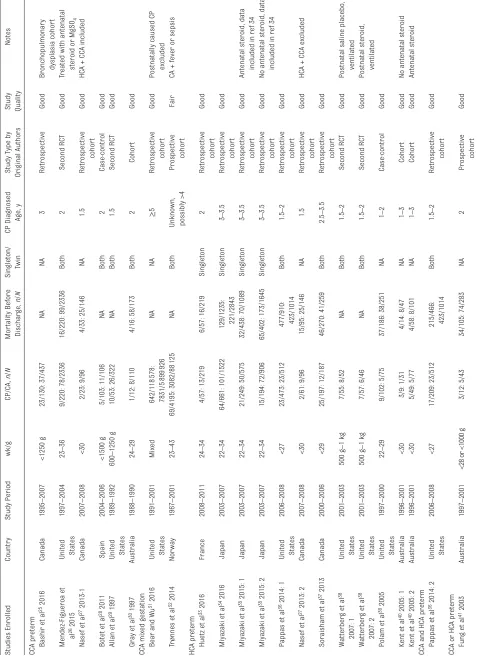
exclusion criteria, there were 17 studies analyzing the incidence of
CP in the CA population (125256 CA
patients and 5994722 controls)25–41
and 22 studies analyzing the incidence of CA in the CP population (2513 CP patients and 8135
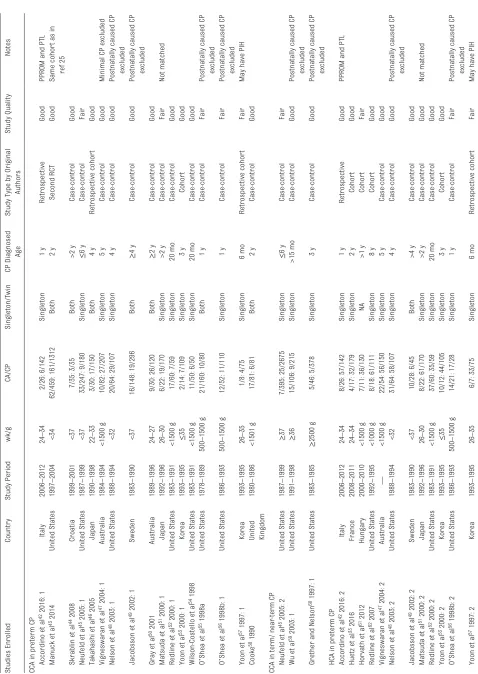
controls)42–63 (flow diagram in Fig
1B; characteristic information in Tables 1 and 2).
CP in CCA Patients
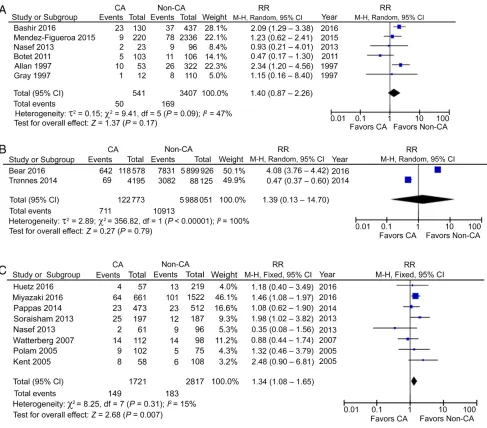
Using a forward approach, 6 cohort studies reported the incidence of CP in preterm CCA patients, including 541 CCA patients and 3407
non-CCA participants and showed no
significantly increased risk.25–30
The pooled RR (95% CI) was
1.40 (0.87–2.26), with moderate
heterogeneity (I2 = 47%; Fig 2A).
Two studies reported CP in a mixed population of preterm and term deliveries in CCA patients, including
122773 CCA patients and 5988051
non-CCA participants, 31, 32
again with a nonsignificant RR of
1.39 (95% CI: 0.13–14.70) and with
high heterogeneity (I2 = 100%; Fig
2B). This analysis would suggest that there may be no relationship between CCA and CP when analyzing FIGURE 2
data across all stages of pregnancy and that it is inappropriate to report the CA condition in combined gestational stages, which is shown by the high heterogeneity.
CP in hCA Patients
Eight studies reported CP in preterm HCA patients, including 1721 HCA patients and 2817
non-HCA participants.27, 33, 34, 36–40 In
contrast to CCA, HCA seemed to be a risk factor for CP in preterm gestation, with a RR of 1.34 (95%
CI: 1.08–1.65; P < .01) and with
low heterogeneity (I2 = 15%; Fig
2C). However, the incidence of CP in HCA patients is small, only 8.7 per 100 preterm infants compared
with 6.5 per 100 non-HCA–exposed
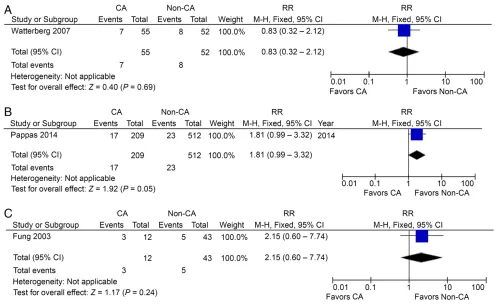
infants. Interestingly, the use of prenatal or postnatal steroids was reported in 3 studies, but did not lead to a significant decrease of CP
in preterm HCA patients (Figs 3 A–C
and 4A).35, 38, 40
CP in CCA and/or hCA Patients
One study reported CP in preterm patients with both CCA and HCA, including 209 patients and 512
controls.36 The RR was borderline at
1.81 (95% CI: 0.99–3.32; P = .05; Fig
4B). Thus, there is no strong evidence that a combination of CCA and HCA is associated with CP. One study reported CP in preterm patients with CCA or HCA, including 12 patients
and 43 controls.41 The RR in this case
was not significant at 2.15 (95% CI:
0.60–7.74; Fig 4C), again confirming
the view that CCA may not be a risk for preterm CP, as well as the need for definitive criteria for diagnosing CA.
CCA in CP Patients
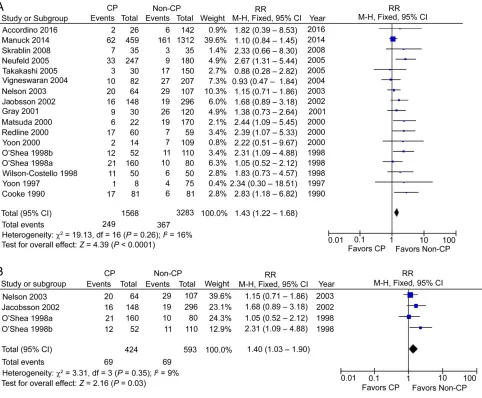
Using a backward approach, 17 cohort studies reported the incidence
of CCA in preterm CP patients, including 1568 CP patients and 3283
non-CP participants.42–58 The RR was
significant at 1.43 (95% CI: 1.22–
1.68; P < .01), with low heterogeneity
(I2 = 21%; Fig 5A). This increased
association is in contrast to no significantly increased risk from the analysis using a forward approach. When defined postnatal causes were excluded, we were left with 4 studies with 424 preterm CP patients and 593 controls, which showed a significant increase of CCA in preterm
CP patients, 48, 49, 55, 56 with an RR of
1.40 (95% CI: 1.03–1.90; P < .05) and
low heterogeneity (I2 = 9%; Fig 5B).
Three studies reported the incidence of CCA in term/near-term CP patients, including 547 CP patients
and 3268 non-CP participants.45, 59, 60
The RR was significantly high at 3.06
(95% CI: 1.84–5.09; P < .01), with
medium heterogeneity (I2 = 49%;
FIGURE 3
Fig 6A). Again, when postnatal causes were excluded, 2 studies with 152 term/near-term CP patients and 593 controls showed a significant increase of CCA in term/near-term
CP patients, 59, 60 with an RR of 4.13
(95% CI: 2.13–7.99; P < .01), with
medium heterogeneity (I2 = 34%;
Fig 6B).
hCA in CP Patients
Twelve studies reported the incidence of HCA in preterm CP patients, including 340 CP patients and 1298 non-CP
participants, 33, 42, 47–49, 51–53, 56, 57, 61, 62
but the RR was not significant at
1.12 (95% CI: 0.98–1.28), with
high heterogeneity (I2 = 67%; Fig
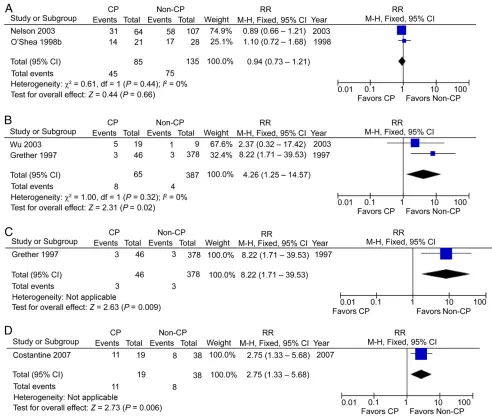
6C). The absence of association from studies using a backward approach contradicts the conclusion of increased risk in studies using a forward approach. When postnatal causes were excluded, 2 studies with
85 preterm CP patients and 135
controls48, 56 showed no significant
change with an RR of 0.94 (95%
CI: 0.73–1.21; Fig 7A). Two studies
reported the incidence of HCA in term/near-term CP patients, including 65 CP patients and 387
non-CP participants, 59, 60 and the
RR in this case was significant at
4.26 (95% CI: 1.25–14.57; P < .05),
with low heterogeneity (I2 = 0%; Fig
7B). Again, when postnatal causes were excluded, we were left with 1 study with 46 term/near-term CP patients and 378 controls showing a significant increase of HCA in term/
near-term CP patients60 with an RR
of 8.22 (95% CI: 1.71–39.53; P < .01;
Fig 7C).
CCA or hCA in CP Patients
One study reported CCA or HCA cases in preterm CP patients, including
19 patients and 38 controls, 63 with
a significant RR of 2.75 (95% CI:
1.33–5.68; P < .01; Fig 7D). One
hesitates to come to any conclusion with these small numbers.
DISCUSSION
This meta-analysis reveals the absence of a risk for CP in CCA patients. HCA, on the other hand, seems to be associated with a significant risk for CP, although the incidence of CP in HCA-exposed infants is only 8.6%. This review also points out the less convincing analysis from cohort studies using a backward approach. The fact that there is no increased incidence of CP in CCA patients but a higher incidence of CCA in CP patients perhaps points to another factor (such as prematurity itself) in the causal pathway of CP, perhaps significant only when it coexists with CCA . Statistics derived from a forward approach of studying CA FIGURE 4
populations have fewer potential sources of bias and confounding than those obtained from a backward approach of studying a CP population. The statistical power of these 2 strategies differs
substantially.64 HCA seems to show a
stronger risk in the studies that used a forward strategy in the preterm population. Although the number of studies is small, an association is found using a backward approach from studies of the near-term/term population, a group that avoids the potential influence of prematurity. The fact that there is no association of HCA with CP in preterm infants suggests that other factors (including prematurity) probably drown out
the small contribution of HCA. The perinatal etiologic risk factors for CP include birth asphyxia, inflammation, restricted growth, birth defects, sex,
race, and genetics.65 Treatments in
response to CA or preterm labor, such as application of tocolytics,
MgSO4, corticosteroids, surfactant,
antibiotics, and mode of delivery, 58
as well as complications in the
pregnant mother12 might also affect
the pathogenesis of CP.
There are many possible reasons why CCA is not as strong a risk
factor as HCA. Wu10 raised the issue
of overdiagnoses of the clinical
diagnosis of “chorioamnionitis” in
recent years. Maternal fever without
maternal inflammation has often been included in the diagnosis of CCA, which then includes a population of fetuses that do not have inflammation. Examples include fever from dehydration and epidural injection. This issue might be solved if all obstetricians followed the recent guidelines of delineating maternal
fever alone from triple-I.5 Even if
there is maternal inflammation with
evidence of high leukocytes >15000
and definite pus observed from cervical os and high fever, which
constitute the criteria of “suspected”
triple-I, 5 the fetus systematically and
the fetal brain may not necessarily be affected by inflammation. The previous definitions of HCA FIGURE 5
coinciding with the added criteria
constituting “confirmed” triple-I, 5
Gram positivity, positive culture, and low glucose in amniotic fluid, as well as positive placental pathology may still not be enough to confirm the presence of fetal inflammation. One can speculate about the confounding effects of the immunologic responses and specific microbiomes in the mother, placenta, and fetus. Even with the evidence of fetal involvement in the
placenta, only the most severe fetal inflammatory response (ie, subacute necrotizing funisitis and chorionic plate vasculitis with thrombosis) was associated with poor developmental outcome, but this was not the case with the milder stages of fetal
inflammatory response.66 Thus, it is
possible that with a refined diagnosis of triple-I, clinicians will be able to get a better idea of the risk of CP with inflammation in the mother-infant dyad. It is speculated that the risk
of CP is restricted to the population of CA with evidence of severe fetal inflammation and is not present in all cases of confirmed triple-I. Not many hospitals in the United States or Europe have the capability of doing amniotic fluid examination and a quick turnaround of placental pathology. Thus, in the future, there will still be continued confusion about the risk of CP in CCA (now suspected triple-I) and CCA + HCA (confirmed triple-I) populations. FIGURE 6
The risk of CP in cases of HCA only, without concomitant signs of CCA, is still to be determined.
Other Biases
Most of the studies in Table 1 involved preterm populations of newborns, whereas 7 studies out of the 29 in Table 2 were of term/ near-term newborns. According to our analysis, HCA seems to be a risk factor for CP in preterm gestation. However, this is likely due to the large weight in the analysis of the
Miyazaki study34 (46.1%). This
study does have limitations, such as a retrospective design and a high rate of exclusions due to incomplete
data (6316 excluded out of 10394
cases). The risk of CP is inversely proportional to gestational age and is 60 times higher at <28 weeks
of gestation than at term.49 The
confounding factor to consider in CA is that the risk of prematurity is higher in cases of CA. More than half of CP cases diagnosed at 1 year of age were free of motor handicap
at the age of 7 years.67 A diagnosis
made at 2 years of age or later is more reliable than one made before
2 years of age.68 Twin pregnancy was
associated with an increased risk
of CP.69 Thus, studies confined to
singleton pregnancies ought to be compared separately from those with twin pregnancies. Exclusion of certain causes of CP also minimizes the bias in the etiologic study of CA, such as CP
caused by child abuse, accidents, 31
TORCH (with toxoplasmosis, rubella, cytomegalovirus, and herpes)
infection, 48 brain malformation,
or even prenatal destructive brain
lesions.60 The discerning reader
will notice that the average relative FIGURE 7
risk of CP in pooled CCA patients was higher than that of CP in HCA patients. The pooled incidence of CP in preterm CCA was 9.2% vs 5.0% for
preterm non-CCA–exposed patients,
but the pooled incidence did not reach significance and there was high heterogeneity among enrolled studies, which was not the case for HCA. In any case, the absolute values of CP in both CCA and HCA are still small, suggesting that even HCA constitutes a relatively small risk factor for CP in a preterm infant. One must also consider the possibility that the incidence of CP may be inversely related to the incidence of death. Investigating the relationship between newborn death and CA from studies with a concomitant report of CP, we found 3 studies that reported the incidence of newborn death before discharge in preterm CCA patients, including 269
CCA patients and 2655 controls, 26, 27, 30
but the RR was not significant at
1.19 (95% CI: 0.80–1.77) and there
was high heterogeneity (I2 = 52%;
Supplemental Fig 14). Seven studies reported the incidence of newborn death before discharge in preterm HCA patients, including 2825 HCA patients and 4880
controls, 27, 33, 34, 36, 37, 39, 40 and in
this case, the RR was significant at
1.25 (95% CI: 1.15–1.36; P < .01)
and there was low heterogeneity
(I2 = 0%; Supplemental Fig 15).
However, the study by Pappas et al36
contributed 62% of the weight of the analysis. In this study, extremely premature infants were included, and it is well known that the mortality rate for extremely premature infants is much greater than that of preterm infants. Comparing CCA in preterm CP to CCA in term CP, one finds less of an association with preterm CP (RR: 1.43 vs 3.06). One can speculate that if the premature infants who died had somehow survived, then there could have been a higher rate of CP.
The etiology of maternal inflammation
may extend beyond CA. Bear and Wu31
showed that a history of genitourinary and respiratory infections in addition to CCA increases the risk of CP when using a forward approach involving 6 million mother-infant dyads, including preterm and term gestational ages. The RR for CP in
24414 preterm patients with CCA
was 4.1 (95% CI: 3.7–4.5) compared
with a RR of 2.01 for 86335 term
CCA patients (95% CI: 1.7–2.4).31
However, no raw data were shown comparing CP in the preterm CCA or non-CCA populations, nor in the term CCA and non-CCA populations, making this study only applicable for mixed-term analysis. When using a
backward approach, Bear and Wu31
found an association of CP with either CCA, genitourinary or respiratory infections (incidence of maternal infection in CP vs non-CP, 13.7% vs
5.5%, P < .01). Interestingly, it is not
known whether maternal infection other than CA occurred specifically in the second and third trimesters, which raises the issue of a susceptibility to infections or inflammation in mother-infant dyads. Thus, it is possible that a subpopulation of mother-infant dyads has an increased chance of fetal inflammation in CCA. This possibility is supported by the increased RR of 7.0 if there was CCA along with a history of other maternal infections. Furthermore, it has been proposed that alterations in the composition of the microbiota might disturb the human immune system, ultimately leading to altered immune responses that may underlie inflammatory
disorders.70
CONCLUSIONS
HCA is a risk factor for CP in preterm studies using a forward approach. An association of HCA with CP is found only in studies of near-term/term infants but not in studies of preterm infants using a backward approach. The incidence of CP after HCA is still small. The evidence that CCA is a risk factor for CP is not borne out from
studies using a forward approach. An association of CP with CCA is found in studies of both preterm and term infants using a backward approach. Future trials of confirmed triple-I with severe fetal inflammatory involvement need to be carried out.
ABBREvIATIONS
CA: chorioamnionitis
CCA: clinical chorioamnionitis CI: confidence interval CP: cerebral palsy
HCA: histologic chorioamnionitis RR: risk ratio
triple-I: intrauterine inflamma-tion or infecinflamma-tion or both
REFERENCES
1. Graham HK, Rosenbaum P, Paneth N, et al. Cerebral palsy. Nat Rev Dis Primers. 2016;2:15082
2. Arneson CL, Durkin MS, Benedict RE, et al. Prevalence of cerebral palsy: Autism and Developmental Disabilities Monitoring Network, three sites, United States, 2004. Disabil Health J. 2009;2(1):45–48
3. Boulet SL, Boyle CA, Schieve LA. Health care use and health and functional impact of developmental disabilities among US children, 1997-2005. Arch Pediatr Adolesc Med. 2009;163(1):19–26
4. Centers for Disease Control and Prevention (CDC). Economic costs associated with mental retardation, cerebral palsy, hearing loss, and vision impairment–United States, 2003. MMWR Morb Mortal Wkly Rep. 2004;53(3):57–59
5. Higgins RD, Saade G, Polin RA, et al; Chorioamnionitis Workshop Participants. Evaluation and management of women and newborns with a maternal diagnosis of chorioamnionitis: summary of a workshop. Obstet Gynecol. 2016;127(3):426–436
molecular techniques. J Perinat Med. 2015;43(1):19–36
7. Hauth JC, Gilstrap LC III, Hankins GD, Connor KD. Term maternal and neonatal complications of acute chorioamnionitis. Obstet Gynecol. 1985;66(1):59–62
8. Kim CJ, Romero R, Chaemsaithong P, Chaiyasit N, Yoon BH, Kim YM. Acute chorioamnionitis and funisitis: definition, pathologic features, and clinical significance. Am J Obstet Gynecol. 2015;213(suppl 4):S29–S52 9. Shatrov JG, Birch SC, Lam LT,
Quinlivan JA, McIntyre S, Mendz GL. Chorioamnionitis and cerebral palsy: a meta-analysis. Obstet Gynecol. 2010;116(2 pt 1):387–392 10. Wu YW. Systematic review of
chorioamnionitis and cerebral palsy.
Ment Retard Dev Disabil Res Rev. 2002;8(1):25–29
11. Wu YW, Colford JM Jr. Chorioamnionitis as a risk factor for cerebral
palsy: a meta-analysis. JAMA. 2000;284(11):1417–1424
12. van Lieshout P, Candundo H, Martino R, Shin S, Barakat-Haddad C. Onset factors in cerebral palsy: a systematic review [published online ahead of print April 1, 2016]. Neurotoxicology. doi: 10. 1016/ j. neuro. 2016. 03. 021 13. Berger A, Witt A, Haiden N, et al.
Intrauterine infection with Ureaplasma species is associated with adverse neuromotor outcome at 1 and 2 years adjusted age in preterm infants.
J Perinat Med. 2009;37(1):72–78 14. Kaukola T, Herva R, Perhomaa M,
et al. Population cohort associating chorioamnionitis, cord inflammatory cytokines and neurologic outcome in very preterm, extremely low birth weight infants. Pediatr Res. 2006;59(3):478–483
15. Kim JN, Namgung R, Chang W, et al. Prospective evaluation of perinatal risk factors for cerebral palsy and delayed development in high risk infants.
Yonsei Med J. 1999;40(4):363–370 16. Torfs CP, van den Berg B, Oechsli FW,
Cummins S. Prenatal and perinatal factors in the etiology of cerebral palsy. J Pediatr. 1990;116(4):615–619 17. Stroup DF, Berlin JA, Morton SC,
et al. Meta-analysis of observational
studies in epidemiology: a proposal for reporting. Meta-analysis of Observational Studies in Epidemiology (MOOSE) group. JAMA. 2000;283(15):2008–2012
18. National Heart, Lung, and Blood Institute. Quality assessment of case-control studies. Available at: www. nhlbi. nih. gov/ health- pro/ guidelines/ in- develop/ cardiovascular- risk- reduction/ tools/ case- control. Accessed August 30, 2016
19. National Heart, Lung, and Blood Institute. Quality assessment tool for observational cohort and cross-sectional studies. Available at: www. nhlbi. nih. gov/ health- pro/ guidelines/ in- develop/ cardiovascular- risk- reduction/ tools/ cohort. Accessed August 30, 2016 20. Lewis S, Clarke M. Forest plots: trying
to see the wood and the trees. BMJ. 2001;322(7300):1479–1480
21. Huedo-Medina TB, Sánchez-Meca J, Marín-Martínez F, Botella J. Assessing heterogeneity in meta-analysis: Q statistic or I2 index? Psychol Methods. 2006;11(2):193–206
22. Song F, Sheldon TA, Sutton AJ, Abrams KR, Jones DR. Methods for exploring heterogeneity in meta-analysis. Eval Health Prof. 2001;24(2):126–151 23. Sterne JA, Egger M. Funnel plots
for detecting bias in meta-analysis: guidelines on choice of axis. J Clin Epidemiol. 2001;54(10):1046–1055 24. Cochrane UK. The Cochrane
Collaboration open learning material. Available at: http:// handbook. cochrane. org/ chapter_ 9/ 9_ analysing_ data_ and_ undertaking_ meta_ analyses. htm. Accessed April 22, 2017
25. Bashir RA, Bhandari V, Vayalthrikkovil S, et al. Chorioamnionitis at birth does not increase the risk of neurodevelopmental disability in premature infants with bronchopulmonary dysplasia. Acta Paediatr. 2016;105(11):e506–e512 26. Mendez-Figueroa H, Abramovici
A, O’Neil AE, Dahlke J, Pedroza C, Chauhan S. Chorioamnionitis without and with neonatal sepsis: newborn and infant outcomes. Am J Obstet Gynecol. 2015;212(suppl 1):S318–S319 27. Nasef N, Shabaan AE, Schurr P, et al.
Effect of clinical and histological
chorioamnionitis on the outcome of preterm infants. Am J Perinatol. 2013;30(1):59–68
28. Botet F, Figueras J, Carbonell-Estrany X, Narbona E. The impact of clinical maternal chorioamnionitis on neurological and psychological sequelae in very-low-birth weight infants: a case-control study. J Perinat Med. 2011;39(2):203–208
29. Allan WC, Vohr B, Makuch RW, Katz KH, Ment LR. Antecedents of cerebral palsy in a multicenter trial of indomethacin for intraventricular hemorrhage. Arch Pediatr Adolesc Med. 1997;151(6):580–585 30. Gray PH, Hurley TM, Rogers YM,
et al. Survival and neonatal and neurodevelopmental outcome of 24-29 week gestation infants according to primary cause of preterm delivery. Aust N Z J Obstet Gynaecol. 1997;37(2):161–168
31. Bear JJ, Wu YW. Maternal infections during pregnancy and cerebral palsy in the child. Pediatr Neurol. 2016;57:74–79
32. Trønnes H, Wilcox AJ, Lie RT, Markestad T, Moster D. Risk of cerebral palsy in relation to pregnancy disorders and preterm birth: a national cohort study. Dev Med Child Neurol. 2014;56(8):779–785
33. Huetz N, Triau S, Leboucher B, et al. Association of severe placental inflammation with death prior to discharge and cerebral palsy in preterm infants. BJOG. 2016;123(12):1956–1963
34. Miyazaki K, Furuhashi M, Ishikawa K, et al. Impact of chorioamnionitis on short- and long-term outcomes in very low birth weight preterm infants: the Neonatal Research Network Japan. J Matern Fetal Neonatal Med. 2016;29(2):331–337
35. Miyazaki K, Furuhashi M, Ishikawa K, et al. Long-term outcomes of antenatal corticosteroids treatment in very preterm infants after
chorioamnionitis. Arch Gynecol Obstet. 2015;292(6):1239–1246
Network. Chorioamnionitis and early childhood outcomes among extremely low-gestational-age neonates. JAMA Pediatr. 2014;168(2):137–147 37. Soraisham AS, Trevenen C,
Wood S, Singhal N, Sauve R. Histological chorioamnionitis and neurodevelopmental outcome in preterm infants. J Perinatol. 2013;33(1):70–75
38. Watterberg KL, Shaffer ML, Mishefske MJ, et al. Growth and neurodevelopmental outcomes after early low-dose hydrocortisone treatment in extremely low birth weight infants. Pediatrics. 2007;120(1):40–48
39. Polam S, Koons A, Anwar M, Shen-Schwarz S, Hegyi T. Effect of chorioamnionitis on neurodevelopmental outcome in preterm infants. Arch Pediatr Adolesc Med. 2005;159(11):1032–1035 40. Kent A, Lomas F, Hurrion E,
Dahlstrom JE. Antenatal steroids may reduce adverse neurological outcome following chorioamnionitis: neurodevelopmental outcome and chorioamnionitis in premature infants. J Paediatr Child Health. 2005;41(4):186–190
41. Fung G, Bawden K, Chow P, Yu V. Chorioamnionitis and outcome in extremely preterm infants. Ann Acad Med Singapore. 2003;32(3):305–310 42. Accordino F, Consonni S, Fedeli T, et al.
Risk factors for cerebral palsy in PPROM and preterm delivery with intact membranes. J Matern Fetal Neonatal Med. 2016;29(23):3854–3859 43. Manuck TA, Sheng X, Yoder BA,
Varner MW. Correlation between initial neonatal and early childhood outcomes following preterm birth.
Am J Obstet Gynecol. 2014;210(5):426. e1–426.e9
44. Skrablin S, Maurac I, Banović V, Bosnjak-Nadj K. Perinatal factors associated with the neurologic impairment of children born preterm. Int J Gynaecol Obstet. 2008;102(1):12–18
45. Neufeld MD, Frigon C, Graham AS, Mueller BA. Maternal infection and risk of cerebral palsy in term and preterm infants. J Perinatol. 2005;25(2):108–113
46. Takahashi R, Yamada M, Takahashi T, et al. Risk factors for cerebral palsy in preterm infants. Early Hum Dev. 2005;81(6):545–553
47. Vigneswaran R, Aitchison SJ, McDonald HM, Khong TY, Hiller JE. Cerebral palsy and placental infection: a case-cohort study. BMC Pregnancy Childbirth. 2004;4(1):1
48. Nelson KB, Grether JK, Dambrosia JM, et al. Neonatal cytokines and cerebral palsy in very preterm infants. Pediatr Res. 2003;53(4):600–607
49. Jacobsson B, Hagberg G, Hagberg B, Ladfors L, Niklasson A, Hagberg H. Cerebral palsy in preterm infants: a population-based case-control study of antenatal and intrapartal risk factors.
Acta Paediatr. 2002;91(8): 946–951
50. Gray PH, Jones P, O’Callaghan MJ. Maternal antecedents for cerebral palsy in extremely preterm babies: a case-control study. Dev Med Child Neurol. 2001;43(9):580–585
51. Matsuda Y, Kouno S, Hiroyama Y, et al. Intrauterine infection, magnesium sulfate exposure and cerebral palsy in infants born between 26 and 30 weeks of gestation. Eur J Obstet Gynecol Reprod Biol. 2000;91(2):159–164 52. Redline RW, Wilson-Costello D,
Borawski E, Fanaroff AA, Hack M. The relationship between placental and other perinatal risk factors for neurologic impairment in very low birth weight children. Pediatr Res. 2000;47(6):721–726
53. Yoon BH, Romero R, Park JS, et al. Fetal exposure to an intra-amniotic inflammation and the development of cerebral palsy at the age of three years. Am J Obstet Gynecol. 2000;182(3):675–681
54. Wilson-Costello D, Borawski E, Friedman H, Redline R, Fanaroff AA, Hack M. Perinatal correlates of cerebral palsy and other neurologic impairment among very low birth weight children. Pediatrics. 1998;102(2 pt 1):315–322
55. O’Shea TM, Klinepeter KL, Dillard RG. Prenatal events and the risk of cerebral palsy in very low birth weight infants. Am J Epidemiol. 1998;147(4):362–369
56. O’Shea TM, Klinepeter KL, Meis PJ, Dillard RG. Intrauterine infection and the risk of cerebral palsy in very low-birthweight infants. Paediatr Perinat Epidemiol. 1998;12(1):72–83 57. Yoon BH, Jun JK, Romero R, et al.
Amniotic fluid inflammatory cytokines (interleukin-6, interleukin-1beta, and tumor necrosis factor-alpha), neonatal brain white matter lesions, and cerebral palsy. Am J Obstet Gynecol. 1997;177(1):19–26
58. Cooke RW. Cerebral palsy in very low birthweight infants. Arch Dis Child. 1990;65(2):201–206
59. Wu YW, Escobar GJ, Grether JK, Croen LA, Greene JD, Newman TB. Chorioamnionitis and cerebral palsy in term and near-term infants. JAMA. 2003;290(20):2677–2684
60. Grether JK, Nelson KB. Maternal infection and cerebral palsy in infants of normal birth weight. JAMA. 1997;278(3):207–211 61. Horvath B, Grasselly M, Bodecs
T, Boncz I, Bodis J. Histological chorioamnionitis is associated with cerebral palsy in preterm neonates.
Eur J Obstet Gynecol Reprod Biol. 2012;163(2):160–164
62. Redline RW, Minich N, Taylor HG, Hack M. Placental lesions as predictors of cerebral palsy and abnormal neurocognitive function at school age in extremely low birth weight infants (<1 kg). Pediatr Dev Pathol. 2007;10(4):282–292
63. Costantine MM, How HY, Coppage K, Maxwell RA, Sibai BM. Does peripartum infection increase the incidence of cerebral palsy in extremely low birthweight infants? Am J Obstet Gynecol. 2007;196(5):e6–e8 64. University of Texas at Austin
Department of Mathematics. Common mistakes involving power. Available at: www. ma. utexas. edu/ users/ mks/ statmistakes/ PowerMistakes. html. Accessed June 30, 2016
65. Nelson KB, Blair E. Prenatal factors in singletons with cerebral palsy born at or near term. N Engl J Med. 2015;373(10):946–953
impairment and death in extremely preterm infants. J Pediatr. 2013;163(3):652–657.e2
67. Nelson KB, Ellenberg JH. Children who
‘outgrew’ cerebral palsy. Pediatrics. 1982;69(5):529–536
68. Kuban KC, Leviton A. Cerebral palsy. N Engl J Med. 1994;330(3): 188–195
69. Yokoyama Y, Shimizu T, Hayakawa K. Prevalence of cerebral palsy in twins, triplets and quadruplets.
Int J Epidemiol. 1995;24(5): 943–948
70. Round JL, Mazmanian SK. The gut microbiota shapes intestinal immune responses during health and disease.
DOI: 10.1542/peds.2016-3781 originally published online May 31, 2017;
2017;139;
Pediatrics
Henrik Hagberg and Sidhartha Tan
Zhongjie Shi, Lin Ma, Kehuan Luo, Monika Bajaj, Sanjay Chawla, Girija Natarajan,
Systematic Review
Chorioamnionitis in the Development of Cerebral Palsy: A Meta-analysis and
Services
Updated Information &
http://pediatrics.aappublications.org/content/139/6/e20163781
including high resolution figures, can be found at:
References
http://pediatrics.aappublications.org/content/139/6/e20163781#BIBL
This article cites 66 articles, 5 of which you can access for free at:
Subspecialty Collections
http://www.aappublications.org/cgi/collection/neonatology_sub Neonatology
sub
http://www.aappublications.org/cgi/collection/fetus:newborn_infant_ Fetus/Newborn Infant
ine_sub
http://www.aappublications.org/cgi/collection/evidence-based_medic Evidence-Based Medicine
following collection(s):
This article, along with others on similar topics, appears in the
Permissions & Licensing
http://www.aappublications.org/site/misc/Permissions.xhtml
in its entirety can be found online at:
Information about reproducing this article in parts (figures, tables) or
Reprints
http://www.aappublications.org/site/misc/reprints.xhtml
DOI: 10.1542/peds.2016-3781 originally published online May 31, 2017;
2017;139;
Pediatrics
Henrik Hagberg and Sidhartha Tan
Zhongjie Shi, Lin Ma, Kehuan Luo, Monika Bajaj, Sanjay Chawla, Girija Natarajan,
Systematic Review
Chorioamnionitis in the Development of Cerebral Palsy: A Meta-analysis and
http://pediatrics.aappublications.org/content/139/6/e20163781
located on the World Wide Web at:
The online version of this article, along with updated information and services, is
http://pediatrics.aappublications.org/content/suppl/2017/05/17/peds.2016-3781.DCSupplemental
Data Supplement at:
by the American Academy of Pediatrics. All rights reserved. Print ISSN: 1073-0397.