© 2017 IJSRST | Volume 3 | Issue 1 | Print ISSN: 2395-6011 | Online ISSN: 2395-602X Themed Section: Science and Technology
Ranking Multi-Factor Criteria in A Make or Buy Decision Using
Non-Additive Fuzzy Integrals
Emma Serwaa Obobisa1, Chen Hai-bo1, Henry Asante Antwi2, John Osei Antwi3, Stephany Abokzele Adongo1 1School of Finance and Economics, Jiangsu University, 301 Xuefu Road, Zhenjiang, Jiangsu, P.R. China
2School of Management, Jiangsu University, 301 Xuefu Road, Zhenjiang, Jiangsu, P.R. China
3School of Management and Economics, University of Electronic Science and Technology, Chengdu, P.R. China
ABSTRACT
In the past firms mostly focused on the cost aspect of make or buy, giving less emphasis on the other determinants of make or buy decisions. Using non-additive fuzzy integrals, we model and rank a collection of multi-factor criteria for make or buy decision. Four component factors classified as resource base, transaction cost, firm size and external factors were analyzed and ranked. We observed that among these variables tested firm's resource base emerged as the highest decision criterion for in make or buy decision over transaction costs. This implies that a firm's resources (FR), proxied by resource availability, innovative competence, share risk/expertise and market penetration were more dominant that cost elements such as supplier competition, buyer experience, volume uncertainty, production cost advantage and technology uncertainty.
Keywords : Make, Buy, Decision Multi, Factor, Fuzzy
I.
INTRODUCTION
The complex dynamism of the business environment over the recent years has hindered the survival of most firms especially after the financial crisis in 2008. This has therefore presented firms with the challenge to make critical decision so as to survive in this fierce environment. The decision-making is a critical process that needs to be approached with all seriousness since firm‟s survival or failure depends on it. Furthermore, due to the scarcity of resources in both the internal and external environment of a firm it is prudent to be able to make efficient use of the available resources so as to cut down waste in relation to time and cost. When a positive decision is made it has a significant influence on the performance of a firm and vice versa (Grant, 1991).
According to Welch and Nayak (1992), many firms have made sourcing decisions commonly known as make or buy decision based disproportionately on unit cost, with insufficient regard for strategic or technological issues. These may have been inspired by the copious works of Williamson on the role of transaction cost in decision making. Williamson developed the efficient boundaries
framework in which he advanced the view that a firms decision (as in make or buy) is largely influenced by the transaction cost elements namely the supplier market competition, experience of the buyer, volume of uncertainty, production cost advantage and technology uncertainty.
Minimization of transaction cost would have little advantage if transaction specific assets aren‟t valued in the market. Hence, it is important to move beyond the perspective that "economy is the best strategy" for an organization (Zhuang et al 2006). In essence the success and sustainability of every firm depends on its resources available. The firm's ability to utilize resources available to it, grants it a high market volume leading to competitive advantage. Firms gain competitive advantage from resources available to them, when the resources are of great importance, scarce and fitting to the market they find themselves in and customers are satisfied with the products or services rendered to them (Barney, 1991; Grant, 1991; Wade and Hulland, 2004). Firms have their own opinion relating to the sharing of resources available to them. The effective distribution of this resources lead to increment in resources with similar functions, whiles resources that are dissimilar can lead to harmonize resources (Das and Teng, 2000).
Resources of a firm can be of full importance when a clear understanding of the internal environment is known by the firm. The internal environment provides firm with it strength and weakness. Based on this firms will easily identify which resource need to be shared for high performance. (Easterby-Smith, Lyles and Peteraf 2009; Lockett, Thompson and Morgenstern 2009; Wang and Ahmed, 2007). Thus it is suggested that availability of firm's resources is positively related to make decision. Further Ambrosini et al., (2009) explains that upon identifying the resources and capabilities of the firm, managers have to develop a unique level that the resources and capabilities will be of great importance to the firm. Firm focuses on the constant increase of the resources available, other firm focuses on introducing new resources to adapt to the changes in the business environment and how the firm produces with the new resource adapted for high productivity and customer satisfaction (Ambrosini et al., 2009).
The capabilities that grants firm higher performance are seen in different angles based on the resources available, with different level of efficiency that provides firm with the greater benefits to their customers for a specific cost (Peteraf and Barney, 2003, p. 311). Capabilities portray the firm‟s capacity, skills and ability to purposefully utilize resources to create the firm's resource base. Firms‟ ability to control and manage their resources
changes the way things need to be done positively and essential to high performance. Firms are encouraged and motivated to engage in resource divestment, and then decide which resources should be made internally and to be bought externally (Moliterno and Wiersem, 2007).
Capabilities enables firm to make effective use and sharing of it scares resources available to them which lead to successful execution of task for sustainable competitive advantage. Capabilities lies within it infrastructure, human resource etc which bridge the gap between the resources and the staffs available to work (Grant, 1991; Bharadwaj, 2000; Santhanam and Hartono, 2003; Bharadwaj, 2000; Zhuang and Lederer, 2006). The fast changing and complicated business environment has called on firms to be more flexible in their capabilities to adapt to dynamic changes that occur. This implies firm should not only rely on their internal capabilities but also external source that can lead to large resource base for competitive advantage (Teece et al., 1997; Dyer and Singh, 1998; Newbert, 2008). This implies that firm's ability to exploit and explore innovation activities within the firm is positively related to make decision.
Although effective utilization of resources grants firm with positive results, there has been some situation such as access to employee human capital and access to financial capital and unexpected negative effect also appear to affect result expected by firms. For firms to overcome this situation strategic procedure need to be implemented for sharing and managing the scares resources available for capacity development. Whiles the business environment changes, it has an impact on the capabilities of firm and how activities need to be carried out with the resource available (McKelvie and Davidson, 2009).
outcome. In contrast, in high-pace market, they are simple, highly experiential and fragile process with unpredictable outcomes (Eisenhardt and Martin, 2000). Firms consider some laid down decision in acquiring the resources needed for production of goods and services. These conditions are (1) the firm's ex ante market position; (2) its ex ante resource base, which allows for complementarities; (3) its position in inter-organizational networks, which gives it access to privileged information; and (4) the prior knowledge and experience of it managers that provide direction for value-creating potential of the resource. The stated factors outline why firms have different resources for it activities. Managerial decision assists in shaping firms' direction toward superior competitive positions. Based on the condition, managers are able to identify market position on demand for value creation (Schmidt and Keil, 2013). To that extent, it is argued that a firm's ability to share risk associated to new product development is positively related to buy decision. Similarly, a firm's ability to access new market with alternative firm is positively related to buy decision. The high inception of new business and advancement of technology has increased competition in business environment. The products and services rendered by firms have minimum lifetime whiles the demand from customers keep increasing. Innovation has surfaced to be the ultimate solution for these issues for high growth. Firms still strive hard to coil their own ideas to engage in the current market environment, due to the fact that internal capabilities are insufficient to do so. Firms seek external knowledge and skills to improve upon their routine. The search of knowledge from outside source has enabled firms to increase their internal competencies and various department process of technological knowledge within the market they exist (2003, Howells et al., 2003; Hagedoorn, 2002; Gallego, 2013). Firms enter into mutual activities and knowledge sharing to be innovative for customer satisfaction and growth in future and to enhance their own knowledge base (Chesbrough, 2006; Siemens 2010)
As market trend changes, firms try to divert to the new trend of business. Firms therefore specialized some aspect of their production through the adoption of external knowledge to adapt to the current business environment, this enables them to gain competitive advantage when the right knowledge is acquired and
implemented correctly (Lane et al., 2006). Firms gain this advantage as a result of adapting new capability to innovate ideas from external sources, which can be in the form of technology, knowledge transfer and combination (Pavlou and El Sawy, 2006; Rothaermel and Deeds, 2006; Duysters and Lokshin, 2011).
According to Grant, 1996; Subramaniam and Venkatraman, 2001, external knowledge plays a key role in the development of a firm. It has become the basis for firm to innovate by tapping idea from already existing firms to improve upon it and come up with their own strategy (Sofka and Grimpe, 2010). Making judicious use of external knowledge and blending those ideas with internal knowledge pave a great way for firms to succeed in this fiercely competitive business environment and this increase firm‟s innovation performance (Cassiman and Veugelers, 2006). Firms willing to acquire external knowledge to innovate have to possess skills, abilities, time and finance to do so. Firms link up with customers through workshop, seminars, forum etc, bridging the gap with suppliers, institution and the general public can increase and provide firms with new knowledge about how the business is moving (Piller and Walcher, 2006; Laursen and Salter, 2006; Lakhani et al., 2007), all the mentioned sources have a common goal for improving firms innovation abilities and firm performance. Searching for external knowledge differs from firm to firm due to the nature of work carried by the various firms (Bahemia and Squire, 2010). Firms seeking for knowledge externally focus on continuous improvement to face today's competitive business environment. Firms have to build upon their competencies to make full use of the people, stakeholders and society on the speed and effectiveness in product development. For this to be effective, firms need to gain high managerial skills that can make them competitive and entreat firms respect to the utilization of external information (Santhanam and Hartono, 2003; Wade and Hulland, 2004; Newbert, 2007).
skilled group is needed for perceived performance of the firm (Gartner, 2012). Management realized that knowledge for high performance does not rely in a single firm, this has increase the willingness to sought for external knowledge (Bogers and West, 2012; Mina 2013). Firms with deep knowledge base mostly gain high performance through innovation. The acquisition of knowledge from your firm will enable you to understand how others are operating. This has called on firms to enter into knowledge integration to implement innovational change (Zhou & Li, 2012). Knowledge acquisition comes in the form of buying or corporation, firms decide on which process is in line with the firms activities and select (Vega-Jurado, 2009; Frenz and Ietto-Gillies, 2009; Garriga 2013). This will means that a firms' ability to utilize external expertise is positively related to buy decision.
In essence managers need better tools for evaluating sourcing decisions that can accommodate the long-term strategic issues. Make or buy decisions are both short and long-term perspective and are treated separately. In the short term, cost or profit comparisons can be used to determine what to “make” and what to “buy.” More important is the long-term question of who should make the specific investments required for production, transportation, and inventory processes. Therefore this study examines the hierarchy of both resource based and transaction cost factors or determinants such as the utilization of external knowledge and skills of make or buy decision. Although there are extant literature on make or buy decision strategies. Most of them seems to focus on developed economies with very few studies on
emerging economies. Surprisingly, most of the literature on emerging economies fails to capture the critical determinants that influences make or buy decision in recent times. The findings from these studies seem inconclusive. This study therefore seek to fill the gap in the literature by investigating the hierarchy of determinants associated with make or buy decision strategy from the perspective of an emerging economy, Ghana. This study therefore extends the frontiers of recent studies by further examining these factors and their priorities that influence the make or buy decision-making process. This will therefore set as a guide for formulation of policies, reforms and recommendation, and guidelines for improving the make or buy decision-making process.
II.
METHODS AND MATERIAL
Source Data
Field survey was conducted using questionnaires to collect data from 185 key informants in five manufacturing firms in Ghana. This helped to get first hand information from management and key players involved in make or buy decision making in respective firms. Initial contact with key informants was done through telephone conversations and then later through electronic mail to explain the objective and purpose of this research so their co-operation can be gained. The demographic information about firm and respondents are highlighted in tables 1 and 2.
Table 1: Profile of Firms
FIRMS'
DESCRIPTION
AGE (YEARS)
SIZE(EMPLOYEES) MAIN PRODUCT
FIRM 1 17 1933 Beverage processing FIRM 2 8 947 Manufacturing and distribution
Table 2 : Personal Information of Respondents
RESPONDANT DESCRIPTION NUMBER
Male 109
Female 76
TOTAL 185
EDUCATION BACKGROUND
Junior high school 11 Senior high school 38 Tertiary education 136
TOTAL 185
JOB POSITION
Top managers 15 Middle managers 92 Supervisor 49 Casual workers 29
TOTAL 185
Interviews were also conducted among departmental heads, supervisors and other top managers to have an in depth understanding of their perception of the factors that influence make or buy decision. The evaluators define their individual range for the linguistic variables employed in this study based on their judgments within the range from 0-100. The fuzzy judgment values of different evaluators regarding the same evaluation criteria are averaged. In general, fuzzy addition and multiplication were used to retrieve the average fuzzy numbers for the priority values under each criterion indicated by the evaluators for mutual funds strategy.
Analytical Procedure
The fuzzy measure is a measure for representing the membership degree of an object in candidate sets. In 1974, Sugeno introduced the concept of fuzzy measure and fuzzy integral, generalizing the usual definition of a measure by replacing the usual additive property with a weak requirement, i.e. the monotonic property with respect to set inclusion. Sugeno and Terano have developed the -additive axiom (Sugeno and Terano, 1997) in order to reduce the difficulty of collecting information.
Let (X, ,g) be a fuzzy measure space:
(-1, ). if A , B ; and AB= , and
( ) ( ) ( ) ( ) ( )
g A B g A g B g A g B .
Let set X{ , ,.., }x x1 2 xn and the density of fuzzy measure
i
g g({ })xi , which can be formulated as follows:
1 2 1 2 1
1
1
1 2 1 2
1 1 1
({ , ,..., }) n n n n
n i i i n
i i i i
g x x x g g g g g g
For an evaluation case with two criteria, A and B, there are three cases based on the above properties.
Case 1: if >0, i.e. g A B( )g A( )g B( ) , implying that A and B have a multiplicative effect.
Case 2: if =0, i.e. g A B( )g A( )g B( ) , implying that A and B have an additive effect.
Case 3: if <0, i.e. g A B( )g A( )g B( ) , implying that A and B have a substitutive effect. In a fuzzy measure space (X,, g), let h be a measurable set function defined in the fuzzy measurable space. Then the definition of the fuzzy integral of h over A with respect to g is
[0,1]
( ) sup [ ( )
Ah x dg g A H
where H={x|h(x) }.
A is the domain of the fuzzy integral. When A=X, then A
can be taken out. Next, the fuzzy integral calculation is described in the following. For the sake of simplification, consider a fuzzy measure g of (X,) where X is a finite set. Let h x: [0,1] and assume without loss of generality that the function h x( )j is monotonically decreasing with respect to
j
, i.e.,1 2
( ) ( ) ( )n
h x h x h x .
To achieve this, the elements in X can be renumbered. With this, we then have
1
( ) in ( )i ( )i
h x dg f x g x
where
1, , ,2
i i
X x x x , i= 1, 2,,n.
In practice, h is the evaluated performance on a particular criterion for the alternatives, and g represents the weight of each criterion. The fuzzy integral of h with respect to g gives the overall evaluation of the alternative. In addition, we can use the same fuzzy measure using Choquet‟s integral, defined as follows:
1 1 1 2 1
( ) (n n) [ ( n ) ( )] (n n ) [ ( ) ( )] ( ) hdgh x g X h x h x g X h x h x g X
.proposed by Sugeno (1974) and Sugeno and Kwon (1995) is then applied to combine the efficiency value of those related criteria to produce a new combined performance value. A brief overview of the fuzzy integral is presented here:
Assume under general conditions,
1
( )k ( )k ( )k
i n
h x h x h x ,
where ( )k i
h x is the performance value of the k-th alternative for the i th criterion, the fuzzy integral of the fuzzy measure g( ) with respect to h( ) on (g:
[0,1]) can be defined as follows. (Cheng and Tzeng, 2001; Chiou and Tzeng, 2002; Keeney and Faiffa, 1976)
1 1 1 2 1
( ) ( ) [ ( ) ( )] ( ) [ ( ) ( )] ( )
k k k k k k k k k
n n n n n
hdgh x g X h x h x g X h x h x g X
where, g X( 1k) g ({ }),x1k
( 2) ({ , }),1 2
k k k
g X g x x …,
1 2
( k) ({ , , , })k k k
n n
g X g x x x
The fuzzy measure of each individual criterion group
( k) n
g X can be expressed
1 1 1 ( ) ({ }) ({ }) ({ }) ({ }) n k n
i i j n
i
g x g x g x g x g x
as follows:
1 2
( k) ({ ,k k k})
n n
g X g x x x
=
1
( ) ({ }) ({ }) ({ }) ({ }) 1
1
n k n
g x g x g x g x g x
i i j n
i
= 1 1
(1 ( )) 1 n
k i i
g x
for -1<<+ is the parameter that indicates the relationship among related criteria (if =0, equation (7) is an additive form, if 0, equation (7) is a non-additive form). The fuzzy integral defined by equation ( )c
f dg is called the Choquet integral.III.
ANALYSIS OF FINDINGS
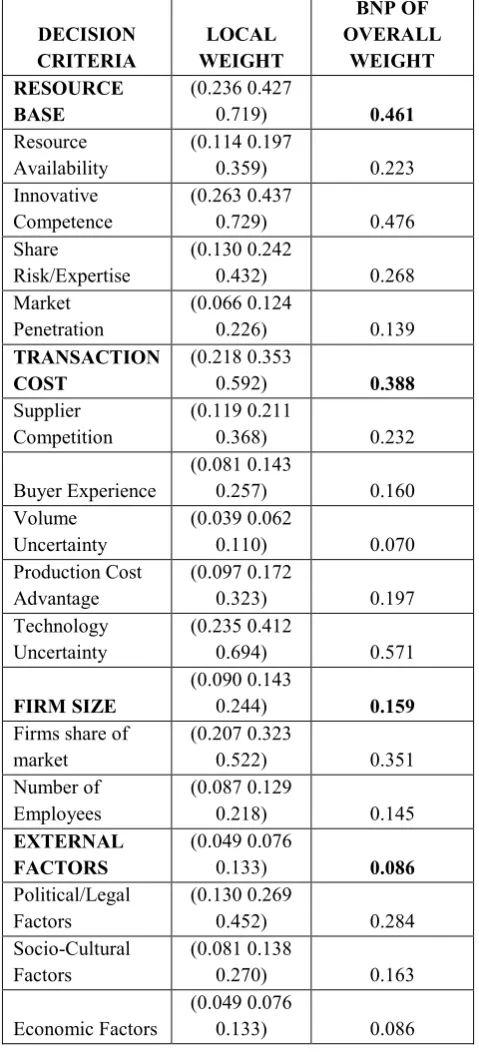
Table 3. The weights of issues for evaluating the mutual funds DECISION CRITERIA LOCAL WEIGHT BNP OF OVERALL WEIGHT RESOURCE BASE (0.236 0.427
0.719) 0.461 Resource
Availability
(0.114 0.197
0.359) 0.223 Innovative
Competence
(0.263 0.437
0.729) 0.476 Share
Risk/Expertise
(0.130 0.242
0.432) 0.268 Market
Penetration
(0.066 0.124
0.226) 0.139 TRANSACTION
COST
(0.218 0.353
0.592) 0.388 Supplier
Competition
(0.119 0.211
0.368) 0.232
Buyer Experience
(0.081 0.143
0.257) 0.160 Volume
Uncertainty
(0.039 0.062
0.110) 0.070 Production Cost
Advantage
(0.097 0.172
0.323) 0.197 Technology
Uncertainty
(0.235 0.412
0.694) 0.571
FIRM SIZE
(0.090 0.143
0.244) 0.159 Firms share of
market
(0.207 0.323
0.522) 0.351 Number of
Employees
(0.087 0.129
0.218) 0.145 EXTERNAL
FACTORS
(0.049 0.076
0.133) 0.086 Political/Legal
Factors
(0.130 0.269
0.452) 0.284 Socio-Cultural
Factors
(0.081 0.138
0.270) 0.163
Economic Factors
(0.049 0.076
0.133) 0.086
resource base as more important in general than transaction cost elements. Similarly there are other factors that are equally perceived as necessary in make or buy decisions that are not cost related and must be considered in the decision to make or buy.
IV.
DISCUSSION AND CONCLUSION
The costs of carrying out business activities have been a sole determinant in relation to make or buy decision of a firm. Despite the growing number of studies and research in the field of make or buy strategy and decision making process few studies have being conducted in relation with the other determinants that influence this process. Therefore the purpose of this study was to identify why a firm has to either make or buy in manufacturing firms in Accra-Ghana by ranking different factors that influences make or buy decision apart from the cost implications. In order to examine the phenomenon under study the research was conducted in a developing country in sub-Saharan African. This is motivated by the fact that there are limited studies examining make or buy decision-making process. Five manufacturing firms were sampled from Accra Ghana to serve as a source of data collection that is used to analysis the hypothesis formulated for this study.
Among these variables tested firm's resource base emerged as the highest decision criterion for in make or buy decision over transaction costs. This implies that a firm's resources (FR), proxied by resource availability, innovative competence, share risk/expertise and market penetration were more dominant that cost elements such as supplier competition, buyer experience, volume uncertainty, production cost advantage and technology uncertainty. This is consistent with emerging literature. Before firm make a decision to make or buy any project or service firms turn to scan it internal and external environment to be able to identify if the skills and knowledge available at the specific time is relevant to effective execution of specific projects.
Also, open innovation that advocated the adaptation of external resources to improve a firm‟s innovation capabilities is also an essential factor for firms to consider the use and utilization of skills, expertise and knowledge outside the firm. And this was found out during an interview session with a top management
member of one of the firms sampled for this study stated that „the adaptation and integration of external knowledge in an individual firm innovation process is essential if firms are to survive in this dynamic business environment since one firm cannot employ all the needed skills and manpower needed‟. This shows that firms do not really consider the amount of capital investment it makes as a result of make or buy in relation to specific projects but also consider the skills and expertise needed to execute the project with high quality and standard. That is the final output is the most significant issue undertake consideration so as to stay competitive. And this in the long run will contribute to firm‟s profitability and sustainability.
Again, the researcher found out that firm keeps equipping it human resource department to meet the current business standard and they recruit and train staffs on the activities of the firm, Heathilife limited for instance had a program for discussing their daily activities with workers and providing them with the necessary direction before they begin their operation. The firms realized that for this to be effective, they decentralized the human resource activities to the various department and weekly report were sent to the human resource department for scrutiny to pave way for the necessary action to be taken.
developing and upgrading their product to meet market standards. Firms in good relation with high level of trust share their technology with other firms and this turn to improve the innovation capabilities of a firm. According to the risk manager of Ernest chemist, he said “it will be in the best interest of the firm to hide it pride and share its ideas with trusted firms for new ideas, it might be risky though but you can get access to new market which will be of great benefit".
Furthermore in order to address some of the findings uncovered in the study there is the need to provide appropriate platform to encourage the dissemination of decision-making process among various departments. Firms have the sole responsibility of developing its internal employee in matter relating to firm‟s decision-making process. Individuals should be trained to have the capabilities of being decisive when it comes to outsourcing and executing projects so as to improve innovation and firm‟s performance. This is a prudent step to be able to cut cost associated with waste and cost in relation to a project. Therefore to make an effective decision not only should cost be the essential factor but also other factors such as the external skills and knowledge available and other factors should be considered critically. Despite the contribution of this study there still exist a number of limitations that hinder this study. The data acquired for the purpose of this study turns to hinder the generalization of the statistical findings since it was collected from few respondents therefore further studies is needed and should include larger sample selected at an unbiased terms. This would correct the selective biased nature of the random selection process adopted for this study.
V.
REFERENCES
[1]. Alegre, J., & Chiva, R. (2008). Assessing the impact of organizational learning capability on product innovation performance: An empirical test. Technovation, 28(6), 315-326.
[2]. Bahemia, H., & Squire, B. (2010). A contingent perspective of open innovation in new product development projects. International Journal of Innovation Management, 14(04), 603-627.
[3]. Bharadwaj, A. S. (2000). A resource-based perspective on information technology capability
and firm performance: an empirical investigation. MIS quarterly, 169-196.
[4]. Bogers, M., & West, J. (2012). Managing distributed innovation: Strategic utilization of open and user innovation. Creativity and innovation management, 21(1), 61-75.
[5]. Cassiman, B., & Veugelers, R. (2006). In search of complementarity in innovation strategy: Internal R&D and external knowledge acquisition. Management science, 52(1), 68-82.
[6]. Chesbrough, H. W. (2006). Open innovation: The new imperative for creating and profiting from technology. Harvard Business Press.
[7]. Das, T. K., & Teng, B. S. (2000). A resource-based theory of strategic alliances. Journal of management, 26(1), 31-61.
[8]. Duysters, G., & Lokshin, B. (2011). Determinants of alliance portfolio complexity and its effect on innovative performance of companies. Journal of Product Innovation Management, 28(4), 570-585. [9]. Dyer, J. H., & Singh, H. (1998). The relational
view: Cooperative strategy and sources of interorganizational competitive advantage. Academy of management review, 23(4), 660-679. [10]. Easterby‐Smith, M., Lyles, M. A., & Peteraf, M.
A. (2009). Dynamic capabilities: Current debates and future directions. British Journal of Management, 20(s1), S1-S8.
[11]. Eisenhardt, K. M., & Martin, J. A. (2000). Dynamic capabilities: what are they?. Strategic management journal, 1105-1121.
[12]. Frenz, M., & Ietto-Gillies, G. (2009). The impact on innovation performance of different sources of knowledge: Evidence from the UK Community Innovation Survey. Research Policy, 38(7), 1125-1135.
[13]. Garriga, H., Von Krogh, G., & Spaeth, S. (2013). How constraints and knowledge impact open innovation. Strategic Management Journal, 34(9), 1134-1144.
[14]. Hagedoorn, J. (2002). Inter-firm R&D partnerships: an overview of major trends and patterns since 1960. Research policy, 31(4), 477-492.
[16]. Lakhani, K. R., & Panetta, J. A. (2007). The principles of distributed innovation. innovations, 2(3), 97-112.
[17]. Laursen, K., & Salter, A. (2006). Open for innovation: the role of openness in explaining innovation performance among UK manufacturing firms. Strategic management journal, 27(2), 131-150.
[18]. Lockett, A., Thompson, S., & Morgenstern, U. (2009). The development of the resource‐based view of the firm: A critical appraisal. International Journal of Management Reviews, 11(1), 9-28. [19]. Moliterno, T. P., & Wiersema, M. F. (2007). Firm
performance, rent appropriation, and the strategic resource divestment capability. Strategic Management Journal, 28(11), 1065-1087.
[20]. Newbert, S. L. (2007). Empirical research on the resource‐based view of the firm: an assessment and suggestions for future research. Strategic management journal, 28(2), 121-146.
[21]. Newbert, S. L. (2008). Value, rareness, competitive advantage, and performance: a conceptual‐level empirical investigation of the resource‐based view of the firm. Strategic management journal, 29(7), 745-768.
[22]. Pavlou, P. A., & El Sawy, O. A. (2006). Decomposing and leveraging dynamic capabilities. Anderson Graduate School of Management, University of California.
[23]. Pavlou, P. A., & El Sawy, O. A. (2006). From IT leveraging competence to competitive advantage in turbulent environments: The case of new product development. Information Systems Research, 17(3), 198-227.
[24]. Peteraf, M. A., & Barney, J. B. (2003). Unraveling the resource‐based tangle. Managerial and decision economics, 24(4), 309-323.
[25]. Vega-Jurado, J., Gutiérrez-Gracia, A., & Fernández-de-Lucio, I. (2009). Does external knowledge sourcing matter for innovation? Evidence from the Spanish manufacturing industry. Industrial and corporate change, 18(4), 637-670.
[26]. Villardón Gallego, L., Gallego, L. V., Petrzelova, J., Petrzelova, J., Durkheim, E., Durkheim, E., ... & Isasi Barbieri, M. (2013). El pensamiento de suicidio en la adolescencia (No. 616.89-008.441. 44-053.6 155.5). e-libro, Corp..
[27]. Wade, M., & Hulland, J. (2004). Review: The resource-based view and information systems research: Review, extension, and suggestions for future research. MIS quarterly, 28(1), 107-142. [28]. Wang, C. L., & Ahmed, P. K. (2007). Dynamic
capabilities: A review and research agenda. International journal of management reviews, 9(1), 31-51.
[29]. Welch, J. A., & Nayak, P. R. (1992). Strategic sourcing: a progressive approach to the make-or-buy decision. The Executive, 6(1), 23-31.
[30]. Zhuang, Y., & Lederer, A. L. (2006). A resource-based view of electronic commerce. Information & Management, 43(2), 251-261.