Development And Evaluation Of An
Undergraduate Multidisciplinary Project
Activity In Engineering And Design
David R. Smith, Brunel University, UKJoanne Cole, Brunel University, UK
ABSTRACT
The School of Engineering and Design Multidisciplinary Project (MDP) at Brunel University is a one week long project based activity involving first year undergraduate students from across the School subject areas of Electronic and Computer Engineering, Mechanical Engineering, Civil Engineering and Design.
This paper describes the main aims of the MDP and gives an overview of how it has developed over the last four years to become a key part of the engineering undergraduate programme at Brunel University. The paper then presents an in-depth evaluation of the MDP, following the collection of 114 survey responses from students across all four subject areas and all four academic years that have participated in the activity, to assess the impact of the MDP on the student learning experience throughout the period of undergraduate study.
The paper also discusses feedback about the MDP obtained from the relevant professional bodies that accredit Brunel University undergraduate engineering programmes, and representatives from the Brunel Placement and Careers Centre, to assess their opinions of the usefulness of the project activity in developing key transferable skills and enhancing the employability of Brunel graduates.
The findings of this study will ensure the continued success of the MDP in future academic years and also provide a case study of a large scale multidisciplinary group project teaching activity that may prove useful to those considering or currently developing such activities at other higher education institutions.
Keywords: Engineering; Undergraduate; Multidisciplinary; Project; Assessment; Evaluation; Teaching; Employability
INTRODUCTION
he Level 1 Multidisciplinary Project (MDP) within the School of Engineering and Design at Brunel University was developed as a teaching activity that would allow students to put into practice problem solving, communication and organisational skills that they have begun to develop in their first term at university. Working together in mixed discipline teams, the students also gain an appreciation for the many other branches of engineering there are outside their own field of study, many of which they will need to work closely with after completing their undergraduate studies and entering employment.
comprised of 3 Mechanical Engineering students, 2 Design students, 2 Electronic and Computer Engineering students and 1 Civil Engineering student. Students are allocated to groups based on their subject area and also their chosen degree course, the goal being to ensure maximum diversity in the academic make up of each group. The basis for the kits provided to each team are Lego Mindstorms robots for the majority of groups, while the remaining groups are provided with a Parallax Basic STAMP 2 chip and a micro-controller chip to design their vehicle around.
Although multidisciplinary projects of this nature are not currently a mandatory requirement for the accreditation of undergraduate engineering courses in the UK and Ireland, the implementation and benefits of such projects have been widely discussed over a number of years [1, 2]. Examples of multidisciplinary projects can currently be found on the syllabi of a number of undergraduate engineering courses across the UK [3, 4, 5]. A number of projects similar to the MDP have also been developed in the US, where multidisciplinary undergraduate projects are a requirement for degree courses accredited by ABET [6, 7, 8, 9]. There are also many examples of universities using Lego Mindstorms in their undergraduate projects [10]. The gradual acceptance of the need for a multidisciplinary project to be part of a standard undergraduate engineering degree arises from the needs of industry and the desire to enhance the employability of undergraduates upon completion of their degrees.
MDP ORGANISATION
The main focus of the MDP is the project week, which takes place in the last week of the Autumn term. All other Level 1 teaching is suspended during this week, allowing all students to concentrate on MDP activities. The build-up to the project activity begins in the first week of term, when the new students in all the participating subject areas are given a brief presentation to introduce them to the MDP and the goals behind it. This briefing also ensures that all students are aware that their presence is required right up to the very end of the term.
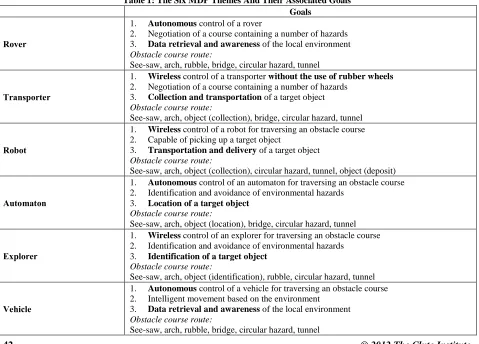
Table 1: The Six MDP Themes And Their Associated Goals Goals
Rover
1. Autonomous control of a rover
2. Negotiation of a course containing a number of hazards 3. Data retrieval and awareness of the local environment Obstacle course route:
See-saw, arch, rubble, bridge, circular hazard, tunnel
Transporter
1. Wireless control of a transporter without the use of rubber wheels
2. Negotiation of a course containing a number of hazards 3. Collection and transportation of a target object Obstacle course route:
See-saw, arch, object (collection), bridge, circular hazard, tunnel
Robot
1. Wireless control of a robot for traversing an obstacle course 2. Capable of picking up a target object
3. Transportation and delivery of a target object Obstacle course route:
See-saw, arch, object (collection), circular hazard, tunnel, object (deposit)
Automaton
1. Autonomous control of an automaton for traversing an obstacle course 2. Identification and avoidance of environmental hazards
3. Location of a target object
Obstacle course route:
See-saw, arch, object (location), bridge, circular hazard, tunnel
Explorer
1. Wireless control of an explorer for traversing an obstacle course 2. Identification and avoidance of environmental hazards
3. Identification of a target object
Obstacle course route:
About one month before the project week the students are assigned to their project groups and each group is allocated a theme. The themes for the 2010/2011 MDP are shown in Table 1 and all represent variations around the basic idea of building a vehicle to traverse an obstacle course. Themes are allocated randomly to project groups and in the last two academic years there have been 60 participating groups, 10 groups allocated to each project theme. At the same point in the term, the students are given a more detailed presentation relating to what they will be expected to do during the project week and information about the resources they will be given to complete the project, along with the project week schedule. The students are strongly encouraged to make contact with their teammates prior to the start of the project week and do some background research into the project kit they will be given. Students are left to decide among themselves what role they will each play in their given project group, one of the key aims of the MDP being to develop the communication and organisation skills required to work successfully in a team.
The MDP has its own dedicated website on the Brunel University e-Learning system and, in the run-up to the project week, extensive documentation relating to the project is made available on this website. This information includes details about the group allocations, theme descriptions, the project week schedule, obstacle course layout, theme challenges and project assessment information. A dedicated notice board is also used to display the various documents, providing a physical location where information can be sought.
The students collect their project kit on the Monday morning of the project week and are pre-assigned a group demonstration time on either the Thursday afternoon or the Friday morning. A prize-giving ceremony takes place early on the Friday afternoon, providing a light-hearted end to the week and the term, acknowledging the best project in each theme and awarding a Lego trophy to the best overall project. During the week, it is down to the students to decide how, when and where to work on their projects. A number of laboratory spaces and rooms with tables and chairs are booked for the students to use throughout the week and the necessary software packages are made available in all the School computer laboratories, some of which have 24-hour student access.
During working hours each day of the project week the MDP coordinators are available at the main Electronic and Computer Engineering undergraduate laboratory to answer student queries and to provide advice, as well as Lego and electronics parts, mains chargers, batteries and so on. A sticky note messaging system that students can use to make contact with each other throughout the week is also provided outside the undergraduate laboratory.
Learning Outcomes And Assessment
The learning outcomes, the assessment criteria and the method of assessment of the MDP are the same across all the participating subject areas, the project accounting for the same credit weighting in four respective Level 1 undergraduate laboratory modules. The key learning outcomes are as follows:
Design, build, test, evaluate, document and present a small prototype system to a given specification; Undertake personal evaluation and reflection;
Work effectively as part of a team;
Communicate effectively in a professional manner.
These learning outcomes are assessed in two equally weighted parts: a project demonstration mark awarded to all members of a project group based on the design and final performance of the vehicle; an individual report mark awarded to each student on submission of a two page reflective review of the project, discussing how the group worked together, the individual contribution the student has made to the project and an evaluation of their own performance.
The group demonstration mark is assessed in three categories:
Analysis of the design problem (10 marks) Design choices made (10 marks)
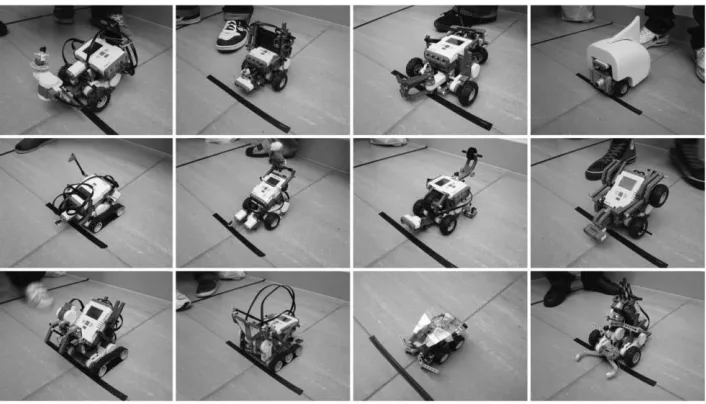
These categories take into account novelty in the use of sensors to complete specific theme challenges, the level of automation achieved in the final demonstration, the creative use of the parts provided in designing the finished article and the performance of the final design on the obstacle course. Figure 1 shows photographs of a selection of completed robots from the 2009 MDP.
Figure 1: A Selection Of The Wide Variety Of Completed Robots From The 2009 MDP
A template for the individual report is provided to all students, consisting of three sections that need to be completed. The three section headings are as follows:
Project Description – a brief description of what your project was about and what the aims of the project were. You should include information about any background research carried out, design choices made and the reasons behind them.
Team Work – a description of how your project group was organized. How was your group managed? Did you have group meetings? How were the group‟s activities scheduled? How successfully did your group work together as a team? Were there any problems encountered and how did you overcome them?
Personal Contribution – a description of your individual contribution to the project. Comment on the success, or otherwise, of your contributions and of the project so far. Do you think all of the original goals of the project will be achieved? What would you change or do differently if repeating the project?
The submitted report is then assessed in the following categories, the first three corresponding to the three report sections given above, the final category being self explanatory:
Critical evaluation of the technical design (10 marks)
Reflective review of how the team worked together (10 marks) Reflective review of personal contribution to the project (20 marks) Quality of the written work (10 marks)
MDP Evolution
A number of aspects of the MDP have changed over the four years it has been part of the undergraduate teaching programme. For example, in the first year that the MDP took place, one of the themes allocated to a number of groups was the construction and demonstration of a small rocket and payload. This theme, although a huge success, was abandoned after the first year as it represented a significant logistical challenge to run and was also dependent on the weather. The rocket theme also required a lengthy approval process to run, the ability to fly the rockets requiring clearance from London Heathrow airport (only 8 km from Brunel University) and local smaller airfields. Subsequent MDP sessions have just used indoor obstacle course based project themes.
Another element of the MDP that has developed significantly over the years is the nature of the individual report that each student participating in the MDP is required to complete. Given the large number of students participating in the MDP each year (a number that has increased year-on-year), the report has gradually decreased in length to its current two-page limit, primarily due to staff constraints on available marking time, but also due to the required content being more explicitly stated to obtain more focused responses from the students. The report submission deadline has also moved over the years from the original submission date in January, to the start of the Spring term, to the Wednesday of the project week. This change was made to remove the possibility of students just writing about their project demonstration, a separate assessment element, rather than reflecting on their performance over the project design and build phase. The last two years has also seen the individual report template introduced to ensure that the students cover the required assessment topics in their write up and conform to the two-page limit.
The level of student engagement in the MDP has been consistent across all four years it has taken place with the changes to the individual report assessment resulting in more students successfully demonstrating a reflective evaluation of their contribution to their project team in their written work. More detailed information about the MDP can be found in [11], this paper being primarily concerned with a large scale evaluation of the project activity conducted over the summer of 2011.
MDP EVALUATION
The MDP was evaluated initially by means of an online survey, which was created using the „SurveyMonkey‟ website and was made live on 30th March 2011. The survey consisted of 15 questions, including
tick box style quantitative questions along with some text based qualitative questions. The survey also included a request for contact details to be provided, if students would be happy to be contacted for a follow-up discussion. Information about the survey was sent by email to all students that have participated in the MDP since it was introduced in the 2007/2008 academic year (approximately 1700 students).
In total there were 114 responses to the survey. Almost 50% of the responses came from students in the 2010/2011 cohort, making many of the findings directly relevant to the current form of the MDP. Responses were received from 8 Civil Engineering students, 43 Design students, 26 Electronic and Computer Engineering students and 37 Mechanical Engineering students, these numbers being roughly proportional to the corresponding number of students from each subject area that take part in the MDP.
Survey Response Overview
Figure 2: Responses To Parts Of The Question:
‘Please Rate The Following Statements About The Organisation Of The MDP’
Throughout the four years that the MDP has taken place, one thing that stands out quite clearly across the whole School is the success of the social side of the project. One of the main elements of the project is the multidisciplinary aspect of the students working together in mixed discipline teams to gain an appreciation for the other branches of engineering that are outside of their own field. Figure 3 shows a very positive response, with students responding that they liked working with students from other subject areas and that they made new friends during the MDP, in addition to finding it fun. Many of the text responses from the qualitative questions in the survey also reflected these results.
Figure 3: Responses To Parts Of The Question:
‘Please Rate The Following Statements About The Value Of Participation In The MDP’
However, despite the fact that the students enjoy working together, a criticism that was made by a number of students was that the project groups are too large. The issue of group size was addressed in one of the survey questions, the responses to which are shown in Figure 4. The data show there is a strong preference for the optimum number of students in an MDP project group to be much lower than the actual 8 – 9 students. This is clearly something that can be addressed in future project weeks, but it does have implications on the required equipment, available work space and project assessment schedule.
0 10 20 30 40 50 60
MDP documentation was easily located on the computer system
MDP documentation was clear and understandable
MDP introductory briefing lectures were clear and understandable
Frequency
Strongly agree
Agree
Neutral
Disagree
Strongly disagree
N/A
0 10 20 30 40
The MDP was fun
I liked working with students from other subject areas
I made new friends during the MDP
Frequency
Strongly agree
Agree
Neutral
Disagree
Strongly disagree
Figure 4: Breakdown Of The Responses To The Question:
‘In Your Opinion, Which Of The Following Would Be The Optimum Number Of Students In An MDP Project Group?’
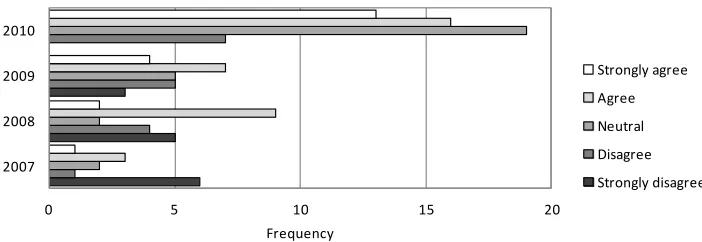
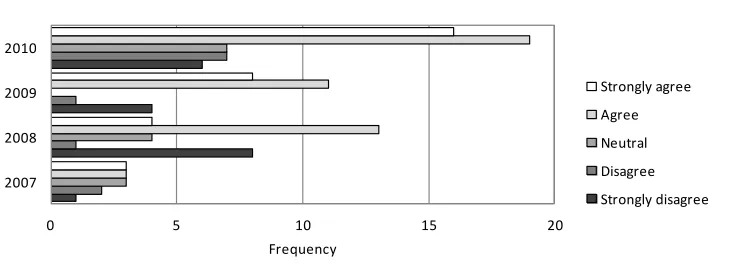
From the text feedback obtained, it was evident that a common issue the students had was the organisation of the MDP. On further analysis it was seen that negative comments about the organisation originated mostly from the 2007 and 2008 project cohorts, the more recent cohorts being much more satisfied. Figure 5 shows the student responses to a statement about MDP organisation. The data clearly highlight the gradual progress made in the perception of the MDP organisation each year, the view of the students improving each year, with only 7 students disagreeing with the statement that the MDP was well organized, from a total of 55 responses in the 2010 cohort.
Figure 5: Responses To The Statement: ‘The MDP Was Well Organized’, By Academic Year
It was found that more students were concerned about there not being enough organization within the project groups themselves, rather than in the running of the MDP as a whole. A common issue raised was that some students were not participating as much as others in a given group, yet claiming the credit when it came to the project assessment. Some students suggested role allocations should be made explicit as part of the project task, which may be very useful in terms of participation, as responsibilities can be given to every group member. Currently the MDP requires project groups to organise themselves and this is clearly not working in all cases.
Survey Responses By Year
One topic that arose frequently in the survey results across each subject area in each year was the issue of feedback. Out of all 83 text responses to the question „List three positive aspects of the MDP‟, none of the students mentioned anything positive about feedback. In the question „List three negative aspects of the MDP‟ however, a few students commented that they did not remember receiving any feedback at all.
87 29
4 0
4 - 5
6 - 7
8 - 9
10 or more
0 5 10 15 20
2007 2008 2009 2010
Frequency
Strongly agree
Agree
Neutral
Disagree
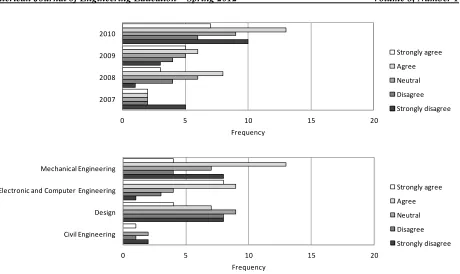
Figure 6: Responses To The Statement: ‘Feedback On The MDP Group Demonstration Was Informative And Constructive’, By Academic Year (Top) And By Subject Area (Bottom)
Figure 6 shows responses to the statement „Feedback on the MDP group demonstration was informative and constructive‟. The data clearly mirror the negative text comments about MDP assessment feedback. It is known that MDP demonstration feedback could be greatly improved and this is to be addressed in the coming academic year.
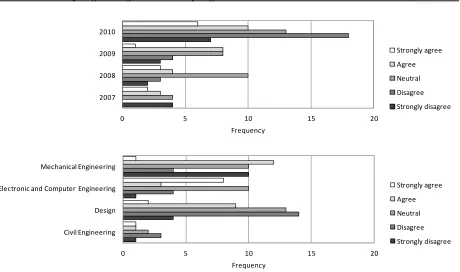
The data shown in Figure 7 also relate to feedback, this time the responses are to the statement „Feedback on the MDP individual report was informative and constructive‟. It is clear that students from Electronic and Computer Engineering seem most happy with their report feedback, while there is room for improvement in the other participating subject areas.
The top plot in Figure 7 shows the results from each academic year and indicates that the students‟ perception of feedback on the MDP individual reports has been very varied over time. In 2008 it seemed to have made dramatic progress, dropping from 26.3% of students strongly disagreeing with the statement, to only 5.3%. However in 2010, the students were clearly not satisfied with this aspect of the MDP in Design and Mechanical Engineering, a point that is backed up by text survey responses. Feedback is a key area that needs to be investigated further and addressed in future MDP weeks.
0 5 10 15 20
2007 2008 2009 2010
Frequency
Strongly agree
Agree
Neutral
Disagree
Strongly disagree
0 5 10 15 20
Civil Engineering Design Electronic and Computer Engineering Mechanical Engineering
Frequency
Strongly agree
Agree
Neutral
Disagree
Figure 7: Responses To The Statement ‘Feedback On The MDP Individual Report Was Informative And Constructive’ By Academic Year (Top) And By Subject Area (Bottom)
Figures 8 and 9 show responses to statements about the amount of time available to complete the project build and individual report aspects of the MDP. The data show that students were predominantly happy with the allocated time, although this is not representative of all students‟ views, as evidenced by some of the text responses on this issue where some students felt that there was not enough time to complete the individual reports.
One student commented that the grade weighting towards their course was too much, considering the project only took place over a single week. Students are expected to spend a full working week on the project activity and in many cases this is certainly true, while in others there are students that are clearly not contributing enough or participating at the expected level for the full project duration. Trying to maintain engagement from all students in each group for the full project duration is clearly difficult and could be better monitored during the project week in future.
Figure 8: Responses To The Statement:
‘There Was Adequate Time To Complete The Project Build And Testing In The Project Week’, By Academic Year
0 5 10 15 20
2007 2008 2009 2010
Frequency
Strongly agree
Agree
Neutral
Disagree
Strongly disagree
0 5 10 15 20
Civil Engineering Design Electronic and Computer Engineering Mechanical Engineering
Frequency
Strongly agree
Agree
Neutral
Disagree
Strongly disagree
0 5 10 15 20
2007 2008 2009 2010
Frequency
Strongly agree
Agree
Neutral
Disagree
Figure 9: Responses To The Statement:
‘There Was Adequate Time To Complete The Individual Report’, By Academic Year
Feedback From Professionals
A number of the professional institutions that accredit the undergraduate courses of the different subject areas that participate in the MDP were contacted, with the aim of getting further ideas to aid the future development of the MDP. The following institutions were contacted: The Institution of Engineering and Technology (IET), the Institution of Mechanical Engineering (IMechE) and the Institution of Civil Engineers (ICE).
In a report following a recent accreditation visit, the IET commented that “The panel commended the multidisciplinary project in the first year and was pleased to learn that this concept will be developed for use elsewhere in the programmes”. The second part of this comment relates to the fact that within the Electronic and Computer Engineering subject area, a group project activity has subsequently been introduced into the Level 2 academic programme, where small groups of students work together on practical design, build and demonstration projects using more advanced electronics, building on the Level 1 MDP experience. When contacted within the context of the current study, the IET provided information about similar projects at other UK universities that it was aware of and expressed a willingness to provide an advisor to the MDP on both technical and professional aspects of the project. The ICE also provided some useful input on how the project could be made more directly relevant to the Civil Engineering students who take part, for example by the inclusion of an additional project challenge where teams have to build a bridge for their vehicle to traverse the rubble obstacle on the demonstration course.
In addition to seeking advice from accrediting bodies, a meeting was held with members of the Brunel University Placement and Careers Centre, primarily focusing on how the MDP can be adapted to improve the transferable skills of participating students and ensure that the students think about the activity with the development of their employability in mind.
One idea put forward was to bring in representatives from industry to give presentations to the students as part of the MDP mid-term briefing talks. These speakers could be from companies that are particularly relevant to individual subject areas, or they could be more general. In addition, a member of staff from the Placement and Careers Centre volunteered to give a presentation that would highlight the key transferable skills that can be put into practice and developed while participating in the MDP, to better prepare students for talking about their work in future work placement and job interviews. These additions to the mid-term briefing sessions will help students to more fully engage in the MDP, making them think about the roles they will play in the project groups and what they need to get out of the project week to best prepare them for future employment.
The Placement and Careers Centre staff also talked about empowering the students and creating an atmosphere of enthusiasm about the project. One suggestion was to invite in company managers and directors, as
0 5 10 15 20
2007 2008 2009 2010
Frequency
Strongly agree
Agree
Neutral
Disagree
CONCLUSIONS
The MDP evaluation survey generated a wealth of information, revealing specific aspects of the teaching activity that worked well and highlighting areas that could be improved or developed further to ensure the MDP remains a key part of the Level 1 undergraduate teaching programme in the School of Engineering and Design. The purpose of this paper has been to discuss some of the findings of this study in the context of teaching activities at Brunel University, giving an overview of the key points raised that are applicable to the planning of the MDP for the coming academic year, while also providing information to aid the development of large scale cross-discipline group project activities at other higher education institutions. The key findings of this study are summarised as follows:
The MDP group sizes are currently too large and there is a need to reduce the size of each group from the current 8-9 students to 5-6 students to improve student engagement and ensure all group members can fully participate in the project design and building phases. Implementing this change will require detailed consideration of equipment, staff, space and schedule constraints and the need to have group members from each of the different participating subject areas.
Although many students do fully engage with the MDP and find the activity a positive and enjoyable experience, there are a number of students who do not feel they are gaining any new skills in participating. These views can be addressed by better informing the students before embarking on the project that the key aims of the MDP are not technical, but lie in the development of transferable skills. Enhancing the mid-term project briefings with the addition of talks from the Placement and Careers Centre and invited speakers from industry will also help better prepare the students for taking part in the MDP. The inclusion of a debriefing session after the conclusion of the project week may help students to become aware of the skills they have put into practice and developed during the course of the project week, perhaps without even realising it.
Some students perceive the project tasks to be not very technically challenging. A small increase in the technical difficulty of the project tasks can be taken into consideration, or at least the inclusion of additional technical challenges in each project theme, to ensure there is always something that can be worked on by all group members throughout the project week.
Some students perceive their participation in the project to be irrelevant to their chosen course. This view is most strongly felt by students in the Design and Civil Engineering subject areas. The lack of engagement by some Design students can be addressed by emphasizing the design aspect of the project, possibly with a more significant design element to the assessment. The lack of engagement by some Civil Engineering students can be addressed by the inclusion of an additional project challenge, such as the construction of an obstacle for the course (e.g. a bridge that the vehicle must traverse). In making such changes it is essential that all students from all subject areas are assessed in the same way to ensure that all students feel they are being treated equally and the distribution of workload within a group is fair.
Students are not always very clear what role they should be playing in their project groups, making it hard for them to assess their individual contribution to the project when completing their individual reports. One way to address this point would be to pre-allocate roles to each student, so that they are aware in advance of the project week what they and their fellow team members are responsible for. However, this does go against the ethos of the MDP, in that students are expected to organize and manage themselves as a team as part of the project assessment. Additional guidance for the students in this area should help to address this point.
ACKNOWLEDGEMENTS
The authors would like to thank the Learning and Teaching Development Unit (LTDU) at Brunel University for funding the evaluation work presented in this paper and Dianna Reid for her valuable contribution in compiling the survey results and providing useful insights into the collected data.
AUTHOR INFORMATION
Dr David Ryan Smith has been a lecturer in the School of Engineering and Design at Brunel University since 2006 and was instrumental in the development of the Level 1 MDP that was implemented in the 2007/2008 academic year. He is currently the Level 1 coordinator for the Electronic and Computer Engineering subject area in the School and is responsible for the running of the MDP. E-mail: [email protected]. Corresponding author.
Dr Joanne Cole is also a lecturer in the School of Engineering and Design at Brunel University and has been since 2009. She has been involved in the coordination of the MDP for the last two academic years, as well as teaching mathematics and programming to Level 1 students. E-mail: [email protected].
REFERENCES
1. Denton, H. G. (1997). Multidisciplinary team-based project work: planning factors. Design Studies, 18(2), 155-170.
2. Richter, D. M., Paretti, M. C. (2009). Identifying barriers to and outcomes of interdisciplinarity in the engineering classroom. European Journal of Engineering Education, 34(1), 29-45.
3. School of Engineering, Warwick University final year group project module (website). Available at http://www2.warwick.ac.uk/fac/sci/eng/eso/modules/year4/es410. Accessed 24th January 2012.
4. Department of Engineering and the Environment, University of Southampton final year multidisciplinary project module (website). Available at
http://www.soton.ac.uk/engineering/undergraduate/modules/sesm6010_multidisciplinary_project.page. Accessed 24th January 2012.
5. Long, P.J.G., Matheson, J.M.R., Palmer, P.R., Parks, G.T. (2009). 1B Integrated Design Project: Mobile Robot. University of Cambridge course manual (electronic document). Available at
http://www.eng.cam.ac.uk/DesignOffice/idp/resources/current/idp_manual.pdf. Accessed 24th January 2012.
6. DePiero, F. W., Slivovsky, L. A. (2007). Multidisciplinary experiences for undergraduate engineering students. Proceedings of the ASEE Annual Conference. Honolulu, HI.
7. Blandford, D. K., Hwang, D. J., Richardson, A. (2001). LEGO 101: A Multidisciplinary Freshman Team Experience. Proceedings of the 2001 American Society for Engineering Education Annual Conference and Exposition. Albuquerque, NM.
8. Hunt, E. M, Lockwood-Cooke, P., Kelley, J. (2010). Linked-Class Problem-Based Learning In Engineering: Method And Evaluation. American Journal of Engineering Education, 1(1), 79-88.
9. Jahanian, S., Matthews, J. M. (1999). Multidisciplinary Project: A Tool for Learning the Subject. Journal of Engineering Education, 153-158.
10. Ringwood, J. V., Monaghan, K. and Maloco, J. (2005). Teaching engineering design through Lego Mindstorms. European Journal of Engineering Education, 30(1), 91-104.
11. Smith, D. R., Cole, J. (2010). Development of an Undergraduate Multidisciplinary Engineering Project. Proc. Constructionism. Available to download in the Constructionism 2010 proceedings at