Scalability Analysis of AODV Routing Protocol in varying
Network Parameters
Aravendra Kumar Sharma
MCA Department, IMS Ghaziabad, India
ABSTRACT
Mobile ad-hoc Networks (MANET) are self-organized infrastructure less networks dynamically formed by autonomous system of mobile nodes that are interconnected via wireless links. The nodes communicate with each other directly or indirectly, via multiple nodes due to limited radio transmission ranges. Thus, the nodes in MANET also act as a router. The key requirement of an efficient routing protocol is to find a route between two nodes quickly and with low bandwidth overhead. In this paper we have evaluated the performance of AODV protocol by varying node density and mobility. We used the NS2.35 simulator to analyse the performance. The simulation result are analysed by graphical manner and trace files based on packet delivery fraction and throughput. The performance of AODV is greatly reduced at higher node density.
Keywords: Mobile ad-hoc Networks, NS2, AODV, TORA, DSDV
I.
INTRODUCTION
Mobile ad-hoc Networks are self-organized infrastructure less networks dynamically formed by an autonomous system of mobile nodes that are interconnected via wireless links.[1] The major challenges in Mobile Ad-hoc network [2] are:-
1) Autonomous- No centralized administration entity is available to manage the operation of different mobile nodes.
2) Dynamic topology- Nodes are mobile and can be connected dynamically in an arbitrary manner. Links of the network vary timely and are based on the proximity of one node to another node.
3) Device discovery- Identifying relevant newly moved in nodes and informing about their existence need dynamic update to facilitate automatic optimal route selection.
4) Bandwidth optimization- Wireless links have significantly lower capacity than the wired links.
5) Limited resources- Mobile nodes rely on battery power, which is a scarce resource. Also storage capacity and power are severely limited.
6) Scalability- Scalability can be broadly defined as whether the network is able to provide an acceptable level of service even in the presence of a large number of nodes.
7) Limited physical security- Mobility implies higher security risks (H.Yang, et al., 2004) such as peer-to- peer network architecture or a shared wireless medium accessible to both legitimate network users and malicious attackers. Eavesdropping, spoofing and denial-of-service attacks should be considered.
8) Infrastructure- less and self-operated, Self-healing feature demands MANET should realign itself to blanket any node moving out of its range.
9) Poor Transmission Quality- This is an inherent problem of wireless communication caused by several error sources that result in degradation of the received signal.
11)Network configuration- The whole MANET infrastructure is dynamic and is the reason for dynamic connection and disconnection of the variable links.
12)Topology maintenance- Updating information of dynamic links among nodes in MANETs is a major challenge.
1.1 Classification of Routing Protocols
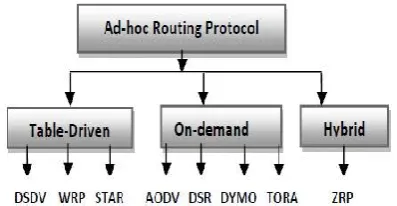
The routing protocol different categories. We can classify them mainly into three major categories proactive, reactive & hybrid.
Figure 1. Classification Of Routing Protocols in MANET
1.1.1 Proactive (Table-Driven) Routing Protocols:- Table-driven routing protocol [7,8] attempt to maintain consistent, up-to-date routing information from each node to every other node in the network. These protocols require each node to maintain one or more tables to store routing information, and they respond to changes in network topology by propagating updates routes throughout the network in order to maintain a consistent network view. The Destination- Sequenced Distance- Vector Routing (DSDV) protocol is a table driven algorithm that modifies the Bellman-Ford routing algorithm to include timestamps that prevent loop-formation. The Wireless Routing Protocol (WRP) is a distance vector routing protocol which belongs to the class of path-finding algorithms that exchange second-to last hop to destinations in addition to distances to destinations. This extra information helps remove the
―counting-to-infinity‖ problem that most distance vector routing algorithms suffer from. It also speeds up route convergence when a link failure occurs.
1.1.2 On Demand-Driven Routing Protocols:- A different approach from table-driven routing is on-demand routing [2,9,13]. This type of routing creates routes only when desired by source node. When a node requires a route to a destination, it initiates a route discovery process within the network. This process is completed once a route is found or all possible routes permutations have been examined. Once a route has been established, it is maintained by a route maintenance procedure until either the destination becomes inaccessible along every path from the source or until the route is no longer desired. On-demand routing protocols were designed with the aim of reducing control overhead, thus increasing bandwidth and conserving power at the mobile stations. These protocols limit the amount of bandwidth consumed by maintaining routes to only those destinations for which a source has data traffic. Therefore, the routing is source-initiated as opposed to table driven routing protocols that are destination initiated. There are several recent examples of this approach (e.g.,AODV [2], DSR [13], TORA [2]) and the routing protocols differ on the specific mechanisms used to disseminate flood search packets and their responses, cache the information heard from other nodes’ searches, determine the cost of a link, and determine the existence of a neighbor. However, all the on-demand routing proposals use flood search messages that either: (a) give sources the entire paths to destinations, which are then used in source routed data packets (e.g., DSR) or (b) provide only the distances and next hops to destinations, validating them with sequence Numbers (e.g., AODV) or time stamps (e.g., TORA).
to combine advantage of both proactive and reactive protocols. The most typical hybrid one is zone routing protocol (ZRP) [3].
II.
OVERVIEW OF AODV PROTOCOL
AODV is an on-demand protocol that is capable of
providing unicast, multicast, and broadcast
communication. Route discovery is based on a
RouteRequest/RouteReply query cycle. Once
discovered, a route is maintained as long as needed by the source. To guarantee loop freedom, AODV utilizes per node sequence numbers. A node increments the value of its sequence number whenever there is a
change in its local connectivity information.
2.1 Control Messages in AODV
There are four control messages are used by AODV described as below
2.1.1 Route Request (RREQ)
When a route is not available for the destination, a route request packet (RREQ) is flooded throughout the network which contains the following format [14].
2.1.2 Route Reply (RREP)
If a node is the destination, or has a valid route to the destination, it unicasts a route reply message (RREP) back to the source. This message has the following format [17].
2.1.3 Route Error Message (RERR)
All nodes monitor their own neighborhood and broadcast message when:
– A node detects that a link with adjacent neighbor is broken (destination no longer reachable).
– If it gets a data packet destined to a node for which it does not have an active route and is not repairing. – If it receives a RERROR from a neighbor for one or more active routes, to notify the other nodes on both sides of the link about loss of this link.
2.1.4 HELLO Messages
Each node can get to know its neighborhood by using local broadcasts, so-called HELLO messages. Nodes neighbors are all the nodes that it can directly communicate with. Although AODV is a reactive protocol it uses these periodic HELLO messages to inform the neighbors’ that the link is still alive. The HELLO messages will never be forwarded because they are broadcasted with TTL = 1. When a node receives a HELLO message it refreshes the corresponding lifetime of the neighbor information in the routing table.
Route Discovery—Route discovery begins when a source node needs a route to some destination. It places the destination IP address and last known sequence number for that destination, as well as its own IP address and current sequence number, into a
RouteRequest (RREQ). It then broadcasts the RREQ
and sets a timer to wait for a reply. When a node
receives the RREQ, it first creates a reverse route
entry for the source node in its route table.
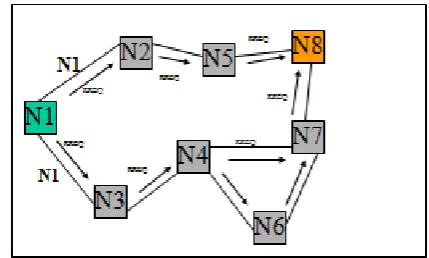
Figure 2. Route Reply
It then checks whether it has an unexpired route to the destination node. In order to respond to the RREQ, the node must either be the destination itself, or it must have an unexpired route to the destination whose corresponding sequence number is at least as great as that contained in the RREQ. If neither of these conditions is met, the node rebroadcasts the RREQ. On the other hand, if it does meet either of
these conditions, the node then creates a RouteReply
(RREP) message. It places the current sequence number of the destination, as well as its distance in hops to the destination, into the RREP, and then unicasts this message back to the source. The node from which it received the RREQ is used as the next hop. When an intermediate node receives the RREP,
it creates a forward route entry for the destination
node in its route table, and then forwards the RREP to the source node. Once the source node receives the RREP, it can begin using the route to transmit data packets to the destination. If it later receives a RREP with a greater destination sequence number or equivalent sequence number and smaller hop count, it updates its route table entry and begins using the new route. If the source node does not receive a RREP by the time its discovery timer expires, it rebroadcasts the RREQ. It attempts discovery up to some maximum number of times. If no route is discovered after the maximum number of attempts, the session is aborted.
Route Maintenance— An active route is defined as a route that has recently been used to transmit data packets. Link breaks in non-active links do not trigger
any protocol action. However, when a link break in
an active route occurs, the node upstream of the break
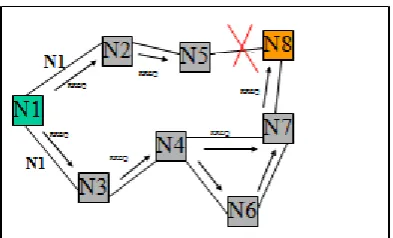
determines whether any of its neighbors use that link to reach the destination. If so, it creates a Route Error (RERR) packet. The RERR contains the IP address of each destination that is now unreachable, due to the link break. The RERR also contains the sequence number of each such destination, incremented by one.
Figure 5. Propagation of RERR
Figure 6. Route Rediscovery
III.
EVALUATION CRITERIA
Performance of AODV protocols in MANET can be realized by quantitative study of values of different metrics used to measure performance of routing protocols which are as follows.
3.1 Packet Delivery Ratio
It’s a ratio of the number of packets received by the destination to the number of packets send by the source This illustrates the level of delivered data to the destination. The greater value of packet delivery ratio means better performance of the protocol.
PDR = Σ No of packet receive / Σ No of packet send
3.2 Throughput
Throughput is the measurement of number of packets passing through the network in a unit of time. This metric show the total number of packets that have been successfully delivered to the destination nodes.
Throughput = (∑CBRreceived)/simulation time
IV.
SIMULATION MODEL
4.1 Simulation Parameters
Parameters Values
Channel Type Channel/Wireless Channel Radio-Propagation
Model
Propagation/Two way ground
Network interface Type Phy/wirelessphy MAC Type 802.11 Interface Queue Type Queue/DropTail
Link Layer Type LL Antenna Omni Antenna Maximun packet in IQ 50
Area (m×m) 1000×1000 No. of mobile Nodes 10-70
Traffic Type Constant Bit Rate (CBR) Routing Protocol AODV
Simulation Time 1000s Mobility Model Random Way Point
Packet Size 512 bytes Simulator Used NS 2 (Version 2.35)
4.2 Simulation Scenario
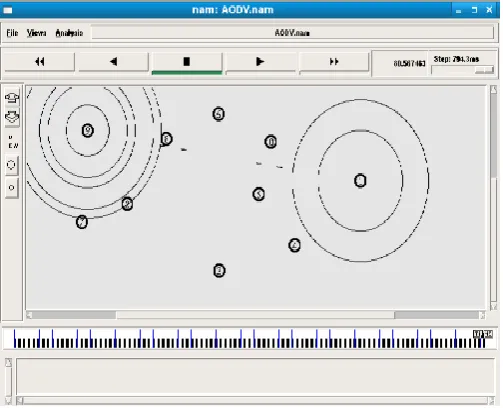
There can be the possibility of following two scenarios shown in fig 7 & 8 below one is, static where nodes are constant & another is dynamic where nodes are moving continuously which is consider in this paper.
Figure 7. Static Simulation Scenario
Figure 8. Dynamic Simulation Scenario
V.
RESULT AND ANALYSIS
5.1 For Packet Delivery Ratio
Figure 9
Analysis:- From the above graph we can say that the packet delivery ratio does not increase constantly. We varied the number of nodes from 10 to 70. It increases up to 20 nodes and then starts decreasing as the number of nodes keep on increasing.
5.2 For Throughput
Figure 10
Analysis:- From the above graph we conclude that the throughput does not increase constantly. We varied the number of nodes from 10 to 70. It increases up to 30 nodes and then starts decreasing as the number of nodes keep on increasing.
VI.
CONCLUSION AND FUTURE SCOPE
This paper provides explanation and simulation analysis of AODV and also provides a classification of MANET routing protocols according to the routing strategy (i.e. table driven, on-demand and hybrid routing protocol).We studied and evaluated the Ad-hoc On-Demand Distance Vector (AODV) routing protocol. We evaluated the protocol in terms of various parameters such as packet delivery ratio and throughput with varying speed and seed and found that that these parameters vary non linearly with the increase in no. of nodes and concluded that the above protocol is not scalable in ad-hoc wireless networks, whose topologies are highly dynamic
In future we wish to make the above protocol scalable and thus improve the performance of the above protocol.
VII.
REFERENCES
[1]. D. Johnson, D.A. Maltz and J. Broch, "The dynamic source routing protocol for mobile ad hoc networks (Internet-draft) ", Mobile Ad-hoc Network (MANET) Working Group, IETF (1998)
[2]. Broch, J; Maltz DA, Johnson DB, Hu Y-C, and Jetcheva J. "A performance comparison of multi-hop wireless ad-hoc network routing protocols", Proceedings of the Fourth Annual ACM/IEEE International Conference on Mobile Computing and Networking (Mobicom98), ACM, October 1998.
[3]. S. Corson, J. Macker,"Mobile Ad hoc Networking (MANET): Routing Protocol Performance Issues and Evaluation Considerations", IETF RFC 2501, 1999.
[5]. E.M. Royer, P.M. Melliar-Smith, and L.E. Moser."An Analysis of the Optimum Node Density for Ad hoc Mobile Networks," Proceedings of the IEEE International Conference on Communications (ICC), Helsinki, Finland, June 2001.
[6]. C. Bettstetter,"Smooth is better than sharp: A random mobility model for simulation of wireless networks", Proceedings of MSWiM’01. ACM, July 2001.
[7]. T. Camp, J. Boleng, and V. Davies. " A survey of mobility models for ad hoc network re-search", Wireless Comm. and Mobile Computing (WCMC), vol 2, issue 5, pp. 483-502, 2002. [8]. C. E. Perkins, B. Royer and S. Das,"Ad hoc On
Demand Distance Vector (AODV) Routing", RFC 3561, 2003.
[9]. J. Yoon, M. Liu, B. Noble. "Random waypoint considered harmful", Twenty-Second Annual Joint Conference of The IEEE Computer and Communications Societies. INFOCOM 2003. [10]. A. Boukerche, "Performance Evaluation of
Routing Protocols for Ad Hoc Wireless Networks", Mobile Networks and Applications", Kluwer Academic Publishers. Manufactured in The Netherlands, vol 9, pp. 333-342, 2004. [11]. R. Misra and C.R.Manda1,"Performance
Comparison of AODV/DSR On-demand Routing Protocols for Ad Hoc Networks in Constrained Situation", ICPWC, 2005.
[12]. S. Kurkowski, T. Camp and M. Colagrosso,"MANET Simulation Studies: The Incredibles", SIGMobile Mobile Computing and Communications Review, Vol 9, issue 4, pp. 50-61, 2005.
[13]. Xin Yu, "Distributed Cache Updating for the Dynamic Source Routing Protocol," IEEE Transactions on Mobile Computing, vol. 5, issue 6, pp. 609-626, June 2006.
[14]. Samyak Shah, Amit Khandre, Mahesh Shirole and Girish Bhole ," Performance Evaluation of Ad Hoc Routing Protocols Using NS2
Simulation" Mobile and Pervasive Computing (CoMPC-2008)
[15]. Laxmi Shrivastava, Sarita S.Bhadauria, G.S.Tomar,"Performance Evaluation of Routing Protocols in MANET with different traffic loads", International Conference on Communication System Network Technologies IEEE, 2011.
[16]. Preeti Bhati, Rinki Chauhan, & R K Rathy,"An efficient Agent based AODV Routing Protocol in MANET", International Journal on Computer Science & Engineering Vol 7 july 2011.
[17]. Rajan Bansal, & Himani Goyal," Analytical Study the performance Evaluation of Mobile Adhoc Network using AODV Protocol", International Journal of Computer Application, Jan 2011.
[18]. H A Esmailli, M R Khalil Shoja,"Performance Analysis of AODV under BlackHole Attack through use of OPNET Simulator", World of Computer Science & Information Technology journal, 2011.
[19]. Sachin Kumar Gupta* & R. K. Saket," Performance metric comparison of AODV and DSDV routing protocols in manets using ns-2", IJRRAS vol 7, issue 3, June 2011.
[20]. Vijayalakshmi M. & Avinash Patel ,"Qos Parameter Analysis On Aodv And Dsdv Protocols In A Wireless Network", Vijayalakshmi M.Indian Journal of Computer Science and Engineering Vol. 1, issue 4, pp. 283-294, 2012.
[21]. Ian D Chakeres & Elizabeth M Belding Royer," AODV Routing Protocol Implementation Design".
[22]. Mouhamad IBRAHIM and Giovanni NEGLIA," Introduction to Network Simulator".