QUANTIFYING QUALITY THROUGH THE
DEVELOPMENT OF CONSTRUCTION QUALITY
INDEX MODEL FOR RIGID PAVEMENT
Nikhil.N.Waghmare
1, Prof. R.V.Devalkar
21
PG Student, Department of Civil Engineering, NDMVP’S KBTCOE, Nashik, (India)
2
Assistant Professor, Department of Civil Engineering, NDMVP’S KBTCOE, Nashik.(India)
ABSTRACT
Anyconstructedfacilityshouldconfirmtopredeterminedqualitystandardsandspecificationsinordertoservethepurposeofaf acility.Itshouldsatisfytheowner’squalityneeds,expectationsandaspirationsabouttheconstructedfacilitywhicharethekeyo bjectivesofacontractor.Butunfortunately,mostofthetimesitisacommonissuethatconstructedfacilitiesfailinsatisfyingthepr edeterminedqualitystandards,specificationsandowner’sexpectedlevelofquality.Thisismainlybecauseofignoranceandmi
sconceptiononthepartofowner’srepresentativewhoacceptssub-standardworksandalsotheirreluctanceinpostoccupancyqualitymeasurementofaconstructedfacility.Forthesamereason,
contractorsarenotworryingaboutqualityandendupdeliveringsub-standardqualityworksandfacilities.Mostofthepresentmethodsofqualityauditbeingsubjectiveinnature,thereisanemergen tneedtodevelopacomprehensive,rational,sensibleandobjectivepostoccupancyqualitymeasurementmodelforaconstructe dfacilitywhichwouldgiveaclearideaabouthowcontractorsareusingresourcesandattainingdesiredworkmanship.Thepres entstudywasundertakentodevelopconstructionqualityindex model for arigid pavement.. The developed model would behelpfulinexaminingthequalitylevelachievedbyarigidpavementandtocomparetherigidpavementsaswellascontractors. Thismodelwouldremainasprimebasisforratingthequalityofrigid pavement and contractor’s abilityin provid ing qualityfacilities
.
Keywords: Acceptance Quality Characteristics (AQC’s), Construction Quality Characteristics (CQC’s),
Construction Quality Index (CQI) Model.
I. INTRODUCTION
TheconstructionindustryisthesecondlargestindustryinIndiaimmediatelyafteragriculture.TheIndianconstructionindustry
hasbeenplayingavitalroleinsocio-economicdevelopmentofthecountrywithagoodcontributiontowardsGrossDomesticProduct(GDP).Generally,constructi
onistranslationofowner’sneedsandrequirementsintoafacilitybuiltbyacontractorasstipulatedincontractdocuments,plans,
anyuncertaintiesandconstraintswillcomeintopicturewhichwon’tgivetotalsatisfactiontoallthestakeholdersinvolvedincon
structionproject.Forthesamereason,contractorsare not getting here quired and specified quality compliances end in
gup in feriorquality facilities.
Everyoneknowsthatqualityisthelatestbuzzwordsoundingeverywhereandineveryindustry.According to R. Edward
Minchin (2008), many organizations /agencies are currently rating or quantifying quality of a built facility through
subjective questionnaire completed by project personnel which is a chief complaint from many contractors. The
question then becomes “can one objectively rate the quality of a built facility.” The answer was given by Florida
Department of Transportation (FDOT), USA by developing a Construction Quality Index (CQI) which is “a rational
measure of the overall quality of a constructed facility that is calculated by determining the quality of the individual
components and linking them to obtain a composite quality index for the job”. The CQI can be used to rate the quality of the contractor’s end product. This is one of the better ways to quantify quality of a facility which will help
the quality managers/quality circles to plant quality attitude in contractors.
II. OBJECTIVE
The objective of the research studyis
1. To study construction Quality index (CQI) and its related terms to quantify the quality of Rigid pavement
system.
2. To collect Construction Quality Characteristics (CQC) related to materials and workmanship in constructing a
rigid pavement system.
3. To sieve the CQCs which are collected from literature survey and to add necessary CQCs for the same from
construction experts to finalize Acceptance Quality Characteristics (AQC).
4.
To analyze the collected data which will help to formulate quality index for building facility in further study.
III. METHODOLOGY
Comprehensive Literature survey
Determining and collecting CQC from
Literature study
Finalising AQC from CQC by mean score
analysis from const.experts through survey
Analysis of AQC's by Statistical analysis
using software
Calculating weighing factors and Formulating CQI of
AQC's Development of
post occupancy to measure the quality
of end product Applying formulated
model to rigid pavement symstem
as example. Final Analysis
IV. LITERATURE REVIEW
Extensiveliteraturesurveyofinternationalandnationalresearchpapers,text
books,ISspecificationandcodebooks,onlinetechnicalpapersandreportsprovidedanaidincollectingsecondary data about
the way of collecting CQCs, the way of design in gpreli minary and schedule survey form sand admin is
teringthesurvey,modeldevelopmentandformulationprocesses,methodologytobeadoptedtoanalyzequalitylevelachieve
dbyarigidpavementetc.whichareuseful for present study.
4.1 Project Quality Management
According to William R. Duncan (1996), Project quality management includes “all activities of the overall
management function that determine the quality policy, objectives, and responsibilities and implements them by
means such as quality planning, quality assurance, quality control, and quality improvement, within the quality
system”. These processes will interact with each other and with the processes in the other knowledge areas as well.
According to Arthur W. Saarinen (1990), “quality management is a systematic way of guaranteeing that organized
activities happen the way they are planned”.
4.2 Quality management in construction sector
According to D.Ashokkumar (2014), many manufacturing industries are adopting Total Quality Management while
construction industries are lacking in implementing Quality Management System. The reason behind it is every
construction project is unique, and quality is ever changing factor from time to time and place to place.
According to Wenzhe Tang (2009), implementation of Total quality management in construction industry has
barriers such as:
Fragmented nature of the construction industry due to diverse responsibilities underlying it. Each project in the construction industry is unique.
The competitive nature of the construction industry and high risk nature of the works involved.
4.3. Measurement of Quality, Condition, Project Success of a Facility
R. Edward Minchin et al., (2008) developed a model to measure the quality of pavements in Florida. The
methodology adopted was as follows: identified acceptance quality characteristics regarding materials used in
constructing the pavement; conducted focus group meetings to procure input from pavement experts from Florida
Department of Transportation, construction industry, academia and consulting firms to generate model weighting
factors by using SuperDecision software in which Analytical Hierarchical Process was coded; formulated the
Construction Quality Index by using a statistical tool.
Irene Wong et al., (2014) developed a methodology based on Design Quality Indicator (DQI) to access the quality
of building design for high-rise residential buildings in Hong Kong. The assessment was focused on identifying the
required qualities in architectural design that can reduce future maintenance problems and setup a measuring system
Glen R. Anderson et al., (1995) proposed a methodology for the development of condition-indexing systems for
aging civil engineering facilities that formalizes the necessary decision-making process. The developed index can be
used as the criterion for prioritization of repair, evaluation, maintenance, and rehabilitation (REMR) expenditures.
Andrew F. Griffith et al., (1999) developed a project success index which comprised of four variables: budget
achievement, schedule achievement, design capacity, and plant utilization to measure the success of a project
objectively.
Semra Comu et al., (2013) developed an Engineering & Construction globalizing index to assess the globalizing
performance in two dimensions: degree of global reach and degree of global integration. The relationships between
international revenue and global reach score and with global integration score have checked for correlation and
found that they were significant
V DATA COLLECTION AND ANALYSIS
This chapter in cludes the identified and collected CQC sre lated to material sand workman ship testresults from the
surve yedliterature,prep are dpreliminary survey form, methodology adopted orfinalizing AQC sfromase to fCQC
sand methodology adopted forad ministering the survey forcal culating AQCweightingfactors.
5.1 Construction Quality Characteristics
According to R. Edward Minchin (2008), construction quality characteristics are inherent measurable facility
character ristics that significantly effects the facility performance which will be under the direct control of the
contractor and can be measurable at the time of construction. All the test results obtained regarding materials used in
constructing a facility were construction quality characteristics which are the inputs for CQI model to calculate the
construction quality index.
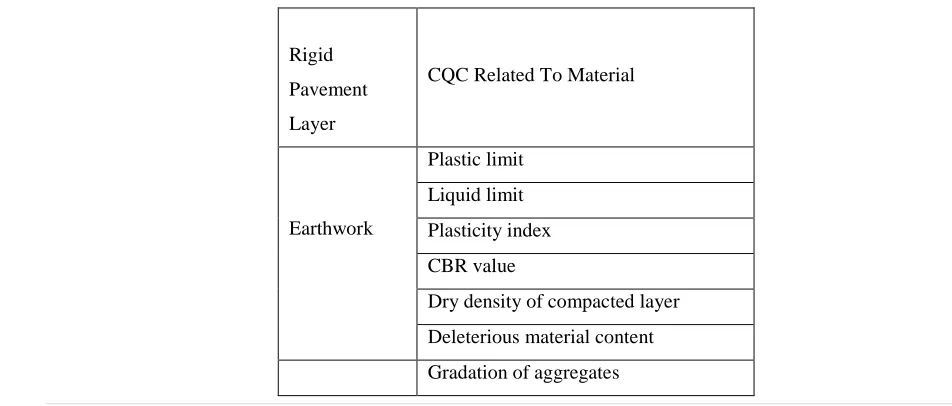
Table 5.1.1 -CQCs related to materials in constructing a rigid pavement (IRC 2002; IRDP 2008)
Rigid
Pavement
Layer
CQC Related To Material
Earthwork
Plastic limit
Liquid limit
Plasticity index
CBR value
Dry density of compacted layer
Deleterious material content
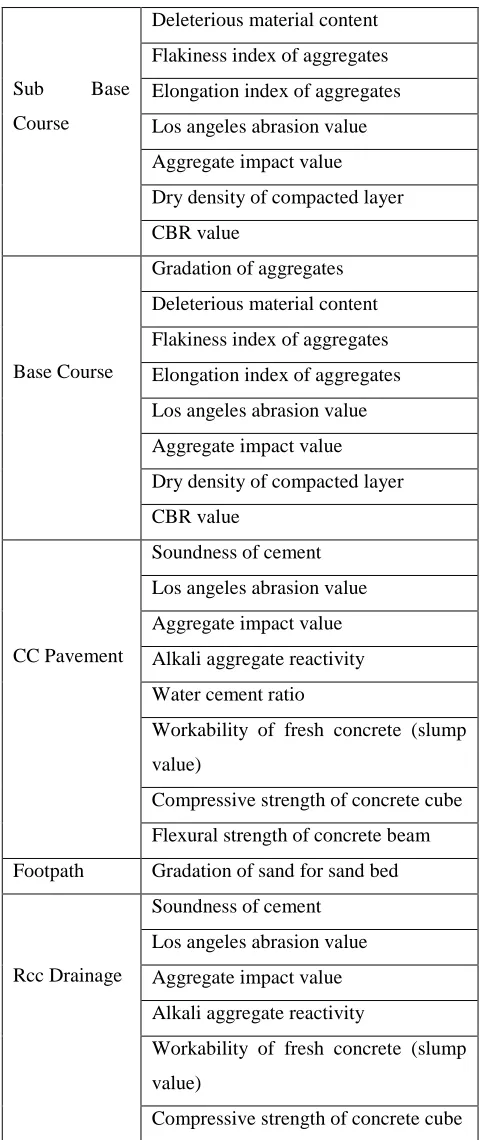
Sub Base
Course
Deleterious material content
Flakiness index of aggregates
Elongation index of aggregates
Los angeles abrasion value
Aggregate impact value
Dry density of compacted layer
CBR value
Base Course
Gradation of aggregates
Deleterious material content
Flakiness index of aggregates
Elongation index of aggregates
Los angeles abrasion value
Aggregate impact value
Dry density of compacted layer
CBR value
CC Pavement
Soundness of cement
Los angeles abrasion value
Aggregate impact value
Alkali aggregate reactivity
Water cement ratio
Workability of fresh concrete (slump
value)
Compressive strength of concrete cube
Flexural strength of concrete beam
Footpath Gradation of sand for sand bed
Rcc Drainage
Soundness of cement
Los angeles abrasion value
Aggregate impact value
Alkali aggregate reactivity
Workability of fresh concrete (slump
value)
Compressive strength of concrete cube
Table 5.1.2 -CQCs related to workmanship in constructing a rigid pavement (IRC 2002; IRDP
Rigid Pavement
Layer CQC Related To
Material
Earthwork
Horizontal alignment
Surface level
Surface regularity
Layer thickness
Sub Base Course
Horizontal alignment
Surface level
Surface regularity
Layer thickness
Base Course
Horizontal alignment
Surface level
Surface regularity
Layer thickness
CC Pavement
Horizontal alignment
Surface level
Surface regularity
Pavement thickness
Alignment of joints
Surface texture depth
Footpath
Horizontal alignment
Surface level
Surface regularity
Footpath thickness
Rcc Drainage
Horizontal alignment
Surface level
Surface regularity
5.2 Mean score analys is of Pre liminary surve yresponses
Based on the 6responsesobta in edfrom preliminary survey,there sultswere compiled in sucha form tha teach
tickmark again sta CQC wasgivena score of one (1)while the vacan tcellagainsta CQC wasgive nascore of zero
(0)and mean score of all CQC swerecal culated. The CQC s with means core≥ 0.5were selected as AQC sfor fur
the ranal ysisindicatin ga greemen to fatleast3 respond entsamon g6 respondents .
5.2.1 Mean score analysis of CQCs
Rigid Pavement
Layer
CQC Related To Materials And Workmanship Mean Score Of 6 Respondents
Earthwork
Plastic limit 0.33
Liquid limit 0.17
Plasticity index 0.33
CBR value 1.00
Dry density of compacted layer 1.00
Deleterious material content 0.00
Horizontal alignment 0.00
Surface level 0.50
Surface regularity 0.17
Layer thickness 0.50
Sub Base
Course
Gradation of aggregates 1.00
Deleterious material content 0.17
Flakiness index of aggregates 0.67
Elongation index of aggregates 0.33
Los angeles abrasion value 0.67
Aggregate impact value 0.67
Dry density of compacted layer 0.83
CBR value 0.83
Horizontal alignment 0.17
Surface level 0.50
Surface regularity 0.33
Layer thickness 0.67
Gradation of aggregates 1.00
Deleterious material content 0.00
Flakiness index of aggregates 0.67
Elongation index of aggregates 0.33
Base Course
Aggregate impact value 1.00
Dry density of compacted layer 0.67
CBR value 0.50
Horizontal alignment 0.17
Surface level 0.50
Surface regularity 0.00
Layer thickness 0.67
CC Pavement
Soundness of cement 0.83
Los angeles abrasion value 0.67
Aggregate impact value 0.83
Alkali aggregate reactivity 0.33
Water cement ratio 1.00
Workability of fresh concrete (slump value) 1.00
Compressive strength of concrete cube 1.00
Flexural strength of concrete beam 0.83
Horizontal alignment 0.00
Surface level 0.67
Surface regularity 0.33
Pavement thickness 1.00
Alignment of joints 0.67
Surface texture depth 0.67
Footpath
Gradation of sand for sand bed 0.50
Horizontal alignment 0.50
Surface level 0.83
Surface regularity 0.33
Footpath thickness 0.83
RCC Drainage
Soundness of cement 0.67
Los angeles abrasion value 0.33
Aggregate impact value 0.33
Alkali aggregate reactivity 0.33
Workability of fresh concrete (slump value) 0.50
Compressive strength of concrete cube 0.67
Horizontal alignment 0.00
Surface level 0.83
Surface regularity 0.17
VI. RESULT AND CONCLUSION
1.
Studied construction Quality index (CQI) and its related terms to quantify the quality of Rigid pavement 2. Identified suitable measurement scales for Construction Quality Characteristics of materials andworkmanship to quantify quality by determining acceptance quality characteristics (AQC) from CQC from
construction experts.
3. Incorporated Construction Quality Characteristics related to major layers of a rigid pavement system in the
development of quality index which gives more contribution in quantifying quality of the same pavement
system. This will result in developing a manageable quality index model .
4. Got necessary recommendations from the construction experts as a guideline for further study to formulate
construction quality index for building facility.
VII. FUTURE WORK PLAN
1. The finalized AQCs are to be taken for generating weighting factors in order to develop a Construction
Quality Index. The weighting factor of AQC is an indicator of the importance of the AQC with respect to
the composite construction quality index.
2. Conducting schedule survey with construction experts to generate weighting factors for AQCs.
3. Data analysis for schedule survey responses by AHP method by using Superdecisions software to generate
weighting factors for the same.
4. Formulating a Construction Quality Index with the help of Construction Quality Characteristics and their
weighting factors by using a statistical tool.
5. Quantifying quality will increase the awareness in a contractor towards quality which leads to improvement
in quality of construction.
VIII. ACKNOWLEDGEMENT
With a deep sense of gratitude I would like to thank all the people who have enlightened our path with their kind
guidance. I am very grateful to these intellectuals who did their best to help me during our work.
The special gratitude goes to Prof. Dr. M.P.Kadam, Head of Civil Engineering Department. Who guided me
especially in academic and paper presentation activities and to all the staff member of the Civil Engineering
Department for their precious suggestions and guidance in work and our PG Coordinator Prof. R. V. Deval kar.
I feel proud and find privilege to express deep sense of gratitude to Prof. Dr. K.S.Holkar, Principal of
NDMVPS’S KBTCOE, Nashik, for his comments and kind permission to complete this work.
REFERENCES
.William R. Duncan, (1996), Project management body of knowledge, Project Management Institute, USA.
1.
Arthur W. Saarinen, Marlene A. Hobel, (1990), “Setting and meeting requirements for quality, Journal ofmanagement in engineering, Vol.6, No. 2, ASCE.
2.
D. Ashok kumar, (2014), “Study of quality management in construction industry”, International journal of3.
Wenz he Tang, Maoshan Qiang, Colin F.Duffield, David M.young, and You mei Lu, (2009),“EnchancingTotal quality management by partnering in construction”, Journal of professional issues in engineerin g
education and practice, Vol. 135, No. 4, ASCE.
4.
Edward Minchin R, Michael I. Hammons, and Junyong Ahn, (2008), “A construction quality index forhighway construction”, Construction management and economics, v26, n 12, p 1313-1324, Routledge
(Taylor &Francis group).
5.
Irene Wong, and Albert Chan,(2014), “How to quantify quality architectural design from the aspect of building performance”, Journal of smart construction and management in the context of new technology,ASCE.
6.
Glen R. And ersen,andVictor H. Torrey, (1995), “Function-based condition indexing for embankment dams”, Journal of geotechnical engineering, Vol. 121, No. 8, ASCE.7.
And rewF.Griffith, G. Edward Gibson, Michele R. Hamilton, Aniello L. Tor tora, andCharles T. Wilson, (1999), “Project success index for capital facility construction projects”, Journal of performance ofconstructed facilities,Vol. 13, No. 1, ASCE.