Page 430 www.ijiras.com | Email: [email protected]
Case Study On Greenhouse Process, Gases, Effect And Control
Management
Imran Rashid Mujawar
Mallik Avijit
Walchand College of Engineering, Sangli, Maharashtra, India
I. INTRODUCTION
The word ‗Greenhouse effect‘ means ‗warming of the surface and lower atmosphere of a planet (as Earth or Venus) that is caused by conversion of solar radiation into heat in a process involving selective transmission of short wave solar radiation by the atmosphere, its absorption by the planet's surface, and irradiation as infrared which is absorbed and partly reradiated back to the surface by atmospheric gases.‘
It‘s basically a heating phenomenon of earth. A warming of the Earth's surface and troposphere (the lowest layer of the atmosphere), caused by the presence of water vapor, carbon dioxide, methane, and certain other gases in the air. Of these gases, known as greenhouse gases, water vapor has the largest effect.
The atmosphere allows most of the visible light from the Sun to pass through and reach the Earth's surface. As the Earth's surface is heated by sunlight, it radiates part of this energy back toward space as infrared radiation. This radiation,
unlike visible light, tends to be absorbed by the greenhouse gases in the atmosphere, raising its temperature. The heated atmosphere in turn radiates infrared radiation back toward the Earth's surface. (Despite its name, the greenhouse effect is different from the warming in a greenhouse, where panes of glass transmit visible sunlight but hold heat inside the building by trapping warmed air.)
Without the heating caused by the greenhouse effect, the Earth's average surface temperature would be only about −18 °C (0 °F). On Venus the very high concentration of carbon dioxide in the atmosphere causes an extreme greenhouse effect resulting in surface temperatures as high as 450 °C (840 °F).
Although the greenhouse effect is a naturally occurring phenomenon, it is possible that the effect could be intensified by the emission of greenhouse gases into the atmosphere as the result of human activity. From the beginning of the Industrial Revolution through the end of the 20th century, the amount of carbon dioxide in the atmosphere increased 30 Abstract: The warming of the earth's atmosphere, due to accumulation principally of carbon dioxide and methane, promises to be the major issue of the next century. Fossil-fuel based industrial development is the major cause of the environmental imbalance; however, agricultural practices are major factors with the capacity of adding to greenhouse gases (the consequence of most modern production technologies) or reducing them by environmentally friendly development schemes. This article analyses the causes and consequences of the Greenhouse effect and proposes remedies which are sustainable and especially appropriate for adoption on small scale in tropical regions.
Objectives:
To study about Greenhouse effect and it’s causes
Detailed study on greenhouse gases
To know about controlling enhanced greenhouse effect
Page 431 www.ijiras.com | Email: [email protected] percent and the amount of methane more than doubled. A
number of scientists have predicted that human-related increases in atmospheric carbon dioxide and other greenhouse gases could lead to an increase in the global average temperature of 1.4 to 5.8 °C (2.5 to 10.4 °F) by the end of the 21st century. This global warming could alter the Earth's climates and thereby produce new patterns and extremes of drought and rainfall and possibly disrupt food production in certain regions. Other scientists involved in climatic research maintain that such predictions are overstated, however.
The global warming from the greenhouse effect could raise sea level one meter about one meter in the next century and several meters in the next few hundred years by expanding ocean water, melting mountain glaciers, and causing ice sheets to melt or slide into the oceans. Such a rise would inundate deltas, coral atoll islands, and other coastal lowlands, erode beaches, exacerbate coastal flooding, and threaten water quality in estuaries and aquifers. Because the worst effects are well into the future, engineering responses to sea level rise will probably be unnecessary for several decades; these structures can be erected over the course of a decade or so. However, because current land use policies can determine whether an area will be developed one hundred years hence, officials should begin today to consider options for averting adverse consequences of sea level rise.[18] The most important decision will generally be determining which areas should be protected with dikes and which should be allowed to flood. Since the beginning of recorded history, sea level has risen so slowly that for most practical purposes, it has been constant. As a result, people and other species have developed coastal areas much more extensively than would have been possible ten thousand years ago, when sea level was rising more rapidly. Whether one is discussing coral atolls, river deltas, barrier islands, or ocean beaches, life is in a delicate balance with the level of the sea. The projected global warming, however, could disrupt that balance by raising sea level a meter in the next century and perhaps several meters in the next two hundred years.
II. PROCESS OF GREENHOUSE
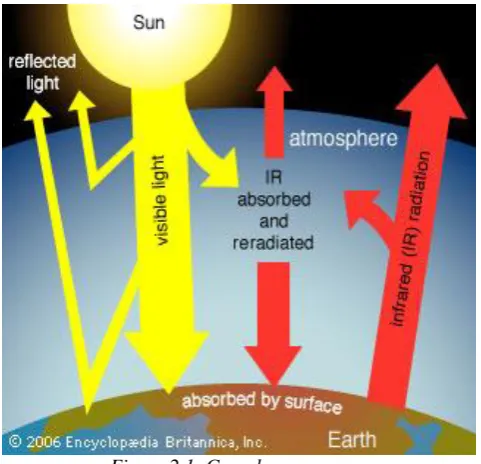
Some incoming sunlight is reflected by the Earth's atmosphere and surface, but most is absorbed by the surface, which is warmed. Infrared (IR) radiation is then emitted from the surface. Some IR radiation escapes to space, but some is absorbed by the atmosphere's greenhouse gases (especially water vapour, carbon dioxide, and methane) and reradiated in all directions, some to space and some back toward the surface, where it further warms the surface and the lower atmosphere.
Figure 2.1: Greenhouse process
It‘s mainly a heat transfer process known as ‗radiation‘. It‘s the transfer of energy across a system boundary by means of an electromagnetic mechanism which is caused solely by a temperature difference. It doesn‘t need a medium to be transferred. Radiation exchange, in fact occurs most effectively o a vacuum. The energy which a radiating surface releases is not continuous but is in form of successive and separate packet or quanta of energy called photons. Photons are propagated through space as rays; the movement of swarm of photons is described as electromagnetic waves. The photons travel in straight paths with unchanged frequency; when they approach the receiving surface, there occurs reconversion of wave motion into thermal energy which is partly absorbed.
Page 432 www.ijiras.com | Email: [email protected]
Figure 2.2: Absorption of radiation
When the incident radiation (G) also called the irradiation impinges on a surface, three things happens; a part is reflected back (Gr), a part is transmitted through (Gt) and the remainder is absorbed (Ga), depending upon the characteristics of the body as shown in the top figure.
Mathematically, Ga + Gt + Gr = G
Dividing both sides by G, we get, Ga/G + Gt/G + Gr/G = 1
or, α + τ + ρ = 1
This α is called the absorptivity.
When the sun ray comes to the earth surface then this radiation takes place; but the absorption of this heat gets bigger when some content of earth absorbs this ray in excess. Some flue gases are responsible for this. Combined those gases are named Greenhouse Gases or GHG.
It refers to circumstances where the shorter wavelengths of visible light from the sun passes through a transparent medium and are absorbed, but the longer wavelengths of the IR (300 GHz to 400 THz (1 mm - 750 nm)) reradiation from the heated objects are unable to pass through that medium.
The trapping of the long wavelengths radiation leads to more heating and a higher resultant temperature. Besides the heating of an automobile by sunlight through the windshield and the namesake example of heating of greenhouse by sunlight passing through the sealed, transparent windows, to describe the trapping of excess heat by the rising concentration of CO2 in atmosphere.
The CO2 strongly absorbs IR and doesn‘t allow much of it to escape into the space. Through this process, CO2 and other greenhouse gases keep the Earth‘s surface 33°Celsius (59.4°F) warmer than it would be without them. We have added 42% more CO2, and temperatures have gone up. There should be some evidence that links CO2 to the temperature rise.
So far, the average global temperature has gone up by about 0.8 degrees C (1.4°F):
"According to an ongoing temperature analysis conducted by scientists at NASA‘s Goddard Institute for Space Studies (GISS)…the average global temperature on Earth has increased by about 0.8°Celsius (1.4°Fahrenheit) since 1880. Two-thirds of the warming has occurred since 1975, at a rate of roughly 0.15-0.20°C per decade."
The temperatures are going up, just like the theory predicted. But the connection with CO2, or other greenhouse gases like methane, ozone or nitrous oxide can be found in the spectrum of greenhouse radiation. Using high-resolution FTIR spectroscopy, we can measure the exact wavelengths of long-wave (infrared) radiation reaching the ground.
Figure 2.3: Spectrum of the greenhouse radiation measured at the surface. Greenhouse effect from water vapour is filtered
out, showing the contributions of other greenhouse gases (Evans 2006)
III. GREENHOUSE GASES
Any gas that has the property of absorbing infrared radiation (net heat energy) emitted from Earth's surface and reradiating it back to Earth's surface, thus contributing to the phenomenon known as the greenhouse effect. Carbon dioxide, methane, and water vapour are the most important greenhouse gases. To a lesser extent, surface-level ozone, nitrous oxides, and fluorinated gases also trap infrared radiation. Greenhouse gases have a profound effect on the energy budget of the Earth system despite making up only a fraction of all atmospheric gases. Concentrations of greenhouse gases have varied substantially during Earth's history, and these variations have driven substantial climate changes at a wide range of timescales. In general, greenhouse gas concentrations have been particularly high during warm periods and low during cold phases.
A number of processes influence greenhouse gas concentrations. Some, such as tectonic activities, operate at timescales of millions of years, whereas others, such as vegetation, soil, wetland, and ocean sources and sinks, operate at timescales of hundreds to thousands of years. Human activities—especially fossil-fuel combustion since the Industrial Revolution—are responsible for steady increases in atmospheric concentrations of various greenhouse gases, especially carbon dioxide, methane, ozone, and chlorofluorocarbons (CFCs).
Page 433 www.ijiras.com | Email: [email protected] upon Earth's surface. To understand the relative influence of
each greenhouse gas, so-called forcing values (which are displayed in watts per square metre) calculated for the time period between 1750 and the present day are given below.
A. MAJOR GREENHOUSE GASES
a. WATER VAPOUR
Water vapour is the most potent of the greenhouse gases in Earth's atmosphere, but its behaviour is fundamentally different from that of the other greenhouse gases. The primary role of water vapour is not as a direct agent of radiative forcing but rather as a climate feedback—that is, as a response within the climate system that influences the system's continued activity. This distinction arises from the fact that the amount of water vapour in the atmosphere cannot, in general, be directly modified by human behaviour but is instead set by air temperatures. The warmer the surface, the greater the evaporation rate of water from the surface. As a result, increased evaporation leads to a greater concentration of water vapour in the lower atmosphere capable of absorbing infrared radiation and emitting it downward.
Figure 3.1: Vapour Cycle
b. CARBON DIOXIDE
Of the greenhouse gases, carbon dioxide (CO2) is most significant. Natural sources of atmospheric CO2 include outgassing from volcanoes, the combustion and natural decay of organic matter, and respiration by aerobic (oxygen-using) organisms. These sources are balanced, on average, by a set of physical, chemical, or biological processes, called ―sinks,‖ that tend to remove CO2 from the atmosphere. Significant natural sinks include terrestrial vegetation, which takes up CO2 during the process of photosynthesis. A number of oceanic processes also act as carbon sinks. One such process, called the ―solubility pump,‖ involves the descent of surface sea water containing dissolved CO2. Another process, the ―biological pump,‖ involves the uptake of dissolved CO2 by marine vegetation and phytoplankton (small, free-floating, photosynthetic organisms) living in the upper ocean or by other marine organisms that use CO2 to build skeletons and other structures made of calcium carbonate (CaCO3). As these organisms expire and fall to the ocean floor, the carbon they contain is transported downward and eventually buried at depth. A long-term balance between these natural sources and sinks leads to the background, or natural, level of CO2 in the atmosphere.
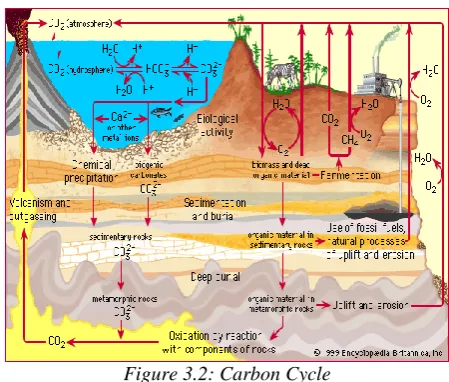
Figure 3.2: Carbon Cycle
Carbon is transported in various forms through the atmosphere, the hydrosphere, and geologic formations. One of the primary pathways for the exchange of carbon dioxide (CO2) takes place between the atmosphere and the oceans; there a fraction of the CO2 combines with water, forming carbonic acid (H2CO3) that subsequently loses hydrogen ions (H+) to form bicarbonate (HCO3
−
) and carbonate (CO3 2−
) ions. Mollusk shells or mineral precipitates that form by the reaction of calcium or other metal ions with carbonate may become buried in geologic strata and eventually release CO2 through volcanic outgassing. Carbon dioxide also exchanges through photosynthesis in plants and through respiration in animals. Dead and decaying organic matter may ferment and release CO2 or methane or may be incorporated
Figure 3.3: Generalized Carbon Cycle
into sedimentary rock, where it is converted to fossil fuels. Burning of hydrocarbon fuels returns CO2 and water (H2O) to the atmosphere. The biological and anthropogenic pathways are much faster than the geochemical pathways and, consequently, have a greater impact on the composition and temperature of the atmosphere.
Page 434 www.ijiras.com | Email: [email protected] In contrast, human activities increase atmospheric CO2
levels primarily through the burning of fossil fuels (principally oil and coal, and secondarily natural gas, for use in transportation, heating, and the production of electricity) and through the production of cement. Other anthropogenic sources include the burning of forests and the clearing of land. Anthropogenic emissions currently account for the annual release of about 7 gigatons (7 billion tons) of carbon into the atmosphere. Anthropogenic emissions are equal to approximately 3 percent of the total emissions of CO2 by natural sources, and this amplified carbon load from human activities far exceeds the offsetting capacity of natural sinks (by perhaps as much as 2–3 gigatons per year). CO2 has consequently accumulated in the atmosphere at an average rate of 1.4 parts per million (ppm) by volume per year between 1959 and 2006, and this rate of accumulation has been linear (that is, uniform over time). However, certain current sinks, such as the oceans, could become sources in the future. This may lead to a situation in which the concentration of atmospheric CO2 builds at an exponential rate.
The natural background level of carbon dioxide varies on timescales of millions of years due to slow changes in outgassing through volcanic activity. For example, roughly 100 million years ago, during the Cretaceous Period, CO2 concentrations appear to have been several times higher than today (perhaps close to 2,000 ppm). Over the past 700,000 years, CO2 concentrations have varied over a far smaller range (between roughly 180 and 300 ppm) in association with the same Earth orbital effects linked to the coming and going of the ice ages of the Pleistocene epoch. By the early 21st century, CO2 levels reached 384 ppm, which is approximately 37 percent above the natural background level of roughly 280 ppm that existed at the beginning of the Industrial Revolution. According to ice core measurements, this level (384 ppm) is believed to be the highest in at least 650,000 years.
Radiative forcing caused by carbon dioxide varies in an approximately logarithmic fashion with the concentration of that gas in the atmosphere.[02] The logarithmic relationship occurs as the result of a saturation effect wherein it becomes increasingly difficult, as CO2 concentrations increase, for additional CO2 molecules to further influence the ―infrared window‖ (a certain narrow band of wavelengths in the infrared region that is not absorbed by atmospheric gases). The logarithmic relationship predicts that the surface warming potential will rise by roughly the same amount for each doubling of CO2 concentration. At current rates of fossil-fuel use, a doubling of CO2 concentrations over preindustrial levels is expected to take place by the middle of the 21st century (when CO2 concentrations are projected to reach 560 ppm). A doubling of CO2 concentrations would represent an increase of roughly 4 watts per square metre of radiative forcing. Given typical estimates of ―climate sensitivity‖ in the absence of any offsetting factors, this energy increase would lead to a warming of 2 to 5 °C (3.6 to 9 °F) over preindustrial times. The total radiative forcing by anthropogenic CO2 emissions since the beginning of the industrial age is approximately 1.66 watts per square metre.
c. METHANE
Page 435 www.ijiras.com | Email: [email protected] square metre—or roughly one-third the radiative forcing of
CO2.
B. LESSER GREENHOUSE GASES
a. SURFACE LEVEL OZONE
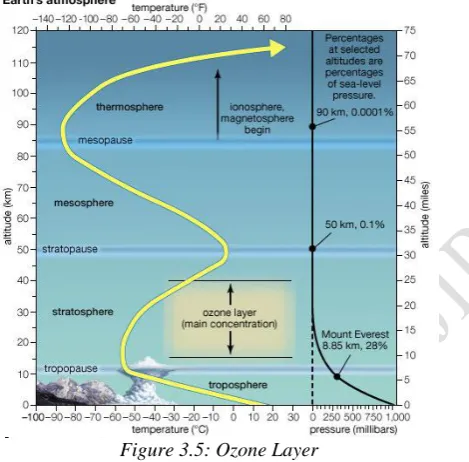
The next most significant greenhouse gas is surface, or low-level, ozone (O3). Surface O3 is a result of air pollution; it must be distinguished from naturally occurring stratospheric O3, which has a very different role in the planetary radiation balance. The primary natural source of surface O3 is the subsidence of stratospheric O3 from the upper atmosphere. In contrast, the primary anthropogenic source of surface O3 is photochemical reactions involving the atmospheric pollutant carbon monoxide (CO). The best estimates of the concentration of surface O3 are 50 ppb, and the net radiative forcing due to anthropogenic emissions of surface O3 is approximately 0.35 watt per square meter.
Figure 3.5: Ozone Layer
b. NITROUS OXIDES AND FLUORINATED GASES
Additional trace gases produced by industrial activity that have greenhouse properties include nitrous oxide (N2O) and fluorinated gases (halocarbons), the latter including sulfur hexafluoride, hydro fluorocarbons (HFCs), and per fluorocarbons (PFCs). Nitrous oxide is responsible for 0.16 watt per square meter radiated forcing, while fluorinated gases are collectively responsible for 0.34 watt per square meter. Nitrous oxides have small background concentrations due to natural biological reactions in soil and water, whereas the fluorinated gases owe their existence almost entirely to industrial sources.
IV. AN EVERYDAY EXAMPLE OF THE GREENHOUSE EFFECT
Suppose, open the door of a car that has been left parked in the sun for a couple of hours, it will be notice that the
temperature inside the car is much warmer than the temperature outside. This is because the windows of the car allow the sunlight to enter. This light, once inside, is then partially converted into heat. However, these same windows do not allow the heat inside the car to pass through as easily as light, so some of this heat accumulates. The net effect is that more heat remains in than can come out, increasing the temperature inside the car.
Figure 4: Greenhouse effect inside a car
V. EFFECTS
One of the major imminent ecological threats of the world is the ‗enhanced greenhouse problem‘. The earth and the lower layers of it‘s atmosphere has shown rising temperatures over the past hundred years. This phenomenon is probably caused by an increase of GHG, absorbing earth‘s heat radiation, so the global temperature rises. Mankind is largely responsible for this increased ‗greenhouse gas concentration‘. Temperatures are expected to rise further, but with different amounts in different regions of the earth.
Higher temperature can cause heating of oceans and melting of Arctic ice, which rises the sea level height. Many more processes, however are involved.
One consequence of a higher sea level is the need to rise the dikes‘ height in the Netherlands.
The main effects are described below:
A. GLOBAL WORMING
Page 436 www.ijiras.com | Email: [email protected] 60C over a period of about 24 years. 2014(24 April), Dhaka
has the highest temperature of 40.20C in the last 54 years. This temperature is about 80C above the usual maximum temperature in Dhaka in April. The main reasons for this unusual temperature rise in Dhaka are the unplanned urbanization, excessive population density, and the increase of cars, and public transports in the city. Also the use of fridges and air conditioners used by the dense city dwellers make a huge amount of HFCs (hydrofluocarbons) contribution to the air, which destroys the protective ozone layer of the Earth. These gases are more dangerous than CO2 as they have a heat trapping capability of 1600 times larger than CO2.
B. SEA-LEVEL RISE AND INUNDATION OF LOW-LYING LANDS
Earth is loosing 159 billion tons of ice per year which may increase the sea-level by 0.5 mm per year. According to the IPCC Fifth Assessment Report published recently, the sea-level of the Bay of Bengal is rising at a rate of 1.5 mm per year. Bangladesh with the Bay of Bengal on the South will be directly affected by the sea-level rise because of its low elevation. If the sea-level rises by 45 cm, a permanent loss of up to 15600 square kilometers of land is expected. If one meter rise happens, around 14000-30,000 sq. km land are expected to be flooded, which means more than 20% of Bangladesh will be under water. Scientists predict that rising sea-levels to submerge 17 percent of Bangladesh's land area will displace 18 million people in the next 40 years by 2050.
C. FREQUENT STORMS AND FLOODS
Scientists believe that rising temperatures will lead to more extreme weather worldwide, including stronger and more frequent cyclones in the Bay of Bengal. And rising seas will make any storm more dangerous because flooding will become more likely to accompany. Bangladesh is particularly at risk because the country, with its low elevation, is crisscrossed by as many as 230 rivers, many of which unstably swell during the monsoon rains. According to data from the government‘s Centre for Environmental and Geographic Information Systems (CEGIS), two-thirds of the country is only five meters above sea-level.[03] This geology, along with river water from the melting Himalayan glaciers in the north caused by the temperature rise, makes the region more vulnerable to severe flooding. The situation is worsened by the prevalence of intense storms, a marker of climate stresses. Sidr, the Category 4 cyclone that ravaged southern Bangladesh in November 2007, killed some 3,500 people, displaced 2 million, and wiped out paddy fields. Sidr was followed by two heavier-than-normal floods that killed some 1,500 people and damaged about 2 million tons of food.
D. SALINITY OF GROUND WATER
With the rise of seal level, the saline sea water from the Bay of Bengal intrudes to the farmlands, which jeopardizes the food output in Bangladesh. Particularly, rice production is significantly affected by this saline water. A 2007 report by the IPCC estimates that the production of staple foods could
drop steeply by 2050 because of soil salinity.[16] This would be devastating in a country where agriculture is the key economic driver with around 65% of the total population being employed in agriculture [9]. This sector accounts for about 22 percent of the nation's economic output, with an additional 33 percent derived from the rural non-farm economy, which is also linked to agriculture, according to the World Bank. Moreover, the salinity intrusion is gradually destroying the Sundarbans, the largest mangrove forest in the world.
VI. WAYS TO REDUCE THE GREENHOUSE EFFECT
The greenhouse effect is the increase in global temperatures which result from greenhouse gases trapping solar heat energy in the atmosphere. It is believed by many experts to be the primary cause of global warming. Greenhouse gases include substances, such as CO2, nitrous oxide, methane and carbon monoxide. Reducing the greenhouse effect can be achieved by taking steps to limit the emissions of greenhouse gases-
Replace Regular Incandescent Light bulb: Replace regular incandescent light bulb with compact fluorescent light (CFL) bulbs. They consume 70% less energy then ordinary bulbs and have longer lifetime.
Drive Less or Carpool: By driving less you are not only saving fuel but also helping in reducing global warming. Also, look out for other possibilities, for e.g.: car pooling. If you have colleagues who live in the same area then you can combine trips. If you need to go to a local market then either walk or go by cycle. Both of them are great form of exercise. The biggest pollution emitting fumes are caused by oil and gasoline. Cutting down consumption, is a huge step to reducing energy wastes.
Reduce, Reuse, Recycle: Reduce your need to buy new products or use less, resulting in a smaller amount of waste. Even if you need to buy, consider buying eco-friendly products. It is most effective of the three R‘s. It simply says cut back from where are you now.
Reuse bottles, plastic containers, and other items bought at the grocery store. Reusing water bottles, yogurt cups, bread ties, and other items is being conscious about what is already out there. It will lessen having to purchase other items that would fulfill the same function. Try to use the disposable products into some other form. Just don‘t throw them away.
Recycling unwanted paper, bottles, etc…is a great earth saving tip. If possible, upcycle tables, furniture, and other outdated items to keep landfills clean. You can recycle almost anything for e.g.: paper, aluminum foils, cans, newspapers. By recycling you can help in reducing landfills.
Go Solar: Many people have caught the energy efficient band wagon of solar energy. Having solar panels installed is something readily possible and available. Incentives and discounts given by government agencies and energy companies make solar energy something to look into. Buy Energy-Efficient Appliances: Always buy products
Page 437 www.ijiras.com | Email: [email protected] amount of money on your energy bill. Energy-efficient
products can help you to save energy, save money and reduce your carbon footprint.
Reduce Waste: Landfills are the major contributor of methane and other greenhouse gases. When the waste is burnt, it release toxic gases in the atmosphere which result in global warming. Reusing and recycling old items can significantly reduce your carbon footprint as it takes far less energy to recycle old items than to produce items from scratch.
Use Less Hot Water: Buy energy saving geysers and dishwasher for your home. Avoid washing clothes in hot water. Just wash them in cold or warm water. Avoid taking frequent showers and use less hot water. It will help in saving energy require to produce that energy. Avoid Products With Lot of Packaging: Just don‘t buy
products with lot of packaging. When you buy such products you will end up in throwing the waste material in the garbage, which then will help in filling landfill sites and pollute the environment. Also, discourage others from buying such products.
Install a Programmable Thermostat: A programmable thermostat doesn‘t cost much and its cost can be recovered from the amount that you save by reducing energy. The easiest and most cost effective advice is simply adjusting your thermostat up 1 degree down in the winter and up by 1 degree in the summer. Lower your thermostat 2 degrees in the winter. Instead of making your home a burning furnace, try putting on extra layers. Turn Off the Lights: Duh! If you‘re not using a room,
there‘s no need for the light to be on.
Turn off Electronic Devices: Turn off electronic devices when you are moving out for a couple of days or more. Unnecessary usage of electronic appliances will not only save fuel i.e. coal by which we get electricity but also increase the lifetime of your gadgets.
Plant a Tree: Planting trees can help much in reducing global warming then any other method. They not only give oxygen but also take in carbon dioxide, during the process of photosynthesis, which is the main source of global warming.
Use Clean Fuel: Electric, smart cars, cars run on vegetable oil, etc…are great examples for using renewable energy. Supporting companies that provide these products will help the rest of the mainstream manufacturing companies convert over.
Look for Renewable Fuel Options: If you can‘t afford an electric car, buy the cleanest gasoline as possible. When car shopping, look at the benefits of options that provide renewable fuel. Although it may be a pretty penny now, you‘re on the ground level of forward thinking.
Save Energy: When you consume less, the less carbon dioxide is released into the atmosphere. Setting your thermostat using your smart phone or changing the type of light bulb you use is a great start.
Replace Filters on Air Conditioner and Furnace: If you haven‘t, not only are you wasting energy, but breathing in dirty air. Cleaning a dirty air filter can save several pounds of carbon dioxide a year.
Go Green: Using energy star appliances will not only save money, but also the amount of energy wasted in your home. Have a look at various ways to go green.
Tune Your Car Regularly: Regular maintenance will help your car function properly and emit less carbon dioxide. Download Earth Saving Apps: Apps like Kil-Ur-Watts
and Wiser EMS not only help calculate your energy costs, but provide tools and ways to save energy and money. Conserve Water: This is a tired tip, but ever so important.
If we added up the water wasted by the millions of Americans brushing their teeth, we could provide water to more than 23 nations with unclean, drinking water. Remember, it takes energy to draw and filter water from underground.
Taking a quick 5 minute shower will greatly conserve energy. The type of shower head used, will also aid in combating global warming. Take showers instead of baths. Showers use less water than baths by 25%. Over the course of a year that‘s hundreds of gallons saved. Stop Idling Your Car: It might be freezing outside, but
unless your car is buried in snow, start your car as usual. It may take longer to warm up, but the world isn‘t just about you.
Eat Less Hamburger: Besides carbon dioxide, methane introduced into the air contributes to global warning. With meat consumed by the seconds, the amount of cows breathing out methane is a huge contributor, thanks to our carnivorous diet and the billion-dollar meat industry. Use Clothesline to Dry Your Clothes: Think of your
grandmother when you do this. Most clothes shouldn‘t be put in the dryer anyway.
Figure 6.1: Using of Clothesline to dry cloths
Eat Naturally: Not only do the health benefits speak wonders for those who eat naturally, but it cuts down the energy costs used by factories who produce processed food.
Ride Your Bike: Not only is bike riding, healthy it reduces the amount of CO2 released into the air. Walking is another easy way to reduce global warming.
Use a Kitchen Cloth Instead of Paper Towels: Paper towels produce nothing but wasted energy. Think of the factory pollution, as well as the tree consumption.
Reuse Towels: Hang towels to dry, instead of popping them back in the wash after a few uses.
Page 438 www.ijiras.com | Email: [email protected] consume more fuel which in turn release more CO2 in the
atmosphere. Keep your engine properly tuned and drive less aggressively. Aggressive driving and frequent applying of brakes hampers the engine and can even lower the mileage of your car.
Take Lunch in a Tupperware: Each time you throw away that brown paper sack, more brown paper sacks are being produced in a factory as we speak.
Wrap your water heater in insulation: By keeping the energy in the water heater condensed, less energy is emitted into the air. This not only helps the earth, but your pocketbook.
Get Home Energy Audit Done: Call a home energy audit company and get an audit done for your home that will help you to identify areas that consume lot of energy and are not energy efficient at all.
Become Part of the Global Warming Community:
Connecting with others will help you become more conscious of the impact we all have. The Climate Change National Forum and Global Humanitarian Forum are great avenues to know the latest facts, statistics, and efforts in making a difference.
Actually celebrate Arbor Day and Earth day: Although most of us hear about these days in passing, see what the buzz is all about. Plant a tree, pick up trash, or join a forum.
Become Aware of Your Contribution: With technology within your fingertips, finding information about protecting the environment is everywhere. To help emit less CO2, the first step is being aware of how much you contribute.
Spread the Awareness: Always try your best to educate people about global warming and it‘s causes and after affects. Tell them how they can contribute their part by saving energy that will be good for the environment. Gather opportunities and establish programs that will help you to share information with friends, relatives and neighbors.By being just a little more mindful, we all can play our part in combating global warming. These easy tips will help preserve the planet for future generations. Scientists won‘t have to defy the space time continuum to keep life on planet earth from continuing.
A. THE ROLE OF INTERNATIONAL AGENCIES
The International Agencies and Government and Non-government Organizations can play an important role in ensuring these policies are encouraged. The means to this end are:
Designing policy guidelines for Governments and International Assistance Agencies on strategies which will lead to reducing emissions of carbon dioxide and methane arising from livestock activities.
Identifying, and assisting in the funding of, livestock- related projects the results from which will help to "reduce·" the "greenhouse effect".
B. TOWARDS AN ENVIRONMENTAL BALANCE
The need is to develop the concept of integrated farming which utilizes high biomass crops for food and feed production, with minimum inputs of fuel which in itself should be derived from biomass (direct burning of crop residues and production of methane from dung in biodigestors).
This approach is being actively promoted in Colombia (Preston and Solarte 1989). The system seeks to reverse the Greenhouse effect by emphasizing carbon dioxide fixing crops (sugar cane and trees), meat production from monogastric animals using local resources, simple biogas technology, and use of biomass as combined sources of feed and fuel, thus reducing dependency on fossil fuels.
The principles of the system are: Establish crops which:
Use of efficiently solar energy giving maximum yields of biomass in a sustainable system that requires minimum imported inputs.
Are easily fractionated into a low-fiber component which satisfies the major needs of monogastric animals (for easily digestible carbohydrate and protein) leaving a fibrous residue suitable for feeding to ruminants, for use directly as fuel or as a substrate for a chemical industry. Exploit in total confinement those animal species which
use efficiently the biomass and are easy to house and manage.
Recycle the animal excreta through low cost biodigestors and ponds to produce a source of fuel and organic fertilizer.
The cropping systems are based around sugar cane as the main biomass source, complemented with forage trees and aquatic plants. Cows, hair sheep, and a mule (or multi-purpose cow) are the principal animal species, complemented with ducks and earth worms. The farm has an area of 2 ha of which 1 ha is in sugar cane, 0.5 ha in forage trees, and 5000 m3 in ponds for AZ olla and fish. The sugar cane is separated into tops and stalk, and the stalk further fractionated into juice and bagasse using an animal-powered (mule or horse) cane mill. The juice provides the basal feed for an annual intake of 40 cows (3 successive lots of 13-14) and is complemented with the AZ olla (50 kg are harvested daily, providing 50 g protein for each of 13 cows), leaves from the forage tree Trichantera gigantean (16 kg of leaves among 13 cows supplies 50 g/protein/cow/day) and 250 g daily of either a commercial protein supplement (40% protein) or soybean meal (to provide the remaining 100 g/ protein/cow/ daily). Thirteen sheep and their progeny are fed on the cane tops complemented with the foliage from Gliricidiasepium, multinutritional blocks and a mixture (9:1) of poultry litter and rice polishing. The mule is fed on the bagasse from the cane supplemented with a multinutritional block and gliricidia foliage. The equipment comprises the animal-powered cane mill, a pedal-powered (adapted from a bicycle) forage chopper and assorted tools.
Page 439 www.ijiras.com | Email: [email protected] animal product is 40 x 90 kg = 3600 kg of cow live weight
(from 40 tons of cane juice) and 26 x 25 kg of lamb liveweight (from the 20 tons of cane tops). Assuming average world prices of US$1.50/kg live weight for both cow and lamb live weight then total income from the animal unit will be US$6,375. From this must be deducted: the cost of the weaned cows (40 x 30 kg live weight x US$1.75 = US$2,100 ) and their protein supplement (40 x 100d x 0.25 kg = 1000 kg x US$500); the cost of the block (347 kg x US$0.15) and the poultry litter (424 kg x US$0.05) and rice polishing (47 kg x US$0.2); leaving a net margin of US$3,347.
Equally important as the economic feasibility of the system is the balance of meat to methane. Total meat output (40 x 90 kg x 0.8 = 2880 kg for cows and 26 x 25 kg x 0.5 = 325 kg for sheep) of 3205 kg is associated with the production of 186 kg methane. The 13 sheep and their progeny eat each day a total of 22 kg dry matter (400MJ) which gives rise to 400 x 0.065 = 26MJ/day methane = 170 kg/year of methane; the 40 cows (each fed for 100 days) are expected to produce 16 kg of methane (a methane production rate of 1.5 kg methane/cow/year is estimated for this species). The ratio of methane to meat is thus:
0.058kg methane per kg meat
By contrast, a steer grazing supplemented tropical pastures requires 4 years to reach slaughter weight of 450 kg with a meat yield of 225 kg. It will consume at least 8600 kg of dry matter in the process which fermented in the rumen will give rise to 190 kg of methane, a ratio of:
0.80g methane per kg meat
VII.CONCLUSIONS
Fossil-fuel based industrial development is the major cause of the environmental imbalance; however, agricultural practices are major factors with the capacity of adding to greenhouse gases (the consequence of most modern production technologies) or reducing them by environmentally friendly Eco development. An example of this latter approach is given, designed specifally for tropical zones, the widespread adoption of which will help to close the production-utilization gap for carbon dioxide with a more than tenfold reduction in emission of methane per unit meat production, compared with traditional tropical systems based exclusively on cattle ranching. Such technologies are sustainable and especially appropriate for adoption on small scale in tropical regions.
REFERENCES
[1] Bolle H J, Seiler W and Bolin B 1986 Other greenhouse gases and aerosols; assessing their role for atmospheric radiative transfer. In: The Greenhouse Effect, Climatic change and Ecosystems (Editors: B Bolin, B R Doos, B Warrick and D Jager) John Wiley and Sons: New York [2] Figueroa Vilda 1989 Feeding systems based on sugar
cane In: Integration of livestock with crops in response to increasing population pressure on available resources (Editor: T R Preston and M Rosales). CTA:Wageningen
[3] Khalil M A K and Rasmussen R A 1986 Trends of
atmospheric methane: past, present and future In: Proceedings of the Symposium on CO2 and other Greenhouse gases. Brussels, Belgium
[4] Preston T R and Leng R A 1987 Matching Ruminant
Production Systems with Available Resources in the Tropics and Subtropics. PENAMBUL Books Ltd: Armidale NSW, Australia
[5] Preston T R 1989 Sugar cane as the basis of intensive livestock production in the tropics. In: Developing World-Agriculture (Editor: A W Speedy) Grosvenor Press International: London
[6] World Resources Institute 1989 World Resources
Institute, Washington DC
[7] Good, P.; et al. (2010), An updated review of
developments in climate science research since IPCC AR4. A report by the AVOID consortium (PDF), London, UK: Committee on Climate Change, p. 14. Report website.
[8] IAP (June 2009), Interacademy Panel (IAP) Member
Academies Statement on Ocean Acidification, Secretariat: TWAS (the Academy of Sciences for the Developing World), Trieste, Italy.
[9] IEA (2009). World Energy Outlook 2009 (PDF). Paris, France: International Energy Agency (IEA). ISBN 978-92-64-06130-9.
[10] IPCC AR4 SYR (2007). Core Writing Team; Pachauri,
R.K; Reisinger, A., eds. Climate Change 2007: Synthesis Report. Contribution of Working Groups I, II and III to the Fourth Assessment Report of the Intergovernmental Panel on Climate Change. IPCC. ISBN 92-9169-122-4.
[11]IPCC AR4 WG1 (2007). Solomon, S.; Qin, D.; Manning,
M.; Chen, Z.; Marquis, M.; Averyt, K.B.; Tignor, M.; Miller, H.L., eds. Climate Change 2007: The Physical Science Basis. Contribution of Working Group I to the Fourth Assessment Report of the Intergovernmental Panel on Climate Change. Cambridge University Press. ISBN 978-0-521-88009-1. (pb: 978-0-521-70596-7)
[12]IPCC AR4 WG2 (2007). Parry, M.L.; Canziani, O.F.; Palutikof, J.P.; van der Linden, P.J.; Hanson, C.E., eds. Climate Change 2007: Impacts, Adaptation and Vulnerability. Contribution of Working Group II to the Fourth Assessment Report of the Intergovernmental Panel on Climate Change. Cambridge University Press. ISBN 978-0-521-88010-7. (pb: 978-0-521-70597-4)
[13]IPCC AR4 WG3 (2007). Metz, B.; Davidson, O.R.;
Bosch, P.R.; Dave, R.; Meyer, L.A., eds. Climate Change 2007: Mitigation of Climate Change. Contribution of Working Group III to the Fourth Assessment Report of the Intergovernmental Panel on Climate Change. Cambridge University Press. ISBN 978-0-521-88011-4. (pb: 978-0-521-70598-1)
[14]IPCC AR5 WG1 (2013), Stocker, T.F.; et al., eds., [15]IPCC AR5 WG2 A (2014), Field, C.B.; et al., eds.,
Page 440 www.ijiras.com | Email: [email protected]
[16]Wikipedia.com
[17]Encyclopedia Britannica
[18]‗Heat & Mass Transfer‘ by J.P. Holman
[19]‗Heat Transfer – A practical approach‘ by Yunus A. Cengel