Impact Factor: 5.515
IMPROVED RESOURCE ALLOCATION
ALGORITHMS FOR CLOUD
J.Divyabharathi
1, Dr. M.Punithavalli
2 1Research Scholar, Department of Computer Applications, Bharathiar University, Coimbatore, Tamilnadu, India
2
Associate Professor, Department of Computer Applications, Bharathiar University, Coimbatore, Tamilnadu, India
Abstract
Past few years, there have been several attempts to reduce energy consumption of data centers. High Power Consumption for Virtual Machines (VMs) is the main issue in Cloud Computing. In this paper, the Virtual Machine (VM) consolidation problem used to reduce energy consumption of data centers while satisfying Quality of Service (QoS) requirements is addressed. The distributed system architecture to perform dynamic VM consolidation to improve resource utilizations of Physical Machines (PMs) and to reduce their energy consumption has been presented. The Proposed algorithm is the hybrid algorithm, which is the combination of Improved Best Fit Resource Allocation (IBFRA) and Minimum Migration (MM). In proposed approach, the user tasks or workloads are initially allocated to VMs based on the Improved Best Fit Resource Allocation (IBFRA) algorithm. Minimum Migration is used for migration process, to reduce the energy by avoiding the use of unused system and efficient usage of unused memory. This method monitors all the virtual machines in all cloud locations centre. It identifies the state virtual machines whether it is sleep, idle, or running (less or over) state. This combination of algorithm will save more energy in cloud and improve the efficiency and quality of the cloud services. Experimental results indicate that the proposed platform yields to the optimal solution for a limited time-frame. The performance of proposed estimation module and state of the art IBFRA-MM estimator is compared and assessed. The comparative results prove that the proposed module attains encouraging gain over its peers.
Keywords: Virtual Machines, Physical Machines, Quality of Service, Minimum Migration, Improved Best Fit Resource Allocation.
1. Introduction
Impact Factor: 5.515 This means that integrating the flexibility of Infrastructure as a Service (IaaS) and also the use of Platform as a Service (PaaS) within one single environment.
The section 2 of this paper explains the cloud computing, resource allocation and energy consumption model. Section three explains the related research carried out in resource allocation concept in cloud computing. The section 4 lists the main objectives of the proposed work. The section 5 describes the proposed work done and its advantages. Section six demonstrates the experiments carried out and the results produced through experiments. Finally section seven, conclusion concludes the proposed work and an experiment carried out and outlines the future work of this paper.
2. Cloud Computing
Cloud computing has become one of the fastest growing framework in computer science. It is a model for providing IT resources as a service in a cost efficient and pay-per-use way. By adopting services in cloud, companies and users are enabled to externalize their hardware resources, services, applications and their IT functions. Cloud computing is gradually more utilized for what was called to be on-demand and utility computing. It is observed that Cloud has emerged to be popular for pay-per-use access to an extensive variety of third-party applications and computational resources over a huge scale (Xu et al, 2015).
2.1 Resource Allocation
Resource allocation is way of assigning the resources that are available to the third parities by the cloud providers in the cloud environment when it is needed. The resource allocations are based on the pricing scheme and the time of allocation (Zhen et al, 2013).
2.2 Energy Consumption Model
The energy consumption models described are on the basis of power consumption measurements and formal specification of representative tool (Xu et al, 2015). That model consists of descriptions of the usual energy-saving strategies used by cloud computing service providers. The models are employed to compute the energy consumed per bit for the purpose of transport and handing out, and the power consumed per bit for storage purposes. The energy per bit and power per bit form the key measures of energy consumption, and the energy efficiency of cloud computing is defined to be the energy consumption per bit of data that is being processed through cloud computing. Calculations are performed in terms of energy per bit, which also lets the results to be scaled with easy to any level of usage.
3. Related Research
In this section, the significant research carried out in resource allocation for cloud computing is presented. An Energy Efficient Computing on Green Cloud Computing architecture of resource management for a virtualized cloud datacenter has been proposed by Aubha Jain, Manoj Mishra, Sateesh Kumar Peddoju and Nitin Jain (Aubha Jain et al, 2013). Moving towards Cloud Computing, high performance computing usage of huge datacenter and huge cluster is increasing day by day and energy consumption by these data center and energy indulgence in environment by these data center is also increasing day by day. The large amount of CO2 dissipation in environment has generated the requirement of green computing. More processor chips generates more heat and more heat requires more cooling and cooling again generates heat and thus a stage where to balance the system by getting the same computing speed at decreased energy consumption.
Exploiting Dynamic Resource Allocation for Efficient Parallel Data Processing proposed by Daniel Warneke. Warneke et al studied the possibilities and issues for an effective parallel data processing in clouds in the research project Nephele (Daniel et al, 2011). Naphele is the facts processing framework employed to utilize the dynamic scheduling provided by Infrastructure as a Service clouds for execution and task scheduling. The tasks of a scheduling job could be allocated to various kinds of virtual machines that are automatically started and ended amid execution of job. In view of this framework, extended assessment of MapReduce-inspired processing jobs on an Infrastructure as a Service (IaaS) cloud framework are performed and contrasted the outcomes to the prominent data processing framework called Hadoop.
Impact Factor: 5.515 reduction of cost while trying to meet the application deadline. However, limited contingency strategies are implemented to correct delays caused by underestimation of tasks execution time in the delivered performance of leased public Cloud resources. To reduce effects of performance variety of resources on flexible deadlines of workflow applications, an algorithm is proposed that utilizes an idle time of resources and funds surplus to reproduce tasks.
Towards Pay-As-You-Consume Cloud computing process proposed by Shadi Ibrahim, Bing sheng. Ibrahim et al studies reveal the reason for such variations is interference among concurrent virtual machines (Shadi et al, 2011). The amount of interference cost depends on various factors, including workload characteristics, the number of concurrent VMs, and scheduling in the cloud. In this work, the concept of pricing fairness from micro economics, and quantitatively analyse the impact of interference on the pricing fairness have been adopted. The key idea behind the pay-as-you consume pricing scheme is a machine learning based prediction model of the relative cost of interference. The preliminary results with Xen demonstrate the accuracy of the prediction model, and the fairness of the pay-as-you-consume pricing scheme.
Real-Time Tasks Oriented Energy-Aware Scheduling in Virtualized Clouds proposed by Xiaomin Zhu. Zhu et al firstly proposed a novel rolling-horizon scheduling architecture for real-time task scheduling in virtualized clouds (Xiaomin et al, 2014). Finally a task oriented energy consumption model is given and analysed. Based on this scheduling architecture, a novel energy-aware scheduling algorithm named EARH has been proposed for real-time, aperiodic, independent tasks. In the EARH a rolling-horizon optimization policy are employed and can be extended to integrate other energy-aware resource allocation algorithms. Furthermore, two strategies in terms of resource scaling up and scaling down are proposed to make a good trade-off between task‟s schedulability and energy conservation. The experimental results show that EARH significantly improves the scheduling quality of others and it is apt for real-time task scheduling in virtualized clouds.
EnReal: An Energy-Aware Resource Allocation Technique for Scientific Workflow Executions in Cloud Environment presented by Xiaolong Xu, Wanchun Dou, Xuyun Zhang and Jinjun Chen. Xu et al presented an energy aware allocation method EnReal for the execution of scientific workflows in cloud datacenters (Xu et al, 2015). Authors firstly presented an energy model to measure energy consumption by workflows in cloud platform. Total energy consumed is given by sum of energy consumption for application execution and dynamic executions. Secondly a four step algorithm EnReal is presented. In step 1, the task requests of scientific workflows are portioned by requested start time. In step 2, resource monitoring of Physical Machines (PM) was done. In step 3, migration of VMs was done from idle PMs. In step 4, an energy-aware global resource allocation policy is designed to deploy VMs dynamically for scientific workflow executions. Simulation was done using CloudSim toolkit and results showed that algorithm gives effective results.
Dataflow-Based Scientific Workflow Composition Framework proposed by XuboFei and Shiyong Lu. Fei et al has recently developed scientific workflow into an enabling technology to automate and speed up the scientific discovery process (Xubo Fei et al, 2012). This workflow composition framework is one of a kind in that workflows are the only operands for composition; along these ways, this approach exquisitely takes care of the two-world problem in existing composition frameworks, in which composition need to manage with both the world of tasks and the world of workflows.
Dynamic Resource Allocation employing Virtual Machines for cloud computing environment proposed by Zhen Xiao and Weijia Song. Xiao et al presented a scheme, which makes use of virtualization technology for the allocation of the datacenter‟s resources in a dynamic manner depending on application requirements and supports green computing through the optimization of the number of servers that are used (Zhen et al, 2013). The concept of “skewness” for measuring the irregularity in the multi-dimensional resource usage of a server was introduced. By minimizing value of skewness, various kinds of workloads are combined nicely and the overall usage of server resources was improved. The categories of heuristics, which avoid the overload in the system efficiently, are developed when saving the energy that is utilized. Trace based simulation and experimental results show that the performance of the algorithm is good.
4. Objectives
Impact Factor: 5.515 efficient resource allocation for IaaS-PaaS cloud providers. The solution should be generic enough to support different type of virtualization technologies, to enable both on-demand and advanced resource provisioning plans to deal with dynamic resource scheduling and to fill the gap between IaaS and PaaS to create a single continuum of services for cloud users.
5. Proposed Work
5.1 Overview of Proposed Improved Best Fit Resource Allocation and Minimum Migration Algorithm
A cloud data center consists of m heterogeneous Physical Machines (PMs) that have different resource capacities. Each Physical Machine (PM) contains a Central Processing Unit (CPU), which is often a multi core. The CPU performance can be defined in terms of Millions of Instructions per Second (MIPS). In addition, a PM is also characterized by the amount of memory, network Input/Output (I/O), and storage capacity. At any given time, a cloud data center usually serves many simultaneous users. Users submit their requests for provisioning of n Virtual Machines (VMs), which are allocated to the PMs. The length of each request is specified in Millions of Instructions (MI). In proposed approach, the VMs are initially allocated to PMs based on the Improved Best Fit Resource Allocation (IBFRA) algorithm. IBFRA first sorts all VMs by their utilization weights in the decreasing order. Then, it starts with the VMs that require the largest amount of resources. The IBFRA algorithm allocates VMs in such a way that the unused capacity in the destination PMs is minimized. Thus, it selects a PM for which the amount of available resources is closest to the requested amount of resources by the VM. Therefore, IBFRA algorithm provides an initial efficient allocation of VMs. However, due to dynamic workloads, the resource utilizations of VMs continue to vary over time. Therefore, an initial efficient allocation approach needs to be augmented with a VM consolidation algorithm that can be applied periodically. In proposed approach, the Minimum Migration (MM) algorithm is applied periodically in order to adapt and optimize the VM placement according to the workload. Minimum Migration (MM) method monitors all the virtual machines in all cloud locations centre. It identifies the state virtual machines whether it is sleep, idle, or running (less or over) state. Also checks number of tasks running and number of tasks can able to run. When a virtual machine is considered overloaded, requiring live migration to one or more VMs from the nearby location cloud centres. When a virtual machine is considered to be under loaded (minimum task running) requiring live migration to one or more VMs (which are already running to perform some jobs) from the nearby location cloud centres. Location based VM selection policy (algorithm) has to be applied to carry out the selection process. This proposed method delivers the following advantages,
IBFRA algorithm is better while working with dynamic workloads, and schedule the best fit VM for the requested dynamic user tasks. It gives allocation of fewer amounts of user tasks to the less capable VMs and more amounts of user tasks to the high capable VMs.
In migration, MM is used to allocate the nearest machine which gives efficient migration and consume minimum amount of energy, cost and time compare to the existing system.
5.2 Proposed Methodologies
5.2.1 Resource Assumption and Analysis of Task
Impact Factor: 5.515
5.2.2 Allocation of Resource for Jobs
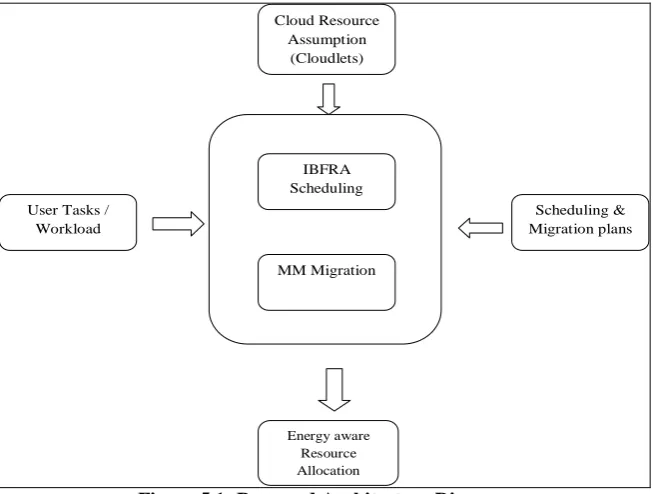
In this module, the resources are allocated for the user given jobs. The provision of these computational resources is controlled by a provider, and resources are allocated in an elastic way, according to consumers‟ needs. A virtual machine does not have access to other virtual machines running conditions. So if one of the following two problems occurs, the execution efficiency of the tasks will be affected. One of the problems is that the dispatcher is out of joint, and the other one is the environment of virtual machines changes, resulting in the problems of some virtual machines and making them unable to send the information back to the scheduler. This will also cause some virtual machines overload while others free. Figure 5.1 shows the architectural diagram of proposed approach. The proposed system is the hybrid algorithm, which combines Improved Best Fit Resource Allocation (IBFRA) algorithm with Minimum Migration (MM) algorithm.
User Tasks / Workload
Cloud Resource Assumption (Cloudlets)
IBFRA Scheduling
MM Migration
Energy aware Resource Allocation
Scheduling & Migration plans
Figure 5.1: Proposed Architecture Diagram
5.2.3 Model Analysis for Migration
In this module, Model Analysis takes place for migration process, where what all the tasks to be migrated. When a virtual machine is considered to be overloaded, requiring live migration to one or more VMs from the nearby location cloud centres. When a virtual machine is considered to be under loaded (minimum task running) requiring live migration to one or more VMs (which are already running to perform some jobs) from the nearby location cloud centres. Location based VM selection policy (algorithm) has to be applied to carry out the selection process.
5.2.4 Migration of Tasks
Impact Factor: 5.515
6. Experimental Results and Analysis
6.1 Experimental Setup
A set of comprehensive simulations and experiments are conducted to evaluate the performance of the proposed energy-aware resource allocation algorithms. Energy consumption, Cost evaluation and VMs utilization are used as measures to evaluate the performance of proposed algorithms. The resource utilization is to measure the running and after-execution resource utilizations of the employed PMs, which can be calculated. The energy consumption is used to gauge the running and the after-execution energy consumptions, which can be calculated. To demonstrate the performance of proposed improved resource allocation algorithms for cloud a baseline method named the greedy task scheduling algorithm and EnReal scheduling algorithm for scientific workflow executions are compared with proposed approach.
Greedy algorithm is such that for the tasks contained in the workflows arrived at the same time, the required VMs of each task are allocated from a most energy-efficient available PM and the PM mode switch operations are also employed to save the energy consumption further. The task requests are divided into several time partitions. The task requests in a time partition has the same requested start time. The number of workflows in the datasets is set to {5, 10, 15, 20, 25, 30}. In this section, experiments have been conducted to show the effectiveness of proposed strategy. In particular, the performance of this method is considered with different evaporation rates. The analysis shows that proposed method can generate consistently stable results in some interval. Apart from that, proposed method is also compared with four existing methods, comparison results of which have confirmed the effectiveness proposed approach. To evaluate proposed algorithm, a popular CloudSim toolkit (Rodrigo et al, 2011) package is used. By using CloudSim, researchers can deploy different resources on cloud and examine their method. Also, it provides performance metrics that evaluate the simulation result, such as energy consumption, number of Service Level Agreement (SLA) violations, which are urgent issues in cloud computing. Improved Best Fit Resource Allocation (IBFRA) and Minimum Migration (MM) algorithm is compared with EnReal and Greedy. The performance of algorithm is evaluated in terms of Energy Consumption, Cost Evaluation, VMs used Evaluation.
6.2 Experimental Results
6.2.1Number of Virtual Machines Used
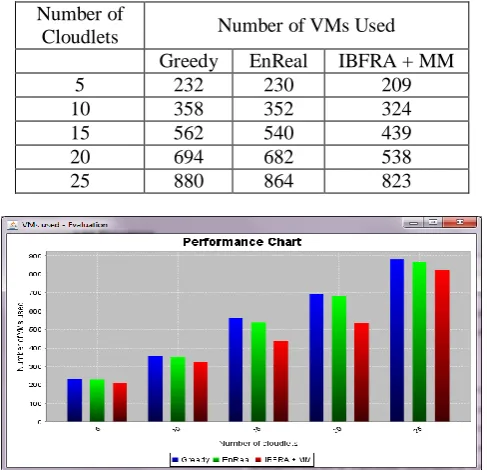
Table 6.1: Number of Virtual Machines Used Measure Number of
Cloudlets Number of VMs Used Greedy EnReal IBFRA + MM
5 232 230 209
10 358 352 324
15 562 540 439
20 694 682 538
25 880 864 823
Impact Factor: 5.515 Table 6.1 shows that the proposed algorithms Improved Best Fit Resource Allocation and Minimum Migration requires less number of Virtual Machines used when compared to existing algorithms Greedy and EnReal algorithm. Figure 6.1 shows that the proposed algorithms Improved Best Fit Resource Allocation and Minimum Migration requires less number of Virtual Machines used when compared to existing algorithms Greedy and EnReal algorithm.
6.2.2 Energy Consumption Ratio
Table 6.2 shows that the proposed algorithms Improved Best Fit Resource Allocation and Minimum Migration consumes less energy when compared to existing algorithms Greedy and EnReal algorithm. Figure 6.2 shows that the proposed algorithms Improved Best Fit Resource Allocation and Minimum Migration consumes less energy when compared to existing algorithms Greedy and EnReal algorithm.
Table 6.2: Energy Consumption Measure Number of
Cloudlets
Energy Consumption
Greedy EnReal IBFRA + MM
5 12 11 10
10 15 13 12
15 19 16 13
20 22 19 15
25 25 21 20
Figure 6.2: Energy Consumption Ratio
6.2.3 Cost Evaluation
Table 6.3 shows that the proposed algorithms Improved Best Fit Resource Allocation and Minimum Migration require low cost when compared to existing algorithms Greedy and EnReal algorithm. Figure 6.3 shows that the proposed algorithms Improved Best Fit Resource Allocation and Minimum Migration requires less cost when compared to existing algorithms Greedy and EnReal algorithm.
Table 6.3: Cost Evaluation Measure
Number of Cloudlets
Cloud Cost ($/hr)
Greedy EnReal IBFRA + MM
5 1.8 1.65 1.5
10 2.25 1.95 1.8
15 2.85 2.4 1.95
20 3.3 2.85 2.25
Impact Factor: 5.515
Figure 6.3: Cost Evaluation
7. Conclusion and Future Work
The Virtual Machine (VM) consolidation problem used to reduce energy consumption of data centers while satisfying Quality of Service (QoS) requirements is addressed. The distributed system architecture to perform dynamic VM consolidation to improve resource utilizations of Physical Machines (PMs) and to reduce their energy consumption has been developed. The Proposed algorithm is the hybrid algorithm, which is the combination of Improved Best Fit Resource Allocation (IBFRA) and Minimum Migration (MM). Numerical results indicate the proposed platform yields to the optimal solution for a limited time-frame. These numerical results have shown that proposed approach explores the optimal solution with an optimality gap of at most 1% in 3 minutes computation time. The performance of proposed estimation module and state of the art IBFRA-MM estimator is compared and assessed. The comparative results prove that the proposed module attains encouraging gain over its peers.
The future work is to find better solutions to the problem of overload balance by using improved Ant Colony Optimization (ACO) algorithm, such as the Ant Colony System (ACS) and the MAX-MIN Ant System (M−MAS). Besides, the threshold is to be improved from a fixed value to an adaptive value. Also some other heuristic methods with Ant Colony Optimization-Virtual Machine Migration (ACO-VMM) are to be combined. There are lot of algorithm which have been proved work well with ACO algorithm like genetic algorithm or simulated annealing algorithm.
References
[1] Anubha Jain, M. Mishra, S.K. Peddoju, 2013, Energy efficient computing-Green cloud computing, Proc. 1st IEEE Int‟l. Conf. Energy Efficient Technologies for Sustainability (ICEETS„13), pp. 978-982.
[2] Daniel Warneke and O. Kao, 2011, “Exploiting dynamic resource allocation for efficient parallel data processing in the cloud”, IEEE Trans. Parallel Distrib. Syst., vol. 22, no. 6, pp. 985-997.
[3] Rodrigo N. Calheiros and R. Buyya, 2014, “Meeting Deadlines of Scientific Workflows in Public Clouds with Tasks Replication”, IEEE Trans. Parallel Distrib. Syst., vol.25, no.7, pp. 1787-1796.
[4] Rodrigo N. Calheiros, R. Ranjan, A. Beloglazov, C.A. De Rose, and R. Buyya, 2011, “CloudSim: a toolkit for modeling and simulation of cloud computing environments and evaluation of resource provisioning algorithms”, Software: Practice and Experience, vol. 41, no. 1, pp. 23-50.
[5] Shadi Ibrahim, B. He, H. Jin, 2011, “Towards pay-as-you-consume cloud computing”, Proc. 8th IEEE Int‟l. Conf. Service Computing (SCC „11), pp. 370-377.
[6] Xiaomin Zhu, L. Yang, H. Chen, J. Wang, S. Yin, and X. Liu, 2014, “Real-Time Tasks Oriented Energy-Aware Scheduling in Virtualized Clouds”, IEEE trans. Cloud Computing, vol. 2, no. 2, pp. 168-180.
Impact Factor: 5.515
[8] Xubo Fei and S. Lu, 2012, A dataflow-based scientific workflow composition framework, IEEE Trans. Services Computing, vol. 5, no. 1, pp. 45-58.
[9] Zhen Xiao, W. Song, and Q. Chen, 2013, “Dynamic resource allocation using virtual machines for cloud computing environment”, IEEE Trans.ParallelDistrib. Syst., vol. 24, no. 6, pp. 1107-1117.
A Brief Author Biography
Mrs. J. Divyabharathi - She is a Part time research scholar and currently working as an Assistant Professor in the department of Computer Science, Kongu College of Arts and Science, Karur. She has 6 months of Teaching experience. She has received her UG and PG degree from Anna University, Coimbatore. Now she is pursuing her M.Phil degree as Part time in the Bharathiar University, Coimbatore. Her area of research is Cloud Computing. She attended many workshops, Seminars and Training programs. She has published 1 paper in reputed journals with good impact factor.
Dr. M. Punithavalli is working as Associate Professor in the Department of Computer Applications, Bharathiar University, Coimbatore, Tamil Nadu. She has 20 years of experience in teaching and 10 years of experience in research. She has published 66 journals in the International / National journals and conferences and 3 books. She has also presented 9 research papers in International and National Seminars. She has delivered invited talks in National and International Conferences. She has guided 6 M.Phil scholars and 11 Ph.D scholars.