ISSN (Online): 2320-9364, ISSN (Print): 2320-9356
www.ijres.org Volume 3 Issue 10 ǁ October. 2015 ǁ PP.36-42
Semi-global Leaderless Consensus with Input Saturation
Constraints via Adaptive Protocols
Zhiyang Wu
1, Jian Li
1, Fang Song
1,21(Laboratory of Intelligent Control and Robotics, Shanghai University of Engineering Science, Shanghai, 201620, P. R. China)
2( State Key Laboratory of Robotics and System, Harbin Institute of Technology, Harbin, 150001, P. R. China )
ABSTRACT: In this paper, the problems of semi-global leaderless consensus for continuous-time multi-agent systems under input saturation restraints are investigated. We consider the leaderless consensus problems under fixed undirected communication topology. New necessary synthesis conditions are established for achieving semi-global leaderless consensus via the distributed adaptive protocols, which is designed by utilizing low gain feedback tactics and the relative state measurements of the neighboring agents. Finally, simulation results illustrate the theoretic developments.
Keywords -Semi-global consensus; Multi-agent systems; Inputsaturation; Adaptive protocols
I.
INTRODUCTION
During the last few decades, consensus has been became a very hot research topic inmany scientific fields, such as computer science, physics, biology,and system control. Roughly speaking, consensus means the agreementof agents on the joint status value via utilizing local interactionfrom the neighbouring agents. In recent years, extensive research attentionhas been paid into the consensus problem of multi-agent systems[1-5]. It should be noted that, although thepower of each individual agent is quite limited, the wholeinteraction network system may accomplish complex tasks in acoordinated fashion. Therefore, the consensus problem has a widerange of potential applications, to mention just a few, includingcooperation of unmanned air vehicles (UAVs) in [6],distributed sensor networks in [7] and [8],attitude alignment for a flock of satellites in [9],flocking control in [10] and [11], congestion control under communication topology [13].Interested readers are referred to the recent survey articles [14], [15] and the references citedtherein for details.It is known that consensus has been studied for several decades in computer science. Broadlyspeaking, there are two classes of consensus, that is, the leaderless consensus and the leaderfollowing one. Usually, the multi-agent system dynamic models are described by double-integratordynamics or single-integrator kinematics [13]-[17]. In recent literature, the general linear dynamicmodel has been considered to address more complicated system dynamics in engineering practice.For instance, in [18] the authors studied the consensus problems of both leaderless and leader-following cases in the situation of fixed interaction networks. In [19] the consensus problemsin the case of leader-following were discussed under a switching communication network. Theleaderless nonlinear consensus subject to parametric uncertainties was achieved by developingadaptive continuous finite-time distributed protocols in [20]. The consensus of multi agents withsecond-order, linear and Lipschitz nonlinear dynamics via utilizing the adaptive algorithms werestudied in [21] and [22], respectively. A distributed observer based algorithm was proposed in [23]for leader-following consensus of networked multiple agents systems.
Indeed, up to now, the investigation on consensus has many comprehensive achievements.However, in practice networked multi-agent systems may have more complicated dynamics. Theindustrial applications of consensus are limited by all kinds of physical conditions, such as the inputsaturation constraints. Till now, more and more research activities has paid close attention tothe consensus problems for networked multiple agents systems under input saturation constraintsbecause of its unique characteristic and practical applications. In [24], the authors investigated theglobal consensus of linear networked multiple agents dynamics with input saturation by distributedobserver-based algorithm over fixed and switching interaction networks. For discrete-time systems,the global consensus problem under input saturation constraints was addressed in [25]. In [26] Suet al. proposed a linear low gain feedback algorithm to reach semi-global consensus for networkedmulti agents dynamics under the assumption of agents are linear asymptotically null controllablewith bounded controls (ANCBC) [27]. While in recent paper [28], the semi-global consensus oflinear dynamics in the case of input saturation was studied by utilizing observer-based algorithmsand the low gain feedback technique, under the assumptions that the communication networkswere jointly connected or connected and each agent was detectable. With the input saturationrestricts, the semi-global synchronization problem for multiple agents with linear systems wasstudied in [29].
protocols. Compared with some existing results, the distinctivepoints of the paper can be expressed as the following sentences. Under the assumption thatthe agents are ANCBC, without realizing any information of the networks, all agents achievean agreement by utilizing the distributed adaptive protocols and using the low gain feedbacktechnique over both fixed and switching interaction networks. Also, we provide simulation resultson two numerical examples to verify the theoretical developments.
The remainder of this paper is arranged as follows. Preliminaries and notations are introducedin Section 2. In Section 3, based on the distributed adaptive protocols, we address the problemof semi-global leaderless consensus under fixed undirected graph.The simulation results on two numericalexamples are given in Section 4 to verify the theoretic developments. Finally, a brief conclusionis drawn in Section 5.
II.
P
ROBLEM BACKGROUND AND PRELIMINARIESIn this paper, we suppose that the information exchange between agents and the leader is described by a
fixed undirected graph
G
( , , ),
V E A
with the set of vertices V
1, 2,...,N
whose elements represent agents of the group, the set of undirected edgesE V Vrepresent neighboring relations among agents, and a weighted adjacency matrixA[aij]Rn n is defined asa
ij 0 if and only if ( , )j i E ; otherwise,0
ij
a
. Here, we also assume thata
ij
a
ji for alli
1, 2,...,
n
.For an undirected graph
G
, a Laplacian matrix L[lij]Rn n of graphG
is defined asL
D
A
, with the degree matrixD
diag d
1,
,
d
N
is defined asi
th diagonal elements1,
( )
N ij j j i
a t
. Define0
(
10( ),
20( ),
,
N0( ))
B
diag b t b
t
b
t
asb
i0
0
if the leader is available by agenti
andb
i0
0
otherwise. The eigenvalues ofL
can be ordered as
1
2
N. Then,
1
0
with its corresponding right eigenvector1 [1,1,...,1]
T nR
. Moreover,
2
0
ifG
is a connected graph.Assume that
M
is a matrix, the notationM
Tdenotes its transpose matrix. A symmetric positive matrixM
indicates that all its eigenvalues are positive, a positive semi-definiteM
indicates that all its eigenvalues are non-negative. The symbol
is the Kronecker product.I
n denotes the identity matrix of dimension.
N N
Lemma 1 [4]:Denote
L
as the Laplacian of a fixed undirected graphG
includeN
agents, denoteL
as the Laplacian of the graph consisting ofN
agents and one leader,b
i0
0
if there is a spanning tree with the leader as the root vertex.Lemma 2 [26]: For any
R
m m and
i,
i
R
m,
i
1, 2,...,
N
T
1 1 1 1
1
( )(
) ( ( )(
))
( )
( ( )(
))
2
N N N N
T
ij i j i j ij i i j
i j i j
a t
a t
In this paper, we consider an MAS of
N
identical continuous-time agents subject to input saturation constraints, moving in an n-dimensional Euclidean space. The dynamic of each agent is modeled by( )
i i i
x
Ax
B
u
y
i
Cx
i,i
1, 2,
,
N
(2)where
x
i
R
n,
y
i
R
Pare the state of agenti
and the measurement output of agenti
respectively,m i
u
R
is the control input,
:
R
m
R
m is a saturation function definedas
( )
u
i
sgn(
u
ij) min
u
ij,
with a scalar value
0.
For T1 2
( ,
,
,
) ,
i m
u
u u
u
T1 2
( )
u
i(
( ),
u
(
u
),
,
(
u
m)) .
To address the leaderless consensus, the average state of
N
agents is defined as follows1
1
Ni i
i
x
x
N
Definition 1. To address the semi-globalleaderless consensus problem, it means that, for any prior given
compact set
R
n, we can design a distributed control law uiby only using the partial information of agent i from neighbors, such that all the agents can reach the same state asymptotically, i.e.,lim
i( )
j( )
0
t
x t
x t
,
i
1, 2,
,
N
with any initial condition
x
i(0)
,i
0,1, 2,
,
N
In order to employ the low gain feedback technique, we need to suppose that the pair (A,B)satisfies the following Assumption 1. For more details, the reader can refer to the book [27].
Assumption 1: The pair
( , )
A B
is ANCBC and each eigenvalue of the matrix A is on theimaginary axis simple.Lemma 3[29]: Under Assumption 2. A unique solution
P
( )
is derived by the following parametric ARE.
T
( )
( )
( )
( )
( )
T
A P
P
A
P
BB P
P
(4) where
0
is a positive scalar. Furthermore, we have
0
lim
P
0.
Lemma 4[29]: Let Assumption 1 hold, for any
0
and
(0,1]
, the unique solution in Lemma 3 is 1( )
( )
P
W
which satisfies a Lyapunov functionT T
(
)
(
)
2
n2
nW A
I
A
I W
BB
(5)Assumption 2:The graph G is connected at all time.
III.
M
AINR
ESULTSThis section investigates the semi-global leaderless consensus with input saturation under a fixedinteraction network topology. The adaptive control algorithm will be employed to address the problem.Now, motivated by the distributed consensus protocol with an adaptive control law in [22], we are ready to design a distributed consensus algorithm as follows:
1
N
i ij ij i j
j
u
K
a m
x
x
m
ij
ija
ij
x
i
x
j
TK x
ˆ
i
x
j
(6)where
ij
ji are the plus quantities,m
ij is the adaptive coupling weights, the feedbackmatrixK
and
K
ˆ
are designed asK
B P
T( )
andK
ˆ
P
( )
BB P
T( )
respectively,P
( )
is theunique solution that can be obtained from the algebra Riccati equation (4).By introducing the above contents, now we propose the results as follows.
Theorem1. Suppose that Assumptions 1 and 2 are satisfied. Then the multi-agent system(2) of N agents achieve semi-global leaderless consensus under the distributed control law (6).
Proof: Let us define 1
,
2,...,
T
T T T
i N
with
ix
ix
i. Then, we have the following equations1
1
( )
( )
N
i i i i i i
i
x
x
A
B
u
B
u
N
ˆ
T
ij ij ij i j i j
m
a
K
(7) Now, for the multi-agent system (2), let us consider a common Lyapunov function candidate
2
1 1 1,
2
N N N
ij T
i i
i i j j i ij
m
V
P
(8)
20,1 , 0 , 1,2,..., 1 1,
sup
2
i N N ij T ix i N i j j i ij
m
c
P
(9)Such a
c
exists since
is bounded and
0lim
P
0
. Let
:
Nn:
c
R
V
c
(10)
and
*
(0,1]
be such that, for each
(0,
*]
,e
c implies that
T
1
( )
,
N
ij ij i j j
B P
m a
x
x
i
1, 2,...,
N
(11)Therefore, by Lemma 3, consider any
(0,
*]
, for anye
c, the derivative ofV
can be evaluated as
T T
1 1 1 1
( )
( )
N N N N
ij
i i i i ij
i i i j ij
m
V
P
P
m
T T 1( ( )
( ))
N i i iP
A
A P
1 1
2
( )
( )
N N
T T
i ij ij i j
i j
P
BB P
m a
1 1N N T
ij T
ij ij i j i j
i j ij
m
a
P
BB P
(12)By Lemma 2, for any
i
R
m,
i
R
m,
i
1, 2,...,
N
, we have T 1 11
( )(
) (
)
( ( )
)
2
N N Tij i j i j m
i j
a t
L t
I
where
1 2
N
Tand
1 2 N
T. Therefore, we can continue(12)
as follows:T T
1 1
( )
( )
N N
i i i i
i i
V
P
P
1 1
2
( )
( )
N N
T T
ij i i j
i j
a
P
BB P
T T
(
( ( )
( )
2
( )
( ))
T N
I
P
A
A P
L
P
BB P
Since the graph is connected, zero is a simple eigenvalue of
L
and all the other eigenvalues are positive. LetN N
U
R
be such a unitary matrix thatU LU
T
:
diag
0,
2,...,
N
.
Because the right and left eigenvectors ofL
corresponding to the zero eigenvalue are1
and1
T , respectively, we can choose1
1
U
Y
N
and2
1
T TU
N
Y
, with
Y
1
R
NN1 andY
2
R
N 1 N . Let
1
,...,
T
T T T
N
U
I
n
. Then we haveT T
(
( ( )
( )
2
( )
( ))
T N
V
I
P
A
A P
L
P
BB P
T T
2( )
( ) 2
( )
( )
N T
i i i
i
P
A
A P
P
BB P
(13)
By Lemma 3 choosing
2
i,i
2,...,
N
,(13)
can be continued as :
T T
2
( )
( ) 2
( )
( )
N T
i i
i
V
P
A
A P
P
BB P
1 N T i i iP
0
0
lim
i( )
( )
0
t
x t
x t
,
i
1, 2,...,
N
This completes the proof.
IV.
S
IMULAIONS
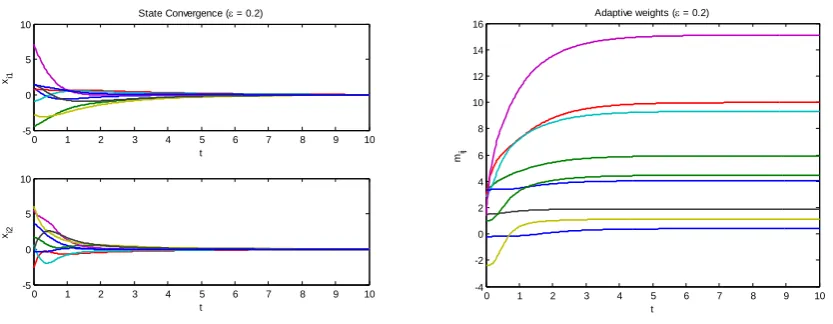
TUDYHerein the simulation experiments are supplied to clarify the theoretic results on the leaderlessconsensus developed in Section 3. Consider a multi agents system consisting of eight agents.Assume that the dynamic of every agent holds the form of (2) with the following parameters:
1
1
0
,
0
1
1
A
B
Obviously the pair
A B
,
satisfies Assumption 1. Suppose the topology is considered as in Fig.1. The initial states of eight agents are randomly assigned. Thus, We chose
ij = 1 and
= 5,
2 = 0.2907 can be obtained by using an exhaustive method. Then
2
2
2.907
. For the situation of
0.2
, then weget a set of solutions as
0.2
0.3429
0.3086
0.3086
0.5556
P
Thus, the feedback gain
K
andK
ˆ
as
ˆ
0.0952
0.1715
0.3086
0.5556 ,
0.1715
0.3087
K
K
Fig. 1: The interaction communication network.
0 1 2 3 4 5 6 7 8 9 10
-5 0 5 10
t
xi1
State Convergence ( = 0.2)
0 1 2 3 4 5 6 7 8 9 10
-5 0 5 10
t
xi2
0 1 2 3 4 5 6 7 8 9 10
-4 -2 0 2 4 6 8 10 12 14 16
t
mij
Adaptive weights ( = 0.2)
Fig. 2: The states of eight agents.Fig. 3: The adaptive weights
m
ij.Under the control law (6), the trajectories of the state difference between agents are shown in Fig. 2. It is obvious that the semi-global leaderless consensus can be achieved.
For the situation of
0.2
, we can get the unique solution1
2
3
4 5
8
0.4
0.4883
0.3906
0.3906
0.6250
P
0 1 2 3 4 5 6 7 8 9 10
-4 -2 0 2 4
t
xi1
State Convergence ( = 0.4)
0 1 2 3 4 5 6 7 8 9 10
-10 -5 0 5
t
xi2
0 1 2 3 4 5 6 7 8 9 10
-2 -1 0 1 2 3 4 5 6
t
mij
Adaptive weights ( = 0.4)
Fig. 2: The states of eight agents.Fig. 3: The adaptive weights
m
ij.Thus, the feedback gain
K
andK
ˆ
as
ˆ
0.1526
0.2441
0.3906
0.6250 ,
0.2441
0.3906
K
K
Under the control law (6), it is obvious that the semi-global leaderless consensus can be achieved. The
simulation results are in Fig. 4. The adaptive weights
m
ij under
0.2
and
0.4
are shown in Fig. 3 and Fig. 5 respectively.V.
C
ONCLUSIONIn this paper, we consider the semi-global leaderless consensus problem of ANCBC multipleagents system subject to input saturation restraints both over fixed and switching topology. Theadaptive control law is proposed by utilizing a low gain feedback strategy. The connectivity of thegraph in fixed networks and the joint connectivity of the graph in switching networks are the keyrequirements to guarantee the semi-global leaderless consensus. Finally, the theoretical resultswere verified by simulation study.
VI.
Acknowledgements
This work was partly supported by the State Key Laboratory of Robotics and System (HIT) underGrant SKLRS-2014-MS-10, the Jiangsu Provincial Key Laboratory of Advanced Robotics Fund Projects under Grant JAR201401, and the Foundation of Shanghai University of Engineering Science under Grant nhky-2015-06, 14KY0130.
R
EFERENCES[1]. R. Olfati-Saber, and R.M. Murray, “Consensus problems in networks of agents with switchingtopology and time-delays,” IEEETransactions on Automatic Control, vol. 49, no. 9, pp. 1520-1533, 2004.
[2]. Jadbabaie, J. Lin, and A.S. Morse, “Coordination of groups of mobile autonomous agentsusing nearest neighbor rules,” IEEE Transactions on Automatic Control, vol. 48, no. 6, pp.988-1001, 2003.
[3]. L. Wang and F. Xiao, “Finite-time consensus problems for networks of dynamic agents,”IEEE Transactions on Automatic Control, vol. 55, no. 4, pp. 950-955, 2010.
[4]. W. Ren and R.W. Beard, “Consensus seeking in multi-agent systems under dynamicallychanging interaction topologies,” IEEE Transactions on Automatic Control, vol. 50, no. 5,pp. 655-661, 2005.
[5]. F. Pasqualetti, D. Borra, and F. Bullo, “Consensus networks over finite fields,” Automatica,vol. 50, no. 2, pp. 349-358, 2014. [6]. D.J. Pack, P. DeLima, G.J. Toussaint, and G. York, “Cooperative control of UAVs for localization of intermittently emitting
mobile targets,” IEEE Transactions on Systems, Man, andCybernetics, PartB: Cybernetics, vol. 39, no. 4, pp. 959-970, 2009. [7]. J. Cortes and F. Bullo, “Coordination and geometric optimization via distributed dynamicalsystems,” SIAM Journal on Control
and Optimization, vol. 44, no. 5, pp. 1543-1547, 2005.
[8]. R. Olfati-Saber and P. Jalalkamali, “Coupled distributed estimation and control for mobilesensor networks,” IEEE Transactions on Automatic Control, vol. 57, no. 10, pp. 2609-2614,2012.
[10]. R. Olfati-Saber, “Flocking for multi-agent dynamic systems: Algorithms and theory,” IEEETransactions on Automatic Control, vol. 51, no. 3, pp. 401-420, 2006.
[11]. K.D. Do, “Flocking for multiple elliptical agents with limited communication ranges,” IEEETransactions on Robotics, vol. 27, no. 5, pp.931-942, 2011.
[12]. P. Ignaciuk and A. Bartoszewicz, “Discrete time sliding mode congestion control in multisource communication networks with time varying delay,” IEEE Transactions on ControlSystems Technology, vol. 19, no. 4, pp. 852-867, 2011.
[13]. W. Ren, “On consensus algorithms for double-integrator dynamics,” IEEE Transactions onAutomatic Control, vol. 53, no. 6, pp. 1503-1509, 2008.
[14]. R. Olfati-Saber, J. Fax, and R.M. Murray, “Consensus and cooperation in networked multi-agent systems,” Proceedings of the IEEE, vol. 95, no. 1, pp. 215-233, 2007.
[15]. W. Ren, R.W. Beard, and E.M. Atkins, “Information consensus in multivehicle cooperativecontrol,” IEEE Control System Magazine, vol. 27, no. 2, pp. 71-82, 2007.
[16]. S.H. Li, H.B. Dua, and X.Z. Lin, “Finite-time consensus algorithm for multi-agent systemswith double-integrator dynamics”, Automatica, vol. 47, no. 8, pp. 1706-1712, 2011.
[17]. Abdelkader and T. Abdelhamid, “On consensus algorithms for double-integrator dynamicswithout velocity measurements and with input constraints,” Systems & Control Letters, vol.59, no. 12, pp. 812-821, 2010.
[18]. P. Wieland, J.S. Kim, and F. Allgower, “On topology and dynamics of consensus among linearhigh-order agents,” International Journal of Systems Science, vol. 42, no. 10, pp. 1831-1842,2011.
[19]. W. Ni and D.Z. Cheng, “Leader-following consensus of multi-agent systems under fixed andswitching topologies,” Systems & Control Letters, vol. 59, no. 3, pp. 209-217, 2010.
[20]. J.S. Huang, C.Y. Wen, and W. Wang, “Adaptive finite-time consensus control of a group ofuncertain nonlinear mechanical systems,” Automatica, vol. 51, pp. 292-301, 2015.
[21]. H.S. Su, G.R. Chen, X.F. Wang, and Z.L. Lin, “Adaptive second-order consensus of networkedmobile agents with nonlinear dynamics,” Automatica, vol. 47, no.2, pp. 368-375, 2011.
[22]. Z.K. Li, W. Ren, X.D. Liu, and M.Y. Fu, “Consensus of multi-agent systems with generallinear and lipschitz nonlinear dynamics using distributed adaptive protocols,” IEEE Transactions on Automatic Control, vol. 58, no.7, pp.1786-1791, 2011.
[23]. Y.G. Hong, G.R. Chen, and L. Bushnell, “Distributed observers design for leader-followingcontrol of multi-agent networks,” Automatica, vol. 44, no. 3, pp. 846-850, 2008.
[24]. Z.Y. Meng, Z.Y. Zhao, and Z.L. Lin, “On global leader-following consensus of identical lineardynamic systems subject to actuator saturation,” Systems & Control Letters, vol. 62, no.2,pp. 132-142, 2013.
[25]. T. Yang, Z.Y. Meng, D.V. Dimarogonas, and K.H. Johansson, “Global consensus for discrete-time multi-agent systems with input saturation constraints,” Automatica, vol. 50, no.2, pp.499-506, 2014.
[26]. H.S. Su, Michael Z.Q. Chen, J. Lam, and Z. L. Lin, “Semi-global leader-following consensus oflinear multi-agent systems with input saturation via low gain feedback,” IEEE Transactionson Circuits and Systems, vol. 60, no. 7, pp.1881-1889, 2013. [27]. Z.L. Lin, “Low gain feedback,” Lecture Notes in Control and Information Sciences, London,U.K.: Springer-Verlag, vol. 240,
1998.
[28]. H.S. Su, Michael Z.Q. Chen, X.F. Wang, and J. Lam, “Semi-global observer-based leader-following consensus with input saturation,” IEEE Transactions on Industrial Electronics, vol.61, no. 6, pp. 2842-2850, 2014.