e-ISSN: 2278-067X, p-ISSN: 2278-800X, www.ijerd.com
Volume 9, Issue 10 (January 2014), PP. 08-16
Genomic DNA AnalysisUsing ANFIS and ANN
Günay Karlı
1, Adem Karadağ
21International Burch University, Faculty of Engineering and IT, Department of IT, Sarajevo, Bosnia and Herzegovina
2Bosna Sema - Educational Institutions, Sarajevo, Bosnia and Herzegovina
Abstract:-Gene expression is governed by the promoter which frequently appears before its associated gene in DNA sequence. In order to locate a gene in a given sequence, researchers have to find the location of a promoter. Thus, the problem of promoter identification is of major significance within biology. So this issue maintains its importance. In this study, we employ ANN (Artificial Neural Network) and ANFIS(Adaptive Neuro-Fuzzy Inference System) classifiers to predict promoters of DNA sequences, and evaluate their performances. The obtained results show that the classifiers competethe existing techniques for identifying promoter regions.
Keywords:-Promoter prediction, ANN, ANFIS, data mining, bioinformatics, DNA
I.
INTRODUCTION
In biology the cell is regarded as the basic unit of life in organisms, being the lowest level of structure that supports all life activities [1].Proteins are a major structural component of cells, having core responsibilities for the maintenance of shape and structure of the particular cell in addition to molecular recognition and catalysis. DNA, which forms the fundamental structural proponent for proteins, is the blueprint carrying all cell information and instructions responsible for protein synthesis and regulation. Molecular biology posits that the information is transmitted from the DNA strand through the RNA to proteins as illustrated by Fig.1.
This is the initial stage where RNA polymerase holoenzyme binds a gene onto mRNA i.e. messenger RNA sequence basing the DNA sequence as a template. The entire process of transcribing one gene characteristic on the other is referred to as an expression [2] and [3]:
This stage will occur in the specific cities considering the high specificity of the chromosome orientations. There exists a Blueprint that refers to a common name for genetic coding whichpossesses the instructions needed by cells in environmental adaptability. This is further collaborating with research that cites that in addition to the instructions carried by the blueprint, there exists a synthesis point for most of the molecule including the RNA and proteins. The instructions contained in the blueprint are designed in such a manner that they are only readable in transcription and translation.
In this sub sequential stage, the ribosomes synthesize the proteins with regard to the carried instructions on the mRNA. Such process through which the information on a single gene is transcribed onto another for facilitation of synthesis for another gene product is generally described as the gene expression. The new gene products, [2]and [5]are majorly comprised of protein structural aspects, though they exist as non-protein coding gene forms such as the rhino and the tRNA; having the minor non-coding RNAs such as mRNA and piRNA and the several diverse long non-coding RNAs that are later responsible for protein regulatory functions. Such specificity is as a result of the recognition by the RNA polymerase from the DNA sequence generally referred to as Promoter.
The promoter is a location within the DNA molecule where the transcription occurs. It is an indispensable location of the gene expression. Molecular biology cites that promoter prediction and identification is a major challenge in this field. More so, the gene data has over the past been observed to grow exemplary too fast to predict the promoter localities. This situation has compelled specialists to seek other intermediary measures in the prediction of the promoter in the DNA molecule. Such endeavor has integrated the use of computations.
It is of great significance to note that before the1990s’ computer programs used for assembling coding arrays into translatable MRNA were not in existence, though various conventional techniques existed long since the 1980s and were used in the prediction of genomic DNA coding locations. Since the innovation and adoption of the digitalized techniques, prediction of the promoter has improved tremendously by each day. Such programs are GenViewer[8], GeneID[9], GenLang[10], GeneParser[11], FGENEH [12], SORFIND [13], Xpound[14], GRAIL[15], VEIL[16], GenScan[17]. This research endeavor, notes that the [18],GRAIL and GeneScan are the most used techniques in both learning institutions and commercially. These techniques are based their endeavor on the evaluation of whether the motifs in DFNA exist or not. Such motifs may be described as either promoter or no-promoter [19]. These researches are based on the manipulations of position weight matrices and the Markov models as indicated in [20][21] and[22]. The endeavor will also integrate artificial intelligence as opposed to a monopoly of statistical approaches.
Amongst them is the Neural Network shave that exhibit acceptable sensitive results. However, despite such efforts, the specificity of the results leaves much to be desired owing to a very high false positive occurrence. This is evidenced in [23]and [24]. In order to achieve a positive promoter prediction, the integration of computational approaches still poses great promise, though this has been subjected to hefty debating. In a bid to eliminate such discontent, specialists in molecular biology suggest that the integration of the ANN is a much proficient approach.
1.1. Promoter and Significance of promoter prediction
The Blueprint; a common name for genetic coding is believed to possess the instructions needed by cells in environmental adaptability. This is further collaborating with research that cites that in addition to the instructions carried by the blueprint, there exists a synthesis point for most of the molecule including the RNA and proteins. The instructions contained in the blueprint are designed in such a manner that they are only readable in two ways as mentioned earlier in this paper i.e. transcription and translation [25].
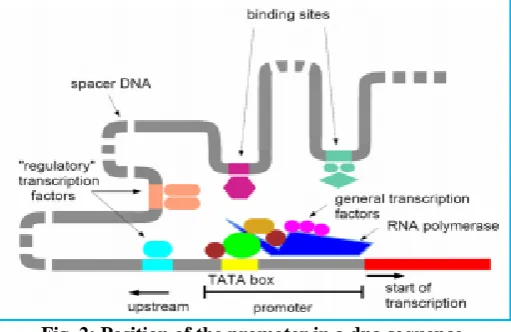
The messenger RNA; usually a single strand RiboNucleic Acid molecule, is amalgamated usually from one of the strands contained in DNA through a complementary of the origins. This strand does relate to a gene. Transcription will usually commence with the RNA polymerase being engulfed by a lone point in the DNA molecule known as the Promoter. [3]points out that, efforts to incorporate computerized biology have helped to easily locate the promoter regions.
Fig. 2: Position of the promoter in a dna sequence.
This has had a very significant impact on transcription as these regions are numerous in the DNA molecule thus easing the gene expression [3].
In rare cases, then there may be the existence of the upstream of the TSS of DNA array that possess transcriptional characteristics, thus the presence of the promoter may not be a necessity. When promoter prediction is incorporated, a researcher is at ease to constrict down the entirely colossal DNA sequences. This paper acknowledges that through biological interventions, it is made easier to verify the DNA sequence that may either be transcribed or no. This though comes along with economic constraints.
In the recent past, the integration of computerization in the promoter identification and prediction has raised debate. And the results obtained by evaluating the classification model proposed in this paper confirm that applying ANN for promoter sequences recognition is promising
II.
METARIAL andMETHODS
There are two core classes of the promoter prediction, namely ‘+’ and ‘-’. These classes will denote the existence of promoter prediction in the DNA sequence, having the ‘+’ denoting for a positive indication of promoter location in the DNA sequence and the ‘-’ denoting the absence of promoter locations in the DNA sequence. This research paper proposes to deal with a supervised learning technique in the prediction of promoter regions in the DNA sequence.
2.1. Data Set
The research sought to incorporate the E. Cole promoter gene arrays of DNA in the testing the proficiency of ANN. Such data were collected from the UCI Repository[27]; this contains a set of 106 promoter and non-promoter instances. The research paper notes that such data is viable in the comparisons of ANN with the models existing in the literature; additionally such information involving the use of the data set is publicly available [4].
The 106 DNA arrays are composed of 57 nucleotides each. 53 of the DNA sequences in the data set had a ‘+’ denoting, indicating the presence of promoter location in the DNA array. The research then sought to align the (+) parameter instances separately allowing for transcription. The following data characterize the (+) instances as observed from the experiment. One is that for every occurrence the (+) represents for the promoter positive presence, a name was also given in each instance and a classification of the DNA array was made composing of A, T, G and C stand for Adenine, Thymine, Guanine, Cytosine [27].
2.2. Adaptive Neuro-Fuzzy Inference System (ANFIS)
This is a Fuzzy Sugeno technique that is usually placed in a framework for adaptive systems to facilitate adaptation and learning [28].. It enhances the utilization of least-squares and a back propagation gradient descent technique. In addition, a hybrid learning algorithm is used in the identification of the membership function parameters and fuzzy IF- Then regulations that are usually considerate of single output or singleton [29]. The fuzzy inference is considered to bear two inputs and a single output. An equation is here below illustrated to affirm to the fuzzy if-then rules of Takagi and Sugeno rule[30].
Where if x=A and y=B then z is f (x, y)
Where A and B are the fuzzy sets in the antecedents and Z = f (x, y) is a crisp function in the consequent.
F (x, y) is usually a polynomial for the input variables x and y.
Consider z= f (x, y) is a first-order Sugeno fuzzy inference system, which contains two rules.
Rule 1: If x is A1 and y is B1, Then: f1 =a1 x +b1 y +c1 Rule 2: If x is A2 and y is B2, Then: f2=a2 x +b2 y +c2
ANFIS structure (Fig. 3.)contains five layers excluding input layer.
Layer 0 is the input layer. It has no nodes where n is the number of inputs to the system. The functionality of nodes in ANFIS can be summarized as follows [32].
Layer 1: Nodes are adaptive; membership functions (MFs) of input variables are used as node functions, and parameters in this layer are referred to as antecedent or premise parameters.
Layer 2: Outputs that indicate Nodes are the fixed using firing strengths
Layer 3: Outputs that indicate Nodes are the fixed using normalized and strong formality
Layer 4: The layer 1 gives the Nodes n adaptive feature for the first order technique and defuzzier parameters Layer 5: An equal output in relation to the sum of the entire rules’ output is fixed to the single node
2.3. Artificial Neural Network (ANN)
The artificial neuron is an enthused component in the body’s natural neurons through computation modeling [33]. The artificial Neural Network works in an induced principle where in instances that the body’s neurons do receive signals through the naturally induced synapses occurring in the dendrites of the neuron, with a much intense magnitude, the ANN is induced thus releasing signal messages via the axon. In other instances the signal may be sent to other synapses and probably induce other neurons as noted by [34]. Usually the human brain is capacitated with the ability to hold numerous and complex operations, thus hails from the possession of numerous and enabling elements such as the complex neurons that consist of a more than 103 to 104 more neuron affiliations. This compounds the neuron coverage in the brain to approximately 1014 interconnections [34]and [35].
Fig. 4: Neural dendrites, axon, and synapse [37]
In modeling, the density of real neurons is highly exhibited, fundamentally comprising of synapses, which are compounded by the density of the respective signals, in addition this is taken under a mathematical simulation thus helping to evaluate the activation of the neuron. This moreover helps to compute the result of the artificial neuron. According to [26] this hails from the property of the ANN that they can integrate artificial neurons in the processing of information.
Usually, getting a precise definition of learning is a difficult task considering that the capability to learn is an essential characteristic of intelligence. From the experiment, it is posited that the ANN description is able to view from the efficient performance of a neuron task owing to updating of network systems. This is evidenced by the literature in [25] and [29].
One is able to obtain the desired output from the manipulation of the ANN; this is so by modifying the ANN weights. In such modifications, getting them by hand is a rather complicated and impossible task, giving supportive ground to the incorporation of ANN. In addition, [29] and [30], algorithms may be integrated in the modifications and alignments of ANN weights.
Fig. 5: Multi-layer neural network
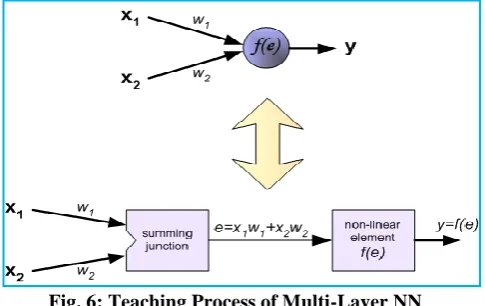
A neuron possess two units that complement the products of weight coefficients and input signals with the other unit being responsible for the neuron activation function following its capability to decode linearity. The units are denoted as Signal e for adder output signal and Signal y for the output signal of non-linearity.
The experiment notes the necessity to obtain a training data set that will comprise of input signals of x1 and x2 with a desired output z. In the network training, modifications of ANN weights are evaluated using the algorithm that will seek to commence with manipulating for both input signals from the training data set. Consequently, the output signals’ values are made easier to identify from each neuron in the network [33]. (See Fig. 5)
Fig. 6: Teaching Process of Multi-Layer NN
The 106 DNA sequences composing the E. coli will feature for having 4 values. These values will stand for the A, T, G and C i.e. Adenine, Thymine, Guanine and Cytosine. Training the ANN and the DNA array with the 57 nucleotides attached to each promoter instance is coupled as an ANN input. The DNA sequence instances present the network output usually a description of either (+) or (-) occurrence.
III.
RESULTS AND DISCUSSION
The experiments aim at evaluating an approach for proper arrays in the prediction and identification of the Promoter using the ANN and ANFIS. It also integrates the comparison of existing approaches from past researches. Such endeavors are usually conducted in two phases that showcase a precise learning algorithm, training and testing. Training will involve establishing a classification model; testing entails the implementation of the classification model previously established.
A standard 5-fold cross-validation was integrated into the evaluation of the ANN performance by having the dataset being randomly portioned into 5 subsets. This classification ensures an equal ratio of (+) and (-) promoter locations in the DNA array.
The performance of the promoter predictions was evaluated using the threshold parameters; accuracy (ACC), Mathew’s Correlation Coefficient (MCC), sensitivity (SE) and specificity (SP). A couple of equations were integrated to affirm to the results. These were;
SE=TP/(TP+FN) (1)
SP=TN/(TN+FP) (2)
ACC= (TP+TN) / (TP+TN+FP+FN) (3)
MCC=((TP*TN)-(FN*FP))/SQRT((TP+FN)*(TN+FP)*(TP+FP)*(TN+FN)) (4)
TP is true positive (promoter predicted as promoter) FN is false negative (promoter predicted as non- promoter) TN is true negative (non- promoter predicted as non- promoter) FP is false positive (non- promoter predicted promoter).
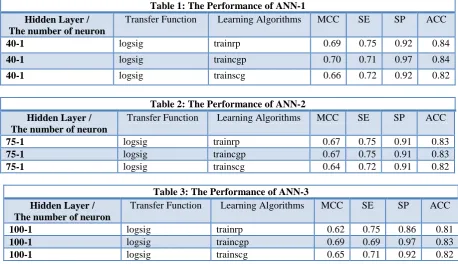
The detailed performance of modules in term of SE, SP, ACC and MCC is shown in the following tables.
This involved the testing of the several structures of the ANN with one layer, ‘logsig’ transfer function and ‘trainrp’, ‘traincgp’ learning algorithms and had the following results;
Table 1: The Performance of ANN-1 Hidden Layer /
The number of neuron
Transfer Function Learning Algorithms MCC SE SP ACC
40-1 logsig trainrp 0.69 0.75 0.92 0.84
40-1 logsig traincgp 0.70 0.71 0.97 0.84
40-1 logsig trainscg 0.66 0.72 0.92 0.82
Table 2: The Performance of ANN-2 Hidden Layer /
The number of neuron
Transfer Function Learning Algorithms MCC SE SP ACC
75-1 logsig trainrp 0.67 0.75 0.91 0.83
75-1 logsig traincgp 0.67 0.75 0.91 0.83
75-1 logsig trainscg 0.64 0.72 0.91 0.82
Table 3: The Performance of ANN-3 Hidden Layer /
The number of neuron
Transfer Function Learning Algorithms MCC SE SP ACC
100-1 logsig trainrp 0.62 0.75 0.86 0.81
100-1 logsig traincgp 0.69 0.69 0.97 0.83
100-1 logsig trainscg 0.65 0.71 0.92 0.82
From the above experiment, this paper notes that there was a positive result, having a tremendous 0.84 (ACC) that is produced by the ANN with the one layer having 40 neurons, logsig transfer function and trainrp learning algorithm.
In the experiments with the ANFIS, the paper acknowledges with great attention that in preparation of FIS, an FCM (fuzzy c-means) was used. This also integrated the application of Genfis3 which its core role is the generation of Sugeno-type FIS structure (fismat) with a given coding for input data (Xin 57-element nucleotide sequence) and output data (Xout - two classes, promoter or non-promoter).
This information is illustrated as;ANFIS info: Number of nodes: 9340
Table 4: The Performance of ANFIS
1. Model 2. Model 3. Model 4. Model 5. Model Average
ACC 0.65 0.75 0.75 0.70 0.65 0.7008
SE 0.80 1.00 0.90 0.80 0.77 0.8538
SP 0.50 0.50 0.60 0.60 0.54 0.5477
MCC 0.31 0.58 0.52 0.41 0.32 0.4281
From the experiment on promoter prediction the best results were found to be at 0.70 (ACC) having been as a result of a non-satisfactory relationship as compared to ANN.
Doing a review on the literature affirms that the application of the leave-one-out cross-validation (LOOCV) in the promoter prediction and when evaluating the performances of the ANN and ANFIS. In these endeavors the entire data excluding the single observation that was engaged in training. Such techniques are a bigger integral part in Bioinformatics[43].
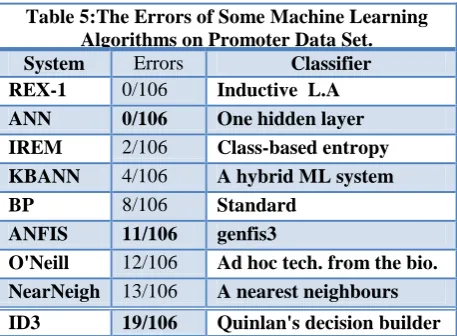
Table 5:The Errors of Some Machine Learning Algorithms on Promoter Data Set.
System Errors Classifier
REX-1 0/106 Inductive L.A
ANN 0/106 One hidden layer
IREM 2/106 Class-based entropy
KBANN 4/106 A hybrid ML system
BP 8/106 Standard
backpropagation with one layer
ANFIS 11/106 genfis3
O'Neill 12/106 Ad hoc tech. from the bio. lit.
NearNeigh 13/106 A nearest neighbours algorithm
ID3 19/106 Quinlan's decision builder
By comparison the classifiers already integrated in the experiments seeking to investigate on promoter prediction, as in Table 4. ANN as described there in the paper does perform better than classifier for promoter prediction, BP, ID3, KB, NN and O’Neil parameters bearing in mind the occurrence of errors.
IV.
CONCLUSIONS
Usually, in Bioinformatics a challenge exists in endeavors seeking to predict and identify the location of promoter regions in the DNA molecule. In such quest to investigate on the same, this paper finds the ANN and ANFIS techniques as being potential eliminators of such challenge. Through the computational ANN, a model based on the structure and functions of biological neural networks is established. In this, information is expected to flow through the network structure of the ANN because a neural network changes - or learns, in a sense - based on that input and output. It will involve a hybrid learning procedure used to form an input-output mapping based on the training data pairs, in addition, employing a fuzzy inference system in the framework of adaptive networks. Thus, the writer finds it of significance that employing ANN for promoter prediction leads to promising results and leads to improvements, increasing the accuracy of the results obtained.
Employing Adaptive Neuro-Fuzzy Inference System is not an adequate method for prediction of promoter as exhibited by the results of the experiment. The dimensionality of this dataset should be reduced by means of the feature selection process, thereby in the future in a bid by increasing the accuracy of employing ANFIS.
REFERENCES
[1]. C. M. O'Connor and U. J. Adams, Essentials of Cell Biology, Cambridge: NPG Education, 2010. [2]. R. Taft, K. Pang and T. Mercer, "a Non-coding RNAs: regulators of disease," Journal of Pathology, no.
220, pp. 126-139, 2010.
[3]. D. Pe'er, From Gene Expression To Molecular Pathways, Hebrew : Hebrew University, 2003.
[4]. C. Gabriela and M.-I. Bocicor, "Promoter Sequences Prediction Using Relational Association Rule Mining," Evolutionary Bioinformatics, vol. 8, pp. 181-196, 2012.
[6]. J.-W. Huang, Promoter Prediction in DNA Sequences, Kaohsiung,: National Sun Yat-sen University, 2003.
[7]. M. Guigo and R. Burset, "Evaluation of gene structure prediction programs," Genomics, vol. 3, no. 34, pp. 353-367, 1996.
[8]. L. Milanesi, N. Kolchanov and I. Rogozin, "GenViewer: A computing tool for protein coding regions prediction in nucleotide sequences," in the 2nd International Congress on Bioinformatics, Supercomputing and Complex Genome Analysis,, 573-587, 1993.
[9]. R. Guigo, S. Knudsen, N. Drake and T. Smith, "Prediction of gene structure," Journal of Molecular Biology, no. 226, pp. 141-157, 1995.
[10]. S. Dong and G. Stormo, "Gene structure prediction by linguistic methods," Genomics, no. 23, pp. 540-551, 1994.
[11]. E. Stormo and E. Snyder, "Identification of coding regions in genomic DNA sequences: An application of dynamic programming and neural networks," Nucleic Acids Research, no. 21, pp. 607-613, 1993. [12]. V. Solovyev, A. Salamov and C. Lawrence, "Prediction of internal exons by oligonucleotide
composition and discriminant analysis of spliceable open reading frames," Nucleic Acids Research, no. 22, pp. 5156-5163, 1994.
[13]. G. Hayden and M. Hutchinson, "The prediction of exons through an analysis of spliceable open reading frames," Nucleic Acids Research, no. 20, pp. 3453-3462, 1992.
[14]. A. Skolnick and M. Thomas, "A probabilistic model for detecting coding regions in DNA sequences," IMA J. Math. Appl. Med. Biol., no. 11, pp. 149-160, 1992.
[15]. Y. Xu, R. Mural and E. Uberbacher, "Constructing gene models from accurately predicted exons: An application of dynamic programming," Comput. Appl. Biosci, no. 10, pp. 613-623, 1994.
[16]. J. Henderson, S. Salzberg and K. Fasman, "Finding genes in DNA with a hidden Markov model," Journal of Computational Biology, vol. 2, no. 4, pp. 127-141, 1997.
[17]. C. Karlin and C. Burge, "Prediction of complete gene structures in human genomic DNA," J. Mol. Biol, no. 268:, pp. 78-94, 1997.
[18]. M. Hrishikesh, S. Nitya and M. Krishna, "An ANN-GA model based promoter prediction in Arabidopsis thaliana using tilling microarray data," Bioinformation, vol. 6, no. 6, p. 240–243, 2011. [19]. J. Gordon, M. Towsey and J. Hogan, "Improved prediction of bacterial transcription start sites,"
Bioinformatics, vol. 22, no. 2, pp. 142-148, 2006.
[20]. R. a. S. D. Liu, "Consensus promoter identification in the human genome utilizing expressed gene markers and gene modelling," Genome Research, no. 12, pp. 462-469, 2002.
[21]. Q. Luo and W. a. L. P. Yang, "Promoter recognition based on the interpolated Markov chains optimized via simulated annealing and genetic algorithm," Recognition Letters Pattern, vol. 9, no. 27, pp. 1031-1036, 2006.
[22]. C. Premalatha and C. a. K. K. Aravindan, "On improving the performance of promoter prediction classifier for eukaryotes using fuzzy based distribution balanced stratified method.," in Proceedings of the International Conference on Advance in Computing, Control, and Telecommunication Technologies IEEE,, ACT, 2009.
[23]. T. S. Y. B. E. R. P. a. V. d. P. Y. Abeel, "Generic eukaryotic core promoter prediction using structural features of DNA," Genome Research, vol. 18, no. 2, pp. 310-323, 2008.
[24]. Y.-J. Zhang, "A novel promoter prediction method inspiring by biological immune principles.," Global Congress on Intelligent Systems, no. 569-573, pp. 569-573, 2009.
[25]. S. Clancy, "Nature Education," DNA transcription, vol. 1, no. 1, p. 41, 2008. [26]. R. Kliman and L. Hoopes, Essentials of Cell Biology, Nature Education, 2010.
[27]. A. Frank and A. Asuncion, "UCI machine learning repository," 2010. [Online]. Available: http://archive.ics.uci.edu/ml/.
[28]. J. Jang, "ANFIS: Adaptive-network-based fuzzy inference systems," IEEE Trans Syst Man Cybern, no. 23, pp. 665-685, 1993.
[29]. Y. Ho and T. Tsai, "Comparing ANFIS and SEM in linear and nonlinear forecasting of new product development performance," Expert SystAppl, no. 38, pp. 6498-6507, 2011.
[30]. T. Takagi and M. Sugeno, "Derivation of fuzzy control rules from human operator’s control actions," in IFAC Symp Fuzzy Inform. Knowledge Representation and Decision Analysis , 1985.
[31]. C. Muniraj and S. Chandrasekar, "Adaptive Neurofuzzy Inference System-Based Pollution Severity Prediction of Polymeric Insulators in Power Transmission Lines," Advances in Artificial Neural Systems, vol. 2011, p. 9, 2011.
[32]. K. Soteris and A. Şencan, "Artificial Intelligence Techniques in Solar Energy Applications," Solar Collectors and Panels, Theory and Applications, pp. 315-340, 2010.
[34]. D. G. Alverez, Artificial Neural Network, Spain: Edugila, 2006. [35]. D. Kriesel, A Brief Introduction to Neural Networks, US: Snipe, 2005. [36]. A. K. Jain, ANN, Michigan : Michigan State University, 1996.
[37]. J. Courche, Terminal Axon Branching Is Regulated by the LKB1-NUAK1 Kinase Pathway via Presynaptic Mitochondrial Capture, US: Cell, 2013.
[38]. J. Gandhi and S. Parekh, "Deployment of Neural Network on Multi-Core Architecture," International Journal of Engineering Research & Technology (IJERT), pp. 1-5, 2012.
[39]. C. Gershenson, ANN for beginner, US: Arxiv, 2008.
[40]. D. Rumelhart and J. McClelland, Parallel Distributed Processing, Cambridge: MIT Press, 1986. [41]. R. Rojas, Neural Networks: A Systematic Introduction, Berlin: Springer, 1996.
[42]. W. A. Golda, "Principles of training multi-layer neural network using backpropagation," 2005. [Online]. Available: http://galaxy.agh.edu.pl/~vlsi/AI/backp_t_en/backprop.html.
[43]. B. Efron, "Estimating the error rate of a prediction rule: improvement on cross-validation," J. Am. Stat. Assoc., no. 78, p. 316–331, 1983.
[44]. T. Abeel, Y. Saeys, E. Bonnet and P. Rouzé, "Generic eukaryotic core promoter prediction using structural features of DNA," Genome Research, vol. 18, no. 2, pp. 310-323, 2008.
[45]. M. Wang, M. Yin and T. Jason, "GeneScout: a data mining system for predicting vertebrate genes in genomic DNA sequences," Information Sciences, vol. 163, no. Special issue, pp. 201-218, 2013. [46]. B. Óscar and B. Santiago, "Cnn-promoter, new consensus promoter prediction program," Revista EIA,
![Fig. 1: The central dogma of molecular biology [3]](https://thumb-us.123doks.com/thumbv2/123dok_us/1383687.1649053/1.595.103.525.616.760/fig-central-dogma-molecular-biology.webp)
![Fig. 4: Neural dendrites, axon, and synapse [37]](https://thumb-us.123doks.com/thumbv2/123dok_us/1383687.1649053/4.595.167.431.310.521/fig-neural-dendrites-axon-and-synapse.webp)