Munich Personal RePEc Archive
Measuring the UK Economy (Conference
Paper)
Freeman, Alan
The University of Greenwich
October 1999
Simultaneous
and
Temporal
Valuation
Contrasted
Andrew J. Kliman, Pace University
Alan Freeman,University of Greenwich
September 1998
A
BSTRACT
This joint paper was presented to the Marx International II conference in Paris, 30th September‐2nd October 1998. It sets out the principal propositions of the Temporal Single System Interpretation of Marx’s theory of value in a systematic and comprehensive way, making it a reference document of this school of thought. It establishes many theorems that underpin subsequent debates, for example
(1) An early systematic refutation of the Fundamental Marxist Theorem (FMT) for the simultaneous interpretation and a demonstration that this yields negative profits with positive surplus value under quite normal conditions of capitalist reproduction;
(2) An explanation of why simultaneous valuation cannot support Marx’s theory of the tendency of the rate of profit to fall whilst temporal valuation does;
(3) A demonstration that under simultaneous valuation, the value of the product is not in general equal to the time of labour whereas under the temporal interpretation it is always so.
The remainder of this paper is taken directly from the original except where defunct web links have been amended or removed. The original abstract has been included as part of the paper.
Keywords: Value; TSSI; temporalism; rate of profit; Marx; MELT; Okishio
Simultaneous
and
Temporal
Valuation
Contrasted
Andrew Kliman and Alan Freeman, March 14, 1999
A
BSTRACT
Contrary to popular belief, under simultaneous valuation the universal official definition of value exploitation (surplus‐labor) is neither necessary nor sufficient for profit to exist. Surplus‐labour cannot therefore be the sole source of profit, if the official definition of Marx’s values is accepted.
We show this, and then present an alternative interpretation of Marx's value theory the “temporal single‐system” interpretation, according to which exploitation is indeed the sole source of profit, that is, it is a necessary and sufficient condition for profit. We also show that other important “errors”
attributed to Marx no longer exist under this interpretation.
A universal claim of economics that simultaneous valuation represents Marx’s own value theory is invalidated by these two findings. All conclusions and debates concerning “Marx’s” theory that have hitherto been treated as settled must therefore be re‐examined, since they apply not to Marx’s theory but to a different theory, advanced in the 20th Century in a continuous tradition passing from von Bortkiewicz, via Sweezy, Seton, Morishima, and others to Sraffa and his successors. This tradition is a valid contribution to economics, but it is illegitimate to conclude from its acknowledged defects that Marx’s own theory is erroneous, inadequate, flawed, or superseded.
On the other hand, many of the most puzzling yet empirically evident features of modern capitalism are explained better than by such value categories. These include cyclic crisis as an endogenous
consequence of accumulation, growing inequality between nations, the social regress which generally accompanies technical progress, and liquidity preference, re‐interpreted as a dynamic consequence of value movement in a money economy.
Economics’ refusal to discuss indeed, its effective suppression of a coherent theoretical approach which successfully interprets real‐world phenomena that mainstream theory cannot account for, means that it cannot be considered a scientific discipline and its claims to authority as a source of objective truth cannot be accepted.
P
REAMBLE
We thank the Marx International II conference for the chance to speak, and warmly invite its
participants to the fifth conference of the International Working Group on Value Theory on March 12th‐ 14th, 1999, in Boston. It is a pluralist event and all contributions generally related to value are welcome; in particular, you don’t have to agree with this paper. Indeed, if you disagree, it is all the more important to hear your views. Our web page www.greenwich.ac.uk/~fa03/iwgvt is also open to contributions.1
We wrote this paper in two separate sections but much of it represents our joint view. The first section supplies the critique of the exploitation theory proposed by simultaneous valuation and was mainly written by Andrew Kliman; the second explains the temporal‐single‐system approach and its relation to the simultaneist paradigm in general; it was mainly written by Alan Freeman. Though any errors are our own, it is the fruit of a long collaboration with many others whose views are often suppressed or ignored by official economics. We acknowledge particular debts to Alejandro Ramos, Eduardo Maldonado‐Filho, Ted McGlone and Paolo Giussani. To assist the harassed reader we begin with the conclusions of each part, and then proceed to the argument.
SUMMARY
OF CONCLUSIONS OF THE FIRST PARTDue to their static character, simultaneist interpretations of Marx’s value theory grant value no role in explaining the dynamics of capitalism. Although proponents of simultaneist interpretations have acknowledged this, they seem untroubled by it. They contend that the “core of the explanatory power of the labor theory of value lies in the analysis of exploitation” rather than the dynamic analysis (Duménil and Lévy (1997:16)) and, invoking the FMT and similar theorems, they have argued that their interpretations do imply that exploitation of workers is the sole source of profit.
This paper demonstrates, to the contrary, that simultaneism and the exploitation theory of profit are incompatible. The FMT holds only when all physical surpluses are positive (or profit rates are equal) in every period, and similar theorems pertaining to more recent simultaneist interpretations hold only when the aggregate price of the net product is positive in every period — no matter how brief the
period. These conditions are shown to be implausible and completely unnecessary for reproduction. A
choice between simultaneous valuation and the exploitation theory of profit must therefore be made.
Marx’s value theory thus seems to be far more of a “package deal” than has hitherto been recognized. The attempts to fragment it into dynamic and static aspects, and to reject the former while embracing the latter, have not succeeded. When his value theory is given a static interpretation, not only do his explanations of dynamic issues, such as the tendency of the profit rate, seem to be false, so does his explanation of the origin of profit, a putatively static issue. Conversely, the temporal single‐system interpretation, which vindicates the internal consistency of his value theory in other respects, also vindicates the logical coherence of the exploitation theory of profit.
1 This site is no longer operational. Many original papers dealing with the TSSI can be found at the web site of the
International Working Group on Value Theory (IWGVT) which has moved to www.valuetheory.org. Remaining papers of archival value are housed (at the time of depositing this paper) in the Repec repository where they can be accessed via http://ideas.repec.org/e/pfr102.html, or in a more organised manner via
SUMMARY OF CONCLUSIONS OF THE SECOND PART
The temporalist and simultaneist (equilibrium) paradigms
(1) Most of this section explains the Temporal Single‐System (TSS) approach. This results in a distinct definition of value, and hence a distinct definition of all other substantive categories of economics
(2) We argue that this belongs to a distinct paradigm, the temporal or non‐equilibrium paradigm, which is a minority, heterodox wing of more or less every branch of economic theory: Post‐ Keynesian macroeconomics, process or recursion theory in econometrics, Austrian and neo‐ Austrian marginalism, monetary circuit theory, and so on.
(3) The distinctive feature of temporalism is, quite simply, that it supposes the past produces the future. More concretely, it defines its objects without presupposing any fixed relation between them. Above all, it does not presuppose a stationary state economy in order to deduce the fundamental categories of price, value, profit, or money.
Equilibrium: a Platonic ideology
(4) Temporalism stands opposed to the dominant tradition in economics which we term the
simultaneist or equilibrium paradigm: the ISLM interpretation of Keynes, simultaneous equation
econometrics, Walrasian general equilibrium, monetarist and quantity‐theory analysis of money, and so on.
(5) The function of simultaneism is not reducible to a particular model or explanation: it constitutes an ontological system: a definition of what is. Above all, it approaches this by eliminating motion; it seeks to define the objects that we study by asking what they would be like, if they never changed.
(6) This ontology, which has its origin in the method of Plato, substitutes an ideal system for the real world. It claims that this ideal system represents the world. In consequence, it becomes impossible to theorise crisis or imperfection in the market, which is perfect by definition. Any imperfection must therefore result from ‘outside’ interference: from exogenous factors, imperfections, adjustments, or shocks. These are the names which economics reserves for the things that it cannot explain: by definition they are not the product of the market, but a deviation from it. The market therefore, by definition, cannot violate the conditions for its own existence. This ideological function is the prime reason for simultaneism’s dominance.
(7) The dominance of simultaneism makes economics a retrogression compared to all true sciences, which have progressed to the temporal paradigm: the Copernican concept in Astronomy, the laws of motion of Physics elaborated by Galileo, Newton and Einstein, the atomic concept in chemistry, the evolutionary concept in biology, and so on. Simultaneism is Creationist Economics.
The use‐value concept of value and its relation to simultaneism
(8) The concept of value towards which all vulgar economics is drawn, as a result of commodity
fetishism, is the idea that the measure of production is use‐value; the size of a thing. Faced with the dual aspect of the commodity defined by Marx, who clearly distinguished exchange‐value from use‐ value, they impose an immediate and violent unity between these two aspects and seek to
measure and define the value of goods in terms of their quantity: that which Marx termed ‘riches’
(9) It is impossible to derive a coherent and consistent use‐value concept of value, except in equilibrium. The relation of the simultaneist paradigm to the value concept is therefore the following: it provides a logically‐coherent value concept rooted in use‐value.
(10) The unscientific character of this value concept is the following: it does not, and cannot, describe or approximate to reality. In particular, it cannot describe a reality in which there is systematic secular change in particular, inflation and technical change. Temporal calculation in systems undergoing secular change leads to systematically different results, in many cases directly opposed to the results which economics takes for granted.
Physicalist and Marginalist variants of the use‐value concept of value
(11) The use‐value concept in economics takes two forms, representing the two aspects of use‐value. It is no more possible to separate the use of a thing from its body, than to separate the body of a thing from its use. Despite the violence of the dispute between marginalist and physicalist schools, We argue that they share a common value concept.
(12) We do not deny the scientific merit of this dispute, which, as Sraffa intended, demonstrates the contradictions that arise from a one‐sided presentation of use‐value as pure utility. The basis of this demonstration is precisely the unity of the two aspects of use‐value. But any subsequent attempt to ground an alternative concept in the purely physical being of the commodity is equally one‐ sided. For this very reason it does not establish an adequate alternative value concept.
(13) We define the specific combination of simultaneous paradigm with a use‐value value concept to be the essence of the neoclassical concept of value. When we refer to a ‘neoclassical value concept’ this is what we mean. It is not intended as a term of abuse, but as a precise, scientific
characterisation; as a definition of a coherent set of logical presuppositions or axioms, which we must entertain if we are to think with this value concept, and which must be found in the world if this value concept is to apply to reality.
Neoclassical Marxism
(14) The evolution of the Marxist wing of economics, from Bortkiewicz onwards, has been to perfect an interpretation of Marx as if he were promulgating a neoclassical value concept. In particular, all simultaneist versions of Marx, it can be shown, yield a use‐value measure of value when time is introduced.
(15) Therefore, Marx’s actual contribution to economics, whether wrong or right, has never been assessed by economics. Instead it has discussed and dismissed a neoclassical Marx; the economists have attempted to understand, and indeed, for three generations have promulgated, their own concepts as if they were Marx’s. The contradictions and errors that they discover arise, not from Marx’s value concept but from the neoclassical value concept.
(16) We therefore find that, in economics two value systems stand opposed to each other, namely, the use‐value concept, which is rendered coherent only by the simultaneist paradigm, and the
What is to be done?
(17) Because it is an ideology in constant conflict with the real world, economics is in a constant state of crisis which is at this moment particularly sharp. This crisis produces a constant flux of ideas which break and fragment away from the neoclassical value concept, and are then re‐absorbed within it, or destroyed.
(18) Individual contributions and insights which result from such breaks can and do possess genuine scientific merit, either in that they succeed in explaining things that happen in the world, or that they develop concepts which do not depend on a Platonic ontology.
(19) Nevertheless, economics consistently demonstrates that because of its social function and organisation, it will not permitt any complete theoretical development beyond individual insights.
(20) The method by which economics prevents such a complete development cannot be reduced to the bad practices of its organisers; it is a church, and the only way to reform a church is to deprive it of secular power. It is in fact the simultaneist paradigm itself, as a method of conducting and
organising discussion, which prevents any coherent theoretical development. This can be seen from the practices of many past debates among heterodox but simultaneist currents, who constantly fragment and frequently fight among each other with more vigour than they fight the mainstream, around issues that seem to resemble ancient debates about the number of angels that can dance on a pin.
(21) This fragmentation derives precisely from the substitution of the methods of neoclassical debate for genuine scientific discourse, and the way that this intersects with the organisation of the economics profession. Instead of argument with respect to evidence, simultaneism substitutes argument with respect to authority and pure logic. The attempt which is made by each dissident school, therefore, is to set itself up as a unique source of authority, with graduate schools, professorships and prizes. But this necessarily sets it against all other schools. Since every such individual school necessarily offers one‐sided and partial insights, and since the funders of
economics in any case always promote the more comfortable, equilibrium variants in each school, the apparatus of the economics profession works very effectively to prevent the evolution of science.
(22) The alternative requires what we term critical pluralist engagement; a genuine confrontation in which each is prepared to examine, and confront, the concepts of the other without eliminating
them a priori as logically illegitimate.
(23) This is not a post‐modernist view. We do not argue that all points of view are equally valid or that no criterion of truth exists. We argue, however, that the question of validity, and the question of truth, may not be settled from within the profession of economics. The practice of heterodox economics should aim at making all the various points of view, and their conclusions, available to the general public: to restore to the public the right to make its own judgements on matters of economic theory and policy. This is not merely a scientific, but a democratic duty.
dialogue between temporalist currents. We agree with the ‘Weintraub‐Davidson‐Eichner’ project to create such a dialogue but with one obvious amendment: hitherto there has been no
temporalist Marxism. Now there is, and it should both be included, and seek to be included.
(25) We do not argue to exclude or denounce simultaneist ideas from this dialogue. The problems arise only because simultaneist thinkers systematically tend towards solipsism: to argue as if their own way of conceiving the world were the only one possible. This makes it very hard to hold a
discussion. We propose only, therefore, that there are certain rules of discourse which we need to establish, to prevent a recourse to tradition, logic and authority as a substitute for genuine open engagement.
S
IMULTANEOUS
V
ALUATION
VS
.
THE
E
XPLOITATION
T
HEORY
OF
P
ROFIT
INTRODUCTION
Despite their other differences, all interpretations of Marx’s value theory agree that it identifies the exploitation of workers, i.e., the extraction of surplus‐labor, as the sole source of profit. Proponents of the various interpretations, moreover, all claim to have replicated this feature of his value theory. Yet the mathematics of their systems often tells a different story. As we will show, in those systems in which the prices and values of inputs are determined simultaneously with the prices and values of outputs, the extraction of surplus‐labor is insufficient and, generally, unnecessary for the existence of positive profit. In these “simultaneist” interpretations, then, surplus‐labor is not the sole source of profit.
It is well known that, when joint products are produced, the standard interpretation is incompatible with Marx’s theory of profit (see Steedman (1977)). As section 1 will show, however, even without joint production, all simultaneist interpretations (not only the standard one) are incompatible with his theory.i
Because theorists have failed to study the problem in a general setting, this incompatibility has not received attention. In some special cases — those in which, in every period, a positive physical surplus of every good is produced or the aggregate price of the net product is positive — simultaneist
interpretations do imply that surplus‐labor and positive profit go hand in hand. Yet section 2 will demonstrate that this result cannot be generalized. We will argue, moreover, that these special cases impose conditions that are much more restrictive and less plausible than is usually thought. In particular, economies can easily reproduce themselves physically without fulfilling either of these conditions.
Even under the most general conditions, on the other hand, surplus‐labor becomes both necessary and sufficient for positive profit once simultaneous valuation is eschewed. This will be shown in section 3. Section 4 contains a brief summary and conclusion.
THE INCOMPATIBILITY
The Fundamental Marxian Theorem
is that it construes wages in the price system as the price of the wage goods workers receive, and wages in the value system as the value of these wage goods.
Employing this interpretation, Okishio (1993a, 1993b) discovered a set of theorems which Morishima (1973) later dubbed the “fundamental Marxian theorem” (FMT). The FMT is often said to have shown that surplus‐labor is necessary and sufficient for positive profit when no joint products are produced (see, e.g., Howard and King (1994, pp. 230, 239)). Yet the FMT relies crucially on a very restrictive condition: in every period, a positive physical surplus of every good is produced.ii
Physical surplus is output net of both consumed inputs and workers’ consumption, and, in this interpretation, profit is simply the vector of physical surpluses valued at end‐of‐period (replacement) prices. Using the usual input‐output notation,iii the column vector of physical surpluses is
f = (I – A – b)x,
so profit is = pf (1.1)
where p is a row vector of unit prices. Unit values are defined as the row vector of vertically integrated labor coefficients , so surplus‐labor, s, is the living labor extracted minus the value of wage goods: s =
x – bx. But since = (I – A)‐1, it follows that (I – A) = and thus that x = ( I – A)x. Surplus‐labor can thus be expressed as s = (I – A)x – bx = (I – A – b)x, or simply as
s = f (1.2)
In the standard interpretation, then, profit and surplus‐labor are simply the same vector of physical surpluses valued in two different ways. When all elements of f are positive, i.e., when a positive physical surplus of every use‐value is produced, it is obvious that the FMT holds. Both and s must then be positive, given only that no prices or values are negative and that some of both are positive. Because all physical surpluses are positive, it does not matter that prices and values differ, or by how much; a set of strictly positive physical surpluses valued according to either must be positive.
It is, however, equally obvious that the FMT fails to hold unless all physical surpluses are positive. Once there is a negative physical surplus of some good, it matters that values and prices differ. The total “worth” of the physical surplus vector can then be negative when valued at prices and positive when valued at values, or vice‐versa.iv Assume, for instance, a two‐good economy, in which f
1 = –1 and f2 = 2. If
1 = 19 and 2 = 10, then s = 19(–1) + 102 = 1. Yet if p1 = 21 and p2 = 10, then = 21(–1) + 102 = –1. If, however, 1 = 21 and p1 = 19, then s = –1 but = 1. This proves that, under the standard interpretation, surplus‐labor is neither sufficient nor necessary for profit to exist.
“New Interpretation” and Simultaneous Single‐System Interpretations
In the past two decades, other simultaneist interpretations of Marx’s value theory have also emerged. In the context of the present paper, the key difference between the standard interpretation, on the one hand, and both the “New Interpretation” (e.g., Duménil (1983), Foley (1982)) and the simultaneous single‐system interpretations (e.g., Lee (1993), Moseley (1993), Ramos and Rodriguez (1996))v, on the other, concerns their definitions of wages and surplus‐labor.
equivalent). The ratio of the aggregate net product, (I – A)x, valued at end‐of‐period (replacement) prices, to living labor,
s = p(I – A)x/x (1.3)
is used to convert monetary sums into labor‐time sums. I call this ratio s to indicate the “simultaneist
monetary expression of labor‐time.” It is alleged to be the ratio between the monetary and labor‐time measures of value added.
In these interpretations, profit is thus defined as the vector of physical net products, valued at end‐of‐ period prices, minus the wage bill:
= p(I – A)x – wx (1.4)
where w is the money wage per unit of living labor extracted, and surplus‐labor is defined as living labor minus the labor‐time equivalent of the money wage:
s = x – (1/s) wx (1.5)
Multiplication of (1.5) by s yields ss = sx – wx = p(I – A)x – wx, or, equivalently,
= ss (1.6)
This result has led proponents of the “New” and single‐system interpretations to claim that they yield an exact correspondence between surplus‐value and profit. Not only is surplus‐labor necessary and
sufficient for positive profit, but the magnitudes of surplus‐labor and profit are strictly proportional.
Yet it simply does not follow from this proportionality that surplus‐labor is sufficient for positive profit. Indeed, it is not sufficient. Equation (1.3) implies that, if the net product valued at end‐of‐period prices is negative, then so is s. Profit is therefore negative although surplus‐labor is positive.
Another perverse implication of these interpretations is that, when the price of the net product and therefore s are negative, equation (1.5) implies that a fall in the money wage rate will lead to a fall,
rather than a rise, in the amount of surplus‐labor extracted! This paradox, like the one above, discloses a serious conceptual flaw in the claim that the price of the net product is, by definition, the monetary value added by living labor.vi
The proportionality of surplus‐labor and profit also fails to imply that surplus‐labor is necessary for profit to exist. As Dmitriev (1974) discovered, if we imagine a fully automated economy that produces a positive net product of all goods — and if, in addition, prices in such an economy exist and are positive — then profit as defined above is positive, even though no labor or surplus‐labor is extracted.
REPRODUCTION
General Issues
Perhaps the main reason that the obvious points made in section 1 have not received attention is that theorists have been interested in economies that are able to reproduce themselves physically. Negative physical surpluses, or a negative price of the net product, have been thought to imply an economy incapable of long‐run reproduction, and have therefore been deemed unworthy of theoretical consideration.
In response, four things may be noted. First, the appeal to physical reproducibility is either an evasion of the issue at hand or the result of a logical fallacy. Even were it true that, if an economy is capable of reproduction, then both surplus‐labor and profit are positive according to the simultaneist
interpretations, it would not follow that surplus‐labor is either necessary or sufficient for positive profit. Analogously, if I am a man, then I am both male and adult. Yet not all males are adults, nor are all adults males.
Second, the existence of negative net products of some goods is not as implausible a condition as is sometimes suggested, and negative physical surpluses are even more plausible. Net products can be negative even in very productive economies. The Hawkins‐Simon conditions, which stipulate that more of a good is produced than is consumed (directly and indirectly) in its own production, do not preclude negative net products, the existence of which also depends on scales of production. Imagine, for instance, that good A is the only input into the production of itself and of good B, and that each process requires ½ unit of good A per unit of output. Thus, only ½ unit of A is needed to produce 1 unit of A. Yet if 10 units of good A and 12 units of good B are produced, then the net product of A equals 10 – (½)10 – (½)12 = –1.
Third, to exclude negative physical surplus and negative net product cases as unworthy of theoretical consideration is to deem all actual economies unworthy of theoretical consideration. All actual
economies produce some negative net products, because some goods (386 computers, for instance) are used as inputs without being reproduced. The economies sustain themselves and even grow by
producing, instead, similar but not identical goods (586 computers).viii
As was noted above, when they claim that surplus‐labor is sufficient for positive profit, simultaneist theorists must postulate either that all net products are positive or that the aggregate price of the net product is positive. Since this postulate is violated in every actual economy, it follows that the claim does not apply to the real world. It is impossible, moreover, for simultaneists to construct comparable theorems to cover real‐world situations, because simultaneous valuation is impossible when some inputs are not reproduced as outputs. To compute the aggregate price of the net product, one takes the gross price of the outputs and subtracts the replacement cost of the inputs, i.e., the vector of inputs pre‐ multiplied by their end‐of‐period prices. Yet inputs that have been used up without being reproduced do not have end‐of‐period prices, so this is impossible.
positive, while another, even slightly different, estimate may conclude that it is negative. The truth of a theorem that surplus‐labor is necessary and/or sufficient for positive “profit” would then depend on the idiosyncrasies of the estimators!
Reproducibility Without “Reproducibility”
Fourth, even if we ignore non‐reproduced inputs, it is very probable that actual economies, even highly productive ones that do reproduce themselves over time, fail to satisfy the received definitions of “reproducibility” (e.g., Roemer, 1981, p. 19). To satisfy such definitions, they must produce non‐negative physical surpluses of all goods in each and every period. In reality, however, reproducibility merely requires that non‐negative surpluses be produced over some longer time span (and that initial reserve stocks be of sufficient size).ix Assume, for instance, a two‐good economy in which the physical surpluses of goods A and B are –1 and 10, respectively, in period 1, and 10 and –1 in period 2. Over these two periods, 9 more units of each good have been produced than were consumed. Given an initial stock of A of at least 1 unit, there is no technological barrier to this economy’s expanded reproduction.
Since the length of a “period” is arbitrary, one may of course lengthen the period and thereby include such cases among those in which all physical surpluses are non‐negative in every period. Yet, once one does so, simultaneist theorems that surplus‐labor is necessary and sufficient for positive profit will become false. Prices may change during the lengthened period in such a way that, for instance, even though surplus‐labor is extracted in both sub‐periods, profit may be negative in each of them and therefore over the lengthened period as a whole.
This is demonstrated in Table 1. It assumes a zero wage rate in order to apply to all simultaneist
interpretations; their definitions of surplus‐labor are identical in this case. If one were to assume a very low real wage consisting of equal amounts of the two goods, the same qualitative results would obtain. Table 1 also assumes that technical coefficients are unchanged over the two days, so that the 2% variations in each sector’s daily output are due to changes in activity levels alone.
Examining the lengthened period, Day 1+2, we seem to have an example of strictly positive physical surpluses — 40,002 units of each good are produced, while only 40,000 units are used up in production. Surplus‐labor (equal to living labor because wages are zero) is likewise positive, over the whole period, and in each sector on each day. Each sector’s profit for Day 1+2 is negative, however, because the cost of its inputs exceeds the total price of its outputs.
Table 1
POSITIVE SURPLUS-LABOR WITH NEGATIVE PROFIT
PHYSICAL QUANTITIES
Inputs _ __ __ Sec- Living
Day tor Good 1 Good 2 Labor Output__
1 10,100 10,100 1.01 20,201.01 1 2 9,900 9,900 0.99 19,800.99 tot. 20,000 20,000 2.00
1 9,900 9,900 0.99 19,800.99 2 2 10,100 10,100 1.01 20,201.01 tot. 20,000 20,000 2.00
1 20,000 20,000 2.00 40,002.00 1+2 2 20,000 20,000 2.00 40,002.00 tot. 40,000 40,000 4.00
PRICES AND PROFITS
Sec- Unit Costs _ Total
Day tor Price Good 1 Good 2 Total Price Profit
1 0.99 9,999 10,201 20,200 19,999.00 -201.00 1 2 1.01 9,801 9,999 19,800 19,999.00 199.00 tot. 19,800 20,200 40,000 39,998.00 -2.00
1 1.01 9,999 9,801 19,800 19,999.00 199.00 2 2 0.99 10,201 9,999 20,200 19,999.00 -201.00 tot. 20,200 19,800 40,000 39,998.00 -2.00
1 19,998 20,002 40,000 39,998.00 -2.00 1+2 2 20,002 19,998 40,000 39,998.00 -2.00 tot. 40,000 40,000 80,000 79,996.00 -4.00
NOTES: The equalized wage rate = 0. Over the two‐day period, the profit rate is equalized, positive physical surpluses are produced, and balanced expanded reproduction occurs. “Total Price” and “Profit” figures are rounded to two decimal places.
It is also worth noting the plethora of equilibrium conditions packed into this example. The wage rate is equalized across sectors. Techniques of production are not changing, and it is consistent with the example to assume that all firms in a sector use the same technique. Over the two‐day period, the two sectors’ physical growth rates are equal, as are their profit rates. By any reasonable definition,
everything is in equilibrium except that prices vary slightly.x
context can be no longer than the length of time during which prices remain constant; but they can change from one instant to the next.)
[image:14.612.70.470.231.682.2]This is the only way to rescue these theorems’ formal validity. The shorter the period, however, the less likely it is that all physical surpluses will be positive. For very short periods, it is almost inconceivable that this is the case. Many factories and offices shut down overnight, but night in one part of the world is midday in another. Some business is therefore always using up some input that its supplier is not reproducing at that moment. Hence, if the theorems in question are valid, they are irrelevant, because their key premise is never true, while if they are relevant, they are invalid.
Table 2
ZERO SURPLUS-LABOR WITH POSITIVE PROFIT PHYSICAL AND VALUE QUANTITIES
Sec- Wage Bundles Living Surplus-
Day tor Good 1 Good 2 Labor Labor Output
1 29,997 29,997 59,994 0 59,994 1 2 9,999 9,999 19,998 0 19,998 tot. 39,996 39,996 79,992 0
1 9,999 9,999 19,998 0 19,998 2 2 29,997 29,997 59,994 0 59,994 tot. 39,996 39,996 79,992 0
1 39,996 39,996 79,992 0 79,992 1+2 2 39,996 39,996 79,992 0 79,992 tot. 79,992 79,992 159,984 0
PRICES AND PROFITS
Sec- Unit Wage Costs _ Total
Day tor Price Good 1 Good 2 Total Price Profit
1 10,401 31,203 29,997 61,200 62,406 1206 1 9,999
2 1 10,401 9,999 20,400 19,998 -402
tot. 41,604 39,996 81,600 82,404 804
1 9,601 9,601 9,999 19,600 19,202 -398
2 9,999
2 1 28,803 29,997 58,800 59,994 1194
tot. 38,404 39,996 78,400 79,196 796
1 40,804 39,996 80,800 81,608 808
1+2 2 39,204 39,996 79,200 79,992 792
tot. 80,008 79,992 160,000 161,600 1,600
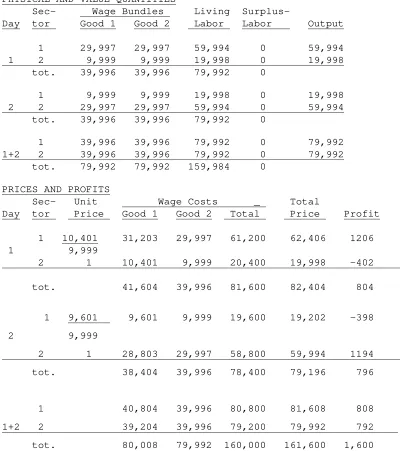
Table 2 presents a similar example that applies to the standard interpretation. Surplus‐labor is zero, but profit is positive. The unit value of each commodity is 1, so the top set of figures represent both physical and value magnitudes. Again, wage rates are equal, techniques are not changing, the two sectors grow at the same rate (zero) in physical terms, and their (positive) two‐day profit rates are equal (1%). This economy can also sustain itself ad infinitum, both in a physical sense — two‐day surpluses of both goods are non‐negative — and because the capitalists are making profits. Even in this tableau, in which the economy is in simple reproduction and everything is in equilibrium except that relative prices vary modestly, the standard interpretation implies that surplus‐labor is unnecessary for positive profit.
THE
TEMPORAL SINGLE‐
SYSTEM
INTERPRETATIONThe results to this point have been negative. It might therefore be thought that, no matter how Marx’s value theory is interpreted, surplus‐labor turns out not to be the sole source of profit. This is not the case. The temporal single‐system interpretation which is dealt with in the next section (see, e.g., Ernst (1982), Kliman and McGlone (1988), Giussani (1991‐92), Freeman and Carchedi, eds. (1996),
Maldonado‐Filho (1997), Ramos (1997)) does imply that surplus‐labor is both necessary and sufficient for profit to exist, and under completely general conditions. More precisely, although negative (positive)
nominal profit and positive (negative) surplus‐labor can coexist, real profit is positive (negative) when
surplus‐labor is positive (negative).
This interpretation, like the newer simultaneist interpretations, construes surplus‐labor as living labor minus the labor‐time equivalent of the money wage:
s = x – (1/t)wtx. (1.7)
Note, however, that variables are now defined within historical time. In particular, , the “temporalist monetary expression of labor‐time,” differs from s because the relation between money and labor‐time
is allowed to vary between the time of input and the time of output.
Nominal profit is interpreted as N = p
t+1x – ptAx – wtx (inputs enter production at time t, output is
produced at time t+1). Real profit, however, deflates sales revenue (pt+1x) in order to adjust for changes
between times t and t+1 in the amount of money that represents one unit of value. Thus
R = (1/[1+i])p
t+1x – ptAx – wtx, (1.8)
where i = (t+1 – t)/t is the rate of inflation in the monetary expression of labor‐time.
t+1 is defined as the ratio of the money price of output to the sum of dead and living labor needed to produce it:
t+1 = pt+1x/([1/t]ptAx + x) = tpt+1x/(ptAx + tx), (1.9) where [1/t]ptAx, the labor‐time equivalent of the price of means of production, is interpreted as dead
labor. Since 1+i = t+1/t, (1.9) implies that t+1/t = 1+i = pt+1x/(ptAx + tx). Substituting this result into (1.8), one obtains
R = (p
tAx + tx) – ptAx – wtx = tx – wtx, (1.10) which implies that
This looks very similar to the proportionality between surplus‐labor and profit that was derived from the newer simultaneist interpretations. Yet whereas s, the simultaneist monetary expression of labor‐time,
need not be positive, examination of (1.10) shows that, if prices and the initial condition 0 are positive, then all subsequent terms of the ‐series must also be positive. The proportionality between surplus‐ labor and real profit, together with this result on , imply that surplus‐labor is both necessary and sufficient for real profit to be positive.
A
DIALOGUE
BETWEEN
THE
TWO
CHIEF
SYSTEMS
OF
VALUE
DOES
IT MATTER WHAT MARX REALLY SAID?Let us suppose we were offered a refutation of Einstein’s special theory which supposed a fixed frame of reference. Would this constitute a refutation of relativity? Since Einstein does not suppose a fixed frame of reference, we would have to conclude that the refutation was manifestly false. No matter how valid or cogent the logic, the ‘refutation’ would refer to a different theory. No conclusions concerning either Einstein or relatitivity could be drawn from it. Of course, one would have to demonstrate that Einstein does not suppose a fixed frame. This would not be difficult, since he insists on this point in many places.
Of course also, he could be wrong for other reasons. To reject a refutation is not the same as accepting that which is refuted. One would at least have to show that his was a rigorous and coherent theory of space and time in its own terms. The issue would then be only: how well does this theory explain the observable world? Relativity could not be discarded on purely logical grounds. Only one procedure could ascertain its validity, namely to test them against rival theoretical systems to see how well each such system explains observed reality.
But suppose physics systematically refused to contemplate anything issuing from the pen of Einstein, and likewise refused to conduct such tests, on the basis of the above ‘refutation’, rejecting relativity as a viable option on the basis that it was illogical? We would have to conclude that physics had ceased to function as a science and had become a dogma.
Marx in many places clearly insists that he does not presuppose equilibrium, and indeed polemicises violently against it, particularly in relation to Say, to Proudhon, to James Mill and not least in reference to Ricardo’s deference to Say.
Nevertheless, the literature on Marx universally attributes to him a concept of value which does, in fact, presuppose equilibrium. Moreover on this basis it does discard him on purely logical grounds. It refuses to subject his theory to the normal scientific test of asking whether it explains the world we live in. It rules his theory out of court before such a dialogue is permitted.
This could be excused as a mere omission, were it not for the following: a substantial literature, dating back at least a decade, offers an alternative, non‐equilibrium interpretation of Marx. Moreover there is an earlier history, dating back to the late 1970s, of systematic silence concerning, and in places
suppression of, contributions leading towards this interpretation.
must therefore follow an unusual course; we have to conjoin a study of the value concept to an analysis of the ideology that denies it.
A
SIMPLE ILLUSTRATION CONCERNING THE FALLING RATE OF PROFITIn the literature on Marx’s ‘tendency of the rate of profit to fall’ it is universally asserted that he made a logical error, because he failed to take into account the cheapening of inputs. Indeed this proposal is generally put in an extremely strong way:
Our conclusions are negative to Marxian Gesetz des tendenziellen Falls der Profitrate
(Okishio 1961:95)
It cannot be shown in general that a rise in the organic composition of capital leads to a fall in the rate of profit…A falling‐rate‐of‐profit crisis is not a theoretical necessity;
indeed, it is not even a possibility under conditions of competitive capitalism (van Parijs
1980:1)
In the absence of sufficient accumulation, capitalist‐using labor‐saving technical change,
and, further, technical change in which the organic composition of capital rises, induces
a rise in the rate of profit (Thompson 1995:97)
By any normal usage of the English language, such statements assert:
(a) that Marx’s own profit rate cannot possibly fall as he predicted as a necessary consequence of a rise in the organic composition of capital in the absence of a change in the mass of surplus value.
(b) moreover the actual profit rate in the economy cannot fall for the same reason.
Almost nowhere do we find the much more scientifically correct statement: “The profit rate which the economists attribute to Marx does not behave as Marx predicted.” When correctly stated, such findings are open to a much simpler explanation, namely, that Marx and the economists are talking about two different things. The ‘proof’ of his error, and of the alleged actual course of the profit rate, depends on a
definition. The proof applies only if value, price and profit are defined, even when the economy is
changing continously, as those magnitudes which would pertain if the economy were to become miraculously static. The ‘refutation’ depends on a distinct value concept, which we term the
simultaneous or equilibrium value concept. This concept is alleged to be Marx’s, and on this basis, his
theory is alleged to be false.
This is not an insignificant or merely hermeneutic issue, of interest only to historians. Ultimately at issue is what happens to the actual profit rate in the actual world economy that is, why crises happen. Economics rules out of court, by this device, the one explanation that accounts for what any averagely‐ educated person may plainly see.
As we shall now show, the simultaneous definition of these magnitudes is not the only one possible. An alternative set of definitions, corresponding to a distinct value concept which we term temporal or non‐
The example
To illustrate these two concepts we begin by supposing a market economy producing a single good. Since this idea has given rise to spurious objections, we note in passing that there are two commodities, the good itself and labour‐power.
We suppose that this economy undergoes steady technical change, such that with a constant labour force, that outputs and inputs rise constantly but that outputs rise faster than inputs. For simplicity we also suppose that the workers consume nothing.xi
We also suppose, again for simplicity, that it is possible to invest the entire product each year (maximum expanded reproduction).
To fix ideas we have chosen a sequence of outputs that gives whole numbers; the reader can easily obtain the same qualitative results for any sequence satisfying the assumptions above. Table 1 then gives the sequence in terms of use‐values:
Period C L Produces X
1 10 10 12
2 12 10 15
3 15 10 20
4 20 10 28
Table 1: use‐value, maximum expanded reproduction
C = means of production consumed as constant capital,
L = quantity of labour power
X = output
Some notation
It is useful to keep track of the units in which a quantity is measured by extending normal money symbols in an obvious way, writing h100 to mean 100 hours of labour‐time. It is easier to see these by raising them, thus: b100 means 100 bushels of corn. If omitted, the implicit unit is use‐value.
Ratios can then be denoted by subscripting the denominator: R$h10 means “10 Reals per hour”. Usefully, subscripts and superscripts then cancel out just like fractions. For example if the exchange‐rate of dollars for Reals is $R$1.6, then R$10 in dollars is R$10 × $R$1.6 = $16
The time at which any variable is measured will from now on be represented with a subscript: for example Ct is constant capital at time t. For period (discrete) systems t indicates a measurement made at the beginning of period [t, t+1].
The simultaneous value calculation
Now calculate the values which correspond to this sequence in the normal, simultaneous manner. To do this, we ask what price would, in each period, reproduce the economy without changing its proportions
that is v1 = 10/ (12 10) = 5
We can calculate values in each period in the same way and so convert all magnitudes to values:
Period v hC hL Equals hX
1 5 50 10 = 60
2 3.33 40 10 = 50
3 2 30 10 = 40
4 1.25 25 10 = 35
Table 2: simultaneous values, maximum expanded reproduction
From this follow a number of conclusions that are taken as ‘standard’ conclusions in the normal interpretation of Marx:
Conclusion 1: values are directly determined by the physical structure of the economy. In each period, there is one and only one possible row in table 2, completely given by the corresponding row in table 1. Values are ‘redundant’; use‐values determine all the properties of the economy.
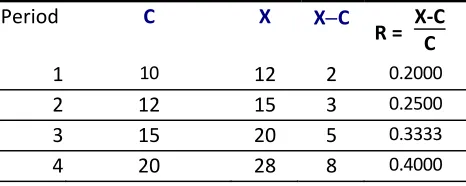
Conclusion 2: organic composition falls, and the rate of profit inevitably rises, with technical progress. Values are as just observed irrelevant to this conclusion; profit is directly given by the physical structure of the economy. We just subtract the physical input from the physical output and divide by the physical input.
Period C X XC
R = XC‐C
1 10 12 2 0.2000
2 12 15 3 0.2500
3 15 20 5 0.3333
4 20 28 8 0.4000
Table 3: use‐value, maximum expanded reproduction
These conclusions are quite conventional in the simultaneous paradigm. However, a number of stranger conclusions spring to the eye.
Conclusion 3: values so defined cannot function as prices. Although values are defined as rates of exchange, that is, actual prices, in fact they cannot be so given the sequence we have specified. The product at the end of period 1 is sold for 5 hours per bushel (hb5 in our full notation). But when used as an input in period 2, it would be paid for at the prices of period 2, so it would have to be bought for hb31/3. If this were a real exchange, it would be impossible. A commodity cannot be sold for one price,
and bought for another.
Conclusion 4: the value added to the total product is not equal to the time worked. At the beginning, we had h50 in input. Consider the combined effect, now, of periods 1 and 2. No product was consumed except in production. The living labour added in both periods was h20. We should have h50 + h20 = h70. But we don’t; we have h50. 20 hours have been lost. It is hardly surprising that the organic composition falls, if we throw away half the value created at the end of every period.
[image:19.612.145.466.114.187.2] [image:19.612.190.423.355.448.2]Strangely enough, this happiness is confined to value; when money or people disappear without trace, it is a great deal more alarming than when they appear without reason.
Nevertheless, if we simply reverse the figures, the above reasoning creates value from nowhere. If we suppose a decrease, instead of an increase, in productivity, then the inputs to each period will be magically greater than the output of the last period. Moreover, the greater the decrease, the more value from nowhere, so that the most productive activity of all is to do nothing at all but simply wait for nature to make inert copies of itself.
Conclusion 6: profits are independent of money: that is, they are independent of the numéraire. This is an extraordinary result, though it fully accords with neoclassical general equilibrium. In a real
economy the monetary profit rate depends on the money used, as discussed in section 2.7. If the dollar is rising relative to the pound, then the profit rate in pounds will be lower than the profit rate in dollars.
The only circumstance in which the profit rate really is independent of the numéraire is if the numéraire is constant, that is, in a stationary economy.xii Otherwise, there are as many profit rates as there are moneys or numéraires. But, according to the presentation above there is only one profit rate; this is ‘the’ profit rate, and Marx’s great error was in failing to understand that it has to rise. As we will shortly show (see equation 2.3) there are as many different profit rates as there are value concepts.
There is therefore no unique profit rate. Before deciding either if Marx was wrong, or assessing what really happens in the economy, we must first enquire which profit rate is under discussion.
Monetarising the simultaneous value concept
We can enquire further into all these results if we ask the following question: how could such an economy function according to sensible market rules, that is, in such a way that the money paid for a commodity is equal to the money received for it? This would happen if, for example, at the end of period 1 we exchanged one hour of labour for 60/40 = $1.5; if at the end of period 2 we devalued by a further 50/30 , at the end of period 3 by a further 40/25, and so on. Defining the monetary expression of
labour to be the ratio between dollars and hours and calling this also e we have
$ he0 = 1
$
he1 = 60/40 = 1.5
$
he2 = 60/40 × 50/30 = 2.5
$
he3 = 60/40 × 50/30 × 40/25 = 4
and we can write a table of money transactions in this money, thus:
Period $h P $C $L Equals $X
1 5 50 10 60
2 5 60 15 75
3 5 75 25 100
4 5 100 40 140
Table 4: use‐value, maximum expanded reproduction
actually done is to revalue the value contribution of labour‐power in each period, by an amount exactly equal to the increment in its productivity. In consequence, the prices, down the lefthand side, are simply ‘corn‐prices’; they use the commodity itself, instead of labour, as numéraire. In short, we have a use‐ value measure of value. The only difference, therefore, between a ‘labour‐value’ system calculated simultaneously, and a straightforward system of corn‐values, is the numéraire; moreover, when we adopt a numéraire which is correctly adjusted, in each period, to permit monetary exchange, simultaneous ‘labour values’ are identical to corn‐values.
We summarise this by the assertion that simultaneous valuation yields a use‐value concept of value. The temporal calculation
The temporal calculation follows from the following, simple idea: outputs have a different value from inputs. While production takes place, values change. The value of outputs is then given, not by solving a simultaneous equation but a difference equation corresponding to the temporal order of the circuit
MCP…CM
We have to suppose an initial value v0, as with any difference equation. This initial condition reflects the whole of a past history that we do not know. It can be demonstrated that the errors that might result from an incorrect initial condition decay exponentially. Here, for illustration, we suppose it to be the simultaneous value, 5.
In period 1, we then calculate v1 as follows:
10v0 + 10 = 12v1
that is 10 × 5 + 10 = 12v1
giving v1 = 5
So far this is the same as the simultaneous value since we chose v0 this way, to achieve a level playing field. However in the next period we find
that is 12 × 5 + 10 = 15v2
giving v2 = 42/3
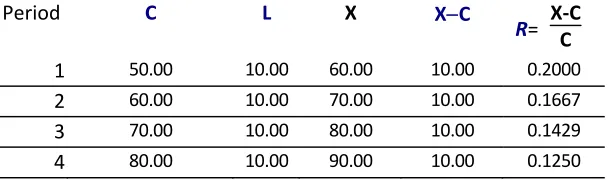
This is greater than the simultaneous value, but less than the old value. Value, according to this concept, has declined but has not fallen as far as it would in the ideal, simultaneous, economy of table 2. We can now reproduce a different table of values in which we will write, in a separate column, the value rate of profit.
Period C L X XC
R= X‐C
C
1 50.00 10.00 60.00 10.00 0.2000
2 60.00 10.00 70.00 10.00 0.1667
3 70.00 10.00 80.00 10.00 0.1429
4 80.00 10.00 90.00 10.00 0.1250
Table 5: temporal value, maximum expanded reproduction
[image:21.612.155.460.579.669.2]