Application of UPFC to Increase Transient
Stability of Inter-Area Power System
Prechanon Kumkratug
Kasetsart University Sriracha Campus, Electrical Engineering, Chonburi, Thailand Email: [email protected]
Abstract—Unified Power Flow Controller (UPFC) is a power electronic based device that has capability of controlling the power flow through the line by controlling appropriate its series and shunt parameter. It has been reported that UPFC can improve transient stability of a simple system. This paper investigates the improvement of transient stability of inter-area power system. The mathematical model of UPFC is present in this paper. The UPFC is modeled as the variable susceptance and is incorporated into the model of power system. The simulation results are tested on the Kundur’s inter-area power system.
Index Terms—power system, transient stability, FACTS, UPFC, inter-area power system.
I. INTRODUCTION
Modern power systems are becoming increasingly stressed because of growing demand. Because of variety of factors, such as environmental legislation, rights of way issues, capital investment, deregulation policies, etc. constrain the construction of new transmission lines, electric utilities are now forced to operate their system in such a way that makes better utilization of existing transmission facilities. It is well known that the power flow through transmission line is a function of line impedance, magnitude and phase angle of bus voltage. If these parameters can be controlled, the power flow through the transmission line can be controlled in a predetermined manner. Flexible AC Transmission System (FACTS) uses advanced power electronics to control the parameters in the power system in order to fully utilize the existing transmission facilities [1].
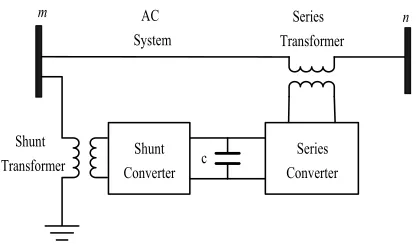
A Unified Power Flow Controller (UPFC) is a member of FACTS devices. It consists of two solid state synchronous voltage source converters coupled through a common DC link as shown in Figure 1[2]. The DC link provides a path to exchange active power between the converters. The series converter injects a voltage in series with the system voltage through a series transformer. The power flow through the line can be regulated by controlling voltage magnitude and angle of series injected voltage. The injected voltage and line current determine the active and reactive power injected by the series converter. The converter has a capability of electrically generating or absorbing the reactive power. However, the
injected active power must be supplied by the DC link, in turn taken from the AC system through the shunt converter. The shunt converter also has a capability of independently supplying or absorbing reactive power to regulate the voltage of the AC system. When the losses of the converters and the associated transformers are neglected, the overall active power exchange between the UPFC and the AC system become zero. However, both the series and shunt converters can independently exchange reactive power [3]. UPFC can improve both steady sate stability, dynamic stability and transient stability [4-5]. For the convenience practical of application, the series voltage angle of UPFC is kept in perpendicular with a line current [6].
System AC
r Transforme
Shunt
Converter Shunt
r Transforme
Series
Converter Series c
m n
Figure 1 Configuration of UPFC.
It has been reported in many papers that UPFC can improve stability of simple system or single machine infinite bus (SMIB) system and multimachine system [5,7]. The inter-area power system has special characteristic of stability behavior [8]. Reference [9] and [10] presented the application of SVC, and TCSC to damping power stability in the inter-area power system.
II. MATHEMATICAL MODEL
A. UPFC Model
Consider the configuration of UPFC inserted between
busm and bus n of power system as shown in Figure 1.
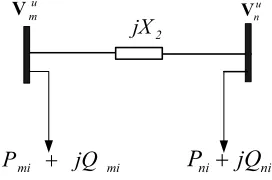
UPFC can be modeled as fictitious active and reactive
power injection at bus m and bus n, respectively as can be
seen in Figure 2.
2 jX u m V u n V mi mi jQ
P
P
nijQ
niFigure 2 Fictitious active and reactive load model of a UPFC.
The detail of deriving the UPFC model can be found
from the previous author’s publication in [7,11].
The fictitious active Pmiu and reactive Qmiu load of UPFC
at bus m as shown are given by
) sin(
V abV
P mnu u n u m u
mi T D (1)
) cos( ) V ( ab V I
Q mu u m q u mi D 2 (2)
The fictitious active Pniu and reactive Qniu load of a
UPFC at bus n are given by
) sin(T D
mu nu mnu
u
ni abV V
P (3)
) cos(Tu D
mn u n u m u
ni abV V
Q (4)
Where
a = voltage magnitude from a series
converter of a UPFC
D = voltage angle from a series conveter of
a UPFC
Iq = shunt current from a shunt converter of
a UPFC
b = susceptance equivalent between bus m
and bus n
u m
V = voltage magnitude at bus m
u n
V = Voltage magnitude at bus n
u mn
T = Voltage angle difference between bus
m and bus n
B. Power System with a UPFC Model
Consider the power system with a UPFC as shown in
Figure 3 (a). In this Figure, UPFC is represented by its
equivalent circuit of Figure 2. The power system can be
represented by generator voltage behind transient
reactance (Ec) and reduced admittance matrix Yint
excluding bus m and bus n. One of possible way to
incorporate the UPFC into power system model is to
convert fictitious active and reactive model to
susceptance model. The admittance Ymuand Ynuas given
in Figure 3(b) can be written by
2 ) V ( jQ P u m u mi u mi u m
Y (5)
) V ( jQ P n u ni u ni u n 2
Y (6)
Now the susceptance model of a UPFC can be
incorporated into power system represented by the
admittance matrix (Yintu ) as can be seen in Figure 3(c).
The dynamic equation of machine system in center of
inertia (COI) is expressed by [12]
i i ~ ~
Z
G (5)
] P M M P P [ M ~ COI T i ei mi i i 1
Z (6)
i=1, 2…ng
Where
i
G
~
= machine angle of the i-th machinei
mi
P = input mechanical power of the
i-th machine
ei
P = output electrical power of the
i-th machine
and PCOI is given by
¦
g
n
i
ei i COI [P P ] P
1
(7)
2
jX
u m
V u
n V
mi
mi jQ
P
ni
ni jQ
P
1
Ec 2 Ec ng
i
Ec
Power System
(a)
1
Ec 2
Ec
ng
i Ec
int
Y
2 jX u
m
V u
n
V
u m
Y u
n
Y
(b)
1
Ec
2
Ec
ng
i
Ec
u
int
Y
(c)
Figure 3 Multimachine power system with a UPFC (a) fictitious load model of UPFC (b) susceptance model of a UPFC (c) the successive model of UPFC.
III. CONTROL STRATEGY
It has been reported in [9] that the use of line power flow (Pf) of tie line (between area) to shunt FACTS
can improve dynamic behavior of power system. This paper applied the line power flow to control parameters of UPFC (a, D and Iq ). When the
dt Pf
d( )/ >0, parameter on a UPFC is controlled in capacitive mode; when the d(Pf)/dt<0, parameter on a UPFC is controlled in reactive mode. The controlled strategy of a UPFC is given by
when dt
P d( f)
>0
max
a
a (8)
90
D (10)
max q
q I
I (11)
when
dt
P
d
(
f)
<0
max
a
a (12)
90
D (13)
min q
q I
I (14)
and when dt
P d( f)
=0
0
a (15)
0
D (16)
0 q
I (17)
IV. SIMULATION RESULTS
The proposed method of improving transient stability by using a UPFC is tested on Kundur’s inter-area power system. The system consists of 4 generators, 4 transformers and 11 buses. The system data and initial operating point is given in [13]. UPFC is equipped between area 1( generator 1 and generator 2) and area 2 (generator 3 and generator 4) at bus 8. It is considered that a 3 phase fault appears at bus 8 at 100 msec and it is cleared at 140 msec.
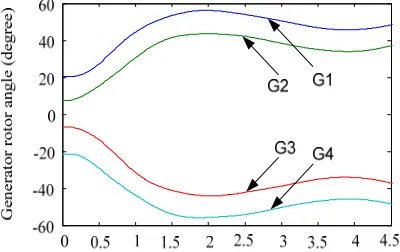
It can be seen from Figure 5 that, without a UPFC (a=0,
DandIq=0), the different of generator rotor angle of area
Figure 4 Kundur’s inter-area power system with a UPFC.
However, with a UPFC (Iq=0.1 pu and a=0.05 pu), the
system is considered as stable as can be seen in Figure 6. This paper also studies the effect of the ratings of a UPFC on stability improvement. Figure 7 shows trajectory of generator rotor angle of Kundur’s inter-area system with a UPFC (a=0.08 and Iq=0.8). Table I summarizes the
generator rotor angle of Figure 6 and Figure 7. It can be seen From the Figure and Table that the trajectory of the generator rotor angle is improved as the rating of a UPFC gets increase.
Figure 5 Trajectory of generator rotor angle of Kundur’s inter-area system without a UPFC.
Figure 6 Trajectory of generator rotor angle of Kundur’s inter-area system with a UPFC (a=0.05 and Iq=0.1).
Figure 7 Trajectory of generator rotor angle of Kundur’s inter-area system with a UPFC (a=0.08 and Iq=0.8).
TABLE I.
IMPROVEMENT OF GENERATOR ROTOR ANGLE FORVARIOUS RATINGS OF UPFC
Gen. No.
First Swing Second Swing
Iq=0.1,a
=0.05 (deg.)
Iq=0.8,a=0.
08 (deg.)
Iq=0.1,a
=0.05 (deg.)
Iq=0.8,a
=0.08 (deg.)
1 55.41 54.33 46.08 41.02
2 42.08 39.21 35.02 28.17
3 -46.24 -39.99 -35.13 -28.26
4 -57.42 -51.06 -46.74 -41.45
V. CONCULSION
This paper investigates the capability of UPFC on transient stability of a inter-area power system. UPFC can be modeled as fictitious active and reactive load of power system. To incorporate UPFC into power system, the fictitious load models are transferred to susceptance models. These models can be controlled by parameters on a UPFC (a,DandIq). This paper uses the line power flow
system. It was found from simulation results that UPFC can improve stability of inter-area power system and also was found that the stability of system is increased as the ratings of UPFC gets increase.
ACKNOWLEDGMENT
The authors gratefully acknowledge Kasetsart university at Sriracha campus for financial support awarded to Prechanon Kumkratug.
REFERENCES
[1] N.G. Hingorani and L. Gyugyi, “Understanding FACTS: concepts and technology of flexible ac transmission systems”, IEEE Press, NY, 1999.
[2] Y.H. Song and A.T. Johns, “Flexible ac transmission systems (FACTS)”, The Institute of Electrical Engineers, London, 1999.
[3] L. Gyugyi, “Dynamic compensation of ac transmission line by solid-state synchronous voltage sources”, IEEE Trans. Power Delivery, Vol. 9, pp. 904-911, Apr. 1994.
[4] M. Noroozian, L. Angquist, M. Ghandhari, and G. Andersson, “Use of UPFC for optimal power flow control”, IEEE Trans. on Power Delivery, Vol. 12, No. 4, pp. 1629-1634, 1997.
[5] M. Ghandhahi, G. Adersson and I.A. Hiskens,“Control Lyapunov functions for series devices”, IEEE Trans. on Power Delivery, Vol. 16, No. 4, 2001, pp. 689-694. [6] E. Gholipour and S. Saasate, “Improving of Transient
Stability of Power Systems Using UPFC”, IEEE Trans. on Power Delivery, Vol. 20, No. 2, pp. 1677-1682, 2005. [7] P. Kumkratug and M.H. Haque, “Versatile model of a
unified power flow controller in simple system”, IEE Proc.-Gener. Transm. Distrib., Vol. 150, No. 2, pp. 155-161.
[8] V.Vital, N. Bhatia and A.A. Fouad, “Analysis of the Inter-area Mode Phenomenon in Power Systems
Following Large Disturbances”, IEEE Transactions on Power System, Vol. 6, No. 4, 1991.
[9] E. Z. Zhou, “Application of Static Var Compensators to Increase Power System Damping”, IEEE Transactions on Power System, Vol. 8, No. 2, 1991. [10] M. Noroozian, G. Andersson and K. Tomsovic, “Robust,
Near Time-Optimal Control of Power System Oscillations with Fuzzy Logic”, IEEE Transactions on Power Delivery, Vol, 11, No.1, 1996.
[11] P. Kumkratug and P. Laohachai, “Time domain simulation technique of a power system transient with VSC based FACTS devices”, AMS2007, Phuket, Thailand.
[12]M.A. Pai, “Energy function analysis for power system stability”, Kluwer Acadenic Publishers, 1981.
[13] P. Kundur, “ Power System Stability and Control”, Mc Graw-Hill, Singapore.
Prechanon Kumkratug received the B.E., M.E. and D.E. degree in electrical engineering from King mongkut’s institute of technology, Ladkrabang and Asian institute of technology and Kasetsart university, Thailand, respectively.
His employment experience included the Advanced info sevices plc., Mahanakhon university of technology, King mongkut’s university of technology, Eastern asia university and Kasetsart university at Sriracha campus, Thailand, respectively. His research interests are power system analysis, stability, control and HVDC/FACTS.