Georgia State University Georgia State University
ScholarWorks @ Georgia State University
ScholarWorks @ Georgia State University
Art and Design Theses Ernest G. Welch School of Art and Design
Summer 7-8-2011
Igniting my Creative Process
Igniting my Creative Process
Stephanie E. Olson
Follow this and additional works at: https://scholarworks.gsu.edu/art_design_theses
Recommended Citation Recommended Citation
Olson, Stephanie E., "Igniting my Creative Process." Thesis, Georgia State University, 2011. https://scholarworks.gsu.edu/art_design_theses/87
! "!
IGNITING MY CREATIVE PROCESS
by
STEPHANIE ELISABETH OLSON
Under the Direction of Dr. Melody Milbrandt
ABSTRACT
This art-based research study will examine creativity and the creative process during the
production of a cohesive body of work. The author’s auto-ethnographic reflections of her
creative process were recorded, and analyzed. The artist/teacher/researcher will provide
conclusions based on her art production and self-reflection.
! ""!
IGNITING MY CREATIVE PROCESS
by
STEPHANIE ELISABETH OLSON
A Thesis Submitted in Partial Fulfillment of the Requirements for the Degree of
Master of Art Education
in the College of Arts and Sciences
Georgia State University
! """!
Copyright by
Stephanie Elisabeth Olson
! "#!
IGNITING MY CREATIVE PROCESS
by
STEPHANIE ELISABETH OLSON
Committee Chair: Dr. Melody Milbrandt
Committee: Dr. Melanie Davenport
Dr. Kevin Hsieh
Electronic Version Approved:
Office of Graduate Studies
College of Arts and Sciences
Georgia State University
! "#!
TABLE OF CONTENTS
LIST OF FIGURES v
CHAPTER 1 INTRODUCTION 1
Terms of the Study 1
Purpose of the Study 2
CHAPTER 2 REVIEW OF LITERATURE 3
CHAPTER 3 METHODOLOGY 7
Art Production 8
Plan for Reflection 9
Limitations of the Study 10
Interpretations and Reflection of Works 11
CHAPTER 4 IMPLEMENTATION & EDUCATIONAL PRACTICE 41
CHAPTER 5 CONCLUSION & RECOMMENDATIONS 44
Conclusions 44
Recommendations for Further Research 46
! #!
LIST OF FIGURES
Figure 3.1 Preliminary Sketch for Cross Connections 14
Figure 3.2 Preliminary Sketch for Cross Connections 14
Figure 3.3 Compositional Photo Study for Cross Connections 14
Figure 3.4 Compositional Photo Study for Cross Connections 14
Figure 3.5 Compositional Photo Study for Cross Connections 14
Figure 3.6 Cross Connections, Media: Antique chalkboard, charcoal, & chalk 17
Size: 3’ x 5’
Figure 3.7 Compositional Photo Study for Instruction 18
Figure 3.8 Compositional Photo Study for Instruction 18
Figure 3.9 Instruction, Media: Antique chalkboard, charcoal, & colored chalk 22
Size: 6’ x 8’
Figure 3.10 Compositional Photo Study for Tie 23
Figure 3.11 Compositional Photo Study for Tie 23
Figure 3.12 Tie, Media: Chalkboard, charcoal, & chalk, Size: 6’ x 8’ 25
Figure 3.13 Compositional Photo Study for Embrace 27
! #"!
Figure 3.15 Compositional Photo Study for Embrace 27
Figure 3.16 Preliminary Sketch for Embrace 27
Figure 3.17 Embrace, Media: Chalkboard, charcoal, & colored chalk Size: 8’ x 6’ 29
Figure 3.18 Compositional Photo Study for Affirmation 31
Figure 3.19 Compositional Photo Study for Affirmation 31
Figure 3.20 Compositional Photo Study for Affirmation 31
Figure 3.21 Affirmation, Media: Projector screen, charcoal, pencil, & chalk 33
Size: 5’ x 5’ 10”
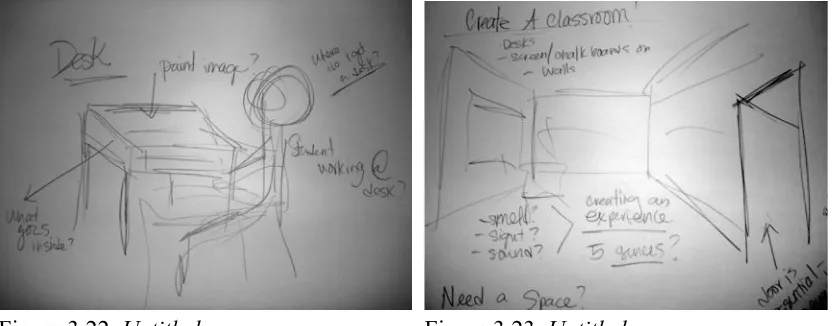
Figure 3.22 Preliminary Sketch for Sterile 35
Figure 3.23 Preliminary Sketch for Sterile 35
Figure 3.24 Sterile, Exterior, Media: Antique desk, primer, enamel, & acrylic 37
Size: 2’ 3” x 2’ x 2’ 10”
Figure 3.24 Sterile, Interior, Media: Antique desk, primer, enamel, & acrylic 37
Size: 2’ 3” x 2’ x 2’ 10”
Figure 3.25 Preliminary Sketch for 784 38
! $!
CHAPTER 1
INTRODUCTION
Terms of the Study
The creative process. What is my creative process? What is meant by creative process?
Trust the process; forget the plan; let the artwork take you in the direction you want to go. What
if I don’t have a process to trust? How do I trust a process that may not work? What if . . .I fail?
I am not sure I completely understand what my creative process is. In the past I have
always visualized my work, focused on the main objectives and had the end goal/product in
sight. My work was always very planned, structured and almost mathematical. I would not
deviate from the original plan in any way, nor would I allow room for development within the
work. I continued to struggle with my inability to predict the final product and being able to just
trust the process. I believe this was the biggest challenge for me when creating art. Recently, I
have begun to understand that to be an artist; I need to allow artwork to change directions during
the creation process.
Not only do I want to better understand the creative process within my own work, I want
to know how to teach this process to my students. Understanding that an artist needs to be able to
allow artwork to change directions, allowing for growth and development during the creative
process is something I want my students to be able to do. I believe these skills are crucial to art
education and something I want to be able to teach better. As Eisner (2002) discusses the
importance of art education, he points out that learning through art can teach students that there
can be multiple perspectives to solving problems, that problem solving is complex, and also that
problems can have more than one solution. By solving problems in the creation of artwork
! %!
& Carter, 2011) agree, “teachers who model creativity or divergent thinking are more successful
in the development of creative thinking behaviors in the classroom” (p.24).
Purpose of the Study
The purpose of the study was to develop my creative process and artistic working
methods. I wanted to use this research to investigate the way I create and the steps I take during
the creation, development and completion of art. I also hoped to better understand myself as an
artist and to expand my creative development. Since beginning to work full time and after
completing my undergraduate degree, I had not found the time to create art. I hope this research
will inspire me to return to creating art regularly. I also hope that this study may inspire others to
evaluate their creative processes and working methods.
The second main objective of this study is professional development. M. Milbrandt & L.
Milbrandt (2011) agree that, “there is little evidence in the current educational system to suggest
that schools teach students how to selectively discuss or use creative thinking processes for
personal or collective benefit or openly support students’ sustained creative involvement” (p. 8).
I hope that by better understanding my working methods, I will be able to better teach my
students how to use creative thinking strategies and is my hope that this research will give me the
tools to guide my students through their creative processes. This study investigates how and if
the creative process can be developed researched and analyzed, by attempting to answer the
question: What is my creative process?
In order to document and assess my findings, I used the artwork created during the study
as a product of the creative process. A visual verbal journal was also be used to chart and reflect
! &!
CHAPTER 2
REVIEW OF LITERATURE
My research of the creative process began with an in depth look at creativity and more
specifically the creative process. I have found that although many researchers have investigated
creativity, there still does not seem to be a clear, agreed upon definition of what creativity is.
Milbrandt and Milbrandt (2011) state, “Part of the problem in our current educational context is
that the term creativity is so ill-defined, ambiguous, and fuzzy so that no common agreement
exists in its meaning” (M. Milbrandt, L.Milbrandt, 2011, p.8). Since my goal is to develop my
own unique process, I have primarily focused my research specifically on the creative process.
Within his book, A Whack on the Side of the Head, the author, Roger von Oech (2008),
takes the reader through many different ways to become more creative by giving very specific
ways to change one’s thinking. He describes the creative process in terms of two different phases
during the development of ideas: an imaginative phase and a practical phase (Oech, 2008). Oech
describes the imaginative phase as the play phase where creators generate new ideas, think about
ways of breaking the rules, and thinking something different. During this phase the creator does
not have limits to their thoughts. The practical phase is the “getting something done” phase of
the process. Here the creative person looks at the problem logically and evaluates the questions
generated. He also discusses the importance for both types of thinking within the creative
process, “Soft thinking in the practical phases can prevent the execution of an idea; hard thinking
in the imaginative phases can limit the creative process and prematurely narrow our thinking”
(Oech, 2008, p. 55).
Similar to Oech’s imaginative and practical stages within the creative process, Gnezda
! '!
(Gnezda, 2011, p.49). She describes these stages in relation to the creative process and during
creation. However, unlike Oech, she describes these stages in relation to the creator’s emotions
and reasons for creating. She says, “A range of emotions tends to accompany the varying neural
actions involved in creativity, making creativity a rich affective experience” (Gnezda, 2011, p.
49). The inspiration stage is described by Haier and Jung as a euphoric “dreamlike state of
defocused attention,” by Canfield as “thrill of intense feeling”, by Ghiselin as “wholly
inexplicable satisfaction or excitement” and Arieti said, “the artist feels almost as if he had
touched the universe” (as cited in Gnezda, 2011, p.49). However, this exciting, energizing stage
is very short and must be connected to the Implementation stage to facilitate the construction of
meaning or a new idea. Gnezda (2011) describes the Implementation stage of the creative
process as frustrating, filled with hard work and self-doubt. “Creators struggle, start over,
reconsider, become exasperated, and question their abilities” (Gnezda, p. 49). Differing from
Oech’s creative process, where the new idea or concept is the revelation, Gnezda’s framework
sets the creative experience on the pedestal. She even describes the longing creators feel when
not absorbed in inspiration stage of the creative process.
Starko (2010), within her book, Creativity in the Classroom, outlines Wallas’s (1926)
“classic description” of the creative process. This process, unlike Gnezda and Oech’s consists of
four main stages; preparation, incubation, illumination and verification. During the preparation
stage, the creator is generating ideas, gathering thoughts and ideas about the problem and
comparing these thoughts to one another. Throughout the incubation stage, the creator is not
consciously thinking about the problem, but letting the subconscious attend to the problem.
However, it is important to note that, incubation and the reality of its existence is a key debate
! (!
differ among creators), comes a point when everything begins to make sense and solutions are
visible. Wallas calls this the illumination stage. The final stage Wallas describes is the
verification stage where the solutions found during illumination are checked and evaluated for
appropriateness and practicality.
In addition to outlining Wallas’ stages of creativity, Starko (2010) also emphasizes the
importance of problem finding. She says, “Problem finding, or the identification and framing of
problems, is fundamental to creative processes” (Starko, 2010, p. 29). Starko points out that
when she refers to a “problem” or “problem finding” she is not only referring to a difficulty but a
change in ones perspective or an opportunity. Thus there may be various types of problems.
Starko outlines three types of problems; Presented: problems with known formulations,
Emergent: problems where the solution is not known to the problem solver, but may exist and
Discovered: a problem where the problem and the solution are unknown. The question then
becomes how do artists and creators formulate the problems they wish to investigate? How are
these problems discovered? Strako describes the process of problem finding as a “complex
interaction of the person, the discipline, and the environment” (Starko, 2010, p.34).
Unfortunately at this time there is no clear research on one way to develop problems, it varies
greatly from individual to individual. When Starko researched firsthand accounts, she found that
they vary from mystical to methodical. Some artists even describe their creativity a gift from the
divine, completely beyond their control (Starko, 2010).
Within her article, Creativity and Imagination: Tools for Teaching Artistic Inquiry, Heid
(2008), outlines a case study that uses various strategies for enhancing creativity within
elementary art students. Although not referencing a specific “process,” the article address several
! )!
references Torrance and Safter’s (1999) levels of creative thinking skills composed of four
levels: fluency, flexibility, originally, and elaboration. Fluency is the ability to generate multiple
ideas with a variety of possibilities. Flexibility is also described as the ability to move from one
idea to another. Originality is the ability to generate multiple solutions that are unique and
elaboration is the ability to extend one’s thoughts by enhancing details (Heid, 2008). Similar to
the previously discussed processes these characteristics are considered to build upon each other,
“these levels exist in an ascending hierarchy of skill and ability” (Heid, 2008, p.42).
Another important aspect of creativity addressed within Heid’s case study is the use of
metaphors and metaphoric thinking. Starko states, “…the ability to engage is metaphor making
operates at the highest levels of cognitive function” (cited by Heid, 2008, p.46). Learning how to
facilitate this type of thinking with my students is one of my main goals of this study. The use of
metaphoric thinking and its importance within creativity is also referenced by Irwin (2004) and
Oech (2008). Oech discusses the importance of metaphors in terms of thinking about similarity.
He says, “We understand the unfamiliar by means of the similarities it has with what is familiar
to us” (Oech, 2008, p.60). Irwin (2004) discusses the metaphors to recreate experiences as a
means for assessment of arts-based research methodology.
After comparing even four models of the creativity process, it is clear that a successful
process must include a stage of thinking that involves some type of inspiration or inclination to
create and a stage that involves actually implementation of the ideas generated. What happens
before and between these stages seems more ambiguous. After comparing the research, it seems
that this depends on a combination of factors, not limited to but including, the creator, the
! *!
CHAPTER 3
METHODOLOGY
My artistic research goal was to create a body of work that explores what it means to be
an art teacher engaged in the human experiences, which occur within the classroom setting,
while simultaneously exploring and developing my own artistic working habits and creative
process. The focus of my research was on developing and documenting my creative process.
Specifically my subject matter was an investigation of my relationship with my students and my
relationship with teaching. While my drawings exemplify human connections, these drawings
are also about my desire to return to the naivety and enthusiasm of a fresh, inexperienced
teacher. In this way, my work serves as a psychological self-portrait. Each one is a reflection of
feelings and experiences that I myself have felt and my portrayal of my students’ reactions to
them.
Irwin (2004) describes A/r/tography as an art-based research method, which emphasizes
living inquiry and reflective practice by studying the in-between spaces of
art-making/researching/ teaching. Rita Irwin (2004) explains that a/r/tography is based on Aristotle’s
three realms of knowledge: theoria (knowing), praxis (doing), and poesis (making).
A/r/tographers are connected to, not separate from, the researching, the teaching, and the
art-making processes. It is this interconnectedness which attracts me to this methodology. Irwin
says, “If we conceive if researching, teaching, and art-making as activities that weave in and
through one another—an interweaving and interweaving of concepts, activities, and feelings—
we are creating fabrics of similarity and difference” (Irwin, 2004, p.28). Throughout her writing
she emphasizes how this way of working, this interconnected thinking is essential to significant
! +!
In order to do this, I recorded my reflections, insights, problems, discoveries and
developments in a visual verbal journal. Within the visual verbal journal, I included ideas for
works of art, sketches, illustrations and photographs. The visual verbal journal was used for
inspiration, planning and documentation. Written journaling, reflecting on the progress before,
during and after the work was included. After the work was completed I compiled a final, more
extensive, written reflection.
I created a total of seven works of art, or an installation containing these works. One of
my main objectives was to allow for spontaneous creations, fluidity and flexibility within my
artistic process; therefore a detailed outline of my process would have been counterproductive.
The work took three months to complete (October 2010 - December 2010). I hoped that during
the creation of this work I would further develop my understanding of my creative process and
professional growth as an artist. I believe this work helped me to build a personal trust within the
creative process. I also found that this work allowed me to understand failures, accept failures
and learn how to grow from them.
Art Production
In order to change my creative process from my previous way of working, I intended to
leave the production plan as open-ended as possible. For example, I did not want to explicitly list
the materials I was going to use. Through the creative process, the materials most appropriate
were selected. Initially I focused on the positive relationships I created with my students;
however, I did not limit my research to this subject alone. As my relationships with my students
evolved and changed my work did as well. I believed that if I planned every aspect of the work,
it would result in stale and boring productions. However, as the direction of my work changed, I
! ,!
A challenge I faced during the production stage was to create a body of work that was
cohesive enough to work together, while simultaneously allowing each piece to be unique and
stand on its own. I realized that I would need to avoid letting my art become too structured as it
has in the past and to avoid obvious or clichéd representations.
Plan for Reflection
In order to understand, reflect and analyze my process, I used a visual verbal journal.
Through the process of journaling and reflecting, I hoped to find new insights into my art
making, my relationship with art and teaching and to understand the development of my creative
process. I also predicted that I would struggle with finding an end point to the work. Knowing
when the work is done or complete became difficult to assess. The reflections followed this
format:
• Date, time of day, location
• Two to four sentences of what I hope to accomplish that day
• Two to four sentences describing what I was able to accomplish and how I felt
about it
• Sketches of ideas and imagery that arose
• Other observations and reflections
I also used the following guiding questions within my refection process:
1. How am I generating my ideas?
2. Where do my ideas come from?
3. How do I feel during this stage?
4. What do I do if I have too many/ too little ideas?
! $-!
6. What causes me to act/not act on an idea?
7. What happens during the actual creation stage of working?
After the three month research period of creating artwork, reevaluating my creative
process, and recording and reflecting upon the process in my journal, I analyzed the journal for
patterns or repeating behaviors, work habits, or mental states that occurred. I tried out some new
strategies for generating ideas from the previously reviewed literature and used the previously
described processes in comparison to my own.
Limitations of the Study
My research was a qualitative self-study; therefore my findings are specific only to my
art production and myself. However, during my research, I hoped to uncover insightful ways to
help my students better understand their creative processes and journeys. It is my belief,
however, that each process is specific to the individual. I looked for a way to facilitate my
students’ discoveries, not mimic mine. I hoped to gain insights regarding the creative process so
I could better guide my students during their discoveries. The main delimitations of the research
included the amount of time allowed for the creation of the work, three months; however, the
work evolved after the three-month period and will continue to inspire future work.
Delimitations also included material costs and material availability. The material cost was
limited to five hundred dollars. Due to location and size restrictions of studio space, materials did
! $$!
Interpretation and Reflection of Works
Visual Verbal Journal
Inspiration stage: For this body of work I was asked to create a series of art works about
something that was meaningful to me and something that I wanted or needed to say about my life
for my studio art class at Georgia State. Starko (2011) explains the importance of problem
finding and the different types of problems. From her explanations I am working on what she
defines as a discovered problem, one in which the problem and solution are unknown.
The inspiration for the body of the work came to me while teaching. I was not thinking
about what to create art about nor was I trying to answer a research question. The concept arose
from feeling and emotions I have been experiencing about my career. Gnezda (2011) discusses
the emotional aspect of the creative process within her work. I can agree that my work absolutely
falls into this classification. I also knew that I wanted to reevaluate my working habits and
creative process, which later became the more essential goal of my work.
Oech (2008) describes the beginning stage of the creative process as having no limits to
thoughts. This is exactly what I experienced when I began thinking about my new body of work.
I also felt the emotional excitement described by Gnezda (2011). The initial idea came when
trying to visually represent a feeling between my students and myself. I wanted to illustrate why
I initially wanted to be a teacher. I began by thinking about and discussing with my peers, what
makes a good teacher and how would this look? I came to the idea that I wanted to include
students and myself. I then began what Wallace (2011) describes as the incubation stage. I knew
what I wanted to create, but I did not know how. I believe this incubation stage is essential
during the creative process because it allows the artists or creator to think though the imaginative
stage. I view the incubation stage as a way to transition into what Oech (2008) describes as the
! $%!
this incubation time. During the incubation stage of my process I found that I would sometimes
think about my work, trying to answer my problem. I found it most helpful to talk through my
ideas with another classmate or a group of classmates. Often this would lead to more ideas and
expanding my originally thinking. At this point I would need more incubation time to process the
new ideas or concepts.
First Piece: Cross Connections. I began by asking myself what am I trying to say and
how am I going to do this? I began by taking photos of my students and myself in my classroom.
I found this very helpful because I was able to work through Wallce’s verification stage. By
analyzing the photographs I could get instant feedback from peers about how the work was
reading and if my message was clear. I could also analyze the formal aspects of the work by
looking at various compositions and perspectives. For this piece I took about 45 images during
the first session. After looking at the images I returned to the inspiration stage of working. At
this point in my process I needed to create the emotion with in the work and I wanted to do it in a
unique way. I began looking at work by other artists who were answering questions about
education. I wanted the teacher/student relationship to be clear and not read as any other
relationship. At this point something seemed to ‘click’ in my mind that I needed to utilized the
materials I work with in the classroom that represent the educational aspect of my work, instead
of falling back on traditional materials and methods such as creating an acrylic painting. This
was the realization of how I could use educational materials to metaphorically represent my
professional identity within my work.
I decided that I wanted to use antique chalkboards and chalk to illustrate my images. This
idea came from a discussion with my peers about what materials best represent school and
! $&!
period before the actual implementation of the work. I believe I was in a constant flux between
Gnezda’s (2011) inspiration and implementation stages. For my process, my ideas would cause
my to change between these stages.
• Date, time of day, location:
Oct. 16th, 5pm, my classroom – Kennesaw GA
• Two to four sentences of what I hope to accomplish that day:
I hope to create one piece of art. I want this work to be compelling, interesting
and to illustrate a teacher student relationship.
• Two to four sentences describing what I was able to accomplish and how I felt
about it:
I was able to work very fast. I did not expect to work as fast as I did and I felt
very good about that. This way of working gave the piece energy and excitement.
I realized that when I began to work that I began to stop thinking. It seemed like
the artwork was creating itself. I also realized that when I got stuck, or started
drawing something I found more challenging, it interrupted this way of working. I
had to force myself to think through the problem. It is important to note that this
piece was critiqued during my drawing and painting class. I found that the
positive reinforcement from the instructor along with my peers was very
! $'!
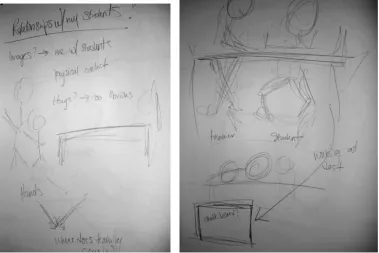
Figure 3.1, Untitled Figure 3.2, Untitled
Figure 3.3, Untitled Figure 3.4, Untitled Figure 3.5, Untitled
• Other observations and reflections:
I really enjoyed working on this piece of art. I felt the large size and materials
gave me the freedom and space to create a more organic feel inserting more
feeling into the piece. In the past I have enjoyed the beginning stage more. Not
[image:22.612.109.488.73.326.2] [image:22.612.109.515.362.516.2]! $(!
most challenge, however this piece was different. I like how easily I could erase
the chalk and the way the charcoal was applied.
1. How am I generating my ideas?
For my first piece my ideas came to me while teaching. I was working with my 5th
grade students. We were discussion points of view and different perspectives. I found
when demonstrating this for my students I had the idea for my next composition.
2. Where do my ideas come from?
The specific idea for representing relationships abstractly came from my relationships
with my students. I wanted to make art about something that I was excited about and
passionate about. The students in the photos are students whom I have had a
particular close relationship with. When thinking about education and the challenges I
face teaching, I always return to solving my problems by think about my students and
my positive relationships with them.
3. How do I feel during this stage?
During the imaginative stage I often feel really excited and ambitious. My mind
continues to develop idea upon idea. I agree with Oech that there are no limits to my
thoughts. Sometimes this way of thinking becomes problematic because I overwhelm
myself and get too ambitious or excited. My motivation is always very high.
4. What do I do if I have too many/ too little ideas?
When working and developing ideas, it seems that I generally have a lot of ideas or
too many. When I wasn’t sure exactly what I wanted the composition to be like, I
took photographs of different compositions. Doing this allowed me to see the ideas I
! $)!
collaboratively in my studio class really helped me work through my thoughts. When
I was forced to work in isolation, I would become frustrated and often stuck on a
particular problem. I found it hard to work through these issues alone. I plan to ask
my classmate and peers for critic through E-mails and electronic communications.
5. How do I decide what ideas I wish to pursue?
After evaluating the different compositions and getting feedback from peers I
eliminated the images that I was no longer excited about. It seemed that time was
very important during this stage. I found that waiting, a day or two, then revisiting the
images allowed me to gain a different perspective. Images I was initially very excited
about no longer were compelling. I was then able to select the compositions shown in
the final illustration.
6. What causes me to act/not act on an idea?
Negative feedback from a peer and time causes me to not act on an idea. Images that
were visually appealing to me, or conceptually aligned with my thoughts made me to
want to pursue the idea. When something seems new or very different, for example,
working large and working on a chalkboard, caused me to pursue an idea.
7. What happens during the actual creation stage of working?
During the creation stage of the work, I found that I experienced different emotions at
! $*!
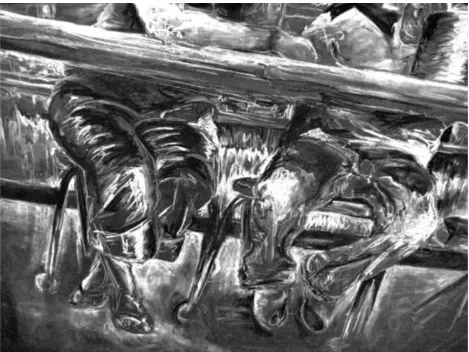
Figure 3.6, Cross Connections
Second Piece: Instruction. When I began this piece I was in Gnezda’s (2011) inspiration
stage almost immediately. I found that the positive reinforcement from my peers reinforced my
motivation. I began by thinking of different ways work through my initial problem of trying to
illustrate a feeling or emotion. Again I experienced what Gnezda (2011) and Oech (2008)
described as the imaginative and inspirational stage. I felt energetic, excited and motivated about
continuing with my process. Since this piece was the second in the series, I found that I moved
faster to the practical stage, as described by Oech (2008), of the creative process. The feelings I
felt during this stage of the process are hard to describe. I felt a need to work. I experienced a
[image:25.612.72.541.69.421.2]! $+!
continue working with the charcoal and on the chalkboards, therefore it seemed much easier to
transition from Oech’s (2008) imaginative stage to the practical stage.
• Date, time of day, location:
Oct. 30th, 7pm, my living room – Kennesaw GA
• Two to four sentences of what I hope to accomplish that day:
I would like to create something different from my first piece but still abstractly
illustrating a feeling. I wanted this piece to be more emotional than my first piece
and chose to change the perspective to closer. For this piece I wanted to allude to
the idea that it was about art education and chose to do this through the actions in
the piece and intimacy of the framing and perspective.
• Two to four sentences describing what I was able to accomplish and how I felt
about it:
I was able to create the feeling that I had intended to portray. I feel very positive
about this piece. Part of this success partially comes from the technically
challenging aspects (foreshortening, lighting and perspective) but also from the
feeling I receive from viewing this work.
[image:26.612.105.474.514.653.2]
! $,!
• Other observations and reflections:
I felt that this piece was more challenging than the first because I really struggled
with how this piece would relate to the first in the series. I feel that the work is
similar in style, medium and size, but creates a different feeling and sense of place
for the viewer. For some reason this piece was more technically challenging,
however now that it is complete, this challenging creates a greater sense of
satisfaction.
1. How am I generating my ideas?
This idea came from the first piece. I really enjoyed creating the first piece and
wanted to do something similar. The positive reactions to my initial piece create
motivation to keep going in this direction and explore my ideas further. I wanted
to create a different emotion with a similar style.
2. Where do my ideas come from?
When analyzing the concept of relationships I started to think about how one
“sees” a feeling or relationship. I came to the conclusion that touch can be
illustrated by focusing on small moments. I found that a very close composition
gave me the closeness I desired.
3. How do I feel during this stage?
Again I felt very excited while drawing and actually working of the piece. I felt
challenged more specifically when working with the hands but found that this
challenge created a desire to “figure out” the problem. Genezda (2011) describes
this as characteristic of the implementation stage. Often artists and creators
! %-!
4. What do I do if I have too many/ too little ideas?
For this piece it seemed that I much easier to analyze the ideas I had. I thinking
the beginning piece in the series was harder because I had not fully developed the
theme or direction I wanted to go. I feel that peer critique helped me work through
my ideas. I have not found a time when I have had too little ideas yet. However, if
I needed more inspiration I would often look at other artists, watch a movie
related to my theme or revisit the initial inspiration of my students and my
classroom.
5. How do I decide what ideas I wish to pursue?
After evaluating the different compositions and getting feedback from peers I
eliminated the images that I was no longer excited about. I also found that
waiting, a day or two, then revisiting the images allowed me to gain a different
perspective. Images I was initially very excited about no longer were compelling.
I was then able to select the compositions shown in the final illustration.
6. What causes me to act/not act on an idea?
I found that there were many factors that influenced what causes me to act or not
act on an idea. The first was other people’s opinions. A negative opinion,
comment or statement would cause me to look very critically at my concept. It is
important to note that the source of this comment was also very important. If the
comment came from a peer whom I trusted, then I would place much
consideration into the idea. If the statement were from an instructor or evaluator,
then I would place even more importance on the concept. Finally if the comment
! %$!
did not value, then I would simply ignore it. I also found that the logistics, cost
and amount of effort needed to implement the idea create affect my choices. For
example, if the idea was extremely expensive I would be forced to eliminate it, or
if the idea required me to leave me comfort zone (break the law, travel etc.).
Finally if my ideas were what I believed to be beyond my skills/technical abilities
I would not pursue it. When I started to expand my ideas about my art concept I
started to have lots of ideas about creating an installation. I wanted to create a full
classroom environment and manipulate the pieces within. However resources and
time caused me to eliminate this idea. I feel that this is another challenge. Often I
am disappointed or frustrated when I have to eliminate an idea or concept simply
because I cannot afford to construct/complete the piece. I also found that those
ideas that would take too long to complete would not be utilized.
7. What happens during the actual creation stage of working?
This piece started with the idea that I wanted to build on what I had established
and learned from the first piece. I wanted to create a more intimate feeling. It was
also important for me to keep the piece slightly ambiguous. I did not want it too
! %%!
Figure 3.9, Instruction
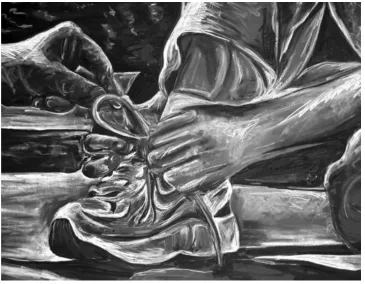
Third Piece: Tie. Similar to my previous piece I began in Gnezda’s (2011) inspiration
stage very quickly. I began by taking more photos of myself working with my students in my
classroom and asking myself what is missing and what more can be said? For this piece my
process moved very quickly into the implementation stage. I feel that this piece is one of my
least successful, which may be attributed to my lack of allowing time for Wallace’s (2011)
incubation time. I felt pressure to produce and do not feel that I gave the work enough time to
progress. I experienced what Gnezda (2011) described as characteristic of the implementation
stage; I struggled and often questioned my abilities.
• Date, time of day, location:
Nov. 5th, 7pm, garage – Kennesaw GA
[image:30.612.75.539.71.397.2]! %&!
• Two to four sentences of what I hope to accomplish that day:
With this piece I was able to create a piece of art that emphasizes a moment in
time. For this piece I was able to portray a sense of teaching and helping with a
still image.
• Two to four sentences describing what I was able to accomplish and how I felt
about it:
I felt okay about this piece at first; however as time progresses and looking back I
feel this is one of my weaker images. Initially I am drawn to the large scale,
however this piece is lacking the intimate relationship found in the other pieces.
Not that the student whom is depicted is lacking the relationship, but the image
does not illustrate the relationship properly. I feel that I am becoming stuck and
possible working the way I once had in the past.
[image:31.612.127.512.401.631.2]
! %'!
• Other observations and reflections:
I am not sure if I like this piece. I think this may be my least successful because it
is missing the main concept I am trying to illustrate. Although it seems technically
okay, it is my weakest piece so far.
1. How am I generating my ideas
For this image I began generating my ideas from my studio critique. I used the
positive reinforcement from my peers and classmates as a starting point.
2. Where do my ideas come from?
The idea for this piece came from the previous piece. I really enjoyed working
large scale and with the charcoal, so I wanted to repeat this.
3. How do I feel during this stage?
During the beginning I felt good. When working I was excited about the
composition, I enjoyed the technical challenge of the hands and the details on the
feet.
4. What do I do if I have too many/ too little ideas?
For this image I did not feel I had a lot of ideas. I want to create an image that
would relate to my series and that would work with the previous images created.
5. How do I decide what ideas I wish to pursue?
For this piece I took various images of interactions with students in my classroom
that portrayed some type of learning or relationship. I then reviewed the images
and look at the compositions I felt were the strongest and the most interesting.
! %(!
I chose to act on this piece because I needed to keep working; I needed to have an
image to bring to our class critique. For this piece, I felt more that I was fulfilling
a requirement.
7. What happens during the actual creation stage of working?
During the creation stage I found myself working more mathematically or
precisely. There was less thinking then with the previous pieces. I also did not
[image:33.612.107.472.263.547.2]enjoy working on this piece as much.
Figure 3.12, Tie
Fourth Piece: Embrace. I struggled to begin this piece. Until this point I felt experienced
the inspiration stage similar to how Gnezda (2011) described it. Gnezda described the
inspirational stage as emotional, euphoric, and exciting. However I started to struggle with new
ideas and where the work needed to go. I found that since I was working within a body of
! %)!
implementation stage. Again I started to question my abilities and struggled with my initial ideas.
In order to work through these feelings I talked to peers and colleagues who were familiar with
my work and asked what was missing. After many discussions I felt that I needed to create
another piece that was more emotional.
• Date, time of day, location:
Nov. 5th, 10pm, garage – Kennesaw GA
(working in the garage was less messy but much less comfortable!)
• Two to four sentences of what I hope to accomplish that day:
Today I hope to create a piece of art that has a very strong sense of feeling and
emotion. The past three works have illustrated abstract relationships, which may
or may not be clear to the viewer, even though they are clear to me. I want to use
what has been successful and build on what I have developed. I would like to take
what the last piece is missing and somehow incorporate it into this piece.
• Two to four sentences describing what I was able to accomplish and how I felt
about it:
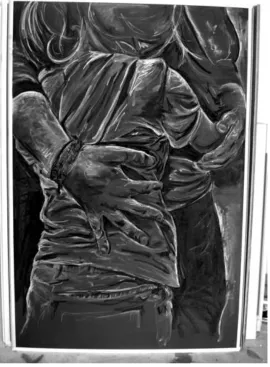
I was able to create what I feel is a very intimate work of art. I feel that the size,
perspective and materials selected helped create this sense of intimacy. At this
point however, I feel that my creative process needs to change and that I need to
reevaluate the materials used and the direction the work is preceding. I really like
this piece and I really enjoyed working on it, however, I am afraid I am falling
back into the “safe” way of working. Reflecting is causing me to look at my work
more critically and see this before I continue.
! %*!
[image:35.612.88.490.72.440.2][image:35.612.76.529.73.207.2]
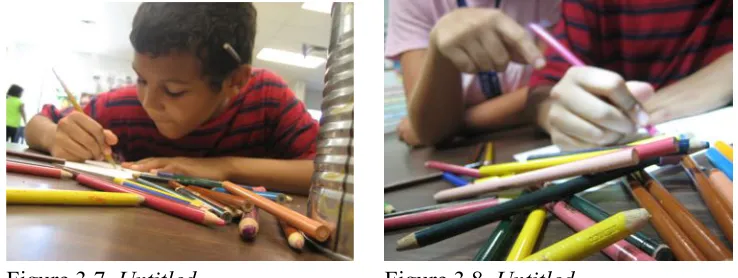
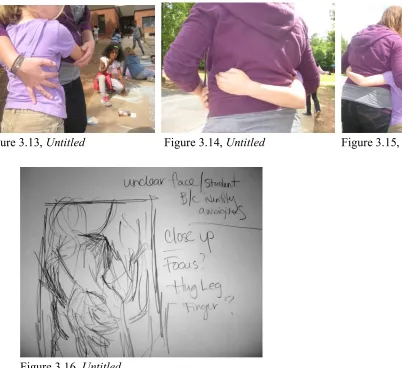
Figure 3.13, Untitled Figure 3.14, Untitled Figure 3.15, Untitled
Figure 3.16, Untitled
• Other observations and reflections:
At this point I feel that the work is becoming too similar. I feel that I am starting
to work the way I have in the past and I need to start looking at creating works in
a different way. I feel that this may be due to my choices in materials and
perspective/point of view.
1. How am I generating my ideas?
For this piece I asked my peers what they thought of the previous image. I
received mixed feedback, however some of the comments were that they message
[image:35.612.109.353.238.436.2]! %+!
was trying to depict. I also received comments that the images were becoming
too similar.
2. Where do my ideas come from?
The idea for this piece came to me when one of my kindergarten students ran up
and hugged my leg so tightly I almost tripped on her. At that moment I knew I
wanted to depict that feeling.
3. How do I feel during this stage?
I was very energized at this stage. I also felt a sense of urgency to work and “get it
out.” I felt very ambitious and motivated and wanted to leave school and start
drawing.
4. What do I do if I have too many/ too little ideas?
This time I drew more images out and I again asked my peers for comments on
my initial sketches. I then began taking photos of various compositions.
5. How do I decide what ideas I wish to pursue?
For this image I had more of a feeling about what idea I wanted to pursue. It was
hard to explain but I felt attached to the intimacy of the image.
6. What causes me to act/not act on an idea?
I was able to act on this idea because I had the materials available to me; I had the
time and the motivation. The idea was exciting and I wanted to put it on paper.
7. What happens during the actual creation stage of working?
During the actual creation, I became very satisfied with the work. I felt that it was
what I wanted to portray, however I also started to feel a sense of completeness. It
! %,!
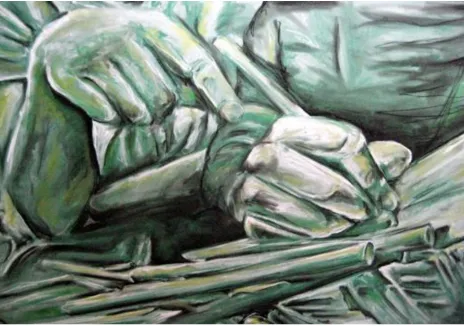
Figure 3.17, Embrace
Fifth Piece: Affirmation. I feel like this piece was a turning point within my work. After
creating two successful pieces I allowed my creative process to continue the way I had originally
been working, however through the process of reflection and using Rita Irwins’s a/r/tographic
methodology I was able to revaluate my process and change it. For this piece I returned to the
beginning stages of the create process. When working on a body of work I was working the
entire body of work as one image and problem with out allowing the original problem to evolve.
I was eliminating the fluency and flexibility Torrance and Safter (1999) described as essential to
creative thinking. Although I do not think this happened instantaneously with this piece I feel
! &-!
I started the inspiration stage of the creative process with this piece by looking into new
materials and re-evaluating my initial creative problem. I realized my work was too similar and
needed to change something. Once I started thinking about the possibilities my thoughts had no
limits, similar to how Oech (2008) describes the imaginative phase of the creative process. The
idea for the projector actually came from a discussion about how chalkboards are becoming
obsolete and how technology is changing the way we teach and instructional methods.
• Date, time of day, location:
Nov. 7th, 2pm, garage – Kennesaw GA
(working in the garage was less messy but much less comfortable!)
• Two to four sentences of what I hope to accomplish that day:
For this piece I hope to create a piece of art that is somewhat different from the
previous works I am creating. I would like this piece to still “fit” or relate to the
other pieces; however I feel that in order to keep the work from becoming cliché,
or overworked. The availability of the materials is also causing me to look at
other options.
• Two to four sentences describing what I was able to accomplish and how I felt
about it:
I feel that this piece works as a transition piece. I was able to create a different
look by changing the perspective, and the materials slight, but I do not feel that
the piece was overall successful. The realistic subject matter of the work my
choice of materials (changed the working surface but still using charcoal and
! &$!
Figure 3.18, Untitled Figure 3.19, Untitled Figure 3.20, Untitled
• Other observations and reflections:
I did not feel the excitement or motivation when working on this piece as I did
with some of the others. I feel that this piece was a useful piece to help my work
change, however I do not think it is my most successful.
1. How am I generating my ideas?
I have been using peer critique, classroom inspiration, and sketches and looking at
other art for inspiration.
2. Where do my ideas come from?
This idea came from a combination of sources. I knew I wanted to change the
materials and format of my work, and I also wanted change the perspective. Some
of these suggestions came from our in class critique and some came from peer
conversations about my work. I also was able to look critically at the pervious
images after I had given myself time to step back. The actual image for this piece
came to me when a student of mine was very excited to show me her artwork.
! &%!
you can literally see how proud they are with themselves. After watching her look
at her work and want to show it off so badly I knew what image I wanted to
depict.
3. How do I feel during this stage?
Again I felt eager, and motivated during this illumination stage.
4. What do I do if I have too many/ too little ideas?
If I have too many ideas, I make a list of the ideas or images. I then use the
process of illumination to sort the ideas that I feel most compelling. I also talk
with peers and faculty about the concepts. I feel that talking about the ideas gives
me a clear idea if I have full developed my concept. If I cannot explain my idea
thoroughly or fully I know that idea is not developed and I need to reevaluate it
and put more time into thinking about what exactly I want it to be about.
5. How do I decide what ideas I wish to pursue?
I usually choose the ideas that I feel the most positive about. I also select the ideas
that seem the most possible. Often I have had an idea that I thought would be
amazing, however if I do not believe that I am able to actually accomplish it, then
I will not select that idea.
6. What causes me to act/not act on an idea?
How much I like an idea, positive reinforcement or feedback, and my chances of
success are the main determining factors when selecting which ideas to act or not
act on.
7. What happens during the actual creation stage of working?
! &&!
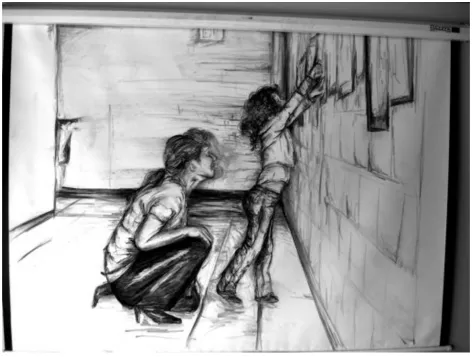
Figure 3.21, Affirmation
Sixth Piece: Sterile. After the returned excitement of the inspiration stage I craved this
feeling again. This allowed me to work through the creative process from the beginning without
skipping to the implementation stage as I had done with the third and four pieces. Using the
proctor screen opened up many more ideas. I started to think about all the different objects that
represented education and how I could use them to communicate my message. I then started
re-evaluating my creative problem. Initially I wanted to explore what why I went into teaching
which was my relationships with my students. My creative question started to change to why was
I so interested in these relationships? I found that I was frustrated with the instructional
restrictions I felt from the administrative aspect of my job. At this point I decided to change my
! &'!
The idea of creating an installation was exciting and intimidating. I decided to start by
creating a three dimensional piece. I was also excited by the idea of the viewer walking around
the work and creating an experience for the viewer. Oech (2008) describes one of the main
characteristics of the imaginative phases as the creator having no limits to their thoughts. This is
exactly how I felt. I was also motivated by peer/faculty comments that my work was becoming
to literal and that I needed to think more metaphorically.
• Date, time of day, location:
Nov. 13th, 2pm, outside porch – Kennesaw GA
• Two to four sentences of what I hope to accomplish that day:
I hope to create a work of art that is very different from my previous works. I
hope that by completely changing my materials I will be able to create pieces that
are more interesting. I want to create something that is three-dimensional, has a
better sense of space.
• Two to four sentences describing what I was able to accomplish and how I felt
about it:
I was able to create a three dimensional piece that was very different from what I
have been making. I am not sure if I like the work yet, mostly because it is so
different from what I have been doing. When creating a body of work I am still
unsure of how close the artwork needs to relate to each other? Maybe it doesn’t
! &(!
[image:43.612.109.525.72.235.2]
Figure 3.22, Untitled Figure 3.23, Untitled
• Other observations and reflections:
The piece has opened up a lot of ideas for me. I feel that thinking mostly
realistically and two dimensionally I have really limited my work. Although I can
become overwhelmed when thinking of all the possible ways to create art, I think
that I have limited my material selection to what I am comfortable with and what
has been successful in the past.
1. How am I generating my ideas?
I began to generate my idea by looking at what was not working in my previous
pieces and talking about my work. I knew I needed to change the direction my
work was going and I wanted to do something more challenging that was out of
my comfort zone.
2. Where do my ideas come from?
The idea for this piece came while I was talking about the ideas for installation. I
was looking at images by other artists. I had made a list of my ideas about
teaching and my relationships with my students, I just needed to come out with a
! &)!
would make my viewer think about the work. The idea of a piece that the viewer
could interact with was also very appealing.
3. How do I feel during this stage?
I felt excited and anxious. I started to feel a lot of anxiety because I did not
consider myself a three dimensional artist nor did I know anything about
installation work.
4. What do I do if I have too many/ too little ideas?
At this point in my creative process my ideas started to expand and expand. I
envisioned an entire classroom manipulated to express my views on teaching, my
relationships with my students and education in general.
5. How do I decide what ideas I wish to pursue?
At this point I needed to think about ideas that were possible to execute and had
the most relevance to my theme, and what I was trying to say.
6. What causes me to act/not act on an idea?
The feasibility of the idea, peer/instructor reactions and the originality of the idea
are the main factor in what causes me to act on an idea.
7. What happens during the actual creation stage of working?
I felt that I really struggled with the creation stage of this piece. My beliefs about
what makes something art were questioned and I had to examine to what extend
to I feel the artist must play in the actual creation of the work. Did I need to carve
the desk out of plaster? Did I need to construct it from wood? At this point I
decided that I wanted to manipulate something that was authentic to the classroom
! &*!
[image:45.612.109.498.68.225.2]
Figure 3.24, Sterile Exterior Figure 3.25, Sterile Interior
Seventh Piece: 784. My last piece caused my thinking and creative process to expand and
develop. After allowing myself to think beyond the chalkboard I was able to expand my ideas.
Retuning to the idea about why I was so interested in investigating the relationships I had with
my students, I started looking at the challenges evolved with doing this. I currently teach 784
students and found the amount of students alone to be very overwhelming. I decided I wanted to
create a piece that illustrated this. I chose to attempt a more conceptual piece.
• Date, time of day, location:
Nov. 20th, 2010, 4pm, Kennesaw GA (my living room)
• Two to four sentences of what I hope to accomplish that day:
Today I hope to create a conceptual piece of art. I want to communicate the
overwhelming feeling of trying to teach 784 students when trying to individualize
each one. I hope to create a piece that relates to my body of work but is not too
similar.
• Two to four sentences describing what I was able to accomplish and how I felt
about it: I was able to accomplish a piece that I felt was visually appealing and I
understood the meaning, but I am not sure it the message will be clear to my
! &+!
Figure 3.26, Untitled
• Other observations and reflections:
This piece as very different from the first piece I have done however, it seems to
relate back to the beginning of my series. When working on this piece I felt it was
a lot more about the thought process and the idea. Working conceptually is very
different from what I am comfortable with, so it seems very hard to tell if I was
successful or not. I enjoy the piece, but is that enough?
1. How am I generating my ideas?
For this piece I generated my ideas by returning to the main idea and focus of my
work. I need to make sure that my work was not going in different directions and
that it was saying what I wanted it to say.
2. Where do my ideas come from?
This idea came to me when thinking about where the other work came from. I
guess this piece should have been my starting piece? Teaching art to 784 students
has been extremely challenging and I have often become frustrated with the
logistics of public school art education. I have found that establishing positive
! &,!
makes my job gratifying and rewarding, but how am I supposed to do that when I
have 784 students? I also knew I wanted to create something more conceptual,
again breaking from my comfort zone of realistic depictions.
3. How do I feel during this stage?
I had mixed emotions during this stage of the creative process. Again I felt the
anxiety of doing something new, but also determined.
4. What do I do if I have too many/ too little ideas?
If I have too many ideas I try to eliminate the ideas that do not relate to my
concept, or ideas that may not be possible. If I have too little ideas I look back at
my previous pieces and ask myself: What else needs to be said? I also look to my
peers for suggestions comments. I also look at other artist work for inspiration.
5. How do I decide what ideas I wish to pursue?
I decided I wanted to pursue this idea because it was a challenge and it was
different from the way I have been working. I also was attracted to the formal
qualities of what I had envisioned.
6. What causes me to act/not act on an idea?
I decided to act on this piece because I had a very clear vision of what I wanted it
to look like in my head. I had received positive feedback from peers/instructor
about the concept and idea.
7. What happens during the actual creation stage of working?
When working on this piece I stated to struggle with how I was going to
! '-!
Figure 3.27, 784
! '$!
CHAPTER 4
IMPLEMENTATION & EDUCATIONAL PRACTICE
After an in depth study of my creative process, I feel I will be more capable of teaching
my students how to work through developing their own working methods. It is my hope that I
will now be able to teach my students to think critically about their own creative processes.
During my research I found five aspects of the development of my creative process that directly
impact my teaching. I found the importance of working collaboratively with peers, importance of
peer /instructor feedback, setting attainable goals, importance of time within the incubation stage
and the importance of changing ones’ perspective.
Prior to my research, I often found little time for my students to work collaboratively. My
students generally would work independently, and I often taught with a whole group instruction.
After analyzing my working methods, this seems quite unfair. I found that working in isolation
was the most challenging part if my process. I was much more successful, positive and happy
when working with my peers. I realize that this highlights the importance of holding class
critiques. It seems far too often that class critiques are something that I would occasionally skip
if running short on time or space. However, my research has illustrated the importance of
critiques and how restrictive not doing them can be.
Through my research I used feedback from peers and faculty to assist in the development
of my work. When teaching, I have forgotten the immense impact the teacher/instructor can have
on the student especially if that student trusts or believes in that teacher. Experiencing this
myself has caused me to reflect and look at my comments to my students differently. This
! '%!
I have always believed in setting very high expectations in my classroom and challenging
them as much as possible. Although this sounds good in theory I found that when looking at my
creative process that if the problem seemed to challenging or overwhelming I needed to
reevaluate and create a manageable goal. This needs to be addressed within education. Students
need to be challenged and held to high expectations; however the goal needs to be attainable.
Another very important insight I have found is the amount of time needed within the
incubation stage of the creative process. Although the amount of time may be different for
everyone, the fact that some reflection time is needed became clear. Often within my classroom I
struggle to find enough time for everything and do not allow my students time to think about
their ideas and let them “incubate.” Within my own development this was an essential stage. In
order to utilize Torrance’s (2008) trait of fluency, I needed a significant amount of time to think
about my ideas. Often I would gain new insights and revelations about my work by just giving
myself time to reflect and think about it. Even though it may be very challenging, I now realize it
is essential that I give my students time to develop or incubate their ideas.
Finally, I found that having the ability to change your perspective and be open-minded is
necessary within the creative process. Torrance (2008) describes this trait of creativity as
flexibility. I was lacking this flexibility within my work. One of my biggest challenges was that
when I would create a body of work in the past, I would create one good piece and then repeat
those steps, not allowing for multiple perspectives. My creative process became very
mathematical. My working was lacking originality. I did not allow myself to learn from the
pieces and was essential just repeating the same idea. In order to become more flexible and
original I needed to analyzing and reflecting on my process. Recording findings within my visual
! '&!
it. This allowed my work to grow and evolve, and to exhibit traits of elaboration in my thinking.
In order to help my students do the same, I will need to give them ample opportunities for
self-reflection and group self-reflection. This could be done through group critique and journaling. From
! ''!
CHAPTER 5
CONCLUSION & RECOMMENDATIONS
Conclusions
The goal of my research has been to examine and refine my creative process. Initially I
did not know what exactly my process and working methods were. My goal was to create a body
of work while simultaneously evaluating my creative process. My goal was to better understand
myself as an artist and then translate this into my teaching philosophy in order to teach my
students how to better understand their own working methods and creative processes. Four
models of creativity were researched and evaluated. First, I looked at Roger von Oech’s
evaluation of creativity. It is his belief that there are two different phases when creating new
ideas, the imaginative phase where you generate new ideas and the practical phase where the
creator is actually getting something done. Similar to Oech’s model of the creative process
Nicole Gnezda’s model of the creative process has two stages: the inspiration stage and the
implementation stage. Although very similar to Oech’s model, Gnezda relates these stages to the
creator’s emotional stage during creation. Wallace offers a more complex model for the creative
process, which includes the following stages: preparation, incubation, illumination and
verification. Finally, Torrance and Safer’s present four main characteristics of creativity, fluency,
flexibility, elaboration and originality.
Utilizing Rita Irwin’s a/r/tographic approach to arts based research I attempted to find
meaning in my creative process by reflecting and journaling when creating a body of work that
consisted of seven pieces. I used the researched models as a beginning point but wanted to allow
! '(!
reflection. I then evaluated my findings in relation to my teaching and research models of the
creative process.
In conclusion, when answering the question: What is my creative process? I now have a
much better understanding of my working methods and creative processes. I found that my
creative process is very similar to Wallace’s and Gnezda’s models, while utilizing Torrance’s
four traits of creativity. In order for me to create, I need to do some preparation; however I often
experience the inspiration stage without planning or trying to create. This experience can be
emotional and exciting as described by Gnezda. I have also found that an incubation stage or
time to think about my ideas is essential to the development of my concepts. I found that when
working, I would experience what Wallace referred to as the illumination stage, where
everything starts to make sense and fit together. It seems that this worked best when I talked
about my ideas, wrote about them or sketched them. I was able to use my visual verbal journal to
elaborate on my ideas. When working through my process, if I did not give myself time to reflect
on the ideas, I found that I would revert to repeating myself. This time of reflection allowed me
to become more original as described by Torrance (2008). I also found that through peer, self,
instructor feedback and evaluation I was able to achieve Wallace’s verification stage of
Torrance’s (2008) traits of elaboration and originality.
Recommendations for Further Research
I think there is still much to be done in terms of research on creativity. I was unable to
find a single agreed upon definition of what creativity is. An agreed upon definition of creativity
would greatly benefit art education and art educators. I also believe that more research into the
creative process specifically for elementary school children would be very beneficial to the field