A New Approach for Iris and Fingerprint
Recognition based on KPCA and LLE Algorithm
Dr. Gandhimathi Amirthalingam Midun Thangavel
Department of Computer Science Department of Computer Science College of Science, Arts & Community for Girls
King Khalid University, Saudi Arabia
Nehru Institute of Technology, Coimbatore, India
Abstract
The paper presents the fusion of two biometric iris and fingerprint to improve the recognition rate. A solution based on Kernel Principal Component Analysis (KPCA) and Locally Linear Embedding (LLE) algorithms are proposed for the iris and fingerprint recognition respectively. The KPCA is one of the most successful techniques that have been used to recognize iris. A non-linear algorithm called Locally Linear Embedding belonging to manifold learning technique is introduced and applied to recognize fingerprint. LLE is considered an effective algorithm for dimensional reduction. LLE preserves intrinsic structure and relationships in a high dimensional space when data are mapped into low dimensional space. The proposed system shows that multimodal recognition system is very efficient to reduce the false rejection rate (FRR) and false acceptance rate (FAR).
Keywords: KPCA, LLE, Iris, Fingerprint, Biometric
________________________________________________________________________________________________________
I. INTRODUCTION
Biometric is the field of pattern recognition research that recognizes the human identity based on physical patterns or behavioral patterns of human. A method of identification based on anthropometry of various parts of the human body had developed including face, fingerprint, retina, iris, ear, palm print, head etc., the size of which remain constant throughout life after attaining full growth [4]. However, greater accuracy and robustness is desired in biometric identification [9]. Several categories of Multimodal biometric methods are multi-algorithm mono-modal, single-algorithm multi-modal and multi-algorithm multi-modal [8]. In this paper, we propose a multi-algorithm multi-modal biometric identification method, which contains more than one sensor with each sensor sensing a different biometric characteristic as iris and fingerprint; it also uses two different algorithms KPCA and LLE.
The performance of the biometrics are measured with FRR (False Rejection Ratio) and FAR (False Acceptance Ratio). FRR, which is the ratio of genuine, has been recognizing as an impostor. FAR, which is the ratio of impostor has been recognize as genuine. EER (Equal Error Rate) which is FAR and FRR are equal (the less EER is the better system performance) and ROC (Receiver Operating Characteristic) is the plot of FRR versus FAR. A novel method, iris can be recognized using kernel principal component analysis (KPCA) and fingerprint can be recognized using locally linear embedding (LLE), is proposed here. KPCA is one of the most thoroughly investigated approaches to iris recognition. In the proposed system, manifold learning technique such as locally linear embedding method is considered for dimensionality reduction to solve various problems in pattern recognition. LLE method transforms the high-dimensional data nonlinear problem into a lower-dimensional space linear problem by local linear fitting and enables us to visualize data structure clearly; hence this method may better deal with the nonlinear problem. The two classifiers perform better individually but fail under certain conditions [10]. The problem can arise at the time of iris image acquisition where the user has to be co-operative while giving the iris image [2]. In case of fingerprint recognition poor quality fingerprint image may create problem [5]. The enhancement module recovers the ridges present but the loss due to cuts and scars present on the fingerprint image may create problem in extraction of minutiae points [1, 3]. Thus the two recognizers are combined at matching score level and final decision about the person’s identity is made. In the next section a brief overview is presented about the iris and fingerprint. In Section 3 the algorithm of the two modalities combined at matching score level are discussed. The experimental results are presented in Section 4. Conclusion is given in the last section.
II. PROPOSED FRAMEWORK
Iris Biometric
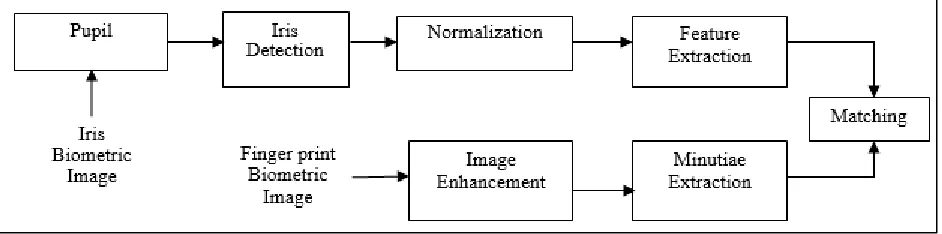
Iris is unique to each individual and remains constant over the life of a person. Iris recognition has become an important enabling technology in our society. Although an iris pattern is naturally an ideal identifier, the development of a high-performance iris recognition algorithm and transferring it from research lab to practical applications is still a challenging task. Automatic iris recognition has to countenance unpredictable variations of iris images in real-world applications. For example, recognition of iris images of poor quality, nonlinearly deformed iris images, iris images at a distance, iris images on the move, and faked iris images all are open problems in iris recognition. A basic work to solve the problems is to design and develop a high quality iris image database including all these variations. Moreover, a novel iris image database may help identify some frontier problems in iris recognition and leads to a new generation of iris recognition technology. The eyeball has a circular black disk in the center known as pupil. The pupil dilates when exposed to light and contracts in dark. Thus the size of pupil varies with respect to light it is exposed to. The iris is the annular ring between the sclera and pupil boundary and contains the flowery pattern unique to each individual. This texture information unique to each individual is extracted from rest of the eye image and is transformed into strip to apply pattern matching algorithm between the database and query images of iris. The important steps involved in iris recognition are Pupil Detection, Iris Detection, Normalization, Feature Extraction and Matching.
Fig. 2: Steps of proposed operation
Prior to implementation of steps mentioned above iris image has to be acquired which should be rich in texture because all subsequent stages depend upon the image quality; the images are acquired using a 3CCD camera under the controlled lab environment. The acquired image is passed to the localization module to detect iris portion from the rest of the image.
Fingerprint Recognition
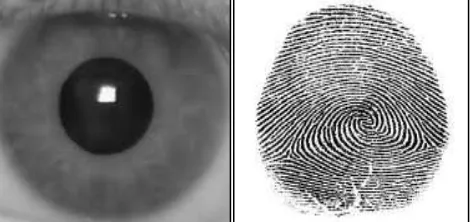
Fingerprint is one of the most widely used biometric modality. The main reason behind the use of fingerprint biometric is that it is the most proven technique to identify the individual. Fig. 1 shows the sample iris and fingerprint images. The fingerprint is basically the combination of ridges and valleys on the surface of the finger. The systematic study on the ridge, furrow, and pore structure in fingerprints has been published in [7]. The major steps involved in fingerprint recognition using minutiae matching approach after image acquisition are Image Enhancement, Minutiae Extraction and Matching. Fig. 2 shows the steps of the operation of iris and fingerprint biometric proposed work.
III. KPCA AND LLEALGORITHM
KPCA Approach for Iris Recognition
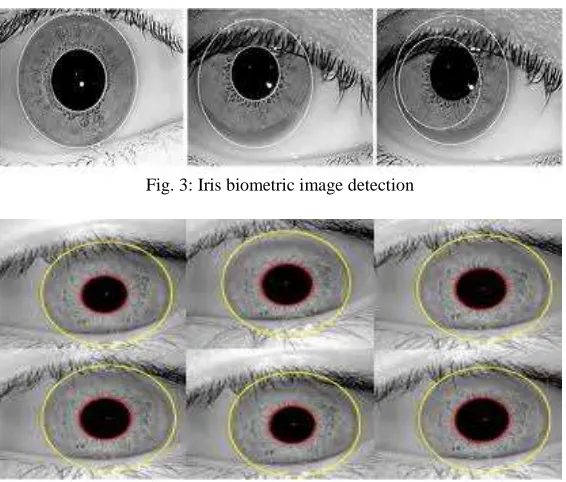
KPCA is an effective method for iris recognition. It is the simplest of the true Eigen vector-based multi variant analysis [6]. It involves mathematical procedure that uses an orthogonal transformation to convert number of possibly correlated variables into a set of values of uncorrelated variables. For example, 5 different iris images of a person with changes in eye movement were tested, which are used in our system are shown in fig. 3. KPCA is used for extracting internal structure of a data from high dimensional data sets, which bring more information for image recognition. Its operation reveals the spatial or structural information of the original images also can be preserved sufficiently. We find eigen vectors and eigen values of a covariance matrix of images in high dimensional space [n*n], where n*n are the dimensions of image. The image data set can be many eigen vectors for a covariance matrix but very few of them are the principle eigen vectors. The Eigen vectors can be used for finding variations among the iris images but principal eigen vector can describe large variations among a bunch of images, shows the significant relationship between the data dimensions. Fig. 4 shows the processed iris image. The KPCA algorithm is formulated as follows:
Consider a training image set {X1, X2…XN}, be an m-dimensional vector obtained from a set of N vector.
N
i
n m X M X
E X
1
] , [ 1
}
Mean - subtracted data in the M x N matrix P. P XiX (2)
The covariance matrix Q of the set of vectors is 1
T P P MQ (3)
{( )( )T}
X X X X E
Q (4) Given this covariance matrix Q we solve the eigen equation
QV=λV (5)
For positive eigen value λj, (j=1…m) with these eigen values stored in decreasing order (λj≥λj+1). The projection feature matrices
V is composed of orthonormal eigen vectors {V1, V2…Vr}.
The principal components are components of the orthonormal basis and they are uncorrelated. r (1≤r≤m), r is principal component, it carry more variance than the other orthogonal directions and they have maximum mutual information with respect to the inputs.
Fig. 3: Iris biometric image detection
Fig. 4: Processed Iris biometric image
LLE Approach for Fingerprint Recognition
Locally linear embedding is an effective algorithm for dimensionality reduction and used to solve various problems in pattern recognition. Local linear embedding algorithm is that nearby points in the high dimensional space remain nearby and similarly co-located in the low dimensional embedding. LLE algorithm is the first classic nonlinear manifold learning algorithm based on the local structure information about the data set, which aims at finding the low-dimension intrinsic structure lie in high dimensional data space for the purpose of dimensionality reduction. In pattern recognition, a large data dimensionality makes recognition difficult and time-consuming and in combination with a small data set, it lowers the accuracy rate. LLE is proposed to overcome this problem. Fig. 5 shows the intra-class variability in fingerprint. Fig. 6 shows the data extraction of the fingerprint. The high dimensional data set lies on, or near to, a smooth low-dimensional manifold, and each contains the fraction of data set. The global transformation takes place to convert high dimensional co-ordinates into low dimensional by exploiting adjacency information with no fundamental loss of information.
Input vectors {X1, X2…XN}, i=1…N data items, each of each of dimensionality D (Xi∈RD) are given.
Output vectors {Y1, Y2…YN}, i=1…N data items will be obtained, each of dimensionality M (Yi∈RM), where M<<D
dimensional embedding co-ordinates for the input points. First, compute k nearest neighbors of each point, X⃗⃗⃗ i.
Second, compute weight matrix Wij. The original point Xi based on its neighbors Xj is reconstructed by linear combination. The
reconstruction error is given by the cost function E (W) with the condition.
jWij 1 then
2
)
(
iXi iWijXj
W
E (6)
Finally, compute the vectors Y⃗⃗⃗ i best reconstructed by weights Wij, the ith data point in the D dimensional space will be used to
reconstruct the same point in the lower M dimensional space. Each point Xi in the D dimensional space is mapped onto a point Yi
in the M dimensional space by minimizing the embedding cost function under the constraints.
iYi 0and 1
1i i
T
i Y
Y M
then, ( )
2iYi iWijYj
Y
Fig. 5: Illustrates intra-class variability in fingerprint
Fig. 6: Fingerprint Minutiae extraction
IV. EXPERIMENT AND RESULT
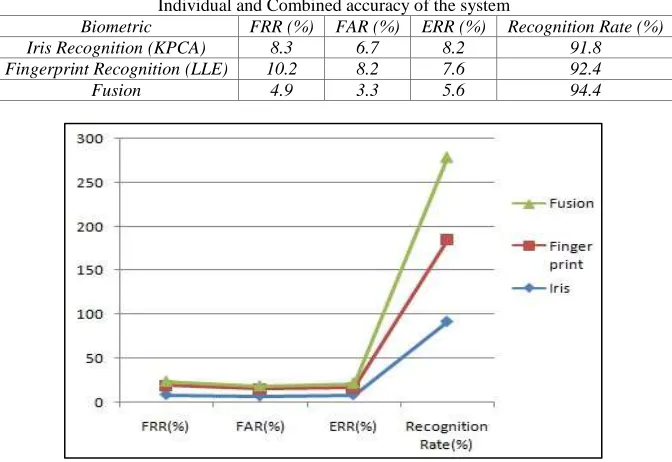
There is a prominent improvement by fusing the iris and fingerprint recognition. For the purpose of this experiment, the iris images from 1000 subjects which were collected using IKEMB-100 camera. It is well suited for studying the uniqueness of iris features and develops novel iris classification and indexing methods. For the Fingerprint database each volunteer contributed 40 fingerprint images of his eight fingers (left and right thumb/second/third/fourth finger), i.e. 5 images per finger. The volunteers were asked to rotate their fingers with various levels of pressure to generate significant intra-class variations. All fingerprint images are 8 bit gray-level BMP files and the image resolution is 328 x 356.
Table – 1
Individual and Combined accuracy of the system
Biometric FRR (%) FAR (%) ERR (%) Recognition Rate (%) Iris Recognition (KPCA) 8.3 6.7 8.2 91.8 Fingerprint Recognition (LLE) 10.2 8.2 7.6 92.4
Fusion 4.9 3.3 5.6 94.4
Fig. 7: Performance of Iris, Fingerprint and fusion biometric
V. CONCLUSION AND FUTURE WORK
The paper presented an iris and fingerprint biometric authentication using a nonlinear dimensionality KPCA and LLE algorithm. The combination is found to be useful as one needs a close up system and other needs contact. LLE algorithm could better covenant and conserve the local geometrical property of nonlinear data. In a near future, we plan to use other nonlinear algorithms and compare it to do best and increase the accuracy for iris and fingerprint. The performance of fusion of iris and fingerprint biometric recognition system shows great promise to personal identity in the biometric authentication society.
ACKNOWLEDGMENT
Authors would like to thank the Biometrics Ideal Test for providing iris and fingerprint data for the experiments.
REFERENCES
[1] S. C. Dass, K. Nandakumar, & A. K. Jain, A Principled Approach to Score Level Fusion in Multimodal Biometric Systems, Proc. of Audio- and Video-based
Biometric Person Authentication (AVBPA), Rye Brook, NY, 2005.
[2] J. G. Daugman, “High confidence visual recognition of persons by a test of statistical independence”, IEEE Transactions on Pattern Analysis and Machine
Intelligence, vol. 15, no. 11, pp. 1148–1161, 1993.
[3] L. Flom, & A. Safir, Iris Recognition System, U.S. Patent No. 4641394, 1987.
[4] A. Gandhimathi, G. Radhamani “Comparison on Multi-modal biometric Recognition methods “, Proc. of International Conference on Computer Intelligence
and Information Technology (CIIT), Springer publications, vol. 250, pp.524-526, Nov 2011.
[5] L. Hong, Y. Wan, & A.K. Jain, “Fingerprint Image Enhancement: Algorithm and Performance Evaluation”, IEEE Transactions on Pattern Analysis and
Machine Intelligence, vol. 20, no. 8, pp. 777-789, 1998.
[6] A. K. Jain, K. Nandakumar, & A. Ross, “Score Normalization in multimodal biometric systems”, The Journal of Pattern Recognition Society, vol. 38, no. 12,
pp. 2270-2285, 2005.
[7] Raymond Thai, Fingerprint Image Enhancement and Minutiae Extraction, Technical Report, the University of Western Australia, 2003.
[8] A. Ross, & A. K. Jain, “Information Fusion in Biometrics”, Pattern Recognition Letters, vol. 24, no. 13, pp. 2115-2125, 2003.
[9] R. Wildes, J. Asmuth, G. Green, S. Hsu, R. Kolczynski, J. Matey, & S. McBride, “A Machine vision System for Iris Recognition”, Machine Vision and
Applications, vol. 9, no. 1, pp. 1-8, 1996.
[10] W. Yunhong, T. Tan, & A. K. Jain, “Combining Face and Iris Biometrics for Identity Verification”, Proceedings of Fourth International Conference on