148 | P a g e
ADVANCED WAVELET TRANSFORM TECHNIQUES FOR ECG FEATURE
EXTRACTION
Prof.S.M.Walke
Shri Chhatrapati Shivaji Maharaj College of Engineering ,A.Nagar
(Affiliated to Savitribai Phule Pune University) Email address: [email protected]
Prof.S.S.Gundecha
Shri Chhatrapati Shivaji Maharaj College of Engineering ,A.Nagar
(Affiliated to Savitribai Phule Pune University) Email address: [email protected]
Abstract — Existing life care systems simply monitor human health and rely on a centralized server to store and process sensed data, leading to a high cost of system maintenance, yet with limited services and low performance. One of the important parameter in health Monitoring is ECG and Wireless ECG acquisition has emerged as a comfortable low-cost technology for continuous Cardiac Monitoring. The analysis of ECG is widely used for diagnosing many cardiac diseases, which are the main cause mortality in developed countries. Wireless ECG sensors have been employed to monitor human health and provide life care services. We present a scheme for ECG feature extraction for capturing ECG signals that will be compared with standard database in real time by using either curvelets or shapelets. Among the various techniques developed for ECG extraction time domain analysis, frequency domain analysis and wavelet transform are predominant techniques. The new advanced Wavelet Transform specially designed for image processing like shapelets, ridgelets can give more accurate results than conventional Waveform Techniques. It is also proposed to develop this system which is compatible with various Devices such as Desktop Computers, PDA and smart phones.
Keywords—Remote health Monitoring,ECG Feature Extraction,Wavelet Transform.
I INTRODUCTION
Medical domain has various integral functions such as detection of symptoms, diagnosis of disease and treatment. While the metropolises boast a variety of specialist clinics and multispecialty hospitals for chronic and emergency medical care. Remotely situated patients, elderly and disabled patients find it physically difficult to travel to their physician for consultation [1]. Such situations warrant the ability to send information about the medical status of the patient electronically to the Doctors. Detection of symptoms and observation of vital signs can be automated by the use of sensors. A patient’s private body area network measures the physical conditions of the patient such as ECG, temperature, blood pressure, heart rate, respiration rate, mobility etc. With the improvement of living standards and the intensified social competition,
various chronic diseases is gradually expanded, among which, the population with coronary heart disease, hypertension, diabetes and other chronic diseases is about 260 million, and the ones with sub-health status is also in a high percentage[2].Studies show that scientific exercise can not only effectively improve the physical condition of patients with coronary heart disease, hypertension, diabetes and the groups of sub-health, but also can, to some extent, reduces the incidence and risk of illness, so as to save health care expenditure of the country and help to reduce the medical costs of patients. With this thought in our mind, we focus our research on establishing the real time monitoring of ECG for patients.
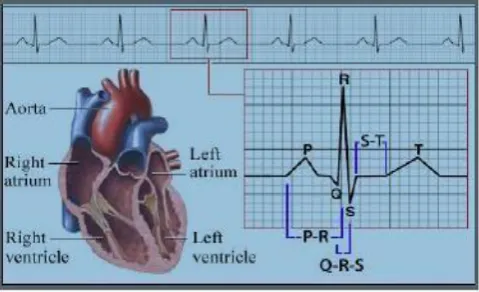
Fig 1: Diagram of Human Heart & Normal ECG Trace
149 | P a g e
literature review are listed below:-
1. Most of the researchers have achieved more than
95% accuracy in Feature extraction, sensitivity and predictivity, for wired bedside ECG signal. These schemes cannot achieve the same accuracy for real time wireless Noisy signals, because of various interferences which impose difficulties in feature extraction[5]. The practical aspects such as effect of noise, movement of patient and real time transmission issues generated by it are not considered. The processing of noiseless bedside wired ECG signals are relatively easy as compared with noisy remotely located wireless real time ECG signal. Hence, the most practical situation and issues generated in real time ECG signals must be considered for accurate diagnosis and treatment.
2. Most of the feature extraction algorithms use fix
parameters such as fixed thresholds and are static in nature [6].
3. The study of effect of noise on preprocessing
module is not considered and further on feature extraction and classifier design also.
4. Some researchers have used the ECG acquisition
from patients as wireless or wired and have captured using 12 Lead ECG or Single channel ECG.
5.Most of the schemes of ECG feature extraction have
not taken baseline modulation into account. Most of the papers reported in the literature have not considered all factors which affect accuracy of QRS complex.
6.Schemes are not comprehensive in design, i.e., they
either do not address all the goals of the noise interference or make too many assumptions about an accurate ECG feature extraction.
Considering the common limitations of ECG Feature extraction algorithms listed above, there is still a need of better algorithm for improved accuracy for real time wireless noisy ECG signals. An algorithm should function efficiently and accurately taking into account all practical aspects eliminating limitations of schemes reported earlier in the literature.
II.LITERATURE SURVEY
The research Papers from IEEE proceedings, journals are referred related to Patient Monitoring System, ECG Feature extraction and methods for detection of arrhythmia are stated and brief survey of some of them is presented here.
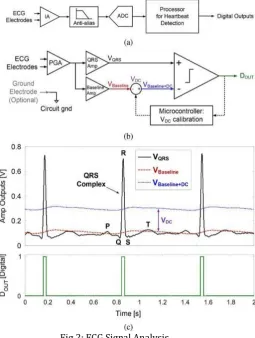
A.A 58 nW ECG ASIC with Motion-Tolerant Heartbeat Timing Extraction for wearable Cardiovascular Monitoring
An ASIC for wearable cardiovascular monitoring is implemented using a topology that takes advantage of the electrocardiogram’s (ECG) waveform to replace the traditional ECG instrumentation amplifier, ADC, and signal processor with a single chip solution. The ASIC can extract heartbeat timings in the presence of baseline drift, muscle artifact, and signal clipping. The circuit can operate with ECGs ranging from the chest location to remote locations where the ECG
magnitude is as low as 30 V.Besides heartbeat detection, a midpoint estimation method can accurately extract the ECG R-wave timing, enabling the calculations of heart rate variability. With 58 nW of power consumption at 0.8 V supply voltage and 0.76 mm of active die area in standard 0.18 m CMOS technology, the ECG ASIC is sufficiently low power and compact to be suitable for long term and wearable cardiovascular monitoring applications under stringent battery and size constraints.
Fig 2: ECG Signal Analysis
B. Noise Reduction and ECG Feature Extraction
Using Interpolation and Hilbert Transform
150 | P a g e
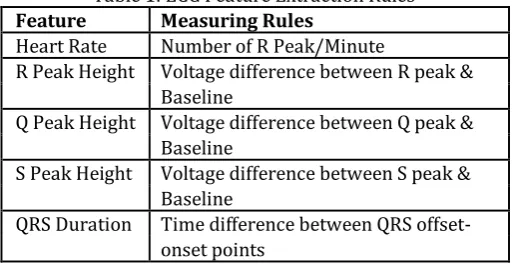
detecting all these characteristic points, Heart Rate, R, Q and S peak heights and QRS duration are measured. Errors in these extracted ECG features are also calculated. The algorithm offers a good level of Sensitivity (99.84%), Positive Predictivity (99.84%) and Detection Accuracy (99.84%) of R peak. Different types of ECG data of all the 12 leads taken from PTB diagnostic ECG database (PTB-DB) is used for testing the performance of the proposed module. Proposed algorithm is divided into five parts. These are (A) Noise Reduction, (B) Lagrange Five Point interpolation and Hilbert transform Computation, (C) R peak detection (D) Baseline Modulation Correction and (E) Q, S, QRS onset offset point identification.
Table 1: ECG Feature Extraction Rules
Feature Measuring Rules
Heart Rate Number of R Peak/Minute
R Peak Height Voltage difference between R peak & Baseline
Q Peak Height Voltage difference between Q peak & Baseline
S Peak Height Voltage difference between S peak & Baseline
QRS Duration Time difference between QRS offset- onset points
C. Energy Efficient Diagnosis Grade Mobile ECG
Monitoring
Real Time calculation of Heart Beat rate& RR Interval is done by using Android 4.0 with beat detection algorithm. Mobility to patients is provided. Platform provides good performance of size & battery life. The Figure shows the architecture of the proposed mobile ECG monitoring system. The wireless sensor node is attached to human’s body, and with the Bluetooth wireless transceiver, we can transmit the recorded ECG signal back to mobile phone or PC. By using mobile phone as a hub, the patient can go anywhere, and we can transmit the ECG signal back to the patient-centric medical cloud using existing 3G or WiFi infrastructure.
Fig 3: A Proposed Mobile ECG System
D. ECG Based Biometric Authentication Using
Ensemble of Features
The efficacy of various features on electrocardiogram (ECG) based biometric authentication process is thoroughly examined. In particular, the features acquired from temporal analysis, wavelet transformation, power spectral density estimation and QRS-complex detection over ECG signals are considered. Recent advances in biomedical and clinical
engineering areas not only improve the recognition performance of biometric authentication systems but also provide feasible implementations. Traditional tools employed in person identification operations, such as ID cards and key codes, are not reliable at all due to the fact that they can be easily manipulated, even if their owner is not available. However, a biometric authentication reserves Effective safety to identify a person considering his/her physiological characteristic, In recent years, electrocardiogram (ECG) signals gathered from individuals have been suggested as a biometric for identity verification. ECG signal inherently reserves the electrical properties of the heart. The information about the heart rate, rhythm, and morphology can be deduced from an ECG signal that can be recorded by a number of electrodes attached to the body.
E. Energy Effect of On-node Processing of ECG Signals
This paper describes the energy trade-off between ECG signal transmissions and on-node feature extraction based on QRS complex detection. When a patient returns home from a hospital, a doctor might still want to monitor the heart condition remotely. An ECG sensor based on wireless sensor network technology can provide this information. Several solutions exist for recording the ECG signal locally, such as the Holter monitor.
Fig 4: Structure of ECG Waveform
151 | P a g e
Furthermore, for active monitoring of patients, real-time signal analysis is required in order to raise alarms when dangerous situations occur. The Pan-Tompkins algorithm is useful for the extraction of the RR interval, which indicates the heart rate and certain forms of arrhythmia. More advanced algorithms can also extract the PQRST characteristics, but many of these algorithms are too complex for the sensor nodes that are used. The properties of an ECG are shown in figure 1. For the correct extraction of the RR interval and the PQRST characteristics, the ECG sensor has to be sampled at 100Hz and 200Hz respectively. on wireless sensor hardware. In particular, the sample rate is set at 100 Hz, the computations are based on integer arithmetic and the filters are reduced to minimize the memory footprint.
COMPARISION OF VARIOUS SCHEMES
Various Schemes proposed for Patient Monitoring can be categorized into web based system using sensors; It also uses Application program interface. This is a centralized user access and hence imposes scalability and delay problems. The features extracted from ECG were used to estimate the timings and amplitudes of atrioventricular activation input functions as morphological and physiological characteristics which were tested using hemodynamic signals from the PhysioNet MGH/MF Waveform database. The model ignores the effects of nervous system and kidney in long term control of arterial pressures. Considering these papers it is observed that each scheme proposed has certain merits & demerits. Major performance evaluation criteria for ECG monitoring are real time operation, reliability, scalability & security. Not much importance is given to noise generated while acquiring the ECG signals in all proposed schemes where complexity & authentication issues needs to be addressed. Some low complexity algorithms to extract fiducial points from ECG with Mobile phone as a gateway for transmission of measured ECG to the cloud is developed. Also energy trade of between ECG signal transmission and on node feature extraction based on QRS complex detection is implemented. ASIC for wearable cardiovascular monitoring is used which can extract heartbeat timings, and midpoint estimation method extracting the ECG R-wave is adopted. The features acquired from temporal analysis, wavelet transformation, power spectral density estimation and QRS complex detection over ECG signals for Biometric authentication are considered. Even undecimated discrete wavelet transform is used for Fetal Heart rate Detector. The ECG feature extraction using Interpolation and Hilbert Transform offers a good level of sensitivity, positive predictability, detection accuracy of R peak. A 0.83-µW QRS detection processor for real time ECG monitoring with Quadratic Spline Wavelet transform providing pre- filtering is used. From above table it can be observed that each system has certain merits & limitations. A combination of such system with less
complexity and user friendliness with security feature is a real challenge in Patient Monitoring Systems.
Ridgelet transforms are preferred over Wavelet transforms in general because of their ability to better represent signals, The curvelet transform is a recent extension of ridgelet transform that overcome ridgelet weaknesses in medical image segmentation. Curvelets transforms has been tested on medical data sets, and results are compared with those obtained from the other transforms. Tests indicate that using curvelets significantly improves the classification of abnormal tissues in the scans and reduce the surrounding noise. Shapelet is a time series subsequence that is identified as being representative of class membership. a new method for the analysis of medical images. It is based on the linear decomposition of each object in the image into a series of localized basis functions of different shapes.
III.CHALLENGES IN ECG EXTRACTION &
PROPOSED SOLUTION
152 | P a g e
Movement, noise, artifacts etc degrades the performance and quality of signals. Among the various ECG feature extraction techniques each method has certain merits and demerits. In order to extract the complete features one method is not suitable and combination of these methods or an entirely new wavelet transform technique having less complexity, less storage, increased accuracy needs to be designed. The Algorithms and procedures reported in the literature so far do not address the issue of Noise interfering while capturing wireless ECG signals. This characterization needs critical evaluation to detect the suitable heart disease. Therefore the procedure proposed must have high precision, high accuracy, simplicity, exact classification of heart signals and symptoms. Most of the research carried out in this area is without considering the practical aspects of wireless ECG signal measurement process. In real-time practical situation a large amount of noise is present and hence it is necessary to predict the exact heart disease under such noisy condition.This is the topic of current research and imposes issues and challenges regarding removal of manual errors, authenticity and estimating correctly the different parameters of ECG waveform which is of prime importance as it is related with human life. In-depth study is required for evaluation of new features and feature extraction for exact diagnosis and treatment. The real time ECG signals will be taken from ECG sensors using Lead – I. These signals will be processed further to reduce the effect of noise, dynamic feature extraction methods and classifiers for exact diagnosis.
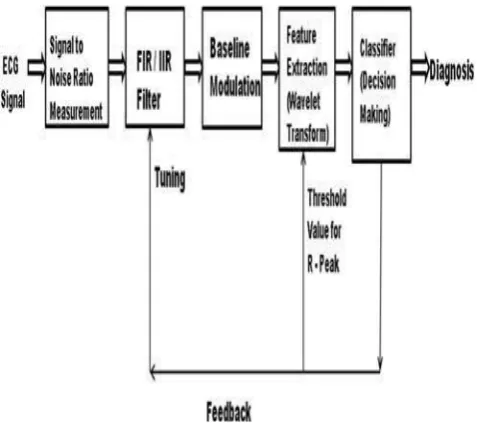
Fig 5: Proposed Architecture
Module I – Design and development of Preprocessing Section
The various preprocessing schemes depend upon the nature of ECG Signals and Signal to Noise Ratio. An ECG signal is corrupted by noise and its percentage of its disturbance depends upon type of
electrode, electromagnetic interference, powerline interference, sensor thermal noise etc. So first step is to detect this S/N ratio, type of Noise and it’s effect on ECG signal. This Noise measurement greatly helps to design various tuning parameters in preprocessing section which consists of bandpass filter, high pass Butterworth filter. The various tuning parameters are cut-off frequencies, Bandwidth, order of filter, cascading stages, Selection of proper Digital filters such as Infinite Impulsive Response (IIR) and Finite Impulsive response (FIR) etc. Careful selections of these tuning parameters are very important to reduce the effect of noise. More precise extraction of ECG signals from noise increases probability of detection accuracy of QRS complex. ECG Baseline often exhibits a slow undulation called baseline wandering which occurs due to patient’s body movement. After identification of the R peak points Baseline Modulation is to be performed.
Module II – Feature Extraction
After Baseline Modulation the signal is applied to Feature extraction unit, which mainly consists of exact detection of QRS complex. The threshold value for detection of QRS Wave is to be kept adaptive depending upon baseline modulation and noise level. Various feature extraction techniques are available for accurate results and some parameters needs to be changed dynamically. A Classifier is a unit which classifies the heart disease, in one of the three categories - Normal Bradycardia Arrhythmia, Tachycardia Arrhythmia and Ischemia. The proposed model will be validated creating a standard database. An attempt will be made to use more advanced techniques for accurate and reliable Feature extraction such as ridgelets and curvelets. The performance will be evaluated by comparing with standard database taking real time examples.
153 | P a g e
accuracy in real-time environment.
The feature extraction will be more accurate than the previous methods reported in the literature so far.It is also possible that the framework can be implemented in handheld high computing communication devices such as smartphones for wireless real-time Patient Monitoring Systems.
IV.CONCLUSION
Patient Monitoring System technology along with their applications in Real-time ECG monitoring for the benefit of humanity are discussed in this paper. Detection of various features of ECG signal is important for diagnosis of various diseases related to Heart. The basic criterion in feature extraction and interpretation of the signal is sensitivity, predictivity and low complexity. A system with desirable feature extraction of ECG is a real challenge in ECG Monitoring systems maintaining less complexity, enhance scalability, increased security & user friendliness. Architecture of such a model is presented and can be implemented by using new techniques of wavelet transform such as curvelets and shapelets.
V. REFERENCES
[1] Abdelghani Benharref and Mohamed Adel Serhani
,”Novel Cloud and SOA-Based Framework for E-Health Monitoring Using Wireless Biosensors”, IEEE Journal of Biomedical and Health Informatics, Vol 18, No 1, pp 46-55, January 2014
[2] Ismile hababeh,Issa Khail, “Designing High
Performance Web-Based Computing Services to Promote Telemedicine Database Management System”,IEEE transactions on Services Computing, 2014
[3] Abhilasha M Patel, Pankaj Gakare,” Real Time ECG
Feature and Arrhythmia Detection on a Mobile Platform”, International Journal of Computer Applications, Vol 44-no.23, pp-975-8887,April 2012.
[4] S.Karpagachelvi, et.al., ”ECG Feature Extraction
Techniques - A Survey Approach”, International Journal of Computer Science and Information Security, Vol. 8, No. 1, pp 76-80, April 2010
[5] Emna Zoghlami Ayari, et.al., ”A Noise Tolerant
Method for ECG Signals Feature Extraction and Noise Reduction”, The 3rd International Conference on Bioinformatics and Biomedical Engineering, pp 1-4, 2009
[6] Gary M Friesen, et.al., “A Comparison of the Noise
QRS Detection Algorithms”, IEEE Transactions on Biomedical Engineering , Vol 37,
No.1, pp 85-98, January 1990
[7] Evangelos B. Mazomenos, et.al., “A Low-Complexity
ECG Feature Extraction Algorithm for Mobile Healthcare Applications”, IEEE Journal of Biomedical And Health Informatics, Vol. 17, No. 2, pp 459- 469, March 2013
[8] Sandeep Gutta, et.al., ”Joint Feature Extraction and
Classifier Design for ECG Based Biometric
Recognition”, IEEE Journal of Biomedical and Health Informatics, Vol. PP, No. 99, pp. 1-1, 2015
[9] S.Dhar1, S.K.Mukhopadhyay1 and et.al., “Noise
Reduction and ECG Feature Extraction Using Interpolation and Hilbert Transform”, 2014 International Conference on Control, Instrumentation, Energy & Communication, pp. 232-236, 2014
[10] David Da He and Charles G. Sodini., “A 58 nW ECG
ASIC With Motion-Tolerant Heartbeat Timing Extraction for Wearable Cardiovascular Monitoring”, IEEE Transactions on Biomedical Circuits And Systems, Vol. 9, No. 3, pp 370 – 376, 2015.
[11] Chio-In Ieong, et.al., ”A 0.83- µW QRS Detection
Processor Using Quadratic Spline Wavelet Transform for Wireless ECG Acquisition in 0.35- _ CMOS”, IEEE Transactions on Biomedical Circuits and Systems, Vol. 6, No. 6, pp 586 - 595, 2012
[12] Swati Banerjee and Madhuchhanda Mitra,
“Application of Cross Wavelet Transform for ECG Pattern Analysis and Classification”, IEEE Transactions on Instrumentation and Measurement, Vol. 63,
No. 2, pp 326 – 333, 2014
[13] Nourhan Bayasi, et.al., ”Low-Power ECG-Based
Processor for Predicting Ventricular Arrhythmia”, IEEE Transactions On Very Large Scale Integration (VLSI) Systems, Vol. PP, No 99, pp 1-13, 2015
[14] Can Ye, Student Member, B. V. K. Vijaya Kumar,
“Heartbeat Classification Using Morphological and Dynamic Features of ECG Signals”, Vol. 59, No. 10, pp 2930-2941, 2012.
[15] Serkan Kiranyaz, Turker Ince.,” Real-Time
Patient-Specific ECG Classification by 1D Convolutional Neural Networks”, IEEE Transactions on Biomedical Engineering, Vol. PP, No. 99, pp 1-1, 2015
[16] Mariano Llamedo and Juan Pablo Mart´ınez, ”
Heartbeat Classification Using Feature Selection Driven by Database Generalization Criteria”, IEEE Transactions on Biomedical Engineering, Vol. 58, No. 3, pp 616-625, March 2011
[17] Joseph J. Oresko, et.al., “A Wearable
Smartphone-Based Platform for Real-Time Cardiovascular Disease Detection Via Electrocardiogram Processing”, IEEE Transactions On Information Technology In Biomedicine, Vol. 14, No. 3, pp 734-740, May 2010
[18] Felipe Alonso-Atienza, et.al., ” Detection of
Life-Threatening Arrhythmias Using Feature Selection and Support Vector Machines”, IEEE Transactions on Biomedical Engineering, Vol. 61, No. 3, pp 832-840, March 2014
[19] Khalifa Elmansouri, et.al., ” Efficient Fetal Heart
Rate Extraction Using Undecimated Wavelet Transform”, 2014 second world conference on complex system, pp 696-701, 2014
[20] A. Orozco-Duque1, et.al., “Classification of
154 | P a g e
Discrete Wavelet Transform for Real Time Applications”, 2013 PAN American Health Care Exchanges Conference, pp 1-5, April 29 2013-May 4 2013
[21] Trung Q. Le, Satish T. S. Bukkapatnam,”
Real-Time Lumped Parameter Modeling of Cardiovascular Dynamics Using Electrocardiogram Signals: Toward Virtual Cardiovascular Instruments”, IEEE Transactions on Biomedical Engineering, Vol. 60, No. 8, pp 2350-2360, August 2013.
[22] Athira Balachandran, et.al., “Daubechies
algorithm for highly accurate ECG feature extraction, IEEE International Conference on Green Computing, Communication and Electrical Engineering (ICGCCEE'14), pp 1-5, 6-8 March 2014
[23] K.Muthuvel, L.Padma Suresh, et.al., ”ECG Signal
Feature Extraction and Classification using Harr Wavelet Transform and Neural Network”, 2014 International Conference on Circuit, Power and Computing Technologies [ICCPCT], pp 1396-1399, 2014
[24] Sambhu D.1,Umesh A.C.2, ”Automatic
Classification of ECG signals with Features Extracted Using Wavelet Transform and Support Vector Machines”, International Journal of Advanced Research in Electrical, Electronics and Instrumentation Engineering, Vol 2,Special Issue 1,Dec 2013
[25] Pankaj K. Gakare and et.al., ”Real Time Feature
Extraction of ECG Signal on Android Platform”, International Conference onCommunication, Information & Computing Technology (ICCICT), pp. 1-5, 2012
[26] Hong Ji Lee, et.al., ”Estimation of Body Postures on
Bed Using Unconstrained ECG Measurements”, IEEE Journal of Biomedical And Health Informatics, Vol. 17, No. 6, pp 985-993, November 2013
[27] R. Rodrígueza, A. Mexicanob, J. Bila, ” Feature
extraction of electrocardiogram signals by applying adaptive threshold and principal component analysis”, Journal of Applied Research and Technology, pp 261-269 ,2015.
[28] Sadeer G. Al-Kindi, Fatima Ali, Aly Farghaly,