Page 104
USING INNOVATIVE TEACHING METHODS IN ACCOUNTING HIGHER EDUCATION Eleonora P. Stancheva-Todorova
Faculty of Economics and Business Administration, Sofia University “St. Kliment Ohridski”,
125 Tzarigradsko Shose Blvd. block 3, Sofia 1113, Bulgaria
Abstract
In order to enhance the capabilities of accounting graduates before entering into the profession, the current textbook-based, rule-intensive, lecture/problem style way of teaching accounting at universities should be substituted by a radically new approach and innovative methods. Considering the need for urgent and fundamental changes to how we teach accounting disciplines, which are so important for all business professionals, this paper is aiming to review and promote few innovative teaching methods after performing some critical analysis of their usefulness and application in the accounting domain. The relevant literature is revised for the purpose of introducing some of the recent accomplishments in mastering the teaching of accounting disciplines at universities. Moreover, some insights from faculty are presented and referred to as good practices in the accounting higher education. In particular, the use of information and communication technologies (ICT), nowadays considered a real challenge before accounting education providers, is critically analysed. A special attention is paid to utilisation of business games and simulations in accounting courses. The Color Accounting teaching system is presented and its implementation in the introductory accounting course is briefly discussed. In addition, the corporate educational films of the Institute of Chartered Accountants in England and Wells (ICAEW) are introduces as a modern substitute for the traditional case study method, widely used in few accounting modules.
Key words: teaching methods, accounting higher education, business games and simulation, Color Accounting, corporate educational films
1. INTRODUCING AND STRUCTURING THE RESEARCH PROBLEM
Academics with even plenty teaching experience are going through many challenges throughout their careers concerning students’ lack of motivation, required personal efforts and dedication for improving youngsters’ learning capabilities, overcoming their negative attitude towards the “boring” nature of accounting technicality, undeveloped numerical skills, etc. Peculiarities of Generation Z1 as their way of learning and their different professional targets (EY 2016, 2017) could hardly explain such “negative paradigms and stereotypes about accounting” (Christopher et al. 2015, p. 77). The increasing number of students failing at their first attempt to take the fundamental accounting course exam is pushing many representatives of academia to search for some new and innovative methods in teaching accounting, to look for and implement some “good” practices to meliorate students’ learning capabilities.
According to Shukla and Sharif, traditional teaching methods in accounting are considered obsolete due to the recent developments in the accounting domain. Despite the impediments for introducing new teaching approaches, such process is inevitable and has already began. Raluca (2016) emphasises the need of using interactive methods in teaching accounting based on the benefits for students and their improved comprehension and retention of accounting knowledge (Raluca 2016, p. 131).
Three decades ago, the managing partners of the largest international accounting and auditing firms in the world (then the “Big Eight”) issued a joint document, calling for fundamental changes in the accounting curriculum. They supported the opinion that in order to enhance the capabilities of accounting graduates before entering into the profession, the current textbook-based, rule-intensive, lecture/problem style way of teaching accounting at the universities should be substituted by a radically new approach and innovative methods (Black 2012). In fact, the high-quality teaching has always been
Page 105
considered as a weak point and supported through recommendation of new training techniques, incentives and rewards for stimulating academics’ teaching activities (AAA&AICPA 2012, 2015; Stancheva-Todorova 2019).
In 2012, after two years of extensive work by more than 50 professionals, the US Pathways Commission on Accounting Higher Education2 (the Pathways Commission) published the report “Charting a National Strategy for the Next Generation of Accountants”. The primary goal of this collective work was to study the future structure of accounting higher education from the perspective of the accounting profession and its requirements. One of the recommendations3 refers to the required improvement of accounting educators’ ability to attract high-potential, diverse entrants into the profession. One of its objectives states that there is an urgent need for transforming the first course in accounting. The real challenge of teaching it is to find the balance between two separate and somehow contradicting to each other purposes – “introducing the broad role of accounting in business and society and beginning to build technical accounting skills” (AAA&AICPA 2012, p. 41). Several actions have been recommended by the Pathways Commission, including the utilization of technology to provide engaging materials; development of a library of teaching and learning materials; and incorporating engaging materials that demonstrate the role accountants play in society, questions and problems that need solving, and career opportunities (p. 40). For instance, one of the factors that should be considered, is the permanent access of students to the Internet and personal electronics which has developed new skills and learning patterns. Despite those changes, introductory courses in accounting still use traditional lecture and demonstration teaching methods. We firmly agree with Commission’s statement, that in order “to capture the interest of high-potential students and recruit them into the accounting profession, significant efforts should be undertaken to provide materials that promote project-based learning and take advantage of technology” (pp. 87-88). Transformation of the used teaching methods is essential prerequisite for satisfying this recommendation.
2. AIM OF THE PAPER, RESEARCH METHODOLOGY AND LIMITATIONS OF THE STUDY
Considering the need for urgent and fundamental changes to how we teach accounting disciplines, which are so important for all business professionals, this paper is aiming to review and promote few innovative teaching methods after performing some critical analysis of their usefulness and application in the accounting domain. The research uses an interpretive and critical methods approach. The relevant literature is revised for the purpose of introducing some of the recent accomplishments in mastering the teaching of accounting disciplines at universities. Moreover, some insights from faculty are presented and referred to as good practices in the accounting higher education. In particular, the use of ICT, nowadays considered a real challenge before accounting education providers, is critically analysed. A special attention is paid to utilisation of business games and simulations in accounting courses. The Color Accounting teaching system is presented and its implementation in the introductory accounting course is briefly discussed. In addition, the corporate educational films of ICAEW are introduces as a modern substitute for the traditional case study method, widely used in few accounting modules. Excluding the factors influencing the choice of teaching methods could be considered as a limitation of the current research. There are plenty of profound surveys and publications on this issue and the author is aware about its importance, especially for the academia. Due to its scope and significance, those factors will be a subject to a separate and more focused study.
2 It was created in 2010 by the American Accounting Association (AAA) and the American Institute of Certified Public
Accountants (AICPA).
3 The Pathways Commission made seven recommendations and formulated their objectives. At that point the author refers to
Page 106
3. TEACHING METHODS USED IN ACCOUNTING COURSES
It is a little bit confusing when reviewing definitions used in the referencing publications. Definitely, there is a serious terminology issue. “Methods” is the prevailing term (Raluca 2016, Riccio & Sakata 2000) though some authors also refer to tools, delivery/teaching strategies, techniques (AICPA 2019), technologies (Goddard School of Business and Economics 2014) and teaching systems (Christopher et al. 2015). For simplicity and only for the purpose of this paper we will use the term “methods” as a generalising term, encompassing teaching methods, strategies, systems and techniques, all of them aiming to enhance traditional accounting teaching. We agree that such assumption could be arguable and precision of terminology is important and by itself might be considered as a separate research problem. It could bring more clarity into the matter but will definitely change the research focus. Hence, we will leave this issue to further discussions.
In 1975, a specific model referred to as “teaching-learning systems for business education” was suggested by Popham, Schrag & Blockhus (in Ricco & Sakatam 2000). The idea behind it is that the choice and utilization of teaching methods should be determined by the competences based on the needs both of learners and business. Rico & Sakata used the so proposed model as a focal point for further research, and enhanced the analysis by studying the opposite relationship between the teaching methods and their possible effects on competences. In addition, some impediments of the teaching methods’ usage by lecturers are presented. The methods studied in the survey are: traditional lecture, Teamwork extra class, teamwork during class, case solving, individual homework assignment, library research, individual assignment during class, student seminar, internet research, computer based activities and companies’ visits. For instance, case solving stimulates students’ confidence, oral communication and written skills as well as group interaction skills. Among the listed impediments for lecturers are the preparation time, training time in method, the required time for students; evaluation, the possible loss of control in the classroom, etc. Structuring the accounting course could also become a challenge due to required time for covering the topic, difficulties when presenting new material, possible technical issues, etc. (Ricco & Sakatam 2000, p. 5). In our opinion, the teaching methods, subject to the research, conducted by Ricco & Sakatam (2000), could be classified as traditional and they are currently widely used by the academics.
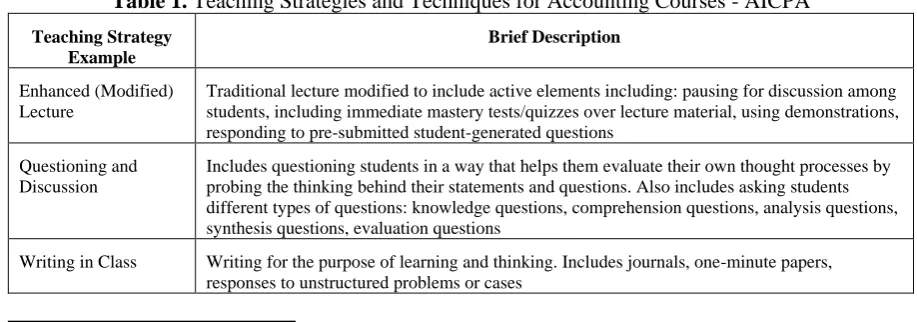
The aforementioned model of Popham, Schrag & Blockhus turned out to be a successful strategy, recently used by AICPA (2019). The teaching tools and methods were linked with the core competencies or elements of core competencies required from graduates based on AICPA Pre-certification Core Competency Framework4, developed by educators and accounting professionals. The purpose was to define a set of skills-based competencies needed by students entering the accounting profession. A list of examples is published on the organisation’s website5that may be used to teach technical content in accounting courses. It is presented in table 1.
Table 1. Teaching Strategies and Techniques for Accounting Courses - AICPA
Teaching Strategy Example
Brief Description
Enhanced (Modified) Lecture
Traditional lecture modified to include active elements including: pausing for discussion among students, including immediate mastery tests/quizzes over lecture material, using demonstrations, responding to pre-submitted student-generated questions
Questioning and Discussion
Includes questioning students in a way that helps them evaluate their own thought processes by probing the thinking behind their statements and questions. Also includes asking students different types of questions: knowledge questions, comprehension questions, analysis questions, synthesis questions, evaluation questions
Writing in Class Writing for the purpose of learning and thinking. Includes journals, one-minute papers, responses to unstructured problems or cases
4
https://www.aicpa.org/content/dam/aicpa/interestareas/accountingeducation/resources/downloadabledocuments/aicpa-pre-certification-core-compentency-framework.pdf
Page 107
Problem-Based Learning Cases
Students use knowledge, concepts, and skills relevant to a course to solve realistic business problems.
Problem-Based Learning Guided Design
A student team attacks a problem by dividing it into a series of prescribed steps (e.g. identify the problem, state the goal, list constraints, etc.) to be resolved in order; after each step, instructor provides written “expert” analysis elaborating on the various alternatives the students had available during the previous step
Group Learning Teamwork
Students work together in teams, collaborating to complete a problem or project
Debates Students work together in teams, collaborating to complete a problem or project
Technology Visual and Computer Based Instruction
Tutorials
Technology-Based Delivery
Courses delivered partially or wholly online
Fieldwork Service Learning
Accomplishment of tasks needed by the community combined with intentional learning goals, conscious reflection, and critical analysis
Fieldwork Accounting Internships
Students get academic credit and real-world experience working in industry, government or public accounting
Source: AICPA 2019
Fieldwork accounting internship is recommended by AICPA as the real-world working experience is considered valuable for the successful career start of graduates. Due to the recent development of information technologies, technology visual and computer based instructions as well as technology-based delivery of accounting courses have been successfully implemented into the accounting curriculum.
According to Shukla and Sharif, the use of ICT by educators is rapidly increasing. The ICT influence is unarguable and could be traced to many education areas, including accounting. Moodle based platforms with virtual classrooms, online libraries and resources have become a necessary elements of the modern teaching process. Youngsters could hardly develop the required professional competences and technical skills, the latter being even integrated in the professional qualifications of the Association of Chartered Certified Accountants (ACCA) and ICAEW. Shukla and Sharif argues that the real challenge before accounting educators is the shift from the traditional teaching methods towards the use of ICT. Such substitution should be made with caution. There could be a resistance of both students and lecturers though the prevailing arguments are supporting the view that technology enhances students’ comprehension of the studied material and their involvement in the learning process.
4. INNOVATIVE TEACHING METHODS INTRODUCED IN ACCOUNTING DISCIPLINES 4.1. Introducing business games and digital business simulations into accounting courses
Page 108
human emotions which usually penetrate interactions between the business parties involved. By wearing the black hat, students could develop their professional skepticism and judgement. Accounting professionals are well known with their prudence and conservatism. They are expected to be pessimistic rather than optimistic when reporting company’s financial results, budgeting company’s revenues, planning and forecasting. In contrast, the yellow hat should demonstrate a positive and constructive perspective on the situation though on the basis of logical thinking. The green hat stimulates creativity as the green colour is considered a symbol of freshness. Participants are expected to think in an innovative way and generate some new ideas about the case under discussion. The blue hat is associated with bringing clarity into the matter. Students, wearing it, are expected to gain control over their thinking process, to organize and direct the smooth running of the activities performed. Raluca (2016) makes an attempt to prove the usefulness of “The six thinking hats” in teaching accounting by analysing a certain case – the possibility to enhance the business activity of an accounting firm. The so provided discussion requires feedback from faculty in order to evaluate its effectiveness in the accounting education context. Probably, a more modern and appropriate game for students is the recently developed Count FEFE6 business game as a result of a two-year European-funded project, which ended 30 September 2018. It is a free mobile digital game, developed for the purpose to support the building of fundamental accounting and finance skills for business.7 The target users are students on university and vocational courses - both accounting specialists (bookkeeping “manual”) and non-specialists (bookkeeping “automatic”). The game gained certain popularity in the academia due to its digital nature, its English, German, Greek and Spanish versions and unarguable benefits for students of using it. The benefits are listed on the website of the Count FEFE game and could be summarized as follows:
• Engagement – it provides more funny and enjoyable way to learn accounting and finance
• Learning by doing – it builds confidence in the form, content and terminology of financial statements and develops broader business, commercial, ethical and risk awareness
• Students receive immediate formative feedback • Flexibility – it works on iPhones and Android phones
• Broad application – it has an optional bookkeeping mode and so is equally relevant for courses which require students to complete the debits and credits and those which do not8
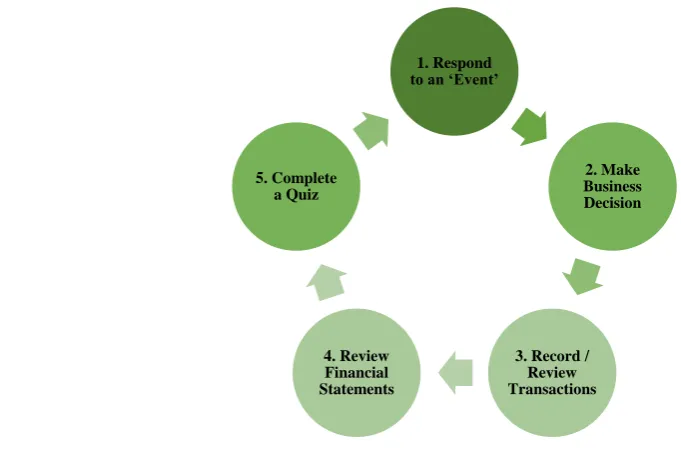
The students are put in the role of the owner-manager of a retail start-up business. The running of company’s business activity over a series of “simulated months” is dependent on and requires participants to respond to events, make business decisions, interpret financial information and complete timed multiple choice quizzes. The “monthly process” is illustrated on figure 1 (Davies et al. 2019).
6 Financial Education for Future Entrepreneurs, http://fefeproject.eu/
Page 109
Figure 1. Count FEFE Game Monthly Process
Source: Davies et al. 2019
The Count FEFE game is structured in such a way that allows users to enhance gradually their accounting and finance literacy after successful completion of each of the three levels, characterised with new business features, new financial data and new challenges (table 2).
The Count FEFE game is a subject to further development. The experts’ team is currently working on expanding its functionalities by adding new levels as management accounting and financial management. Especially for students and tutors, an online learner analytics tool is under creation. Enhancement to other subject areas is also considered (Davies et al. 2019).
Table 2. Count FEFE business game
Game Level
Business Structure
Annual Financial Target for Business
Accounting and Finance Topics
Level 0
(Trainee)
Sole Trader Positive Cash at Year-End
• cash transactions
• drawings
• statement of profit or loss
• statement of financial position • accounting terminology
• presentation of financial statements
Level 1
(Apprentice)
Sole Trader Revenue of V$3.6m • tangible non-current assets and depreciation
• accounting policies
Level 2
(Technician)
Sole Trader Profit of V$0.75m • credit transactions
• accruals and prepayments • sources of rules
• accounting concepts and conventions • financial ratio definitions
• basic accounting measurements and treatments under International Financial Reporting Standards (IFRS) 1. Respond
to an ‘Event’
2. Make Business Decision
3. Record / Review Transactions 4. Review
Financial Statements 5. Complete
Page 110
Level 3
(Master)
Limited Company Return on Capital Employed of 20%
• statement of cash flows • share issues
• dividends
• intangible assets and amortisation
• bad debts • provisions
• capitalise and expense decisions • ratio interpretation
• advanced accounting measurements and treatments under IFRS
• the IFRS Framework
Source: http://fefeproject.eu/summary/
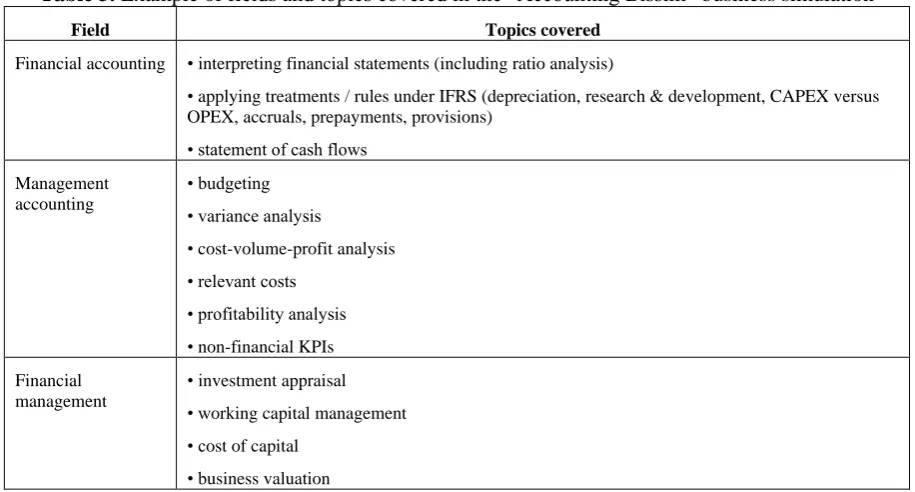
Another business game, recently gaining popularity, is the “Accounting Bissim” business simulation. It provides a team-based competition with up to six teams per “World” with 4 – 8 students per team. Students work together as the Board of Directors of a domestic robot manufacturing business in the year 2031 and have to make key management decisions for up to six decision years. The decisions are related to sales price, production quantity, wage rate, research and development, capital expenditure, advertising, staff numbers, training, financing, credit terms and sustainability (Davies et al. 2019). It is worth mentioning that the annual results of the simulated company include financial statements and non-financial key performance indicators (KPIs).
Page 111
Table 3. Example of fields and topics covered in the “Accounting Bissim” business simulation
Field Topics covered
Financial accounting • interpreting financial statements (including ratio analysis)
• applying treatments / rules under IFRS (depreciation, research & development, CAPEX versus OPEX, accruals, prepayments, provisions)
• statement of cash flows
Management accounting
• budgeting • variance analysis
• cost-volume-profit analysis • relevant costs
• profitability analysis • non-financial KPIs
Financial management
• investment appraisal • working capital management
• cost of capital • business valuation
Source: Davies et al. 2019
4.2. And now Color Accounting – a revolutionary educational technology
According to Cristopher at al., Color Accounting is a new teaching and learning system, which is revolutionary in the way it teaches fundamental accounting concepts and how accounting system works and generates data. Visualisation through a special colour-coding system lies at the heart of this innovative teaching technique and its success is deeply rooted in the existing “link between the psychology of colour and learning comprehension, attention level and retention” (Christopher et al. 2015, p.78). Moreover, colour facilitates learning due to how brain responses to it, how it catches our attention and the way we perceive and process information. There is also an evidence that colour helps organising and sorting and stimulates comprehension of complex structures encompassing many elements (pp. 79-80). Cristopher at al. (2015) consider Color Accounting as a way to transform the first course of accounting, one of the objectives, listed in the Pathways Commission report (AAA & AICPA 2012). Accounting fundamentals should be taught with engaging teaching approaches and materials in order to attract talented young people at universities and reveal their full potential for becoming successful professionals.
Professor Paul Healy, Head of Accounting Unit at Harvard Business School and a supporter of Color Accounting teaching system, argues that its basic advantage is the visualisation of how accounting information system is functioning which makes students’ learning more effective. Based on his teaching experience with Color Accounting, he believes “that it is of value to anyone who is interested in understanding how accounting works (from high school students to MBAs to business executives).”9 Color Accounting10 is described by its team as an educational technology11 with more than twenty years of existence since it was first introduced as an accelerated learning system for corporate training. By using colours, graphics and illuminated plain language, the effectiveness of the teaching/learning process enhances for the benefit of both the trainers and trainees. The two-day corporate workshop, introduced around the year 2000, was transformed over time into a one-day workshop for adults, aiming
9 https://www.accountingschool.com/
10 The use of Color Accounting or Colour Accounting depends on the country and the American or British way of spelling.
Color Accounting International is the organization that publishes the teaching/learning system and its name is spelled in the American way.
Page 112
to build up their business acumen through development of accounting and financial literacy. Soon Color Accounting was introduced at universities and into secondary and tertiary schools around the world thus changing the traditional way of teaching accounting fundamentals for the benefit of younger learners. Despite the growing interest and evidence for its successful implementation in different environment and the increasing number of followers, this educational technology is still unpopular in Bulgaria. In our opinion, it is a matter of time Bulgarian academics to start using it as a tool for enhancing traditional accounting teaching. It could be considered as a tool for overcoming students’ biases that “accounting is boring” and motivating them for becoming professional accountants - a desirable step ahead in light of the forthcoming changes in the role and functions of accountants (Stancheva-Todorova 2018). Being accounting literate is related to the three aspects of learning accounting – its structure, language and mechanics. The structure refers to the way financial information is presented based on the duality concept. As accounting terminology is very specific, the meaning of accounting terms as assets, liabilities, expenses, income, profit, debit, credit, etc. should be well understood by students and used by them with caution. Finally, mechanics imply the technology of generating accounting data based on the double entry system which determines the way of recording business transactions.
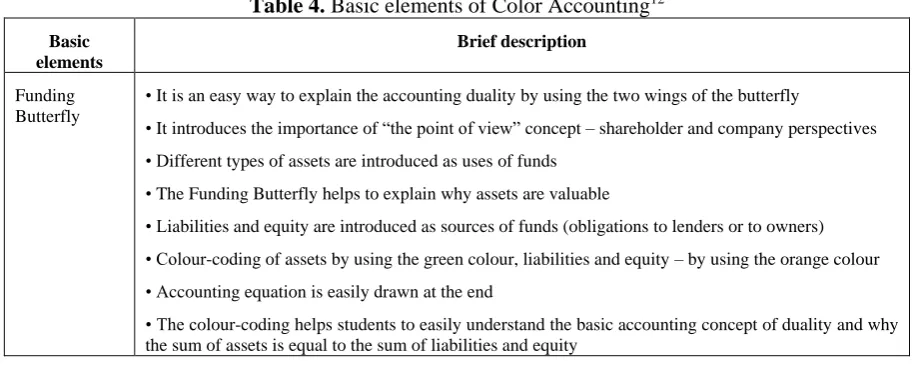
Color Accounting teaching/learning system has three basic elements – the Funding Butterfly, the BaSIS Framework and the buckets and tickets. They are presented with a brief description in table 4.
Table 4. Basic elements of Color Accounting12
Basic elements
Brief description
Funding Butterfly
• It is an easy way to explain the accounting duality by using the two wings of the butterfly
• It introduces the importance of “the point of view” concept – shareholder and company perspectives
• Different types of assets are introduced as uses of funds • The Funding Butterfly helps to explain why assets are valuable
• Liabilities and equity are introduced as sources of funds (obligations to lenders or to owners)
• Colour-coding of assets by using the green colour, liabilities and equity – by using the orange colour • Accounting equation is easily drawn at the end
• The colour-coding helps students to easily understand the basic accounting concept of duality and why the sum of assets is equal to the sum of liabilities and equity
12 The content of the table is author’s attempt to summarise the basic elements of Color Accounting teaching/learning system
Page 113
BaSIS Framework
• BaSIS stands for Balance Sheet and Income Statement
• It is a one-page model of both the balance sheet and the income statement and reveals how the two statements connect
• The colour-coding is enhanced: expenses are coded in green, income in orange13 and company’s profit - in purple
• Assets’ characteristics are easily explained – valuable, tangible and intangible, recognised under certain criteria, used for generating income
• Liabilities are defined as representing claims for creditors and equity – as representing claims for owners
• Expenses are explained in terms of value-sacrificing activities (funds used up) • Income is explained in terms of value-generating activities (funds generated)
• Profit is considered as the third source of funds to the business
• The colour-coding system helps students to understand and distinguish assets from liabilities, on one hand, and expenses and income, on the other
Buckets and tickets
• The buckets represent T-accounts
• The tickets represent company’s transactions
• The debit side of the T-account is coded in green and the credit side in orange
• Tickets should be placed in the proper buckets/T-accounts depending on how transactions affect company’s assets, liabilities, equity, income and expenses
• By using the colour-coding system, company’s transactions and T-accounts are visualised in a way that enables students to understand the logic of the business fund flows and how the accounting data is generated
• The colour-coding helps students to easily understand the basic accounting concept of double entry of transactions, the accrual and matching principles
According to Dave Kolitz14 (2019), a senior lecturer at University of Exeter, United Kingdom (UK) and a licenced solution provider of Color Accounting, there are two models for implementing it into the accounting curriculum:
• Present a Color Accounting workshop as a boot camp / induction course over two or three days before formal lectures begin
• Integrated into the module over a number of weeks
The first model has been implemented at Rhodes University (South Africa) and Middelsex University (UK). Color Accounting is introduced as a one-day workshop on an MBA programme. The second model has been applied at Exeter University (Cornwall campus).
4.3. The corporate educational films of ICAEW – exciting film dramas and case studies
Another teaching tools that deserves academics’ attention, that are quite new and innovative in the accounting domain, are the corporate educational films and probably those, recently introduced by ICAEW are the most globally successful ones. The purpose of those exciting film dramas is to facilitate lecturers in provoking students’ analytical thinking and discussions on business case studies. They also aim to develop students’ employability skills as: adding value, communication, decision-making, problem solving, ethics and professionalism, teamwork and technical competence15 – an advantage that will be assessed throughout the recruitment processes of employers. Real business environment is represented through tough situations, teaching students “how to manage upwards, difficult client
13 For practical reasons, the original yellow in the color-coding was substituted with the orange colour in 2019.
14 The author wants to express her sincere gratitude to Dave Kolitz, who kindly provided to her his presentation at the Color
Accounting conference 2019, 27-30 May, Athens, Greece.
15
Page 114
relationships and team work” (ICAEW 2018). Corporate films facilitate students’ reflective learning as they replicate real-life workplace scenarios thus giving them business insight into how companies and boards operate. The film dramas’ focus is on professional scepticism and everyday business challenges. They demonstrate the importance of professional development and could be used as an effective tool for stimulating students to choose a career in accounting, finance and business.
Till now ICAEW has produced two corporate educational films and is working on a third one. “False Assurance” is the first drama production16. It was filmed on location at Chartered Accountants’ Hall in London and was shot by using professional film equipment. Popular actors from British and international film and television productions are casting. This corporate educational film drama explains the job tasks of auditors, their quite specific role as boards advisors, the need for quality checking and the importance of professional ethics and scepticism. Special attention is given to ethical dilemmas, consequences from taking the “easy way out” and the required behaviour of the professional accountant. The scenario of “False Assurance” is representing two turbulent years of a fictitious company called D-Merton with Alex Frayn being its former chief financial officer. Due to some malicious actions of company’s executive directors, the lack of caution and daring by its board of directors and failure by the auditors to identify and inspect certain issues, D-Merton was brought to its knees. The film comprises of four parts, thus providing the students with the opportunity to discuss their possible actions in the same situations. (ICAEW 2018)
“Without Question”17
is ICAEW’s second corporate training film, created by the same team that made “False Assurance”. Similar to the first ICAEW’s film drama, it was located at Chartered Accountants’ Hall in London. This time the fictitious company’s business is hotel development and management and the Holt family are the founding shareholders. Family members could not agree with each other on the future strategy for the company. The apple of discord is the launching of an initial public offering (IPO) and the loss of control, which is sharpening the conflicts. IPO puts the company, its auditors and other professional advisers under pressure and brings unexpected consequences from their decisions, actions, and lack of effective communication. Reliance on experts, accounting estimates and confidentiality are only few of a variety of issues under discussion. “Without Question” consists of five parts and it is preferable to be watched in groups for initiating discussions of the issues that arise during the film. It is designed not only for teaching at universities, but also for “firms and companies of all sizes, and all around the world” (ICAEW 2017).
If we consider educational films from the lecturer’s perspective, definitely there are many advantages in their favour. Classroom learning is stimulated and students’ interest is captured by using scenarios that represent real-life complex business situations. Those exciting dramas are supported by some training materials aiming to facilitate interactive lectures and seminars. In addition, questions for stimulating learners’ discussions and analytical thinking are provided after each part of the films. Moreover, a useful reference guide to the characters of the films is also available. Films are announced of being purposefully generic and can be used for training in any country.
Richard Cartwright, principal teaching fellow in Accounting at the University of Southampton’s Business School has been using ICAEW films to support his teaching and lists many benefits for the students. He shares that “Because accounting is a practice, students at university don’t get to see and feel what it looks like to be an accountant, ICAEW films allow students to contextualise the theory they study.”18 Graduates also benefit from those exciting dramas as the latter provide them with fascinating topics for discussion and give them some advantage on work interviews with employers.
16 It was written by Duncan Wiggetts and directed by award-winning producer/director Nick White. Wiggetts started writing educational film dramas while working as a partner within PwC’s European risk management team in 2005. He joined ICAEW in 2014 as Director of Professional Conduct.
17 Again the story has been written by Duncan Wiggetts and this time produced by award-winning production company Area
17.
Page 115 5. CONCLUSIONS
Despite the existing variety of innovative teaching methods, academics have to carefully consider and implement them in accounting disciplines. Many factors should be considered when taking a step towards substituting the traditional textbook-based, rule-intensive, lecture/problem style way of teaching accounting at universities. Some methods are more appropriate for undergraduate programmes compared to others. Lots of the teaching techniques require lecturer’s training as a prerequisite for their successful implementation in the classroom. Introduction of business games and digital business simulations into accounting courses depends to a greater extend on lecturer’s ITC skills and the available ITC resources at universities. Funding is another issue though there are some free teaching solutions available for academics as the Count FEFE game. Unfortunately, some of the innovative teaching methods require initial investments, for instance the purchase of licence of ICAEW corporate educational films.
A special attention should be paid to the first accounting course. On the one hand it could be used for introducing the broad role of accounting in business and society and reveal the variety of possible paths for a successful career. On the other hand, introductory accounting module should help students in building their technical accounting skills. A possible solution of this issue is Color Accounting – a revolutionary teaching and learning system with many supporters around the globe and more than 20 years of successful implementation in different environment. Considered as a tool for enhancing traditional accounting teaching, it improves students’ learning comprehension, attention level and retention of accounting knowledge.
ACKNOWLEDGEMENT
This research paper is financed by the “Scientific Research” Fund under project № 80-10-73/12.04.2019.
REFERENCES
1. AAA & AICPA 2015, The Pathways Commission: In Pursuit of Accounting’s Curricula of the Future, viewed 20 January, 2019, <http://commons.aaahq.org/groups/0fa82ab56d/summary> 2. AAA & AICPA 2012, The Pathways Commission: Charting a National Strategy for the Next
Generation of Accountants, viewed 20 December 2018, <http://commons.aaahq.org/posts/a3470e7ffa>
3. AICPA 2019, Sample Teaching Strategies and Techniques for Accounting Courses, viewed 20 May 2019, <https://www.aicpa.org/interestareas/accountingeducation/resources/sample-teaching-strategies.html>
4. Black, W. 2012, The Activities of the Pathways Commission and the Historical Context for Changes in Accounting Education. Issues in Accounting Education, vol. 27 (3). pp. 601-625.
5. Christopher, J., Phillips, M., Schertzer, S. & Germann, A. 2015, An Exploratory Study of Color Accounting: A New Way to Teach and Learn Accounting. Journal of Higher Education Theory and Practice, vol. 15 (7), pp. 77-85.
6. Color Accounting Student Workbook, Accounting Fundamentals, South Africa Edition-English, 2015.
7. Color Accounting Teacher’s Guide, based upon Color Accounting Student Workbook (South Africa), 2016.
Page 116
9. Davies, M., Lorenz, A., Rosairo, F. & Weaver, L. 2019, Enhancing Student Engagement in Accounting: The ‘Count FEFE’ Game/App and Business Simulation Exercise (‘Accounting Bissim’), Presentation on ICAEW HEI 2019 Conference, 18 January, 2019, London, UK.
10. EY 2017, Survey: Gen Z’s future will be brighter than previous generations, viewed 24 February 2019, https://www.ey.com/us/en/newsroom/news-releases/news-gen-zs-future-will-be-brighter-than-previous-generations-ey-survey-finds
11. Goddard School of Business and Economics 2014, Project: Innovation & Coordination of Introductory and Intermediate Accounting Curriculum.
12. ICAEW 2018, False Assurance. How would you act?, viewed 15 March 2019, icaew.com/falseassurance
13. ICAEW 2017, Without Question. Learning Outcomes for Universities, viewed 20 March 2019,
https://www.icaew.com/-/media/corporate/files/technical/audit-and-assurance/false-assurance/icaew-without-question-universities.ashx
14. Kolitz, D. 2019, Presentation materials, Color Accounting conference 2019, 27-30 May, Athens, Greece.
15. Raluca, S. 2016, Using Interactive Methods in Teaching Accounting, Studies in Business and Economics, vol. 11 (2), pp. 130-139.
16. Riccio, E. & Sakata, M. 2000, Teaching-Learning Methods in Accounting Education – an Empirical Research in the Brazilian Scenario, Internet published paper, University of São Paulo - Brazil Faculty of Economics, Administration and Accountancy Department of Accountancy and Actuary, viewed 20 January, 2019,
<https://pdfs.semanticscholar.org/5eeb/680b68d53d866827655c184a5cfd03eaddb5.pdf>
17. Stancheva-Todorova, E. 2019, Accounting educators and practitioners on alert – the time for bigger and constant changes has come! To be published in: Proceeds from scientific conference “Accounting, audit and finance in the changing world”, 19 April, 2019, University of Economics – Varna, Publishing House “Science & Economics”.
18. Stancheva-Todorova, E. 2019, How Artificial Intelligence is Challenging Accounting Profession, Journal of International Scientific Publications ‘Economy & Business’ (on-line), vol. 12, pp. 126- 141., https://www.scientific-publications.net/en/issue/1000031/
19. Shukla, A & Sharif, M. Technology vs. Traditional Teaching in Accounting Education: A Case Study from Fiji National University, Internet published paper, Pacific Journal of Education, vol. 1 (2), pp. 41-49.
Websites:
https://www.aicpa.org/ http://commons.aaahq.org/ http://fefeproject.eu/ https://www.icaew.com/ https://www.ey.com/