132
Contemplative Analysis Of Node Localization And
Clustering Models In Wireless Sensor Networks
Panimalar. K, Kanmani. S
Abstract: WSN in recent years well-thought-out as one among the key factor that cannot be moved out from our daily life. It plays a substantial responsibility in terms of decision making, data collection and processing and so on. However, due to its vast application torrent, the field expects effective computational and communication models for data processing and managing. In this paper two different streams are handled namely, node localization and clustering. The recent approaches that are proposed in the relevant domains are discussed along with its advantages. This paper is modeled to explore the deep insights and the current technologies that are carried to address the mentioned research issues so that enhanced models can be modeled soon. And it gives a quick understanding of the existing techniques in this field to carry out further investigation in the future.
Index Terms: Localization, Clustering, Wireless sensor Networks (WSN).
————————————————————
1 INTRODUCTION
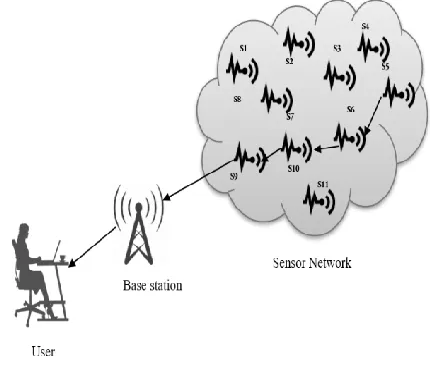
Wireless sensor network plays a vital role in low-cost and effective communication model on building smart sensor. They have the potential to sense data in any environment luminosity, distance, location, visualization, acceleration, resonance, compass, rotation, motion, magnetic, gravity, temperature, moisture, intensity, vibration, pollutants, etc., process the data and communicate them to the neighborhood nodes. This is diagrammatically represented in figure 1. Establishment of WSN in an industry is not higher than the cost of human resources that they deploy to carry on the procedure that is intended to be done by sensors in recent years. WSN is not only deployed in the industries but also in the dangerous environment where the interpretation is expected however it is a hazardous situation of a human. These are intended locations such as forests for identifying the fire accidents and to monitor the dangerous creatures. WSN makes the task easier by automating the process which starts from deployment and ends with data aggregation. The aggregated data later will be used for the decision-making process. In olden days the expenses spent on WSN is high due to the limitations in the computational and communicational process whereas the recent year status in terms of communication and computational nature is higher than needed such as the Internet of Things (IoT), Big data Analytics for effective communication and computation of resources. It is also scalable in nature right from the small-scale industries to a large-small-scale automation procedure. Some of the applications includes monitoring the hazardous environments, military, surveillance for detection of sensitive issues and for target detection, tracking and attacking, in agriculture for farming and cultivation, in healthcare domain for patient monitoring and in residential areas for effective power management, safety measures for vehicles and to monitor the space and its exploration process[18].
The WSN has performance issues that cause hazards in the environment like Medium access scheme in Sensor MAC (S-Mac) that utilizes procedures to decrease consumption of energy and bolster self-setup. To minimize energy intake in snooping to the futile channel, nodes intermittently sleep. Adjacent nodes form virtual clusters to auto-synchronize on scheduled sleep mode. S-MAC utilizes in-channel signaling and sets the radio to sleep throughout broadcasts to further nodes. S-Mac put on message passing in decreasing the latency conflict for applications that involve store-and-forward processing as information moves from end to end in the network. The hardware model Berkeley Motes by crossbow technologies comprises of an embedded microcontroller, low-power radio, flash memory and operated by two AA batteries [19]. The operating system deals with performance in WSN, such as the TinyOS in NesC language is open-source and has a component-based architecture that empowers agile development and usage while limiting the size of the code as a prerequisite in the networks.
Fig. 1. Basic structure of Wireless Sensor Network The TinyOS execution model underpins difficult yet safe synchronized operations. The component library consists of distributed services, drivers, and network protocols and data procurement tools. This bolsters the TinyOS module and concurrency model. Some types of threats are hoaxing, modifying routing data, congestion, passive data collecting, ______________________________________
• Panimalar. K is pursuing Ph. D program in Computer Science
and Engineering, Pondicherry Engineering College,
• Kanmani. S is Professor in Information technology, Pondicherry Engineering College, India, [email protected]
132 subversion of a node, sinkhole, and Denial of Service (DoS)
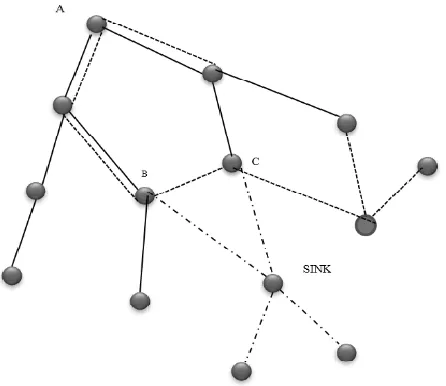
attack. Mate, simplified middleware for application-specific virtual machines implemented on TinyOS. The Quality of Service includes the Sequential Assignment Routing (SAR) which is a primary protocol reliant on three issues in routing choices: Energy, QoS, and the priority level of each message. To evade failure in the route, a multi-path approach and localized path rebuild arrangements are used. To make multiple paths, a tree is established from the source to destination by avoiding nodes with low energy, as a result, each node will be part. SAR determines the weighted QoS metric in the network, which is the product of the QoS metric and a weight coefficient. The average weighted QoS metric is inversely proportional to QoS. The objective is to minimize the average weighted QoS throughout the lifetime of the network. A path recompilation applied if the topology changes due to node failures. An illustration shown in figure 2. The trees rooted at B and C, two of the one-hop neighbors of the sink. Node A belongs to both trees, and path lengths of 2 and 3, respectively, to the sink, using the two trees.
Fig. 2. Sequential Assignment Routing
The network layer issues include Sensor Protocols for Information via Negotiation (SPIN) is a resource-aware and versatile which are intended to surmount the problems emerge from existing protocols. Each node perceived as a possible representative that has ample information accessed by Base Station (BS) through queries. SPIN-1 built to limit the degree of WSN within the network. SPIN-2 built to decrease the depletion of the energy of the nodes. The transport layer includes a consistent transport protocol with the basic technique of using minimum necessities on the routing setup and least signaling called Pump Slowly, Fetch Quickly (PSFQ) which takes a different approach for a developing new class of reliable data applications. Thereby it reduces the data consistency communication cost and receptive to error rates permitting effective procedure under exceedingly error-prone environments. It consists of three protocol roles: Message relay (Pump operation), Relay-initiated error recovery (Fetch operation), and Selective status report (Report operation).
1.1 Features of Wireless Sensor Networks
WSN has the following distinctive attributes and limitations considered for the efficient deployment of nodes on the network. Sensor networks communicate these characteristics, but also have few distinctive highlights [13].
Application-specific is design prerequisite of the network. WSN can sense in any harsh environmental conditions. Application-specific is design prerequisite of the network. Low cost in the WSN rule bargains many sensors that
arrayed to measure any physical environment.
Power consumption constraints, usage of capacitors, and batteries to consume minimum power to its performance or more by functioning low power levels in WSN.
Mobility means the handling of unpredictable information trails and mobile nodes of the network [12].
Cross-layer used for improving transmission performance while it carelessly handled and measured that will play havoc in the overhead of the network.
In the homogeneous network, the energy uniformly distributed, and so all nodes are of the same capability, enables the network to be simple and low hardware cost. In a heterogeneous network, the potentiality of nodes
varies concerning processing, battery, storage, and mobility. It enhances in boosting the life of the network. Ease of use becomes the capacity to equip immediately for
topological variation in the network of WSN.
WSN can sense in any harsh environmental conditions. The failure of nodes is directly proportional to
environmental interference and calamities of nature [19]. Henceforth, it is mandatory either to select new path with more energy to communicate with the base station or to use the existing links to limit energy consumption.
Energy constrained nodes are compact and restricted in energy computation and storage volumes.
Self-configurable are nodes that arbitrarily organized. Once positioned, nodes must organize themselves independently into a network for communication.
Fault Tolerance is the capability to withstand network operation with no disruption due to node failures. If nodes in the environment are arranged with diminutive impedance then the protocols can be more relaxed,
Lifetime is exceptionally perilous for most applications, and its essential constraining element is the energy consumption of the nodes, which need to be self-powering.
1.2 Application of Wireless Sensor Networks
WSN be made up of many types of sensors such as seismic, thermal, visual, infrared, acoustic, magnetic and radar. These sensors used to monitor different conditions such as humidity, light, temperature, pressure, soil, noise, stress, and detection of moving objects. These applications can be broadly categorized into military, environmental, health, home, and other commercial areas.
Home Applications
133 1) Appliance Control
The home appliances can be probed and controlled through remote PC or phones. Using WSN it trends to development of smart appliances which will lead to convenient lifestyle.
2) Home automation
It involves introducing a degree of computerized or automatic control to certain electrical and electronic systems in a building. These include lighting, temperature control, etc. This will be helpful for handicapped and old aged people that will enable them to control home appliances and alert them in critical situations.
3) Intrusion Detection System
It is important to provide security mechanism for home, Using WSN, a home can be embedded with motion sensor to detect unauthorized person movement. As there is growth in wireless technology, the danger of attacks has also increased. There are many algorithms available to detect the anomaly.
Military Application
The characteristics like rapid distribution, self-organizing, and fault tolerance makes them perfect for military & surveillance purpose. Military applications include Area Monitoring, Border Monitoring, Military-theatre, or Battlefield surveillance, Targeting systems, Battle damage assessment, Attack detection, Target Tracking, and many more.
1) Area monitoring
The nodes are deployed over every area to monitor physical activity in the battlefield. When sensors detect unusual sound or vibration then it is immediately reported to the base station, which then takes proper action. Similarly, WSN can be installed in security systems to detect motion of the uninvited high-speed vehicles in traffic control system.
2) Target Tracking
It is one of the most significant applications in which nodes monitor and report the positions of moving objects to the application’s user with a minimum latency. In real life scenario, detection of illegal borders crossing, gas leakage, fire spread, and wildlife monitoring are the application using target tracking. The multi-target tracking system supports three different indoor environments, such as an open environment with no obstructions nor objects, an internal environment with furniture and various objects, and a heavily chaotic office environment.
3) Border monitoring
It is critical to the security of every state and the encounters are changing quickly. It is an important application in WSN since the end users use the sensor data and the sensor network system deliver the data of interest with confidentiality. The continuous monitoring reduces the chances of missing any potential criminal activity where the ability of a WSN to operate without any human involvement.
4) Battlefield surveillance
WSNs can detect and track military targets such as tanks and vehicles. The nodes, which are arranged over a wide area use acoustic and magnetic sensors for detecting the presence of the moving objects, the motion sensor is used to classify the moving target such as a walking person or a vehicle. Nodes
can be positioned in Nuclear station and used in chemical and biological warning systems. Figure 3 illustrates the military application.
Environmental Application
Environmental applications like tracking the actions of birds, animals, and insects, monitoring environmental conditions that affect Agricultural and irrigation, monitoring earth and planetary exploration, chemical/ biological detection, Marine and Soil Monitoring, forest fire detection, flood detection, and pollution (Water, Air, noise) study.
1) Flood Detection
The main aim is to predict flood in rivers by a simple calculation to offer a real-time result to save the life of people who may be affected by the flood. Using WSN technology, Weather sensors are used in flood detection system to detect, predict, and hence prevent floods. The nodes effectively monitor and detect occurrence of flood in flood prone areas. The parameters that are recorded using nodes are water level, amount of rainfall, relative humidity, and temperature. The relative humidity and temperature values are used to monitor the rate of rainfall. The amount of rainfall values is used to predict the water level. The water level will determine the extent of the flood as low, medium, or high. This will enhance early flood detection. The flood status is sent directly to the occupants of the flood prone region directly from the surveillance center.
2) Air pollution monitoring
Air pollution monitoring is a very complex, but it is very important. It is very time consuming and quite expensive to collect data periodically and store in built-in data. But using WSN, it can make air pollution monitoring less complex and instant readings can be obtained. The sensors monitor the parameters and send to the control centre by communication network. The wireless mode includes GSM, GPRS, etc.
3) Tsunami Detection
134 which analyse the pressure data and predict which, if any,
barriers need to be provided.
4) Agricultural Wireless Sensor
WSN can be used to control the environment which involves monitoring soil. Sensors are deployed throughout the soil field and these sensors form a cluster that communicate with each other to reach the processing center which analyze the soil data (dryness, moisture) sent and then accordingly adjust the environment conditions and thus can start the sprinkling system.
5) Weather Monitoring
Using a node, the parameters like temperature, Gas and humidity are measured and recorded without intervention of humans. These parameters are transmitted to a remote location through a communication link. The data can also be store in an inbuilt data logger and can be physically downloaded to a computer later for further processing. Hence, the communication system is an essential element in an automated weather station.
6) Forest fire Detection
Forest fires are common in any part of the world due to Lightening, extreme heat, or negligence of local natives. Using WSN, substantial number of nodes are organized in the forest. These nodes are grouped into clusters as shown in figure 4, so that each node has a corresponding cluster header. These nodes can measure environment temperature, relative humidity, and smoke.
Health Application
Health monitoring applications using WSN progress the existing health care method and patient monitoring. It can be done in a human body by placing sensors for determining the signals like heartbeat rate or breathe rate, Glucose level monitoring, Organ monitoring, Cancer Detectors, and General health monitoring.
1) Heartbeat Sensor
Wearable sensor system is useful to monitor vital sign in hospitals. Heartbeat sensor detects and transmits the changes in the human heartbeat and to the computing unit which computes the abnormalities and store data simultaneously.
2) Biomedical Application
Biomedical WSN permit the growth of new applications and services to improve the quality of medical care provided to the citizens. Advanced sensors are combined with wireless communication that will help to reduce the costs, improving the monitoring capability and to provide better life quality for the patient. The application includes drug delivery, detections and diagnosis, targeted therapy.
3) Telemedicine
Telemedicine provides a clinical care and help to many peoples in the great distances on the globe. It is guided through an audio-visual method over high-bandwidth and so low-latency connections and through Store-and-forward method which use the collected data like ECG, heart rate, oxygen saturation, respiratory rate, blood pressure, etc., and images like CT, MRI, ultrasound, etc. The image/video content and transmit to a specialist at proper time for evaluation in offline
4) Patient remote monitoring
It Enables doctors to monitor patients remotely and give them appropriate advice and support; to reach anywhere at any time. It is an alternative to regular home check-ups of patients with certain medical conditions or to the elderly who are unable to regularly visit a hospital. Patient monitoring is a method of collecting medical record of a patient present at a remote location as given in figure 5. To deal with this issue, medical assistance is provided through internet based on wireless networks and compatible with existing infrastructure.
However due to the advantage of the scalability and the increase in the growth of industries and the need of WSN in such streams also bring up the issues in WSN such as data transferring among the sensors, data aggregation, security etc. To handle these issues different effective ideas were proposed such as Node Localization, Clustering of nodes among the sensors so that the data reaches the destination.
2. CONTRIBUTION AND PAPER ORGANIZATION
135 and advantages. The tables briefly explain the theme of the
proposed model, parameters, performance metrics that they used for evaluating. Section 6 concludes the paper by disclosing insights that the author identified from the paper and provides future work direction.
3. NODE LOCALIZATION
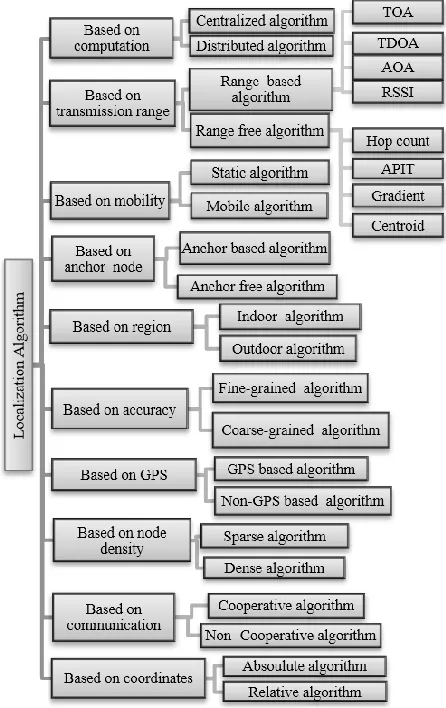
The concept of node localization emerges when the nodes are randomly deployed in the network. In the past decades, the sensors were deployed in a predefined location. Later, as the size of the region increases and due to inconvenience in reaching the exact location to deploy the sensors, this random deployment of sensors came into picture. The advantage in random deployment is it does not require predefined location identification for deployment. It can be placed in the places where we like to with the help of drones or chopper, etc. It is amongst the key techniques in the WSN. The place estimation method is usually classified into Target/source localization and node self-localization. In target localization, we mainly introduce the energy-based method [9]. Then we investigate the node self-localization methods. Considering that the widespread adoption on the WSN, the localization methods are wide and varied in several applications. There are some challenges using some special scenarios. The classification of the localization algorithm given in figure 6.
Fig. 6. Classification of Localization algorithm 3.1 Performance constraints of nodes in localization
Each node opts for its localization method using the factors. Subsequently, the nodes deployed in ad-hoc style; it makes the network density very much irregular and thus reduces the performance of the localization system.
Anchor Nodes: Beacon or anchor nodes know their coordinates by a physical position. The gain of known nodes in the network quickly gives global coordinates [14]. The shortcoming by known nodes is additional hardware cost and subsequently cannot be used for indoor localization.
Energy Efficiency: In WSN, the nodes have limited and outstanding energy supplies. The senor nodes perform many tasks as localization measurements, communication with the neighbours, and position estimation. In many applications, consumption of energy is one of the most vital considerations.
Cost: The budget of the localization algorithm consists of cost in hardware, communication, and computation. Hardware cost takes account of the node mass, the density of known nodes [17]. Communication cost comprises of two fragments. They are inter-node exchange and interaction amid nodes along with BS in centralized localization. More power is exhausted throughout this communication in distinction to internode communication. Hardware cost utilizes more energy as associated to inter-node communication or computation cost. In mobility-assisted localization schemes, it is essential to study the computation and communication costs. Moreover, cost plays a necessary compromise against accuracy and often driven by practical applications requirement.
Coverage: It is a degree of the part of the nodes arranged in the network, which may position. A few algorithms are not potent enough to focus on all the nodes. It subjected to the mass of the nodes, location of the known nodes in the network. Different strategies of placing anchor nodes adapted in assessing the coverage performance of localization algorithms. The evaluation of how the localization accuracy diverges calculated by the number of anchor nodes, location of anchor or neighbour per node. While trying to lessen the quantity of known nodes or neglect them, a localization algorithm can negotiate its correctness and ease.
Accuracy: The localization algorithm would provide the precise position of nodes so that the concerning task can be carried out. This is predominately application dependent. The algorithm accuracy shows how it corresponds to the estimated positions of nodes. If merely average position error used, there is a remarkable variance inaccuracy of the relative geometry of the network expected by the algorithm and the actual network. To compute exactness is to verify the residual error among estimated and real location, aggregate and mean the result. This is known as Mean Absolute Error [11].
Scalability: In significant scale positioning, the monitoring area among nodes is important. Geographical scaling implies expanding the network size and density ascending by the number of sensors in the space. Aggregating the density of nodes poses some trials in localization.
136 an algorithm gives significant consideration for the
requirement of node density.
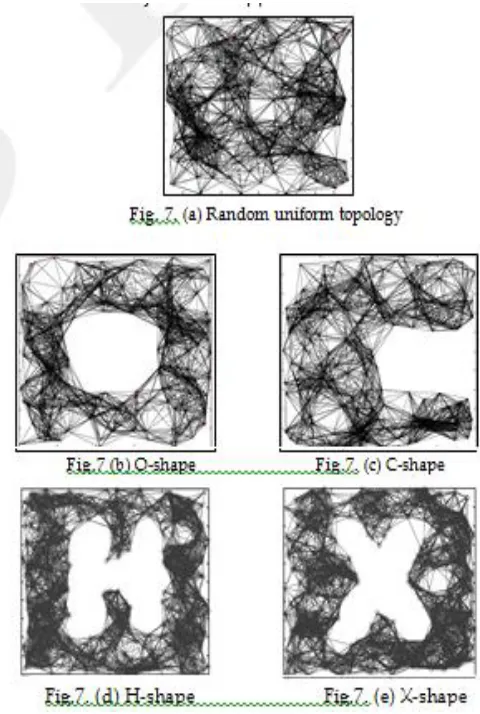
Topology: Node distribution topologies play a prominent role in the result of localization accuracy. Sensor network topologies are of two categories: In even topologies, anchor nodes are placed in an exact grid. In random topologies, anchor nodes placed uniformly or randomly. Random reflects the real-world deployment scenarios like in thicket or inside the volcano. Here the nodes are placed manually or in an impossible location. As per the placement policies of nodes along with the shape of the problems classified one of the networks, topology subdivided into two, such as irregular and regular topologies. In regular, nodes are put consistently over a range as a lattice or arbitrarily. The hypothesis of this does not signify the physical state due to several aspects that limit the positioning of nodes and thus is not operative given in figure 7 (a). In irregular, the evaluated distance between nodes significantly diverges from the actual distance due to the existence of difficulties inside the network area. Contingent upon problem size and shape inside the network area, the shape of the irregular topologies can be C, H, X and O, given in figure 7 (b)-(e) these are of irregular node arrangement that constraints many real-time applications
.
With this paper, we present a wide survey on challenges and the recent studies in an effective manner (Table 2). The entire process of estimating the unknown node position inside the network is known as node self-localization. And WSN comprises many inexpensive nodes which are densely
deployed in a very region of interests to measure certain phenomenon. The leading objective would be to determine the location of the target [13]. Localization is significant travelers have an uncertainty with the exact location of some fixed or mobile devices. One example has been in the supervision of humidity and temperature in forests and/or fields, where thousands of sensors are deployed by way of plane, giving the operator minimal possible ways to influence may location of node. An efficient localization algorithm might utilize all the free information from the wireless nodes to infer the positioning of the individual devices. Another application will be the positioning of a mobile robot determined by received signal strength from your number of radio beacons placed at known locations around the factory floor. The primary function of a location estimation method to calculate the geographic coordinates of network nodes with unknown position in the deployment area. Localization in WSNs is the process of determining the geographical positions of sensors. Only a few the anchors inside the networks have prior knowledge about their positions. Localization algorithms utilize the location information of anchors and estimates of distances between neighbouring nodes to discover the positions in the rest of the sensors [18]. The issue in random deployment is data aggregation. Due to random deployment, the location of the sensors is also not known in prior. Hence localization of such nodes is required for effective path identification and data aggregation. Node localization is one such scheme where the node locations are identified after the random deployment with the help of few anchor nodes.
4. NODE CLUSTERING
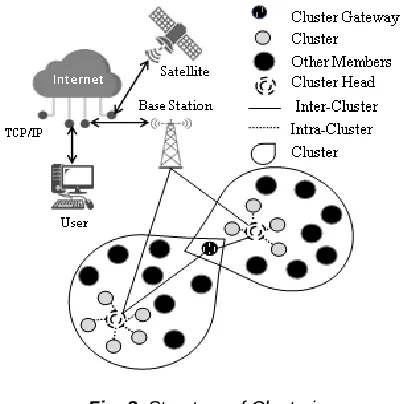
137 common role and responsibility on behalf of all the nodes in
the cluster. It operates as an access point between the nodes and the BS. CH may be fixed or variable and nominated by sensors that are high in resources. The CH can also be elected by ample factors like maximum residual energy of a node, minimum separation distance and minimum distance to the mobile node. Clustered data are arranged in a group to remove redundancy by CH. They are forwarded directly to sink or by other CH in some hierarchal structure to conserve energy [3]. The CH acts as the interface midst the node and the base station. Due to intra-cluster traffic from the CHs proximity to BS result in coverage issue and sapping the energy quickly. To surmount the energy consumption in CH, the role of CH should be rotated among all the nodes. By this load balancing can be attained. Moreover, the cluster formed near the sink must possess the sparse number of nodes in their cluster to save energy from intra cluster communication as they must manage most of the traffic. The CHs distant from BS for relaying data due to inter-cluster traffic result in disrupting the connectivity. In the cluster, message transfer within the nodes can be sent directly or by multi-hop with ease of CH. Vast quantity of data to be transmitted through intra cluster at CH to BS is reduced by aggregating and reviewing the data that result in network scalability and reducing energy consumption. Further energy consumption is lessened by putting nodes to sleep mode while they are idle and by improving bandwidth utilization. Within the cluster, it focusses on the route setup for decrease in the size of the routing table. Hence clustering is the best approach to reduce redundancy, enhancing scalability, network lifetime, connectivity, stabilizing network topology, decreasing delay, overhead, to have effective load balancing. These advantages can prove clustering to be efficient approach for routing [6].
Fig. 8. Structure of Clustering 4.1 Phases of clustering algorithm
Any clustering algorithm is generally divided into three main phases: Cluster formation phase, construction phase (selection of cluster head) and maintenance phase. The uttermost challenge is to elect the cluster head.
Cluster Formation Phase: This is the initial setup phase. This has major influence on the network behavior by creating
clusters of varying density with different density. The major work of this phase is to manipulate the cluster’s size, to minimize and balance the energy expenditure in the network, for tracing out errors and recovering from failing circumstances or in the event-driven clustering schemes, for triggering the cluster formation during the time necessity. A node can calculate its distance from the sink based on RSSI or GPS. Each node receives message and adhere additional message then send it to the nearest CH node. The node format of the CH node is given in figure 9. Here the hop count is set Maximum. Each time when node forwards a CH node it decrements the hop count field. In distance-based cluster formation, the nodes of the network know their a priori location. In Heterogeneous cluster formation, nodes in the network has varying dataflow responses. The data traffic within the clusters become heterogeneous resulting in delay and jitter values, limiting the usefulness of resource-intensive applications. In Density-based cluster formation, nodes in each group are extracted from a probability distribution in relation to the total number of nodes in the network. It helps maximize the network lifetime adaptive clustering, and density-based fuzzy imperialist competitive clustering algorithm.
Fig 9. Format of CH node formation
Cluster Head Selection (Construction Phase): Cluster-head capabilities depend on the clustering objectives and their effective range. Most of the work on CH node selection has focused on the energy capacity of network nodes. Some algorithms include references to advanced nodes, defined as those nodes with more energy [6].
Maintenance Phase: The nodes communicate with its elected CH. In most of the approaches nodes directly communicate with CH in one-hop technique as it depends on the distance between node and CH. In large scale network, multihop communication may also be adopted for intra- cluster communication., adaptation to external perturbations and then disruption or rotation. The network experiences limited loads if the cluster size remains small, but the power consumption is high during the intra-cluster transmission and the lifetime is greatly reduced. But on certain circumstances the size of the clusters in the network may be equal denoting that the numbers of nodes in all clusters are same.
4.2 Design challenges in clustering algorithm
To save energy and get maximum lifetime designing the clustering algorithm is important.
138 Robustness: For the cluster network maintaining the network
integrity is the vital part. This includes mobility of nodes, discrepancy in network size, and abrupt operational error. This deal with these changes clustering algorithms is required in the network to provide high robustness.
Data Load Management: CHs nearer to BS be imperilled to added data to transmit data to other layers. To prevail over this crisis, the CHs closer to the BS, keep lesser member nodes to lessen overload. Thus, the entire nodes in the cluster have equal energy exhaustion, and network lifetime.
Fault Tolerance: The nodes are built up of hardware which can face failure, delay in data transfer, interference, exhaustion of energy. For any harsh environment it is difficult to replace affected hardware. But by using cluster-based protocol, constraint is overcome. The data collected from nodes in WSN can be secured by fault tolerant technique.
Limited energy: WSN are made up of small devices with limited battery power. Hence it is difficult to maintain power in harsh environments. It is hard to recharge or replace the power source of nodes if once deployed. Using clustering algorithm, the power consumption in the nodes can be reduced by forming the clusters. The direct data transmission with the base station can be avoided. In flat network, flooding technique is used for data transmission. Likewise, in cluster- based network, multihop routing technique aids usage of energy saving by decreasing the number of transmission path.
Data Aggregation: Data fusion boosts the network lifetime and provide resources to entire network. During the data exchange in the network, it helps eliminating redundancy of data in CH and send them to the base station (BS).
Storage: In WSN, the devices are made of minimal hardware used in sensing data in any application. This mainly includes the memory where the collected data are stored. Typically, the limited stored data are moved regularly to BS in WSN. To overcome these disadvantages continuous monitoring of the storage is recommended. But by clustering technique and data compression the amount of data to be transmitted is decreased and thereby decreases the energy and communication cost.
Network Lifetime: In WSN, the nodes lead to limited power, limited bandwidth, processing capabilities and energy restriction. Clustering helps in the data transfer, data path access, intra cluster communication cost by decreasing the usage of nodes through selection of CH. Here the data transmission is carried out on the high energy path resulting in increase of network lifetime.
Quality of Services: It is the essential constraint of any application to function precisely. Hence depending on the application, the QoS parameters are end to-end delay, reliability, throughput, jitter, and bandwidth are defined. Clustering algorithms are the state-of-the-art protocols which highlight the QoS.
4.2 Classification of clustering algorithm
Clustering algorithm plays a vital role in achieving the applications specific goals. The classification of clustering
algorithm depicted in figure 10.
Fig.10.Classification of clustering algorithm (a) Based on cluster formation
Probabilistic clustering: Each node decides itself a role and given a ID, it is the probability value used to determine CH. This approach helps in decreasing communication cost, achieve better energy consumption, load balancing, maximum network lifetime faster convergence, low message overhead.
Non –probabilistic clustering: The CH is elected based on the parameters like connectivity, degree, distance etc. Thus, the selected CH has the highest resources among its neighborhoods. Some algorithms use a combination of residual energy, transmission power, mobility to achieve more generalized goals. The cluster formation is also considered on the nodes and is based on the communication of nodes with their neighbor. It uses one-hop or multi-hop communication.
(b) Based on number of nodes
Uniform clustering: To make an exemplar cluster distribution, the distances between nodes can be reduced by multi-hop approach and the residual energy of each node is considered for selecting the appropriate cluster head nodes.
139 (c) Based on Functionality
Homogenous clustering: Each node has similar processing and hardware capabilities. The CH is elected either by the information from closely located nodes or by the parameters. To achieve high energy efficiency and load balancing, the role of CH is rotated periodically.
Heterogeneous clustering: The nodes in the network can be of two categories. Nodes with higher hardware and processing capabilities are usually used as CH, helps in data gathering and used as a backbone within the network. Nodes having lower processing capabilities sense the data attributes [8].
(d) Based on Network type
Centralized clustering: The node can access every node in WSN. The BS acts like a super node and controls the entire functionality like CH selection, cluster formation and data transfer. This is suitable for limited scale application.
Distributed clustering: In homogeneous environment, the information on node and its neighbor are only needed, so this approach is recommended. By this method flexibility, fast convergence is achieved.
(e) Based on node type
Dynamic clustering: Periodic re-election of CH and reformation of clusters happens. It is used, where topology frequently changes, and clusters reorganize to effectively react to topological changes and improved energy efficiency.
Static clustering: Cluster formation and CH selection is fixed. In most of the techniques, clusters are formed once, but CHs are periodically changed to gain energy efficiency.
(f) Based on node density
Equal clustering: This provide minimum overlapping and traffic load is not evenly distributed among all the nodes. To form clusters of equal size and to evenly distribute them across the network equal clustering algorithm is used.
Unequal clustering: The nodes closer to the base station consume more energy and results in quick battery drain. This is because the network traffic increases as we get close to the base station. To balance energy consumption, unequal clustering approach is used. By decreasing the size of the cluster formed near to the BS, the CH near to it can forward the data by inter cluster communication.
In this paper the recent methodologies that are carried out to enhance the network lifetime via clustering is presented along with the deep insights. The research leads identified from these papers can be used for effective ideas in near future. As WSN is application specific, clustering process should be selected based on application requirements.
5. RESULTS AND DISCUSSION
The advantages of the models that are proposed in recent times and the inference from the author of this paper is given in this section.
5.1 Node clustering and Localization
In Parvathi, et al. [1] a novel optimization technique for leveraging the clustering process, lessening the problems of
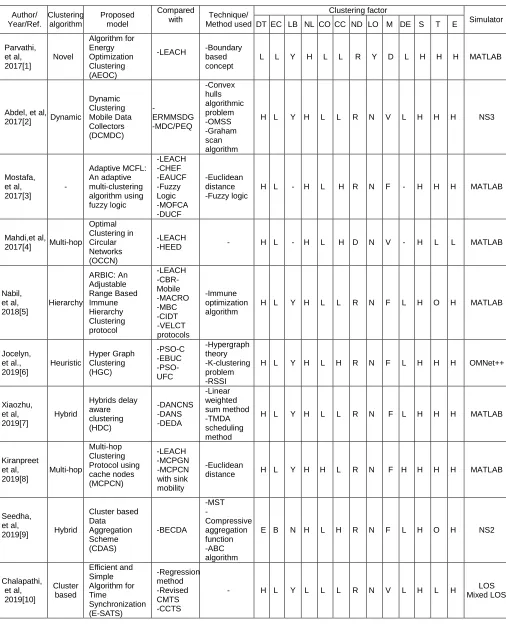
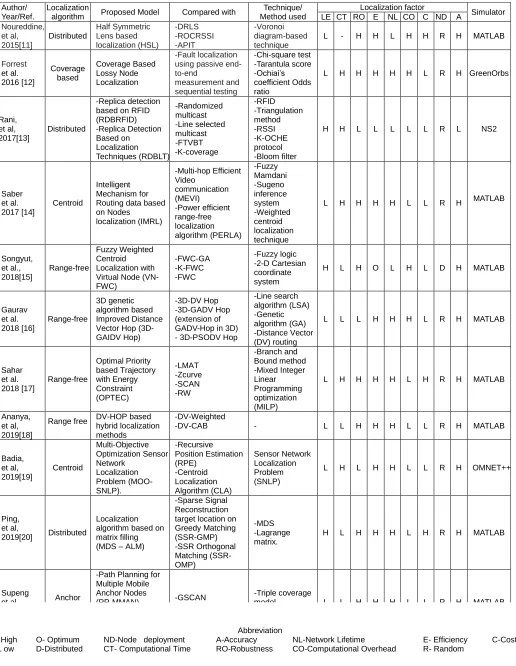
energy dissipation is proposed. In Abdelrahman, et al. [2] DCMDC is solution for maintaining MDC relay networks. In Mostafa, et al. [3] an adaptive multi-clustering algorithm using fuzzy logic is presented. The proposed avoids selecting new cluster heads leading to a reduction in the number of messages. In Mahdi, et al. [4] a multi-hop communication protocol to mitigate energy consumption and increase the lifetime of the network is proposed. In Nabil, et al. [5] an Adjustable range-based immune hierarchy clustering protocol is proposed. This utilizes the immune algorithm to determine the best positions of the clusters’ heads that optimize metrics of clustering. In Jocelyn, et al. [6] a heuristic clustering-based HyperGraph is proposed. During the cluster formation phase and the selection of the cluster Head, this method consumed less energy. In Xiaozhu, et al. [7] intelligent data fusion based on hybrid delay-aware adaptive clustering is proposed. This helps in reducing delay. In Kiranpreet, et al. [8] to include all nodes without extra cost the proposed protocol is used. In Seedha, et al. [9] cluster-based data aggregation scheme for latency and packet loss reduction reduces overhead and end to- end delay. In Chalapathi, et al. [10] a time synchronization protocol for a cluster based WSN to achieve microsecond level synchronization. Thus, optimizing the energy of nodes are vital to extend the network lifetime in above mentioned literature. In Noureddine, et al. [11], percentage of localizable nodes is boosted with existing models. This allows a non-localizable node to use the negative information to diminish its location uncertainty. In Forrest, et al. [12] end to end transmission is higher. In Rani, et al. [13] the proposed model based on RFID is RDBRFID and model based on techniques RSSI, triangulation is RDBLT are proposed. The performance is compared with multicast and non-clustered methods. In Saber et al. [14] an effective selection of the next hop CH to reduce the energy dissipation of nodes and to extend the network lifetime is proposed. In Songyut, et al. [15] localization accuracy is improved by adding virtual nodes that collaborate with physical anchor nodes to provide the necessary coverage of the unknown nodes. In Gaurav, et al. [16] processes and calculations are carried out at target node level, which makes the proposed energy efficient. In Sahar, et al. [17] a novel mobile anchor trajectory planning scheme proposed to refer in effect trajectories in terms of localization error, mobile anchor energy consumption and lifetime of the node. In Ananya, et al. [18] hybrid DV-HOP model gives high localization accuracy which in turn lowers the localization error. In Badia, et al. [19] trade-off between location accuracy and implementation cost is promising in multi-objective optimization. In Ping, et al. [20] a localization algorithm suitable for node location is proposed. In Supeng, et al. [21] the analysis on static WSN using the proposed method is well done with appropriate measures. Addressing the model with dynamic path planning are not considered.
140
Table 1: Comparative Analysis of recent clustering algorithm
Abbreviations
H- High B-Balanced EC-Energy Consumption LO-Localization DE- Delay V- Variable R- Random CO-Computational Overhead L-L ow D-Distributed CC-Communication cost T-Throughput F-Fixed E- Efficiency U- Uniform DT-Data transmission Y-Yes S-Stability ND-Node deployment LB-Load balancing M- Mobility O- Optimum N-No NL-Network Lifetime
Author/ Year/Ref. Clustering algorithm Proposed model Compared
with Method used Technique/
Clustering factor
Simulator DT EC LB NL CO CC ND LO M DE S T E
Parvathi, et al, 2017[1] Novel Algorithm for Energy Optimization Clustering (AEOC)
-LEACH -Boundary based concept
L L Y H L L R Y D L H H H MATLAB
Abdel, et al,
2017[2] Dynamic
Dynamic Clustering Mobile Data Collectors (DCMDC) -ERMMSDG -MDC/PEQ -Convex hulls algorithmic problem -OMSS -Graham scan algorithm
H L Y H L L R N V L H H H NS3
Mostafa, et al, 2017[3] - Adaptive MCFL: An adaptive multi-clustering algorithm using fuzzy logic -LEACH -CHEF -EAUCF -Fuzzy Logic -MOFCA -DUCF -Euclidean distance -Fuzzy logic
H L - H L H R N F - H H H MATLAB
Mahdi,et al,
2017[4] Multi-hop
Optimal Clustering in Circular Networks (OCCN) -LEACH
-HEED - H L - H L H D N V - H L L MATLAB
Nabil, et al, 2018[5] Hierarchy ARBIC: An Adjustable Range Based Immune Hierarchy Clustering protocol -LEACH -CBR-Mobile -MACRO -MBC -CIDT -VELCT protocols -Immune optimization algorithm
H L Y H L L R N F L H O H MATLAB
Jocelyn, et al., 2019[6] Heuristic Hyper Graph Clustering (HGC) -PSO-C -EBUC -PSO-UFC -Hypergraph theory -K-clustering problem -RSSI
H L Y H L H R N F L H H H OMNet++
Xiaozhu, et al, 2019[7] Hybrid Hybrids delay aware clustering (HDC) -DANCNS -DANS -DEDA -Linear weighted sum method -TMDA scheduling method
H L Y H L L R N F L H H H MATLAB
Kiranpreet et al, 2019[8] Multi-hop Multi-hop Clustering Protocol using cache nodes (MCPCN) -LEACH -MCPGN -MCPCN with sink mobility -Euclidean
distance H L Y H H L R N F H H H H MATLAB
Seedha, et al,
2019[9] Hybrid
Cluster based Data Aggregation Scheme (CDAS) -BECDA -MST -Compressive aggregation function -ABC algorithm
E B N H L H R N F L H O H NS2
Chalapathi, et al, 2019[10] Cluster based Efficient and Simple Algorithm for Time Synchronization (E-SATS) -Regression method -Revised CMTS -CCTS
141
Table 2: Comparative Analysis of recent localization algorithm
Abbreviation
H- High O- Optimum ND-Node deployment A-Accuracy NL-Network Lifetime E- Efficiency C-Cost L-L ow D-Distributed CT- Computational Time RO-Robustness CO-Computational Overhead R- Random
Author/ Year/Ref.
Localization
algorithm Proposed Model Compared with
Technique/ Method used
Localization factor
Simulator LE CT RO E NL CO C ND A
Noureddine, et al, 2015[11] Distributed Half Symmetric Lens based localization (HSL) -DRLS -ROCRSSI -APIT -Voronoi diagram-based technique
L - H H L H H R H MATLAB
Forrest et al. 2016 [12] Coverage based Coverage Based Lossy Node Localization -Fault localization using passive end-to-end measurement and sequential testing -Chi-square test -Tarantula score -Ochiai’s coefficient Odds ratio
L H H H H H L R H GreenOrbs
Rani, et al, 2017[13]
Distributed
-Replica detection based on RFID (RDBRFID) -Replica Detection Based on Localization Techniques (RDBLT) -Randomized multicast -Line selected multicast -FTVBT -K-coverage -RFID -Triangulation method -RSSI -K-OCHE protocol -Bloom filter
H H L L L L L R L NS2
Saber et al. 2017 [14] Centroid Intelligent Mechanism for Routing data based on Nodes localization (IMRL) -Multi-hop Efficient Video communication (MEVI) -Power efficient range-free localization algorithm (PERLA) -Fuzzy Mamdani -Sugeno inference system -Weighted centroid localization technique
L H H H H L L R H MATLAB
Songyut, et al., 2018[15] Range-free Fuzzy Weighted Centroid Localization with Virtual Node (VN-FWC) -FWC-GA -K-FWC -FWC -Fuzzy logic -2-D Cartesian coordinate system
H L H O L H L D H MATLAB
Gaurav et al. 2018 [16] Range-free 3D genetic algorithm based Improved Distance Vector Hop (3D-GAIDV Hop)
-3D-DV Hop -3D-GADV Hop (extension of GADV-Hop in 3D) - 3D-PSODV Hop
-Line search algorithm (LSA) -Genetic algorithm (GA) -Distance Vector (DV) routing
L L L H H H L R H MATLAB
Sahar et al. 2018 [17] Range-free Optimal Priority based Trajectory with Energy Constraint (OPTEC) -LMAT -Zcurve -SCAN -RW -Branch and Bound method -Mixed Integer Linear Programming optimization (MILP)
L H H H H L H R H MATLAB
Ananya, et al, 2019[18]
Range free DV-HOP based hybrid localization methods
-DV-Weighted
-DV-CAB - L L H H H L L R H MATLAB
Badia, et al, 2019[19] Centroid Multi-Objective Optimization Sensor Network Localization Problem (MOO-SNLP). -Recursive Position Estimation (RPE) -Centroid Localization Algorithm (CLA) Sensor Network Localization Problem (SNLP)
L H L H H L L R H OMNET++
Ping, et al,
2019[20] Distributed
Localization algorithm based on matrix filling (MDS – ALM)
-Sparse Signal Reconstruction target location on Greedy Matching (SSR-GMP) -SSR Orthogonal Matching (SSR-OMP) -MDS -Lagrange matrix.
H L H H H L H R H MATLAB
Supeng et al. 2019 [21]
Anchor based
-Path Planning for Multiple Mobile Anchor Nodes (PP-MMAN) -Compensation Algorithm for Positioning (CAP) -GSCAN -GTURN -Triple coverage
142
6. CONCLUSION
This paper presents the recent methodologies that are carried out on node localization and clustering models in WSN. The study gives brief introduction on these streams of how they emerged. These are the factors that affects the nature of WSN which are intended to work better than the predicted. In this paper a deep insight on every proposed models is imposed such as the theme of the paper, the method that they proposed are used to handle the theme, the parameters that they considered for achieving the consistency, the performance metrics that they used for evaluating their proposed model, the advantages of the proposed model and deals with the insights of the author of this survey paper. The research leads are clearly intended in this literature for betterment of the research models. The future work will be concentrated on the advantage of different type of existing localization algorithm or the novel across various topology and in 3D localization in WSN. In distributed WSN, detection of cluster head and detection of the cluster replica are major challenge. The choice of routing protocol with regards to localization technique must be investigated to achieve better output in terms of metrics. The static and dynamic path planning need further deep research to avoid the obstacle on the path. This can be achieved using hybrid or intelligent techniques or by optimization techniques based on soft computing.
REFERENCES
[1]. C. Parvathi, Suresha, ―AEOC: A Novel Algorithm for Energy Optimization Clustering in Wireless Sensor Network‖, Springer journal of Advances in Intelligent Systems and Computing, 2017, Pages 216-224. [2]. Abdelrahman Abuarqoub, Mohammad Hammoudeh,
Bamidele Adebisi, Sohail Jabbar, Ahcène Bounceur, Hashem Al-Bashar,‖ Dynamic clustering and management of mobile wireless sensor networks‖, Elsevier journal of Computer Networks, Volume 117 ,2017, Pages 62–75.
[3]. Mostafa Mirzaie, SayyedMajid Mazinani,‖ Adaptive MCFL: An adaptive multi-clustering algorithm using fuzzy logic in wireless sensor network‖, Elsevier journal of Computer Communications, Volume 111,2017, Pages 56–67.
[4]. Mahdi Arghavani, Mohammad Esmaeili, Maryam Esmaeili, Farzad Mohseni, Abbas Arghavani,‖ Optimal energy aware clustering in circular wireless sensor networks‖, Elsevier journal of Ad Hoc Networks, Volume 65,2017, Pages 91–98.
[5]. Nabil Sabor, Sabah M. Ahmed, Mohammed Abu-Zahhad, Shigenobu Sasaki,‖ ARBIC: An Adjustable Range Based Immune Hierarchy Clustering protocol supporting mobility of Wireless Sensor Networks‖, Elsevier journal of Pervasive and Mobile Computing, Volume 43, 2018, Pages 27–48. [6]. Jocelyn Edinio Zacko Gbadouissa, Ado Adamou
Abba Ari, Chafiq Titouna, Abdelhak Mourad Gueroui, Ousmane Thiare,‖ HGC: HyperGraph based Clustering scheme for power aware wireless sensor networks‖, Future Generation Computer Systems, Volume 105 ,2019, Pages 175–183. [7]. Xiaozhu Liu, Rongbo Zhu, Ashiq Anjum , Jun Wang,
Hao Zhang, Maode,‖Intelligent data fusion algorithm based on hybrid delay-aware adaptive clustering in
wireless sensor networks‖, Elsevier journal of Future Generation Computer Systems, volume 104 ,2019, Pages 1–14.
[8]. Kiranpreet Kaur, ·Ridhi Kapoor,‖ MCPCN: Multi‑hop Clustering Protocol Using Cache Nodes in WSN‖, Springer journal of Wireless Personal Communications,2019.
[9]. V. Seedha Devi, T. Ravi, S. Baghavathi Priya, ―Cluster Based Data Aggregation Scheme for Latency and Packet Loss Reduction in WSN‖, Elsevier journal of Computer Communications, Volume 149 ,2019, Pages 36–43.
[10]. G. S. S. Chalapathi , Vinay Chamola,S. Gurunarayanan , Biplab Sikdar , ―E-SATS: An Efficient and Simple Time Synchronization Protocol for Cluster-Based Wireless Sensor Networks‖, IEEE sensors journal, Volume 19, Issue 21, 2019,Pages 10144-10156.
[11]. Noureddine Lasla, Mohamed F. Younis, Abdelraouf Ouadjaout,‖ An Effective Area-Based Localization Algorithm for Wireless Networks‖, IEEE transactions on computers, Volume 64, issue 8, 2015.
[12]. Forrest Sheng Bao, Yulei Pang, Wu-Jün Zhou, Wu Jiang, Yinfei yang, Yang Liu, and Chen Qian,‖ Coverage-Based Lossy Node Localization for Wireless Sensor Networks‖, IEEE Sensors Journal, Volume 16, issue 11, 2016, Pages 4648-4656. [13]. T.P. Rani, C. Jayakumar, ―Unique identity and
localization-based replica node detection in hierarchical wireless sensor networks‖, Elsevier journal of Computers and Electrical Engineering, Volume 64,2017, Pages 148–162.
[14]. Saber Amri, Fekher Khelifi, Abbas Bradai, Abderrezak Rachedi, Med Lassaad Kaddachi , Mohamed Atri , ―A new fuzzy logic based node localization mechanism for Wireless Sensor Networks‖, Elsevier journal of Future Generation Computer Systems, Volume 93, 2017, Pages 799– 813.
[15]. Songyut Phoemphon, Chakchai So-In, Nutthanon Leelathakul, ―Fuzzy Weighted Centroid Localization with Virtual Node Approximation in Wireless Sensor Networks‖, IEEE Internet Of Things Journal, Volume 5, issue 6, 2018.
[16]. Gaurav Sharma, Ashok Kumar, ―Improved range-free localization for three-dimensional wireless sensor networks using genetic algorithm‖, Elsevier journal of Computers and Electrical Engineering, Volume 72,2018, Pages 808–827.
[17]. Sahar Kouroshnezhad, Ali Peiravi, Mohammad Sayad Haghighi, Qi Zhang,‖ A mixed-integer linear programming approach for energy-constrained mobile anchor path planning in wireless sensor network localization ―, Elsevier journal of Ad Hoc Networks, Volume 87, 2019, Pages 188–199. [18]. Ananya Dwivedi and P. Raghu Vamsi, ―DV-HOP
Based Hybrid Range-Free Localization Methods for Wireless Sensor Networks‖, Springer Nature, 2019, Pages 452–463.
143 transaction on Wireless Communications and
Mobile Computing,Pages 1773-1778.
[20]. Ping Wang, Gang Tu,‖ Localization algorithm of wireless sensor network based on matrix Reconstruction‖, Elsevier journal of Computer Communications,2019.
[21]. Supeng Sun, Jianping Zhao ⇑, Xiaochuan Tian, Jing Zhang,‖ Path planning for multiple mobile anchor nodes assisted localization in wireless sensor networks‖, Elsevier journal of Measurement, volume 141 ,2019, Pages 124–136.
[22]. Azzedine Boukerche, Horacio A. B. F. Oliveira, Eduardo F. Nakamura, Antonio A. F. Loureiro, ―Localization Systems for Wireless Sensor Networks,‖ IEEE Wireless Communications, Volume 14, Issue 6, Pages 6-12, 2007.
[23]. I.F. Akyildiz, W. Su, Y. Sankarasubramaniam, E. Cayirci, ―Wireless Sensor Networks: a survey,‖ Journal of Computer Networks, Elsevier, Volume 38, Pages 393-422, 2002.
[24]. Colin Elkin, Rajika Kumarasiri, Danda B. Rawat, Vijay Devabhaktuni, ―Localization in wireless sensor networks: A Dempster-Shafer evidence theoretical approach‖, Elsevier journal of Ad Hoc Networks, Volume 54 ,2017, Pages 30–41.
[25]. Khalid A. Darabkh ∗, Mohammad Z. El-Yabroudi , Ali H. El-Mousa, ―BPA-CRP: A balanced power-aware clustering and routing protocol for wireless sensor networks‖, Elsevier journal of Ad Hoc Networks , Volume 82 ,2019,Pages 155–171.
AUTHORS PROFILE
Panimalar. K. received her B.Tech 2009 in and M.Tech 2011 in Computer Science and Engineering from Pondicherry University. Currently doing research in department of Computer Science and Engineering, Pondicherry Engineering College, Puducherry. She is a member of ISTE.