RESEARCH
Novel insight into the relationship
between organic substrate composition
and volatile fatty acids distribution
in acidogenic co-fermentation
Huijun Ma
1, He Liu
1,2*, Lihui Zhang
1, Meng Yang
1, Bo Fu
1,2and Hongbo Liu
1,2Abstract
Background: Co-fermentation is an attractive technology for improving volatile fatty acids (VFAs) production by
treatment of solid organic wastes. However, it remains unclear how the composition of different organic matters in solid waste influences the VFAs distribution, microbial community structure, and metabolic pathway during acido-genic fermentation. In this study, different organic wastes were added into waste activated sludge (WAS) as co-fermentation substrates to explore the impact of organic matter composition on VFAs pattern and the microbiological mechanism .
Results: Acetate was the most dominant VFA produced in all fermentation groups, making up 41.3–57.6% of the
total VFAs produced during acidogenic co-fermentation under alkaline condition. With the increased addition of potato peel waste, the concentrations of propionate and valerate decreased dramatically, while ethanol and butyrate concentrations increased. The addition of food waste caused gradual decreases of valerate and propionate, but etha-nol increased and butyrate was relatively stable. Some inconsistency was observed between hydrolysis efficiency and acidification efficiency. Our results revealed that starch was mainly responsible for butyrate and ethanol formation, while lipids and protein favored the synthesis of valerate and propionate. Microbial community analysis by high-throughput sequencing showed that Firmicutes had the highest relative abundance at phylum level in all fermenta-tion groups. With 75% potato peel waste or 75% food waste addifermenta-tion to WAS, Bacilli (72.2%) and Clostridia (56.2%) were the dominant respective classes. In fermentation using only potato peel waste, the Bacilli content was 64.1%, while the Clostridia content was 53.6% in the food-only waste fermentation.
Conclusions: Acetate was always the dominant product in acidogenic co-fermentation, regardless of the substrate
composition. The addition of carbon-rich substrates significantly enhanced butyrate and ethanol accumulation, while protein-rich substrate substantially benefited propionate and valerate generation. Potato peel waste substantially favored the enrichment of Bacilli, while food waste dramatically increased Clostridia content in the sludge.
Keywords: Waste activated sludge, Substrate composition, VFA distribution, Microbial community, Acidogenic
co-fermentation, Alkaline pH
© The Author(s) 2017. This article is distributed under the terms of the Creative Commons Attribution 4.0 International License (http://creativecommons.org/licenses/by/4.0/), which permits unrestricted use, distribution, and reproduction in any medium, provided you give appropriate credit to the original author(s) and the source, provide a link to the Creative Commons license,
and indicate if changes were made. The Creative Commons Public Domain Dedication waiver (http://creativecommons.org/
publicdomain/zero/1.0/) applies to the data made available in this article, unless otherwise stated. Background
With increasing energy demands and a shortfall in renewable resources, many studies of energy utilization
are now aimed toward resource recovery. Common tar-gets include biogas and volatile fatty acids (VFAs) from agricultural residues, food waste, and sewage sludge containing high levels of organic matter [1, 2]. The large amounts of proteins, polysaccharides, and other types of organic matter in waste activated sludge (WAS) can be efficiently hydrolyzed to water-soluble organic substances
Open Access
*Correspondence: [email protected]
1 School of Environmental and Civil Engineering, Jiangnan University, Wuxi 214122, China
by fermentative microorganisms, thus achieving resource recovery [3, 4]. VFAs, the main intermediates during anaerobic fermentation, have been recognized as a valu-able carbon resource in wastewater, and can be used as platform molecules to produce biopolymers and medium chain fatty acids with high added value [5–7]. In addi-tion to the improvement of VFA yields during anaerobic fermentation of solid wastes [3, 8], it is also important to control the composition of VFAs and to achieve selective VFA production to benefit downstream processing and applications.
An increasing number of studies are now using co-fermentation to improve the VFAs product yield from anaerobic sludge fermentation. However, there is little information on how the complex organic matter content influences the VFAs distribution and the microbial mech-anism that proceeds during co-fermentation. For exam-ple, VFAs yields were 1.75-, 10.7-, and 2.6-fold higher than WAS fermentation alone, when food waste, peren-nial ryegrass, or henna plant was used as co-fermentation substrate, respectively, with a carbon-to-nitrogen ratio (C/N) of about 22/1 [9–11]. Interestingly, reported pat-terns of VFAs in previous co-fermentation studies were different, even when the substrate types and addition ratios were similar. Reported VFAs yields were twofold [12] and 10.6-fold [13] higher than for sludge fermenta-tion alone when the mixing ratio of food waste to sludge was 50% during co-fermentation. Some studies have attributed the increased VFAs yields to the involvement of organic matter and the microbial community [14, 15]. For example, when adding different types of substrates, some major phyla, such as Firmicutes, Chloroflexi, and Proteobacteria, were significantly changed [16].
These previous studies hinted that the composition of the organic matter in solid wastes significantly influ-enced the composition of the fermented VFAs. However, research has been lacking on the detailed relationship between the organic matter and the distribution of VFAs, and on how the organic composition influences the microbial community or metabolic pathway. This knowl-edge gap has hindered the industrial application of selec-tive VFA production process.
This study investigated the effects of different organic matters on the VFAs metabolic pathway and the micro-bial community shift during the co-fermentation of sludge and carbon-rich organic wastes. Potato peel waste and food waste, the two common carbon-rich sub-strates used in China, were added into WAS in differ-ent proportions for anaerobic fermdiffer-entation. The release and consumption of different organic components were studied along with the VFAs product yields and compo-sition changes. Shifts in microbial community structure and functional community evolution under the different
experimental conditions were studied by high-through-put sequencing analysis.
Methods
Characteristics of WAS, potato peel waste, and food waste
WAS used in fermentation was dewatered sludge obtained from a municipal wastewater treatment plant in Wuxi, China (Shuofang wastewater treatment plant, Wuxi, Jiangsu). Potato peel waste was obtained from a vegetable market in Wuxi, and food waste was col-lected from the canteen of Jiangnan University. The food waste mainly consisted of fat, rice, meat, and vegetables. Potato peel waste and food waste were fully crushed by a food crusher after bones and other hard objects were removed. WAS, crushed potato peel waste, and crushed food waste were stored at 4 °C for subsequent fermen-tation experiments. Composition and properties of the wastes are shown in Table 1. The lipid content in potato peel waste was below the detection limit, and its con-centration was neglected in the following calculations of organic consumption.
Seeding sludge was obtained from the Shuofang waste-water treatment plant, and an upflow anaerobic sludge blanket (UASB) reactor (effective volume ~5.0 L) was used for acidogenic bacteria acclimation. The WAS was heated at 105 °C for 2 h to kill non-spore-forming methanogens. Before being used as sludge inoculum, the heat-treated sludge was added to the UASB reac-tor for re-activation. Glucose was continuously pumped into the UASB to enrich the acidogenic bacteria during the operation, and the temperature was maintained at 37 ± 2 °C. Seeding sludge was obtained when the efflu-ent pH fell below 4.0. The cultivation period was more than 3 weeks [17]. Characteristics of the seeding sludge
Table 1 Characteristics of WAS, potato peel waste, and food waste
* Not detected
Parameters WAS Potato peel
waste Food waste
Solid content (%) 14.54 ± 0.10 20.59 ± 1.42 35.12 ± 1.03 VS/TS (%) 45.85 ± 0.29 94.62 ± 0.61 93.68 ± 0.47
pH 6.60 ± 0.08 6.01 ± 0.12 5.08 ± 0.16
TCOD (mg/g TS) 849.29 ± 19.45 1292.45 ± 28.94 1497.32 ± 39.23 SCOD (mg/g TS) 262.78 ± 6.41 543.20 ± 2.02 618.28 ± 7.13 TN (mg/g TS) 25.90 ± 1.24 4.53 ± 0.07 10.53 ± 1.06 Protein (mg/g VS) 323.96 ± 5.86 69.81 ± 5.60 123.03 ± 2.56 Carbohydrate
(mg/g VS) 305.34 ± 12.32 792.23 ± 10.34 284.65 ± 5.54 Starch (mg/g VS) 183.74 ± 3.12 673.44 ± 4.36 214.50 ± 1.34
Lipid (mg/g VS) 93.73 ± 0.45 * 564.23 ± 1.54
Table
2
S
ample set-up and c
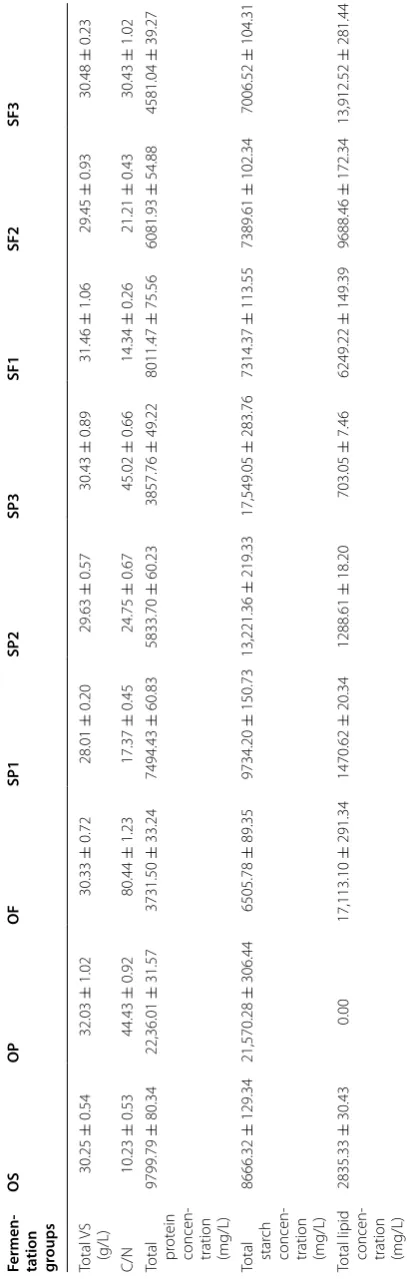
onc en tr ations of or ganic ma terials b ef or e f ermen ta tion Fermen ‑ ta tion gr oups OS OP OF SP1 SP2 SP3 SF1 SF2 SF3 Total V S (g/L) 30.25 ± 0.54 32.03 ± 1.02 30.33 ± 0.72 28.01 ± 0.20 29.63 ± 0.57 30.43 ± 0.89 31.46 ± 1.06 29.45 ± 0.93 30.48 ± 0.23 C/N 10.23 ± 0.53 44.43 ± 0.92 80.44 ± 1.23 17.37 ± 0.45 24.75 ± 0.67 45.02 ± 0.66 14.34 ± 0.26 21.21 ± 0.43 30.43 ± 1.02
Total pr
ot
ein
concen
-tration (mg/L)
9799.79 ± 80.34 22,36.01 ± 31.57 3731.50 ± 33.24 7494.43 ± 60.83 5833.70 ± 60.23 3857.76 ± 49.22 8011.47 ± 75.56 6081.93 ± 54.88 4581.04 ± 39.27
Total star
ch
concen
-tration (mg/L)
8666.32 ± 129.34 21,570.28 ± 306.44 6505.78 ± 89.35 9734.20 ± 150.73 13,221.36 ± 219.33 17,549.05 ± 283.76 7314.37 ± 113.55 7389.61 ± 102.34 7006.52 ± 104.31
Total lipid concen
-tration (mg/L)
were as follows: total solids (TS) 54.90 ± 0.72 g/L, vol-atile solids (VS)-to-TS ratio (VS/TS) 85.72 ± 1.23%, protein 653.20 ± 10.01 mg/g TS, carbohydrate 208.41 ± 80.21 mg/g TS, and VFAs 3.45 ± 0.23 g/L. The cultivated seeding sludge was washed three times with deionized water before use in the fermentation reactors.
Experimental set‑up
Prior to fermentation, WAS was pretreated by heat and alkali to accelerate the hydrolysis of organic matter. WAS was heated at 105 °C for 3 h, and pH was adjusted to 12 with the addition of 5 M NaOH. A pH of 10 was main-tained during fermentation by daily addition of 2 M HCl or 2 M NaOH to inhibit the activity of methanogenic bacteria. To ensure that enough acidogenic microor-ganisms were in the fermentation reactor, an amount of seeding sludge (~15% of VS) was added to control the food–microorganism ratio (F/M) to about 5.67 before the tests started. Nine 500-mL serum bottles were placed in an air-bath shaker (35 ± 1 °C, 120 rpm) for anaerobic fer-mentation. According to the substrate contents in each bottle, they were labeled as OS (only pretreated sludge as substrate), OP (only potato peel waste as substrate), OF (only food waste as substrate), SP1 (VS ratio of pre-treated sludge and potato peel waste = 3:1), SP2 (VS ratio of pretreated sludge and potato peel waste = 1:1), SP3 (VS ratio of pretreated sludge and potato peel waste = 1:3), SF1 (VS ratio of pretreated sludge and food waste = 3:1), SF2 (VS ratio of pretreated sludge and food waste = 1:1), SF3 (VS ratio of pretreated sludge and food waste = 1:3). The total VS concentration of organic substrates before fermentation was set to about 30 g/L and the fermenta-tion was conducted in batch operafermenta-tion for 12 days. The experimental set-up, as well as the initial organic matter concentrations, are shown in Table 2. Before acidogenic fermentation, 400 mL of substrate and seeding sludge was added into each reactor and 50 mM 2-bromoethanesul-fonic acid sodium salt was added to inhibit methanogens. Each reactor was sealed with a rubber stopper and nitro-gen was purged for 15 min to displace oxynitro-gen in the head-space. The nitrogen purge was conducted at the beginning of each fermentation and during each sample collection.
Analytical methods
All samples collected during fermentation were 10.0 mL in volume, and were analyzed immediately after collec-tion. Determination of TS, VS, soluble chemical oxygen demand (SCOD), total COD (TCOD), and total nitrogen (TN) were conducted according to standard methods [18]. Total lipid and total starch were analyzed according to Chinese standard methods [19]. Protein concentra-tions were measured using the Lowry-Folin method [20]. The C/N ratio was calculated through the ratio of total
organic carbon (TOC) to TN. TOC was detected with a TOC analyzer (LiquiTOC, Elementar Analysensysteme, Langenselbold, Germany). To measure soluble COD, samples were first centrifuged at 10,200×g for 10 min, and then filtered with 0.45-μm syringe filters.
VFAs concentrations in the filtrate samples were detected by gas chromatography (GC-2010, Japan) with flame ionization detection (FID). Separation was achieved on a fused-silica capillary column (PEG-20M, 30 m × 0.32 mm × 0.5 mm, China). The initial column temperature was 80 °C, and then it was heated to 210 °C and held for 2 min. The running temperature was main-tained at 80 °C during detection. The injection port and detector temperatures were 250 °C. Before GC meas-urement, 4-methyl-valeric acid (internal standard), 3 M phosphoric acid (acidifier), and the filtrate sample were mixed in a 1:1:1 ratio (v:v:v). This method was the same as used in previous studies [21].
Calculations of the hydrolysis and acidification effi-ciencies were performed according to the following equations:
where SCODfinal is the SCOD at the end of the fermen-tation, mg/L; SCODinitial is the SCOD before fermenta-tion, mg/L; and CODVFA is VFA concentration as COD concentration, mg COD/L. The transformation of VFA to COD was conducted as in previous studies [22].
DNA extraction
Samples of OS, OP, OF, SP3, and SF3 were preserved at the end of fermentation for microbial analysis. The total DNA of the five samples was extracted with a MoBio PowerSoil DNA Isolation Kit (Mo Bio Laboratories, Carlsbad, CA, USA) according to the manufacturer’s instruction, and as used in a previous study [23]. The quantity and qual-ity of the extracted DNA were checked with a Nanodrop 2000 spectrophotometer (Thermo Scientific, Schaum-burg, IL, USA). The two primers used for sequencing on the Illumina Miseq sequencing platform were 515F (5′-GTGCCAGCMGCCGCGG-3′) and 907R (5′ -CCGT-CAATTCMTTTRAGTTT-3′). The raw sequence data were deposited in the NCBI Sequence Read Archive (SRA) database, and the accession number is SRP091729.
Canonical correspondence analysis
The relationship between bacteria at genus level and environmental parameters was assessed with canoni-cal correspondence analysis (CCA) using CANOCO 4.5
(1) Hydrolysis efficiency(%)
= (SCODfinal−SCODinitial)/total COD
software. CCA is an effective method to combine envi-ronmental factors to assess how the environment affects research objects (such as bacteria). The arrows in CCA represent environmental factors, and the four quadrants indicate the positive and negative correlation between the environmental factors and the two axes. The length of the arrow represents the connection of environmental factors and the distribution of the samples. For example, longer arrow length indicates a greater influence of envi-ronmental factors on the bacteria.
Results and discussion
VFAs production and composition during fermentation
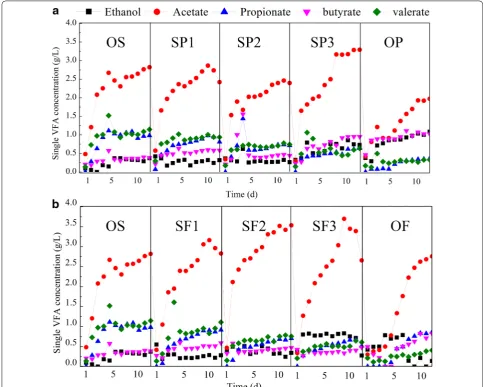
Ethanol and four VFAs (acetate, propionate, butyrate, and valerate) were observed in all fermentation groups
(Fig. 1a). In all cases, acetate was produced in large quan-tities, making up 41.3–47.7% of VFAs content. When fermented with only potato peel waste (OP), the acetate concentration was 1.93 g/L. With an increased potato peel waste addition ratio, the concentration of propi-onate decreased dramatically from 1.11 to 0.32 g/L and valerate decreased from 1.52 to 0.29 g/L. In contrast, the concentration of ethanol increased from 0.33 to 1.08 g/L and butyrate increased from 0.40 to 1.07 g/L. As a result, the final percentages of acetate, ethanol, butyrate, propi-onate, and valerate were 46.6, 6.7, 10.9, 16.9, and 18.9%, respectively, in the OS group, and 41.3, 22.6, 21.3, 7.8, 7.0%, respectively, in the OP group.
As shown in Table 1, protein, starch, and lipid were the main organic compounds in WAS, potato peel waste
and food waste, respectively. The addition of potato peel waste resulted in increased starch concentration, decreased protein concentration, and enhanced the generation of ethanol and butyrate, while reducing the accumulation of propionate and valerate. Some previ-ous studies reported that when straw [24] or pretreated bagasse [25] was used as co-fermentation substrate, the variation of propionate and butyrate showed a similar trend to that observed in this study. It is likely that the polysaccharides were eventually biodegraded to glucose, similar to the starch substrates used in the present study. It has been verified that glucose fermentation above pH 6.0 produces butyrate and acetate as the main VFA prod-ucts, while the dominant product is usually ethanol for fermentation under more acidic conditions [26]. This explanation is consistent with the increased accumula-tion of butyrate and ethanol observed in this study.
As shown in Fig. 1b, when sludge was co-fermented with food waste, acetate was also the dominant VFA produced, with VFAs content ranging between 48.0 and 57.6%, although its concentration decreased significantly to 2.68 g/L in the OF group. As the food waste addi-tion ratio increased, valerate and propionate contents gradually decreased from 1.10 to 0.41 and from 0.86 to 0.49 g/L, respectively. However, ethanol concentration increased from 0.26 to 0.74 g/L and butyrate was rela-tively stable (0.45–0.51 g/L).
Table 2 shows that the lipid concentration increased from 2835.33 ± 30.43 mg/L in the OS group to 17113.10 ± 291.34 mg/L in the OF group as the ratio of food waste increased, while the valerate and propion-ate concentrations decreased and ethanol increased. Lipids are mainly biodegraded to fatty acids and glycerol, and glycerol further promotes the generation of H2 and ethanol [27]. This might be a reason for the enhanced ethanol generation in the present study. Decreased con-centrations of valerate and propionate were observed when potato peel waste and food waste were added, and these changes might be related to low protein con-centration. Several reports have suggested that nitro-gen-rich substrates enhance propionate and valerate generation during fermentation under alkaline condi-tions. For example, increased protein consumption
would promote propionate generation, and propionate, instead of acetate, was the main product and accounted for 63.4% of total VFAs in the co-fermentation of sludge and food waste [9].
As shown in Fig. 1a and b, acetate was always the major VFA produced, regardless of the composition of the organic matter in the substrate. We speculate that there are two possible reasons for the dominant acetate accu-mulation. First, the seeding sludge used in this study was domesticated for a long time before the fermentation, and this would have enriched the acidogenic microorgan-isms in the seeding sludge [28]. Second, alkaline condi-tions in the fermentation killed or inhibited most of the regular fermentative microorganisms, while the acido-genic bacteria, with most being Gram-positive species and able to generate spores, survived under the harsh alkaline environment [29].
Organic matter changes during fermentation
Table 3 shows the extent of hydrolysis and acidifica-tion, as well as the VFAs yields at the end of each acido-genic fermentation. With the increasing ratio of potato peel waste or food waste, hydrolysis efficiency gradu-ally increased. In the nine fermentation groups, the two highest hydrolysis efficiencies were observed in the OP and OF groups (69.49 ± 1.91 and 54.01 ± 1.34%, respec-tively). Potato peel waste and food waste were more eas-ily hydrolyzed than WAS, thus improving hydrolysis efficiency.
For acidification efficiency and VFAs yields, the same trends were observed in all fermentation groups. When potato peel waste was used as substrate for co-fermenta-tion, the highest acidification efficiency (26.92 ± 0.46%) and VFAs yield (343.54 ± 14.63 mg COD/g VS) were observed in the SP3 group. With the addition of food waste, the SF3 group presented the highest acidi-fication efficiency (23.00 ± 0.64%) and VFAs yield (282.02 ± 6.35 mg COD/g VS). The results demonstrated that co-fermentation with sludge and carbon-rich sub-strates benefited VFAs generation.
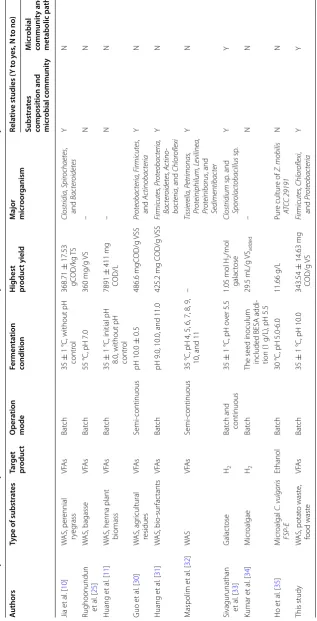
Comparing with Table 4, the VFAs yields in this study were similar to those of Jia et al. [10], Rughoonund et al. [25], and Huang et al. [11], which gave the respective
Table 3 Extent of hydrolysis, acidification, and VFAs yields at the end of fermentation
Parameters OS SP1 SP2 SP3 OP SF1 SF2 SF3 OF
Hydrolysis
efficiency (%)49.67 ± 1.67 45.44 ± 1.02 51.17 ± 1.62 56.39 ± 1.53 69.49 ± 1.91 50.35 ± 1.38 48.45 ± 1.82 53.13 ± 1.69 54.01 ± 1.34
Acidification
efficiency (%)14.51 ± 0.53 17.75 ± 0.68 21.25 ± 0.43 26.92 ± 0.46 16.74 ± 0.28 18.23 ± 0.27 20.62 ± 035 23.00 ± 0.64 17.56 ± 0.43
VFAs yield
Table 4 C omparison of substr at es , pr oduc ts , and micr obial c ommunities b et w een pr evious lit er atur
e studies and this study
– Not men
tioned in lit
er atur e A uthors Type of substr at es Tar get pr oduc t O per ation mode Fermen ta tion condition H ighest pr oduc t yield M ajor micr oor ganism Rela tiv
e studies (
Y t
o y
es
, N t
o no
)
Substr
at
es
composition and micr
obial c ommunit y M icr obial communit y and metabolic pa th w ay Jia et al . [ 10 ] W AS, per ennial ry eg rass VFA s Bat ch 35 ± 1
°C, without pH
contr ol 368.71 ± 17.53 gC OD/k g T S Clostridia , Spir ochaetes , and Bacter oidetes Y N
Rughoonundun et
al . [ 25 ] W AS, bagasse VFA s Bat ch 55
°C, pH 7.0
360 mg/g V S – N N Huang et al . [ 11 ] W
AS, henna plant biomass
VFA s Bat ch 35 ± 1
°C, initial pH
8.0, without pH contr
ol 7891 ± 411 mg COD/L – N N Guo et al . [ 30 ] W AS, ag ricultural residues VFA s Semi-continuous pH 10.0 ± 0.5 486.6 mgC OD/g V SS Pr oteobacteria, F irmicutes , and Actinobacteria Y N Huang et al . [ 31 ] W AS, bio -sur fac tants VFA s Bat ch
pH 9.0, 10.0, and 11.0
425.2 mg C OD/g VSS Firmicutes , P roteobacteria, Bacter oidetes , A ctino -bacteria , and Chlor oflexi Y N M aspolim et al . [ 32 ] WA S VFA s Semi-continuous 35
°C, pH 4, 5, 6, 7, 8, 9, 10, and 11
– Tissier ella, P etrimonas , Pr oteiniphilum, L evilinea, Pr oteiniborus , and Sedimentibacter Y N
Sivagurunathan et
al . [ 33 ] G alac tose H2 Bat
ch and continuous
35
±
1
°C, pH o
ver 5.5 1.05 mol H2 /mol galac tose Clostridium sp . and Spor olactobacillus s p. Y Y Kumar et al . [ 34 ] M icr oalgae H2 Bat ch
The seed inoculum included BESA addi
-tion (1
g/L), pH 5.5
29.5 mL/g VSadded – N N Ho et al . [ 35 ] M icr oalgal C. vulgaris FSP -E Ethanol Bat ch 30
°C, pH 5.0-6.0
11.66 g/L Pur e cultur e of Z. mobilis AT CC 29191 N N This study W AS, potat o wast e, food wast e VFA s Bat ch 35 ± 1
°C, pH 10.0
figure of 368.71 ± 17.53 g COD/kg TS, 360 mg/g VS, and 7891 ± 411 mg COD/L. However, the studies of Guo et al. [30] and Huang et al. [31] gave higher VFA yields of 486.6 mg COD/g VS and 425.2 mg COD/g VS, respec-tively, possibly a reflection of the different substrate types. The VFAs yield in the OS group of the present study was only 132.30 ± 5.43 mg COD/g VS, while previ-ous studies using sludge-only fermentation showed VFAs yields of 100–250 mg COD/g VS [36, 37]. The complex composition of the sludge organics may be a reason for the relative low VFAs generation. The low hydrolysis effi-ciency was the limiting step of acidogenic fermentation, especially in the sludge-only fermentation group (extent of WAS hydrolysis <50%). It is also noted that the fer-mentation with the highest hydrolysis efficiency (OP) did not show the highest VFAs production, indicating some inconsistency between hydrolysis efficiency and acidifica-tion efficiency.
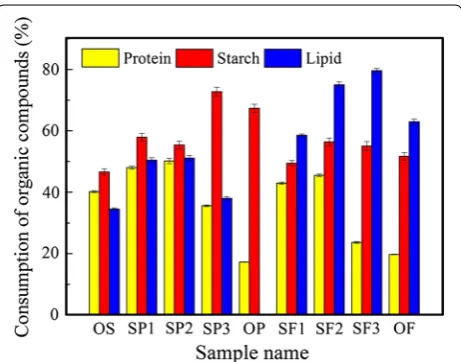
The effects of potato peel waste or food waste on the consumption of different organic matters at the end of fermentation are shown in Fig. 2. When the addition ratio of potato peel waste or food waste was below 50%, protein, starch, and lipid consumption efficiencies were higher than the WAS and carbon-rich substrate fermen-tations (OS, OP, and OF). For example, the protein con-sumption of SP1, SP2, SF1, and SF2 groups were 48.02, 50.16, 42.92, and 45.50%, respectively, which were higher than the protein consumption in the WAS and carbon-rich substrate fermentations (40.10% for OS, 17.28% for OP, 19.75% for OF). It is likely that the appropriate addi-tion ratio of carbon-rich substrates could be used to enhance the consumption of organic matter. In addition, a balance of nutrients in fermentation substrates could
be used to promote microbial growth and enhance the activity of relevant enzymes. Feng et al. [38] found that addition of carbohydrate substrate promoted the con-sumption of protein in sludge and promoted VFAs gen-eration because of the activation of enzymes involved in protein hydrolysis.
When the addition of potato peel waste or food waste exceeded 50%, protein consumption decreased dramati-cally (from 50.16 ± 0.88% in SP2 to 17.28 ± 0.09% in OP and from 45.50 ± 0.45% in SF2 to 19.75 ± 0.10% in OF). However, starch and lipid consumption were enhanced significantly when the addition of potato peel waste or food waste was increased to 75%. This demonstrated that the consumption of carbon-rich substrate predominated over protein consumption in a carbon-rich environment. Moreover, starch and lipid consumption in potato-only and food waste fermentation (OP and OF groups) were less than in SP3 and SF3 groups. Evidently, unbalanced nutrient supply was not beneficial for organic matter consumption.
Relationship between substrate consumption and VFA generation
The relationships between the generation of four dif-ferent VFAs and the consumption of protein, lipids, and starch at the end of each fermentation were further analyzed. Figure 3a, d, and g shows that the accumula-tions of propionate, butyrate, and valerate demonstrated quadratic relations with lipid consumption, with the R2 values of 0.63, 0.62, and 0.69, respectively. The gen-eration of propionate and valerate was enhanced but butyrate production was decreased when more lipids were consumed. However, the trends in VFAs genera-tion reversed when the lipid concentragenera-tion exceeded 4000 mg/L. These results indicate that moderate lipid consumption promoted the growth of acidogenic micro-organisms, while excess lipid consumption inhibited it. This caused more propionate and valerate accumula-tion at a lower lipid consumpaccumula-tion rate and less propi-onate and valerate accumulation with increased lipid consumption [39, 40]. Figure 3b, e, and h shows that the generation of propionate and valerate gradually decreased with starch consumption, but butyrate con-centration proportionally increased. In relation to pro-tein consumption, propionate and valerate accumulated gradually (Fig. 3c, i) with higher protein consumption, while butyrate concentration declined gradually at low protein consumption, but then increased greatly (Fig. 3f) at higher protein consumption.
According to the above results, starch was mainly responsible for butyrate formation, while lipid and protein consumption favored the synthesis of valerate and propion-ate. However, different kinds of substrates can be converted Fig. 2 Consumption of different organic materials in the nine
to acetate by acidogenic microbes through different meta-bolic pathways. Therefore, acetate accumulation became dominant regardless of the composition of the substrates in acidogenic fermentation under alkaline conditions. The results in Additional file 1 further implied that pure protein substrate (BSA group) gave a VFA distribution similarity to that of the WAS fermentation group, while the glucose (typical carbohydrate) substrate in acidogenic fermentation gave a VFA distribution similarity to that of the potato-only fermentation group. This demonstrated that fermentation with glucose mainly produced acetate and butyrate while fermentation with bovine serum albumin (BSA) preferen-tially improved valerate and propionate production, apart from the acetate accumulation.
Diversity of bacterial community
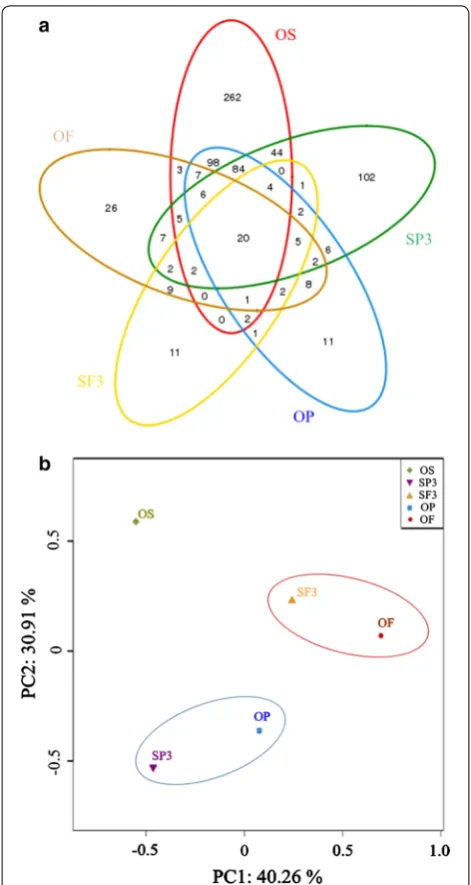
and 26.2% of OF). The number of OTUs in the OS group was the highest of the five fermentation groups, indicat-ing that the OS sample had the most abundant microbial populations. The Shannon–Weaver index of the OS sam-ple (4.09) was also the highest among all the groups (2.25 for SP3, 1.90 for SF3, 1.98 for OP, and 2.40 for OF). This was because of the relative abundance of protein in the OS sample when compared with SP3, OP, SF3, and OF, which would lead to the survival of more protein-con-suming bacteria.
Principal component analysis (PCA) of classified OTUs revealed that the microbial communities in SP3, OP, SF3, and OF fermentation groups were significantly shifted from that in the OS group (Fig. 4b). Relatively similar communities occurred in OP and SP3, and in OF and SF3, but not among the four tests. This finding was fur-ther supported by the results of taxonomic analysis. The different classification groups in the five groups clearly revealed the significant impact of organic matter compo-sition on microbial similarity during fermentation.
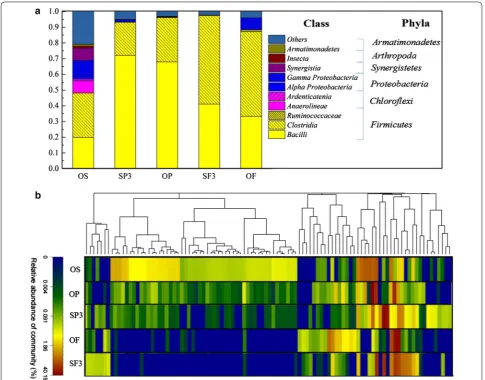
The distribution of the bacterial community further explained the differences among OS, OF, OP, SF3, and SP3 groups in detail (Fig. 5a). Five groups showed rela-tively low diversities with a total of 7 identified phyla observed. The phyla Firmicutes, Chloroflexi, and Pro-teobacteria, which were recognized as common fermen-tative phyla [41], were dominant in all five communities with a combined contents of 84.0, 98.9, 99.7, 98.1, and 97.5% in OS, OF, OP, SF3, and SP3, respectively. How-ever, the distribution of the three phyla in the five groups was obviously different. Firmicutes showed the highest relative abundance in the five groups. From Table 4, Fir-micutes, Chloroflexi, and Proteobacteria could always be enriched under alkaline conditions, and these bacteria mainly participated in VFAs generation.
At the class level, it was observed that Clostridia (28.2%), Bacilli (11.7%), Gammaproteobacteria (10.0%), Synergistia (7.9%), and Anaerolineae (7.8%) were the five main classes in the OS group, while Bacilli and Clostridia were the two major classes in the SP3, OP, SF3, and OF groups. The abundance of the Bacilli class increased dra-matically when potato peel waste was added in the sludge (72.2% in SP3 and 64.1% in OP), while the Clostridia class rose significantly with the addition of food waste (56.2% in SF3 and 53.6% in OF). Some studies have reported that bacteria from Clostridia and Bacilli were able to produce acetate; however, Clostridia bacteria can also produce butyrate [42], and Bacilli bacteria can produce lactic acid [43]. The distribution of special bacterial class in different fermentation groups clearly proved that the composition of organic matter could significantly influence the bacte-rial community structure, and selectively enrich specific acidogenic bacteria during anaerobic co-fermentation.
To further explore the microbial diversity in the five groups, the results of hierarchical clustering analysis at the genera level are shown in Fig. 5b (genera with relative abundance >1% in each sludge sample are listed in Addi-tional file 2). Relatively similar communities occurred in groups SP3 and SF3, and in OP and OF. Nevertheless, the bacterial community in the OS group was different from the other four groups. This further proves that the com-position of organic matter influences and shifts the bac-terial community structure at genus level.
Relationship between substrate composition and bacteria community
Previous studies have explored the relationship between microbial activity and different types of substrates in co-fermentation (Table 4). For example, Guo et al. [30] found that bacteria like Proteobacteria and Firmicutes were enriched under alkaline conditions with added agri-cultural residue. Moreover, use of perennial ryegrass or fermentation with only WAS gave different microbial communities [10]. Several researchers have also stud-ied different microbial communities and their meta-bolic pathways based on a single type of substrate. For example, Sivagurunathan et al. [33] reported that two Clostridium strains showed different metabolic pathways in different operation modes with galactose as substrate. However, little attention was paid to the relationship
between the organic matter composition and the micro-bial mechanism, or details such as the micromicro-bial commu-nity and metabolic pathway.
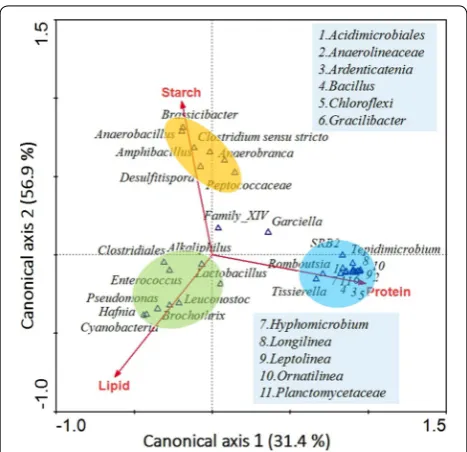
more likely to be enriched, indicating that these genera probably had a close relationship with protein degrada-tion. These results indicated that the structure of the bacterial community was significantly influenced by the organic components in the substrates and thereby gener-ated particular products. For example, the Clostridiales, which was dominant in the starch-enriched substrate, contributed significantly to butyrate production [44], while Anoxybacillus, a kind of anaerobic bacteria that only consumes carbohydrate, produced formate, lactate, acetate, and ethanol in low concentrations [45]. Ornati-linea, which was abundant in the OS fermentation group, was able to consume a variety of protein substrates to produce valerate as the main product [46]. The intersec-tion angle between starch and canonical axis 1 (Fig. 6) was smaller than the factors of lipids and protein, sug-gesting that starch was more important than other fac-tors in determining the typical genera in the five groups. The close relationship between protein and the bacterial community mainly explained the enrichment of some specific genera in the OS group.
To further investigate how the different substrates determined the VFAs distribution, the VFAs synthe-sis pathway was analyzed in detail (Fig. 7). Lipid, starch, and protein are transformed to pyruvate as the common intermediate through a series of biochemical reactions, and then transformed into downstream intermediates. Therefore, pyruvate can be considered as the core and starting point of the VFAs metabolic pathway network
with different substrates. The metabolic pathways and the theoretical chemical equations for propionate, butyrate, and valerate are listed in Fig. 7.
Some propionate-producing bacteria, like Planctomyc-etaceae and Brassicibacter, were enriched by consuming a large amount of protein (Fig. 6). From Fig. 7a, propi-onate was generated through two steps from pyruvate, and vitamin B12 was a co-factor to carboxyl transferase of methyl malonyl CoA, which was involved in the con-version step of pyruvate to malonyl CoA. Vitamin B12 could not exist alone in strong acidic or alkaline condi-tions unless it combined with protein [47], and the lack of protein would limit the combination of vitamin B12, thus inhibiting propionate generation. The presence of vita-min B12 might benefit propionate accumulation.
Valerate production was related to the conversion of glutamate, which was generated from protein (Fig. 7b). Bacteria like Bacillus reduced glutamate to proline [48] and then further reduced it to 5-aminovalerate. Finally, 5-aminovalerate was fermented by bacteria like Brassici-bacter via 5-hydoxyvaleryl-CoA and 2-pentenoyl-CoA to valerate. Ammonia, acetate, and propionate were also produced simultaneously during fermentation. The path-way in Fig. 7b also demonstrates that the consumption of protein could promote the generation of acetate, propi-onate, and valerate.
The increase in butyrate that was observed with the addition of starch is possibly related to the type of butyrate-producing bacteria and the acetate concentra-tion (Fig. 7c). It was reported that most butyrate-produc-ing bacteria preferred glucose as their substrates [49], and the enzymes related to butyrate production were mainly transferases of acetyl-coenzyme and butyrate kinase. Over 50% of butyrate-producing bacteria, like Clostrid-ium sensu stricto and Brochothrix, have both enzymes, which means that they could produce butyrate through the transformation of intracellular acetate [50]. However, some butyrate-producing bacteria could only generate butyrate by using extracellular acetate because of the absence of butyrate kinase. In this study, the SP3 and OP groups had abundant acetate and high concentrations of glucose as extracellular substrates for butyrate-producing bacteria, thus offering a good environment for butyrate generation.
Bacteria related to acetate production were extensively distributed in the fermentation. For example, bacteria like Ornatilinea and Gracilibacter could produce acetate by consuming the protein or carbohydrate substrates. More-over, the process of acetate generation and conversion are complex. Figure 7d shows that acetate was generated not only by the conversion of acetyl-coenzyme A, but also through H2 and CO2 transformation by homoacetogene-sis and acetaldehyde transformation by Saccharomycetes Fig. 6 CCA analysis of the microbial communities and the organic
in the VFA pathway [51]. The extensive distribution of acetate-producing bacteria and their various metabolic pathways made acetate the major VFA produced during acidogenic fermentation.
Conclusion
Substrate composition significantly influenced the VFAs production and distribution in acidogenic co-fermen-tation, as observed by the addition of different types of organic matter. In all cases, acetate was the dominant product in acidogenic fermentation, regardless of the substrate composition. The fermentation profiles and metabolic pathway analysis revealed that the addition of carbon-rich substrates significantly enhanced butyrate and ethanol accumulation, while protein-rich substrates substantially favored propionate and valerate generation.
The abundance of the Bacilli class increased dramati-cally when potato peel waste was added to the sludge, while the Clostridia class rose significantly with the addi-tion of food waste. These trends indicate that the organic matter composition significantly influenced the bacterial community structure, and selectively enriched specific acidogenic bacteria during anaerobic fermentation. The novel findings in this study are very helpful for substrate selection and parameter control for future selective VFAs production by acidogenic co-fermentation from waste activated sludge.
Abbreviations
BSA: bovine serum albumin; CCA: the canonical correspondence analysis; COD: chemical oxygen demand; C/N: carbon-to-nitrogen ration; FID: flame ionization detector; GC: gas chromatograph; OF: the fermentation substrate was only food waste; OP: the fermentation substrate was only potato peel waste; OS: the fermentation substrate was only pretreated sludge; OTUs: oper-ational taxonomic units; PCA: principal component analysis; SF1: the VS ratio of pretreated sludge and food waste was 3:1; SF2: the VS ratio of pretreated sludge and food waste was 1:1; SF3: the VS ratio of pretreated sludge and food waste was 1:3; SP1: the VS ratio of pretreated sludge and potato peel waste was 3:1; SP2: the VS ratio of pretreated sludge and potato peel waste was 1:1; SP3: the VS ratio of pretreated sludge and potato peel waste was 1:3; TN: total nitrogen; TS: total solid; VFAs: volatile fatty acids; VS: volatile solid; WAS: waste activated sludge.
Authors’ contributions
HL designed the study, analyzed the results, and revised the manuscript. HM performed the experiments and wrote the manuscript. LZ and MY took part in the experimental work. BF helped analyze the data of bacteria community and revise the manuscript. HL participated in most of data analysis. All authors discussed the results and helped to draft the manuscript. All authors read and approved the final manuscript.
Additional files
Additional file 1. Single VFA accumulation at the end of alkaline fermen-tation with glucose and bovine serum albumin (BSA).
Additional file 2. Content of bacteria at genus level in OS, SP3, SF3, OP, and OF fermentation groups (data given as percentages).
Author details
1 School of Environmental and Civil Engineering, Jiangnan University, Wuxi 214122, China. 2 Jiangsu Key Laboratory of Anaerobic Biotechnology, Wuxi 214122, China.
Acknowledgements
We would like to acknowledge Dr. Walquiria Simpcicio for her contribution to the revision processes of this manuscript. This research was financially sup-ported by the National Natural Science Foundation of China (51678280), the National Key Technology R&D Program of the Ministry of Science and Technol-ogy (2014BAD24B03-02), the Fundamental Research Funds for the Central Universities (JUSRP51633B), and the Natural Science Foundation of Jiangsu Province of China (BK20141112).
Competing interests
The authors declare that they have no competing interests. Availability of supporting data
The authors promise the availability of supporting data. Consent for publication
The authors have consented for publication.
Publisher’s Note
Springer Nature remains neutral with regard to jurisdictional claims in pub-lished maps and institutional affiliations.
Received: 19 March 2017 Accepted: 17 May 2017
References
1. Nishio N, Nakashimada Y. Recent development of anaerobic diges-tion processes for energy recovery from wastes. J Biosci Bioeng. 2007;103:105–12.
2. Appels L, Baeyens J, Degrève J, Dewil R. Principles and potential of the anaerobic digestion of waste-activated sludge. Prog Energy Combust Sci. 2008;34:755–81.
3. Wu H, Gao J, Yang D, Zhou Q, Liu W. Alkaline fermentation of primary sludge for short-chain fatty acids accumulation and mechanism. Chem Eng J. 2010;160:1–7.
4. Sheng GP, Yu HQ, Li XY. Extracellular polymeric substances (EPS) of micro-bial aggregates in biological wastewater treatment systems: a review. Biotechnol Adv. 2010;28:882–94.
5. Chen H, Wang D, Li X, Yang Q, Zeng G. Enhancement of post-anoxic denitrification for biological nutrient removal: effect of different carbon sources. Environ Sci Pollut Res. 2015;22:5887–94.
6. Andersen SJ, Candry P, Basadre T, Khor WC, Roume H, Hernandez-Sana-bria E, et al. Electrolytic extraction drives volatile fatty acid chain elonga-tion through lactic acid and replaces chemical pH control in thin stillage fermentation. Biotechnol Biofuels. 2015;8:1–14.
7. Agler MT, Wrenn BA, Zinder SH, Angenent LT. Waste to bioproduct con-version with undefined mixed cultures: the carboxylate platform. Trends Biotechnol. 2011;29:70–8.
8. Liu H, Xiao H, Yin B, Zu Y, Liu H, Fu B, et al. Enhanced volatile fatty acid pro-duction by a modified biological pretreatment in anaerobic fermentation of waste activated sludge. Chem Eng J. 2016;284:194–201.
9. Chen Y, Luo J, Yan Y, Feng L. Enhanced production of short-chain fatty acid by co-fermentation of waste activated sludge and kitchen waste under alkaline conditions and its application to microbial fuel cells. Appl Energy. 2013;102:1197–204.
10. Jia S, Dai X, Zhang D, Dai L, Wang R, Zhao J. Improved bioproduction of short-chain fatty acids from waste activated sludge by perennial ryegrass addition. Water Res. 2013;47:4576–84.
12. Liu X, Li R, Ji M, Han L. Hydrogen and methane production by co-digestion of waste activated sludge and food waste in the two-stage fermentation process: substrate conversion and energy yield. Bioresour Technol. 2013;146:317–23.
13. Zhang J, Lv C, Tong J, Liu J, Liu J, Yu D, Wang Y, et al. Optimization and microbial community analysis of anaerobic co-digestion of food waste and sewage sludge based on microwave pretreatment. Bioresour Tech-nol. 2016;200:253–61.
14. Yang M, Kuittinen S, Zhang J, Vepsäläinen J, Keinanen M, Pappinen A. Co-fermentation of hemicellulose and starch from barley straw and grain for efficient pentoses utilization in acetone–butanol–ethanol production. Bioresour Technol. 2015;179:128–35.
15. Silvestre G, Fernandez B. A. Bonmati. Addition of crude glycerine as strategy to balance the C/N ratio on sewage sludge thermophilic and mesophilic anaerobic co-digestion. Bioresour Technol. 2015;193:377–85. 16. Zhang W, Werner JJ, Matthew AT, Angenent LT. Substrates type drives
variation in reactor microbiomes of anaerobic digesters. Bioresour Tech-nol. 2014;151:397–401.
17. Wang J, Liu H, Fu B, Xu K, Chen J. Trophic link between syntrophic aceto-gens and homoacetoaceto-gens during the anaerobic acidogenic fermentation of sewage sludge. Biochem Eng J. 2013;70:1–8.
18. APHA. Standard methods for the examination of water and wastewater. Washington DC: American Public Health Association Inc.; 1998. 19. SEPA. Water and wastewater monitoring methods. 4th ed. Beijing:
Chi-nese Environmental Science Publishing House; 2002.
20. Lowry OH, Rosebrough NJ, Farr AL, Randall RJ. Protein measurement with the folin phenol reagent. J Biol Chem. 1951;193:265–75.
21. Ma H, Chen X, Liu H, Liu H, Fu B. Improved volatile fatty acids anaerobic production from waste activated sludge by pH regulation: alkaline or neutral pH? Waste Manag. 2016;48:397–403.
22. Liu X, Liu H, Chen Y, Du G, Chen J. Effects of organic matters and initial carbon-nitrogen-ratio on the bioconversion of volatile fatty acids from sewage sludge. J Chem Technol Biotechnol. 2008;83:1049–55. 23. Xu S, Fu B, Zhang L, He L. Bioconversion of H2/CO2 by acetogen enriched
cultures for acetate and ethanol production: the impact of pH. World J Microbiol Biotechnol. 2015;31:941–50.
24. Zhou A, Guo Z, Yang C, Kong F, Liu W, Wang A. Volatile fatty acids produc-tivity by anaerobic co-digesting waste activated sludge and corn straw: effect of feedstock proportion. J Biotechnol. 2013;168:234–9.
25. Rughoonundun H, Mohee R, Holtzapple MT. Influence of carbon-to-nitrogen ratio on the mixed-acid fermentation of wastewater sludge and pretreated bagasse. Bioresour Technol. 2012;112:91–7.
26. Matsushika A, Sawayama S. Characterization of a recombinant flocculent
Saccharomyces cerevisiae strain that co-ferments glucose and xylose: influence of pH and acetic acid on ethanol production. Appl Biochem Biotechnol. 2012;168:2094–104.
27. Clomburg JM, Gonzalez R. Anaerobic fermentation of glycerol: a platform for renewable fuels and chemicals. Trends Biotechnol. 2013;31:20–8. 28. Rosa PRF, Santos SC, Sakamoto IK, Varesche MBA, Silva EL. The effects of
seed sludge and hydraulic retention time on the production of hydrogen from a cassava processing wastewater and glucose mixture in an anaero-bic fluidized bed reactor. Int J Hydrog Energy. 2014;39:13118–27. 29. Yuan Y, Liu Y, Li B, Wang B, Wang S, Peng Y. Short-chain fatty acids
produc-tion and microbial community in sludge alkaline fermentaproduc-tion: long-term effect of temperature. Bioresour Technol. 2016;211:685–90.
30. Guo Z, Zhou A, Yang C, Liang B, Sangeetha T, He Z, et al. Enhanced short chain fatty acids production from waste activated sludge conditioning with typical agricultural residues: carbon source composition regulates community functions. Biotechnol Biofuels. 2015;8:192–206.
31. Huang X, Mu T, Shen C, Lu L, Liu J. Effects of bio-surfactants combined with alkaline conditions on volatile fatty acid production and microbial community in the anaerobic fermentation of waste activated sludge. Int Biodeterior Biodegrad. 2016;114:24–30.
32. Maspolim Y, Zhou Y, Guo C, Xiao K, Ng WJ. The effect of pH on solubiliza-tion of organic matter and microbial community structures in sludge fermentation. Bioresour Technol. 2015;190:289–98.
33. Sivagurunathan P, Kumar G, Park JH, Park JH, Park HD, Yoon JJ, Kim SH. Feasibility of enriched mixed cultures obtained by repeated batch transfer in continuous hydrogen fermentation. Int J Hydrog Energy. 2016;41:4393–403.
34. Kumar G, Zhen G, Sivagurunathan P, Bakonyi P, Nemestóthy N, Bélafi-Bakó K, Kobayashi T, et al. Biogenic H2 production from mixed microalgae bio-mass: impact of pH control and methanogenic inhibitor (BESA) addition. Biofuel Res J. 2016;11:470–4.
35. Ho SH, Huang S, Chen C, Hasunuma T, Kondo A, Chang JS. Bioethanol production using carbohydrate-rich microalgae biomass as feedstock. Bioresour Technol. 2013;135:191–8.
36. Luo J, Feng L, Chen Y, Sun H, Shen Q, Li X, Chen H. Alkyl polyglucose enhancing propionic acid enriched short-chain fatty acids production during anaerobic treatment of waste activated sludge and mechanisms. Water Res. 2015;73:332–41.
37. Kayhanian M, Tchobanoglous G. Computation of C/N ratios for various organic fractions. BioCycle. 1992;33:58–60.
38. Feng L, Chen Y, Zheng X. Enhancement of waste activated sludge protein conversion and volatile fatty acids accumulation during waste activated sludge anaerobic fermentation by carbohydrate substrate addition: the effect of pH. Environ Sci Technol. 2009;43:4373–80.
39. Phan S, Salentinig S, Gilbert E, Darwish TA, Hawley A, Nixon-Luke R, Bryant G, Boyd BJ. Disposition and crystallization of saturated fatty acid in mixed micelles of relevance to lipid digestion. J Colloid Interface Sci. 2015;449:160–6.
40. Yang J, Xiong YL. Inhibition of lipid oxidation in oil-in-water emul-sions by interface-adsorbed myofibrillar protein. J Agric Food Chem. 2015;63:8896–904.
41. Regueiro L, Veiga P, Lema JM, Carballa M. Influence of transitional states on the microbial ecology of anaerobic digesters treating solid wastes. Appl Microbiol Biotechnol. 2014;98:2015–27.
42. Cho C, Jang YS, Moon HG, Lee J, Lee SY. Metabolic engineering of clostridia for the production of chemicals. Biofuels Bioprod Biorefin. 2015;9:211–25.
43. Daffé M. The cell envelope of tubercle bacilli. Tuberculosis. 2015;95:155–8. 44. Levine UY, Looft T, Allen HK, Stanton TB. Butyrate-producing bacteria,
including mucin degraders, from the swine intestinal tract. Appl Environ Microbiol. 2013;79:3879–81.
45. Goh KM, Kahar UM, Chai YY, Chong CS, Chai KP, Ranjani V, Illias RM, Chan KG. Recent discoveries and applications of Anoxybacillus. Appl Microbiol Biotechnol. 2013;97:1475–88.
46. Podosokorskaya OA, Bonch-Osmolovskaya EA, Novikov AA, Kolganova TV, Kublanov IV. Ornatilinea apprima gen. nov., sp. nov., a novel cel-lulolytic representative of class Anaerolineae. Int J Syst Evol Microbiol. 2012;63:86–92.
47. Savvi S, Warner DF, Kana BD, McKinney JD, Mizrahi V, Dawes SS. Functional characterization of a Vitamin B12-dependent methylmalonyl pathway in Mycobacterium tuberculosis: implications for propionate metabolism during growth on fatty acids. J Bacteriol. 2008;190:3886–95.
48. Buckel W. Unusual enzymes involved in five pathways of glutamate fermentation. Appl Microbiol Biotechnol. 2001;57:263–73.
49. Wiese BI, Górka P, Mutsvangwa T, Okine E, Penner GB. Short communica-tion: interrelationship between butyrate and glucose supply on butyrate and glucose oxidation by ruminal epithelial preparations. J Dairy Sci. 2013;96:5914–8.
50. Jang YS, Im JA, Choi SY, Lee JI, Lee SY. Metabolic engineering of Clostrid-ium acetobutylicum for butyric acid production with high butyric acid selectivity. Metab Eng. 2014;23:165–74.