How to Identify Customers of
e-Services in VAT
Martijn M.J.A. Veltrop
The growth of e-commerce asks for adjustments in EU VAT. Through the internet, products can be supplied all over the world, without requiring the physical presence of the supplier in the state of consumption. To remain fiscal neutrality, as of 1 January 2015 all B2C supplies of e-services will be taxable at the customer’s location. To apply the correct VAT rate and to assign the liability of VAT, suppliers must subsequently determine the status of the customer, his capacity and the location to which the service is provided. Especially in B2C e-commerce it may be difficult for suppliers to identify their customer. To stimulate customers to provide all relevant information and reduce their incentives to manipulate, suppliers are effectively required to implement fast and simple ordering systems and impose a universal pricing strategy. This will be the only way for suppliers to get in compliance with the new legislation.
1
Introduction
Who has never downloaded music, ordered an e-book online or participated in a multiplayer game? We live in a digital era where an increasing number of devices like computers, tablets and mobile phones allow people to consume online. 1 Even during the recent economic crisis
in Europe, e-commerce is growing thanks to its speed and simplicity.2
E-commerce asks for adjustments of the European Value Added Tax (VAT) system. VAT should follow the destination principle and be
1 OECD, BEPS ACTION 1: ADDRESS THE TAX CHALLENGES OF THE DIGITAL ECONOMY, 24 March 2014, p. 9.
imposed at the place where the consumption actually takes place. 3 For
practical reasons however, most place of supply rules for private consumption are based on the origin principle, which means that transactions are taxable at the place where the supplier is established. The internet makes it possible to supply digital products all over the world, without requiring the physical presence of the supplier in the state of consumption. 4 Suppliers outside the European Union (EU) were
able to supply e-services free of VAT to private customers within the EU. Fiscal neutrality in VAT however, requires the same treatment for similar services. 5 To eliminate the distortion of competition, 6 the
destination principle came into force for B2C supplies of e-services from non-EU suppliers to EU private customer on the 1st of January 2010. For
EU suppliers of e-services the origin principle remained applicable until 2015, so suppliers established in a Member State with a low VAT rate still had a competitive advantage in contrast to suppliers established in other Member States. As of 1 January 2015, the customer’s location will be the place of supply for all B2C supplies of e-services.7
To apply the correct VAT rate and to assign the liability of VAT, suppliers must subsequently determine the status of the customer, his capacity and the location to which the e-service is provided. B2C e-commerce is characterized by a high number of low value transactions to different customers all over the world.8 This makes it difficult for suppliers of
e-services to identify their customer. The compliance costs can become so high that these low value transactions will no longer be profitable. Although the European Commission has come up with an Implementation Regulation (IR) and (not legally binding) Explanatory Notes, they do not really help suppliers of e-services to get in compliance with the new legislation.
3 OECD, Taxation and Electronic Commerce – Implementing the Ottawa Taxation Framework Conditions, 2001, p. 45.
4 Jinyan Li, Consumption taxation of electronic commerce: problems, policy and proposals for reform, Canadian Business Law Journal (Volume 38), 2003, p. 430.
5 M.E. van Hilten, H.W.M. van Kesteren, Omzetbelasting, FED Fiscale Studieserie nr. 6, dertiende druk, Kluwer, Deventer, 2012, p. 14. 6 Mr. A.J. van Doesum, prof. dr. H.W.M. van Kesteren, mr. G.J. van Norden en mevr. mr. drs. I.H.T. Reinders, De nieuwe regels voor de plaats van dienst in de btw, WFR 2008/279, p. 1.
7 Art. 58 VAT Directive 2006/112/EC.
2
Supplies of e-Services
2.1 B2C supplies of e-services
Suppliers first need to determine the status of the customer and must know what qualifies as an e-service. For B2C supplies of e-services, the customer's location may be based on a presumption.
Status of the customer
The status of a customer will be determined based on the definition in the VAT Directive.9 “A taxable person shall mean any person who,
independently, carries out in any place, any economic activity, whatever the purpose or results of that activity.” 10 Any person not covered by the
definition of taxable person will be regarded as a non-taxable person. Non-taxable persons can be natural persons like private consumers or legal persons, for example public bodies not identified for VAT purposes. The legal aim of VAT is to tax private consumption. Therefore, also taxable persons not acting as such will be regarded as non-taxable persons for B2C transactions. A taxable person is not acting as such, when he receives services exclusively for private use.11 Fiscal neutrality
would be harmed if private consumption was treated differently, only on the basis of the status of the customer.
E-services
The definition of e-services12 is very broad so it will cover future
technological developments. Article 7 IR and its corresponding annex mention the supply of webhosting, subscription to online newspapers, downloading music and accessing online multiplayer games as examples of e-services. The list, however, is not limitative.13 All services covered
by the definition should be regarded as e-services.
Non-taxable person’s location
A natural person will be located at the place of his permanent address or where he usually resides. As permanent address qualifies the address entered in the population register, or the address indicated to the
9 Art. 17(1) Implementation Regulation No 282/2011. 10 Art. 9(1) VAT Directive 2006/112/EC.
11 Art. 19 first paragraph Implementation Regulation No 282/2011. 12 Art. 7(1) Implementation Regulation No 282/2011.
relevant tax authorities.14 For privacy reasons, in most Member States
this information is only available for public authorities and cannot be used by commercial parties. Therefore, most natural persons will be located at the place where they usually live as a result of personal and occupational ties,15 like the address of their house, the place where their
family lives or the location where their employer is established.
The location of a non-taxable legal person will be the place where that person is established. Such a person has no economic activity and cannot refer to the general concept of establishment. However, the same principles are used for determination of the place of establishment of a legal non-taxable person as are used for taxable persons.16
Presumptions of the customer’s location
In case a supplier of e-services is not able to determine a customer's location with certainty, he may base it on a presumption.17 For instance,
for e-services supplied to locations where the physical presence of the customer is needed for providing the e-service to him, it shall be presumed that the customer is established, has his permanent address or usually resides at that location.18 The provision refers to locations
such as a WiFi hot spot, a restaurant or a hotel lobby, but it can be applied to all situations where the physical presence of a customer is necessary for providing the e-service to him.
If e-services are not supplied in situations as mentioned above, the customer’s location may be presumed to be:
- The place of installation of the fixed land line used for receiving the e-service.19
- The country identified by the mobile country code stored on the SIM card used when receiving the e-service.20
- The place where the decoder (or similar device) is located or a viewing card is sent to.21
If no fixed land line, SIM card or decoder is used for receiving e-services, the customer’s location can be presumed to be the place
14 Art. 12 Implementation Regulation No 282/2011. 15 Art. 13 Implementation Regulation No 282/2011.
16 Art. 13a Amending Implementation Regulation No 1042/2013. 17 European Commission, Explanatory Notes on the EU VAT changes to the place of supply of telecommunications, broadcasting and electronic services that take into in 2015, 3 April 2014, p. 64.
identified as such by the supplier based on two items of non-contradictory evidence. 22 To allow suppliers operating in different
markets to collect different information, all commercially relevant information can be evidence for the identification of the customer’s location.23 The illustrative list with items of evidence include the billing
address of the customer, the IP-address of the device used by the customer, the bank account used for the payment, the mobile country code stored on the SIM card used by the customer for receiving the e-service and the location of the customer’s fixed land line through which the e-service is supplied to him.24 To none of the items has been given
priority and it is up to the supplier to consider which information is most commercially relevant for identifying the customer's location.25
Mini One-Stop-Shop
Since a single supplier of e-services can have customers located all over Europe, he might be obligated to register in 28 Member States. In order to prevent an increase of the administrative burden for suppliers26 and
not to harm the growth of e-commerce at the internal market,27 the
Commission introduced an optional Mini One Stop Shop (MOSS) Union scheme. The supplier can register for MOSS in any Member State that has provided him with a VAT identification number, which will become his Member State of identification. From this Member State, the supplier electronically submits quarterly VAT returns detailing supplies of e-services to non-taxable persons located in other Member States along with the VAT due. The VAT returns together with the VAT paid are then transmitted by the Member State of identification to the corresponding Member States of consumption.28
22 Art. 24b(d) Implementation Regulation No 1042/2013.
23 European Commission, Explanatory Notes on the EU VAT changes to the place of supply of telecommunications, broadcasting and electronic services that enter into force in 2015, 3 April 2014, p. 68.
24 Art. 24f Implementation Regulation No 1042/2013.
25 European Commission, Explanatory Notes on the EU VAT changes to the place of supply of telecommunications, broadcasting and electronic services that enter into force in 2015, 3 April 2014, p. 69.
26 European Commission, Taxation: Developing the One Stop Shop for cross border VAT compliance, 13 January 2012, published at: http://europa.eu/rapid/press-release_IP-12-17_en.htm.
27 OECD Working Party No. 9, Consumption Tax Aspects of Electronic Commerce, February 2001.
Although larger companies will be compliant with the new rules because of their reputation, this may not be the case for small web shops. How can a Member State know that an e-service will be consumed by one of its residents? There is still no computer technology that is able to follow all online transactions. This means that a state of consumption must rely on the information provided by the state where the supplier is established and the willingness of a supplier to be in compliance.29 Both
the state and the supplier, however, have no incentive to do so, since they will not receive any reward in return and only bear the administrative costs.
2.2 B2B supplies of e-services
The special provision for e-services only covers B2C transactions. In accordance with the case Dudda30, transactions between taxable
persons fall within the scope of the B2B main rule. B2B supplies of services are taxable at the place where the receiving taxable person is established, has his permanent address or usually resides.31
Taxable person, acting as such
Although public bodies may qualify as taxable persons on the basis of this definition mentioned before, they shall not be regarded as taxable persons in transactions they engage as public authorities.32 As a result,
public bodies can either act as non-taxable persons or as taxable persons. To prevent practical problems, public bodies identified for VAT purposes will always be regarded as taxable persons for the application of the place of supply rules.33 Nevertheless, supplies of e-services to
customers with the status of taxable person fall only within the scope of the B2B main rule, when that customer is acting as such.
29 Herman van Kesteren, Society’s Online Revolution and the Short Arms of the Tax Authorities, VAT in an EU and International Perspective – Essays in honour of Han Kogels, p. 126.
30 See ECJ judgment of 26 September 1996 in J. Dudda v. Finanzamt Bergisch Gladbach, Case 327/94 point 21.
31 Art. 44 VAT Directive 2006/112/EC.
32 Prof. Dr. A. Van Doesum, F. Nellen LL.M, VAT in a Day, 2013, Kluwer BV, p. 20.
Taxable person’s location
To determine a taxable person's business establishment account shall be taken of the place where essential decisions concerning the general management of the business are taken, the place where the registered office of the business is located and the place where the management meets. The most important criterion is the place where the essential decisions concerning the general management of the business are taken.34 From Planzer35 follows that other factors such as the place of
residence of the main directors, the place where general meetings are held and the place where administrative documents are kept may also need to be taken into account.
E-services supplied to a fixed establishment of a taxable person, located at a place other than the place where the business is established, shall be taxable at the place where the fixed establishment is located. 36
Already in 1985, the concept of fixed establishment was defined in
Berkholz.37 In this case however, the fixed establishment was providing
services, whereas in the context of the B2B main rule, a fixed establishment is receiving services. This fixed establishment is characterized by a sufficient degree of permanence and suitable structure in terms of human and technical resources to be able to receive and use services for its own needs,38 but does not have to be
able to provide such services by itself.I note fixed establishments that perform solely internally tasks for the enterprise - like advertising, purchasing goods or recruiting staff - can qualify as customer under this definition.
When a taxable person does not have a business establishment or a fixed establishment, the place of supply shall be at his permanent address or usual residence.39 This means that the place of supply of a
natural taxable person shall only be at his permanent address or usual residence, in absence of a place where essential decisions are made or a place that fulfils the criteria for a fixed establishment.
If the physical presence of a customer at a certain place is needed for receiving an e-service and the customer's location cannot be based on other information, the supplier can presume that the customer is
34 Art. 10 Implementation Regulation No 282/2011.
35 See ECJ judgment of 28 June 2007 in Planzer Luxembourg Sarl vs. Bundeszentralamt fur Steuern, Case 73/06 point 61.
36 Art. 44 VAT Directive 2006/112/EC.
37 See ECJ judgment of 4 July 1985 in GünterBerkholz vs. Finanzamt Hamburg-Mitte-Altstadt, Case 168/84 point 18.
38 Art. 11(1) Implementation Regulation No 282/2011.
established, has his permanent address or usually resides at that place.40
Reverse charge mechanism
As a result of the reverse charge mechanism, the recipient of a B2B transaction will become liable for VAT instead of the supplier. The supplier must be established in another Member State and does not have an intervening fixed establishment in the Member State where the VAT is due.41 A fixed establishment will intervene and become liable for
VAT, when its technical and human resources are used by the supplier for the fulfillment of the supply within the Member State of consumption.42
3
Difficulties for Suppliers of e-Services
Suppliers of e-services with a high volume of low value transactions to different customers around the world may face compliance costs that exceed the small profit-margins of these online transactions. Besides difficulties in identifying the status of the customer, his capacity and the location to which an e-service is provided, suppliers may not feel confident to rely on the presumptions and the items of evidence.
3.1 Status of a customer
As of 1 January 2015, both the B2C rule for e-services and the B2B main rule follow the destination principle and will determine the customer's location as place of supply. The liability of VAT however may be different as a result of the reverse charge mechanism.
To simplify the application of the B2C rule for e-services,43 suppliers
may regard a customer as non-taxable person when the supplier can prove that a customer has not communicated a VAT identification number to him and if he has no information to the contrary.44 But how
should a supplier prove that he did not receive anything? It is not clear
40 Art. 24a(1) Implementation Regulation No 1042/2013. 41 Art. 196 VAT Directive 2006/112/EC.
42 Art. 192a VAT Directive 2006/112/EC in conjunction with Art. 53(2) Implementation Regulation No 282/2011.
43 European Commission, Explanatory Notes on the EU VAT changes to the place of supply of telecommunications, broadcasting and electronic services that enter into force in 2015, 3 April 2014, p. 48.
whether the supplier should take an active role and ask the customer for a VAT identification number.45 What qualifies as evidence remains
unanswered as well.
Suppliers can still regard a customer that did not communicate a VAT identification number as a taxable person, but they then need sufficient information to substantiate the status of the customer. If this is not possible, tax authorities can held the supplier liable for payment of VAT.46 In practice, many customers with the status of taxable person
will communicate their VAT identification number only once to the supplier, and not repetitively for each separate transaction.47
Suppliers may assume that an EU customer has the status of taxable person, when the customer communicates a VAT identification number or demonstrates his status and the supplier checks its validity together with the customer’s name and address.48 VAT identification numbers
can be confirmed rapidly through the VAT Information Exchange System49 accessible by a web application. This seems to be a simple and
fast method to determine the status of a customer, but the outcome of this procedure only confirms the existence of the communicated VAT identification number. The status of taxable person is based on objective factors and does not depend on a VAT identification number. In my view these assumptions do not provide the supplier with any more certainty.
3.2 Capacity of a taxable person
Customers with the status of taxable person will act in that capacity when services are intended to be used for business purposes. The B2B main rule will also apply when a taxable person intends to use the e-service both for private and business purposes, as long as it does not lead to abuse.50 A taxable person receiving e-services exclusively for
45 Merkx, Btw-uitvoeringsverordening uitvoerbaar?, WFR 6924 p. 1309. 46 European Commission, Explanatory Notes on the EU VAT changes to the place of supply o telecommunications, broadcasting and electronic services that enter into force in 2015, 3 April 2014, p. 49.
47 Mr. J.P. Hulshof, Mr. E.W.E.M. Cox, De gewijzigde Btw-verordening: een knipperlicht in het schemerduister, BtwBrief, oktober 2011.
48 Art. 18(1)(a) Implementation Regulation No 282/2011. 49 Web application of VIES can be reached at:
http://ec.europa.eu/taxation_customs/vies/vieshome.do?locale=en.
private use does not act in his capacity of taxable person and must be regarded as non-taxable person.51
However, it may not always be clear in which capacity a customer acts at the moment of supply. Therefore suppliers may consider the e-services to be supplied for the customer’s business use if a VAT identification number is communicated, unless a supplier has information to the contrary such as information on the nature of the service provided.52
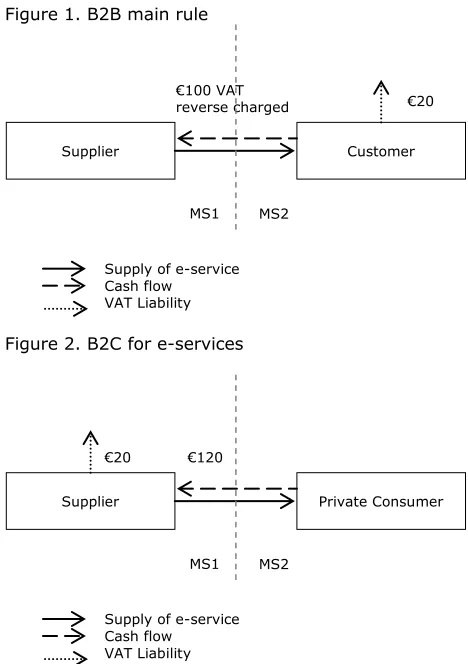
Suppliers cannot focus only on whether a VAT identification number was communicated, but they also have to take into account other information. I find it very arbitrary to determine the capacity in which a taxable person is acting, on the basis of information such as the nature of the service provided. Think for instance of music that can be downloaded from a website. How does the supplier of this e-service know whether his customer is going to play the music at home or at the business floor of his company? Since it is not evident for suppliers of e-services to answer this question, there is an essential risk to be not in compliance and be confronted with VAT assessments as the following example will illustrate.
Based on the assumption that the customer is a taxable person acting as such, the place where the customer is established will be determined as place of supply by the B2B main rule. If the supplier himself is not established in that Member State, the reverse charge mechanism will apply and the liability of VAT will shift from supplier to customer. The supplier then sends an invoice without VAT, but with the description ‘VAT reverse charged’. The customer does not pay any VAT to the supplier, but will do a self-assessment in his own VAT return.
After a while, it becomes clear that the customer has not acted in his capacity of taxable person and retrospectively seen the B2C rule for e-services should have been applied. Although the VAT is payable in the same Member State, the reverse charge mechanism will not be applicable. The supplier should collect VAT and pay the corresponding amount (through the MOSS system) to the tax authorities of the Member State where the customer is located.
The mistake will not lead to many problems as long as the customer pays the VAT to the competent tax authorities. However, in cases in which the customer faces bankruptcy, tax authorities of the Member State of consumption will get after the supplier to get their tax revenue. The supplier is obligated to pay the VAT assessment and will bear the burden.
Figure 1. B2B main rule
Figure 2. B2C for e-services
3.3 Identify an establishment as customer
Identifying the correct establishment as customer is important, because Member States apply different VAT rates and invoice requirements.53
Since a customer may have several fixed establishments in different
53 European Commission, Guide to the VAT mini One Stop Shop, Brussels, 23 October 2013, p. 24.
Private Consumer Supplier
Supply of e-service Cash flow
VAT Liability €120
MS1 MS2 €20
Customer Supplier
Supply of e-service Cash flow
VAT Liability €100 VAT reverse charged
MS1 MS2
Member States besides his business establishment, a supplier shall identify the establishment to which an e-service is provided based on the nature and use of the service provided.54 If no fixed establishment
can be identified in this way, a supplier should identify the establishment that agreed with the contract, ordered the e-service and provided his VAT identification number.55 According to art. 22 IR, a fixed
establishment could also be identified as customer when that entity is paying for it. This criterion does not seem to be helpful, because the invoice has to be made up in accordance with the specific requirements of the Member State where the paying establishment is located, before it can be paid by an entity.56
If no fixed establishment can be identified by this procedure, a supplier may consider the customer’s business establishment as place of supply. I think this kind of reasoning is in line with the B2B main rule, which states that the place of supply is where the business is established, unless the service is used by a fixed establishment for its own needs.
3.4 Rebuttable presumptions
Although a customer’s location may be identified on the basis of a particular presumption, suppliers may rebut every presumption with three non-contradictory items of evidence indicating that the customer is located elsewhere.57 The provision uses the term ‘may’, which
indicates that suppliers have no obligation to do so.
Tax authorities can rebut a presumption as well,58 but to ensure legal
certainty they will only do so when they have an indication of misuse or abuse by the supplier.59 This means that tax authorities will not make
use of this option in case a supplier applied the wrong VAT rate as a result of incorrect information that was provided to him by his customer, unless the supplier should have known that the communicated information was incorrect.
54 Art. 22(1) Implementation Regulation No 282/2011. 55 Art. 22(1) Implementation Regulation No 282/2011.
56 I. Lejeune, E. Cortvriend, D. Accorsi, Implementing Measures Relating to EU Place-of-Supply Rules: Are Business Issues Solved and Is Certainty Provided?, International VAT Monitor, May/June 2011.
57 Art. 24d(1) Implementation Regulation No. 282/2011. 58 Art. 24d(2) Implementation Regulation No. 282/2011
3.5 Manipulative items of evidence
No method will ever be completely waterproof, but in my opinion the items of evidence for the identification of a customer’s location give too many possibilities for manipulation.
Firstly, the communicated billing address can simply be false, because customers will receive the ordered e-services digitally. In contrast, goods purchased online will never reach a customer when he provides a wrong address. Besides that, non-taxable persons have no right of reduction and do not need a proper invoice following the requirements for refunding VAT.
The second item is insecure as well, because customers can hide their real IP-address and show a different location60 by using a free
proxy-server61 or making use of a Tor-network62. Besides that, many
companies make use of worldwide networks that function on servers centralized in one country. If their employees use the network to order an e-service, the supplier may identify the customer on the basis of the IP-address at a different location than where that customer actually is located.
Further European integration has made it easier to open bank accounts in other Member States or even outside the EU, like Switzerland. That is why the location of a bank account used for the payment is not a good item of evidence. The billing address held by the bank would be more helpful, but unfortunately that will be kept secret.
Customers can easily buy foreign SIM cards63 that contain a different
mobile country code, which can be used as item of evidence. There may arise some practical difficulties with the mobile network by using a foreign SIM card within your home country. Therefore, I assume that such kind of manipulation will only occur in border areas.
Altogether, only the location of a fixed land line through which an e-service is supplied seems to be an item of evidence that cannot be easily manipulated. There must be a link between the fixed land line
60 B. Chacos, How (and why) to surf the web in secret, PCWorld, 7 November 2012.
61 Like for instance: http://proxify.com.
62 The necessary software can be downloaded for free from: https://www.torproject.org.
and a customer to indicate that the customer actually belongs at the location of the fixed land line.64
Qualifying all commercially relevant information as evidence intends to minimize the administrative burden for suppliers, but simultaneously it provides customers with lots of possibilities to fake evidence. To minimize the risks of not being in compliance, suppliers will have to take this potential manipulation into account, which may increase their administrative burden even further. It is the supplier's responsibility to be in compliance, but he has to base the tax treatment on information provided to him by the customer. Although tax authorities can require the supplier to do reasonable commercial security checks over the provided information, they may not expect full investigations. It is not feasible for suppliers of e-services, who may have a high number of low value transactions to different customers all over the world. Their relatively small profit-margins do not allow them to do full investigations. It is not fair to hold suppliers responsible for the consequences that result from weak legislation.
4
Get in Compliance
To reduce the risk of not being in compliance with the new legislation, suppliers of e-services need all relevant information and must be able to rely on it. With fast and simple ordering systems, suppliers can stimulate their customers to provide all relevant information. Imposing a universal pricing strategy will minimize the incentives for manipulation, so that customers provide correct information.
4.1 Fast and simple ordering systems
The speed and simplicity of e-commerce are the most important factors of its success,65 so suppliers of e-services should make the ordering
process fast and simple if they want to stimulate their customers to provide all relevant information. Although suppliers might want to collect as much information as possible, they should be aware of the fact that it may damage the speed and simplicity of their ordering
64 European Commission, Explanatory Notes on the EU VAT changes to the place of supply of telecommunications, broadcasting and electronic services that enter into force in 2015, 3 April 2014, p. 58.
systems. Each additional question during the ordering process may deter potential customers and could lead to less revenue.
Although electronic signatures are a good approach to identify customers, only governmental institutions seem to be willing to use this approach, because the requirements for using personal data66 do not
match with speed and simplicity of online transactions. As an alternative, many websites use a combination of username and password with which the customer can log into a secured web portal.67
The secured web portal, commonly called an account, saves the provided information of the customer in a database. This information can easily be taken from the database when the customer makes new transactions with the same account at a later stage. The customer then only has to adjust the picked up information when something is changed. Suppliers must keep in mind that there are strict requirements for storing this personal data and that collecting this data may not infringe a person’s privacy.
4.2 Reduce incentives to manipulate
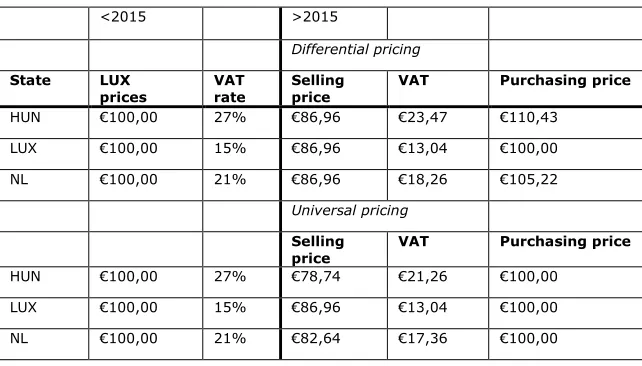
Before 2015, all e-services were provided from the same Member State, for the same price with the same VAT rate. As of 1 January 2015, the place of supply for B2C supplies of e-services will be the Member State where the customer is located. Suppliers can set unique selling prices for the same e-service in each particular Member State, on which the VAT rate of that particular Member State will be applicable. If suppliers would keep the selling price at the same level in all Member States, the same e-service will be more expensive for a customer located in Hungary (27% VAT) than for another customer located in Luxembourg (15% VAT). The difference in purchase price is the result of fiscal sovereignty of both Member States to set their own VAT rate. Hungarian customers would have an incentive to provide information on which a supplier may presume that they are located in Luxembourg, which would reduce their purchase price by nearly ten per cent.
This incentive can be minimized by imposing universal pricing instead of differential pricing.68 Instead of using the same selling price (excluding
VAT) in all Member States, suppliers could choose to set different selling prices in each Member State in such a way that the purchasing prices (including VAT) are equal in all Member States. Hungarian customers would no longer have an incentive to manipulate the items of evidence, because it would not lead to a lower price anymore.
Table 1. Overview of the consequences of the chosen pricing strategy.
An unanswered question remains what the common purchasing price should be. Most suppliers of e-services are currently established in Luxembourg,69 so they could adopt the Luxembourgish prices for all
Member States. This would reduce the profit-margins in the other Member States, since the higher VAT rates must be compensated by a reduction of the selling prices. If they adopt the Hungarian price level, customers in all other Member States will be confronted with a price
68 EY, VAT changes concerning telecommunication, broadcasting and e-commerce services from 2015, 24 July 2013, published at: http://www.ey.com/LU/en/Services/Tax/Tax-alert_20132407_VAT- changes-concerning-telecommunication--broadcasting-and-e-commerce-services-from-2015.
69 R. Vos, De totstandkoming van het nieuwe btw-stelsel voor e-commerce vanaf 2015, BTW-bulletin 2013/109.
<2015 >2015
Differential pricing
State LUX
prices VAT rate Selling price VAT Purchasing price
HUN €100,00 27% €86,96 €23,47 €110,43
LUX €100,00 15% €86,96 €13,04 €100,00
NL €100,00 21% €86,96 €18,26 €105,22
Universal pricing
Selling
price VAT Purchasing price
HUN €100,00 27% €78,74 €21,26 €100,00
LUX €100,00 15% €86,96 €13,04 €100,00
increase, which may impact the sales figures negatively. I expect that suppliers of e-services will try to find a balance between reducing the profit-margins and increasing prices.
Although suppliers of e-services seem to be willing to give up some of their profit-margins, when it leads to more certainty and lower compliance costs, VAT must be neutral and should not influence decisions of taxable persons. Since the Member States increased the compliance costs by introducing new legislation, it would be fair if they should also take the responsibility for the consequences. For instance, Member States could minimize the incentive to manipulate evidence by introducing a harmonized VAT rate for e-services. In my view, it is not realistic that Member States will give up their fiscal sovereignty to set different VAT rates for e-services, especially now the number of online transactions will increase only further.