Copyright © 2015 by Iranian Occupational Health Association (IOHA) IJOH 8: 69-77, 2016
ORIGINAL ARTICLE
Effect of Training Interventions on the Reduction of Unsafe
Behaviors Using Deming Model
MAHBOOBEH ES-HAGHI
1, PARVIN SEPEHR
2*1Department of Occupational Health, Faculty of Health, Kerman University of Medical Sciences, Kerman, Iran;
2Department of Occupational Health, Faculty of Health, North Khorasan University of Medical Sciences,
Bojnurd, Iran.
Received March 17, 2016; Revised October 14, 2016; Accepted December 22, 2016
This paper is available on-line at http://ijoh.tums.ac.ir
ABSTRACT
Training interventions are regarded as essential managerial strategies in various organizations. The present study investigated managerial interventions in training based on Deming model and their effectiveness to decrease the rate of unsafe behaviors of workers. It was a case study, conducted in a rolling industry and a descriptive- analytic research, done periodically during three years (2012-2015). It was tried to implement training programs based on the Deming cycle. To study the effectiveness of training interventions, safety performance indicators and standardized questionnaires were used. A comparison was also drawn between the rate of unsafe behaviors before and a year after applying the interventions. Sampling safety behavior was used to determine the rate of unsafe behaviors and such behaviors were investigated through checklists and random observations. The mean score of unsafe behaviors was 46%. The most and the least frequently occurred unsafe behaviors were failure to use earmuffs (14.5%) and throwing tools (0.02%) respectively. The results showed that applying interventions were influential in decreasing unsafe behaviors (31%, P=0.006). After interventions, obtained results of safety performance indicators and the status of training came to a desirable level. Findings also proved that training is one of the major cornerstones of improved safe behaviors. Therefore, it is important to hold regular training courses and establish an efficient training system in the workplace to develop safety purposes and professional health.
KEYWORDS:
Training interventions, Unsafe behaviors, Deming model
INTRODUCTION
Accidents and their consequences are major issues in industries and organizations. Several potential factors can cause accidents, which are important on their own, and proper solutions should be proposed to them. Some of these factors include management system, work process, equipment and materials, and environment and manpower [1]. After Chernobyl disaster, the critical role of humans has been taken into consideration and factors that lead to undesirable individual and group behaviors are more paid attention to [2].
* Corresponding Author: Parvin Sepehr Email:[email protected]
Such behaviors are called unsafe [3] which play a significant role in the occurrence of accidents [4-5]. Examinations of industrial disasters show that the main causes of most accidents in the workplace are unsafe behaviors and errors occurred due to workers violation of safety guidelines. Every two millions of unsafe behaviors lead to a catastrophic accident [6] which happens in an inappropriate safety management system and a poor safety culture. Therefore, controlling the rate of unsafe behaviors of workers will be one of the most influential solutions to reduce accidents.
Effect of Training Interventions on the Improvement of Unsafe Behaviors … ijoh.tums.ac.ir | 70
and achieving safety. To change behaviors, workers should be aware of safety issues, and this awareness should become part of their attitudes. They should also feel committed to working safely, and this commitment should be visible in their behaviors. These will come true if workers receive adequate training through coherent, collaborative and integrated training programs. In fact, training is the main infrastructure to move toward safe behaviors (Fig.1) and it plays a significant role in controlling unsafe behaviors [7].
Unsafe behavior is the deviation from safety rules and standards that are set to perform an activity. Safe behavior is also expected to improve people’s awareness, skills, and attitudes toward safety issues and to create desirable behaviors in workers so that they perform their activities and responsibilities in a safer manner [8-9]. Safety of behaviors increases concentration and attention while doing activities and it plays a critical role to prevent many accidents in industrial environments [4, 10]. Given the significance of safe behaviors in the workplace, structured and integrated training, aiming at increasing the individual and organizational effectiveness, can promote knowledge, skills and attitudes toward safety performance and as a result, it can be effective in reducing unsafe behaviors and enriching safety culture.
Fig.1. The process of modifying behaviors through training
Behavior Commitment
Attitude Awareness
Training
The preventive approach to safety management is influenced by effectiveness of training programs which focus on workers’ skill and knowledge [11]. In this regard, workers’ perception of the effect of training programs on safe behaviors is a significant factor [12]. Behavior changes due to training results in the improvement of safety culture among workers [13]. Safety culture includes the application of all the values and beliefs shared with organizational culture, and it creates normal and standard behaviors in the workplace. Behaviors are a reflection of safety awareness, which is supported and institutionalized by training. In fact, there is no contradiction between safe behavior and safety culture, and improvement in behavior will result in a positive safety culture. It can be said that, reduction of unsafe behaviors is the requisite to create a positive safety culture. The present study focused on this issue, which requires holding integrated and coherent training programs. The significance of training interventions and holding training programs as managerial and executive solutions is considered essential in organizations.
The purpose of the present study,
conducted as a case study in a rolling industry, was to assess the effects of managerial interventions, including training, and also the influence of training mediations on the reduction of unsafe behaviors.
MATERIALS AND METHODS
Participants and procedure: This study was descriptive-analytic conducted periodically during three years (2012-2015). It tried to hold training programs based on the Deming cycle and the effectiveness of these training courses on the reduction of the rate of unsafe behaviors. This study, which composed of 72 participants, was carried out as a case study in a rolling industry.
Unsafe acts occurred in the factory under study were selected according to their significance, and also with regard to existing conditions such as regulations, facilities, available cultural infrastructures, and desirability and plausibility of possible suggestions to reduce unsafe behaviors. The inventory of unsafe acts was prepared through 1) interview with the personnel, supervisors, managers and related experts; 2) study and examination of regulations and guidelines of safety and health; 3) records of previous studies conducted on this issue and also previous accidents; 4) and finally considering the inventory of unsafe acts issued by ANSI [14].
71| IJOH | June 2016 | Vol. 8 | No. 2 Es-haghi & Sepehr
(Equation 1)
N= the total number of observations needed
k= amount obtained from the standard normal table S= accuracy needed
P= the ratio of observations of unsafe behaviors to total observations
People’s unsafe behaviors were observed during 20 days in two work shifts, and the p-value i.e. the ratio of unsafe observations to total observations was obtained. According to relation 1, observations were calculated to be 2280. During the first year of the implementation of the study, staffs’ behaviors were randomly observed. Each short-term observation lasted 4 seconds [19]. Short-term observations were conducted to avoid judgments by observers. These times were set by experts and through the review of previous research findings. After the specification of unsafe behaviors, it was decided to do a need analysis of training programs and implement them according to Deming cycle to improve safe behaviors. This will be discussed in the following section.
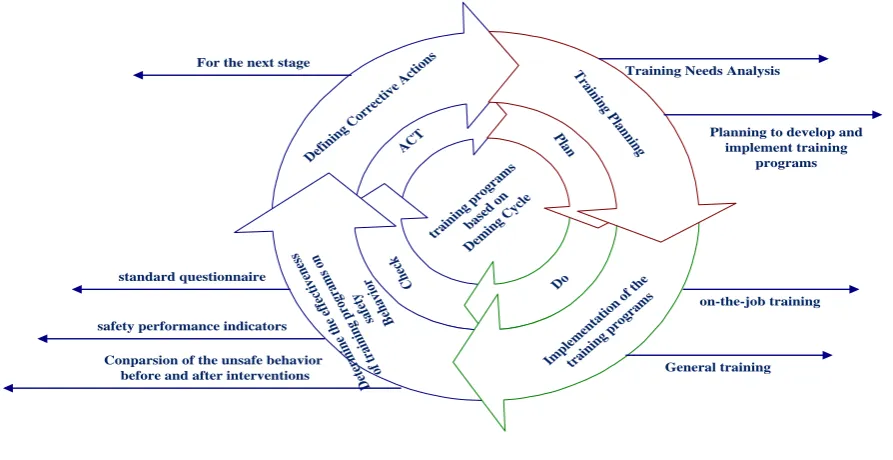
Training intervention through Deming Model: We tried to implement training programs including the four processes of Plan-Do-Check-Act (PDCA) based on the Deming Cycle (Fig.2).
Training planning (Plan) (first year): At first, a list of training subjects was prepared through needs analysis, which was later approved by the management and was put into action.
Training needs analysis: Training needs analysis is the process of data collection and exploration according to which training needs of individuals under study are identified. If the need analysis is done considering the existing conditions and needs of the population under study in an objective and appropriate way, it will play an essential role in the effectiveness of activities.
Planning to develop and implement training programs: In this step, given the needs analysis conducted previously, a written and organized program including the time and place of implementation, training courses and their contents and teaching methods was developed. This stage was planned with the cooperation of supervisors of different sections and related officers to schedule the participation of all the staffs, considering working schedule and break hours in the company under study. At the end, the written program was delivered to the management for their awareness and approval, the necessary measures were taken and it went under final examinations and approvals.
Implementation of the training programs (Do) (second year): This stage includes two main steps.
General training:Training programs were implemented using various informative methods such as workshops, lectures, movies and animations, sessions of questions and answers, and teamwork. These programs were put into action by skilled experts, and all the participants actively took part in the sessions. To avoid any interference with the process of working and production and to optimize the training, the class time was planned to be 45 min in each working day. Participants were divided into two groups and received 10 sessions of training. Total sessions held for both groups lasted 900 min or 15 h. In order to avoid interference with the production, the courses were held after lunchtime or at the end of the work, overtime considered. In courses like workplace safety, concepts such as danger, accident, and causes of accidents were dealt with from two aspects of conditions and unsafe acts. The staffs participated in discussions according to their experiences. It is notable that, before starting the courses, some photos and videos were taken from staffs’ activities and went under further examination.
On-the-job training: In addition to training courses, another activity was held with the consent of the management and heads of different sections, which aimed at improving the awareness and attitude of the staff. To assure the effectiveness of the programs, they were continuously held along with the regular training, aiming at improving commitment, attitude, and behaviors of staff and to help them to review what they had learned. They were considered as on-the-job training. It is notable that this stage mostly focused on teaching desired skills, which aimed at helping staffs learn the subjects and influencing their attitude, working commitment and their behaviors.
Determining the effectiveness of training programs on safety behaviors (Check) (third year):The purpose of this stage was to determine the effectiveness of training programs on unsafe behaviors in a one-year period. To define the usefulness of training programs, the following approaches were generally used:
The rates of unsafe behaviors were compared before and after training interventions. The effectiveness of the study and reduction of
) p -1 ( 2
k
) p ( 2
Effect of Training Interventions on the Improvement of Unsafe Behaviors … ijoh.tums.ac.ir | 72
unsafe acts were identified through staffs’ behavioral representations, checklists, observations, interviews and conversations with staffs.
To monitor the effects of interventions, safety performance indicators were used. They include Accident Frequency Rate (AFR); Accident Severity Rate (ASR) and Frequency Severity Indicator (FSI) .]02[ These indicators help to compare the effects of interventions on safety indices in terms of time, before and after interventions.
Training level of staffs was probed before and after interventions through a standard questionnaire (Cronbach alpha=0.78) and a Five-Point Likert Scale. The purpose of this questionnaire was to assess staffs’ awareness and attitude and the content of educations they’d received. It was filled out via a semi-supervision approach.
Defining corrective actions (Act): In this phase, training problems and shortcomings such as
the time and place of training and the topics of training courses were discussed so that they would be dealt with in later courses and the quality of training will be improved. Furthermore, to improve continuously the process of training, the required corrective actions for the next stage were identified (discussion section).
Exploration of results: One year after the implementation of interventional measures in the training environment, the rate of unsafe behaviors was reexamined to assure the effectiveness of interventions in the improvement of safe behaviors. The collected data were analyzed based on the highest rate of unsafe behaviors and through statistical tests such as Chi-square test, independent t-test, and paired t-test in SPSS software, version 16 (Chicago, IL, USA), and Excel 2007 software. Finally, a comparison was drawn between the means of unsafe behaviors before and after the interventions.
ACT
C he ck
Do
P
lan
trai ning
pro gram
s
bas ed o
n
Dem ing
Cyc le Def
inin g C
orre ctiv
e A ctio
ns
D et er m
in
e th e ef fe ct
iv
en es s
of
t
ra
in
in
g pr og ra m s on
sa fe ty
B eh av
io
r
Impl emen
tatio n of
the
trai ning
pro gram
s
T ra
inin
g P la
nn
ing Planning to develop and implement training
programs Training Needs Analysis
on-the-job training
General training safety performance indicators
standard questionnaire
Conparsion of the unsafe behavior before and after interventions
For the next stage
Fig.2. Four stages of implementing training programs based on Deming Cycle
Table 1. Training subjects drawn from the needs analysis
Workplace safety The necessity of using personal protective equipment and taking good care of
them
Installing guards for machinery Getting familiar with sound pollutions and the resulting hearing loss
Work related accidents Skin health and skin diseases caused by work
Fire safety Harmful factors present in the workplace and ways to deal with them
Ergonomic Familiarity with workplace related diseases
RESULTS
Demographic characteristics of staffs’ ages, their total work experiences and their experiences regarding working in the present factory are presented in Table 2.
73| IJOH | June 2016 | Vol. 8 | No. 2 Es-haghi & Sepehr
and the lowest rate occurred at 16:00-17:00 with 38.3%.
The impact of working days on unsafe acts was studied through Chi-square test, which showed that they had no effects on the occurrence of unsafe behaviors (P=0.975). In other words, there is no difference between the rate of unsafe behaviors on Saturday, Sunday, Monday or other weekdays.
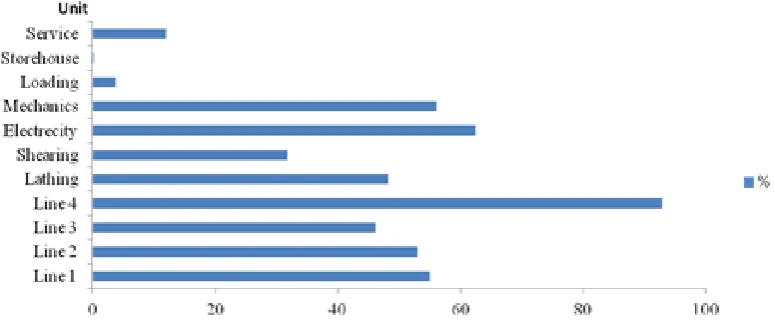
The results of independent t-test between unsafe behaviors and job shift showed a significant relationship between these two factors (P=0.047), i.e. shift workers were more probable to commit unsafe acts than those working in morning shifts. The findings of independent t-test between unsafe behaviors and marital status revealed no significant relationship between these two factors (P=0.147). Distribution of unsafe behaviors based on various work units of the factory showed that the maximum rate of unsafe behaviors was related to the fourth line of production 4 (there were four production lines in the production section, the task of which was to roll metal pieces) with 92.9%, and the minimum rate belonged to storehouses with 0.1% (Fig.3).
Fig.3. Distribution of unsafe behaviors based on various work units
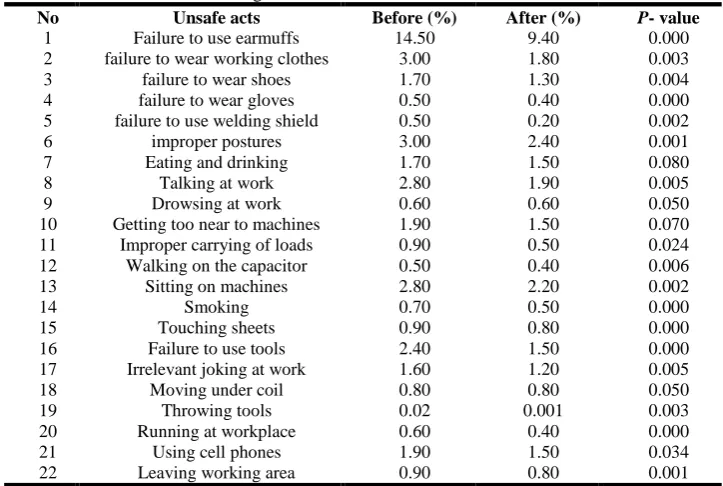
According to the analyses, the mean of unsafe behaviors occurred among staffs was 46%. The maximum and minimum unsafe acts were respectively related to failure to wear earmuffs regularly (14.5%) and throwing tools (0.02%). This information is presented in Table 3, which is differentiated by unsafe acts. Analyses also showed that the rate of unsafe behaviors reached 31% after implementing the training interventions. In Table 3, the percentage of results after interventions is shown according to the type of unsafe acts. The findings of paired t-test revealed that interventions were effective in the improvement of safe behaviors (P=0.006).
Overall, 63% of unsafe acts (e.g. approaching a machine’s operating zone) could seriously hurt workers and lead to accidents with severe consequences in the short term. Besides, 37% of such acts (e.g. smoking or failure to wear
earmuffs) could result in chronic incidents in the long term. Furthermore, 88% of unsafe acts led to personal injuries (e.g. failure to wear earmuffs) and 12% of them caused injuries to coworkers (playing pranks or throwing tools).
Investigation of incidents in a three-year period and using Safety Performance Indicators showed that, in the first year, i.e. the beginning of the study, Accident Frequency Rate (AFR) was 2.7. In other words, nearly three accidents happened in the company per 200 thousand hours of productive work. After the implementation of interventions in a three-year period, the Accident Frequency Rate reduced to 1.1. Also, the number of wasted days per 200 thousand working hours (Accident Severity Rate) decreased from 21.2 days to 3.8 days. Frequency Severity Indicator also decreased which proves the positive effects of interventions in the period under study (Table 4).
Table 2. Demographic characteristics
Ranges Variable
31.47±7.38 Age (yr) )Mean±SD)
9.60±7.30 Total work experiences(year)
(Mean±SD)
5.90±1.30 Work experiences in the present
factory (year) )Mean±SD)
25-30 (64.9%) The age range with the highest
percentage of unsafe behaviors
45-50 (29.2%) The age range with the lowest
Effect of Training Interventions on the Improvement of Unsafe Behaviors … ijoh.tums.ac.ir | 74
Table 3. Percentage of unsafe behavior before and after intervention
P- value After (%) Before (%) Unsafe acts No 0.000 9.40 14.50 Failure to use earmuffs
1
0.003 1.80
3.00 failure to wear working clothes
2
0.004 1.30
1.70 failure to wear shoes
3
0.000 0.40
0.50 failure to wear gloves
4
0.002 0.20
0.50 failure to use welding shield
5 0.001 2.40 3.00 improper postures 6 0.080 1.50 1.70 Eating and drinking
7
0.005 1.90
2.80 Talking at work
8
0.050 0.60
0.60 Drowsing at work
9
0.070 1.50
1.90 Getting too near to machines
10
0.024 0.50
0.90 Improper carrying of loads
11
0.006 0.40
0.50 Walking on the capacitor
12
0.002 2.20
2.80 Sitting on machines
13 0.000 0.50 0.70 Smoking 14 0.000 0.80 0.90 Touching sheets 15 0.000 1.50 2.40 Failure to use tools
16
0.005 1.20
1.60 Irrelevant joking at work
17
0.050 0.80
0.80 Moving under coil
18 0.003 0.001 0.02 Throwing tools 19 0.000 0.40 0.60 Running at workplace
20
0.034 1.50
1.90 Using cell phones
21
0.001 0.80
0.90 Leaving working area
22
The high correlation of 0.86 between the training status and improvement of safe behaviors showed that there is a close and direct relationship between these two factors (P<0.001). The status of training before and after interventions was examined through a standardized questionnaire.
The findings revealed that staff’s training level was in an unsatisfactory condition before interventions. However, after the interventions and holding training programs based on Deming model (Table 5), it reached a desirable status.
Table 5. The status of training before and after interventions
Mean of score Standard deviation Evaluation
obtained desirable
Before 17.08 21 99.4 Undesirable
After 21.49 21 3.014 Desirable
DISCUSSION
Regulations and guidelines formulated by international standards for different careers and activities were used to develop an inventory of unsafe acts. These guidelines identify any violations and unsafe behaviors in the population under study. In addition, in order to identify unsafe behaviors, reports of accidents were analyzed. These reports include all the accidents, which led to major and minor injuries, and those that required first aids. Approaches used to prepare an inventory of unsafe behaviors include interview with staffs regarding work related dangers and the accidents
happened to them or those they had been observing, and observation of staffs at work.
In the present study, 46% of behaviors of workers under investigation were unsafe, that is one of the critical antecedents of incidents [21]. Failure to use or improper use of protective tools was the most frequently committed unsafe act with a rate of 23.8% [19, 22]. Furthermore, a large proportion of accidents in construction projects occurred due to these two unsafe behaviors [23-24]. According to a staff survey, the main reasons for failure to use protective equipment are that they interfere with work, lead to lack of control over the
75| IJOH | June 2016 | Vol. 8 | No. 2 Es-haghi & Sepehr
working process and lack of comfort especially during summer and finally staffs have negative attitude toward such tools. In addition to these factors, lack of awareness about possible dangers of not using protective tools is another reason for failure to apply such devices [25]. The unsafe behaviors of not using tools and talking during work were successively ranked. Investigations revealed that workers did not use personal protective tools mainly for personal reasons and company had provided those tools for them. During the training courses, the importance of application of protective equipment and their effect on health were emphasized through films and warnings about the accidents caused in the absence of those tools.
Distribution of unsafe acts based on working hours showed that the highest rate of unsafe acts happened during the midday, which might have been caused by hunger or tiredness. Distribution of unsafe behaviors according to age groups showed that younger workers do more unsafe acts compared to their older coworkers. The reason is that older workers are more experienced so they have a more realistic perspective regarding safety issues. They are also physically weaker which make them behave more cautiously and safely. Younger people, however, are less experienced and less patient and therefore they do more unsafe acts. A study on the job attitude of construction workers of Hong Kong showed that, since older people are more experienced and there are less job opportunities available for them, they have a more positive attitude toward safety and are less probable to do unsafe acts .[26] Besides, there was a significant relationship between job shift and the percentage of unsafe behaviors. However, in other studies there was not any significant relationship between working full time, the number of accidents and unsafe behaviors [27] .
The purpose of this study was to investigate the effects of training interventions on the improvement of safe behaviors. More reasonable findings can be attained in the measures taken and interventions implemented if more interactions are created and if they are developed both formally (through meetings) and informally (by focusing on workers’ daily interactions) [28] . These interactions can lead to practical ideas, executive solutions and trust [29] . One of the opportunities created in this study was that workers had satisfying interactions. The employees’ participation created a learning environment and led to positive changes in safe behaviors at the workplace [30].Participants shared their experiences, knowledge and actively took part in the discussions according to their level of knowledge, awareness and their commitment to safety issues and their real experiences at work. Shared experiences led to knowledge and
awareness transfer among coworkers. This stage of the process was formally created among the staff and was accepted by researchers to correct unsafe behaviors [31]. This was reflected in their individual performance in real environment and led to positive changes in safe behaviors. Such changes that result from cooperative training programs institutionalize cohesive interactions in people [32]. Building required skills and qualifications to the safe performance of activities calls for something more than mere knowledge. People should also be able to apply their basic acquired knowledge in the workplace. In other words, people should become committed to their knowledge so that necessary behaviors are created. Knowledge and commitment should go hand in hand in order to fulfill safe behaviors. Knowledge without commitment ends in disqualification and unsafe behaviors [3, 33] and desired safe behaviors won’t be performed; if they are, they won’t be at a desired standard level. Therefore, in the present study, on-the-job training at the workplace was held to remind and increase commitment to safe behaviors.
After implementing the interventions over the course of a year, their effectiveness to improve safe behaviors were examined. Investigations showed that implementation of training safety programs increases awareness and commitment among all staffs and this will decrease the rate of accidents and unsafe behaviors [14, 34]. Training safety programs focusing on behavior lessen the rate of unsafe acts by 10% [35] and the rate of accidents by 62% [36]. Data collected from safe performance indicators and questionnaire reflect the importance of managerial interventions and the focus on issues related to safe behavior, which are the beginning of major changes and improvements in safety.
In the fourth stage of Deming cycle, problems and drawbacks observed in the training process dealt with in later courses. In order to regularly improve the training process, corrective actions including causal relationships of accidents and investigation of repeated incidents were identified based on the Deming cycle, and unsafe behaviors occurred in the industry were studied cognitively and psychologically.
Effect of Training Interventions on the Improvement of Unsafe Behaviors … ijoh.tums.ac.ir | 76
Generally, the findings of the present study acknowledge the significance of training as an important and effective way to raise people’s awareness, attitude and commitment in the workplace toward safety and health issues. Therefore, it is necessary to attend and build an effective training system in the workplace to promote safety purposes and professional health. In the present study, as it was planned, all the population under investigation took part in training programs. However, there were limitations to examine unsafe behaviors at night shifts and it is suggested to deal with them in future research.
CONCLUSION
Training is one of the major and important pillars in the improvement of safe behaviors. This can result in the increase of knowledge, skills and positive attitude of staff toward safety and commitment to the safety of the organization. Therefore, consistent and integrated training programs decrease the rate of unsafe acts and will obviate one of the main and direct accident causing factors.
ACKNOWLEDGEMENT
We would like to show our gratitude to management and staffs of the rolling industry for their assistance during the course of this research. We did not receive any financial support. The authors declare that there is no conflict of interest.
REFERENCES
1. Driscoll TR, Harrison JE, Bradley C, Newson RS. The role of design issues in work-related fatal injury in Australia. J Safety Res
2008;39(2):209-214.
2. Mariscal MA, Herrero SG, Otero AT. Assessing safety culture in the Spanish nuclear industry through the use of working groups. Saf Sci
2012;50(5):1237-1246.
3. Choudhry RM, Fang D. Why operatives engage in unsafe work behavior: Investigating factors on construction sites. Saf Sci 2008;46(4):566– 584.
4. Stranks J. Human factor and behavioural
safety. 1st ed, Elsevier Publishing.,
Butterworth-Heinemann, UK, 2007.
5. Fernández-Muñiz, Montes-Peón J, Vázquez-Ordás CJ. Safety culture: Analysis of the causal relationships between its key dimensions. J Safety Res 2007;38(6):627-641.
6. Zhou Q, Fang D, Wang X. A method to identify strategies for the improvement of human safety behavior by considering safety climate and personal experience. Saf Sci 2008;46(10):1406– 1419.
7. Burke JM, Sarpy AS, Smith-Crowe K,
Chan-Serafin S, O. Salvador R, Islam G. Relative effectiveness of workers safety and health training methods. Am J Public Health
2006;96(2):315-324.
8. Agwu MO. Impact of employees safety culture on organisational performance in shell bonny terminal integrated project (BTIP). Eur J Bus Soc Sci 2012;1(5):70-82.
9. Baram M, Schoebel M. Safety culture and behavioral change at the workplace. Saf Sci
2007;45(6):631-636.
10.Guldenmund FW. The use of questionnaires in safety culture research – an evaluation. Saf Sci
2007;45(6):723–743.
11.O’Connor P ,O’Dea A, Kennedy Q, Buttrey SE. Measuring safety climate in aviation: A review and recommendations for the future. Saf Sci
2011;49(2):128-138.
12.Wirth O, Sigurdsson OS. When workplace safety depends on behavior change: Topics for behavioral safety research. J Saf Res
2008;39(6):589–598.
13.Glendon AI, Stanton NA. Perspectives on safety culture. Saf Sci 2000;34(1-3):193-214. 14.Salvendy G. Handbook of industrial
engineering: Technology and operations
management. 3 ed, Wiley-Interscience
Publication., New York, USA, 2001.
15.Gardner D. Barriers to the implementation of management systems: lessons from the past.
Qual Assur 2000;8(1):3-10.
16.Cooper MD, Phillips RA. Exploratory analysis of the safety climate and safety behavior relationship. J Safety Res 2004;35(5):497-512. 17.Petersen D. Analyzing safety system
effectiveness (Industrial health & safety). 3rd ed, Wiley Publishing., 1996.
18. Mohammadfam I. Safety quantitative
evaluation. Fanavaran Publication., Tehran,
Iran., 2002. [in Persian].
19.Mohamadfam I, Fatemi F. Evaluation of relationships between unsafe behaviors with occupational accidents in a Vehicle Manufacturing. Iran Occup Health 2007;5(3-4):44-50. [in Persian].
20.Dhillon BS, Raouf A. Safety assessment: A quantitative approach. 1st ed, CRC press., 1993.
21.Nouri J ,Azadeh A, Fam M. The evaluation of safety behaviors in a gas treatment company in Iran. J Loss Prev Process Ind 2008;21(3):319-325.
22.Azadeh A, Mohammadfam I. The evaluation of importance of safety behaviors in a steel manufacturer by entropy. J Res Health Sci
77| IJOH | June 2016 | Vol. 8 | No. 2 Es-haghi & Sepehr
23.Aksorn T, Hadikusumo BHW. Critical success factors influencing safety program performance in Thai construction projects. Saf Sci
2008;46(4):709-727.
24.Suraji A, Duff AR, Peckitt SJ .Development of casual model of construction accident causation. J Constr Eng Manag
2001;127(4):337-344.
25.Cavazza N, Serpe A. Effects of safety climate on safety norm violations: exploring the mediating role of attitudinal ambivalence toward personal protective equipment. J Saf Res
2009;40(4):277-283.
26.Siu O-l, Phillips DR, Leung T-W. Safety climate and safety performance among construction workers in Hong Kong: The role of psychological strains as mediators. Accid Anal Prev 2004;36(3):359-366.
27.Adie W, Cairns J, Macdiarmid J, Ross J, Watt S, Taylor CL, et al. Safety culture and accident risk control: Perceptions of professional divers and offshore workers. Saf Sci 2005;43(2):131– 145.
28.Nielsen KJ. Improving safety culture through the health and safety organization: A case study. J Safety Res 2014;48:7-17.
29.Kogi K. Facilitating participatory steps for planning and implementing low-cost improvements in small workplaces. Appl Ergon
2008;39(4):475-81.
30.Mohammadfam I, Ghasemi F, Kalatpour O, Moghimbeigi A. Constructing a Bayesian network model for improving safety behavior of employees at workplaces. Appl Ergon
2017;58:35-47.
31.Guldenmund FW. The nature of safety culture: a review of theory and research. Saf Sci
2000;34(1-3):215-257.
32.Mohammadfam I, Bastani S, Golmohamadi R, Saei A, Es-haghi M. Applying social network analysis to evaluate preparedness through
coordination and trust in emergency management. Environ Hazards 2015;14(4):329-340.
33.Wachter JK, Yorio PL. A system of safety management practices and worker engagement for reducing and preventing accidents: An empirical andtheoretical investigation. Accid Anal Prev 2014;68:117-130.
34.Mohammadfam I, Kianfar A, Mahmoudi S. Evaluation of relationship between job stress and unsafe acts with occupational accident rates in a vehicle manufacturing in Iran. Int J Occup Hyg 2010;2(2):85-90.
35. Williams JH, Geller ES. Behavior-based intervention for occupational safety: critical impact of social comparison feedback. J Safety Res 2000;31(3):135-142.
36.Knipling RR, Hickman JS, Geller ES.
Behavioral safety management. Presentation to the U.S. DOT human factors coordinating committee. Virginia Polytechnic Institute and State University. October 30 2002..
37.Thaden TLv, Gibbons AM. The safety culture indicator scale measurement system (SCISMS). Human factors division institue of aviation. Technical report HFD-0-3-8/FAA-08 Prepared for Federal Aviation Administration, Atlantic City International Airport, NJ DTFA 01-G-015. 2008.
38. Jafari MJ, Gharari M, Ghafari M, Omidi M, Kalantari S, Asadolah-Fardi R. The influence of safety training on safety climate factors in a construction site. Int J Occup Hyg 2014; 6(2):81-87.