
ISSN: 2374-2712 (Print), 2374-2720 (Online) Copyright © The Author(s). 2014. All Rights Reserved. Published by American Research Institute for Policy Development
Heavy Metal Contaminations of Drinking Water Sources due to
Illegal Gold Mining Activities in Zamfara State - Nigeria
Mark Omotola Afolayan Oladipo1, Raymond Limen Njinga2, Ugoeze Ucheoma Elele3 & Adamu Salisu3
Abstract
The assessment levels of concentration of metal such as Co, Cd, Zn, Cu, Ni, Pb, Mn, Fe, and Cr pollution in water were evaluated as results of sudden increase in gold mining activities in Bagega, Sunke and Dareta villages in Zamfara State, Nigeria. From our investigation, the water quality in Bagega showed high concentration of Pb with a value of 15600 ppm much above the limit set by WHO (2011a). The two remaining villages Sunke and Dareta had Pd concentration values of 549 and 445 ppm respectively far above the limit set by WHO, 2011a. These high concentrations of Pb indicate serious neurological and toxicological hazards. Also, the work revealed high concentration of Fe and Zn which are not directly poisonous to human health but can essentially stimulate the increase in concentration of other toxicological elements such as arsenic. This high concentration of Zn was observed in Sunke village with a value of 2560 ppm twice more than the limit set by WHO, 2011a. In terms of toxicological point of view, the concentrations of all the nine (9) heavy metals Co, Cd, Zn, Cu, Ni, Pb, Mn, Fe, and Cr were above the limit set by FEPA 1998 and WHO 2011a in the villages under investigation are of significant concern on the health of the local population.
Keywords: Heavy metals, illegal gold mining activity, water pollution, neurological health hazard
Introduction
The development of natural resources worldwide involves the manipulation of the environment to arrive at specific objectives.
1 Center for Energy Research and Training, Ahmadu Bello University, Zaria, Nigeria.
2 Physics Department, Ibrahim BadamasiBabangida University, Lapai, Niger State, Nigeria.
Email: [email protected]
Minerals resources is the most exploited natural resources and it involves extraction, grinding, ore concentration and dispersal of tailings [1]. These activities carried through mining processes, generate lots of environmental hazards, chemical waste and cause various degrees of damages and threats to plants, animals and human. Mining can generate large concentration of highly soluble inorganic matter, some of which are considered toxic.
The composition and processing of ores also determined the nature of pollutants [2]. Besides the precious metals generally extracted from ores, varying concentrations of other undesirable toxic and non-toxic metals such as Chromium, Copper, Lead, Zinc, Sulphate, Potassium, Sodium and Calcium are often exposed to the weather/environment resulting into the mobilization of metals and other chemical compounds related to the ore into the nearby water-bodies [2]. Increase in concentrations of these elements in the water-bodies pose serious health hazards to the host communities. As a result in the variation in their physicochemical states and the prevailing chemicals conditions, these metals contaminants migrate and threaten human health by contamination soil, streams, ground-water and food crops. This work therefore, focus on the possible problems related to gold mining in the villages of Dareta, Bagega and Sunke, which are all settlements in Bukuyum Local Government area of Zanfara State, Nigeria. A specific attention was directed towards the possibilities of neurological and assessments of contamination hazards.
Gold mining can have devastating effects on the nearby water resources, the panning and sedimentation processes which are carried out in the middle of the stream bed enable us to be very curious. Water used for panning and sedimentation were obtained from the bore-hole project near the stream-bed as well as the dog holes at various locations in the bed itself. Heavy metals associated with Gold mining waste can dissolve and disperse into surrounding streams as a result of rainwater percolation through the waste [1] or dispersed as particles through erosion processes. Impact of Gold mines can be environmentally detrimental and can constitute serious neurological hazards to exposed or contaminated individuals.
The rainy season commence in April and end September while hot seasons from March to May. The peak of the rainfall is in July-August. The average temperature variation is between 300 to 350. The coldest temperatures are experienced
during the harmattan periods when the temperature drop to approximately 180. During the harmattan periods, the winds are cold, dry, dusty and strong.
Basically, Bagega is a settlement on the North-Eastern part of Hawwal in Zamfara State, Nigeria. It is located on the Southern part of Anka, the Headquarters of Anka local Government area with coordinate of longitude 60East of the prime meridian and latitudes 11043’ north of the equator. This village is subjected to poor
drainage system due to vast portions of clay, terrain that makes up its landscape and it is relatively big, more socially, accessible and economically more active settlement.
Materials and Method
In view of investigating possibilities of heavy metal exposure and contamination in Bagega, Dareta and Sunke mining operations and the extent of concentration of heavy metals of surface and underground water sources available to people who settled in these villages, atomic absorption spectroscopy (AAS) technique was employed. The technique has a special radiation source called the hollow cathode lamb and the sample to be analyzed is converted to gaseous atoms in a hot flame. A special equipment known as the nebulizer is used to introduce the sample into the hot flame. There is no specialization involved since all forms of the analyte are converted in part to the same gaseous atom. The AAS is useful for metallic elements and the precise wavelength associated with the atomic spectra lines provides excellent identification of the analyte.
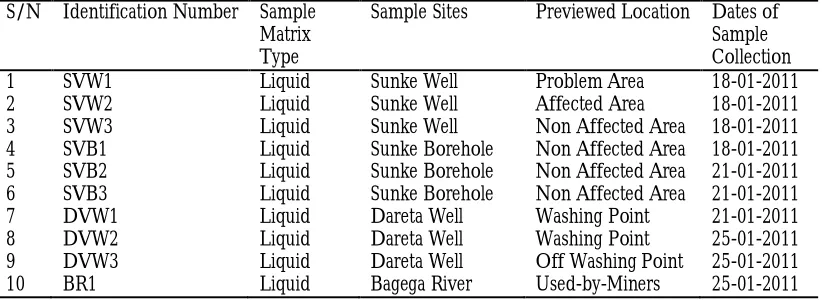
Table 1: Description of Sampling Sites
S/N Identification Number Sample Matrix Type
Sample Sites Previewed Location Dates of
Sample Collection
1 SVW1 Liquid Sunke Well Problem Area 18-01-2011
2 SVW2 Liquid Sunke Well Affected Area 18-01-2011
3 SVW3 Liquid Sunke Well Non Affected Area 18-01-2011
4 SVB1 Liquid Sunke Borehole Non Affected Area 18-01-2011
5 SVB2 Liquid Sunke Borehole Non Affected Area 21-01-2011
6 SVB3 Liquid Sunke Borehole Non Affected Area 21-01-2011
7 DVW1 Liquid Dareta Well Washing Point 21-01-2011
8 DVW2 Liquid Dareta Well Washing Point 25-01-2011
9 DVW3 Liquid Dareta Well Off Washing Point 25-01-2011
10 BR1 Liquid Bagega River Used-by-Miners 25-01-2011
Problem Area: Mining Activity Present, Affected Area: Within Mining Site, Non Affected Area: Far from Mining Site, Washing Point: Washing point of the villagers, Off Washing Point: Far from the washing point of the villagers, Used-by-Miners: Washing point of mining materials
Experimental
The water samples were collected from the above described sites (Table 1) into 2.0 liters plastic container that were washed thoroughly and rinse several times with distilled water to prevent matrix contamination. Since these samples stayed more than a day, there were acidify with nitric acid (HNO3) to ensured that the element
Because the atomic spectra are lines of absorbing and emitting wavelength identical to the characteristic emission wavelength which is less than the excitation wavelength, the followed stages were employed during the experiment; the analyte were prepare in aqueous solution; the solution aspirated into the flame using the nebulizer; the solvent then evaporates and the gaseous analyte decomposeds, some of it converted into gaseous atom; the gaseous atoms absorbed radiation from the cathode lamb; different hollow cathode lamp were used for each element that were under investigations; the absorbance of the sample were determined by comparing I0
when there are no analyte present in the flame and Itrans. when analyte are present
Applying Beer’s law in which the absorption is directly proportional to the path length in the flame and concentration of atomic vapour in the flame. Both of these variables are difficult to determine, but the path length can be held constant and the concentration of atomic vapour is directly proportional to the concentration of the analyte in the solution being aspirated.
The heavy metals in the water types from Boreholes, Wells and Rivers in Sunke, Dareta and Bagega were determined as described by [4]. The digested water samples were quantified for the heavy metals Co, Cd, Zn, Cu, Ni, Pb, Mn, Fe, and Cr in flame of the atomic absorption spectrometer (FAAS). Procedural blanks were prepared and aspirated along with the analytical samples in order to correct for background absorption. In cases where the concentration levels of the metals to be analyzed were too low, concentration methods were applied. Another procedure that was employed involved the extraction technique using organic salt-Ammonium Pyrolidinedithiocarbonate (APDC) for extraction of Cu, Fe, Pb, and Zn. The pH of the water samples were carried out in the field using Sension Platinum Series portable pH. The water samples were then stored in a refrigerator at 4 0C (Haier Thermocool)
to slow down bacterial and chemical reaction rates.
Results and Discussion
Table 2: WHO (2011a) Recommended Guideline Values and FEPA (1998)
Substances WHO 2011-Guideline values (ppm) FEPA, 1998-Guidline values (ppm)
Pb 0.01 Less than 0.5
Cu 002 1.50
Cr 0.05 0.05
Ni 0.07 -
Cd 0.003 0.01
Zn 005 15
Mn 0.05 Less than 0.5
Fe 0.10 Less than 0.3
Co 0.01 Less than 0.5
pH - 6.5 - 9.2
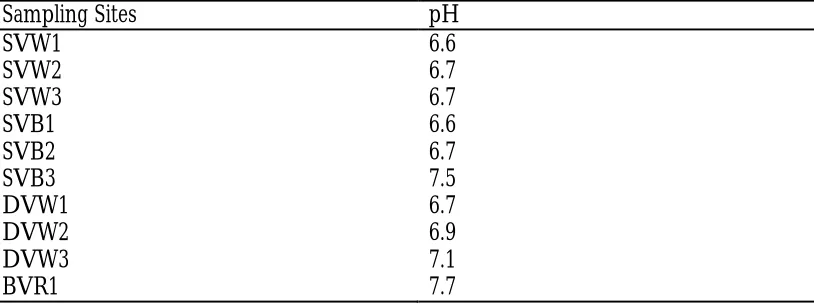
The pH values of the three sites are shown in Table 3. The distribution of these values within the studied sites appeared to be acceptable with the results of the report of the committee on protection of water criteria, Federal Environmental Protection Agency, Nigeria (1998) with permissible criteria of pH range 6.5 - 9.2 [3].
Table 3: pH values of the water samples from Sunke, Dareta and Bajaga villages in Zamfara State
Sampling Sites pH
SVW1 6.6
SVW2 6.7
SVW3 6.7
SVB1 6.6
SVB2 6.7
SVB3 7.5
DVW1 6.7
DVW2 6.9
DVW3 7.1
BVR1 7.7
Table 4: Elemental Concentration of Water Samples Collected from Wells in Sunke Mine
Heavy metals (ppm) SVW1 SVW2 SVW3 Mean max. Range
Co 54 18 BDL 34 54 18 - 54
Cd 12 15 11 15 15 11 – 15
Zn 1 10 29 29 29 1 – 29
Cu 15 30 23 23 30 15 – 30
Ni 3 15 13 10 15 3 – 15
Pb 21 148 326 165 326 21 – 326
Mn 49 51 22 41 49 22 – 49
Fe 256 345 341 314 345 256 - 345
Cr 25 96 40 54 96 25 – 96
ppm: parts per million, BDL: Below the detection limit
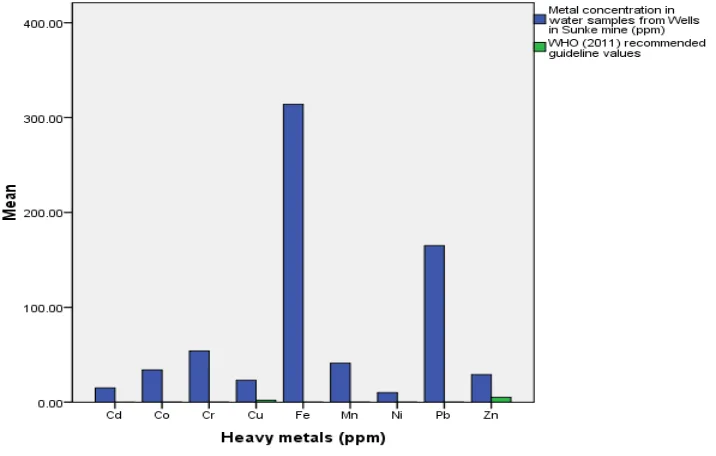
Figure 1: Comparison of Metal Concentration in Wells from Sunke with [5], Safety Limit
The ranged of Pb from Wells in Sunke illegal mine site had a mean value for (SVW1, SVW2 & SVW3) of 365 ppm and the maximum value of 326 ppm was observed in SVW3. This result was not expected to be high because the Well in this site (SWV3) was the non affected area type. This anomaly could be due to the heavy metals associated with “illegal” gold mining dissolved in the soluble compounds or dispersed into surrounding streams which eventually are found in the Well water [1].
From the Fig 1, Fe is found to have the highest concentration with a mean value of 314 ppm. In these particular sites, SVW2 had the maximum value of 345 ppm in the affected area of the “illegal” gold mining. The ranged in the concentration of Fe observed was 256 – 345 ppm within the three Wells water in Sunke village.
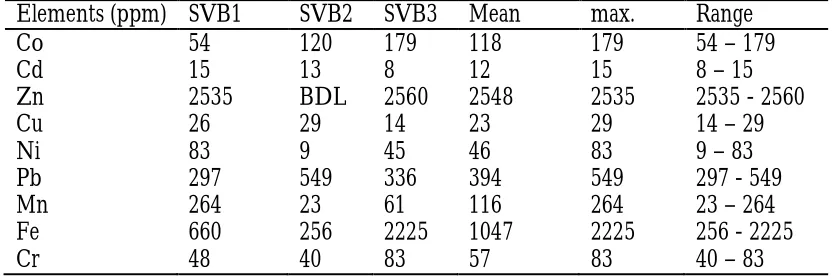
Table 5: Elemental Concentration of Water Samples Collected from Boreholes in Sunke Mine
Elements (ppm) SVB1 SVB2 SVB3 Mean max. Range
Co 54 120 179 118 179 54 – 179
Cd 15 13 8 12 15 8 – 15
Zn 2535 BDL 2560 2548 2535 2535 - 2560
Cu 26 29 14 23 29 14 – 29
Ni 83 9 45 46 83 9 – 83
Pb 297 549 336 394 549 297 - 549
Mn 264 23 61 116 264 23 – 264
Fe 660 256 2225 1047 2225 256 - 2225
Cr 48 40 83 57 83 40 – 83
Figure 2: Comparison of Metal Concentration in Boreholes from Sunke With [5], Safety Limit
The results as seen in Fig. 2 of the Borehole water obtained from Sunke indicated that Zn had the highest value followed by Fe and Pb even though all the heavy metal obtained were above the standard limit set by [5] shown in Table 2.
Table 6: Elemental Concentration of Water Samples Collected from Wells In Dareta Mine
Elements (ppm) DVW1 DVW2 DVW3 Mean max. Range
Co 251 BDL 24 138 251 24 – 251
Cd 11 13 23 16 23 11 – 23
Zn 2817 17 14 949 2817 14 - 2817
Cu 14 2 55 24 55 2 – 55
Ni 45 12 BDL 29 45 12 – 45
Pb 148 178 445 257 445 148 - 445
Mn 66 57 16 46 66 16 – 66
Fe 653 15 471 380 653 15 – 653
Cr 38 63 38 46 63 38 – 63
ppm : parts per million, BDL: Below the detection limit
Figure 3: Comparison of Metal Concentration in Wells from Dareta with [5] Safety Limit
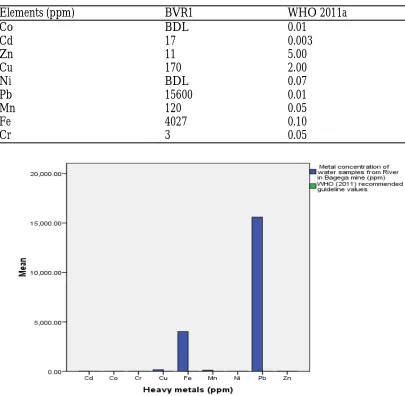
Table 7: Elemental Concentration of Water Samples Collected from River in Bagega Mine
Elements (ppm) BVR1 WHO 2011a
Co BDL 0.01
Cd 17 0.003
Zn 11 5.00
Cu 170 2.00
Ni BDL 0.07
Pb 15600 0.01
Mn 120 0.05
Fe 4027 0.10
Cr 3 0.05
Figure 4: Comparison of Metal Concentration in River from Bagega with [5] Safety Limit
This site (BVR1) do not have mean because this village does not have other means of drinking water or other household work other than the river which is also used for the “illegal” gold mining. The anomalously high value of Pb in this water sample (river water washing point) could be linked with the sedimentation of the washed gangues from the mine ore zone [8, 9 & 10].
Figure 5: Comparison of Metal Concentration from the four Water Types with [5] Safety Limit
Fig. 5 shows the summary of three (3) heavy metals obtained generally in all the water sample types. Their concentration could give rise to serious health problems. From the results, Pb appear to show the highest concentration obtained from Wells in Sunke mine, followed by Fe and finally Zn (Pb > Fe > Zn).
5.0 Conclusion
The data collected from the different sampling areas of Sunke, Dareta and Bagaga involved in illegal Gold mining activities in Zamfara State, Nigeria shows that the values of concentration of the following heavy metals; Co, Cd, Zn, Cu, Ni, Pb, Mn, Fe, and Cr in the water types (Boreholes, Wells, and River) were above the limit of [5] and that of the report of the committee on protection of water criteria, Federal Environmental Protection Agency (FEPA), Nigeria, 1998. From our investigation, the water quality in Bagega showed high concentration of Pb with a value of 15600 ppm.
The two remaining villages Sunke and Dareta had Pd concentration values of 549 and 445 ppm respectively which were all above the limit set by [5]. High concentrations of Pb indicate serious neurological and toxicological hazards to the inhabitant and the workers of the illegal mines [6]. Also, high concentration of Fe and Zn are not directly poisonous to human health but can stimulate the increase in concentration of other toxicological elements such as arsenic.
Acknowledgement
References
Fernando P. Carvalho*, João M. Oliveira, G. Alberto, (2011). Factors affecting 210Po and 210Pb activity concentrations in mussels and implications for environmental bio-monitoring programmes. Journal of Environmental Radioactivity, Vol. 102, Pg128-137
Raymond A.Wuana and Felix E. Okieimen (2011). Heavy Metals in Contaminated Soils: A Review of Sources, Chemistry, Risks and Best Available Strategies for Remediation. International Scholarly Research Network, Volume 2011, Article ID 402647, 20 pages, doi:10.5402/2011/402647
Oladipo M.O.A., Njinga R. L., Baba A , and Mohammed I. Contaminant evaluation of major drinking water sources (boreholes water) in Lapai metropolis. Advances in Applied Science Research, 2011, 2 (6):123-130 (www.pelagiaresearchlibrary.com)
APHA (1998). Standard methods for the Examination of Water and Wastewater (20th ed). New York: American Public Health, Association (APHA), American Water Works Association (AWWA), and Water Pollution Control Federation (WPCF).
World Health Organization (WHO) (2011a). Guidelines for Drinking Water Quality, Fourth Edition.
World Health Organization (2011b). Lead in Drinking-water. Background document for development of WHO Guidelines for Drinking-water Quality
M. J. McLaughlin, B. A. Zarcinas, D. P. Stevens, and N. Cook, (2000). “Soil testing for heavy metals,” Communications in Soil Science and Plant Analysis, vol. 31, no. 11–14, pp. 1661–1700.
Colin Hayes, Eddo J. Hoekstra, (2010).Technical Digest on Lead in Drinking Water. Institute for Health and Consumer Protection, Via E. Fermi 2749, 21027 Ispra (VA), Italy Mohsen Dehghani and Alireza Kashefi Ghasem Abadi, (2011). Measurement of Heavy Metals
(Zn, Cu, Fe, Ni, Cd, Co) in Chadormalu Underground Water Resources and Presentation of an Environmental Management Plan. International Journal of Applied Science and Technology, Vol. 1 No.4, Pg 90-96.
![Figure 2: Comparison of Metal Concentration in Boreholes from Sunke With [5], Safety Limit](https://thumb-us.123doks.com/thumbv2/123dok_us/10103785.1997294/9.516.75.461.94.350/figure-comparison-metal-concentration-boreholes-sunke-safety-limit.webp)

![Figure 5: Comparison of Metal Concentration from the four Water Types with [5] Safety Limit](https://thumb-us.123doks.com/thumbv2/123dok_us/10103785.1997294/12.516.71.458.188.415/figure-comparison-metal-concentration-water-types-safety-limit.webp)
