Available Online At www.ijpret.com
INTERNATIONAL JOURNAL OF PURE AND
APPLIED RESEARCH IN ENGINEERING AND
TECHNOLOGY
A PATH FOR HORIZING YOUR INNOVATIVE WORK
A FUZZY RECOMMENDER SYSTEM INTEGRATING WEB CONTENT AND WEB
USAGE MINING
ANJALI B. RAUT, DR. G. R. BAMNOTE
1. Department of Computer Science & Engg., HVPM’s COET, Amravati, India.
2. Department of Computer Science & Engg., PRMITR, Badnera, Amravati, India.
Accepted Date:
27/02/2013
Publish Date:
01/04/2013
Keywords
Web Mining,
World Wide Web,
Fuzzy logic (FL),
Web Content Mining,
Web Usage Mining.
Corresponding Author Ms. Anjali B. Raut
Abstract
In today’s era of e-commerce Recommender systems have
become an important part. Business has come to realize the
potential of these personalized and adaptive systems in order
to increase sales and to retain their customers. Also web users
have to rely on such systems to help them to in more
efficiently and conveniently finding information of their
interest from large information available on WWW. In this
paper we propose a framework for recommender system
which integrates fuzzy clustering of web pages and web usage
Available Online At www.ijpret.com I. Introduction
OVER the last decade, we have witnessed
an explosive growth in the information
available on the World Wide Web (WWW).
Today, web browsers provide easy access to
many sources of text and multimedia data.
More than billion pages are indexed by
search engines, and finding the desired
information is not an easy task. This large
amount of resources creates the need for
developing automatic mining techniques on
the WWW, thereby giving rise to the term
“web mining.” Web Mining is the use of
Data Mining techniques to automatically
discover and extract information from web.
Web creates the new challenges of
information retrieval as the amount of
information on the web and number of
users using web growing rapidly.
A recommender system is a web-based
interactive software agent. It attempts to
predict user references from user data
and/or user access data for the purpose of
facilitating and personalizing users’
experience on-line by providing them with
recommendation lists of suggested items.
The recommended items could be products,
such as books, movies, and music CDs, or
line resources, such as web pages or
on-line activities. Recommender systems have
become extremely common in recent years.
A few examples of such systems:
• When viewing a product on Amazon.com, the store will
recommend additional items based on a
matrix of what other shoppers bought
along with the currently selected item.
• Netflix offers predictions of movies that a user might like to watch based on the
user's previous ratings and watching
habits (as compared to the behavior of
other users), also taking into account
the characteristics (such as the genre) of
the film.
Recommender systems typically produce a
list of recommendations in one of two ways
- through collaborative or content-based
filtering. Collaborative filtering methods are
based on collecting and analyzing a large
amount of information on users’ behaviors,
activities or preferences and predicting
what users will like based on their similarity
to other users. Content-based filtering
Available Online At www.ijpret.com and characteristics of the items that are
going to be recommended. In other words,
these algorithms try to recommend items
that are similar to those that a user liked in
the past (or is examining in the present).
The objective of this paper is to provide an
outline of web mining, its various
classifications, Web Mining Process and
propose a framework a for recommender
system which integrates fuzzy clustering of
web pages and web usage mining
approaches.
II. Web Mining
World Wide Web is a major source of
information. The web is a vast collection of
completely uncontrolled heterogeneous
documents. Thus, it is huge, diverse, and
dynamic, and raises the issues of scalability,
heterogeneity, and dynamism, respectively.
Due to these characteristics, we are
currently drowning in information, but
starving for knowledge; there by making the
web a fertile area of data mining research
with the huge amount of information
available online. Data mining refers to the
nontrivial process of identifying valid, novel,
potentially useful, and ultimately
understandable patterns in data.
Oren Etzioni was the person who coined the
term Web Mining first time. Initially two
different approaches were taken for
defining Web Mining. First was a
“process-centric view”, which defined Web Mining as
a sequence of different processes [1]
whereas, second was a “data-centric view”,
which defined Web Mining in terms of the
type of data that was being used in the
mining process [2]. The second definition
has become more acceptable, as is evident
from the approach adopted in most
research papers [3][5]. Web Mining is also a
cross point of database, information
retrieval and artificial intelligence [4].
Web mining can be broadly defined as the
discovery and analysis of useful information
from the WWW. In web mining data can be
collected at the server side, client side,
proxy servers, or obtained from an
organization’s database. Depending on the
location of the source, the type of collected
data differs. It also has extreme variation
both in its content (e.g., text, image, audio,
Available Online At www.ijpret.com techniques to be used for a particular task
in web mining widely varying. Some of the
characteristics of web data are
1) Unlabeled
2) Distributed
3) Heterogeneous
4) Semistructured
5) Time varying
6) High dimensional.
Therefore, web mining basically deals with
mining large and hyper-linked information
base having the abovementioned
characteristics. Thus, web mining, though
considered to be a particular application of
data mining, requires a separate field of
research, mainly because of the
abovementioned characteristics.
A. Web Mining Process
Web mining may be decomposed into the
following subtasks:
1. Information Retrieval/ Resource
Discovery: It is the process of retrieving
the web resources. Resource discovery
or IR deals with automatic retrieval of all
relevant documents, while at the same
time ensuring that the nonrelevant
resources are fetched as few as
possible. The IR process mainly includes
document representation, indexing, and
searching for documents.
2. Information Extraction: It is the transform process of the result of
resource discovery and automatically
extracting specific information from
newly discovered Web resources. Once
the documents have been retrieved the
challenge is to automatically extract
knowledge and other required
information. Information extraction (IE)
is the task of identifying specific
fragments of a single document that
constitute its core semantic content.
3. Generalization: It is process of
uncovering general patterns at
individual Web sites and across multiple
sites [3]. In this phase, pattern
recognition and machine learning
techniques are usually used on the
extracted information. Most of the
machine learning systems, deployed on
Available Online At www.ijpret.com interest than the web itself. A major
obstacle when learning about the web is
the labeling problem as data is rich on
the web but it is unlabeled.
4. Analysis: Analysis is a data-driven
problem which presumes that there is
sufficient data available so that
potentially useful information can be
extracted and analyzed. Humans play an
important role in the information or
knowledge discovery process on the
web since the web is an interactive
medium. This is especially important for
validation and or interpretation of the
mined patterns which take place in this
phase. Once the patterns have been
discovered, analysts need appropriate
tools. Some others use Online analytical
processing (OLAP) techniques such as
data cubes for the purpose of
simplifying the analysis of usage
statistics from sever access logs.
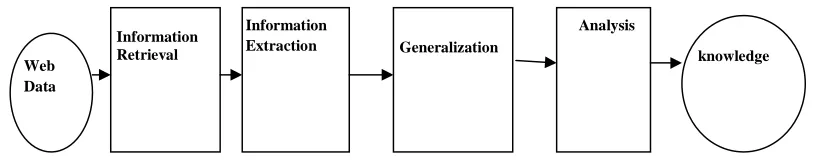
Based on the aforesaid four phases (Fig. 1),
web mining can be viewed as the use of
data mining techniques to automatically
retrieve, extract and evaluate information
for knowledge discovery from web
documents and services.
Figure 1. Web mining Process
B. Web Mining Taxonomy
Web Mining is use of Data Mining
techniques to automatically discover and
extract information from web documents
and services [1].
Web has different facets that yield different
approaches for the mining process: Information
Retrieval
Information
Extraction Generalization
Analysis
Web Data
Available Online At www.ijpret.com • Web pages consist of text.
• Web pages are linked via hyperlinks
• User activity can be monitored via Web server logs.
This three facets leads to the distinction
into three categories i.e. Web content
mining, Web structure mining and Web
usage mining [4][5][6]. Following Fig 2
shows the Web Mining taxonomy.
Figure 2. Web mining Taxonomy
C. Web Content Mining (WCM):
Web content mining is the process of
extracting useful information from the
contents of web documents. Content data
is the collection of facts a web page is
designed to contain. It may consist of text,
images, audio, video, or structured records
such as lists and tables. Application of text
mining to web content has been the most
widely researched.
D. Web Structure Mining (WSM):
The structure of a typical web graph
consists of web pages as nodes, and
hyperlinks as edges connecting related
pages. Web structure mining is the process
of discovering structure information from
the web. Web structure mining studies the
web’s hyperlink structure. It usually
involves analysis of the in-links and out-links
of a web page, and it has been used for
search engine result ranking.
E. Web Usage Mining(WUM):
Web usage mining is the application of data
mining techniques to discover interesting
usage patterns from web usage data. Web
usage data includes data from web server
logs, browser logs, user profiles,
registration data, cookies etc. Web usage
mining focuses on analyzing search logs or
other activity logs to find interesting
patterns. One of the main applications of
web usage mining is to learn user profiles.
WCM and WSM uses real or primary data
on the web whereas WUM mines the
secondary data derived from the interaction
Available Online At www.ijpret.com III. A Web Mining Framework for
Fuzzy Recommender System
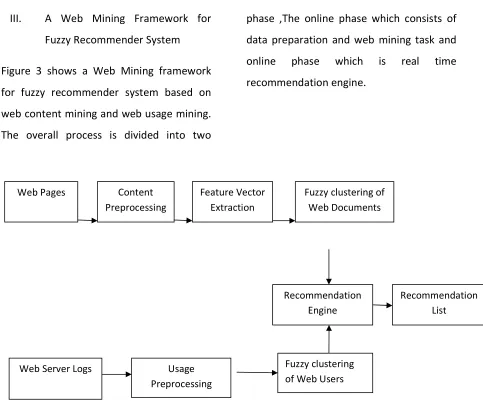
Figure 3 shows a Web Mining framework
for fuzzy recommender system based on
web content mining and web usage mining.
The overall process is divided into two
phase ,The online phase which consists of
data preparation and web mining task and
online phase which is real time
recommendation engine.
Figure 3. Web mining framework for fuzzy recommender system
IV. Clustering of Web Documents
Clustering analysis is widely used to
establish object profiles based upon
objects’ variables. Objects can be
customers, web documents, web users, or
facilities (Chang, Hung, and Ho, 2007).
Unlike classification, which analyzes
class-labelled data objects, clustering analyzes
data objects without consulting a known
class label. The objects are clustered based
on the principle of maximizing the
intra-class similarity and minimizing the
inter-class similarity. This means that clusters of
objects are created for the objects within a
Web Pages Content
Preprocessing
Feature Vector Extraction
Fuzzy clustering of Web Documents
Fuzzy clustering of Web Users Usage
Preprocessing Web Server Logs
Recommendation Engine
Available Online At www.ijpret.com cluster have high similarity in comparison to
one another, but are very dissimilar to the
objects of other clusters. There exist many
clustering algorithms, which can be
classified into several categories, including
partitioning methods, hierarchical methods.
A partitioning method classifies objects into
several one-level clusters, where each
object belongs to exactly one cluster, and
each cluster has at least one object. A
hierarchical method creates hierarchical
decomposition of objects. Based on how
the hierarchy is formed, hierarchical
methods can be classified into
agglomerative (bottom-up) approaches and
divisive (top-down) approaches. All these
traditional methods are hard clustering
method. In hard clustering data is divided
into distinct clusters, where each data
element belongs to exactly one cluster.
In fuzzy clustering (also referred to as soft clustering), data elements can belong to more than one cluster, and associated with
each element is a set of membership levels.
A. Preprocessing of Web Pages
This preprocessing step comprises of
different methods like Content extractor,
stop word removal and stemming .
• In Content extractor phase only the primary content of web page is get
identified.
• Cleaning HTML, XML or SGML tags from the Web pages,
• Eliminating all punctuations like comma, full stop, quotation mark, etc., only
except the underscore in-between
words,
• Eliminating all digital numbers,
• Changing all characters to lower case and
• Eliminating the stops words, which are very common words such as a, and the
etc.
B. Web Page Representation Using Vector Space Model
The vector space model is based on linear
algebra and treats documents and queries
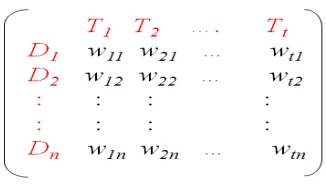
Available Online At www.ijpret.com corresponding to occurrence of words
(called here terms) in respective documents Let t be size of the terms set, and n be size
of the documents set. Then all documents
Di, i = 1..n may be represented as t
dimensional vectors:
Di = [ai1, ai2, ..., ait]
where coefficients aik represent the values
of term k in document Di [Salton 89]. Thus
both documents and terms form a
document matrix . A(n×t). Rows of this matrix represent documents, and columns
so called term vectors
Figure 4: Document representation in the
vector space model
We use tfidf approach for term weighting.
Then tfidf (term frequency / inverted
documentfrequency) of term j in document I
is defined by:
Available Online At www.ijpret.com rresponding to occurrence of words
) in respective documents
Let t be size of the terms set, and n be size
of the documents set. Then all documents
, i = 1..n may be represented as
t-represent the values
[Salton 89]. Thus
both documents and terms form a
term-A(n×t). Rows of this
matrix represent documents, and columns –
entation in the
approach for term weighting.
Then tfidf (term frequency / inverted
documentfrequency) of term j in document I
Tfidf weighs the frequency of a term in a
document with a factor that discounts
importance when it appears in almost all
documents. Therefore terms that appear
too rarely or too frequently are ranked
lower than terms that hold the balance and,
hence, are expected to be better able to
contribute to clustering results.
Fuzzy Clustering using Fuzzy C Means
Clustering is one of the Data Mining
techniques to improve the efficiency in
information finding process. Many
clustering algorithms have been developed
and used One of the most widely used fuzzy
clustering algorithms is the
Means (FCM) Algorithm.
attempts to partition a finite collection of n
elements
collection of c fuzzy clusters with respect to
some given criterion. Given a finite set of
data, the algorithm returns a list of c cluster
centres
matrix
, where each element w
which element xi belongs to cluster c
the k-means algorithm, the FCM aims to weighs the frequency of a term in a
document with a factor that discounts its
importance when it appears in almost all
documents. Therefore terms that appear
too rarely or too frequently are ranked
lower than terms that hold the balance and,
hence, are expected to be better able to
contribute to clustering results.
Clustering using Fuzzy C Means
Clustering is one of the Data Mining
techniques to improve the efficiency in
information finding process. Many
clustering algorithms have been developed
and used One of the most widely used fuzzy
clustering algorithms is the Fuzzy
C-(FCM) Algorithm. The FCM algorithm
attempts to partition a finite collection of n
into a
collection of c fuzzy clusters with respect to
some given criterion. Given a finite set of
data, the algorithm returns a list of c cluster
and a partition
, where each element wij tells the degree to
belongs to cluster cj . Like
Available Online At www.ijpret.com minimize an objective function. The
standard function is:
which differs from the k-means obj
function by the addition of the membership
values uij and the fuzzifier m. The fuzzifier m
determines the level of cluster fuzziness. A
large m results in smaller memberships
wij and hence, fuzzier clusters. In the limit m
= 1, the memberships wij converge to 0 or 1,
which implies a crisp partitioning. In the
absence of experimentation or domain
knowledge, m is commonly set to 2.
V. Web Usage Mining
Web Usage Mining is the type of Web
mining activity that involves the automatic
discovery of user access patterns from one
or more Web servers. As more
organizations rely on the Internet and the
World Wide Web to conduct business, the
traditional strategies and techniques for
market analysis need to be revisited in this
context. In Web usage mining, the prim
Web resource that is being mined is a
Available Online At www.ijpret.com minimize an objective function. The
means objective
function by the addition of the membership
and the fuzzifier m. The fuzzifier m
determines the level of cluster fuzziness. A
large m results in smaller memberships
and hence, fuzzier clusters. In the limit m
onverge to 0 or 1,
which implies a crisp partitioning. In the
absence of experimentation or domain
knowledge, m is commonly set to 2.
Web Usage Mining is the type of Web
mining activity that involves the automatic
patterns from one
or more Web servers. As more
organizations rely on the Internet and the
World Wide Web to conduct business, the
traditional strategies and techniques for
market analysis need to be revisited in this
context. In Web usage mining, the primary
Web resource that is being mined is a
record of the requests made by visitors to a
Web site, most often collected in a Web
server log. The content and structure of
Web pages, and in particular those of one
Web site, reflect the intentions of the
authors and designers of the pages and the
underlying information architecture. The
actual behavior of the users of these
resources may reveal additional structure.
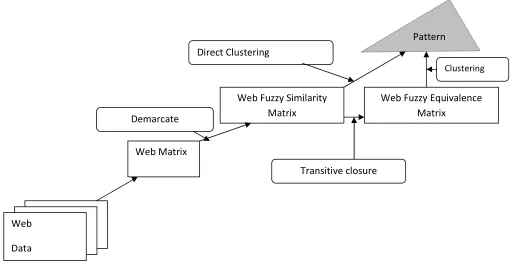
The data object of web fuzzy clustering is
the web source matrix which represents the
data objects attributes of the given web
data set, but the direct processing data
object of web fuzzy clustering is web fuzzy
similarity matrix or web fuzzy equivalence
matrix. So we should abstract web source
data firstly, get web data matrix
representing web object
then transform it into web fuzzy similarity
matrix or web fuzzy equivalence matrix
which are suitable for web fuzzy clustering.
In the end, we use web fuzzy clustering
method on web fuzzy similarity matrix or
web fuzzy equivalence matrix
clustering results. The Web Fuzzy Clustering
processing Model (WFCM) is shown in
Figure 5[15].
record of the requests made by visitors to a
Web site, most often collected in a Web
server log. The content and structure of
Web pages, and in particular those of one
Web site, reflect the intentions of the
s and designers of the pages and the
underlying information architecture. The
actual behavior of the users of these
resources may reveal additional structure.
The data object of web fuzzy clustering is
the web source matrix which represents the
s attributes of the given web
data set, but the direct processing data
object of web fuzzy clustering is web fuzzy
similarity matrix or web fuzzy equivalence
matrix. So we should abstract web source
data firstly, get web data matrix
representing web objects attributes, and
then transform it into web fuzzy similarity
matrix or web fuzzy equivalence matrix
which are suitable for web fuzzy clustering.
In the end, we use web fuzzy clustering
method on web fuzzy similarity matrix or
web fuzzy equivalence matrix and obtain
clustering results. The Web Fuzzy Clustering
Available Online At www.ijpret.com Figure 5: Web fuzzy clustering processing model
It is useful to combine Web usage mining
with content and structure analysis in order
to “make sense” of observed frequent
paths and the pages on these paths.
Following is a hybrid algorithm based input
from fuzzy Web document clustering and
Web Usage Mining. The proposed algorithm
as follows.
Proposed Algorithm for Fuzzy
Recommender System:
Input:
(1)Number of Clusters and Alpha Cut Value.
(2)Output from Fuzzy clustering of Web
Documents i.e cluster of web pages.
(3) Output From Fuzzy clustering of Web
users i.e. clusters of users.
Output:
Pr is the final recommend set of pages
Let Ci is current user and cluster set
C={C1,C2,…Ck} consist of the members of
same cluster Let {p1,p2…pk} are the pages
visited by the users C
For (i=1; i<=k; i++) Web
Data
Web Matrix
Web Fuzzy Equivalence Matrix
Web Fuzzy Similarity Matrix
Clustering
Transitive closure Direct Clustering
Pattern
Available Online At www.ijpret.com {// traverse the recommend set
Pu=[p1,p2,…,pn] that come from Web
Usage mining
p=traverse (Pu);
//search the theme that p belongs to in
the cluster sets
Topic=search1 (ClusterSets,p);
// K is the number of topic that P belongs
to;
for (j=1; j<=k; j++)
{P1=search2(ClusterSets, topic);
//return the most N pages that similar to p
from the theme;
P2= P2+P1;} P3= P3+ P2;}
//function Find finds other pages that
similar to [p1,p2,…,pk] in same theme;
//function Intersect look for the intersection
between P and P3.P’=Find(P3)
Pr=Intersect (P’,P)
V. CONCLUSIONS
This paper proposes a Fuzzy Recommender
System which uses web mining framework.
It integrates the fuzzy clustering of web
document and Web Usage mining for the
discovery and analysis of Web navigational
patterns based on fuzzy clustering of web
documents and users. We believe that the
successful integration of soft computing
techniques with Web is likely to lead to the
next generation of personalization tools and
Recommendation System which are more
intelligent and more useful for Web users.
References
1. Oren Etzioni, “The World Wide Web:
quagmire or gold mine?”, Communications
of ACM”, Nov 96.
2. R. Cooley,B. Mobasher and J. Srivastava
,”Web Mining: Information and Pattern
Discovery on the World Wide Web”, In the
Proceeding of ninth IEEE International
Conference on Tools with Artificial
Intelligence(ICTAI’97),1997.
3. Hillol Kargupta, Anupam Joshi,
Krishnamoorthy Sivakumar and Yelena
Yesha, “Data Mining: Next Generation
Challenges and Future Directions”, MIT
Available Online At www.ijpret.com 4. WangBin and LiuZhijing , “Web Mining
Research” , In Proceeding of the 5th
International Conference on
Computational Intelligence and Multimedia
Applications (ICCIMA’03) 2003.
5. R. Kosala and H.Blockeel, “Web Mining
Research: A Survey”, SIGKDD Explorations
ACM SIGKDD, July 2000.
6. Sankar K. Pal,Varun Talwar and Pabitra
Mitra , “Web Mining in Soft Computing
Framework : Relevance, State of the Art and
Future Directions ”, IEEE Transactions on
Neural Network , Vol 13,No 5,Sept 2002 .
7. Andreas Hotho and Gerd Stumme,
“Mining the World Wide Web- Methods,
Application and Perceptivities”, in
Künstliche Intelligenz, July 2007. (Available
at http://kobra.bibliothek.uni-kassel.de/)
8. A. K. Jain,M. N. Murty and P. J. Flynn,
“Data clustering: A review,” ACM
computing surveys,31(3):264-323,Sept
1999.
9. O. Zamir and O. Etzioni, “Web
document clustering: A feasibility
demonstration”, in Proceeding of 19th
International ACM SIGIR Conference on
Research and Development in Informational
Retrieval , June1998.
10.Michael Steinbach, George Karypis and
Vipin Kumar, “A Comparison of Document
Clustering Techniques”, KDD Worksop on
Textmining, 2000.
11.Nicholas O. Andrews and Edward A. Fox,
“Recent Development in Document
Clustering Techniques”, Dept of Computer
Science, Virgina Tech 2007.
12.King-Ip Lin and Ravikumar Kondadadi,
“A Similarity Based Soft Clustering
Algorithm for Documents”, in Proceeding of
the 7th International Conference on
Database Systems for Advanced
Applications (DASFAA-2001), April 2001.
13.Pawan Lingras, Rui Yan and Chad
West, “Fuzzy C-Means Clustering of Web
Users for Educational Sites”, Springer
Publication, 2003.
14.Anupam Joshi and Raghu Krishnapuram,
“ Robust Fuzzy Clustering Methods to
Support Web Mining”, Proceedings of the
Workshop on Data Mining and Knowledge
Available Online At www.ijpret.com 15.Maofu Liu, Yanxiang He and Huijun Hu,
“Web Fuzzy Clustering and Its Applications
In Web Usage Mining”, Proceedings of 8th
International Symposium on Future
Software Technology (ISFST-2004).
16.Klir & Yuan ,”Fuzzy Sets and Fuzzy Logic:
Theory and Applications”, Prentice Hall