T
T
h
h
e
e
r
r
a
a
n
n
o
o
s
s
t
t
i
i
c
c
s
s
2011; 1:30-47Review
Why Integrin as a Primary Target for Imaging and Therapy
Gang Niu
1,2and Xiaoyuan Chen
2 1. Imaging Sciences Training Program, Radiology and Imaging Sciences, Clinical Center and National Institute Biomedical Imaging and Bioengineering, NIH
2. Laboratory of Molecular Imaging and Nanomedicine, National Institute of Biomedical Imaging and Bioengineering, National Institutes of Health, Bethesda, MD
Corresponding author: Dr. Xiaoyuan Chen, Laboratory of Molecular Imaging and Nanomedicine (LOMIN), National Institute of Biomedical Imaging and Bioengineering (NIBIB), National Institute of Health (NIH) , 31 Center Dr, 31/1C22, Bethesda, MD 20892, USA; Tel: 301-451-4246; Email: [email protected]
© Ivyspring International Publisher. This is an open-access article distributed under the terms of the Creative Commons License (http://creativecommons.org/ licenses/by-nc-nd/3.0/). Reproduction is permitted for personal, noncommercial use, provided that the article is in whole, unmodified, and properly cited.
Published: 2011.01.16
Abstract
Integrin-mediated cell adhesion is involved in many essential normal cellular and pathological functions including cell survival, growth, differentiation, migration, inflammatory responses, platelet aggregation, tissue repair and tumor invasion. 24 different heterodimerized transmem-brane integrin receptors are combined from 18 different α and 8 different β subunits. Each in-tegrin subunit contains a large extracellular domain, a single transmembrane domain and a usually short cytoplasmic domain. Integrins bind extracellular matrix (ECM) proteins through their large extracellular domain, and engage the cytoskeleton via their short cytoplasmic tails. These rin-mediated linkages on either side of the plasma membrane are dynamically linked. Thus, integ-rins communicate over the plasma membrane in both directions, i.e., outside-in and inside-out signaling. In outside-in signaling through integrins, conformational changes of integrin induced by ligand binding on the extracellular domain altered the cytoplasmic domain structures to elicit various intracellular signaling pathways. Inside-out signaling originates from non-integrin cell sur-face receptors or cytoplasmic molecules and it activates signaling pathways inside the cells, ulti-mately resulting in the activation/deactivation of integrins. Integrins are one of key family proteins for cell adhesion regulation through binding to a large number of ECM molecules and cell mem-brane proteins. Lack of expression of integrins may result in a wide variety of effects ranging from blockage in pre-implantation to embryonic or perinatal lethality and developmental defects. Based on both the key role they played in angiogenesis, leukocytes function and tumor development and easy accessibility as cell surface receptors interacting with extracellular ligands, the integrin su-perfamily represents the best opportunity of targeting both antibodies and small-molecule an-tagonists for both therapeutic and diagnostic utility in various key diseases so far.
Key words: Integrin, inside-out signaling, outside-in signaling, cell adhesion molecule, angiogene-sis.
1. INTRODUCTION
Adhesion of cells to the surrounding extracellu-lar matrix (ECM) and to other cells is essential for tissue integrity, which have been crucial for the evo-lution from protozoans to metazoans. Integ-rin-mediated cell adhesion to ECM plays a central role
signaling pathways that regulate diverse processes including proliferation, migration, cell survival, dif-ferentiation, tumor invasion and metastasis [3-4]. As a family of heterodimeric transmembrane receptors consisting of an α and a β subunit, 18 different α and 8 different β subunits are known in mammals, which can combine to 24 different integrin receptors [5-6].
Some subunits can combine with several different partners, adding to the structural complexity of in-tegrin receptors. All these inin-tegrins can be segregated into two groups, one containing and the other lacking an extra von Willebrand factor type A domain
(vWFA, known as αA or αI in integrins) in their α-subunits (Fig. 1). The composition and morphology of integrin-dependent adhesions (focal complexes/ podosomes, focal adhesions and fibrillar adhesions) vary with the cell type, matrix and integrin, and may switch from one adhesion contact to another, con-tributing to cell advancement, tissue remodeling and repair [7]. Based on their important biological and pathological function, integrins have been intensively investigated as imaging or therapy targets, which will be discussed in details in the following chapters of this book. The purpose of this chapter is to give an overall description of the structure, expression pat-tern, and biological/pathological function of various integrins.
Figure 1. The integrin superfamily. The integrins can be subdivided according to their β chains but note that some α
chains can combine with several β chains. 24 different in-tegrins are present in humans [8].
2. INTEGRIN STRUCTURE
Each integrin subunit contains a large extracel-lular domain (N-terminus of >700 residues), a single transmembrane domain (>20 residues) and a usually short cytoplasmic domain (C-terminus of 13–70 resi-dues) [9]. The I (inserted) domain is the most
im-portant integrin domain in ligand recognition [10].
For integrins, the αI domain presents in approx
i-mately half of all α subunits and the βI domain pr
e-sents in all β subunits.The αI domain is the primary ligand binding region in the integrins which have this domain. Whereas in integrins which lack the α I do-main, the binding site in the integrin ―head‖ is formed by structural contributions of both the α and β chains
[11].αI is a GTPase-like domain in which the catalytic site at the apex is replaced with a conserved met-al-ion-dependent adhesion site (MIDAS), which is occupied by a divalent cation. All of the integ-rin–ligand interfaces analyzed thus far have had at their center a coordinate bond between the integrin MIDAS and a carboxylate from the ligand and Mg2+ is
the physiological metal that comprises integrin MIDAS [12]. αI domains have been crystallized in
three distinct conformations, termed closed, interme-diate, and open, with coordination of the metal in the MIDAS, arrangement of the β6-α7 loop, and axial disposition of the C-terminal α7-helix along the side of the I domain [13-14]. Change in coordination at the MIDAS of α I domains is coupled to backbone movements of loops that bear the coordinating resi-dues to increase complementarities to ligands (Figure 2) [15].
In the α2 I domain-collagen triple helical peptide structure [16], the stiff collagen rod docks onto a shallow trench on top of the I domain, with MIDAS situated at the center, coordinated by a glutamate
residue of collagen. Another major αI ligand class is
comprised of cell surface molecule intercellular cell adhesion molecules (ICAMs). These are recognized by
a β2 class of integrins that are exclusively expressed on leukocytes. This interaction is crucial in enabling leukocyte migration into sites of inflammation. Based on the structure of the ICAM-3-αL I domain solved by
Song et al. [17], and the important structural deter-minants for the interaction are distributed across a
rigid scaffold composed of a β sheet and a structurally
constrained loop.
When present, αI domain is situated at the top of
the heterodimer and forms clear protrusions [18-19], whereas the βI domain folds together intimately with the β-propeller domain of the a subunit, constituting half of the large globular head [20].The crystal
struc-ture of the ectodomain from the αI domain-lacking
integrin, αvβ3, was also determined in both un-liganded (in the presence of Ca2+ or Mn2+) and
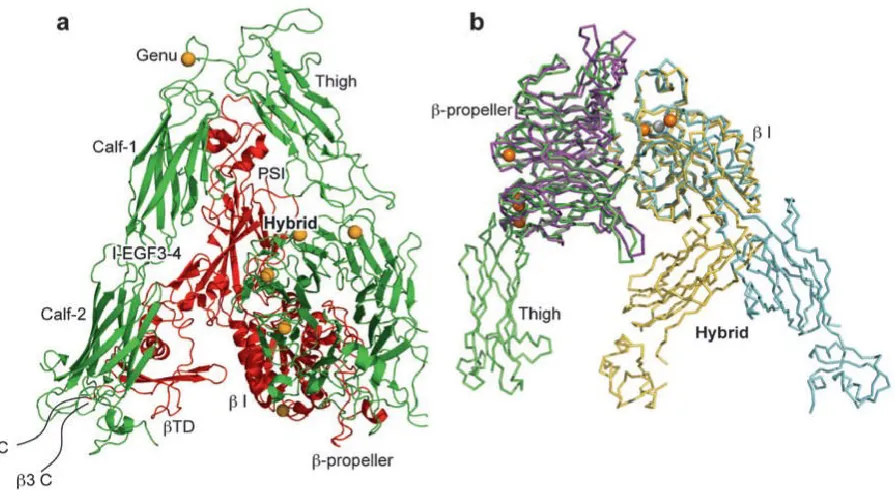
lig-and-bound states [11, 21]. As shown in Figure 3, αv consists of four domains: an N terminal seven-bladed
β-propeller, an Ig-like Thigh domain and two large
(Plexin-Semaphorin-Integrin) domain in which an Ig-like ―Hybrid‖ domain is inserted in its c-terminal loop (the Hybrid domain contains in turn an αA-like
domain (βA domain) inserted between its two β-sheets). PSI is followed by four EGF-like domains
and a membrane proximal novel tail domain (β-TD).
The propeller and βA domains assemble into a ―head‖
structure, which accounts for formation of the αβ heterodimer. The integrin head sits on top of an α and
a β ―legs‖, formed respectively of the Thigh and Calf domains from the αV-subunit and the PSI, Hybrid, EGF1-4 and βTD domains from the β3-subunit [11].
The structure of liganded αvβ3 ectodomain was
determined after diffusing the high affinity cyclic pentapeptide, cilengitide, which contains the proto-typical Arg-Gly-Asp (cRGD), into preformed integrin
crystals in the presence of 5 mM Mn2+. RGD inserts
into a crevice between the propeller and βA domains,
with the residues R and D side chains exclusively contacting the propeller and βA domains, respectiv e-ly, and bringing these two domains closer together [21]. The activating inward movement of α1 helix and rearrangement of the F/α7 loop seen in liganded α I
are also observed in liganded β I, leading to similar although much less dramatic changes in the three surface loops coordinating MIDAS and the SDL loop. Metal coordination at ADMIDAS changes
signifi-cantly, such that it no longer locks the α1 helix to the F/α7 loop, allowing the activating movements in both. The inward movement of α1 carries ADMIDAS with it, moving it closer to MIDAS, thus helping sta-bilize the new metal ion at MIDAS [21].
Figure 3. Crystal structures of integrins αVβ3 and αIIbβ3. (a) The structure of αVβ3 in the bent conformation. The αV and
β3 subunits are colored in green and red, respectively. (b) Superposition of liganded-open αIIbβ3 and unliganded-closed
αVβ3 headpieces. The α and β subunits are colored in green and yellow in αVβ3 and in purple and light blue in αIIbβ3. Calcium and magnesium ions in αIIbβ3 only are gold and gray spheres, respectively [18].
Crystal structures of the αvβ3 ectodomain in
complex with the cyclic RGD peptide [21], as well as another RGD-type integrin (αIIbβ3) complexed with
ligand mimetic compounds [22] have revealed that the minimal RGD set provides two essential an-chorpoints: one is the Asp carboxylate, which
coor-dinates directly the β MIDAS; the other is the Arg side
chain (or basic moiety), which forms a salt bridge to an acidic residue in the b-propeller domain of the
αv/αIIb subunit. In addition, these anchorpoints are
located at the bottom of the narrow cleft or ‗well‘,
where the small ligand compounds are well accom-modated, burying more than half of the molecular
surface at the interface. αvβ3 integrin shows little
preference in its choice among the many RGD-containing proteins. Surprisingly, even the strict RGD sequence requirement rule can be bent [23]. For example, cells from homozygous knock-in mice
car-rying the RGD→RGE mutation in fibronectin exhi b-ited normal fibronectin assembly in an
αvβ3-dependent manner [24]. This observation indi-cated that the positioning of both an acidic and basic residue in proper geometrical proximity is sufficient for meaningful affinity. The well-type pocket
con-taining β MIDAS seems specifically designed to a
c-commodate ‗loop ligand‘. Residues adjacent to RGD
seem to provide some specificity toward certain
in-tegrins, both by making extra direct contacts and by
changing the ‗width‘ of the RGD segment [25-26].
Although α MIDAS and β MIDAS normally function in a tandem fashion in αI domain-containing integrins, they each could potentially engage two in-dependent external ligands simultaneously. For ex-ample, semaphorin 7A, a GPI-anchored membrane protein that contains an RGD motif, was reported to promote axon outgrowth through b1 integrin(s),
though the α subunit responsible for this activity was not determined [27]. Purified a1b1 does recognize semaphorin 7A in an RGD-dependent manner [28]. It is therefore tempting to speculate that RGD binds to
the β MIDAS, leaving the α MIDAS unoccupied.
laminins. Full integrin-binding activity of LG1-3 re-quires the heterotrimeric C-terminal portion of the coiled-coil domain, including the most distant C-terminal region of the b and g chains [32].
Accumulating evidence supported that the structure changes of integrins are the basis of the in-tegrin signaling. Indeed, negative stain electron mi-croscopy with image averaging of integrins has shown three overall conformations of the extracellular domain and these correspond to a low affinity, bent conformation (as in the αvβ3 structure), an interm e-diate affinity, extended form with a closed headpiece, and a high affinity, extended form with an open headpiece, which is induced by ligand mimetic com-pounds [22]. In integrins that lack the I-domain, the
ligand binds directly to the β I-like domain, and causes a downward movement of its α7 helix, sim
i-larly to what was described above for the integrin α
I-domains. This shift results in a swing-out movement
of the β chain hybrid and PSI domains and these do-mains act as a rigid lever that transmits and amplifies
the motion, resulting in a separation of the α and β
legs and integrin extension [22]. On the other hand, the swing-out movement of the upper β leg could
readily occur if it were preceded by extension of both legs.
Several models have been proposed to integrate the structural changes of integrins and consequent biochemical findings [33]. For example, a ―switc
h-blade‖ model proposed that the head structure with
the large (~ 80°) Hybrid swing-out represents the high
affinity state of βA. To provide the necessary space for
the Hybrid swing-out, the model suggests that the integrin first fully extend its knees, converting the bent into a linear asymmetric conformation, described as such in 2D EM images [19]. An alternate ―dea
d-bolt‖ model suggest that elastic deformation of the F/α7 loop is possible with only modest quaternary changes at the βTD interface with βA and possibly
Hybrid domains [34]. It has been found that upon binding of ICAM-5 to the LFA-1 I-domain, a
remark-able outward movement of the α7 helix was observed,
which resulted in the replacement of the
correspond-ing α7 helix from a neighborcorrespond-ing I-domain into the α7
helix position, but in an upside-down configuration.
This α7 helix replacement was further propagated, resulting in a large I-domain/ICAM-5 cluster. In this way, a weak initial interaction between the integrin and a ligand can result in the formation of large lig-and/receptor aggregates [35].
3. INTEGRIN SIGNALING
Integrins bind ECM proteins through their large extracellular domain, and engage the cytoskeleton via
their short cytoplasmic tails. These integrin-mediated linkages on either side of the plasma membrane are dynamically linked. The cytoskeleton controls affinity and avidity of the integrin extracellular domain to modulate the ECM, and integrin binding to ECM changes the shape and composition of the cytoskele-ton beneath [36]. Thus, integrins communicate over the plasma membrane in both directions, i.e., out-side-in and inside-out signaling [18]. In outout-side-in signaling through integrins, ligands bind to extracel-lular integrin domains, where a conformational change occurs so that the signal is transmitted into the cell. Integrin clustering may also occur. Inside-out signaling originates from non-integrin cell surface receptors or cytoplasmic molecules and it activates signaling pathways inside the cells, ultimately re-sulting in the activation/deactivation of integrins. In this case, adhesion may be regulated both by confor-mational changes in the integrin and by valency change (integrin clustering). In fact, both signaling events may occur simultaneously and reinforce each other [8].
Changes in interactions and/or in the structures of the cytoplasmic domains of integrins within the membrane-proximal regions play crucial roles in in-tegrin activation via inside-out signaling [37-38]. Conformational changes of integrin induced by ligand binding on the extracellular domain altered the cyto-plasmic domain structures to elicit various intracel-lular signaling pathways. A prominent biochemical event in integrin outside-in signaling is protein tyro-sine phosphorylation due to activation of Src and FAK family protein tyrosine kinases [39-40]. Src and its inhibitory Csk are constitutively bound to the integrin
β-tails. Integrin binding to ligand induces Src activa-tion through Csk dissociaactiva-tion, Src transphosphoryla-tion and/or recruitment of tyrosine phosphatases (e.g
receptor tyrosine phosphatase RPTPα, or PTP-1B [39]. However, the spatiotemporal and structural basis of the interaction of integrin cytoplasmic-tails with the growing list of signaling molecules including cyto-solic and receptor kinases (Src, FAK, Syk, ILK and PKC) and phosphatases remains to be determined [9].
CHO (Chinese-hamster ovary) cells inhibits the acti-vation of both β1 and β3 integrins without altering integrin expression [44]. NMR studies suggest that direct disruption of α–β tail interaction by the talin head domain result in integrin activation [46]. Pro-posed a two-step activation model, the talin head domain first recognizes the high-affinity binding site in the membrane-distal region, which provides a strong linkage between the talin and the integrin β
tail, and subsequently binds to a second lower-affinity membrane proximal site that is involved in α–β asso-ciation, triggering separation of the tails and integrin activation [47-48]. Although talin is an important player in integrin activation mechanisms, the possi-bility remains that other integrin tail-binding proteins can substitute for talin. For example, many other PTB-domain-containing proteins including Numb, Dok-1, ICAP-lα (integrin cytoplasmic domainassoci-ated protein-lα) and Kindlins bind to integrin β tails in a similar fashion to talin [49].
Integrin activation requires transmission of conformational rearrangements from the cytoplasmic face to the extracellular domain. The interaction be-tween the membrane-proximal regions of the α and β
subunits is believed to be stabilized by a salt bridge between a conserved arginine residue in the α tail and an aspartate residue in the β tail and by the hydro-phobic residues immediately N-terminal to the argi-nine and aspartate residues [50]. Mutations that
dis-rupt this ‗clasp‘ lead to integrin activation, and inte g-rins can be constitutively activated by deletion or mutations in these membrane-proximal sequences [42]. These data together strongly indicate that this membrane-proximal interaction plays an essential role as a stabilizer in the association of the α and β
membrane proximal regions, maintaining the integ-rins in a low-affinity state. In addition, mutational analysis and computational modeling together sug-gest that a helical interface between the integrin α and
β subunit transmembrane domains stabilizes the in-active state, and suggest that disruption of this helical transmembrane interface leads to activation [51] [52].
4. LIGANGDS OF INTEGRINS
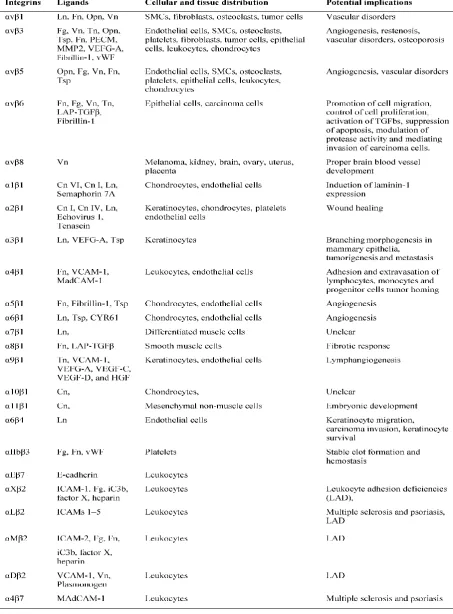
The majority of integrin ligands are protein components of ECM (Table 1). ECM is assembled from components synthesized and deposited outside the cell surface that provide structural and functional integrity to connective tissues and organs [53]. The ECM can also serve as a reservoir or provisional
ma-trix for growth factors and plasma proteins found in the blood [54]. The protein components of ECM can be divided into three major classes: (1) structural pro-teins such as the collagens and elastin (although col-lagen can also have functional properties); (2) mul-tidomain adhesive glycoproteins such as fibronectin, vitronectin, and laminin; and (3) matricellular pro-teins such as secreted protein acidic and rich in cys-teine (SPARC; also known as osteonectin and BM-40), thrombospondin 1 (TSP1) and 2 (TSP2), tenascin C and X, and osteopontin [53]. Among them, collagen primarily provides tensile strength to the tissue and elastin is responsible for the elastic recoil. Fibronectin, an adhesive glycoprotein, is a multifunctional protein that can act as a structural molecule owing to its fi-brillar architecture, a biological glue that mediates interactions between cells and other ECM proteins, or a bridge forming cell to cell contacts [55]. Matricellu-lar proteins are secreted macromolecules that interact with cell-surface receptors, ECM, growth factors, and proteases but do not function as structural molecules
per se [56]. These glycoproteins regulate interactions between cells and ECM. For instance, SPARC, TSP1, and tenascin C disrupt cell–matrix interactions (i.e., are counteradhesive) — a critical component of angi-ogenesis and tissue remodeling [57].
All five αV integrins, two β1 integrins (α5, α8) and αIIbβ3 share the ability to recognize ligands con-taining an RGD tripeptide active site, which is shared by The RGD binding integrins are among the most promiscuous in the family, with β3 integrins in par-ticular binding to a large number of ECM and soluble vascular ligands including fibronectin, fibrinogen, vitronectin, vWF, LAP-TGFβ and Del-1. Although many ligands are shared by this subset of integrins, the rank order of ligand affinity varies, presumably reflecting the preciseness of the fit of the ligand RGD conformation with the specific α-β active site pockets [58].
Collagens are a major family of structural ECM proteins and characterized by the presence of triple helical regions. Cells employ four different αI domain containing integrins including α1, α2, α10, and α11 to
maintain holds with them. Immunoglobulin super-family members also act as ligands for several integ-rins, and the best characterized integrin ligands are VCAM-1 (Vascular Cell Adhesion Molecule) and the ICAMs. VCAM-1 binds to α4β1, αVβ3 and α4β7,
5. BIOLOGICAL AND PATHOLOGICAL
FUNCTION OF INTEGRINS
Cell adhesion is involved in many essential normal cellular and pathological functions including
cell survival, growth, differentiation, migration, in-flammatory responses, platelet aggregation, tissue repair and tumor invasion. Integrins are one of key family proteins for cell adhesion regulation through binding to a large number of extracellular matrix molecules and cell membrane proteins. Using knockout mice it has become evident that the integ-rins possess both redundant and nonredundant func-tions, and that lack of expression may result in a wide variety of effects ranging from blockage in pre-implantation to embryonic orperinatal lethality and developmental defects.
β1 Integrin. The largest subgroup of integrins is formed by the β1 subunit containing integrins which consist of 12 members with different ligand binding properties. Besides ECM proteins, some β1 integrin containing receptors also interact with cellular recep-tors. For example, α4β1 and α9β1 bind to VCAM-1 and α4β1 to MadCAM-1 [60]. During early embryo-genesis totipotent embryonic cells differentiate and polarize to form endoderm, basement membrane (BM), and ectoderm. However, embryoid bodies
de-rived from β1-deficient ES cells develop endoderm, but do not form a BM, polarized ectoderm and a cav-ity [61]. β1-integrin null embryos die by embyronic day (E)9.5–10.5 in utero owing to implantation defects [62-63]. The major function of β1 integrin during early
development may be to induce laminin-1 expression since exogenous addition of laminin 1 allows BM
formation also in the absence of β1 integrins, though
the signaling pathway mediating the regulation is still unclear [64]. β1 integrins are crucial for the attac h-ment of basal keratinocytes to the BM, since loss of β1
leads to widespread blisters between the epidermis
and the BM. In addition, loss of β1 integrin in skin
decreases the proliferation of basal keratinocytes by about 70% [65]. Similarly to skin, β1 integrins are
important for the attachment to and maintenance of the BM in brain [66]. Although β1 integrins are i m-portant ECM receptors, they are not generally re-quired for cell migration. While some cells, such as keratinoctes or primordial germ cells, are highly de-pendent on β1 integrin, other such as myoblasts,
neurons and lymphocytes migrate normally also in
the absence of β1 integrin. Tumor cells expressing β1
integrin formed significantly larger primary tumors and had a dramatically increased metastasis into liver and lung [67]. Moreover, ablation of the β1 integrin
gene in mammary epithelium dramatically impairs
mammary tumorigenesis in mice [68]. However, in human patients, no clear correlation between tumor
formation, invasion and β1 integrin expression could
be identified yet.
Integrins α1β1 and α2β1 are expressed on lym-phatic endothelium in healing wounds in response to VEGF. Inhibition of these integrins blocked lym-phangiogenesis in these wounds [69]. In normal ani-mals, VEGFA treatment upregulates expression of both α1β1 and α2β1 on vascular endothelial cells. Function-blocking antibodies directed against both integrins reduced VEGFA-induced angiogenesis in vivo and reduced tumor growth and angiogenesis [70]. Tumors grown in α1β1-deficient mice grew more slowly and exhibited less angiogenesis, indicating an important role for this integrin in angiogenesis [71]. However, mice lacking α2β1 integrins exhibit in-creased B16F10 melanoma growth and angiogenesis when compared with wild-type mice [72]. By contrast, Lewis lung carcinoma (LLC) tumors did not exhibit increased angiogenesis or growth in α2-null mice. The different response resulted from different level of a VEGFR1 binding placental growth factor (PLGF) ex-pression which was high from B16F10 melanoma cells and low from LLC cells. Enhanced angiogenesis was attributed to an increase in VEGFR1 expression and function on α2-null endothelial cells [72].
Integrin α4β1, a receptor for VCAM and fibron-ectin containing the CS1 region, is best known as a lymphocyte integrin involved in adhesion and ex-travasation of lymphocytes by binding to VCAM1 which is expressed on inflamed endothelial cells. Loss
of integrin α4 during development leads to defects in placentation, heart development and coronary artery development, causing lethality between E10.0 and E12.0 [73]. It has been reported that integrin α4β1 was expressed on neo-vasculatures in both murine and human tumors and responded to VEGF, bFGF, IL1
progenitor cell homing to tumors by integrin α4β1
antagonists could be a useful supplementary ap-proach to suppress tumor angiogenesis and growth.
Embryonic deletion of the integrin α5 subunit induces early mesenchymal abnormalities, leading to lethality of α5-null embryos [77]. Further studies us-ing α5-null ES cells to grow teratocarcinomas showed decreased proliferation, increased apoptosis and de-creased vascularization in teratocarcinomas derived from α5-null ES cells compared with controls [78]. Integrin α5β1 expression is induced in response to a variety of angiogenic stimuli, such as bFGF, IL8 and the ECM protein DEL1 (also known as EDIL3), but not by VEGF [79]. Integrin α5β1-mediated adhesion promotes endothelial cell migration and survival in
vivo and in vitro by suppressing the activity of protein
kinase A (PKA) [80]. Integrin α5β1 is poorly expressed on quiescent endothelium but its expression is signif-icantly upregulated on endothelium during tumor angiogenesis in both mice and humans [81]. In some types of cancer, integrin α5β1 is also expressed on tumor cells and plays a direct role in tumor cell mi-gration, invasion, and survival [82-84]. A small pep-tide antagonist (amino-acid sequence PHSCN) to in-tegrin α5β1 significantly reduced neovascularization and formation of metastases in an animal model of prostate carcinoma that expresses integrin α5β1 [83, 85-86]. Expression of α5β1 is also upregulated during corneal angiogenesis [87].
Integrin α6β1 is expressed at high levels in c a-pillary endothelial cells in vivo [88]. Unlike α6β4,
which shows a preference for laminin 5, integrin α6β1
binds most laminin isoforms as well as other ECM proteins including CYR61, thrombospondin 1 and thrombospondin 2 [89]. As α6 integrin antagonists and α6 small interfering RNA constructs inhibit a
n-giogenesis, it is possible that integrin α6β1 promotes
angiogenesis. However, as these agents can block the function of both integrins α6β1 and α6β4, it is not yet clear what part integrin α6β1 plays in tumor angi o-genesis [88]. Antibody inhibitors of α6 integrin pre-vented endothelial cell tube formation in vitro, sug-gesting a role for α6 in the angiogenic process [88].
Integrin α9β1 is structurally similar to integrin
α4β1. However, unlike α4β1, it is a receptor for a number of ECM proteins and cell surface receptors including tenascin C, thrombospondin, osteopontin, IIICS fibronectin, VCAM1 and other ligands [90]. In-tegrin α9β1 is expressed on epithelia, osteoclasts, smooth muscle cells and also endothelial cells. α9β1
promotes VEGFA-stimulated angiogenesis by directly binding to VEGFA and blocking antibodies to α9β1
suppress VEGFA-induced angiogenesis [91]. Howev-er, other studies found that α9β1 also binds directly to
the N terminus of thrombospondin and blocking an-tibodies to α9β1 inhibited angiogenesis induced by this thrombospondin fragment [92]. Integrin α9β1
also has a role in growth factor-mediated lymphan-giogenesis as PROX1, a lymphatic endothelial cell-selective transcription factor, coordinately up-regulates integrin α9β1 and VEGFR3 expression and endothelial cell motility in vivo [93]. This integrin promotes VEGFC- and VEGFD-stimulated cell mi-gration by directly binding these growth factors and antagonism of α9β1 suppresses VEGFC-induced mo-tility [94]. Taken together, these studies indicate that
α9β1 has unique and crucial roles in lymphangio-genesis. Indeed, integrin α9β1-null mice die 8–12 days after birth owing to lethal defects in development of the lymphatic system; however, they do not exhibit obvious defects in development of blood vessels [95].
αvβ3 Integrin.The integrin αvβ3 is the first of the
αv integrins to be characterized and shown to regu-late angiogenesis [96-97]. It binds with multiple components of the ECM including vitronectin, fi-bronectin, fibrinogen and osteopontin since they are all RGD-containing proteins. It has been found in 1994 that integrin αvβ3 was widely expressed on blood vessels in human tumor biopsy samples but not on vessels in normal human tissues. Its expression on endothelial cells is stimulated by angiogenic growth
factors such as bFGF, TNFα and IL8 and it is upreg u-lated on endothelium in tumors, wounds and sites of inflammation αvβ3 integrin has a key role in endo-thelial cell survival and migration during angiogene-sis [96] [98]. Antagonists of αvβ3 inhibited angioge n-esis and tumor growth in a variety of animal models of cancer and blocked corneal as well as choroidal angiogenesis in animal models of ocular disease [98-99]. In addition, integrin αvβ3 antagonists induce endothelial cell apoptosis through a caspase 8-dependent cell death program [100].In vitro studies revealed that agonists of endothelial cell αvβ3, but not other integrins, suppressed p53 activity, blocked p21WAF1/CIP1 expression, and increased the bcl-2/bax ratio, thereby promoting cell survival [101].
Ligation of endothelial αvβ3 integrin has also been shown to activate mitogen-activated protein kinase (MAPK), FAK and Src, among other kinases, resulting in cell proliferation, differentiation and migration [102].
Based on the sizable body of evidence addressed above, it is reasonable to draw the conclusion that
an-ti-angiogenic therapy, including the humanized monoclonal antibody Vitaxin and the RGD mimetic Cilengitide [103-104]. However, these agents did not appear to be as successful at inhibiting angiogenesis in clinical trials for cancer treatment as originally hoped [105]. Recently, it has been reported that low concentrations of RGD-mimetic integrin inhibitors promote VEGF mediated angiogenesis by altering
αvβ3 integrin and vascular endothelial growth factor receptor-2 trafficking, thereby stimulating tumor growth and angiogenesis [106].
More importantly, a series of genetically Knock-out studies forced researchers to reconsider the role of integrin αvβ3 and αvβ5 in angiogenesis. For example, genetic ablation of the αv integrin subunit
did not appear to affect developmental angiogenesis [107]. Even conditional deletion of αv integrin in Tie2-expressing endothelial cells is not sufficient to affect angiogenesis either [108]. Furthermore, β3 null and β3/β5 doubly deficient mice produce vascular networks without obvious defects during develop-mental angiogenesis, and more surprisingly, display enhanced tumor growth and pathological angiogene-sis [109-110]. However, male mice lacking β3 integrin
exhibit coronary capillaries of irregular endothelial thickness, with endothelial protrusions into the lu-men, and expanded cytoplasmic vacuoles. These de-fective coronary vessels can be normalized by ad-ministration of inhibitors of VEGF or VEGF receptor 2 (VEGFR2, also known as KDR), suggesting that en-hanced VEGF signaling might compensate for the loss
of β3 integrin [111]. In addition, with a mouse knockin model, it has been demonstrated that the phosphory-lation of Tyr747 and Tyr459 in β3 integrin participates in enhancing pathological angiogenesis [112].
All considered, the above studies suggest that avβ3 integrin may have both positive and negative roles during angiogenesis. Indeed, avβ3 can bind a plethora of factors that are thought to enhance angi-ogenesis including VEGFR2, vitronectin, fibronectin, Del1, ANGPTL3, CYR61, bone sialoprotein, thrombin, and can also bind to several factors that are thought to induce anti-angiogenic effects including thrombos-ondin, angiostatin, and tumstatin [113]. Another ex-planation is that functioning as a biosensor, avβ3 may promote angiogenesis in the ligated state, but when ligands are absent or ligand binding is antagonized, avβ3 may activate a death pathway to inhibit angio-genesis. Thus, depending on the microenvironment and the ligation state, integrins promote or inhibit angiogenesis by positively or negatively regulating cell survival [114]. In this way, integrin avβ3 appears to function as a regulator of angiogenesis by balancing opposing signals in the tumor microenvironment.
αvβ5 integrin. All though integrin αvβ5 binds
with similar ECM components with αvβ3, the related angiogenic promoting pathway is distinct from that
regulated by αvβ3. For example, anti-αvβ3 antibodies
blocked angiogenesis induced by bFGF, whereas
an-tibodies that target αvβ5 blocked the angiogenesis induced by VEGF in both the rabbit corneal eye pocket and the chick chorioallantoic membrane assay [115]. The VEGF–αvβ5 pathway is dependent on Src kinase and protein kinase C30. In vivo angiogenesis assays showed αvβ5 is required for TGF- β and VEGF-mediated angiogenesis and VEGF acted through αvβ5 to promote vascular permeability [116], indicating αvβ5 may also promote tumor metastasis [117]. However, integrin αvβ5-null mice exhibit com-pletely normal development and normal angiogenesis [118], indicating that this integrin is not required for vascular development.
Genetic ablations of the αv subunit, which eli
m-inate expression of integrins αvβ1, αvβ3, αvβ5, αvβ6 and αvβ8 suggest that, in some mice, αv integrins are
not required for blood vessel development in most
tissues. Twenty percent of embryos lacking αv inte g-rins survive to birth with normal blood vessels in many tissues. However, 80% of mice die in utero be-tween E10.5 and E11.5 with defective placental blood
vessels. The remaining 20% of αv-null mice die shortly after birth with severe brain and intestinal haemorrhage, with distended and leaky vessels in these tissues [107]. Thus, αv integrins appear to have
key roles in embryonic development of blood vessels in tissues such as placenta and brain.
αvβ6 integrin. The αvβ6 receptor is the only
known integrin that is restricted exclusively to epi-thelial cells [119]. The αvβ6 integrin is expressed pri-marily during embryonic development and is not expressed constitutively in healthy epithelia. Howev-er, αvβ6 is upregulated during tissue remodeling, including wound healing and carcinogenesis [120].
αvβ6 facilitates keratinocyte adhesion and migration on fibronectin, tenascin and vitronectin, all of which are components of the early wound matrix [121]. Us-ing mouse β6-/- keratinocytes, Huang et al. found that
of αvβ6 in normal human keratinocytes [125] and on the non-transformed keratinocyte cell line, HaCaT [126].
To date, αvβ6 expression has been reported in carcinomas of the lung, breast, pancreas, stomach, colon, ovary, salivary gland as well as oral and skin squamous cell carcinoma [120, 127-131]. Elevated
αvβ6 expression facilitated the invasion and dissem-ination of colon carcinoma cells in vivo [132-133]. The
β6 overexpressing cell line was significantly more invasive, which was, in part, through
αvβ6-dependent upregulation of the type IV colla-genase MMP-9 [134-135]. High αvβ6 expression cor-related with elevated uPA, uPAR and MMP-9 in ovarian carcinoma cell lines [136]. It has also been proposed that contribution of αvβ6 for promoting cancer progression in vivo is related to the mechanism of epithelial–mesenchymal transition (EMT) by acti-vating latent TGF-b [137]. The upregulation of αvβ6
related with the poor prognosis [132], suggesting that
αvβ6 expression may be useful in predicting malig-nant transformation. Indeed, the integrin αvβ6 now emerges as an attractive new candidate as a thera-peutic target for metastatic colon carcinoma. Howev-er, epithelial cells in samples of lichen planus (a chronic mucocutaneous disease) have also been shown to express αvβ6 suggesting that αvβ6 expres-sion per se is insufficient to drive malignant progres-sion [138]. The net effect on tumor behavior is likely to depend on the stage of tumor development. In the later stages of tumor development, as cells become refractory to growth inhibition, then the role of LAP in promoting both αvβ6-dependent cell movement and MMP-9 expression may become prominent, culmi-nating in a pro-oncogenic effect of TGFb [139].
α6β4 Integrin. α6β4 plays a key role in the fo r-mation and stabilization of junctional adhesion com-plexes called hemidesmosomes (HDs) that are con-nected to the intermediate filament (IF) system, as well as in the regulation of a variety of signaling
pro-cesses. Increased expression of α6β4 and changes in its distribution were then correlated with increased aggressiveness of tumors and poor prognosis [140]. β4
subunit has an unusual size of approximately 200 kDa, which is due to an unusually long cytoplasmic do-main of over 1,000 amino acids [141]. This dodo-main contains two pairs of type III fibronectin (FNIII) do-mains, separated by a connecting segment (CS) [142].
β4 knockout mice developed severe blistering of the skin [143]. Moreover, a mutation in the β4 gene is re-sponsible for the pyloric atresia associated with junc-tional epidermolysis bullosa (EB) syndrome in
hu-mans. It has been found that interaction between α6β4
and plectin is critical for proper HD assembly and at
least two sites on plectin and three on β4 mediate their
interaction. The actin binding domain (ABD) of plec-tin binds to the first pair of FNIII domains and part of
the CS of β4 [144]. Two other HD components, BP180
and BP230, bind to the third FNIII domain of β4 and
to a region comprising the C-terminal end of the CS and the second pair of FNIII domains, respectively [145]. The α6 subunit of α6β4 interacts with the te t-raspanin CD151 [146].
Apart from promoting keratinocytes migration, studies on the invasion of carcinoma cells revealed a
role for α6β4-dependent activation of phosphatidyl-inositol (PI)-3 kinase, which is an upstream regulator of Rac1 [147]. Since growth factors activate enzymes that initiate the disassembly of HDs, the presence of overactive growth factor receptors may explain why
α6β4 is unable to initiate HD formation in many ca
r-cinoma cells. In fact, α6β4 cooperates with several
different tyrosine kinases in carcinoma cells to pro-mote invasion, including c-met (hepatocyte growth factor receptor), ErbB2 and ErbB1 [148]. There is evi-dence that proteins other than tyrosine kinases can
cooperate with α6β4 to promote invasion. For exa m-ple, invasion of breast carcinoma cells is stimulated by promoting Rab11-mediated vesicular trafficking un-der hypoxic conditions [149].
Leukocytes specific integrins. The arrest of leuko-cytes rolling on target vascular beds involves rapid formation of shear-resistant adhesions by specialized leukocyte integrins. This arrest can be mediated by integrins that contain the β2 subunit, e.g. aLβ2 (leu-kocyte functionassociated antigen-1 (LFA-1)) or α4 subunit, e.g. α4β1 (very late antigen-4 (VLA-4)). In leukocytes, integrins are involved in slow rolling, adhesion strengthening, and transendothelial migra-tion [150-151]. Lymphocyte and myeloid cells cease rolling and arrest on lymph node high endothelial venules as well as on peripheral tissues upon activa-tion of at least one of the four major leukocyte integ-rins: VLA-4, α4β7, LFA-1, and the myeloidspecific integrin (integrin αMβ2 (Mac-1)) [152]. In addition, these integrins transmit signals that facilitate respira-tory burst, complement-mediated phagocytosis, cy-tokine production, proliferation, survival, differentia-tion, degranuladifferentia-tion, and cellular polarization. Loss or
reduced β2 on cell surface, defects in β2 signaling, mutations in β2 will cause leukocyte adhesion def i-ciencies (LAD) [153].
this dramatic change in integrin affinity is triggered when the rolling leukocyte encounters and rapidly responds to a proper chemoattractant signal pre-sented on the apical endothelial surface [156]. The distribution of LFA-1 integrins to the leading edge of a polarized leukocyte is reported to proceed through a signaling cascade involving Rap1 and its downstream effectors RAPL and the threonine–serine kinase, Mst1 [157]. Integrins play key roles in cellular migration acting both as adhesive molecules that maintain lo-comotion over the apical endothelial surface and as signaling molecules, which, together with chemokine signals, maintain polarity and motility [158].
Leukocyte integrins are recognized therapeutic targets in various diseases, and integrin blocking
monoclonal antibodies (natalizumab against α4 i n-tegrins and efalizumab against LFA-1) are already used in the clinic against multiple sclerosis and pso-riasis [159-160]. Leukocyte adhesion cannot be inhib-ited by compounds containing the RGD sequence, but longer peptides to recognition sites in ICAM mole-cules or microbe-derived ICAM-1 inhibitors do show inhibitory activity [161-162]. It has been reported that promatrix metalloproteinases (proMMPs), particu-larly proMMP-9, are potent ligands of the leukocyte
β2 integrins and translocating proMMP-9/ αMβ2
complex is part of the cell surface machinery guiding neutrophil migration [163], suggesting that a promis-ing therapeutic approach could be to disrupt the as-sociation between the matrix metalloproteases and integrins. It has also been found that the Del-1 protein is an important endogenous inhibitor of leukocyte adhesion [164]. The Del-1 protein is a secreted protein expressed by endothelial cells in immunoprivileged tissues, such as the brain, the eye, and the lung. Alt-hough a secreted molecule, Del-1 is absent from plasma and is rather localised to endothelial cells and/or the extracellular matrix [164]. In fact, it binds to the β2 integrins (LFA-1, Mac-1) and when coated on plastic, leukocytes adhere to the protein. However, leukocyte binding to ICAM-1 is inhibited when both Del-1 and ICAM-1 are present. Del-1 knockout mice show a strong activation of adhesion and of inflam-matory cell recruitment [164].
6. PERSPECTIVES OF INTEGRINS AS
IMAGING AND THERAPY TARGETS
Integrins are ideal pharmacological targets based on both the key role they played in angiogenesis, leukocytes function and tumor development and easy accessibility as cell surface receptors interacting with extracellular ligands [1]. So far, the integrin super-family represents the best opportunity of targeting both antibodies and small-molecule antagonists for
both therapeutic and diagnostic utility in various key diseases [165]. Preclinical studies and clinical trials showed that quite a few integrin targeting antibodies were effective to block tumor growth and metastasis.
Most of studies focused on αv integrins including MEDI-522 (vitaxin) against αvβ3 [98], CNTO 95
against both αvβ3 and αvβ5 [166], 17E6 against αvβ3, αvβ5 and αvβ1 [167]. Besides, antibodies targeting to other integrins have been developed. For example, Tysabri (natalizumab), an antibody which blocks α4 integrins and inhibits the α4-mediated adhesion of leukocytes to their counter receptor was used for treatment of patients with relapsing forms of multiple sclerosis (MS) [168]. Small molecular antagonists, mainly based on RGD containing peptides and RGD peptidomimetic [169-171], also showed potent inhibi-tion of angiogenesis. More detailed informainhibi-tion can be found in several recently published review articles [1, 172].
Integrin ligands are also under investigation as tumor endothelium-targeted diagnostic agents and integrin targeting is proving useful in tumor imaging. Both peptide and antibody-based diagnostic agents targeting RGD-binding integrins or αv integrins have
been evaluated in animal models of cancer after 18F or 64Cu labeling. Tumor xenografts with positive integrin
αvβ3 expression were visualized clearly on PET im-ages [173-175]. Other imaging modalities besides PET have also been investigated for integrin αvβ3 targeted imaging. For example, integrin αv-targeted ultra-sound microbubbles preferentially bound neovascu-lature at the periphery of experimental tumors [176]. The clinical significance of molecular imaging with integrin-targeting agents may be useful for lesion de-tection and grading. In addition, imaging will help identify appropriate patients for integrins related therapy and monitor the therapeutic responses. More important, integrin-targeting agents might also be useful in selectively delivering chemotherapeutics or gene therapeutic agents to tumors, thus minimizing systemic toxicities. For example, after fused with a RGD targeting moiety, RGD4C-TNF showed im-proved tumor accumulation and therapy effect in a human breast tumor model [177].
integrins in the same cell utilizing different signaling pathways. For example, when α2β1 is ligated, both
α5β1 and αVβ3 will be suppressed through PKA. When α5β1 is ligated, α2β1 will be suppressed through PKCα [182]. Integrins are also known to have transdominant roles over other integrins and can thus control overall cell behavior [183]. After epithelial integrity is restored in wounds, αvβ6 expression will be strong upregulated. However, mutating the β6
cytoplasmic domain by removing the terminal 11 amino acids prevents this density-dependent
upreg-ulation of αvβ6 and replaces it by upregulating αvβ5. This provides evidence that the expression of these integrins is linked and expression may be switched from one to the other [135].
So far, a lot of breakthroughs in integrin research have been made with purified integrins, or I-domains and their ligands. However, it is becoming increas-ingly apparent that integrin mediated cell adhesion is unusually complex. Thus, it is critical to study the events occurring at the cellular and organism levels in a temporal manner to make more meaningful conclu-sions. It is very promising for molecular imaging of living cells or animal models to meet the requirement. For example, microscopic imaging with FRET could identify integrin-integrin interaction and integ-rin-other proteins interaction in living cells [184] [185]. PET imaging with positron emission radioisotopes labeled integrin-targeting probes could visualize ex-pression and regulation of integrins in animal models in a real-time mode [186]. We believe integrating data from both microscopic and macroscopic methods will quicken our steps on the long scientific journey to decipher the integrins related pathways.
ACKNOWLEDGEMENT
This work was supported by the intramural Re-search Program (IRP) of the National Institute of Bi-omedical Imaging and Bioengineering (NIBIB), Na-tional Institutes of Health (NIH). Dr. G. Niu current-ly is an Imaging Sciences Training Fellowship jointcurrent-ly supported by the Radiology and Imaging Sciences Department, NIH Clinical Center and the Intramural Research Program, NIBIB, NIH.
CONFLICT OF INTEREST
The authors have declared that no conflict of in-terest exists.
REFERENCES
1. Lu X, Lu D, Scully M, Kakkar V. The role of integrins in cancer and the development of anti-integrin therapeutic agents for cancer therapy. Perspect Medicin Chem. 2008;2:57-73.
2. Hynes RO. Integrins: a family of cell surface receptors. Cell. 1987;48:549-54.
3. Hynes RO. Integrins: versatility, modulation, and signaling in cell adhesion. Cell. 1992;69:11-25.
4. Serini G, Valdembri D, Bussolino F. Integrins and angiogenesis: a sticky business. Exp Cell Res. 2006;312:651-8.
5. Brakebusch C, Bouvard D, Stanchi F, Sakai T, Fassler R. Integrins in invasive growth. J Clin Invest. 2002;109:999-1006. 6. Hynes RO. Integrins: bidirectional, allosteric signaling
machines. Cell. 2002;110:673-87.
7. Vogel V, Sheetz M. Local force and geometry sensing regulate cell functions. Nat Rev Mol Cell Biol. 2006;7:265-75.
8. Ginsberg MH, Partridge A, Shattil SJ. Integrin regulation. Curr Opin Cell Biol. 2005;17:509-16.
9. Springer TA. Complement and the multifaceted functions of VWA and integrin I domains. Structure. 2006;14:1611-6. 10. Xiong JP, Stehle T, Diefenbach B, Zhang R, Dunker R, Scott DL,
et al. Crystal structure of the extracellular segment of integrin
αVβ3. Science. 2001;294:339-45.
11. Gahmberg CG, Fagerholm SC, Nurmi SM, Chavakis T, Marchesan S, Gronholm M. Regulation of integrin activity and signalling. Biochim Biophys Acta. 2009;1790:431-44.
12. Takagi J. Structural basis for ligand recognition by integrins. Curr Opin Cell Biol. 2007;19:557-64.
13. Lee JO, Bankston LA, Arnaout MA, Liddington RC. Two conformations of the integrin A-domain (I-domain): a pathway for activation? Structure. 1995;3:1333-40.
14. Lee JO, Rieu P, Arnaout MA, Liddington R. Crystal structure of
the A domain from the α subunit of integrin CR3
(CD11b/CD18). Cell. 1995;80:631-8.
15. Shimaoka M, Xiao T, Liu JH, Yang Y, Dong Y, Jun CD, et al.
Structures of the αL I domain and its complex with ICAM-1
reveal a shape-shifting pathway for integrin regulation. Cell. 2003;112:99-111.
16. Emsley J, Knight CG, Farndale RW, Barnes MJ, Liddington RC.
Structural basis of collagen recognition by integrin α2β1. Cell.
2000;101:47-56.
17. Song G, Yang Y, Liu JH, Casasnovas JM, Shimaoka M, Springer TA, et al. An atomic resolution view of ICAM recognition in a complex between the binding domains of ICAM-3 and integrin
αLβ2. Proc Natl Acad Sci U S A. 2005;102:3366-71.
18. Luo BH, Carman CV, Springer TA. Structural basis of integrin regulation and signaling. Annu Rev Immunol. 2007;25:619-47. 19. Nishida N, Xie C, Shimaoka M, Cheng Y, Walz T, Springer TA.
Activation of leukocyte β2 integrins by conversion from bent to
extended conformations. Immunity. 2006;25:583-94.
20. Takagi J, Strokovich K, Springer TA, Walz T. Structure of
integrin α5β1 in complex with fibronectin. EMBO J.
2003;22:4607-15.
21. Xiong JP, Stehle T, Zhang R, Joachimiak A, Frech M, Goodman SL, et al. Crystal structure of the extracellular segment of
integrin αvβ3 in complex with an Arg-Gly-Asp ligand. Science.
2002;296:151-5.
22. Xiao T, Takagi J, Coller BS, Wang JH, Springer TA. Structural basis for allostery in integrins and binding to fibrinogen-mimetic therapeutics. Nature. 2004;432:59-67. 23. Curnis F, Longhi R, Crippa L, Cattaneo A, Dondossola E, Bachi
A, et al. Spontaneous formation of L-isoaspartate and gain of function in fibronectin. J Biol Chem. 2006;281:36466-76. 24. Takahashi S, Leiss M, Moser M, Ohashi T, Kitao T, Heckmann
development but dispensable for fibril assembly. J Cell Biol. 2007;178:167-78.
25. DiCara D, Rapisarda C, Sutcliffe JL, Violette SM, Weinreb PH, Hart IR, et al. Structure-function analysis of Arg-Gly-Asp helix
motifs in αvβ6 integrin ligands. J Biol Chem. 2007;282:9657-65.
26. Shiu JH, Chen CY, Chang LS, Chen YC, Lo YH, Liu YC, et al. Solution structure of gamma-bungarotoxin: the functional significance of amino acid residues flanking the RGD motif in integrin binding. Proteins. 2004;57:839-49.
27. Pasterkamp RJ, Peschon JJ, Spriggs MK, Kolodkin AL. Semaphorin 7A promotes axon outgrowth through integrins and MAPKs. Nature. 2003;424:398-405.
28. Suzuki K, Okuno T, Yamamoto M, Pasterkamp RJ, Takegahara N, Takamatsu H, et al. Semaphorin 7A initiates T-cell-mediated
inflammatory responses through α1β1 integrin. Nature.
2007;446:680-4.
29. Aumailley M, Bruckner-Tuderman L, Carter WG, Deutzmann R, Edgar D, Ekblom P, et al. A simplified laminin nomenclature. Matrix Biol. 2005;24:326-32.
30. Nishiuchi R, Takagi J, Hayashi M, Ido H, Yagi Y, Sanzen N, et al. Ligand-binding specificities of laminin-binding integrins: a comprehensive survey of laminin-integrin interactions using
recombinant α3β1, α6β1, α7β1 and α6β4 integrins. Matrix Biol.
2006;25:189-97.
31. Ido H, Harada K, Futaki S, Hayashi Y, Nishiuchi R, Natsuka Y,
et al. Molecular dissection of the α-dystroglycan- and
integrin-binding sites within the globular domain of human laminin-10. J Biol Chem. 2004;279:10946-54.
32. Kunneken K, Pohlentz G, Schmidt-Hederich A, Odenthal U, Smyth N, Peter-Katalinic J, et al. Recombinant human laminin-5 domains. Effects of heterotrimerization, proteolytic processing,
and N-glycosylation on α3β1 integrin binding. J Biol Chem.
2004;279:5184-93.
33. Arnaout MA, Mahalingam B, Xiong JP. Integrin structure, allostery, and bidirectional signaling. Annu Rev Cell Dev Biol. 2005;21:381-410.
34. Xiong JP, Stehle T, Goodman SL, Arnaout MA. New insights into the structural basis of integrin activation. Blood. 2003;102:1155-9.
35. Zhang H, Casasnovas JM, Jin M, Liu JH, Gahmberg CG, Springer TA, et al. An unusual allosteric mobility of the
C-terminal helix of a high-affinity αL integrin I domain variant
bound to ICAM-5. Mol Cell. 2008;31:432-7.
36. Geiger B, Bershadsky A, Pankov R, Yamada KM.
Transmembrane crosstalk between the extracellular
matrix--cytoskeleton crosstalk. Nat Rev Mol Cell Biol. 2001;2:793-805.
37. Calderwood DA. Integrin activation. J Cell Sci. 2004;117:657-66. 38. Hughes PE, O'Toole TE, Ylanne J, Shattil SJ, Ginsberg MH. The conserved membrane-proximal region of an integrin cytoplasmic domain specifies ligand binding affinity. J Biol Chem. 1995;270:12411-7.
39. Arias-Salgado EG, Lizano S, Sarkar S, Brugge JS, Ginsberg MH, Shattil SJ. Src kinase activation by direct interaction with the
integrin β cytoplasmic domain. Proc Natl Acad Sci U S A.
2003;100:13298-302.
40. Cluzel C, Saltel F, Lussi J, Paulhe F, Imhof BA, Wehrle-Haller B.
The mechanisms and dynamics of αvβ3 integrin clustering in
living cells. J Cell Biol. 2005;171:383-92.
41. Kim M, Carman CV, Springer TA. Bidirectional transmembrane signaling by cytoplasmic domain separation in integrins. Science. 2003;301:1720-5.
42. O'Toole TE, Mandelman D, Forsyth J, Shattil SJ, Plow EF,
Ginsberg MH. Modulation of the affinity of integrin αIIbβ3
(GPIIb-IIIa) by the cytoplasmic domain of αIIb. Science.
1991;254:845-7.
43. Calderwood DA, Zent R, Grant R, Rees DJ, Hynes RO, Ginsberg
MH. The Talin head domain binds to integrin β subunit
cytoplasmic tails and regulates integrin activation. J Biol Chem. 1999;274:28071-4.
44. Tadokoro S, Shattil SJ, Eto K, Tai V, Liddington RC, de Pereda
JM, et al. Talin binding to integrin β tails: a final common step
in integrin activation. Science. 2003;302:103-6.
45. Calderwood DA, Yan B, de Pereda JM, Alvarez BG, Fujioka Y, Liddington RC, et al. The phosphotyrosine binding-like domain of talin activates integrins. J Biol Chem. 2002;277:21749-58. 46. Vinogradova O, Velyvis A, Velyviene A, Hu B, Haas T, Plow E,
et al. A structural mechanism of integrin αIIbβ3 "inside-out" activation as regulated by its cytoplasmic face. Cell. 2002;110:587-97.
47. Garcia-Alvarez B, de Pereda JM, Calderwood DA, Ulmer TS, Critchley D, Campbell ID, et al. Structural determinants of integrin recognition by talin. Mol Cell. 2003;11:49-58.
48. Wegener KL, Partridge AW, Han J, Pickford AR, Liddington RC, Ginsberg MH, et al. Structural basis of integrin activation by talin. Cell. 2007;128:171-82.
49. Calderwood DA, Fujioka Y, de Pereda JM, Garcia-Alvarez B,
Nakamoto T, Margolis B, et al. Integrin β cytoplasmic domain
interactions with phosphotyrosine-binding domains: a structural prototype for diversity in integrin signaling. Proc Natl Acad Sci U S A. 2003;100:2272-7.
50. Ma YQ, Yang J, Pesho MM, Vinogradova O, Qin J, Plow EF.
Regulation of integrin αIIbβ3 activation by distinct regions of
its cytoplasmic tails. Biochemistry. 2006;45:6656-62.
51. Stefansson A, Armulik A, Nilsson I, von Heijne G, Johansson S. Determination of N- and C-terminal borders of the transmembrane domain of integrin subunits. J Biol Chem. 2004;279:21200-5.
52. Luo BH, Springer TA, Takagi J. A specific interface between integrin transmembrane helices and affinity for ligand. PLoS Biol. 2004;2:e153.
53. Schultz GS, Wysocki A. Interactions between extracellular matrix and growth factors in wound healing. Wound Repair Regen. 2009;17:153-62.
54. Macri L, Silverstein D, Clark RA. Growth factor binding to the pericellular matrix and its importance in tissue engineering. Adv Drug Deliv Rev. 2007;59:1366-81.
55. Clark RA. Fibronectin matrix deposition and fibronectin receptor expression in healing and normal skin. J Invest Dermatol. 1990;94:128S-34S.
56. Bornstein P. Diversity of function is inherent in matricellular proteins: an appraisal of thrombospondin 1. J Cell Biol. 1995;130:503-6.
57. Sage EH. Regulation of interactions between cells and extracellular matrix: a command performance on several stages. J Clin Invest. 2001;107:781-3.
58. Humphries JD, Byron A, Humphries MJ. Integrin ligands at a glance. J Cell Sci. 2006;119:3901-3.
59. Rothlein R, Dustin ML, Marlin SD, Springer TA. A human intercellular adhesion molecule (ICAM-1) distinct from LFA-1. J Immunol. 1986;137:1270-4.
60. Brakebusch C, Fassler R. β1 integrin function in vivo: adhesion,
migration and more. Cancer Metastasis Rev. 2005;24:403-11. 61. Aumailley M, Pesch M, Tunggal L, Gaill F, Fassler R. Altered
synthesis of laminin 1 and absence of basement membrane
component deposition in β1 integrin-deficient embryoid
bodies. J Cell Sci. 2000;113 (Pt 2):259-68.
62. Fassler R, Meyer M. Consequences of lack of β1 integrin gene
expression in mice. Genes Dev. 1995;9:1896-908.
63. Stephens LE, Sutherland AE, Klimanskaya IV, Andrieux A,
Meneses J, Pedersen RA, et al. Deletion of β1 integrins in mice
64. Li S, Harrison D, Carbonetto S, Fassler R, Smyth N, Edgar D, et al. Matrix assembly, regulation, and survival functions of laminin and its receptors in embryonic stem cell differentiation. J Cell Biol. 2002;157:1279-90.
65. Brakebusch C, Grose R, Quondamatteo F, Ramirez A, Jorcano JL, Pirro A, et al. Skin and hair follicle integrity is crucially
dependent on β1 integrin expression on keratinocytes. EMBO J.
2000;19:3990-4003.
66. Graus-Porta D, Blaess S, Senften M, Littlewood-Evans A,
Damsky C, Huang Z, et al. β1-class integrins regulate the
development of laminae and folia in the cerebral and cerebellar cortex. Neuron. 2001;31:367-79.
67. Brakebusch C, Wennerberg K, Krell HW, Weidle UH, Sallmyr
A, Johansson S, et al. Β1 integrin promotes but is not essential
for metastasis of ras-myc transformed fibroblasts. Oncogene. 1999;18:3852-61.
68. White DE, Kurpios NA, Zuo D, Hassell JA, Blaess S, Mueller U,
et al. Targeted disruption of β1-integrin in a transgenic mouse
model of human breast cancer reveals an essential role in mammary tumor induction. Cancer Cell. 2004;6:159-70. 69. Hong YK, Lange-Asschenfeldt B, Velasco P, Hirakawa S,
Kunstfeld R, Brown LF, et al. VEGF-A promotes tissue repair-associated lymphatic vessel formation via VEGFR-2 and
the α1β1 and α2β1 integrins. FASEB J. 2004;18:1111-3.
70. Senger DR, Claffey KP, Benes JE, Perruzzi CA, Sergiou AP, Detmar M. Angiogenesis promoted by vascular endothelial
growth factor: regulation through α1β1 and α2β1 integrins.
Proc Natl Acad Sci U S A. 1997;94:13612-7.
71. Pozzi A, Moberg PE, Miles LA, Wagner S, Soloway P, Gardner HA. Elevated matrix metalloprotease and angiostatin levels in
integrin α 1 knockout mice cause reduced tumor
vascularization. Proc Natl Acad Sci U S A. 2000;97:2202-7. 72. Zhang Z, Ramirez NE, Yankeelov TE, Li Z, Ford LE, Qi Y, et al.
α2β1 integrin expression in the tumor microenvironment
enhances tumor angiogenesis in a tumor cell-specific manner. Blood. 2008;111:1980-8.
73. Yang JT, Rayburn H, Hynes RO. Cell adhesion events mediated
by α4 integrins are essential in placental and cardiac
development. Development. 1995;121:549-60.
74. Garmy-Susini B, Jin H, Zhu Y, Sung RJ, Hwang R, Varner J.
Integrin α4β1-VCAM-1-mediated adhesion between
endothelial and mural cells is required for blood vessel maturation. J Clin Invest. 2005;115:1542-51.
75. Jin H, Aiyer A, Su J, Borgstrom P, Stupack D, Friedlander M, et al. A homing mechanism for bone marrow-derived progenitor cell recruitment to the neovasculature. J Clin Invest. 2006;116:652-62.
76. Jin H, Su J, Garmy-Susini B, Kleeman J, Varner J. Integrin α4β1
promotes monocyte trafficking and angiogenesis in tumors. Cancer Res. 2006;66:2146-52.
77. Yang JT, Rayburn H, Hynes RO. Embryonic mesodermal
defects in α5 integrin-deficient mice. Development.
1993;119:1093-105.
78. Taverna D, Hynes RO. Reduced blood vessel formation and
tumor growth in α5-integrin-negative teratocarcinomas and
embryoid bodies. Cancer Res. 2001;61:5255-61.
79. Boudreau NJ, Varner JA. The homeobox transcription factor
Hox D3 promotes integrin α5β1 expression and function during
angiogenesis. J Biol Chem. 2004;279:4862-8.
80. Kim S, Harris M, Varner JA. Regulation of integrin
αvβ3-mediated endothelial cell migration and angiogenesis by
integrin α5β1 and protein kinase A. J Biol Chem.
2000;275:33920-8.
81. Kim S, Bell K, Mousa SA, Varner JA. Regulation of angiogenesis
in vivo by ligation of integrin α5β1 with the central cell-binding
domain of fibronectin. Am J Pathol. 2000;156:1345-62.
82. Gong J, Wang D, Sun L, Zborowska E, Willson JK, Brattain MG.
Role of α5β1 integrin in determining malignant properties of
colon carcinoma cells. Cell Growth Differ. 1997;8:83-90. 83. Livant DL, Brabec RK, Pienta KJ, Allen DL, Kurachi K,
Markwart S, et al. Anti-invasive, antitumorigenic, and antimetastatic activities of the PHSCN sequence in prostate carcinoma. Cancer Res. 2000;60:309-20.
84. O'Brien V, Frisch SM, Juliano RL. Expression of the integrin α5
subunit in HT29 colon carcinoma cells suppresses apoptosis triggered by serum deprivation. Exp Cell Res. 1996;224:208-13. 85. Umeda N, Kachi S, Akiyama H, Zahn G, Vossmeyer D, Stragies
R, et al. Suppression and regression of choroidal
neovascularization by systemic administration of an α5β1
integrin antagonist. Mol Pharmacol. 2006;69:1820-8.
86. Dietrich T, Onderka J, Bock F, Kruse FE, Vossmeyer D, Stragies R, et al. Inhibition of inflammatory lymphangiogenesis by
integrin α5 blockade. Am J Pathol. 2007;171:361-72.
87. Muether PS, Dell S, Kociok N, Zahn G, Stragies R, Vossmeyer
D, et al. The role of integrin α5β1 in the regulation of corneal
neovascularization. Exp Eye Res. 2007;85:356-65.
88. Lee TH, Seng S, Li H, Kennel SJ, Avraham HK, Avraham S. Integrin regulation by vascular endothelial growth factor in
human brain microvascular endothelial cells: role of α6β1
integrin in angiogenesis. J Biol Chem. 2006;281:40450-60. 89. Leu SJ, Liu Y, Chen N, Chen CC, Lam SC, Lau LF. Identification
of a novel integrin α6β1 binding site in the angiogenic inducer
CCN1 (CYR61). J Biol Chem. 2003;278:33801-8.
90. Liao YF, Gotwals PJ, Koteliansky VE, Sheppard D, Van De Water L. The EIIIA segment of fibronectin is a ligand for
integrins α9β1 and α4β1 providing a novel mechanism for
regulating cell adhesion by alternative splicing. J Biol Chem. 2002;277:14467-74.
91. Vlahakis NE, Young BA, Atakilit A, Hawkridge AE, Issaka RB,
Boudreau N, et al. Integrin α9β1 directly binds to vascular
endothelial growth factor (VEGF)-A and contributes to VEGF-A-induced angiogenesis. J Biol Chem. 2007;282:15187-96. 92. Staniszewska I, Zaveri S, Del Valle L, Oliva I, Rothman VL,
Croul SE, et al. Interaction of α9β1 integrin with
thrombospondin-1 promotes angiogenesis. Circ Res.
2007;100:1308-16.
93. Mishima K, Watabe T, Saito A, Yoshimatsu Y, Imaizumi N, Masui S, et al. Prox1 induces lymphatic endothelial
differentiation via integrin α9 and other signaling cascades. Mol
Biol Cell. 2007;18:1421-9.
94. Vlahakis NE, Young BA, Atakilit A, Sheppard D. The lymphangiogenic vascular endothelial growth factors VEGF-C
and -D are ligands for the integrin α9β1. J Biol Chem.
2005;280:4544-52.
95. Huang XZ, Wu JF, Ferrando R, Lee JH, Wang YL, Farese RVJr., et al. Fatal bilateral chylothorax in mice lacking the integrin
α9β1. Mol Cell Biol. 2000;20:5208-15.
96. Brooks PC, Clark RA, Cheresh DA. Requirement of vascular
integrin αvβ3 for angiogenesis. Science. 1994;264:569-71.
97. Cheresh DA. Human endothelial cells synthesize and express an Arg-Gly-Asp-directed adhesion receptor involved in attachment to fibrinogen and von Willebrand factor. Proc Natl Acad Sci U S A. 1987;84:6471-5.
98. Brooks PC, Montgomery AM, Rosenfeld M, Reisfeld RA, Hu T,
Klier G, et al. Integrin αvβ3 antagonists promote tumor
regression by inducing apoptosis of angiogenic blood vessels. Cell. 1994;79:1157-64.
99. Friedlander M, Theesfeld CL, Sugita M, Fruttiger M, Thomas
MA, Chang S, et al. Involvement of integrins αvβ3 and αvβ5 in