Organized by C.O.E.T, Akola & IWWA, Amravati Center. Available Online at www.ijpret.com21
INTERNATIONAL JOURNAL OF PURE AND
APPLIED RESEARCH IN ENGINEERING AND
TECHNOLOGY
A PATH FOR HORIZING YOUR INNOVATIVE WORK
SPECIAL ISSUE FOR
NATIONAL LEVEL CONFERENCE
"SUSTAINABLE TECHNOLOGIES IN
CIVIL ENGINEERING"
COMPARATIVE STUDY OF SEISMIC PERFORMANCE OF RCC AND STEEL FRAMED
STRUCTURE
*A. R. GUPTA1, P. G. NAGARKAR2
1. Civil Engineering Department, Faculty of Civil Engineering, College of Engineering & Technology Akola, Maharashtra.
2. Civil Engineering Department, PG Student ME (Structural Engineering) Final year, College of Engineering & Technology Akola, Maharashtra.
Accepted Date: 13/03/2015; Published Date: 01/04/2015
Abstract:Recently, it is required to make the structure efficient, reliable and sustainable to all adverse circumstances. The most dangerous and disastrous one is earthquake. So, there is need to evaluate and improve the seismic performance of multistoried buildings. The structural type is now increasing for the pursuit of the economy, rationalization of structures and efficiency of construction now. There is several number of factors affecting the behavior of building which are required to be studied. In this paper we are dealing with comparative study of seismic analysis of RCC framed structure and steel framed structure. The equivalent static analysis is carried out in the study using the software and the comparison of these models are presented. The work will present elaborated view about the nature and performance of RCC and steel framed structure seismically.
Keywords: Seismic Analysis, RCC, Steel.
Corresponding Author: PROF. A. R. GUPTA
Co Author: MR. P. G. NAGARKAR
Access Online On:
www.ijpret.com
How to Cite This Article:
A. R. Gupta, IJPRET, 2015; Volume 3 (8): 21-27
Organized by C.O.E.T, Akola & IWWA, Amravati Center. Available Online at www.ijpret.com22
INTRODUCTION
Reinforced Concrete (RC) has been the most popular construction material used worldwide in the past century. It has proven to be a wonderful construction material that possesses almost all of the desirable properties such as excellent insulation from environment, durability, low cost, ease of construction, ability to mould in any given shape to name a few. Even from structural aspects, reinforced concrete construction serves its intended purpose extremely well, if properly designed and constructed. However, the performance of reinforced concrete structures during past earthquakes has forced researchers to evaluate the suitability of the material to resist seismic excitations. As compared to the Reinforced cement concrete (RCC) the steel has got some important physical properties like the high strength per unit weight and ductility. The high yield and ultimate strength result in slender sections. Being ductile the steel structures give sufficient advance warning before failure by way of excessive deformations. These properties of steel are of very much vital in case of the seismic resistant design. Thus, a comparative study is necessary to be done from the point of view of seismic performance.
1. SINIFICANCE OF STUDY
In the past, for the design of a building, the choice was normally between a concrete structure and a masonry structure. But the failure of many multi-storied and low-rise R.C.C. and masonry buildings due to earthquake has forced the structural engineers to look for the alternative method of construction. So, it is necessary to study both the performances of RCC framed and steel framed structures in seismic conditions.
Organized by C.O.E.T, Akola & IWWA, Amravati Center. Available Online at www.ijpret.com23
2. SCOPE OF STUDY
Three dimensional space frame analysis is carried out for two different framed structures such as;
1. RCC framed Building
2. Steel framed Building
Equivalent static analysis of these buildings, in terms of lateral displacement, storey drift & shear force is presented & compared within the considered configuration. At the end, a suitable configuration of building to be used is suggested.
4. BUILDING CONFIGURATION
Two different frames are considered,
1. RCC framed structure
2. Steel framed structure
The building plan is as shown in figure:
16 m
Organized by C.O.E.T, Akola & IWWA, Amravati Center. Available Online at www.ijpret.com24
Table 4.1 Properties of members of different configurations of building:
Parameters RCC Framed Structure Steel Framed Structure
Plan dimensions 16m X 16m 16m X 16m
Total height of building 17m 17m
Beam sections 230mm X 400mm ISHB 300
Column sections 300mm X 300mm ISHB 350
5. METHOD OF ANALYSIS
The seismic analysis of all buildings are carried out by Seismic coefficient method by using
IS 1893(part I) -2002. The other parameters used in seismic analysis
a) Moderate seismic zone-III
b) Zone Factor = 0.16.
c) Importance Factor = 1
d) Response Reduction Factor = 5
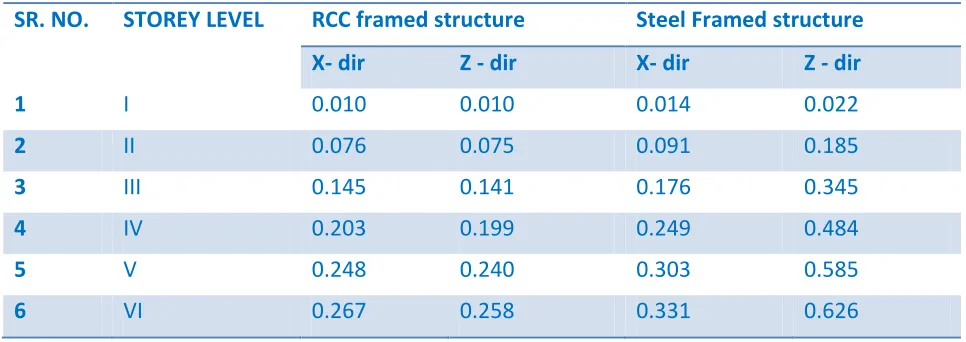
Analyses of results In all, two buildings have been analyzed for seismic load. The seismic force was applied in X & Z direction independently.
Table 5.1 Lateral Displacements:
SR. NO. STOREY LEVEL RCC framed structure Steel Framed structure
X- dir Z - dir X- dir Z - dir
1 I 0.010 0.010 0.014 0.022
2 II 0.076 0.075 0.091 0.185
3 III 0.145 0.141 0.176 0.345
4 IV 0.203 0.199 0.249 0.484
5 V 0.248 0.240 0.303 0.585
Organized by C.O.E.T, Akola & IWWA, Amravati Center. Available Online at www.ijpret.com25
Table 5.2 Storey Drift:
SR. NO. STOREY LEVEL RCC framed structure Steel Framed structure
X- dir Z - dir X- dir Z - dir
1 I 0.010 0.010 0.014 0.022
2 II 0.066 0.065 0.077 0.163
3 III 0.069 0.067 0.084 0.161
4 IV 0.058 0.057 0.074 0.139
5 V 0.045 0.041 0.054 0.101
6 VI 0.020 0.018 0.027 0.040
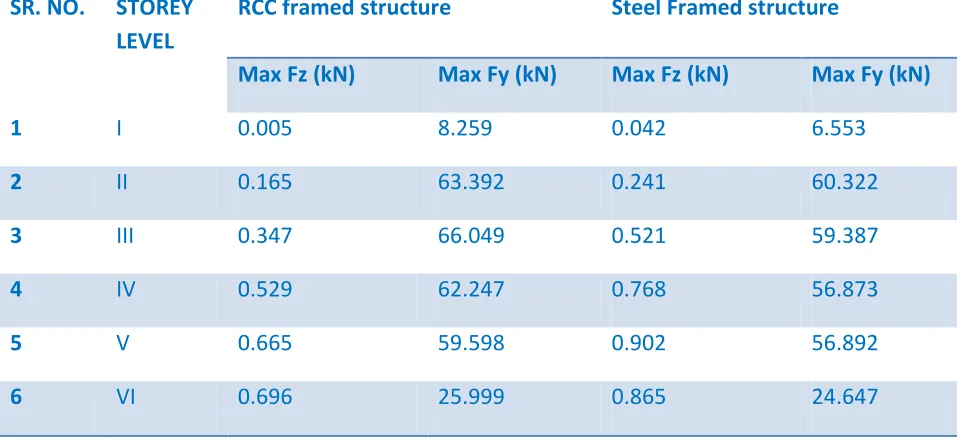
Table 5.3 Maximum shear force:
SR. NO. STOREY
LEVEL
RCC framed structure Steel Framed structure
Max Fz (kN) Max Fy (kN) Max Fz (kN) Max Fy (kN)
1 I 0.005 8.259 0.042 6.553
2 II 0.165 63.392 0.241 60.322
3 III 0.347 66.049 0.521 59.387
4 IV 0.529 62.247 0.768 56.873
5 V 0.665 59.598 0.902 56.892
Organized by C.O.E.T, Akola & IWWA, Amravati Center. Available Online at www.ijpret.com26
1) Storey levels Vs Lateral displacement 2) Storey levels Vs Lateral displacement
STOREY LEVELS STOREY LEVELS
6. CONCLUSIONS
From the results obtained i.e. seismic analysis of RCC framed structure and Steel framed structures, it can be concluded as
1)Lateral displacements in longitudinal and transverse direction in RCC framed structures are
less as compared to the Lateral displacement in Steel framed structures.
2)Steel framed structure will resist more lateral forces and will undergo deformation due to
the property of ductility but at the same condition RCC framed structure will undergo cracks.
3)Storey drift in longitudinal transverse direction in RCC framed structures are less as
compared to the Lateral displacement in Steel framed structures.
4) Shear forces in RCC framed structures are relatively less as compared to that in Steel framed
structures.
REFERENCES
1. Siamak Sattar and Abbie B. Liel, 2010. “Seismic performance of reinforced concrete frame
structures with and without masonry infill walls”. Dept. of Civil, Environmental and Architectural Engineering, Univ. of Colorado, Boulder
Organized by C.O.E.T, Akola & IWWA, Amravati Center. Available Online at www.ijpret.com27
2. Young J. Park, Andrei M. Reinhorn and Sashi K. Kunnatii, 1988. “Seismic damage analysis of
reinforced concrete buildings”, Proceedings of ninth world conference on earthquake engg, Tokyo Japan.
3. Dr. Saraswati Setia, Vineet Sharma, 2012. “Seismic Response of R.C.C Building with Soft
Storey”, International Journal of Applied Engineering Research, ISSN 0973-4562 Vol.7 No.11.
4. Sarosh Hashmat Lodi, Aslam Faqeer Mohammad, 2012. “Nonlinear Static Analysis of an Infill
Framed Reinforced Concrete Building”, World conference on earthquake engg, Losbia.
5. E. Pavan Kumar, A. Naresh, M. Nagajyothi, M. Rajasekhar, 2014. “Earthquake Analysis of
Multi Storied Residential Building - A Case Study”, Int. Journal of Engineering Research and Applications ISSN : 2248-9622, Vol. 4, Issue 11( Version 1), pp.59-64.
6. A. E. Hassaballa ,Fathelrahman M. Adam ,M. A. Ismaeil,2013. “Seismic Analysis of a
Reinforced Concrete Building by Response Spectrum Method”, IOSR Journal of Engineering (IOSRJEN) e-ISSN: 2250-3021, p-ISSN: 2278-8719 Vol. 3, Issue 9, ||V3|| PP 01-09.
7. Jag Mohan Humar and Mohamed A. Mahgoub, 2003.“Determination of seismic design forces
by equivalent static load method”, Special Issue on the Proposed Earthquake Design requirements of the National Building Code of Canada, 2005 edition.
8. IS 456: 2000, “Code for practice of plain and reinforced concrete code of practice, Bureau of
Indian Standards”, New Delhi.
9. IS 1893: 2002, “Code for earthquake resistant design of structures- general provisions for
buildings, Part I, Bureau of Indian Standards”, New Delhi.
10. IS 800: 2007, “Indian Standard Code of practice for General Construction of Steel in India,