Available Online At www.ijpret.com
INTERNATIONAL JOURNAL OF PURE AND
APPLIED RESEARCH IN ENGINEERING AND
EFFECT OF ARC
SUBMERGED ARC WELDING (SAW) PROCESS
AMRAT M.
1. Research Scholar, Dr. K N Modi University, Newai, Rajasthan. 2. Asst. Professor, L.E. College, Morbi, Gujarat
Accepted Date:
16/01/2013
Publish Date:
01/02/2013
Keywords
Submerged arc welding,
Weld bead geometry,
Heat affected zone,
welding heat input
Corresponding Author
Mr. Amrat M. Patel
Research Scholar, Dr. K N
Modi University, Newai,
Rajasthan.
IJPRET-QR CODE
Available Online At www.ijpret.com
INTERNATIONAL JOURNAL OF PURE AND
APPLIED RESEARCH IN ENGINEERING AND
TECHNOLOGY
A PATH FOR HORIZING YOUR INNOVATIVE WORK
EFFECT OF ARC WELDING PARAMETERS CONTROLLING
SUBMERGED ARC WELDING (SAW) PROCESS- A REVIEW
AMRAT M. PATEL1, Dr. ASHISH V. GOHIL2
Research Scholar, Dr. K N Modi University, Newai, Rajasthan. , L.E. College, Morbi, Gujarat.
Abstract
Submerged arc welding (SAW) is an important metal fabrication technology specially applied to join metals of large thickness in welding process. The process use of granular flux blanket that covers the molten weld pool during operation, protection through atmospheric contamination of the weld bead and slower cooling rate, achieved by this arrangement can improve mechanical properties of the weldment. Welding input parameters play a very significant role in determining the quality of a weld joint. The joint quality can be assessed in terms of properties such as weld-bead geometry, mechanical properties, and distortion. Best quality and cost effective welds can be achieved by proper understanding the weld metal properties and the influence of welding parameters. This paper presents the comprehensive research review on ef
welding parameter on quality of welds.
INTERNATIONAL JOURNAL OF PURE AND
APPLIED RESEARCH IN ENGINEERING AND
A PATH FOR HORIZING YOUR INNOVATIVE WORK
WELDING PARAMETERS CONTROLLING
A REVIEW
Submerged arc welding (SAW) is an important metal technology specially applied to join metals of large thickness in welding process. The process use of granular flux blanket that covers the molten weld pool during operation, protection through atmospheric contamination of the weld rate, achieved by this arrangement can improve mechanical properties of the weldment. Welding input parameters play a very significant role in determining the quality of a weld joint. The joint quality can be assessed in ad geometry, mechanical properties, and distortion. Best quality and cost effective welds can be achieved by proper understanding the weld metal properties and the influence of welding parameters. This paper presents the comprehensive research review on effect of arc
Available Online At www.ijpret.com
INTRODUCTION
Welding is an efficient and economical
method for joining of metals. The
advantages of welding, as a joining process,
include high joint efficiency, good set up,
flexibility and low fabrication costs. Due to
its good reliability, deep penetration,
smooth finish and high productivity,
submerged arc welding (SAW) has become
a natural choice in industries for fabrication.
It is widely recognized as very productive
welding process from single wire approach
to more productive variants as twin wire,
tandem ad metal power addition 1,2. Due to
these qualities SAW is preferred in
fabrication Industries. Electrode stick out
important parameter in SAW direct effect
on parameters like penetration, hardness,
impact value, yield strength and ultimate
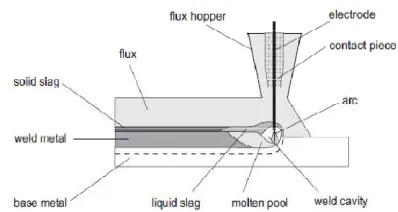
strength of the weld joint 23. Figure 1.
Shows submerged arc welding.
Figure 1 Submerged arc welding
Submerged Arc Welding Process
Parameters
A. Arc voltage
Arc voltage, also called welding voltage,
means the electrical potential difference
between the electrode wire tip and the
surface of the molten weld puddle. It is
indicated by the voltmeter provided on the
equipment. It hardly affects the electrode
melting rate, but it determines the profile
and surface appearance of the weld bead.
As arc voltage increases, the weld bead
becomes wider and flatter, and the
penetration decreases. Murugun et al.5
observed that voltage has no significant
effect on penetration, reinforcement
decreases but bead width increases with
increases in voltage. Increase in voltage
increases bead width while using a
particular electrode diameter and extension
irrespective of the electrode positive or
Available Online At www.ijpret.com
Figure 2 Effect of arc voltage on bead
width (after 25)
B. Speed of arc travel
For a given combination of welding current
and voltage, increase in the welding speed
or the speed of arc travel results in lesser
penetration, lesser weld reinforcement and
lower heat input per unit length of weld.
Excessively high travel speeds decrease
fusion between the weld deposit and the
parent metal, and increase tendencies for
undercut, arc blow, porosity and irregular
bead shape. As the travel speed is
decreased, penetration and weld
reinforcement increase. But too slow a
speed results in poor penetration, because
under this condition, the weld puddle is
directly under the electrode tip and the
force of the arc is cushioned by the weld
puddle. Excessively slow speeds also
produce a convex bead shape, which results
in an uneven weld bead with slag inclusions
24
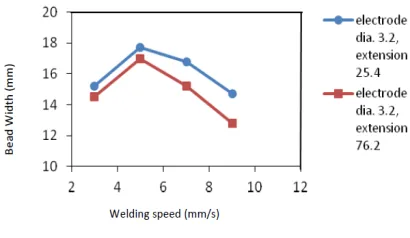
. It is clear from the Figure 3 that with
increase in welding speed the bead width
increases initially but it decreases with
further increase in the welding speed.
Figure 3 Effect of welding speed on bead
width (after 25)
C. Size of electrode
As in the case of SAW, the electrode size is
selected according to the plate thickness
and the desired size of weld. With increase
in electrode size, welding current can be
increased so as to get higher deposition
rates, deeper penetration and increased
weld size. At a given welding current,
changing over to a larger electrode results
in a wider, less penetrating bead. Hence in
joints with poor fit-up, a larger electrode is
preferred to a smaller one for bridging the
root gap. For a given electrode size, a high
current density (i.e. welding current in amps
Available Online At www.ijpret.com expressed in amps/ mm2) results in a
strong, penetrating arc, while a lower
current density gives a soft arc which is less
penetrating 2.
D. Electrode stick-out
It is also termed electrode extension. It
refers to the length of the electrode,
between the end of contact tube and the
arc, which is subject to resistance heating
(also called I2R heating) at the high current
densities used in the process. The longer
the stick-out, the greater the amount of
heating and the higher the deposition rate.
Increased electrode stick-out reduces to
some extent the energy supplied to the arc,
resulting in lower arc voltage and a
different bead shape. Hence when the
electrode stick-out is increased to obtain
higher deposition rate, the voltage setting
on the equipment must be increased to
maintain correct arc length. Deposition
rates can be increased by as much as
25-50% by increasing electrode stick-out, but
the technique is little used in industry.
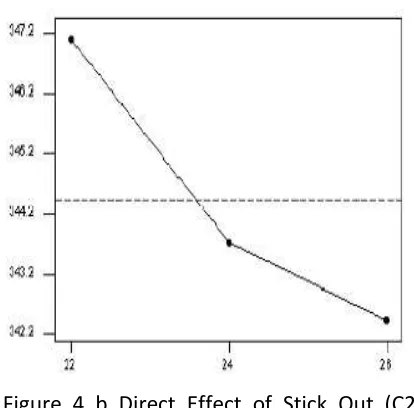
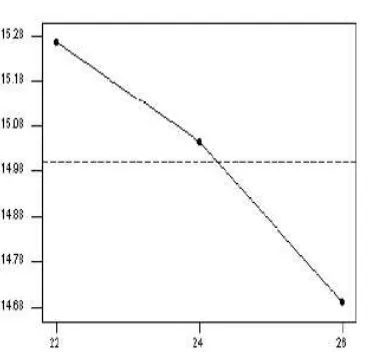
Figure 4(a-d) It shows that with increase in
electode stick out hardness of the
weldement increases, yield strength and
impact value decreases, ultimate tensile
strength of the joint initially decreases but
after increases provided welding current
and voltage are kept at constant 23.
Figure 4 a Direct Effect of Stick out (C2) on
Hardness of Weldment (C7)
Figure 4 b Direct Effect of Stick Out (C2)
Available Online At www.ijpret.com Figure 4 c Direct Effect of Stick out (C2) on
Impact Strength of the Joint (C8)
Figure 4 d Direct Effect of Stick out (C2) on
Ultimate Tensile Strength of the Joint (C10)
E. Flux
A flux protects weld pool from atmospheric
contamination and also provides alloying
elements brings about desirable chemical
changes to the weld metal and control the
shape of the deposited metal. It also
pointed out that filler wire and flux
composition has a decisive role in formation
of weld microstructure to achieve the
desired properties in the weldment10.
Mechanical properties of the welds are
improved for the fluxes containing TiO2
contents due to presence of acicular
ferrite11. Figure 8 shows that with increases
in titanium content hardness increase
which results in better mechanical
properties12.
F. Welding Polarity
Polarity is the direction of current flow.13
reported that polarity influences the
amount of heat generated at the welding
wire and work piece in the welding process
which depends on direct current electrode
positive (DCEP or reverse) or direct current
negative polarity (DCEN or straight). There
is more arc spread in straight polarity than
in reverse polarity resulting in a higher bead
width and less penetration. The two third of
the total heat is generated at the positive
welding wire and the one third of the total
heat is generated at the negative welding
wire14. Robinson15 observed that DCEN has
more electrode melting rate as compared
Available Online At www.ijpret.com Figure 5 a Direct effect of welding speed on
the width of the different HAZ region 26
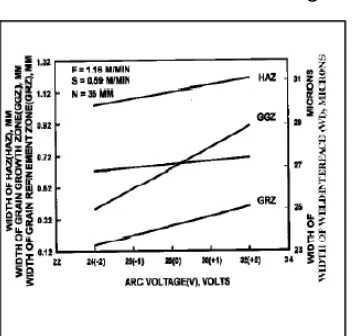
Figure 5 b Direct effect of arc voltage on the
width of the different HAZ region 26
Figure 5 d Direct effect of heat input on the
width of the different HAZ region 26
Figure 5 e Direct effect of wire feed rate on
HAZ characteristics 26
REVIEW OF THE QUALITY OF WELD
Submerged arc welding is a welding process
which is capable of welding thick material
with high productivity and suitable for
welding of all sorts of low carbon steel, low
alloy steel, stainless steel and heat resisting
steels. Review of effect of submerged arc
welding on quality of weld joint has been
discussed below.
Effect of process parameters on HAZ
In submerged arc welding heat affected
zone, required bead size and quality can be
controlled by selecting the different process
variables.
Viano, D.M.; Ahmed, N.U.; Schumann, G.O.
16
Available Online At www.ijpret.com results in a decrease in cooling rate and the
widths of the different zones of the HAZ
increase steadily with the increase in heat
input. Due to the influence of heat input
and travel speed on microstructure and
mechanical properties of double tandem
submerged arc high strength low alloy steel.
Murugun and Gunaraj 24 while predicting
area of heat affected zone for bead on plate
and bead on joint in submerged arc welding
of pipes developed the mathematical model
which can effectively control the area of
HAZ by substituting appropriate values of
process variables.
V. Gunaraj and N. Murugan 26 Figure 5(a-d).
shows the effects of process variables on
HAZ parameters. The dimensions of the
different HAZ layers increases with the
increases in Voltage, wire feed rate, heat
input but decreases with increases in
welding speed.
Moeinifar, S.; Kokabi, A.H.; Hosseni, H.R.M.
18
on studying the effect of process
parameters of tandem submerged arc
welding on heat affected zone of welded
specimen of high strength low alloy steel
found that thermal cycles of tandem
submerged arc welding has a significant
effect on morphology of martensite and
austenite constituents. Investigation of
microstructure of submerged arc welded
high strength low alloy steel joints revealed
that increase in heat input coarsened the
grain structures both in weld metal and
heat affected zone.
Keshav Prasad; D. K. Dwivedi 17, describe
the microstructure and tensile properties of
Submerged Arc Welded 1.25Cr-0.5Mo Steel
Joints concluded that the increase in the
heat input affects the proportions of
different micro constituents both in the
weld metal and heat affected zone (HAZ). It
is also observed that with increase in heat
input the tensile strength (UTS, YS)
decreases.
Aniruddha Ghosh, Somnath
Chattopadhyaya, R.K.Das, P.K.Sarkar 19
describes the Heat Affected Zone related to
submerged arc welding process is
significantly less. The grain growth are even
lower than the 10% of the total area as
observed by digital image processing tool
Available Online At www.ijpret.com affected zone of the process. The grains are
predominantly of smaller variety and the
counts for larger grain are almost negligible.
The absence of larger size grains in the
image vouch for the soundness of the weld
in comparison to the competing welding
methodologies of structural steel plates.
EFFECT OF PROCESS PARAMETERS ON
MECHANICAL PROPERTIES
The independent process parameters which
influence the mechanical properties and
can be controlled are voltage, current, stick
out, wire feed rate and travel speed, etc. 23.
Prasanta Kanjilal; Tapan Kumar Pal ;Sujit
Kumar Majumdar[06], studying the
prediction of mechanical properties in
submerged arc weld metal of C-Mn Steel,
the prediction model has been developed
for steel weld metal mechanical properties
as a function of flux ingredients such as
CaO, MgO, CaF2 and Al2O3 in submerged
arc welding carried out at fixed welding
parameters, and concluded that among the
flux ingredients, MgO appears to be
important on its own in influencing the
mechanical properties.
A Sharma, N Arora, B K Mishra 9 while the
study of statistical modeling of deposition
rate in twin-wire submerged arc welding
concluded that a significant amount of
material loss might occur in the case of
single- wire SAW. Material losses also
depend on the polarity. In the case of Direct
current electrode negative (DCEN), the loss
is, on average, about 8 percent, whereas in
the case of DCEP, the same is about 4 per
cent.
S. W. Wen, P. Hilton and D. C. J. Farrugia 7,
while doing Finite element modeling of a
submerged arc welding process concluded
that the geometrical distortion and residual
stresses and strains caused by welding can
be minimized through process optimization.
It is therefore demonstrated that finite
element analysis can be applied to better
understand the SAW process and hence will
be a useful tool for future process
development and control with the view of
optimizing product properties.
Kolhe and Datta20 while the detailed study
on the microstructure and mechanical
properties of submerged arc weld multipass
Available Online At www.ijpret.com control the percentage of phase formation
in the welded joint which influences the
microstructure. Microstructure and wear
property while the study of alloy cladding
by submerged arc welding revealed that
presence of increased content of retained
austenite in the microstructure results in
lower hardness.
S. Moeinifar, A.H. Kokabi, H.R. Madaah
Hosseini 21 The influence of thermal cycles
on the properties of the coarse grained heat
affected zone is investigated. The thermal
simulated involved heating the X80 steel
specimens to the peak temperature of 1400
◦C, with different cooling rates. The
four-wire tandem submerged arc welding
process, with different heat input values,
was used to generate a welded
microstructure. The martensite/ austenite
constituent appeared in the microstructure
of the heat affected zone region for all the
specimens along the prior-austenite grain
boundaries and between the bainitic ferrite
laths. The blockylike and stringer
martensite/austenite morphology were
observed in the heat affected zone region.
The fractional area of M/A particles due to
different cooling rate was the main factor in
increasing of the hardness values in the
coarse grained heat affected zone. The
Charpy absorbed energy of specimens was
assessed using Charpy impact testing at −50
◦C. The martensite/austenite constituent’s
size such as mean diameter and length are
important factors influencing Charpy impact
properties of coarse grained heat affected
zone. The micro crack nucleation may occur
from M/A particles at the intersection of
prioraustenite grain boundaries.
EFFECT OF PROCESS PARAMETERS ON
WELD BEAD GEOMETRY
Ghosh, A.; Chattopadhyaya, S.; Sarkar, P.K.22
investigated that weld bead geometry is
appreciably affected by input parameters. It
shows that increase of welding speed has a
negative effect on weld bead parameters
and with increase in the current increase in
penetration and marginal increase in
reinforcement height is observed but the
bead width decreased, however increase in
arc voltage made the weld bead wider and
flatter but decreases the penetration. Wire
feed rate has a significant positive effect
but welding speed has an appreciable
Available Online At www.ijpret.com parameter penetration whereas arc voltage
has a less significant negative effect on
penetration and reinforcement which
indicate that weld bead geometry is
influenced by these process parameters.
N. Murugan, R.S. Parmar and S.K. Sud 05,
while discussing the effect of submerged
arc process variables on dilution and bead
geometry in single wire surfacing said that
the control parameters are required to be
feed to the system according to some
mathematical formulation to achieve the
desired end results. The responses, namely,
penetration, reinforcement, width and
dilution as affected by open-circuit voltage,
wire feed-rate, welding speed and nozzle to
plate distance, have been investigated. The
main and interaction effect of the control
factors is shown in graphical form, which is
more useful in selecting the process
parameters to achieve the desired quality
of the overlay.
R.S. Chandel, H.P. Seow, F.L. Cheong 02
studied the effect of increasing deposition
rate on the bead geometry of submerged
arc welds concluded that for a given current
(and heat input) the melting rate can be
increased by using electrode negative,
longer electrode extension, and smaller
diameter electrodes. There are other ways
to increase the deposition rate without
increasing the heat input, these being by
using a twin-arc mode and by adding metal
powders.
J.Tusek, M. Suban01 It was found that the
use of metal powder will increase the
deposition rate and the welding arc
efficiency and reduce the shielding-flux
consumption. When dealing with,
high-productivity multiple-wire submerged-arc
welding and cladding with metal-powder
addition. By using the metal-powder
addition it is possible to alloy a weld or a
cladding with optional chemical elements.
K. Y. Benyounis, A. G. Olabi03 while dealing
with optimization of different welding
processes using statistical and numerical
approaches, developed a mathematical
relationship between the welding process
input parameters and the output variables
of the weld joint in order to determine the
welding input parameters that lead to the
Available Online At www.ijpret.com Serdar Karaoğlu and Abdullah Seçgin04 It
focuses on the sensitivity analysis of
parameters and fine tuning requirements of
the parameters for optimum weld bead
geometry. Effects of welding current,
welding voltage and welding speed design
parameters on the bead width and bead
height show that even small changes in
these parameters play an important role in
the quality of welding operation. The results
also reveal that the penetration is almost
non-sensitive to the variations in voltage
and speed.
DISCUSSION
The several process control parameters in
SAW influence bead geometry,
microstructure of welded joints.
Composition of base metal, electrode wire
and flux also effect on the microstructure of
weld metal. The effect is reflected on the
mechanical properties of the weld in terms
of weld quality as well as joint performance.
The study of various works, reviewed that,
the selection of the suitable process
parameters are the primary means by
which acceptable HAZ properties, optimized
bead geometry and minimum residual
stresses are produced. Some researchers
realized that the mechanical properties of
weld are influenced by the composition of
the base metal and to a large extent by the
weld bead geometry and shape relationship
as well. Some of the researchers observed
that with increase in electrode stick out,
hardness of the weldment increases, yield
strength and impact value decreases,
ultimate tensile strength of the joint initially
decreases but thereafter increases provided
welding current and voltage are kept at
constant levels. While discussing the
submerged arc welding with cored wires
few researchers summarized that
deposition rates with cored wires at the
same welding current are between 20 and
30% higher than with the equivalent
diameter solid wire. Some researchers
studied the function of flux ingredients such
as CaO, MgO, CaF2 and Al2O3 in submerged
arc welding and concluded that among the
flux ingredients, MgO appears to be
important on its own in influencing the
mechanical properties. Statistical and
numerical methods are useful for
determination of optimized welding input
Available Online At www.ijpret.com quality. Further process parameters should
be chosen so as to achieve the minimum
heat affected zone and least residual
stresses and distortion. The following gaps
in literature review have been discovered.
• Very less work has been reported on
metal transfer in SAW, which influences the
chemical composition and metallurgy of
weld metal, arc stability, weld bead
geometry as well as strength of the weld.
• Very less work on current voltage
transient study in submerged arc welding
has been reported as many characteristics
are influence by current voltage.
• The study of effect of polarity change
affects the amount of heat generated at
welding electrode and work piece. Hence
influences the metal deposition rate, weld
bead, HAZ and mechanical properties of the
weld metal.
ACKNOWLEDGEMENT
I wish to expresses my deep sense of
gratitude and indebtedness to my
supervisor Prof. (Dr.) Ashish V. Gohil for his
valuable guidance, patient reviews, and
painstaking efforts in providing valuable
suggestion in giving final shape to the text
Available Online At www.ijpret.com
REFERENCES
1. J Tusek, M. Suban, High-productivity
multiple-wire submerged-arc welding and
cladding with metal-powder addition,
Journal of Materials Processing Technology
2003; 133: 207–213.
2. RS Chandel, HP Seow, FL Cheong, Effect
of increasing deposition rate on the bead
geometry of submerged arc welds, Journal
of Materials Processing Technology 1997;
72: 124–128.
3. KY Benyounis, AG Olabi, Optimization of
different welding processes using statistical
and numerical approaches - A reference
guide 2008; 39: 483-496.
4. Serdar Karaoğlu and Abdullah Seçgin,
Sensitivity analysis of submerged arc
welding process parameters, Journal of
Materials Processing Technology, 2008;
202: 500-507.
5. N. Murugan, R.S. Parmar and S.K. Sud,
Effect of submerged arc process variables
on dilution and bead geometry in single
wire surfacing. Journal of Materials
Processing Technology, 1993; 37: 767-780.
6. Prasanta Kanjilal; Tapan Kumar Pal ;Sujit
Kumar Majumdar,Prediction of Mechanical
Properties in Submerged Arc Weld Metal of
C-Mn Steel,Journal of materials and
manufacturing process, 2007; 22: 114-127.
7. S. W. Wen, P. Hilton and D. C. J.
Farrugia, Finite element modeling of a
submerged arc welding process. Journal of
Materials Processing Technology, 2001;
119: 203-209.
8. E. Armentani, R. Esposito, R. Sepe,The
effect of thermal properties and weld
efficiency on residual stresses in welding.
Journal of Achievements in Materials and
Manufacturing Engineering, 2007; 20:
319-322.
9. A Sharma, N Arora, B K
Mishra,Statistical modeling of deposition
rate in twin-wire submerged arc welding,
Journal of Engineering Manufacture, 2009;
Available Online At www.ijpret.com 10. Fleck NA, Grong O, Edwards GR and
Matlock DK, Role of filler metal wire and
flux composition in submerged arc weld
metal transformation kinetics, Welding
Journal, 1986; 5: 113s-121s.
11. Ma A, Hirata VM and Munoz MLS,
Influence of chemical composition of flux on
the microstructure and tensile properties of
submerged arc welds, Journal of Material
Processing Technology, 2005; 169: 346-351.
12. Beidokhti B, Koukabi AH and Dolati A.
Effect of titanium addition on the
microstructure and inclusion formation in
submerged arc welded HSLA pipeline steel,
Journal of Material Processing Technology,
2009; 209: 4027-4035.
13. Harwig DD, Dierksheide JE, Yapp D,
Blackman S. Arc behaviour and melting rate
in VP- GMAW process, Welding Journal,
2006; 3; 52s-62s.
14. Little RL, Welding and Welding
Technology, pp. 169-176, Tata McGraw Hill
Publishing Co.Ltd. 2004.
15. Robinson MH, Observation on electrode
melting rates during submerged arc
welding, Welding Journal, 1961; 11:
503s-509s.
16. Viano DM and Ahmed NU, influence of
heat input and travel speed on
microstructure and mechanical properties
of double tandem submerged arc high
strength low alloy steel weldments, Journal
of science and technology of welding and
joining, 2000; 5 : 26- 34.
17. Keshav Prasad, DK Dwivedi,
Microstructure and Tensile Properties of
Submerged Arc Welded 1.25Cr-0.5Mo Steel
Joints, Journal of Materials and
Manufacturing processes, 2008; 23:
463-468.
18. Moeinifar S, Kokabi AH and Hosseni
HRM, Effect of tandem submerged arc
welding process and parameters of gleeble
simulator thermal cycles on properties of
the intercritically reheated heat affected
zone, Material and Design, 2010; 32:
869-876.
19. Aniruddha Ghosh, Assessment of Heat
Affected Zone of Submerged Arc Welding
Available Online At www.ijpret.com 20. Kolhe KP and Datta CK, Predication of
microstructure and mechanical properties
of multi pass SAW, Journal of Material
Processing Technology, 2008; 197: 241-249.
21. S Moeinifar, AH Kokabi, HR Madaah
Hosseini, Role of tandem submerged arc
welding thermal cycles on properties of the
heat affected zone in X80 microalloyed pipe
line steel.
22. Ghosh A, Chattopadhyaya S, Sarkar PK,
Effect of input parameters on weld bead
geometry of SAW process, Proceeding of
International Conference (ICME), Dhaka
Bangladesh. 2007.
23. Datta S, Sunder M, Bandyopadhyay A,
Nandi G, Pal PK and Roy SC, Effect of
electrode stickout on quality and
performance of submerged arc
weldments-Experimental and statistical analysis,
International Conference on Mechanical
Engineering, , 2005; 39: 1-6.
24. Murugun N and Gunaraj V, Prediction
and Comparison of area of heat affected
zone for bead on plate and bead on joint in
submerged arc welding of pipes, Journal of
Material Processing Technology. 1999; 95:
246-261.
25. Yang LJ, Chandel RS, Bibby MJ, The
effects of process variables on the bead
width of submerged arc welding, Journal of
Material Processing Technology, 1992; 29:
133-144.
26. V Gunaraj And N. Murugan, Prediction
of Heat-Affected Zone Characteristics in
Submerged Arc Welding of Structural Steel