Available Online at www.ijpret.com 100
INTERNATIONAL JOURNAL OF PURE AND
APPLIED RESEARCH IN ENGINEERING AND
TECHNOLOGY
A PATH FOR HORIZING YOUR INNOVATIVE WORK
EFFECT ON FLEXURAL STRENGTH OF GEOPOLYMER CONCRETE BY USING
FLY ASH AND ALKALINE SOLUTION AS A 100% REPLACEMENT OF CEMENT
ABHIJITSINH PARMAR1, DHAVAL M PATEL2
1. Head & Assistant Professor, Department of Civil Engineering, SVBIT, Gandhinagar. 2. Assistant Professor, Department of Civil Engineering, SVBIT, Gandhinagar.
Accepted Date: 19/11/2014; Published Date: 01/12/2014
\
Abstract: With the passing of times, the emission of Carbon from different aspects are on a verge of rise, as the time passes by the rate goes on increasing, production of cement also adds up in the emission of carbon, Replacing Cement 100% by Fly Ash is a step taken to decrease the carbon emission from concrete, By replacing Geo-polymers in concrete in place of cement by using waste materials as binders, & implementing various curing techniques to provide strength to our units.
Keywords: Geopolymer, Fly ash, Alkaline Solution, Flexural Strength, Replacing Cement,
Reduce Carbon emission in atmosphere
Corresponding Author: MR. ABHIJITSINH PARMAR
Access Online On:
www.ijpret.com
How to Cite This Article:
Available Online at www.ijpret.com 101 INTRODUCTION
Geopolymers are new materials for fire and heat-resistant coatings and adhesives, medicinal applications, high-temperature ceramics, new binders for fire-resistant fiber composites, toxic and radioactive waste encapsulation and new cements for concrete[1].
The properties and uses of geopolymers are being explored in many scientific and industrial disciplines: modern inorganic chemistry, physical chemistry, colloid chemistry, mineralogy, geology, and in other types of engineering process technologies.
Geopolymers are part of polymer science, chemistry and technology that forms one of the major areas of materials science. Polymers are either organic material, i.e. carbon-based, or inorganic polymer, for example silicon-based.
The organic polymers comprise the classes of natural polymers (rubber, cellulose), synthetic organic polymers (textile fibers, plastics, films, elastomers, etc.) and natural biopolymers (biology, medicine, pharmacy) [2]. Raw materials used in the synthesis of silicon-based polymers are mainly rock-forming minerals of geological origin [3].
MATERIALS
This includes materials and their specifications the tests performed on geopolymer concrete as per relevant standards and details of making and testing of geopolymer concrete. On the basis of literature review and trails experimental program was derived. It specifies the materials (such as fly ash), mixture proportion, parameters such as ratio of alkaline solution to source material, methods of curing, tests to be performed, period of testing. The materials used for making fly ash-based geopolymer concrete specimens are fly ash as the source material, aggregates, alkaline solution, and water.
Alkaline solution:-
Available Online at www.ijpret.com 102 Table -1: Chemical Properties of Fly Ash
Chemical composition weight % Fly Ash
SiO2 53.79
Al2O3 32.97
Fe2O3 5.51
CaO 1.84
MgO 0.92
Na2O 0.37
K2O 1.76
TiO2 2.10
SO3 0.46
P2O5 0.15
Table -2: Sieve analysis of Fine Aggregate
Table -3: Sieve analysis of Coarse Aggregate
Sieve Retain Retain Cumulative Passing
Gm % % %
10 mm 0 0 - 10
4.75 mm 6 3 3 97
2.36 mm 38 19 21 79
1.18 mm 54 27 48 52
600 31 15.5 63.5 36.5
300 43 21.5 85 15
150 10 5 90 10
Pan 20 10 100 0
COARSE AGGREGATE 10 MM
Sieve Retain Retain Cumulative Passing
Gm % % %
12.5 16 0.8 0.8 99.2
10 212 10.6 11.4 88.6
4.75 1445 72.25 83.65 16.35
Available Online at www.ijpret.com 103 Silica Fume:-
Silica fume is a by product of producing silicon metal or ferrosilicon alloys. One of the most beneficial uses for silica fume is in concrete. Because of its chemical and physical properties, it is a very reactive pozzolan. Concrete containing silica fume can have very high strength and can be very durable. Silica fume is available from suppliers of concrete admixtures and, when specified, is simply added during concrete production. Placing, finishing, and curing silica-fume concrete require special attention on the part of the concrete contractor.
MIX DESIGN
Table -4: Mix Design for One Beam
Materials Weight in kg
Fly Ash 2.51
Fine Aggregate (sand) 2.76
Coarse Aggregate (10mm) 1.86
Coarse Aggregate (20mm) 1.86
Silica Fume 0.93
Alkaline Solution
NaOH Flakes 0.21
Water 0.26
Na2siO3 1.19
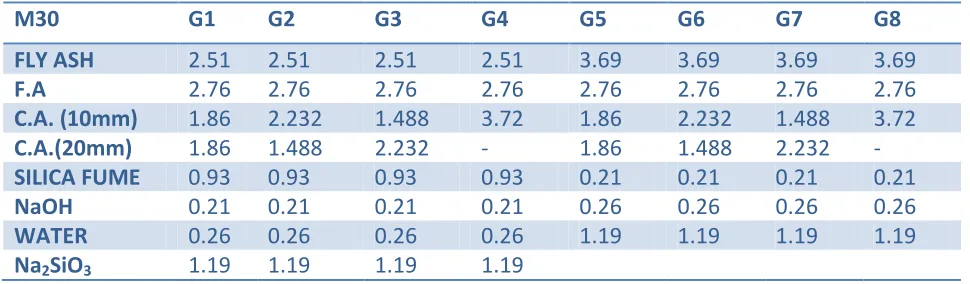
Table -5: Different Proportion for Test
M30 G1 G2 G3 G4 G5 G6 G7 G8
FLY ASH 2.51 2.51 2.51 2.51 3.69 3.69 3.69 3.69
F.A 2.76 2.76 2.76 2.76 2.76 2.76 2.76 2.76
C.A. (10mm) 1.86 2.232 1.488 3.72 1.86 2.232 1.488 3.72
C.A.(20mm) 1.86 1.488 2.232 - 1.86 1.488 2.232 -
SILICA FUME 0.93 0.93 0.93 0.93 0.21 0.21 0.21 0.21
NaOH 0.21 0.21 0.21 0.21 0.26 0.26 0.26 0.26
WATER 0.26 0.26 0.26 0.26 1.19 1.19 1.19 1.19
Available Online at www.ijpret.com 104 EXPERIMENTAL PROGRAM
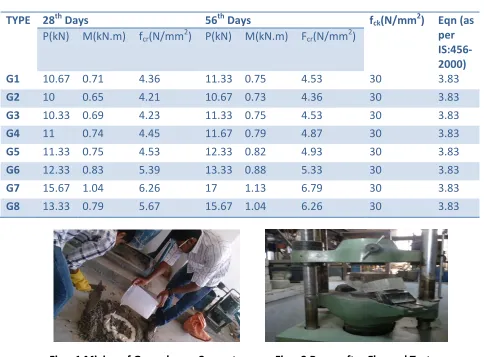
Geopolymer Concrete Beams having grade M30 were made by fly Ash as a 100% replacement of cement and Alkaline Solution. Moulds with dimensions of 500 mm X 100mm X 100 mm. After casting, all moulds were cured by 5 different methods natural, Self, Oven cured, by Adding Accelerometer as an admixture and cured by silica fume. Mix proportion of geopolymer concrete as per table – 6.
Table – 6 Flexural test results of 28th and 56th days
TYPE 28th Days 56th Days fck(N/mm2) Eqn (as
per IS:456-2000)
P(kN) M(kN.m) fcr(N/mm2) P(kN) M(kN.m) Fcr(N/mm2)
G1 10.67 0.71 4.36 11.33 0.75 4.53 30 3.83
G2 10 0.65 4.21 10.67 0.73 4.36 30 3.83
G3 10.33 0.69 4.23 11.33 0.75 4.53 30 3.83
G4 11 0.74 4.45 11.67 0.79 4.87 30 3.83
G5 11.33 0.75 4.53 12.33 0.82 4.93 30 3.83
G6 12.33 0.83 5.39 13.33 0.88 5.33 30 3.83
G7 15.67 1.04 6.26 17 1.13 6.79 30 3.83
G8 13.33 0.79 5.67 15.67 1.04 6.26 30 3.83
Fig – 1 Mixing of Geopolymer Concrete Fig – 2 Beam after Flexural Test
CONCLUSION
Available Online at www.ijpret.com 105
Increasing the Silica Fume content in Geopolymer Concrete will decrease the Flexural strength of Geopolymer Concrete.
The maximum Flexural Strength gain from the Oven Curing of 24 hours.
Also Increasing the C.A./F.A. ratio increase the Flexural Strength.
REFERENCES
1. Michael J. Gibbs, Peter Soyka and David Conneely - CO2 Emissions from cement production, (ICF Incorporated). It was reviewed by Dina Kruger (USEPA).
2. Stevenson, M., and Panian, L. - “Sustainability through Strength,” Concrete International, V. 31, No. 3, Mar. 2009, pp. 34-39.
3. Raijiwala D.B. Patil H. S. - Geopolymer concrete: A concrete of next dicade.
4. Joseph Davidovits - Geopolymer chemistry & application 2nd edition (June 2008), Institute Geopolymer, France
5. Prof. M. A. Bhosale, Prof. N. N. Shinde - Geopolymer Concrete by Using Fly Ash in Construction (Energy, shivaji University, India), (Department of Energy Technology, Shivaji University, Kolhapur)
6. N. Lloyd and V. Rangan - Geopolymer Concrete Sustainable Cement less Concrete
7. Satpute Manesh B., Wakchaure Madhukar R., Patankar Subhash V. - Effect of Duration and Temperature of Curing on Compressive Strength of Geopolymer Concrete
8. Djwantoro Hardjito, Steenie E. Wallah, Dody M.J. Sumajouw, and B.V. Rangan - Factors influencing the compressive strength of fly ash-based Geopolymer concrete
9. S.vaidya ,E.i.diaz,E.n.allouche - Experimental evaluation of self cure geopolymer concrete for mass pour applications
10.ashida A Jhumarwala, P. S. Rao , T. N. Patel - Experimental Investigation on Self-Compacting Geopolymer Concrete (SCGC)