www.wjpls.org 84 Badadare et al. World Journal of Pharmaceutical and Life Sciences
OVERVIEW ON OF SOLID DISPERSION TECHNOLOGY
Snehal S. Badadare*, Lokhande S. S. and Raje V. N.
G.E.S. College of Pharmacy (D.Pharm), Limb, Satara.
Article Received on 02/09/2019 Article Revised on 23/09/2019 Article Accepted on 14/10/2019
INTRODUCTION
The term solid dispersion refers to a group of solid products consisting of at least two different components, generally a hydrophilic matrix and a hydrophobic drug. The matrix can be either crystalline or amorphous. The drug can be dispersed molecularly, in amorphous particles (clusters) or in crystalline particles. Though many routes of drug administration are there but the oral drug delivery is the most preferred route due to ease of administration, patient compliance, flexibility in formulation, etc. However, in case of the oral route there are several bottlenecks such as limited absorption of poorly water soluble drugs from gastrointestinal tract resulting in low bioavailability and poor pharmacological response.[1] Most of the new chemical entities under development now-a-days are intended to be used as a solid dosage form that originates an effective and reproducible in-vivo plasma concentration after oral administration due to many advantages of this route like greater stability, smaller bulk, accurate dosage and easy production.[2]
The term „Solid Dispersion‟ refers to a group of solid products consisting of at least two different components, generally „a Hydrophobic Drug and a Hydrophilic Carrier‟. The carrier can be either crystalline or amorphous. When the solid dispersion is exposed to aqueous media, the carrier dissolves and the drug gets released as fine colloidal particles and as a result there is enhancement of solubility/dissolution rate of poorly water soluble drugs.[3]
The advantages related to the SD when compared
conventional capsule and tablet formulations
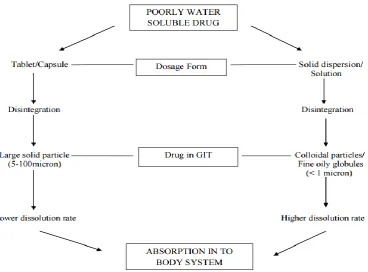
conventional (Figure 1) is that the formulation is disintegrated in the form of particle size less than 1 um and is, therefore, more easily dissolved, whereas, in conventional formulations, the size particle is greater than 5 micrometers.[4,5]
World Journal of Pharmaceutical and Life Sciences
WJPLS
www.wjpls.org
SJIF Impact Factor: 6.129*Corresponding Author: Snehal S. Badadare
G.E.S. College of Pharmacy (D.Pharm), Limb, Satara.
ABSTRACT
Solid dispersion is one of the most promising strategies to improve oral bioavailability of poorly soluble API. Solid dispersions have attracted considerable interest as an efficient means of improving the dissolution rate and hence the bioavailability of a range of poorly water-soluble drugs. Solid dispersions of poorly water-soluble drugs with water-soluble carriers have been reduced the incidence of these problems and enhanced dissolution. This review article mainly focuses on solubility ranges, biopharmaceutical classification system (BCS), list of poorly soluble drugs, commercial preparations, classification, types, and advantages, and limitations, methods of preparation and characterization of solid dispersions.
Figure 1: Schematic Representation Of The Increased Bioavailability Of Poorly Water Soluble Drugs By SD.[6]
The higher aqueous solubility in the amorphous state based on the solvation energy involved in the process dissolution due to the arrangement of the molecules that system, which is arranged at random. Therefore, in this case, low energy solvation is required to separate them and homogenize them in half, providing a faster and
effective dissolution. Thus, the development
formulations containing the drug in amorphous form are often beneficial in terms of dissolution and bioavailability.[7]
The dissolution of the drug contained in the SD is influenced by many other factors, including the method used in obtaining, proportion and characteristics of the carrier, the pH of the dissolution medium temperature and particle surface characteristics resulting from SD.[8] Among the mentioned influences, the more relevant in determining the properties of the SD are.
Classification of SD
Based on the physical state of the carrier the SD is categorized as crystalline SD and amorphous SD. It is classified into a first generation, second generation, third generation, and fourth generation.
First Generation:-In the first generation, crystalline carriers were generally used in SDs. Urea and sugars are considered as a first crystalline carrier in the preparation of SD. Urea was used as a first crystalline carrier to form eutectic mixture with sulfathiazole.[9]
Second Generation:-The second generation contains
amorphous carrier instead of crystalline one. They have the ability to produce amorphous SD in which drug and
carrier are uniformly miscible and soluble to originate a homogenous molecular interaction.[10] Povidone, polyethylene glycol (EG) polymethacrylate is fully synthetic polymer and natural product based polymer include cellulose derivative, such as hydroxylpropyl
methylcellulose (HPMC), ethyl cellulose or
hydroxypropylcellulose (HPC), or starch derivatives like cyclodextrin.[11]
Third Generation: - In the third generation, new
technology has been adopted to overcome the drawbacks such as precipitation and recrystallization using self-emulsifier and surface active agent. The utilization of these carriers not only improves the dissolution profile but also the physical and chemical stability of the drug. The surfactant used in SD is poloxamer, gelucine44/14, solupus, compritol 888 ATO sodium lauryl sulfate (SLS), d-alpha tocopheryl PEG 1000 succinate (TPGS-1000), polyoxyethylene hydrogenated castor oil, Tween 80, and sucrose laurate is used in SD.[12]
Fourth Generation: - In the fourth generation, the aim of introducing SD is for solubility enhancement and extended release in a controlled manner. In this system, the poorly water-soluble drug is dispersed in either water-soluble carrier or water-insoluble carrier.[13] The water-insoluble carrier used in SD is ethyl cellulose, eudragit RS, eudragit RL, HPC, polyethylene oxide (PEO), and carboxyvinyl polymer (carbomer). Cui et al.[14]
Advantages of Solid Dispersion[15,16]
molecularly dispersed in the dissolution medium, thereby resulting in reduced. Particle size or increased surface area.
2. Particles with improved wettability. Drug solubility increases as wettability increases. Use of carriers without surface activity such as urea, and with surface activity such as cholic acid and bile salts improve drug wettability. Carriers enhance drug dissolution profile by direct dissolution or co-solvent effect.
3. Particles with high porosity. Studies have shown that the particles in solid dispersions have a high degree of porosity. The porosity depends on the properties of carriers used. For example, a solid dispersion containing linear polymers produces larger and more porous particles than those containing reticular polymers and hence results in a higher dissolution rate and bioavailability.
4. Particles in amorphous state the solubility of drugs in amorphous state is higher than the crystalline drugs as latter requires energy to break the crystal lattice. Hence in solid dispersion, the drug exists as dissolution and when the precipitation of drug occurs, it exists as a metastable polymorphic form with enhanced dissolution than the crystal form
Disadvantages of solid dispersion[17]
1. Instability
2. By absorbing moisture, phase separation, crystal growth or a change from metastable crystalline form to stable form can take place resulting in reduction of drug solubility
3. Difficulty in handling because of tackiness.
Limitations of Solid Dispersions[18]
Although a great research interest in solid dispersion in the past four decades, the commercial utilization is very limited. Problems of solid dispersion involve
(i) The physical and chemical stability of drugs and vehicles.
(ii) Method of preparation.
(iii) Reproducibility of its physicochemical properties. (iv) Formulation of solid dispersion into dosage forms, and
(v) Scale-up of manufacturing processes.
Characterization
Several methods have been used to characterize solid dispersions, apart from classical analytical techniques such as[19,20]
Differential scanning Caloriemetry (DSC) X-ray diffraction (XRD)
Infrared Spectroscopy (IR) Hot stage and electron microscopy Dissolution testing
Raman Spectroscopy
Scanning Electron Microscope (SEM), Transmission Electron Microscopy (TEM)
Methods for determination of residual solvents (e.g. GC, Karl-Fischer, Loss on drying or non-destractive methods like NIR)
Powder flowability: angle of repose,
compressibility. Solubility studies.
In-vitro dissolution rate studies.
In-vivo studies: bioavailability, pharmacokinetics.
Stability Studies (effect of humidity,
recrystallization of amorphous drug).
Methods of Preparation of Solid Dispersions
There are several methods used to prepare solid dispersions. Some of these various techniques are briefly discussed below.
1. Co-melting Method This method involves the
preparation of physical mixture of a drug and a water-soluble carrier and heating it directly till melting. The molten mixture is then solidified rapidly in an ice-bath under vigorous stirring. The final solid mass is crushed, pulverized and sieved. The modification in the method can be done by pouring the homogenous melt in the form of a thin layer onto a ferrite plate or a stainless steel plate and cooled by flowing air or water on the opposite side of the plate. In addition, a super-saturation of a solute or drug in a system can often be obtained by quenching the melt rapidly from a high temperature. Under such conditions, the solute molecule is arrested in the solvent matrix by the instantaneous solidification process. The quenching technique gives a much finer dispersion of crystallites when used for simple eutectic mixtures. Advantage of co-melting method is that it is economic and solventless process, however this method is not suitable for the drug or carrier which is unstable at fusion temperature or evaporates at higher temperature. Some of the means to overcome these problems could be by heating the physical mixture in a sealed container or melting it under vacuum or in presence of inert gas like nitrogen to prevent oxidative degradation of drug or carrier.[21]
2. Fusion Method It is a modification of co-melting method. The carrier is placed in a porcelain dish and heated till melting over steam bath. The accurately weighed amount of drug is dispersed into molten carrier gradually using a glass rod. After complete dispersion of drug within carrier, the dish is removed from steam bath and left aside to cool at room temperature till solidification of its contents. Then, the solid dispersion formed is pulverized and sieved. This method is useful in reducing thermal decomposition of drugs.[22]
3. Freeze-drying Method This process consists of
that the drug is subjected to minimal thermal stress during the formation of the solid dispersion and the risk of phase separation is minimized.[23]
4. Supercritical Fluid (SCF) Method:-Supercritical
fluid methods are mostly applied with carbon dioxide (CO2), which is used as either a solvent for drug and matrix or as an anti-solvent. This technique consists of dissolving the drug and the carrier in a common solvent that is introduced into a particle formation vessel through a nozzle, simultaneously with supercritical CO2 (the gas is heated beyond its critical temperature and pressure). When the solution is sprayed, the solvent is rapidly extracted by the SCF, resulting in the precipitation of solid dispersion particles on the walls and bottom of the vessel. Advantages of this technique include reduction of particle size and residual solvent content as well as the high yield.[24]
5. Use of Surfactants: - Adsorption of surfactant on solid surface modifies their hydrophobicity, surface charge, and also controls other interfacial properties such
as flocculation/dispersion, floating, wetting,
solubilization, corrosion inhibition and enhanced oil recovery. Use of surfactants results in solvation/ plasticization, reduction of melting active pharmaceutical ingredient, glass transition temperature and combined glass transition temperature of solid dispersion.[25]
6. Melt Agglomeration Process: - This technique has
been used to prepare solid dispersion in which the binder acts as a carrier. Solid dispersions are prepared either by heating binder, drug and excipient to a temperature above the melting point of the binder (melt- in procedure) or by spraying a dispersion of drug in molten binder on the heated excipient (spray-on procedure). Instruments like rotary processor is preferable for high melt agglomeration as it is easier to control temperature and higher binder content can be incorporated in the agglomerates. Melt-in method gives a higher dissolution rates than the spray-on method with PEG 3000,
poloxamer 188 and gelucire 50/13. Enhanced
homogeneous distribution of drug in agglomerate can be achieved by the melt-in method. Larger particles results in densification of agglomerates where as fine particles cause complete adhesion to the mass after melting.[25] 7. Melt Extrusion Method
It consists of extruding the previously mixed drug and carrier, at high rotational speed, at melting temperature for a small.[25] Period of time. In this method, drug carrier mix is simultaneously melted, homogenized, and processed using a twin-screw extruder. The extrudate may be shaped as granules, pellets, sheets or powder form, which can be further processed into conventional tablets.[26] Polymeric materials such as vinyl polymers (PVP, PVP-vinyl acetate), polyethylene oxide, PEG, etc are used in hot-melt extrusion.
8.Melting Solvent Method (Melt Evaporation)
In this method, the drug is dissolved in a suitable liquid solvent followed by incorporation of the solution directly into the melt of a suitable carrier which is then evaporated until a clear, solvent-free film is left. This technique has an advantage of both the fusion and
solvent evaporation methods. It is only limited to drugs with a low therapeutic dose (below 50 mg) and applicable for drugs that are thermolabile or have high melting points.[25,26]
9. Kneading Method: - In this method, carrier is
permeated with water and transformed to paste. Drug is then added and kneaded for particular time. The kneaded mixture is then dried and passed through sieve if necessary. This method is suitable for thermolabile drugs but, it is not suitable for drugs sensitive to moisture.[27]
10. Co-Grinding Method: - Physical mixture of drug
and carrier is mixed for some time employing a blender at a particular speed. The mixture is then charged into the chamber of a vibration ball mill. The powder mixture is pulverized. Then, the product is collected and kept at room temperature in a screw capped glass vial until use.[28]
11. Electrospinning
Electrospinning is a process in which solid fibers are produced from a polymeric fluid stream solution or melt delivered through a millimeter-scale nozzle. This process involves the application of a strong electrostatic field over a conductive capillary attaching to a reservoir containing a polymer solution or melt and a conductive collection screen. Upon increasing the electrostatic field strength up to but not exceeding a critical value, charge species accumulated on the surface of a pendant drop destabilize the hemispherical shape into a conical shape (commonly known as Taylor‟s cone). Beyond the critical value, a charged polymer jet is ejected from the apex of the cone (as a way of relieving the charge built-up on the surface of the pendant drop). The ejected charged jet is then carried to the collection screen via the electrostatic force. The Coulombic repulsion force is responsible for the thinning of the charged jet during its trajectory to the collection screen. The thinning down of the charged jet is limited If the viscosity increases, the charged jet is dried.[29] This technique has tremendous potential for the preparation of nanofibres and controlling the release of biomedicine, as it is simplest, the cheapest this technique can be utilized for the preparation of solid dispersions in future.[30]
12. Co-precipitation Method: - Required amount of
drug is added to the solution of carrier. The system is kept under magnetic agitation and protected from the light. The formed precipitate is separated by vacuum filtration and dried at room temperature.[31]
13. Direct Capsule filling:-The technique includes
found that RES mesoporous silica MSM shown higher drug loading and more complete dissolution in comparison with solvent equilibrium method.
15. Ultra Rapid Freezing: - In this technique, the frozen particles are collected by applying drug-polymer solution to a solid cryogenic substrate. Then, the solvent is removed by lyophilization.[34] Compared SFD with SC ant solvent method on Oxeglitazar. They investigated that SFD shown lower crystallinity and higher dissolution rate.
16 Spray Drying: - It is one of the most efficient technologies for manufacturing of SD. In this technique, the drug carrier solution is passed through the nozzle and atomized into very fine droplets with the increased surface area. These droplets are going for evaporation process and produce SDs commercially available spray dryer such as incivek and intelence which is utilized for production of SDs.[35] had presented the formulation of SD containing polypeptide-k to enhance its aqueous solubility using trehalose and Tween-80 they had concluded that the optimized batch of formulation had exhibited higher solubility in water as well as various aqueous buffers as compared to pure polypeptide-k.[36] Had enhanced the dissolution rate of Etravirine by converting it from crystalline to amorphous form by spray drying method. They had used various polymers such as Solupus and Povidone which covert it into highly soluble amorphous form. They had suggested that spray drying method is an efficacious method which enhances the solubility as well as the release rate of Etravirine.
CONCLUSION
One of the most challenging problems in pharmaceutical field is to increase the bioavailability of orally administered poorly water soluble drug. Solid dispersion technology extremely helps in improving the dissolution property of such drugs. Various techniques described in this review are successfully used for the preparation of solid dispersions in the bench and lab scale and can be used as industrial scale also.
REFERENCES
1. Noyes AA and Whitney WR: The rate of solution of solid substances in their own solutions. Journal of American Chemical Society, 1897; 19: 930-934.
2. Sankula K, Kota S and Nissankarrao S:
Enhancement of Dissolution rate of Ciprofloxacin by using various Solid Dispersion Techniques. International Journal of Pharma Research and Health Sciences, 2014; 2: 80-86.
3. Jafari E: Preparation, Characterization and Dissolution of Solid Dispersion of Diclofenac Sodium Using Eudragit E-100. Journal of Applied Pharmaceutical Science, 2013; 3: 67-70.
4. Bikiaris D, Papageorgiou GZ, Stergiou A, et al., Physicochemical studies on solid dispersions of
poorly water-soluble drugs: evaluation of
capabilities and limitations of thermal analysis
techniques, Thermochimica acta, 2005; 439(1): 58-67.
5. Serajuddin A, Solid dispersion of poorly
water‐soluble drugs: Early promises, subsequent problems, and recent breakthroughs, Journal.
6. Serajuddin A, Solid dispersion of poorly
water‐soluble drugs: Early promises, subsequent problems, and recent breakthroughs, Journal.
7. Loh ZH, Samanta AK, Heng PWS, Overview of milling techniques for improving the solubility of poorly water-soluble drugs, asian journal of pharmaceutical sciences, 2015; 10(4): 255-74. 8. Singh M, Hemant K, Ram M, Shivakumar H,
Microencapsulation: a promising technique for
controlled drug delivery, Research in
pharmaceutical sciences, 2011; 5(2): 65-77.
9. Sekiguchi K, Obi N. Studies on absorption of eutectic mixture. I. A comparison of the behavior of eutectic mixture of sulfathiazole and that of ordinary sulfathiazole in man. Chem Pharm Bull, 1961; 9: 866-72.
10. Vasconcelos T, Sarmento B, Costa P. SDs as strategy to improve oral bioavailability of poor water soluble drug. Drug Discovery Today, 2007; 12: 1068-75.
11. Kohri N, Yamayoshi Y, Xin H, Iseki K, Sato N, Todo S, Improving the oral bioavailability of albendazole in rabbits by the solid dispersion technique. J Pharm Pharmacol, 1999; 51: 159-64. 12. Sabitri B*, Snehamayee M., Recent Approaches of
Solid Dispersion: A New Concept towards Oral Bioavailability, Asian J Pharm Clin Res, 2018; 11(3): 72-78.
13. Huang J, Wigent RJ, Schwartz JB. Nifedipine molecular dispersion in microparticles of ammonio methacrylate copolymer and ethylcellulose binary blends for controlled drug delivery: Effect of matrix composition. Drug Dev Ind Pharm, 2006; 32: 1185-97.
14. Cui F, Yang M, Jiang Y, Cun D, Lin W, Fan Y, et al. Design of sustained-release nitrendipine microspheres having solid dispersion structure by quasi-emulsion solvent diffusion method. J Controll Release, 2003; 91(3): 75-84.
15. Mehta S, Joseph N.M, Feleke F, Palani S. Improving solubility of BCS class II drugs using solid dispersion. J Drug Deliv Ther, 2014; 4(3): 7-13. 16. Sharma D, Soni M, Kumar S, Gupta G.D. Solubility
enhancement–Eminent role in poorly soluble drugs. Res J Pharm Technol, 2009; 2(2): 220-224.
17. .Das S.K, Roy S, Kalimuthu Y, Khanam J, Nanda A. Solid dispersions: an approach to enhance the bioavailability of poorly water-soluble drugs. Int J Pharmacol Pharm Technol, 2012; 1(1): 37-46. 18. H. Karanth, V. S. Shenoy, and R. R. Murthy,
19. Sheen, P. C.; Khetarpal, V. K.; Cariola, C. M. and Rowlings, C.E. Formulation studies of poorly water-soluble drug in solid dispersions to improvr bioavailability. Int. J. Pharm, 1995;118: 221-227. 20. Dalvi PB, Gerange AB, Ingale PR. Solid dispersion:
strategy to enhance solubility. J Drug Deliv Therapeut, 2015; 5(2): 20-28.
21. Kalaiselvan R, Mohanta GP, Manna PK, Manavalan R. Studies on mechanism of enhanced dissolution of albendazole solid dispersions with crystalline carriers. Indian J Pharm Sci., 2006; 68(5): 599-607. 22. Akiladevi D, Shanmugapandiyan P, Jebasingh D,
Basak S. Preparation and evaluation of paracetamol by solid dispersion technique. Int J Pharm Pharm Sci., 2011; 3(1): 188-191.
23. DJ van Drooge, WL Hinrichs, MR Visser, HW Frijlink. Characterization of the molecular distribution of drugs in glassy solid dispersions at the nano-meter scale, using differential scanning calorimetry and gravimetric water vapour sorption techniques. Int J Pharm, 2006; 310(1): 220-229. 24. Majerik V, Charbit G, Badens E, Horváth G,
Szokonya L, Bosc N, N Teillaud N. Bioavailability enhancement of an active substance by supercritical antisolvent precipitation. J Supercrit Fluids, 2007; 40(1): 101-110.
25. Dixit ND, Niranjan SK. A Review: solid dispersion. World J Pharm Pharm Sci., 2014; 3: 238-257. 26. Singh J, Walia M, Harikumar SL. Solubility
enhancement by solid dispersion method: a review. J Drug Deliv Ther, 2013; 3(5): 148-155.
27. Ghareeb MM, Abdulrasool AA, Hussein AA,
Noordin MI. Kneading technique for preparation of binary solid dispersion of meloxicam with poloxamer 188. AAPS Pharm Sci Tech, 2009: 10(4): 1206-1215.
28. Nokhodchi A, Talari R, Valizadeh H, Jalali MB. An investigation on the solid dispersions of chlordiazepoxide, Int J Biomed Sci., 2007; 3(3): 211-216.
29. Hohman, M.M, Shin, M., Rutledge, G., and
Michael, P., Brenneraelectrospinning and
electrically forced jets. II. Applications. Phys of fluids., 2001;13(8): 2221-2236.
30. Neamnark, A., Rujiravanit, R., and Supaphol, P., Electrospinning of hexanoyl Chitosan. Carbohydrate polymers. Int. J. Pharmaceut., 2006;66: 298-305. 31. Shah N, Iyer RM, Mair HJ, Choi DS, Tian H,
Diodon R, Fahnrich K. A Pabst-Ravot, K Tang, E Scheubel et al. Improved human bioavailability of vemurafenib, a practically insoluble drug, using an amorphous polymer-stabilized solid dispersion prepared by a solvent-controlled coprecipitation process. J Pharm Sci., 2013; 102(3): 967-981. 32. Serajuddin ATM, Sheen PC, Mufson D, Bernstein
DF, Augustine MA. Effect of vehicle amphiphilicity on the dissolution and bioavailability of a poorly water soluble drug from solid dispersions. J Pharm Sci., 1988; 77(5): 414-417.
33. Li J, Miao X, Chen T, Ouyang D, Zheng Y. Preparation and characterization of pelletized solid dispersion of resveratrol with mesoporous silica microparticles to improve dissolution by fluid-bed coating techniques. Am J Pharm Sci, 2016; 11: 528-35.
34. Badens E, Majerik V, Horvath G, Szokonya L, Bosc N, Teillaud E, et al. Comparison of solid dispersions produced by supercritical antisolvent and spray-freezing technologies. Int J Pharm, 2009; 377: 25-34.
35. Kaur P, Singh SK, Garg V, Gulati M, Vaidya Y.
Optimization of spray drying process for
formulation of solid dispersion containing polypeptide-k powder through quality by design approach. Powder Technol, 2015; 284: 1-11. 36. Ramesh K, Shekar BC, Khadgapathi P. Formulation