Background: Spine surgery has been transformed significantly by the growth of minimally invasive surgery (MIS) procedures. Easily marketable to patients as less invasive with smaller incisions, MIS is often perceived as superior to traditional open spine surgery. The highest quality evidence comparing MIS with open spine surgery was examined. Methods: A systematic review of randomized controlled trials (RCTs) involving MIS versus open spine surgery was performed using the Entrez gateway of the PubMed database for articles published in English up to December 28, 2015. RCTs and systematic reviews of RCTs of MIS versus open spine surgery were evaluated for three particular entities: Cervical disc herniation, lumbar disc herniation, and posterior lumbar fusion. Results:A total of 17 RCTs were identified, along with six systematic reviews. For cervical disc herniation, MIS provided no difference in overall function, arm pain relief, or long‑term neck pain. In lumbar disc herniation, MIS was inferior in providing leg/low back pain relief, rehospitalization rates, quality of life improvement, and exposed the surgeon to >10 times more radiation in return for shorter hospital stay and less surgical site infection. In posterior lumbar fusion, MIS transforaminal lumbar interbody fusion (TLIF) had significantly reduced 2‑year societal cost, fewer medical complications, reduced time to return to work, and improved short‑term Oswestry Disability Index scores at the cost of higher revision rates, higher readmission rates, and more than twice the amount of intraoperative fluoroscopy. Conclusion: The highest levels of evidence do not support MIS over open surgery for cervical or lumbar disc herniation. However, MIS TLIF demonstrates advantages along with higher revision/readmission rates. Regardless of patient indication, MIS exposes the surgeon to significantly more radiation; it is unclear how this impacts patients. These results should optimize informed decision‑making regarding MIS versus open spine surgery, particularly in the current advertising climate greatly favoring MIS.
Keywords: Lumbar spine fusion, microdiscectomy, minimally invasive spine surgery, open spine surgery, randomized controlled trials
Minimally Invasive versus Open Spine Surgery: What Does the Best
Evidence Tell Us?
Shearwood McClelland III, Jeffrey A. Goldstein
Address for correspondence: Dr. Shearwood McClelland III, Department of Orthopaedic Surgery, Spine Research Institute, NYU Hospital for Joint Diseases, 306 East 15th Street, Ground Floor, New York, NY 10003, USA. E‑mail: [email protected] Minimally invasive surgery versus conventional open surgery: Cervical disc herniation
Five studies of Class I evidence were found examining MIS versus conventional open surgery in treating cervical disc herniation. These comprised four RCTs – two conducted in Germany, one in Korea, and one in Egypt and one systematic review examining studies up to January 12, 2014.[1‑5] The RCTs comprised a total of 219 MIS patients and 212 open surgery patients, with long‑term follow‑up ranging from 104 to 121 weeks.
Of note, the open surgery group was comprised discectomy without fusion in only one of the four RCTs, comprising 19 of
Original Article
Introduction
R
esearch studies provide an objective method ofevaluating the efficacy of medical and surgical therapies. The degree to which a study influences management is
related to the level of evidence that it provides. There are
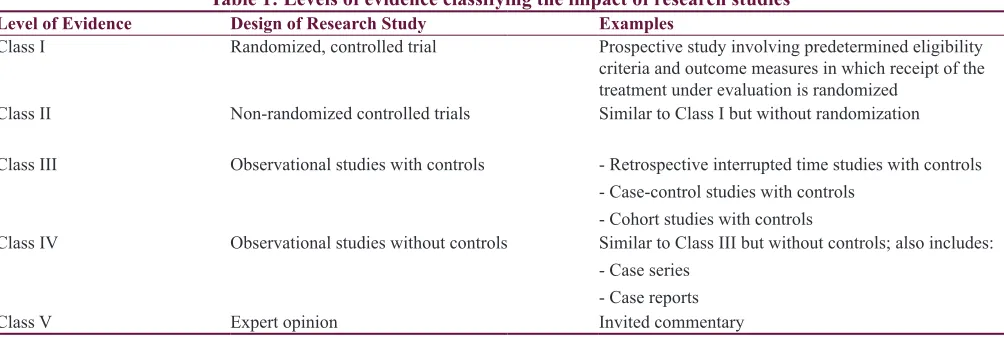
generally five classes of evidence within which research
studies fall, which are listed in Table 1. Of these classes, Class I evidence – derived from a prospective randomized controlled trial (RCT) – is the most powerful in assessing the virtue of a particular treatment modality. This review examines the existing highest quality evidence examining minimally invasive surgery (MIS) versus conventional open surgery for three procedures: Cervical disc herniation, lumbar disc herniation, and posterior lumbar fusion. Literature searches were made systematically using the Entrez gateway of the PubMed database for articles published in English up to and through December 28, 2015.
Department of Orthopaedic Surgery, NYU Langone Medical Center, Division of Spine Surgery, Hospital for Joint Diseases, New York, NY, USA
Access this article online
Quick Response Code:
Website:
www.ruralneuropractice.com
DOI:
10.4103/jnrp.jnrp_472_16
How to cite this article: McClell S, Goldstein JA. Minimally invasive versus open spine surgery: What does the best evidence tell us?. J Neurosci Rural Pract 2017;8:194-8.
This is an open access article distributed under the terms of the Creative Commons Attribution-NonCommercial-ShareAlike 3.0 License, which allows others to remix, tweak, and build upon the work non-commercially, as long as the author is credited and the new creations are licensed under the identical terms.
For reprints contact: [email protected]
the 212 open surgery patients (9%).[1,4] The remaining 193 open surgery patients received fusion as well as discectomy through anterior cervical discectomy and fusion.[2,3,5] In contrast, only 37 of the 219 MIS patients (17%) received fusion, whereas 100 of the remaining 182 MIS patients received posterior foraminotomy.[1,2,5] Of the remaining 82 MIS patients, 60 underwent anterior cervical discectomy, whereas 22 received
either foraminotomy or discectomy (specific procedure per
patient not reported).[3,4]
With regard to operative approach, only 97 of the 219 MIS patients (44%) in RCTs underwent an anterior approach, whereas 193 of the 212 conventional open patients (91%) in RCTs underwent an anterior approach.[1]
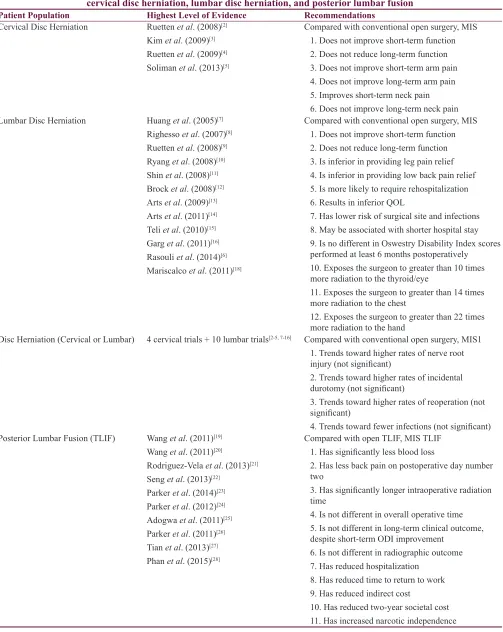
The collective results of these RCTs [Table 2] indicate that compared with conventional open surgery for cervical disc herniation, MIS does not improve function (short‑ or long‑term), arm pain (short‑ or long‑term), or long‑term neck
pain. MIS did improve short‑term neck pain, but this finding was not significant when included in the pooled estimate
analysis including lumbar cases.[1]
Minimally invasive surgery versus conventional open surgery: Lumbar disc herniation
Twelve studies of Class I evidence were found examining MIS versus conventional open surgery in treating lumbar disc herniation. These were comprised ten RCTs and two systematic reviews.[1,6‑16] The ten RCTs comprised a total of 586 MIS patients and 573 conventional open patients. No patients in either group received fusion. All 573 open patients received discectomy, whereas 564 of the 586 MIS patients received discectomy; the remaining 22 MIS patients (4%) received percutaneous nucleotomy. Eight of the ten RCTs had follow‑up longer than 1 week; in these studies, follow‑up ranged from 52 to 104 weeks.
The collective results of these studies [Table 2] indicated that MIS was inferior to conventional open surgery for lumbar disc herniation with regard to leg pain relief, low back pain relief, quality‑of‑life, and rehospitalization rate (due to increased disc reherniation).[6] However, MIS was associated with lower risk of infection and shorter hospital stay.[6] There was no difference in short‑term function, long‑term function,
or 6‑month postoperative Oswestry Disability Index (ODI) scores.[1,6]
A recent nonrandomized study examining operating field
sterility between MIS and open lumbar microdiscectomy found no difference in colony counts between MIS and open cases; the authors, therefore, conclude that any decreased rate of infection reported for MIS may be related to extraoperative factors such as patient selection and postoperative care.[17] The issue of radiation exposure to the surgeon was addressed in one Class II in vivo prospective study comparing radiation exposure during ten MIS versus ten open lumbar microdiscectomy cases.[17] MIS resulted in more than 10 times the radiation to the thyroid/eye of the surgeon, 14 times more radiation to the chest of the surgeon, and 22 times more radiation to the surgeon’s hand compared with open surgery [Table 2].[18]
Minimally invasive surgery versus conventional open surgery: Disc herniation (cervical or lumbar) One systematic review performed a pooled analysis of cervical and lumbar disc herniations from 14 RCTs. Compared with conventional open surgery, MIS trended toward decreased infection, but increased nerve root injury, durotomy, and reoperation rates; however, none proved statistically
significant [Table 2].[1]
Minimally invasive surgery versus conventional open surgery: Posterior lumbar fusion
Three RCTs were found examining MIS versus open transforaminal lumbar interbody fusion (TLIF).[19‑21] In the first study (52 patients; 25 MIS versus 27 open), MIS compared to open surgery revealed no difference in operative time, clinical results, or radiographic results; mean follow‑up was 27.5 months (range = 12–38 months). However, MIS
patients had significantly less blood loss, significantly less back pain on postoperative day 2 but had significantly longer
intraoperative radiation time.[19] An important caveat of this study is that all patients had previously undergone open lumbar spine surgery before randomization. The second study involved 79 patients (41 MIS, 38 open) with single‑level degenerative lumbar spine disease who had no previous surgical treatment of segmental defects; mean follow‑up was
Table 1: Levels of evidence classifying the impact of research studies
Level of Evidence Design of Research Study Examples
Class I Randomized, controlled trial Prospective study involving predetermined eligibility
criteria and outcome measures in which receipt of the treatment under evaluation is randomized
Class II Non‑randomized controlled trials Similar to Class I but without randomization
Class III Observational studies with controls ‑ Retrospective interrupted time studies with controls ‑ Case‑control studies with controls
‑ Cohort studies with controls
Class IV Observational studies without controls Similar to Class III but without controls; also includes: ‑ Case series
‑ Case reports
Table 2: Summary of the highest levels of evidence regarding minimally invasive versus open spine surgery for cervical disc herniation, lumbar disc herniation, and posterior lumbar fusion
Patient Population Highest Level of Evidence Recommendations
Cervical Disc Herniation Ruetten et al. (2008)[2]
Kim et al. (2009)[3]
Ruetten et al. (2009)[4]
Soliman et al. (2013)[5]
Compared with conventional open surgery, MIS 1. Does not improve short‑term function 2. Does not reduce long‑term function 3. Does not improve short‑term arm pain 4. Does not improve long‑term arm pain 5. Improves short‑term neck pain 6. Does not improve long‑term neck pain Lumbar Disc Herniation Huang et al. (2005)[7]
Righesso et al. (2007)[8]
Ruetten et al. (2008)[9]
Ryang et al. (2008)[10]
Shin et al. (2008)[11]
Brock et al. (2008)[12]
Arts et al. (2009)[13]
Arts et al. (2011)[14]
Teli et al. (2010)[15]
Garg et al. (2011)[16]
Rasouli et al. (2014)[6]
Mariscalco et al. (2011)[18]
Compared with conventional open surgery, MIS 1. Does not improve short‑term function 2. Does not reduce long‑term function 3. Is inferior in providing leg pain relief 4. Is inferior in providing low back pain relief 5. Is more likely to require rehospitalization 6. Results in inferior QOL
7. Has lower risk of surgical site and infections 8. May be associated with shorter hospital stay 9. Is no different in Oswestry Disability Index scores performed at least 6 months postoperatively
10. Exposes the surgeon to greater than 10 times more radiation to the thyroid/eye
11. Exposes the surgeon to greater than 14 times more radiation to the chest
12. Exposes the surgeon to greater than 22 times more radiation to the hand
Disc Herniation (Cervical or Lumbar) 4 cervical trials + 10 lumbar trials[2‑5, 7‑16] Compared with conventional open surgery, MIS1
1. Trends toward higher rates of nerve root injury (not significant)
2. Trends toward higher rates of incidental durotomy (not significant)
3. Trends toward higher rates of reoperation (not significant)
4. Trends toward fewer infections (not significant) Posterior Lumbar Fusion (TLIF) Wang et al. (2011)[19]
Wang et al. (2011)[20]
Rodriguez‑Vela et al. (2013)[21]
Seng et al. (2013)[22]
Parker et al. (2014)[23]
Parker et al. (2012)[24]
Adogwa et al. (2011)[25]
Parker et al. (2011)[26]
Tian et al. (2013)[27]
Phan et al. (2015)[28]
Compared with open TLIF, MIS TLIF 1. Has significantly less blood loss
2. Has less back pain on postoperative day number two
3. Has significantly longer intraoperative radiation time
4. Is not different in overall operative time 5. Is not different in long‑term clinical outcome, despite short‑term ODI improvement
6. Is not different in radiographic outcome 7. Has reduced hospitalization
8. Has reduced time to return to work 9. Has reduced indirect cost
10. Has reduced two‑year societal cost 11. Has increased narcotic independence
32.7 months (range = 24–37 months).[20] Compared with open surgery, MIS was not significantly different with regard
to operative time, blood loss, or postoperative hospital time.
However, MIS had significantly less postoperative drainage
and shorter postoperative recovery time (40 days versus 76 days) at the cost of more than twice the intraoperative
fluoroscopy time. Visual analog scale (VAS) scores at 3, 6, 12, and 24 months postoperatively were not significantly different
between the two groups, whereas the ODI was initially better in
MIS but became insignificantly different at 12 and 24 months
postoperatively.[20] The third study involved 41 patients (21 MIS, 20 open) with minimum 3‑year follow‑up (range = 36– 54 months) who underwent single‑level TLIF and found that despite improved functional status of the MIS TLIF group in the short‑term, there were no clinically relevant differences from the open TLIF group when follow‑up was performed at least 3 years postoperatively.[21]
Several prospective nonrandomized trials found MIS TLIF to be superior with regard to narcotic independence, 2‑year societal cost, and accelerated return to work.[22‑26] A meta‑analysis comprising one RCT, five prospective trials, and five retrospective trials found MIS to have similar operative
time, complication rate, and reoperation rate, with MIS TLIF having less blood loss and shorter hospital stay at the cost
of significantly increased X‑ray exposure compared with
open TLIF.[27] A second meta‑analysis of 21 studies found MIS TLIF to have lower blood loss and infection rates with superior postoperative ODI and VAS back pain scores at the cost of higher radiation exposure for the surgical team.[28] A recent systematic review including TLIF or posterior lumbar interbody fusion (PLIF) found equipoise in patient‑reported clinical outcomes between MIS and open fusions, with equivalent rates of surgical complications but lower rates of medical complications in MIS.[29] Another recent meta‑analysis comparing MIS TLIF to open TLIF/PLIF found the two procedures to have equivalent fusion rates and complications rates; however, the MIS group had both a higher revision rate and readmission rate.[30]
Conclusion
The highest levels of evidence do not support MIS over open surgery for either cervical or lumbar disc herniation. However, for fusion cases, MIS TLIF demonstrates advantages, most prominently in reduced hospitalization, societal cost, and time to return to work at the cost of higher revision and readmission rates. There has yet to be a RCT comparing MIS TLIF solely
Regardless of patient indication, MIS results in significantly
more radiation exposure to the surgeon, particularly in surgery involving the lumbar spine. It is unclear whether this exposure impacts patients as well, and this area certainly deserves further study.
These results from an analysis of the current highest levels of evidence should be made clear to patients to give them the best chance to make an informed decision when choosing MIS versus open spine surgery, particularly given the current medical advertising climate which greatly favors the choice of MIS.
Financial support and sponsorship Nil.
Conflicts of interest
There are no conflicts of interest.
References
1. Evaniew N, Khan M, Drew B, Kwok D, Bhandari M, Ghert M. Minimally invasive versus open surgery for cervical and lumbar discectomy: A systematic review and meta‑analysis. CMAJ Open 2014;2:E295‑305.
2. Ruetten S, Komp M, Merk H, Godolias G. Full‑endoscopic cervical posterior foraminotomy for the operation of lateral disc herniations using 5.9‑mm endoscopes: A prospective, randomized, controlled study. Spine (Phila Pa 1976) 2008;33:940‑8.
3. Ruetten S, Komp M, Merk H, Godolias G. Full‑endoscopic anterior decompression versus conventional anterior decompression and fusion in cervical disc herniations. Int Orthop 2009;33:1677‑82.
4. Kim KT, Kim YB. Comparison between open procedure and tubular retractor assisted procedure for cervical radiculopathy: Results of a randomized controlled study. J Korean Med Sci 2009;24:649‑53.
5. Soliman HM. Cervical microendoscopic discectomy and fusion: Does it affect the postoperative course and the complication
rate? A blinded randomized controlled trial. Spine (Phila Pa
1976) 2013;38:2064‑70.
6. Rasouli MR, Rahimi‑Movaghar V, Shokraneh F, Moradi‑Lakeh M, Chou R. Minimally invasive discectomy versus microdiscectomy/open discectomy for symptomatic lumbar disc herniation. Cochrane Database Syst Rev 2014;9:CD010328. 7. Huang TJ, Hsu RW, Li YY, Cheng CC. Less systemic cytokine
response in patients following microendoscopic versus open lumbar discectomy. J Orthop Res 2005;23:406‑11.
8. Righesso O, Falavigna A, Avanzi O. Comparison of open discectomy with microendoscopic discectomy in lumbar disc herniations: Results of a randomized controlled trial.
Table 2: Contd...
Patient Population Highest Level of Evidence Recommendations
Posterior Lumbar Fusion (TLIF/PLIF) Goldstein et al. (2015)[29]
Jin‑Tao et al. (2015)[30]
Compared with open TLIF/PLIF, MIS TLIF/PLIF has 1. Higher revision rate
2. Higher readmission rate
3. No difference in surgical complication rate 4. Fewer medical complications
9. Ruetten S, Komp M, Merk H, Godolias G. Full‑endoscopic interlaminar and transforaminal lumbar discectomy versus conventional microsurgical technique: A prospective, randomized, controlled study. Spine (Phila Pa 1976) 2008;33:931‑9.
10. Ryang YM, Oertel MF, Mayfrank L, Gilsbach JM, Rohde V. Standard open microdiscectomy versus minimal access trocar microdiscectomy: Results of a prospective randomized study. Neurosurgery 2008;62:174‑81.
11. Shin DA, Kim KN, Shin HC, Yoon DH. The efficacy of
microendoscopic discectomy in reducing iatrogenic muscle injury. J Neurosurg Spine 2008;8:39‑43.
12. Brock M, Kunkel P, Papavero L. Lumbar microdiscectomy:
Subperiosteal versus transmuscular approach and influence
on the early postoperative analgesic consumption. Eur Spine J 2008;17:518‑22.
13. Arts MP, Brand R, van den Akker ME, Koes BW, Bartels RH, Peul WC; Leiden‑The Hague Spine Intervention Prognostic Study Group (SIPS). Tubular diskectomy vs. conventional microdiskectomy for sciatica: A randomized controlled trial. JAMA 2009;302:149‑58.
14. Arts MP, Brand R, van den Akker ME, Koes BW, Bartels RH,
Tan WF, et al. Tubular diskectomy vs. conventional
microdiskectomy for the treatment of lumbar disk herniation: 2‑year results of a double‑blind randomized controlled trial. Neurosurgery 2011;69:135‑44.
15. Teli M, Lovi A, Brayda‑Bruno M, Zagra A, Corriero A,
Giudici F, et al. Higher risk of dural tears and recurrent
herniation with lumbar micro‑endoscopic discectomy. Eur Spine J 2010;19:443‑50.
16. Garg B, Nagraja UB, Jayaswal A. Microendoscopic versus open discectomy for lumbar disc herniation: A prospective randomised study. J Orthop Surg (Hong Kong) 2011;19:30‑4.
17. Li CH, Yew AY, Kimball JA, McBride DQ, Wang JC, Lu DC.
Comparison of operating field sterility in open versus minimally
invasive microdiscectomies of the lumbar spine. Surg Neurol Int 2013;4 Suppl 5:S295‑8.
18. Mariscalco MW, Yamashita T, Steinmetz MP, Krishnaney AA, Lieberman IH, Mroz TE. Radiation exposure to the surgeon during open lumbar microdiscectomy and minimally invasive microdiscectomy: A prospective, controlled trial. Spine (Phila Pa 1976) 2011;36:255‑60.
19. Wang J, Zhou Y, Zhang ZF, Li CQ, Zheng WJ, Liu J. Minimally invasive or open transforaminal lumbar interbody fusion as revision surgery for patients previously treated by open discectomy and decompression of the lumbar spine. Eur Spine J 2011;20:623‑8. 20. Wang HL, Lü FZ, Jiang JY, Ma X, Xia XL, Wang LX. Minimally
invasive lumbar interbody fusion via MAST quadrant retractor
versus open surgery: A prospective randomized clinical trial. Chin Med J (Engl) 2011;124:3868‑74.
21. Rodríguez‑Vela J, Lobo‑Escolar A, Joven E, Muñoz‑Marín J, Herrera A, Velilla J. Clinical outcomes of minimally invasive versus open approach for one‑level transforaminal lumbar interbody fusion at the 3‑ to 4‑year follow‑up. Eur Spine J 2013;22:2857‑63.
22. Seng C, Siddiqui MA, Wong KP, Zhang K, Yeo W, Tan SB, et al. Five‑year outcomes of minimally invasive versus open transforaminal lumbar interbody fusion: A matched‑pair comparison study. Spine (Phila Pa 1976) 2013;38:2049‑55. 23. Parker SL, Mendenhall SK, Shau DN, Zuckerman SL, Godil SS,
Cheng JS, et al. Minimally invasive versus open transforaminal
lumbar interbody fusion for degenerative spondylolisthesis: Comparative effectiveness and cost‑utility analysis. World Neurosurg 2014;82:230‑8.
24. Parker SL, Adogwa O, Bydon A, Cheng J, McGirt MJ. Cost‑effectiveness of minimally invasive versus open transforaminal lumbar interbody fusion for degenerative spondylolisthesis associated low‑back and leg pain over two years. World Neurosurg 2012;78:178‑84.
25. Adogwa O, Parker SL, Bydon A, Cheng J, McGirt MJ. Comparative effectiveness of minimally invasive versus open transforaminal lumbar interbody fusion: 2‑year assessment of narcotic use, return to work, disability, and quality of life. J Spinal Disord Tech 2011;24:479‑84.
26. Parker SL, Adogwa O, Witham TF, Aaronson OS, Cheng J, McGirt MJ. Post‑operative infection after minimally invasive versus open transforaminal lumbar interbody fusion (TLIF): Literature review and cost analysis. Minim Invasive Neurosurg 2011;54:33‑7.
27. Tian NF, Wu YS, Zhang XL, Xu HZ, Chi YL, Mao FM. Minimally invasive versus open transforaminal lumbar interbody fusion: A meta‑analysis based on the current evidence. Eur Spine J 2013;22:1741‑9.
28. Phan K, Rao PJ, Kam AC, Mobbs RJ. Minimally invasive versus open transforaminal lumbar interbody fusion for treatment of degenerative lumbar disease: Systematic review and meta‑analysis. Eur Spine J 2015;24:1017‑30.
29. Goldstein CL, Macwan K, Sundararajan K, Rampersaud YR. Perioperative outcomes and adverse events of minimally invasive versus open posterior lumbar fusion: Meta‑analysis and systematic review. J Neurosurg Spine 2016;24:416‑27.