K.Ranjith Singh et al, International Journal of Computer Science and Mobile Applications, Vol.2 Issue. 11, November- 2014, pg. 163-175 ISSN: 2321-8363
HYBRID INTRUSION DETECTION
FOR CLUSTER BASED WIRELESS
SENSOR NETWORK
1
K.RANJITH SINGH
1
Dept. of Computer Science, Periyar University, TamilNadu, India
2
T.HEMA
2
Dept. of Computer Science, Periyar University, TamilNadu, India
ABSTRACT: Intrusion Detection System is an important technology in business sector as well as active area of research. It is an important tool for information security. An intrusion detection system is used to detect attacks or intrusions and report these intrusions to the user in order to take evasive action. Most of the existing commercial NIDS products are signature-based but not adaptive. Our paper proposes an Adaptive NIDS using K-Means clustering techniques of Data mining approaches. Definite behaviour of network traffic is precisely captured using Data mining approaches, and the set excavated differentiates between “normal” and “attack” traffic. Current researches comprise of single engine detection systems, whereas our proposed system is constructed by a number of Agents, which are totally different in both training and detecting processes. Using k-means clustering algorithm, respective type of packets is clustered under respective Agents formed after clustering. Each of the Agents is responsible for capturing a network behaviour type and hence the system has strength on detecting different types of attacks as well as ability of detecting new types of attacks. The experimental results show that the network traffic pattern used as reliable agents outperforms from traditional signature-based NIDS.
1. INTRODUCTION
An intrusion detection system (IDS) is a device or software application that
monitors network and/or system activities for malicious activities or policy violations
and produces reports to a Management Station. Some systems may attempt to stop an
intrusion attempt but this is neither required nor expected of a monitoring system.
They are primarily focused on identifying possible incidents, logging information
about them, and reporting attempts. As networking becomes more widespread, the
K.Ranjith Singh et al, International Journal of Computer Science and Mobile Applications, Vol.2 Issue. 11, November- 2014, pg. 163-175 ISSN: 2321-8363 sufficient to ensure the security in computer networks, which some intrusions take
advantages of vulnerabilities in computer systems or use socially engineered
penetration techniques that traditional intrusion prevention techniques are not enough
in protection. Network Intrusion Detection System (NIDS) will be another wall for
protection. Most of the existing commercial NIDS are signature-based but not
adaptive. There are many have problems such as attack stealthiest: attackers try to
hide their actions from either an individual in monitoring the system or a NIDS novel
intrusion: it is undetectable by signature-based NIDS; they can only be detected as
anomalies by observing deviations from normal network behaviour. Whereas
Anomaly detection approaches attempt to identify abnormal behaviour in patterns
and can make use of supervised or unsupervised methods to detect the anomalies or
attacks. Unlike the other two methods, these approaches can detect new emerging
threats. The supervised anomaly detection approach trains a classifier with just
'normal' labelled patterns. Deviations from 'normal behaviour', everything that is not
'normal', are considering attacks. The disadvantage of the supervised methods for
anomaly detection is that the labelling procedure of the training data is expensive and
time consuming. The unsupervised anomaly detection approach overcome this
problem by making use of data clustering algorithms, which makes no assumption
about the labels or classes of the patterns.
The patterns are grouped together based on a similarity measure and the
anomalies or attacks are the patterns in the smaller clusters. Two assumptions need to
be made for this to be true: the normal patterns or connections are many more than
the attacks and that the attacks are different than the normal patterns. In this paper, an
adaptive NIDS using K-means technologies is developed, which accurately capture
the actual behaviour of network traffic. The proposed NIDS combines the efficiency
of both signature based and anomaly based constructed by different types of agent.
There are six types of agent based on clustering depending on types of packet. The
K.Ranjith Singh et al, International Journal of Computer Science and Mobile Applications, Vol.2 Issue. 11, November- 2014, pg. 163-175 ISSN: 2321-8363 detected with the present of network portfolio. In addition, it can adopt the changes
of network automatically with the adaptive learning of agents.
2. RELATED WORK
Most of the commercial NIDSs sold in the market are signature-based with a
disadvantage in detection of previously known attacks only. Especially, different
kinds of attack come every day. The signature-based NIDS will not be functional
when new kinds of attack coming.
Therefore, many researchers have proposed and implemented different
intrusion detection models based on data mining techniques to tackle this problem. In
this section, a brief review on current works is given. NIDS need to be accurate,
adaptive, and extensible. Developed a general and systematic method for intrusion
detection and provides an overview on two general data mining algorithms that have
been implemented: association rules and frequent episodes using network intrusion
detection as a concrete application example, it describes how to construct models that
are both accurate in describing the underlying concepts, and efficient for analyzing
data in real-time. The same authors describe a framework, MADAM ID, for Mining
Audit Data for Automated Models for Intrusion Detection. Proceedings of introduces
a new type of clustering-based algorithm for unsupervised anomaly NIDS, which
trains on unlabeled data in order to detect new intrusions. Presents a data mining
based approach to support signature discovery in NIDS. Furthermore, discusses
outlier detection algorithms used in data mining systems. In this paper, an adaptive
NIDS based on various data mining techniques is proposed. However, unlike most of
the current researches, which only one engine is used for detection of various attacks;
the proposed system is constructed by a number of agents, which are totally different
in both training and detection processes. In this stage, three data mining approaches:
clustering, association and sequential association, are adopted and five types of agent
K.Ranjith Singh et al, International Journal of Computer Science and Mobile Applications, Vol.2 Issue. 11, November- 2014, pg. 163-175 ISSN: 2321-8363 attack comes, the proposed system can detect such anomaly by distinguishing it from
normal traffic.
3. PROPOSED DESIGN OF AGENT BASED NIDS
Using the Data Mining Approaches, we can implement the k-means algorithm
for clustering respective type of packets under respective Agents which will form
after clustering. This model is supposed to improve performance.
The k-means algorithm is an evolutionary algorithm that gains its name from
its method of operation. The algorithm clusters observations into k groups, where k
is provided as an input parameter. It then assigns each observation to clusters based
upon the observation’s proximity to the mean of the cluster. The cluster’s mean is then recomputed and the process begins again. Here’s how the algorithm works:
1. The algorithm arbitrarily selects k points as the initial cluster centers (“means”).
2. Each point in the dataset is assigned to the closed cluster, based upon the
Euclidean distance between each point and each cluster center.
3. Each cluster center is recomputed as the average of the points in that cluster.
4. Steps 2 and 3 repeat until the clusters converge. Convergence may be defined
differently depending upon the implementation, but it normally means that either
no observations change clusters when steps 2 and 3 are repeated or that the
changes do not make a material difference in the definition of the clusters.
3.1. System architecture
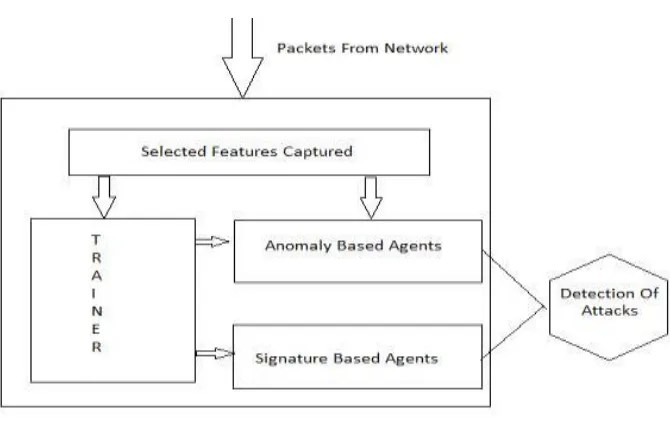
The proposed NIDS is composed of four modules, feature miner, Anomaly
based agents, and signature based agent and agent trainers. First, a feature
extractor converts the data from a monitored system into features which will be
used in both training and network intrusion detection stages. Figure 1 shows the
K.Ranjith Singh et al, International Journal of Computer Science and Mobile Applications, Vol.2 Issue. 11, November- 2014, pg. 163-175 ISSN: 2321-8363
Proposed IDS
Figure 1.Architecture of agent-based NIDS
The results among all agents are gathered by the agents for
concluding the final decision of the system (Figure 2).
SENSOR
It calculates using K-means to find how far (Euclidean distance) of a
candidate cluster from normal. If the distance is larger than a threshold, the cluster
will be regarded as an intrusion, or vice versa.
K.Ranjith Singh et al, International Journal of Computer Science and Mobile Applications, Vol.2 Issue. 11, November- 2014, pg. 163-175 ISSN: 2321-8363 For each agent, corresponding trainer is built for updating agent in an
adaptive manner. Same as the Detection Engine, a Feature Distributor assigns
necessary feature vectors to each training node. Each training node is built in a
corresponding data mining approach and updated corresponding agent adaptively.
Figure 3 shows the structure of a Trainer.
Agent Trainer
It reforms Corresponding Agents
Figure3. Architecture of the agent trainer
An anomaly detection model is based on normal behaviour only and
deviations from it. In other words, the normal behaviour of the network is profiled.
This model is possibly high in false alarm rate as previously unseen (yet legitimate)
system behaviours may be recognized as anomalies, but the adaptive ability of this
model to the environment is expected in higher.
3.2. Feature miner
The Feature miner has corresponding functions for each kind of statistics,
and it is flexible to use currently, the system supports the following frame feature
extraction.
3.3.Clustering-based agent
It extracts behaviour pattern from traffic in terms of frames, and tries to
make the normal traffic from isolated clusters in training stage. Then, each cluster
K.Ranjith Singh et al, International Journal of Computer Science and Mobile Applications, Vol.2 Issue. 11, November- 2014, pg. 163-175 ISSN: 2321-8363 an unknown traffic to be clustered, its traffic property with those trained clusters is
compared. If the unknown traffic vector has distance too further away from normal
clusters, it is classified as attack traffic, or vice versa.
1. TTL
2. Window Size
3. Packet Length
4. Number of packets in a frame
5. Threshold value of sync bit set count
6. Number of connection attempted to open in a frame
3.3.1. Feature selection
Different feature sets for different clustering-based agents are shown in
Table 1.The features selected are specifying for the quantity based attacks such as
probing and denial of service.
Table1. Features for clustering-based agents
Agent Feature selected
Cluster Number of Mean Packet Size Time To Live Window size
TCP Unique ports Accessed
Cluster Number of Mean Packet Size Time To Live Window size
UDP Unique ports Accessed
Cluster Number of Mean Packet Size Time To Live Window size
K.Ranjith Singh et al, International Journal of Computer Science and Mobile Applications, Vol.2 Issue. 11, November- 2014, pg. 163-175 ISSN: 2321-8363
3.3.2.Frame formation. In the proposed NIDS, consider the basic unit for feature
extraction is frame containing number of packets.
3.3.3.Training phase – cluster formation. Depending upon the previous traffic
pattern records, the newly arrived packets are trained accordingly and divided
into clusters and lead to recalculation of cluster’s mean.
3.3.4.Sensor-It is based on how far (Euclidean distance) of a candidate cluster
from normal. If the distance is larger than a threshold, the cluster will be regarded
as an intrusion, or vice versa.
4. EXPERIMENTS
Investigations on the performance of proposed NIDS is studied, and
also, different types of attack are tested to evaluate the strength and limitation
of each agent.
Figure4. ALARM GENERATION RULE
4.1. Experiment Parameters
K.Ranjith Singh et al, International Journal of Computer Science and Mobile Applications, Vol.2 Issue. 11, November- 2014, pg. 163-175 ISSN: 2321-8363 agent, the k-means clustering approach was adopted and the statistic seed is set
with k = 256. Squared-error threshold is set to 0(did not set) and maximum loop
count is 500. Detail features selected for each clustering-based agent were
specified in section 3.3.1. In signature based detection agent, minimum support is
set to 100% and depreciation percentage, depr= 96. For the tidy representation of
data, the different combinations of agents are represented in Table 8.
Table 2 : SAMPLE POLICY FOR DIFFERENT SET OF AGENTS
TCP AGENT 1 Cluster of TCP packets using k-means algorithm
TCP AGENT 2 Cluster of TCP packets using signature based detection
UDP AGENT 1 Cluster of UDP packets using k-means algorithm
UDP AGENT 2 Cluster of UDP packets using signature based detection
ARP AGENT 1 Cluster of ARP packets using k-means algorithm
ARP AGENT 2 Cluster of ARP packets using signature based detection
RULE 1 TCP AGENT 1 (AND) TCP AGENT 2
RULE 2 UDP AGENT 1 (AND) UDP AGENT 2
RULE 3 ARP AGENT 1 (AND) ARP AGENT 2
4.2. Results
Each agent inspects specific kind of traffic, there is lower detection rate in
each agent and higher false alarm rate from certain agent. After the alarm decision,
a higher detection rate can be achieved, while policy applied limits the false alarm
rate. The signature based detection agents yield better detection rate than
clustering-based agents on the same attack type, due to its tolerance on noisy
background and the adapting ability on attack speed. The benchmarking traditional
signature-based NIDS shows that for the attack type without signature, the
detection rate is very low, while the proposed NIDS which only based on normal
K.Ranjith Singh et al, International Journal of Computer Science and Mobile Applications, Vol.2 Issue. 11, November- 2014, pg. 163-175 ISSN: 2321-8363
4.3 INTRUSION DETECTION PERFORMANCE
ATTACKS AGENT
RULE S
TCP1 TCP2 UDP1 UDP2 ARP1 ARP2 RULE1 RULE2 RULE3 TCP 98.4 98.1 0.0 0.0 0.0 0.0 98.25 0.0 0.0 LAND
DOS 99.1 98.9 0.0 0.0 0.0 0.0 99 0.0 0.0 UDP 0.0 98.6 98.0 0.0 0.0 0.0 98.3 0.0 FLOOD
TCP SYN 99.6 91.4 0.0 0.0 0.0 0.0 95.5 0.0 0.0
The performance is analysed using accuracy and false alarm rate as the
parameters. Hence, using the average of both the agents designated on the basis
of clustering based detection agents and signature based detection agents, the
rate of accurately finding the attacks increases since the attacks are first tested
with the signature based detection and then the remaining unsuspected packets
to the clustering based agents.
5. CONCLUSIONS
Most of the existing commercial NIDS products are signature-based but not
adaptive. In our paper, an adaptive NIDS using data mining technology is
developed. Data mining approaches are used to accurately capture the actual
behaviour of network traffic, and portfolio mined is useful for differentiating
“normal” and “attack” traffics. On the other hand, most of the current researches
are using only one engine for detection of various attacks; the proposed system is
constructed by a number of agents, which are totally different in both training and
detecting processes. Using the Data Mining Approaches, we can implement the
k-means algorithm for clustering respective type of packets under respective Agents
K.Ranjith Singh et al, International Journal of Computer Science and Mobile Applications, Vol.2 Issue. 11, November- 2014, pg. 163-175 ISSN: 2321-8363 capturing a kind of network behaviour and hence the system has strength on
detecting different types of attack. In addition, its ability on detecting new types of
attacks. The experimental results show that the frequent patterns mined from the
audit data could be used as reliable agents, which outperformed from traditional
signature-based NIDS. For future development, the following directions are
proposed: (i) To develop more agents which are strength on other aspects
(ii) To set the thresholds by the system with minimum human interrupt
(iii) To introduce incremental updating mechanism for the detection agents.
REFERENCES
[1]IBMs Aglet Mobile Agent Implementation.
[2] G.W. Lee and S. J. Stolfo, “Data Mining Approaches for Intrusion
Detection,” In Proceedings of the Seventh USENIX Security Symposium
(SECURITY '98), San Antonio, TX, January 1998.
[3] W. Lee, S. Stolfo and K. Mok, “Mining Audit Data to Build Intrusion
Detection Models,” In Proceedings of the Fourth International Conference
on Knowledge Discovery and Data Mining (KDD '98), New York, NY,
August 1998.
[4] R. Agrawal, T. Imielinski and A. Swami, “Mining Associations between
Sets of Items in Massive Databases,” In Proceedings of the ACM-SIGMOD
Int'l Conference on Management of Data, Washington D.C., pp. 207-216,
May 1993.
[5] R. Agrawal and R. Srikant, “Fast Algorithms for Mining Association
Rules,” In Proceedngs of the 20th Int'l Conference on Very Large
Databases (VLDB94), Santiago, Chile, September. 1994.
[6] H. Mannila, H. Toivonen and A. I. Verkamo, “Discovery of Frequent
K.Ranjith Singh et al, International Journal of Computer Science and Mobile Applications, Vol.2 Issue. 11, November- 2014, pg. 163-175 ISSN: 2321-8363 1(3), pp. 259-289, 1997.
[7] W. Lee, S. Stolfo and K. Mok, “Mining in a Data-flow Environment:
Experience in Network Intrusion Detection,” In Proceedings of the 5th
ACM SIGKDD International Conference on Knowledge Discovery & Data
Mining (KDD '99), San Diego, CA, August,1999.
[8] W. Lee and S. J. Stolfo, “A framework for constructing features and models
for network intrusion detection systems,” ACM Transactions on Information
and System Security (TISSEC), Vol. 3, Issue 4, pp. 227-261, November
2000.
[9]L. Portnoy, E. Eskin and S. J. Stolfo, “Intrusion detection with unlabeled
data using clustering,” In Proceedings of ACM CSS Workshop on Data
Mining Applied to Security (DMSA-2001), Philadelphia, PA, November
2001.
[10] Han, X. L. Lu, J. Lu, C. Bo, and R. L. Yong, “Data mining aided
signature discovery in network-based network intrusion detection system,”
ACM SIGOPS Operating Systems Review, Vol. 36, No. 4, pp. 7-13,
October 2002.
[11] M. I. Petrovskiy , “Outlier Detection Algorithms in Data Mining
Systems,” Source Programming and Computing Software, Vol. 29 , Issue 4,
pp. 228 237, July-August 2003.
[12] R. Agrawal, T. Imielinski, A. Swami and R. Srikant, “Mining
Association Rules between Sets of Items in Large Databases,” In
Proceedings of the 1993 ACM SIGMOD International Conference on
Management of Data, pp. 207- 216, May 1993
[13] R. Agrawal and R. Srikant, “Mining Sequential Patterns,” In
Proceedings of the Int'l Conference on Data Engineering (ICDE), Taipei,
Taiwan, March 1995.
K.Ranjith Singh et al, International Journal of Computer Science and Mobile Applications, Vol.2 Issue. 11, November- 2014, pg. 163-175 ISSN: 2321-8363 [15] http://www.ll.mit.edu/SST/ideval/data/data_index.html
[16] Malgalhaes, Ricky. “Host based IDS vs. Network based IDS.”
[Online] Available
http://www.windowsecurity.com/articles/Hids_vs_Nids_Part1.html, July 10,
2003.
[17] VarunChandola, Arindam Banerjee, and Vipin Kumar. Anomaly
Detection: A survey.2007
[18] Leonid Portnoy, EleazarEskin, Sal Stolfo. Intrusion detection with
unlabeled data using clustering. 2001
[19] Stefano Zanero, Sergio M. Savaresi. Unsupervised learning
techniques for a intrusion detection system. 2004
[20] Alexandar Lazarevic, LeventErtoz, Vipin Kumar, AyselOzgur,
Jaideep Srivastava. A Comparative study of anomaly detection schemes in
network intrusion detection. 2003
[21] Anita K. Jones, Robert S. Sielken. Computer system intrusion