ISSN : 2581-7175
©IJSRED: All Rights are ReservedPage 433
SOIL STABILIZATION WITH CEMENT
1
KhineZar Mon, 2SweSweKhaing
1
Civil Department, Technological University (Mawlamyine)
2
Civil Department, Technological University (Mawlamyine)
---
************************
---Abstract:
This paper presents the classification of soil and modification or stabilization of soil with cement. Soil samples are taken at about 3 ft depth from Mawlamyine which are denoted by soil A. Laboratory tests are conducted to determine the engineering properties and strength characteristics of studied soil with and without cement. Soil stabilization can be explained as the alteration of the soil properties by chemical or physical means in order to enhance the engineering quality of the soil. The soil from site place are performed for laboratory tests and moisture content test, grain-size analysis, atterberg limit test, sieve analysis standard proctor compaction tests and California bearing ratio (CBR) test. The above tests are also carried out the classification of soil and modification or stabilization of soil.
Keywords- Moisture Content, Atterberg Limit, Cement, Compaction, CBR
---
************************
---I. INTRODUCTION
Soil is used as a construction material in various civil engineering projects and its supports structural foundation. Soils are sediments or other unconsolidated accumulation of solid particles produced by the physical and chemical disintegration of rocks, and which may or may not contain organic matter.Soil has distinct advantages as a construction material, including its relative availability, low cost, simple construction techniques, and materials properties which can be modified by mixing, blending and compaction. However, there are distinct disadvantages to the use of soil as a construction material, including its non-homogeneity, variation in properties in space and time, changes in stress-strain response with loading, erodability, weathering, and difficulties in transitions between soil and rock.
Civil engineering works in highways, buildings, dams and other structures have strong relationship with soil. These structures need a strong and stable layer of foundation soil to build on. Therefore, soil must be able to carry imposed loads from any structure placed upon it without shear failure or destructive unallowable settlements. Thus, proper estimation of bearing strength of foundation soil is very essential for safety and performance of the structures. The poor engineering properties of soil create problems for construction projects. The soil requires be stablilized. Soil stabilizations are implemented for improving soils, which have inadequate engineering properties. Soil stabilization refers to the process of changing soil properties to improve engineering properties of soil. Soil can be stabilized by mechanically or chemically. Mechanical stabilization means improving the soil properties by rearrangement of particles and densification by compaction, or by changing the gradation through addition or removal of soil particles. Chemical stabilization means improving the soil properties with chemical stabilizers such as
cement, lime, fly ash, natural pozzolan, bitumen and enzyme etc. This paper described the addition of cement to the studied soils will change the strength behaviour of these soils. The objective of the stabilization is to increase the bearing capacity of the soil, its resistance to wearing process and soil permeability.
II. PERFORMED TEST RESULTS OF NATURAL SOILS
In order to determine the properties of natural soil before adding cement, the following tests are performed. They are water-content determination, grain-size analysis of soil,atterberg limit test, compaction test and California Bearing Ratio (CBR) test are performed.
Soil samples are taken at about 3 ft depth from Mawlamyine Region which are denoted by soil A. The studied soils excavated, placed in plastic bags, and transported to the laboratory for preparation and testing. Laboratory test were carried out to classify soil sample.
A. Water-Content Determination
Water-content determination is a routine laboratory test to determine the amount of water present in a quantity of soil in terms of its dry weight. The water-content determination of soil A is 20.24%.
B. Grain-Size Analysis of Soil
The grain-size characteristics of soil are evaluated by a mechanical analysis. It is the determination of the size range of particles presented in a soil, and can’t be expressed as a percentage of the total dry weight. The following methods are generally used to find the particle size distribution of soil.
ISSN : 2581-7175
©IJSRED: All Rights are ReservedPage 434
1. Sieve analysis is used for particle size larger than0.075 mm in diameter.
2. Hydrometer analysis is used for particle size smaller than 0.0075 mm in diameter.
C. Atterberg Limit Test
The water content levels at which the soil change from one state to the other are the Atterberg Limit.
They are the plastic limit (PL), liquid limit (LL), and shrinkage limit (SL). These limits are referred to as Atterberg Limits. The plasticity index is the difference of liquid limit and plastic limit. The following equation is used to find the plasticity index.
PI=LL-PL (1)
D. Compaction Test
Compaction is the densification of soil by removal of air, which requires mechanical energy. This test is used for determining optimum moisture content and maximum dry density.
E. California Bearing Ratio (CBR) Test
The CBR test is a simple strength test that compares the bearing capacity of a material with that of a well-graded crushed stone (thus, a high-quality crushed stone material should have a CBR of 100%). It is primarily intended for, but not limited to, evaluating the strength of cohesive materials having maximum particle sizes less than 0.75 inches. The CBR method is probably the most widely used methods for designing pavement structures. The CBR is a comparative measure of the shearing resistance of soil. Classification system on the basis of CBR number is described Table I.
TABLE I
CLASSIFICATION SYSTEM ON THE BASIC OF CBR NUMBER
TABLE II CBRVALUE FOR SOIL A
Penetration (mm)
Penetration Resistance (unsoaked)
Penetration Resistance (soaked)
Load 5.678 N/d
Stress (KPa) x
100
Load 5.678 N/d
Stress (KPa) x
100
0 0 0 0 0
0.5 110 6.23 58 1.70
1 180 5.28 93 2.73
1.5 250 7.34 128 3.76
2 320 9.39 163 4.78
2.5 390 11.44 198 5.81
3 490 14.38 248 7.28
4 592 17.37 299 8.77
5 689 20.22 347 10.18
6 799 23.45 401 11.77
7.5 869 25.50 437 12.82
9 1039 30.49 522 15.32
10 1139 33.42 572 16.78
12.5 1409 41.35 707 20.75
Fig.1 CBR Value for untreated soil A
TABLE III
CBRTEST RESULTS OF UNTREATED SOIL A
Samples
CBR (%)
General
Rating Uses Unsoaked Soaked
Soil A
16.57
(10 -20) -
Fair-
Good Subgrade
- 8.42
(5 - 10) Poor-Fair Subgrade
F. Soil Classification
0 5 10 15 20 25 30 35 40 45
0 2 4 6 8 10 12 14
S
tr
es
s
K
P
a
x
1
0
0
Penetration (mm)
Unsoaked Soaked
CBR% Material Rating
>80 Sub base Excellent
50 to 80 Sub base Very Good
30 to 50 Sub base Good
20 to 30 Subgrade Very Good
10 to 20 Subgrade Fair-good
5 to 10 Subgrade Poor-fair
ISSN : 2581-7175
©IJSRED: All Rights are ReservedPage 435
To classify the soil, laboratory tests including sieveanalysis, water content analysis. Atterberg Limits, compaction and CBR tests are required.
TABLE IV
PHYSICAL PROPERTIES OF SOIL STUDIED
Sr.
No Properties
Soil Sample A
1 Liquid Limit (%) 28.36
2 Plastic Limit (%) 21.39
3 Plasticity Index (%) 6.97
4 Gravel (%) 0
5 Sand (%) 42.8
6 Silt (%) 10.86
7 Clay (%) -
8 Natural Moisture Content (%) 20.24
9 Maximum Dry Density lb/ft3 100.2
10 Optimum Moisture Content (%) 21.12
III. DESIGN RESULTS OF SOIL STABILIZATION WITH CEMENT
A. Cement Stabilization
Portland cement is used widely for stabilization low-plasticity clays, sandy soils, and granular soils to improve the engineering properties of strength and stiffness. At low cement contents, the product is generally termed cement-modified soil. A cement-cement-modified soil has improved properties of reduced plasticity or expansive characteristics and reduced frost susceptibility. At higher cement contents, the end product is termed soil-cement. Higher cement contents will unavoidably include higher incidences of shrinkage cracking caused by moisture changes.
The particles may be bound together by the action of the stabilization agent itself or may be cemented by products of chemical reactions between the soil and stabilization agent as in the case of cement. Although, there is not test requirement for the optimum cement content when using cement to modify the subgrade. An amount of cement 5%,6% and 7% by dry weight of the soil should be used for the modification of the subgrade.
TABLE V
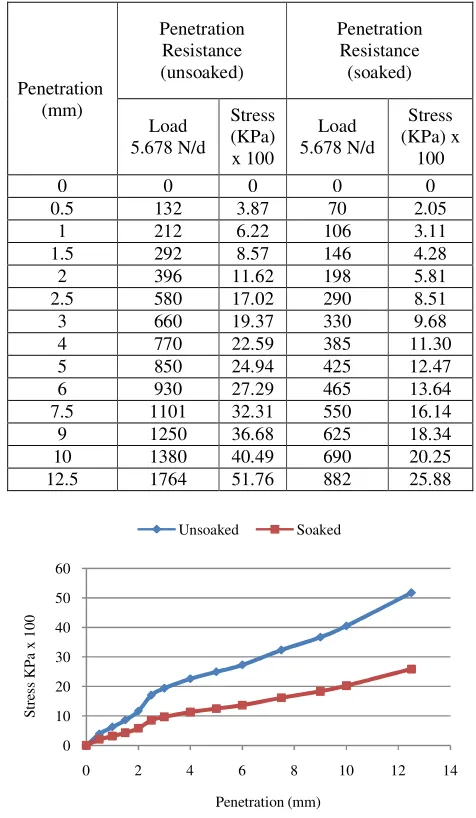
THE CBR RESULTS OF TREATED SOIL WITH CEMENT 5%
Penetration (mm)
Penetration Resistance (unsoaked)
Penetration Resistance (soaked)
Load 5.678 N/d
Stress (KPa) x 100
Load 5.678 N/d
Stress (KPa) x
100
0 0 0 0 0
0.5 132 3.87 70 2.05
1 212 6.22 106 3.11
1.5 292 8.57 146 4.28
2 396 11.62 198 5.81
2.5 580 17.02 290 8.51
3 660 19.37 330 9.68
4 770 22.59 385 11.30
5 850 24.94 425 12.47
6 930 27.29 465 13.64
7.5 1101 32.31 550 16.14
9 1250 36.68 625 18.34
10 1380 40.49 690 20.25
12.5 1764 51.76 882 25.88
Fig.2The Result of Soil Treated with Cement 5%
TABLE VI
THE CBR RESULTS OF TREATED SOIL WITH CEMENT 6%
Penetration (mm)
Penetration Resistance (unsoaked)
Penetration Resistance (soaked)
Load 5.678 N/d
Stress (KPa) x 100
Load 5.678 N/d
Stress (KPa) x
100
0 0 0 0 0
0.5 148 4.34 72 2.11
1 232 6.81 116 3.40
1.5 320 9.93 158 4.64
2 460 13.5 227 6.66
2.5 620 18.19 318 9.33
0 10 20 30 40 50 60
0 2 4 6 8 10 12 14
S
tr
es
s
K
P
a
x
1
0
0
Penetration (mm)
ISSN : 2581-7175
©IJSRED: All Rights are ReservedPage 436
3 760 22.30 376 11.03
4 900 26.41 445 13.06
5 1040 30.52 518 15.20
6 1190 34.92 590 17.31
7.5 1340 39.32 667 19.57
9 1598 46.89 790 23.18
10 1680 49.30 836 24.53
12.5 2020 59.27 1018 29.87
Fig. 3 The Results of Soil Treated with Cement 6%
TABLE VII
THE CBR RESULTS OF TREATED SOIL WITH CEMENT 7%
Penetration (mm)
Penetration Resistance (unsoaked)
Penetration Resistance (soaked)
Load 5.678 N/d
Stress (KPa) x 100
Load 5.678 N/d
Stress (KPa) x
100
0 0 0 0 0
0.5 158 4.64 81 2.38
1 236 6.93 119 3.49
1.5 360 10.56 189 5.55
2 520 15.26 262 7.69
2.5 656 19.25 328 9.62
3 820 24.06 410 12.03
4 1158 33.98 568 16.67
5 1424 41.79 711 20.86
6 1656 48.59 818 24.00
7.5 1980 58.10 978 28.70
9 2304 67.61 1052 30.87
10 2535 74.42 1168 34.27
12.5 2860 83.92 1340 39.32
Fig.4The results of Soil Treated with Cement 7%
TABLE VIII
CBRTEST RESULTS OF TREATED SOIL A(CEMENT 5%)
Samples
CBR (%)
General
Rating Uses Unsoaked Soaked
Soil A
24.67
(20-30) -
Very-
Good Subgrade
- 12.38
(10-20) Fair-Good Subgrade
TABLE IX
CBRTEST RESULTS OF TREATED SOIL A(CEMENT 6%)
Samples
CBR (%)
General
Rating Uses Unsoaked Soaked
Soil A
26.36
(20-30) -
Very-
Good Subgrade
- 13.52
(10-20) Fair-Good Subgrade
TABLE X
CBRTEST RESULTS OF TREATED SOIL A(CEMENT 7%)
Samples
CBR (%)
General
Rating Uses Unsoaked Soaked
Soil A 27.89
(20-30) -
Very-
Good Subgrade
0 10 20 30 40 50 60
0 2 4 6 8 10 12 14
S
tr
es
s
K
P
a
x
1
0
0
Penetration (mm)
Unsoaked Soaked
0 10 20 30 40 50 60 70 80 90
0 2 4 6 8 10 12 14
S
tr
es
s
K
P
a
x
1
0
0
Penetration (mm)
ISSN : 2581-7175
©IJSRED: All Rights are ReservedPage 437
- 13.94
(10-20) Fair-Good Subgrade
From the test results, soaked CBR values of treated soil range from 10 to 20 and general rating are Fair-Good. Therefore, both types of studied soil is suitable for subgrade course before application of cement with 5%, 6% and 7%.
IV. DISCUSSION AND CONCLUSIONS
From this research works, the following facts can be discussed.
1. With respect to moisture content measurements and specimen size, the recommended amount of soil required to obtain an accurate measurement increases with increasing maximum particle size.
2. The sieve sizes recommended for mechanical sieving in this laboratory exercise (No.4, No.10, and No.40) are based on the assumption that the soil contains little or no gravel-size particles (i.e.; particles retained by the No4 sieve).
3. Plasticity index is a qualitative measure of the swell potential of soil. Clays with high exchange capacity, including bentonite, montmorillonite, and smectite, have high swell potentials. Liquid limit is defined as the water content at which the groove close at exactly 25 cranks. Most likely, it will required either more or less than 25 craks to close the crack for the first test. To derive liquid limit using the multipoint method, the procedure is repeated at three different water contents, and the data are plotted on semi-log graph.
4. Compaction of subgrade soils is a basic subgrade detail and is one of the most fundamental geotechnical operations for any pavements project. The purpose of compaction is generally to enhance the strength or load-carrying capacity of the soil, while minimizing long-term settlement potential. Compaction also increase stiffness and strength, and reduces swelling potential for expansive soils.
5. The CBR test is penetration test meant for the evaluation of subgrade strength of roads and pavements. The results obtained by these test are used with the empirical curves to determine the thickness of pavement and its component layers. This is the most widely used method for the design of flexible pavement. This instruction sheet covers the laboratory method for the determination of CBR of undisturbed and remold compacted soil specimens, both in soaked as well as unsoaked state.
As a result of testing, the CBR value of untreated soil in soaked condition is 8.42. Therefore, soil condition is Poor-Fair for subgrade. After stabilization with cement 5%, 6% and 7%, the CBR value of treated soil in soaked condition is 12.38, 13.52, 13.94. CBR values of treated soils range from 10 to 20 and general rating are Fair-Good. So, the studied soil is suitable for subgrade course after stabilization with cement.
ACKNOWLEDGEMENT
The author is also grateful to Dr. Min ZawAung, Principal of Technological University (Mawlamyine), for his valuable guidance, correction and advice.Finally, the author deeply grateful to her parents for their supports, encouragement and the author would like to express heartfelt gratitude to all of her teachers who taught her everything from childhood till now.
REFERENCES
[1] Das, B.M. 2002. Principles of Geotechnical Engineering. Pacific Grove: Brooks Cole.
[2] Duncan, C.I. 1992. Soils and Foundations for Architects and Engineers. New York: Van Nostrand Reinhold.
[3] Schaefer, V.R., M.T. Suleiman, D.J. White, and C. Swan. 2005. Utility Cut RepairTechniques-Investigation of Improved Utility Cut Repair Techniques toReduce Settlement in Repaired Areas. Iowa: Report No. TR-503, Iowa Department of Transportation.
[4] Spangler, M.G., and R. Handy. 1982. Soil Engineering. New York: Harper & Row.
[5] ELE International 2007. In-situ CBR.http://www.ele.com/geot/cali.html. [6] Federal Highway Administration. 2007. Resilient modulus.
[7] http://www.tfhrc.gov/pubrds/04sep/03.html.
[8] Karamihas, S.M., and T.D. Gillespie. 2002. Assessment of Profiler Performance forConstruction Quality Control: Phase I. Michigan: Transportation Research Institute, University of Michigan.
[9] Rollings, M.P. and R.S. Rollings. 1996. Geotechnical Materials in Construction. New York: McGraw-Hill.
[10] Webster, S.L., R.H. Grau, and T.P. Williams. 1992. Description and Application ofDual Mass Dynamic Cone Penetrometer. Vicksburg, Mississippi: Report No. GL-92-3, Department of Army, Waterways Experiment Station.
[11] Christopher, B.R., and R.D. Holtz. 1991. Geotextiles for Subgrade Stabilization inpermanent Roads and Highways. Atlanta, GA: Proceedings, Geosynthetics.
[12] Macdonald, R., and S. Baltzer. 1997. Subgrade performance study part I: Materials,Construction and Instrumentation. Denmark: Danish Road Institude.
[13] Portland Cement Association. 1995. Soil-Cement Construction Handbook. Skokie, IL.
[14] http://www.ijtrd.com/Bearing Strength on the Effect of Cement-NP on Studied Soils/Volume 5 Issue 5, ISSN:2394-9333/IJTRD18064.pdf