Tribology in Industry
www.tribology.rsExperts System Based on the Neural Network and
Mobile Database in the Field Galvanic Metal Coating
A. Đorđević
a, D. Jovanović
b, B. Nedić
a, D. Lukić
c, M. Stefanović
a, M. Erić
aaFaculty of Engineering, University of Kragujevac, Sestre Janjić 6, 34000 Kragujevac, Serbia. bZastava Arms, Kososvska 4, 34000 Kragujevac, Serbia.
cUniversity of Novi Sad, Faculty of Technical Sciences, Department of Production Engineering, Novi Sad, Serbia.
Keywords:
Mobile databases Neural network Expert system Production
Galvanic metal coating
A B S T R A C T
In a modern era of information technologies, everyday changes are more numerous and various. One of those changes is related to the greater use of mobile devices in a decision making processes. They may be used in the field of automation and improvement of production processes. Their main purpose may be seen as the achievement of optimal production quality, lower production costs, timely deliveries, rational management of material and information flows. Having this in mind, it may be said that interactive data processing from different data sources and the application of artificial intelligence methods is possible within the field of metal coating data processing and prediction. In this paper, novel developed model and expert system, which consists of mobile databases and neural network for the prediction of quality of coating has been presented. Input data obtained from the databases are related to the starting conditions of deposition and the quality of the given coating material, while the target data are related to the thickness and roughness of the material surfaces. Application of the presented solution may confirm the possibility of integration of mobile databases and neural networks within a mobile expert system in the field of modern production systems.
© 2018 Published by Faculty of Engineering
Corresponding author:
Milan Erić
Faculty of Engineering, University of Kragujevac, Sestre Janjić 6, 34000 Kragujevac, Serbia. E-mail: [email protected]
1. INTRODUCTION
Application of metal materials is directly correlated to their properties and especially their surface conditions. According to the [1], metal materials are the most used engineering material, since they are used as main materials in machinery, transport resources and structures. Hence, forming the appropriate properties of material surface parts is an important issue, which may be supported by
application of adequate expert system. These expert systems should be based on the application of tools and methods developed in the context of modern information technologies If the level of such information technology development is analysed, it can easily be concluded that research in scientific disciplines are completely interconnected. In such circumstances, each part of the information system can communicate with other elements. Some elements may generate, some may
R
ES
EA
R
transform, and some may revise or deliver data to a certain decision place.
2. LITERATURE REVIEW
Having in mind that the paper presents the opportunities of mobile databases and artificial neural networks (ANN) integral application in a metal coating surface studies, and that the platform for this application is already developed metal coating database, this part of the research is intended for the literature review related to these fields. Within the paper [2], the impact of distributed mobile databases on the devices with the possible Bluetooth connection is analysed and described. A special case of database engine SQL Server CE impact on pocket mobile device iPAQ was considered. Time for the response on the certain queries, general traffic flow and energy (batteries) consumption in a correlation with the amount of inquiries were measured.
Within the research [3], the author presented a range of possible mobile interactions with databases. They have identified possible two schemes of mobile accesses, which are: strategy based on the query processing and strategy based on caching management. Issue of mobile
database and neural network integration presents the focus of the author in the paper [4]. In this paper, object-oriented database has been used to store neural network complex data, since neural networks may be presented as a part of intelligent database systems.
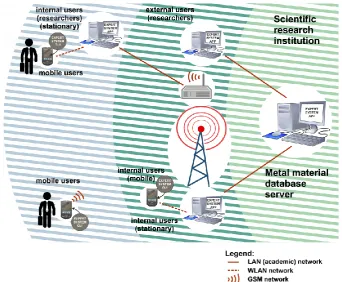
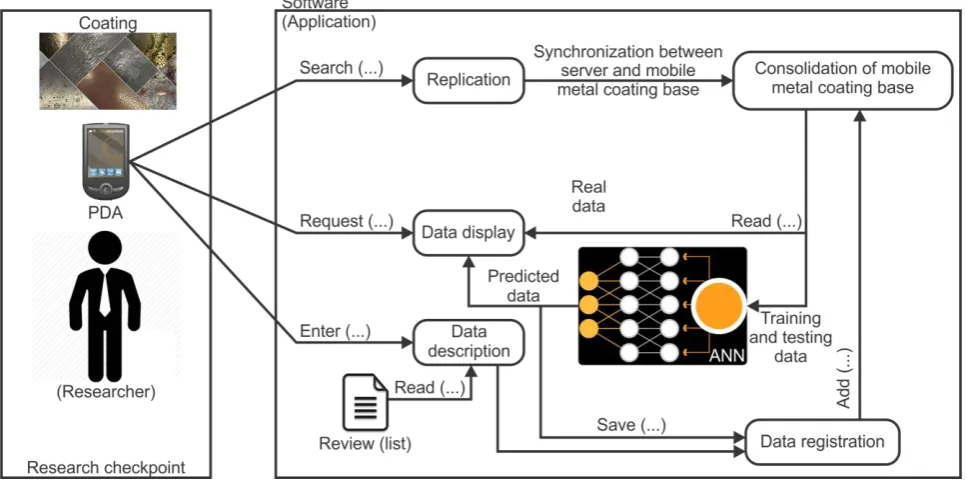
Therefore, mobile databases, neural networks and portable user devices, within presented research, may provide all the necessary means for prediction and determination of appropriate surface quality based on expert system within the research institution galvanic metal coating database server. Based on the access to existing research results within the database and application of neural networks, researchers can perform certain activities to predict surface quality parameter values and after that preserve the real and ANN output parameter values within the metal coating database, for the further research. After which, these information present important knowledge for other expert system mobile and stationary users. Figure 1 presents the possible way of implementing the general structure of collecting information from developed database. The concept and the structure of this database is presented in the papers [5,6] with the application of adequate portable devices [7].
Fig. 1. Schematic representation of the general scenario of integral database server use with expert system for
Presented expert system solution incorporates ANN for prediction of surface roughness and thickness. ANN have been proven as very promising and accurate method for forecasting [8], classification [9] and data processing [10]. Advantages of ANNs are related to the facts that they are able to generalize, learn from complex relationships and that they have nonparametric nature [11]. Therefore, application of ANN is broad, and includes information systems and mechanical production processes [12-15].
When addressing issue of mobile devices, it must be emphasized that we are currently categorizing a large number of different electronic devices. These categories from the point of view of databases, their transmission and signals with research equipment include mobile phones, smartphones, ultra-mobile computers, iPods. The category of mobile devices does not include laptops, because they fall into the category of portable devices, and the reason for this is their size and reduced mobility. E-book readers and tablets due to their characteristics may be subdivided under both of these categories, but can be considered as mobile devices in a wider sense.
Functions that were only possible on personal computers became possible on mobile devices thanks to the development of technology. These functions became possible by installing additional word processing applications, reading electronic books, multimedia, database management systems. So, mobile devices have become a replacement for computers [16]. Thanks to this, the user can be out of his job, and he can still, if he wants to manage the necessary data. In order for all this to be possible, mobile devices had to develop a system connection for connecting to a wireless computer network, data exchange and synchronization with personal computers.
In the telecommunications world, major changes have occurred in the emergence of mobile phones. Also, the emergence of mobile phones has significantly affected the improvement of life and business. In particular, the PDA offered an
extremely large number of computer
applications and various useful tools. All this is the reason that there is a tendency for mobile phones to get certain functionality and features that the PDA has, and that PDAs get the ability to make calls via mobile networks. The devices that
thanks to this were smart phones. Smartphones have the ability to communicate with voice over the network, have a higher-level system, and the ability to install new applications, can create and view multimedia content, the ability to connect to wireless LANs.
New possibilities of using these devices as well as the continuous development of better performance create new chances for the application of these devices that can relate both to the business and to the personal level. This paper presents the concept of the use or access to metal coating applications and databases. One of the most important features of mobile devices is the ability to synchronize with computers and the ability to back up. Synchronization between mobile devices and desktop computers is done by connecting the computer most often through a USB port and by merging specialized software
on both systems (ActiveSync). During
synchronization, it is possible to reserve all the data of the mobile device that will be stored on the computer [17].
Also, the important feature of the mentioned mobile devices is related to communication in order to transmit and share data with a metal coating database or available research equipment. There are several standards and protocols that are supported by different devices and technological generations, like: 6LowPAN, IPv4/IPv6, RPL, Wi-Fi, Bluetooth, LPWAN, JSON-LD, Web Thing Model, Alljoyn, IoTivity, Weave, Homekit, AMQP (Advanced Message Queuing Protocol), DDS (Data-Distribution Service for Real-Time Systems), LLAP (lightweight local automation protocol), REST (Representational state transfer) - RESTful HTTP, etc. [18].
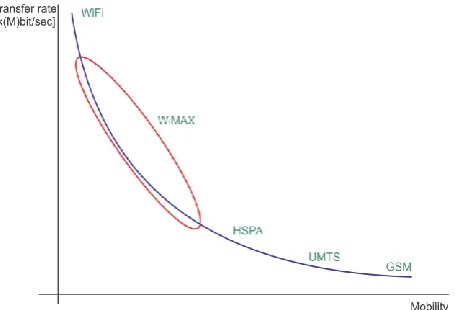
Wi-Fi technology has created a higher bandwidth and transfer speed. All of this has affected the fact that mobile power consumption significantly increases the energy consumption, so the processor load and new batteries are obstacles for wider use on mobile devices. The new standard from the IEEE 802 standard group includes access speeds up to 100 Mbit / s for mobile users, and for stationary device users up to 1 GB/s. The Fig. 2 shows the transmission ratio and mobility of certain data transfer technologies. The good side of Wi-Fi is that it can provide high transfer speeds. At the same time Wi-Fi has a problem in having a small range of access points and there is no possibility of accessing users on the go. On the other hand, coverage of the GSM network is remarkable (most operators in Serbia have network coverage of over 98 %), with very low data rate.
Fig. 2. Relationship between transfer rate and
mobility technologies for data transfer.
From the very appearance of computers there are also databases. Over time they changed their forms and forms. With the advent of computers, their development, their popularity and availability, the possibility of storing information and searching information has become available to almost everyone. The ability to store electronic data has changed over time, starting with simple files, major database systems on desktop computers, to very powerful database servers today [19].
Thanks to the lower cost of technology, data collection has become an easy and storage is cheap. It is now possible to study not only the collection and storage of data, but also their
analysis and understanding. Database
distribution has created the need for developing analytical tools that can convert saved data into
useful information and new knowledge. Clipper application was initially one of the most popular on the Serbian market as the first relational database on computers behind which was the dbase (popular dbf) database format in different versions. Highly popular was Microsoft Access, which can be used as a database for writing Windows applications. However, when it comes to large scale systems that need to be stored and manipulated by large amounts of data and concurrent users, it is mentioned on database servers that can meet these needs in terms of
performance, security features and
administration.
Limited capabilities of processor, cache, battery power, memory, as well as insufficient bandwidth of mobile networks and wireless networks have affected the sun and limit access to databases on mobile devices. Based on these facts, database management systems (DBMS) for mobile devices have been depreciated from DBMS servers [19].
3. SYSTEM ARCHITECTURE
Research in the field of galvanic metal coatings is mainly focused on the determination of processing condition influence on galvanic metal coating characteristics. A large number of studies showed that it is difficult to
determine direct dependence between
processing conditions (currents, weather,
topography, concentration, temperature,
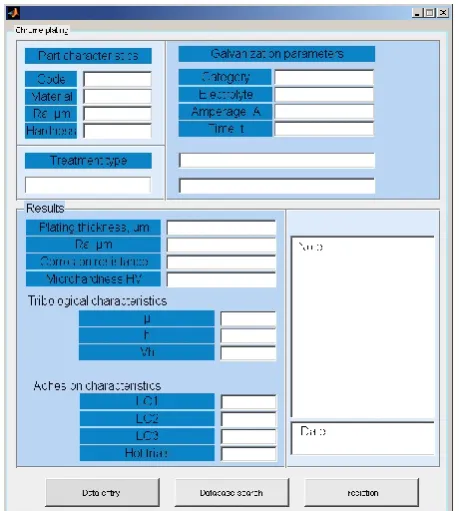
technological systems performance. The special quality of the ANNs is their ability to simultaneously track multiple target functions depending on the requirements of the research. Graphical user interface developed fort the standalone part of the application on the mobile client side is presented on the Fig. 3. By selecting the Prediction button from a user interface prediction of coating thickness and coating surface roughness is lunched.
Fig. 3. Graphical user interface on the user mobile device.
The use of mordent devices in industry enables for experimental tests data results of galvanic chromium coating on steel to be accommodate with other information such as reports and results [20].
Such data may include the following:
• part characteristics (code, material, hardness, roughness),
• galvanization parameters (category,
electrolyte, amperage and time),
• results (plating thickness, roughness, corrosion resistance, micro-hardness), • tribological characteristics, and • adhesion characteristics.
This gives a possibility for various database applications, among all ANN application.
4. APPLICATION OF THE PROPOSED SYSTEM
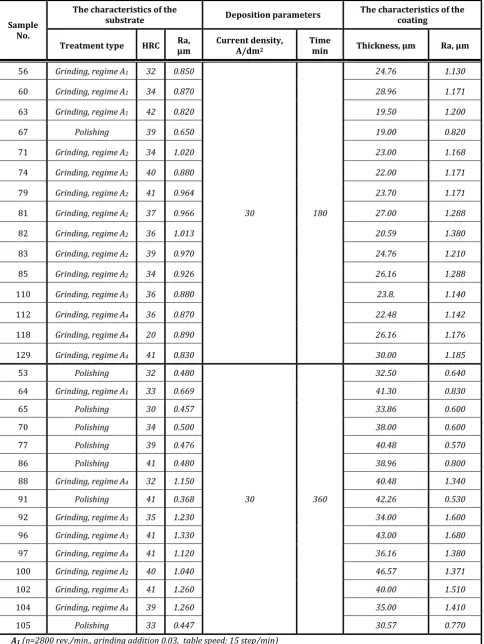
Samples were made with technologies of milling, grinding, polishing and sandblasting. Prior to final grinding, metal samples were heated and thus the different hardness values of the material have been achieved. Coating was performed with different current density values and different time periods. The obtained experimental data of the work piece characteristics and galvanization parameters from metal coating database are shown in Table 1.
Metal coating databases integrated with ANN structure allow obtainment of information on all the necessary data for prediction, data related to the publications published based on the research conducted by the application of this expert system. Also, data regarding the number of citations of these researches are accessible.
Created expert system provides the ability for data entries, database search and predictions. In the case of galvanic metal coating, entered data were obtained from experimental, but also may be obtained from production conditions. Basis for data entries is the work-piece primary key (sample code number), so that all the other characteristics are associated with it.
By selecting the Prediction button a user interface used for prediction of coating thickness and coating surface roughness is lunched. To perform prediction, within this part of the software solution, experimental data on the work piece characteristics and galvanization parameters were selected from previously filled database. These selected data are parameter values related to material surface thickness and roughness to which the coating is applied, galvanizing time period and galvanizing current density. After retraction of available data ANN training was executed.
Table 1. Overview of samples with galvanic chromium coatings.
Sample No.
The characteristics of the
substrate Deposition parameters The characteristics of the coating
Treatment type HRC Ra, μm Current density, A/dm2 Time min Thickness, µm Ra, μm
56 Grinding, regime A1 32 0.850
30 180
24.76 1.130
60 Grinding, regime A1 34 0.870 28.96 1.171
63 Grinding, regime A1 42 0.820 19.50 1.200
67 Polishing 39 0.650 19.00 0.820
71 Grinding, regime A2 34 1.020 23.00 1.168
74 Grinding, regime A2 40 0.880 22.00 1.171
79 Grinding, regime A2 41 0.964 23.70 1.171
81 Grinding, regime A2 37 0.966 27.00 1.288
82 Grinding, regime A2 36 1.013 20.59 1.380
83 Grinding, regime A2 39 0.970 24.76 1.210
85 Grinding, regime A2 34 0.926 26.16 1.288
110 Grinding, regime A3 36 0.880 23.8. 1.140
112 Grinding, regime A4 36 0.870 22.48 1.142
118 Grinding, regime A4 20 0.890 26.16 1.176
129 Grinding, regime A4 41 0.830 30.00 1.185
53 Polishing 32 0.480
30 360
32.50 0.640
64 Grinding, regime A1 33 0.669 41.30 0.830
65 Polishing 30 0.457 33.86 0.600
70 Polishing 34 0.500 38.00 0.600
77 Polishing 39 0.476 40.48 0.570
86 Polishing 41 0.480 38.96 0.800
88 Grinding, regime A4 32 1.150 40.48 1.340
91 Polishing 41 0.368 42.26 0.530
92 Grinding, regime A3 35 1.230 34.00 1.600
96 Grinding, regime A3 41 1.330 43.00 1.680
97 Grinding, regime A4 41 1.120 36.16 1.380
100 Grinding, regime A2 40 1.040 46.57 1.371
102 Grinding, regime A3 41 1.260 40.00 1.510
104 Grinding, regime A4 39 1.260 35.00 1.410
105 Polishing 33 0.447 30.57 0.770
A1 (n=2800 rev./min., grinding addition 0.03, table speed: 15 step/min)
A2(n=2800 rev./min., grinding addition 0.03, table speed: 30 step/min)
Fig. 4. Neural network created to predict the thickness of the coating.
Based on the selection from the graphical user interface Fig. 5 shows the structure of the initially trained ANN used to predict the coating characteristics. ANN consists of two layers, the hidden layer has ten and output layer one neuron.
After ANN creation and training, corresponding results are obtained in the form of the graphically presented correlations between the ANN output and the target values. Graphically presented correlations point out the existence of
agreement or disagreement between the output and the target values. Ideally, all displayed points are grouped around the regression lines; dots that are not close to the regression line represent the failure of ANN to predict appropriate outputs.
Fig. 5. Appearance of the created neural network with two layers.
Hence, the integration of ANN and metal coating databases may provide answers for the questions regarding the research validity, researchers, used literature, and economic benefits from performed researches.
According to the general scenario presented on the Fig. 1, structure of the possible information system with the mobile metal coating database server may be illustrated with the UML shown on the Fig. 6.
Software application may be considered as successful if it is possible for the users of PDA devices to initiate replication procedure that symphonises information from the device with the data on the metal coating server database. Other advantages of the successful expert system are the possibility to make predictions based on the query requests and to register (save) real variable and predicted values.
5. MODELING RESULTS
Based on a defined ANN (Fig. 5), the correlations coefficient R for the training, validation, testing group and the overall correlation coefficient between the predicted output values and the measured target values of coating thickness and surface roughness Ra are determined (Fig. 7). In the training set, with its regression line, linear correlation coefficient value is satisfactory equal to R = 0.77978. The same applies to the value of the correlation coefficient in the case of validation R = 0.90618. However, the value of the correlation coefficient in the case of testing is R = 0.31123, which indicates the dispersion of the results in testing group, therefore the ANN could not be accepted as reliable for prediction of the thickness of the coating, although the total value of the correlation coefficient is R> 0.78786.
Fig. 7. Training results for coating thickness
prediction.
Having in mind the previously outlined, there has been minor additional ANN configuration adjustment, i.e. the number of neurons in the hidden layer was increased to the twenty and
subsequently re-tests were performed.
Configuration of newly created ANN is shown on a Fig. 8.
Fig. 8. The increased number of neurons in the neural network hidden layer
After ANN structure changes, new results for correlation coefficient were obtained. These results are shown on Fig. 9.
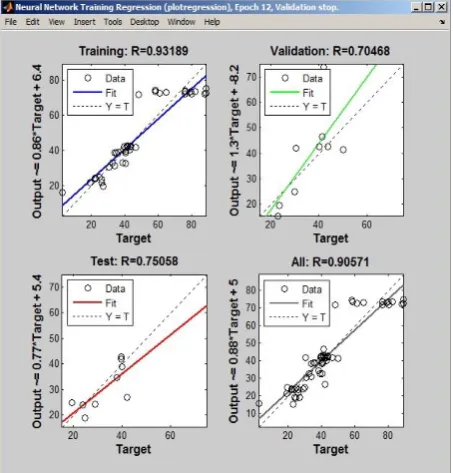
The Fig. 9 shows the results of subsequently trained ANN, the correlation coefficients in the training group had the satisfactory value of R = 0.93189, validation of R = 0.70468 and testing of R = 0.75058. Therefore the overall correlation coefficient is R> 0.9, and it can be concluded that there is a high correlation between the predicted output values and the measured target values.
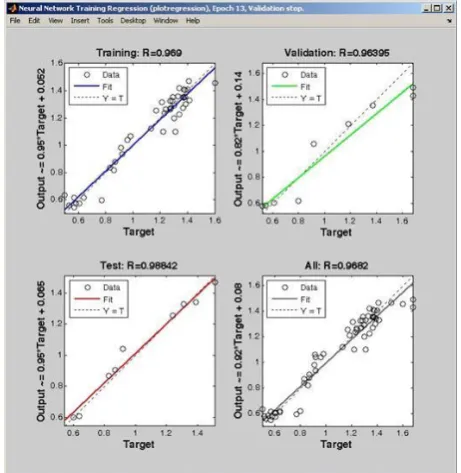
Similarly, as in the previous case, Fig. 10 shows the correlation between predicted output values and measured target values of the coating surface roughness in a training, validation, and testing group, R = 0.969, R = 0.96395, R = 0.98842, respectively.
Fig. 10. The increased number of neurons in the neural network hidden layer for coating surface roughness.
The overall correlation coefficient value in ANN for coating surface roughness is R = 0.9682. As the values of the correlation coefficient in all four groups between the predicted output values and measured target values are R>0.9, it may be concluded that the modelled ANN is acceptable for further application.
6. CONCLUSION
Modern information and communication systems with development of mobile devices provided conditions for faster communications and computing in all scientific fields, and even in the field of metal coatings. Essential characteristics that separate mobile computing devices from other, are: mobility and availability.
In this paper, author have analysed the justification of the presented concept (and the appropriate scenarios for the usage of the mobile devices). The paper presented possible access to data and prediction of values for unknown cases from mobile device, or real and
predicted data storing within the metal coating database on the server. Based on the graphically displayed obtained results, it can be concluded that the developed concept provides the ability to predict the values of parameters, such as galvanic coating quality characteristics: thickness and roughness.
Information collected from databases on mobile devices may be used at the research checkpoints (a location where the experiment takes place) in order to obtain appropriate input parameter values, based on the expected outcomes, that are obtained by the application of the ANN. After that decisions can be made, for the input
parameters of galvanic metal coating
adjustment, in order to obtain expected quality of the metal surface roughness and thickness.
Finally, it may be concluded that this kind of expert system may prove as helpful, since it represents a good response to IT challenges placed in front of the meal material industry
Acknowledgement
The paper has been fully supported by the Serbian Ministry of Education, Science and Technological Development under the projects TR35021, TR35034 and III44010.
REFERENCES
[1] L.A. Dobrzanski, J. Madejski, Prototype of an expert system for selection of coatings for metals, Journal of Materials Processing Technology, vol. 175, iss. 1-3, pp. 163-172, 2016,
doi:10.1016/j.jmatprotec.2005.04.034
[2] H. Artail, M. Shihab, H. Safa, A distributed mobile database implementation on Pocket PC mobile devices communicating over Bluetooth, Journal of Network and Computer Applications, vol. 32, iss. 1, pp. 96-115, 2009, doi: 10.1016/j.jnca.2008.04.003
[3] A. Waluyo, B. Srinivasan, D. Taniar, Research in Mobile Database Query Optimization and Processing, Mobile Information Systems, vol. 1, iss. 4, pp. 225-252, 2005, doi: 10.1155/2005/161239
[5] M. Erić, M. Babić, S. Mitrović, B. Tadić, D. Džunić, Conversion Of Data Into Information In Tribology Research, Journal of the Balkan Tribological Association, vol. 20, no. 1, pp. 49-62, 2014. [6] M. Erić, S. Mitrović, M. Babić, F. Zivić, M. Pantić,
Application of Contemporary Information Technologies in Nanotribometry, Tribology in Industry, vol. 33, no. 4, pp. 159-163, 2011. [7] K. Siau, Z. Shen, Mobile communications and
mobile services, International Journal of Mobile Communications, vol. 1, iss. 1-2, pp. 3-14, 2003. [8] P.C. Chang, Y.W. Wang, C.Y. Tsai, Evolving neural
network for printed circuit board sales forecasting, Expert Systems With Applications, vol. 29, iss. 1, pp. 83-92, 2005, doi: 10.1016/j.eswa.2005.01.012
[9] M. Ture, I. Kurt, A. Turhankurum, K. Ozdamar, Comparing classification techniques for predicting essential hypertension, Expert Systems With Applications, vol. 29, iss. 3, pp.
583-588, 2005, doi:
10.1016/j.eswa.2005.04.014
[10] A. Chojaczyk, A. Teixeira, L. Neves, J. Cardoso, C. Guedes Soares, Review and application of Artificial Neural Networks models in reliability analysis of steel structures, Structural Safety, vol.
52, pp. 78-89, 2015, doi:
10.1016/j.strusafe.2014.09.002
[11] C. Feng, X. Wang, Surface roughness predictive modeling: neural networks versus regression, IIE Transactions, vol. 35, iss. 1, pp. 11-27, 2003, doi: 10.1080/07408170304433
[12] A. Abrahams, E. Coupey, E. Zhong, R. Barkhi, P. Manasantivongs, Audience targeting by B-to-B advertisement classification: A neural network approach, Expert Systems with Applications, vol.
40, iss. 8, pp. 2777-2791, 2013, doi: 10.1016/j.eswa.2012.10.068
[13] A.M. Alfantazi, G. Brehaut, U. Erb, The effects of substrate material on the microstructure of pulse-plated Zn–Ni alloys, Surface and Coatings technology, vol. 89, iss. 3, pp. 239-244,1997, doi: 10.1016/S0257-8972(96)02894-0
[14] S.O. Haykin, Neural networks and learning machines, Pearson, 2009.
[15] J. Doshi, D. Desai, Application of Failure mode & effect analysis (FMEA) for continues quality improvement - Multiple case studies in automobile SMEs, International Journal for Quality Research, vol. 11, no. 2, pp. 345-360, 2017, doi: 10.18421/IJQR11.02-07
[16] H. Artail, M. Shihab, H. Safa, A distributed mobile database implementation on Pocket PC mobile devices communicating over Bluetooth, Journal of Network and Computer Applications, vol. 32, iss. 1, pp. 96-115, 2009, doi: 10.1016/j.jnca.2008.04.003
[17] F. Ibikunle, A. Adegbenjo, Management Issues and Challenges in Mobile Database System, International Journal of Engineering Sciences & Emerging Technologies, vol. 5, iss. 1, pp. 1-6, 2013. [18] IoT Standards and Protocols at:
https://www.postscapes.com/internet-of-things-protocols/, accessed: 07.12.2018.
[19] M. Kovačević, Overview of current technologies for mobile and broadband wireless communications, Telekomunikacije, vol. 2, 2009.(in Serbian) [20] M. Erić, V. Nedić, M. Stefanović, M. Djukić,