J. Phys. C : Solid State Phys., Vol. 12, 1979. Printed in Great Britain. 0 1979
Quadrupole splitting of Mossbauer lines due
to
defects
in
COO
Nuria Barberan?, P W Tasker and A M Stoneham
Theoretical Physics Division, AERE, Harwell, Oxfordshire OX11 ORA, UK
Received 23 February 1979
Abstract. The Fe3+ lines observed in COO Mossbauer sources may arise from the decay of Co3+ ions associated with cation vacancies in the crystal. These defects produce an electric-field gradient that causes a quadrupole splitting of the resonance line and that can, in principle, distinguish between different types of defects. The calculation of the quadrupole splitting at FeZ+ and Fe3+ sites near various vacancy clusters includes the relaxation of the lattice about the defect. This lattice polarisation and distortion is shown to be extremely important, since simple calculations based on perfect ion positions give very different field gradients at neighbouring sites. The results are compared with the experiments available and the quadrupole splittings observed are close to those predicted by a vacancy model.
1. Introduction
One of the problems that has concerned physicists working with the Mossbauer effect is the necessity for strong, single-line sources with which several types of target can be investigated. A particularly interesting case is 5 7 C 0 0 (Ok and Mullen 1968) used for studying targets containing iron compounds. This material has several advantages over the commonly used 7Co-doped sources, since it has a large recoil-free fraction at room temperature. Materials containing CO make very strong sources and a COO source can avoid line broadening in doped materials because of interactions with neighbouring impurities. However, it is well known (see e.g. Wertheim, 1961) that several different cation charge states are observed in these oxide sources. In particular, the Mossbauer spectrum obtained using COO as a source or target shows peaks due to Fe2+ and Fe3+ or even higher charge states (Ingalls and DePascuali 1965), the proportions of which depend on the method of preparation (Sond and Mullen 1976). The literature reports many experimental attempts to develop a standard method of making a single-line COO source, but t h s has not yet been achieved.
The origin of the ferric ions in COO sources is controversial and several interpreta- tions of the observation exist. It has been suggested (Ingalls and De Pascuali 1965) that metastable charge states of iron are produced by an Auger process following the electron-capture disintegration of 57C0. Alternatively the coexistence of several types of stoichiometric oxide (Mullen and Ok 1966) or microcrystalline COO with cation defects (Schroeer and Triftshauser 1965) has been proposed. The most common inter- pretation (Leon and Negrete 1970, Triftshauser and Craig 1966, Tejada and Fontcuberta 1978) is the stabilisation of highly charged cation states by neighbouring vacancies. Catlow et a1 (1977a) have calculated the probable defect structure of COO and shown
t Permanent address: Facultad de Ciencias, Universidad de Barcelona, Barcelona, Spain.
that complicated vacancy-hole (i.e. trivalent cation) complexes are likely. We have, therefore, calculated the quadrupole interaction on the nucleus of the emitting ion for each of the probable vacancy clusters, The values obtained for the quadrupolar splitting in F e 3 + or Fezf can, in principle, determine the defect structure of the crystal and will show whether the presence of Fe3+ in COO sources can be due to the cation vacancies. Our calculations will also assess the importance of including correct lattice relaxation about a defect structure, rather than determining quadrupole splitting from the ideal lattice geometry. The quadrupole interaction is determined from the electric-field gradient at the iron sites and is evaluated after the lattice has been relaxed to equilibrium. The methods used here have a general application t o the calculation of such interactions in nuclear research and spectroscopy.
2. The calculation
2.1. Vucancy clusters
Catlow et a1 (1977a) have calculated the vacancy-hole binding energies for various vacancy clusters in the divalent metal oxides. They used the same lattice-relaxation methods as used here to allow the ions to relax around the defect. The main conclusion was that it is inadequate to consider defects in these oxides without allowing for vacancy aggregation, and that simple single-vacancy-hole pairs will only dominate the defect structure in the stoichiometric case. Larger vacancy clusters are important for deviations greater than from the stoichiometric composition. Even in more stoichiometric materials Schroeer and Triftshauser (1968) have suggested that non-stoichiometric microcrystals may exist with the excess oxygens incorporated at the grain boundary.
These calculations consider explicitly both a simple single-vacancy structure and the most probable vacancy aggregate consisting of four vacancies and one interstitial
I
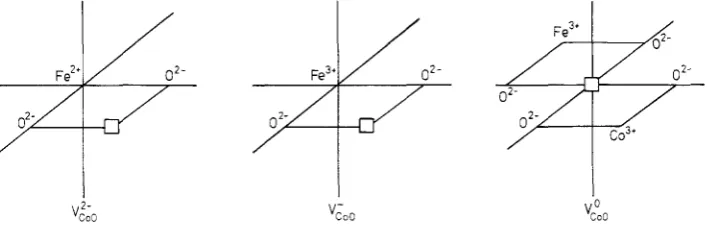
Figure 1. The three types of single-vacancy defects used for the calculation of electric-field gradients at Fe impurities in a COO lattice.
in a cluster. The electric-field gradient has been calculated at an iron site in COO for three distinct defects associated with a single vacancy. These are shown in figure 1 as the Vo, V- and V z - centres. In the first case the charge is neutral since two holes are bound t o the vacancy on adjacent cation sites. One of these sites gives rise to an Fe3+
Quadrupole splitting of Mossbauer lines due to defects in
COO
3829of the crystal but there the lattice makes no contribution to the quadrupole splitting. Electrical neutrality is achieved by isolated hole centres elsewhere in the lattice which do not contribute significantly to the electric-field gradient at the defect centre.
The 4 : 1 vacancy cluster is the basic defect aggregate considered by Catlow et a1
(1977~) in the metal oxides. In highly non-stoichiometric materials these clusters may
c03'
I
Figure 2 . 4: 1 cluster in the COO lattice with Co3+ ions in octahedral positions and tetra- hedral interstitial site explicitly shown.
Fe3'
Fe3' I O ,O,O 1
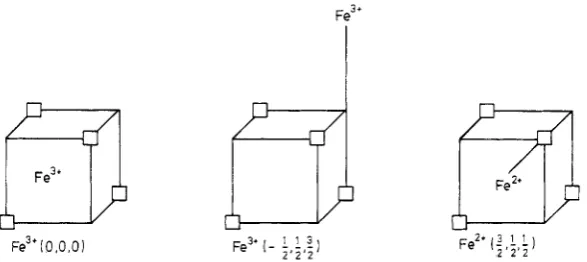
Figure 3. Fe impurity sites associated with the 4: 1 cluster. Additional Co3 ions are present
as indicated in figure 2.
figure 2. Fe3' ions are produced by the decay of Co3+ ions at either the interstitial site at the centre of the cube or at one of the octahedral substitutional sites and Fe2+ ions are created at normal associated CO' + octahedral sites. These three possibilities are
illustrated in figure 3.
In the experimental preparation of COO sources a spinel phase is known to be present in the resulting material. Consequently we have also calculated the quadrupole splitting for F e 2 + and Fe3+ in the appropriate spinel material in order to distinguish between this phase and defect structures in normal COO. The vacancy clusters considered here are a representative rather than exhaustive set and should enable the magnitude of
the lattice contribution to the electric-field gradient to be calculated.
2.2. Lattice relaxations
An ionic model of C o o has been used in all these calculations with short-range potentials parameterised from the bulk properties. The ions are relaxed t o equilibrium about the defect using the HADES program. This program considers a region of crystal around the
defect in which all the atoms are explicitly treated and an outer region treated as a continuum and matched using the Mott-Littleton method (Mott and Littleton 1938). Details of the method have been given elsewhere (Norgett 1974, Lidiard and Norgett 1972) and the method has been used in many other studies of defects in ionic crystals (see e.g. Norgett et a1 1977, Catlow et al, 1977b). The program calculates exactly all the Coulomb sums and the additional short-range interionic potentials are taken from the work of Catlow et a1 (1977b). The cation-anion and anion-anion potentials take the form
V+ - ( r ) = A + - exp( - r / p + -) I/_ - ( r ) = A - - exp(-r/p- - ) - C - - / r 6 (1)
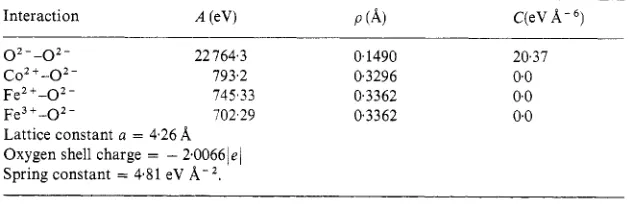
where the parameters A, p and C are given in table 1. There is no short-range interaction
Table 1. Short-range potentials of the form V ( r ) = A exp( - r i p ) - C r - 6 used in the calcula- tions. Only the oxygen atom is polarisable with shell-model parameters as given.
0 2 - - 0 2 - 22164.3 0.1490 20.37
C O * + - 0 2 - 793.2 0,3296 0.0
FeZC-02- 745.33 0,3362 0.0
Fe3 +-02 - 702.29 0.3362 0.0
Lattice constant a = 4.26 8,
Oxygen shell charge = - 2.00661eI Spring constant = 4.81 eV A - 2 .
between the cations. The polarisation of the ions is included by the shell model (Dick and Overhauser 1958) in which each ion is considered as a core and shell coupled by an harmonic potential. The parameters are given in table 1 and reproduce well the dielectric properties of the crystal.
2.3. Quadrupole splitting
Quadrupole splitting of Mossbauer lines due to defects in
COO
3831Thus in a polycrystalline material, where the emission has no angular dependence, the energy splitting of the Mossbauer line is given by
where e is the electron charge, Q the quadrupole moment of the nucleus and q and q
are derived from components of the electric-field gradient at the nucleus. The electric- field gradient has a contribution from the asymmetric distribution of charge due to the surrounding ions in the lattice and from the non-cubic distribution of electrons in partially filled orbitals on the atom itself. The lattice contribution is
where
KO
is an element of the electric-field gradient tensor. The sum is over all ions Kin the lattice of charge Z K and distance rK from the Mossbauer nucleus; r t is the a
component of the vector rK. The resulting tensor has zero trace and in the principal axis representation is diagonal with components named according to the convention
The asymmetry parameter q is given by
The
V,,
component of the field gradient at the nucleus is enhanced by the electron dis- tortion of the Mossbauer atom and is modified by the Sternheimer antishielding factory,. Thus q in equation (2) is given by
where the second term is the electronic contribution to the field gradient modified by a
Table 2. Parameters used in the calculation of the energy splitting. Nuclear quadrupole moment, Q from Sharma (1971); (1 - ym) from Sen and Narasimhan (1976); (1 - R) from Ingalls (1964) and ( r - 3 ) 3 d from Freeman and Watson (1965).
Q = 0.18 x cm2 (1 - yr) = 10.64
(1 - R ) = 0.68
( r - 3 ) 3 d = 5.0809 a u ( F e z i )
Sternheimer shielding factor R. The values for the parameters used in these calculations are given in table 2. The Fe3+ and Fe2+ ions are in high-spin states and so the Fe3+ ground state has 6S symmetry. There will be no contribution to the field gradient from this spherically symmetrical state and observation of this ion provides a sensitive test of the lattice field gradient. The electronic contribution, however, is large for Fe2+
(5D)
and will be shown to dominate the lattice term.
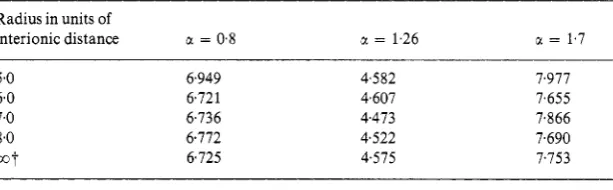
Table 3. Values of ( a 3 / e ) V,, in a tetragonal distorted lattice; a = b # c, a = cja with singly charged ions.
Radius in units of
interionic distance a = 0.8 a = 1.26 a = 1.7 5.0
6.0 7.0
8.0
a t
6,949 6.72 1 6,736 6.772 6,725
4.582 4,607 4.473 4.522 4.575
7.977 7,655 7.866 7.690 7.753
t
Values taken from summation given by D e Wette 1961successive shell of ions is included. These oscillations decrease as the sum converges. The results in table 4 are obtained by extrapolating the envelope of the curve to achieve greater accuracy. The resulting tensor is diagonalised to obtain the principle components of the field gradient. The approach can be checked against previous work. De Wette (1961) has calculated field gradients for tetragonal lattices, which is equivalent to dis- torting a cubic lattice along one axis. He used a method of summing over planes, whereas we have used an explicit summation over a sphere of ions, since we are considering point defects. l'able 3 provides a comparison between his results and those obtained by summing over the sphere. It can be seen that they agree to within a few per cent.
3. Results and discussion
The defect clusters employed in these calculations have been described in
0
2.1, and the hole that is bound to the vacancies is considered as trapped on an adjacent cation. This hole can hop to equivalent sites around the vacancies with a rate that depends on the overlap of the wavefunction on neighbouring ions. In the case of the Vo centre (figure 1) this would lead to altered field gradients at the Fe3+ site. Similarly in the case of the 4: 1 cluster, the hole may hop to equivalent CO sites orientated along different axes. If the hopping rate is slow compared with the lifetime of the Mossbauer state ( - s.) the Fe atom will feel the asymmetric charge distribution calculated. However, if the rate is fast, a more delocalised charge distribution will be apparent, leading to lower quadru- pole splittings. This effect may become important at high temperatures. Other arrange- ments are possible for trapped holes associated with the 4 : 1 cluster in addition to those considered here. We have chosen only the most symmetrjcal case. However, the relaxed energy splittings are similar in all the cases studied and other clusters are unlikely to differ greatly. When calculating the electronic contribution to the quadrupole splitting important in Fe2+, (equation 6), the influence of the lattice potential on the electronic levels was not considered, and unperturbed ionic wavefunctions were assumed. In Fe2 +Quadrupole splitting o j Mossbauer lines due to defects in COO 3833
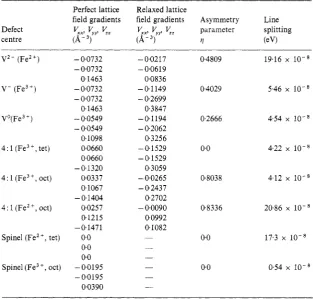
The results obtained in these calculations are given in table 4. In each case we give the principal components of the electric-field gradient and the line splitting that should be observed. Also shown are the field gradients calculated assuming the perfect lattice positions. These differ greatly from the results obtained from the relaxed geometry. If we consider the single vacancy defects shown in figure 1, both the V2- and V- centres have identical field gradients (due to the single vacancy) in the perfect lattice. After
Table 4. Electric-field gradients and Mossbauer line splittings for FeZ+ and Fe3+ in defect configurations in cobalt oxide
Defect centre V2- (Fe2+)
V- (Fe3+)
Vo(Fe3')
4 : 1 (Fe3+, tet)
4 : 1 (Fe3+, oct)
4:1(Fe2+,oct)
Spinel (Fe", tet)
Spinel (Fe3+, oct)
Perfect lattice field gradients
VXX,
yy>
v,,
(A-
- 0.0732 -0.0732
0.1463
- 0'0732
- 0.0732 0.1463
- 0.0549
- 0.0549 0.1098 0,0660 0.0660 0.0337 0.1067 00257 -0.1320 -0.1404 0,1215 -0.1471 0.0 0.0 0.0
-
0.0195 -0.01950.0390
Relaxed lattice
field gradients Asymmetry parameter v
Line splitting (eV)
- 0.0217 -0.0619
0.0836 -0.1149
0,3847
- 0.2699
- 0.1 194
- 0.2062 0.3256 -0.1529 -0.1529 0.3059
- 0.0265
- 0.2437 0.2702 0.0992 0,1082
- 0.0090
- - - - - - 0,4809 0,4029 0,2666 0.0 0.8038 0,8336 0.0 0.0
19.16 x lo-'
5.46 x l o - '
4.54 x 10⁻⁸
4.22 x lo-'
4.12 x l o - '
20.86 x l o - '
17.3 x l o - '
0.54 x lo-'
at these octahedral sites is very small compared with defect gradients. It leads to a line splitting that is an order of magnitude less than that due to vacancies in COO, and is therefore unlikely to be confused with them. The natural width of the Fe line is 4.7 x 10-
'
eV and so the splitting due to the spinel structure may not be observable, although the splitting or broadening due to the defects (minimum value = 1.98 x is experi- mentally detectable.There is little detailed experimental data on quadrupole splittings of Fe lines in COO and generally only the linewidth is given and not the calculated quadrupole splitting using a Lorentzian approximation. For example, Sond and Mullen (1976) report a width of
-
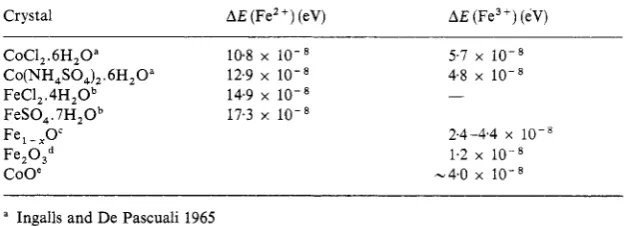
0.7 mm s - l , for the Fe3' line at room temperature. If this is due to unresolved quadrupole splitting it gives a value of N 4.0 x eV in good agreementwith the splitting caused by defects. Table 5 shows splittings of Fe lines observed in
Table 5. Quadrupole line splittings observed in a variety of crystals
Crystal AE (Fe") (eV) AE (Fe3+) (eV)
CoC1,. 6H,0a 10.8 x lo-* 5.7 x 10⁻⁸
FeC1,.4H,0b 14.9 x lo-' -
Fe,OSd 1.2 x 10⁻⁸
Co(NH,SO,),
.
6H,0a 12.9 x lo-' 4.8 x lo-' FeSO,. 7 H 2 0 b 17.3 x l o - 'Fel-xOc 24-4'4 x lo-'
COO' -4.0 x lo-'
a Ingalls and De Pascuali 1965
De Benedetti et al 1961 Greenwood and Howe 1972 Kistner and Sunyar 1960
e Song and Mullen 1976 (linewidths only)
other materials for comparison. In all cases the quadrupole effect in Fe2+ is much greater because of the electronic term a n 4 although it can be smaller than the values calculated here, there is evidence that this splitting decreases with temperature (De Bene- detti et al 1961). Our calculations are for a static lattice and thus refer to absolute zero temperature. The splittings of the Fe3+ lines are close to those predicted for the COO
case for all materials except Fez03, where the linewidth is narrower. Apart from the COO results, the Fe3+ splittings in Fe,-,O are of greatest interest since this non- stoichiometric crystal has the same defect structure as COO (Catlow et a1 1977a). Here the energy splitting observed is in close agreement with our calculations.
The main conclusions from this study can be summarised as follows. The hgher- charge states of iron (Fe3+) can be produced from the decay of Co3+ which is present in COO and stabilised by cation vacancies. The line splitting observed as a broadening of the Fe3+ line is compatible with the field gradients that would be produced by the vacancy clusters. The field gradients produce line splittings which are large compared with the natural linewidth and are thus experimentally observable. The splittings of the Fezf line are naturally much larger because of the electronic term but the various clusters produce splittings for the Fe3 + line that are distinguishable in principle. Finally,
Quadrupole splitting of Mossbauer lines due to defects i n COO 3835
configuration when calculating the quadrupole interaction. The resulting field gradients differ substantially from those obtained using the unrelaxed geometries: perfect lattice calculations are therefore totally inadequate.
References
Catlow C R A, Fender, B E F and Muxworth D G 1977a J . Physique C7 67
Catlow C R A, Mackrodt W C, Norgett M J and Stoneham A M 1977b Phil. M a g . 35 177 De Benedetti S, Lang G and Ingalls R 1961 Phys. Rev. Lett. 6 60
De Wette F W 1961 Phys. Rev. 123 103
Dick B G and Okerhauser A W 1958 Phys. Rei.. 1 I2 90
Freeman A J and Watson R E 1965 Hyperfine interactions in Magnetic Materials in Treatise on Magnetism Greenwood N N and Howe A T 1972 J . Chem. Soc. Dalton 110
Ingalls R 1964 Phys. Rev. A 133 787
Ingalls R and De Pascuali G 1965 Phys. Lett. 15 262 Kistner 0 C and Sunyar A W 1960 f h y s . Rev. Lett. 4 412 Leon V and Negrete P 1970 Solid St. Commun. 8 740
Lidiard A B and Norgett M J 1972 in Computational Solid State Physics ed F Herman, N W Dalton and T R Koehler (New York: Plenum Press)
Mott N F and Littleton M J 1938 7 " s . Faraday Soc. 34 485 Mullen J G and Ok H N 1966 Phys. Ret.. Letr. 17 287 Norgett M J 1974 U K A E A Report A E R E R 7650
Norgett M J, Stoneham A M and Pathak A P 1977 J . Phys. C : Solid St. Phys. 10 555 Ok H N and Mullen J G 1968 Phys. Rev. 168 550
Schroeer D and Triftshausen W 1968 Phys. Rev. L e t t . 20 1242 Sen K D and Narasimhan P T 1976 Phys. Rer. A14 539 Sharma R R 1971 Phys. Rev. Lett. 26 563
Sond C and Mullen J G 1976 Phyh. Rev. B14 2761 Stoneham A M 1969 Rev. M o d . Phys. 41 82
Tejada J and Fontcuberta J 1978 Univ. de Barcelona Preprint Triftshauser W and Craig P P 1966 Phys. Rev. L e t t . 16 1161 Wertheim G K 1961 Phys. Rev. 124 764