© 2011 Pearson Education, Inc.
LECTURE PRESENTATIONS
For CAMPBELL BIOLOGY, NINTH EDITION
Jane B. Reece, Lisa A. Urry, Michael L. Cain, Steven A. Wasserman, Peter V. Minorsky, Robert B. Jackson
Lectures by Erin Barley Kathleen Fitzpatrick
The Chemical Context of Life
Overview: A Chemical Connection
to Biology
• Biology is a multidisciplinary science
• Living organisms are subject to basic laws of
physics and chemistry
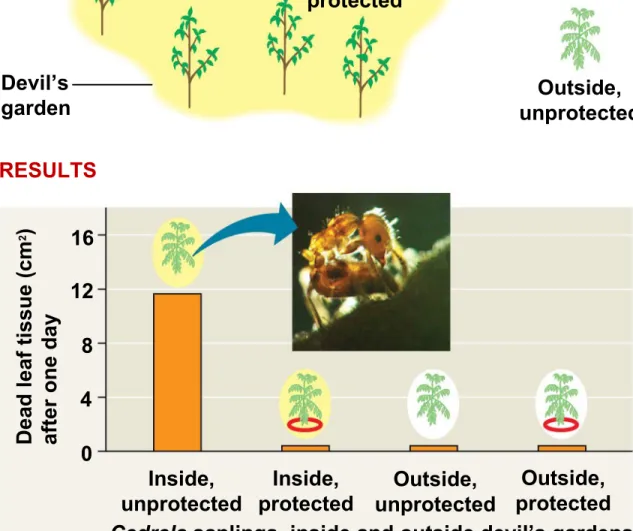
• One example is the use of formic acid by ants to
maintain “devil’s gardens,” stands of Duroia
trees
Figure 2.2 Duroia tree Devil’s garden Cedrela sapling Inside, unprotected Inside, protected Insect barrier Outside, protected Outside, unprotected EXPERIMENT RESULTS Inside, unprotected Inside, protected Outside, unprotected Outside, protected
Concept 2.1: Matter consists of chemical
elements in pure form and in combinations
called compounds
• Organisms are composed of matter
• Matter is anything that takes up space and
has mass
Elements and Compounds
• Matter is made up of elements
• An element is a substance that cannot be broken down to other substances by
chemical reactions
• A compound is a substance consisting of two or more elements in a fixed ratio
• A compound has characteristics different
from those of its elements
Figure 2.3
The Elements of Life
• About 20–25% of the 92 elements are
essential to life
• Carbon, hydrogen, oxygen, and nitrogen
make up 96% of living matter
• Most of the remaining 4% consists of
calcium, phosphorus, potassium, and sulfur • Trace elements are those required by an
organism in minute quantities
Concept 2.2: An element’s properties
depend on the structure of its atoms
• Each element consists of unique atoms
• An atom is the smallest unit of matter that
still retains the properties of an element
Subatomic Particles
• Atoms are composed of subatomic particles
• Relevant subatomic particles include
– Neutrons (no electrical charge)
– Protons (positive charge)
– Electrons (negative charge)
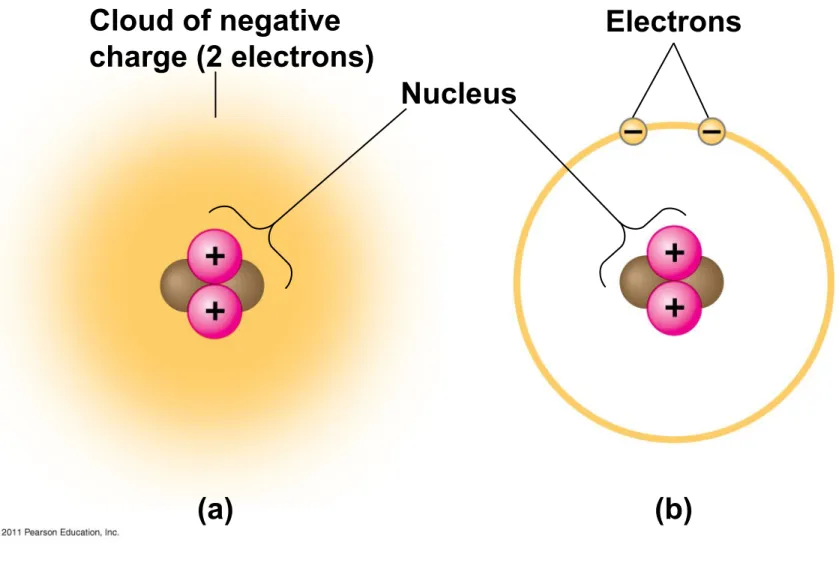
• Neutrons and protons form the atomic nucleus
• Electrons form a cloud around the nucleus
• Neutron mass and proton mass are almost
identical and are measured in daltons
Figure 2.5
Cloud of negative charge (2 electrons)
Electrons
Nucleus
Atomic Number and Atomic Mass
• Atoms of the various elements differ in
number of subatomic particles
• An element’s atomic number is the number
of protons in its nucleus
• An element’s mass number is the sum of
protons plus neutrons in the nucleus
• Atomic mass, the atom’s total mass, can be approximated by the mass number
Isotopes
• All atoms of an element have the same
number of protons but may differ in number of neutrons
• Isotopes are two atoms of an element that differ in number of neutrons
• Radioactive isotopes decay spontaneously, giving off particles and energy
• Some applications of radioactive isotopes in biological research are
– Dating fossils
– Tracing atoms through metabolic processes – Diagnosing medical disorders
The Energy Levels of Electrons
• Energy is the capacity to cause change
• Potential energy is the energy that matter has because of its location or structure
• The electrons of an atom differ in their
amounts of potential energy
• An electron’s state of potential energy is
called its energy level, or electron shell
Figure 2.8
A ball bouncing down a flight of stairs provides an analogy for energy levels of electrons.
Third shell (highest energy level in this model)
Second shell (higher energy level)
Electron Distribution and Chemical
Properties
• The chemical behavior of an atom is
determined by the distribution of electrons in electron shells
• The periodic table of the elements shows the
electron distribution for each element
• Valence electrons are those in the
outermost shell, or valence shell
• The chemical behavior of an atom is mostly
determined by the valence electrons
• Elements with a full valence shell are
chemically inert
Electron Orbitals
• An orbital is the three-dimensional space where an electron is found 90% of the time
• Each electron shell consists of a specific
number of orbitals
Figure 2.10
Neon, with two filled Shells (10 electrons)
First shell
Second shell
First shell Second shell
1s orbital 2s orbital Three 2p orbitals (a) Electron distribution diagram
(b) Separate electron orbitals
(c) Superimposed electron orbitals 1s, 2s, and
2p orbitals
x y
Figure 2.10a
Neon, with two filled Shells (10 electrons)
First shell
Second shell
Figure 2.10b
First shell Second shell
1s orbital 2s orbital Three 2p orbitals
(b) Separate electron orbitals
x y
Figure 2.10c
(c) Superimposed electron orbitals 1s, 2s, and
Concept 2.3: The formation and function of
molecules depend on chemical bonding
between atoms
• Atoms with incomplete valence shells can
share or transfer valence electrons with certain other atoms
• These interactions usually result in atoms
staying close together, held by attractions
called chemical bonds
Covalent Bonds
• A covalent bond is the sharing of a pair of valence electrons by two atoms
• In a covalent bond, the shared electrons
count as part of each atom’s valence shell
Figure 2.11-3
Hydrogen atoms (2 H)
• A molecule consists of two or more atoms held together by covalent bonds
• A single covalent bond, or single bond, is
the sharing of one pair of valence electrons
• A double covalent bond, or double bond, is
the sharing of two pairs of valence electrons
• The notation used to represent atoms and
bonding is called a structural formula
– For example, H—H
• This can be abbreviated further with a
molecular formula
– For example, H2
Figure 2.12
(a) Hydrogen (H2)
(b) Oxygen (O2)
(c) Water (H2O) Name and Molecular Formula Electron Distribution Diagram Lewis Dot Structure and Structural Formula Space-Filling Model
• Covalent bonds can form between atoms of the same element or atoms of different
elements
• A compound is a combination of two or more
different elements
• Bonding capacity is called the atom’s
valence
• Atoms in a molecule attract electrons to varying degrees
• Electronegativity is an atom’s attraction for the electrons in a covalent bond
• The more electronegative an atom, the more
strongly it pulls shared electrons toward itself
• In a nonpolar covalent bond, the atoms share the electron equally
• In a polar covalent bond, one atom is more
electronegative, and the atoms do not share the electron equally
• Unequal sharing of electrons causes a partial
positive or negative charge for each atom or molecule
Figure 2.13
H H
H2O
+ +
–
Ionic Bonds
• Atoms sometimes strip electrons from their
bonding partners
• An example is the transfer of an electron
from sodium to chlorine
• After the transfer of an electron, both atoms
have charges
• A charged atom (or molecule) is called an
ion
Figure 2.14-2
+ –
Na
Sodium atom
Cl
Chlorine atom
Na+
Sodium ion (a cation)
Cl–
Chloride ion (an anion)
• A cation is a positively charged ion • An anion is a negatively charged ion
• An ionic bond is an attraction between an anion and a cation
• Compounds formed by ionic bonds are called
ionic compounds, or salts
• Salts, such as sodium chloride (table salt),
are often found in nature as crystals
Weak Chemical Bonds
• Most of the strongest bonds in organisms are
covalent bonds that form a cell’s molecules
• Weak chemical bonds, such as ionic bonds
and hydrogen bonds, are also important
• Weak chemical bonds reinforce shapes of
large molecules and help molecules adhere to each other
Hydrogen Bonds
• A hydrogen bond forms when a hydrogen atom covalently bonded to one
electronegative atom is also attracted to another electronegative atom
• In living cells, the electronegative partners
are usually oxygen or nitrogen atoms
Figure 2.16
Water (H2O)
Ammonia (NH3)
Hydrogen bond
–
–
+
+
+
+
Van der Waals Interactions
• If electrons are distributed asymmetrically in
molecules or atoms, they can result in “hot spots” of positive or negative charge
• Van der Waals interactions are attractions between molecules that are close together as a result of these charges
• Collectively, such interactions can be strong,
as between molecules of a gecko’s toe hairs and a wall surface
Concept 2.4: Chemical reactions make and
break chemical bonds
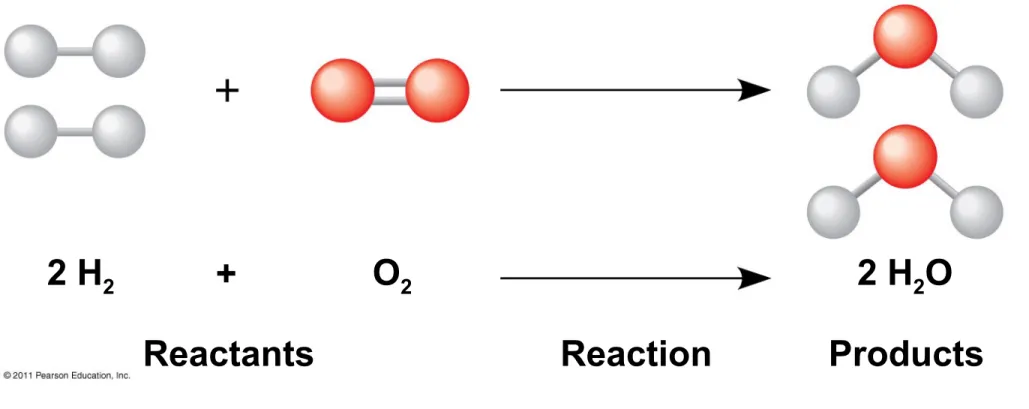
• Chemical reactions are the making and breaking of chemical bonds
• The starting molecules of a chemical reaction
are called reactants
• The final molecules of a chemical reaction
are called products
Figure 2.UN02
Reactants Reaction Products
• All chemical reactions are reversible:
products of the forward reaction become reactants for the reverse reaction
• Chemical equilibrium is reached when the forward and reverse reaction rates are equal