Online Appendix:
“An Experimental Investigation of
Stochastic Adjustment Dynamics”
Wooyoung Lim
∗Philip R. Neary
†September 3, 2016
∗Email: [email protected];Web: http://wooyoung78lim.wix.com/wooyounglim. Address:
Depart-ment of Economics, Hong Kong University of Science and Technology, Clear Water Bay, Kowloon, Hong Kong.
†Email: [email protected]; Web: https://sites.google.com/site/prneary/. Address:
APPENDIX
A
Behaviour in Period 1
How might a subject approach the Language Game? That is, what might/ought one
play in period 1? There are two reasons this is of interest. First of all, the Language
Game is a novel game in the literature so there is no chance that the subjects, even
if they are students of economics, have been exposed to it before. Acclimatising to a
new environment can take time, and it is of independent interest how subjects might
approach a novel strategic environment. Second, while 200 periods is more than most
experiments, it is still nowhere near the glacial time horizons required for long run
stochastic stability results to ‘kick in’, so path dependence may well become an issue.
If a subject recognises this, then he may tailor his initial behaviour accordingly.
To address the above, we illustrate how the Language Game is effectively a fusion of
two of the classic existing large population games, a Stag Hunt + a Battle of the Sexes,
and we consider how the differences between them may affect behaviour. We emphasise
this fusion as some of our subjects were economics undergraduates and so would have
been exposed to these games before. The issue then is how they might play a richer
game that is effectively the simultaneous playing of two existing games of which they
are familiar.
Despite the heterogeneity and the fact that subjects are interacting with more than
one ‘type’ of player, local interactions are opponent independent, in that a subject’s
payoff is determined solely by his choice of action and the action choice of his opponent.
That is, in any pairwise interaction the identity of the opponent, or in this case his group
affiliation, is irrelevant. This feature ‘scales up’ to the population level in that a player
cares only about the number of others using each action and not on how those others
are distributed across the two groups. Formally, this can be seen from equations 1-4
in the text as the only variable that matters to an individual is the scalar summary
While the Language Game is a coordination game where actions are strategic
com-plements, it is not a pure coordination game in the standard sense since it does not
possess a unique Pareto efficient equilibrium.1 Despite the fact that the game is richer
than both a Stag Hunt and a Battle of the Sexes (GAA and GBB are both normalised Stag Hunts, while and GAB is a Battle of the Sexes), we believe most subjects will
recognise that the payoff to each action is increasing in the number of those choosing it,
and given that there are only two actions, will further deduce that there is a clear
most-preferred outcome for them. The immediate issue then faced by a subject is whether
to choose this most-preferred action. Clearly this decision depends on his conjecture
about everyone else. A sophisticated subject may then work through something like
the following checklist of questions: Have those in my group reached this same
conclu-sion? Have those in the other group realised that they have a most-preferred action?
If everyone in the population has realised that they have a most-preferred action, have
they also realised that this choice differs for those in different groups?
As mentioned above, the only information a subject needs to best-respond is the
total number choosing each action. Implicitly, a subject has realised that there is a
threshold fraction of people at which each action becomes optimal. A subject may then
realise that this threshold is shared by everyone in his group, and may further recognise
the tension that exists because, for any action, each group’s threshold for it being a
best-response lie on opposite sides of 50%.2
The above highlights that the Language Game has a flavour oftension `a la a Battle
of the Sexes (see the “asymmetric contests” ofSamuelson and Zhang(1992) for the large
1However, the Language Game is a ‘pure coordination problem’ according to Young(2001), who defines such a game as one wherein all players havemstrategies, and strategy sets can be ordered such that it is a strict equilibrium for each player to play theirmth strategy. In fact, when profile (a,b) is an equilibrium, there is more than one such ordering available.
population analog). The big difference is that in the Language Game, a subject cares
directly about the behaviour of everyone, whereas in a large population Battle of the
Sexes only the behaviour of those in the other group affects your payoff directly.3 To put
it another way, one interpretation of the Language Game is that it is an extended Battle
of Sexes that has been enriched in a way so that members of each “sex” also interact
amongst themselves, i.e., men also interact with men and women also interact with
women.4 So, a considerate subject will then have to start making conjectures about
the conjectures of those in his own group (despite their preferences being perfectly
aligned) and also those from the other group. After this, a considerate subject might
start looking at the relative sizes of the groups and considering relative strength of
preferences of each.
While the subjects are most likely unaware of the formal definition of risk dominance,
they presumably appreciate that there is risk (however defined) associated with each
action choice. This again goes to the interpretation of the Language Game. A second
interpretation involves taking the most commonly used setting in the literature on large
population games (a normalised Stag Hunt) and simply “doubling” it.5 That is, suppose that there are two groups,AandB, each located on a distinct island. For each of these island economies, the local interactions are given by GAA and GBB respectively. The Language Game can then be viewed as an “opening up” of the islands to one another
(thereby requiring the addition of the across group local interactionGAB). If a subject views things in this way, he may well believe that everyone in the population will
choose their most-preferred action. The subject then compares the size of his group to
3In a repeated large population Battle of the Sexes, the behaviour of those in your group could affect your payoff via its effect on those in the other group. However, in a repeated Battle of the Sexes, conjecturing how those in your group would behave in period 1 is pointless.
4This feature of the Language Game allows it to provide a more realistic framework for studying the emergence of standards and operating systems (Farrell and Saloner,1985;Katz and Shapiro,1985; Arthur,1989), since it does not insist that preferences are homogeneous but still allows a given player to interact with everyone in the population.
the threshold needed for his most-preferred action to be optimal.
Lastly, we mention the most commonly used prediction device for one-shot games,
level-k (Nagel, 1995). The level-k model is a non-equilibrium model of strategic be-haviour that is entirely pinned down by specifying the bebe-haviour of the level-0s. It has
been traditional to model level-0 behaviour as randomising uniformly over all choices.6
Given that profile (a,b) is an equilibrium in all of our treatments, such level-0 be-haviour would lead everyone of levelk ≥1 to adopt their most-preferred action, and as such players of different levels would not be distinguishable.
B
State Space for each Treatment
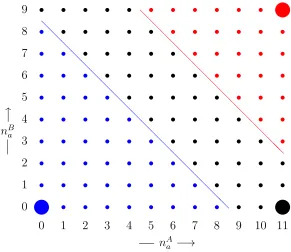
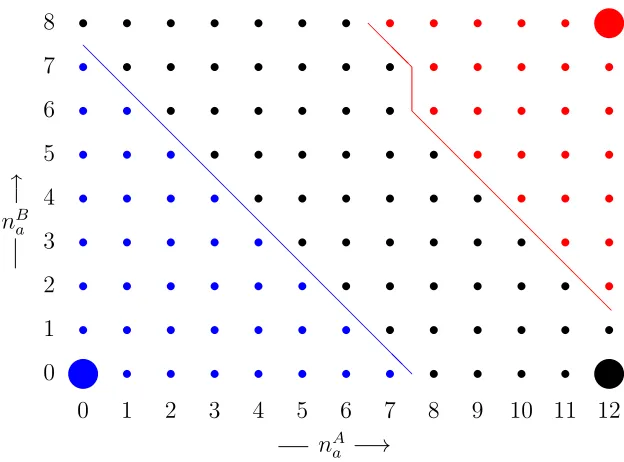
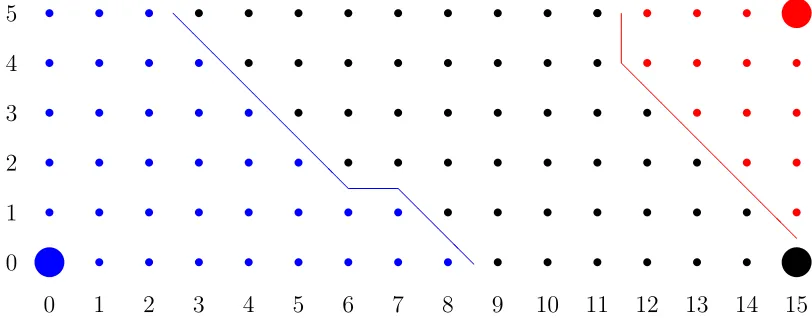
Here we illustrate the state space under the best-reply dynamic for each treatment.
A given game is defined by the tuple (NA, NB, α, β). Our three treatments are:
G1 : (11,9,0.57,0.67)
G2 : (12,8,0.58,0.71)
G3 : (15,5,0.58,0.80)
B.1
State Space for each Treatment
Treatment 1:
(11
,
9
,
0
.
57
,
0
.
67)
For Treatment G1, the state space looks as in Figure 1below.
@ @ @ @ @ @ @ @ @ @ @ @ @ @ @ @ @ @ @ @ @ @ @ @ @ @ @ @ @ @ @ @ @ @ s s s s s s s s s s s s s s s s s s s s s s s s s s s s s s s s s s s s s s s s s s s s s s s s s s s s s s s s s s s s s s s s s s s s s s s s s s s s s s s s s s s s s s s s s s s s s s s s s s s s s s s s s s s s s s s s s s s s s s s ~ ~ ~ nA a −→
nBa
x 0 1 2 3 4 5 6 7 8 9
0 1 2 3 4 5 6 7 8 9 10 11
Treatment 2:
(12
,
8
,
0
.
58
,
0
.
71)
For Treatment G2, the state space looks like as in Figure 2 below.
@ @ @ @ @ @ @ @ @ @ @ @ @ @ @ @ @ @ @@ @ @ @ @ @ @ @ @ @ @ s s s s s s s s s s s s s s s s s s s s s s s s s s s s s s s s s s s s s s s s s s s s s s s s s s s s s s s s s s s s s s~ s s s s s s s s s s s s s s s s s s s s s s s s s s s s s s s s s s s s s s s s s s s s s s s s s s s s s s s ~ ~
nAa −→
nB a x 0 1 2 3 4 5 6 7 8
0 1 2 3 4 5 6 7 8 9 10 11 12
Treatment 3:
(15
,
5
,
0
.
58
,
0
.
8)
For Treatment G3, the state space looks like as in Figure 3 below.
@ @ @ @ @ @ @ @ @ @ @ @ @ @ @ @ @ @ @ @ @ @ ~ s s s s s s s s s s s s s s s s s s s s s s s s s s s s s s s s s s s s s s s s s s s s s s s s ~ s s s s s s s s s s s s s s s s s s s s s s s s s s s s s s s s s s s s s s s s s s s s s s ~ 0 1 2 3 4 5
0 1 2 3 4 5 6 7 8 9 10 11 12 13 14 15
C
Experimental Instructions (Game 1)
INSTRUCTIONS
Welcome to the study. In the following hour, you will participate in 200 rounds of
decision making. Please read these instructions carefully; the cash payment you will
receive at the end of the study depends on how well you perform so it is important that
you understand the instructions. If you have a question at any point, please raise your
hand and wait for one of us to come over. We ask that you turn off your mobile phone
and any other electronic devices. Communication of any kind with other participants
is not allowed.
Your Role
There is a total of 20 participants in the study. These 20 individuals are randomly
assigned into two different Groups: Group A and Group B, with11individuals assigned to Group A and9individuals assigned to Group B. These group assignments are fixed throughout the study.
In each round, you play a game with the rest of the participants - both those in the
same group as you and those in the other group. Each player will be asked to take a
decision that will affect the earnings of every other player including themselves. At the
end of the round, a summary of what happened in that round, along with your earnings
for that round, will be displayed on the computer monitor.
Your Decision in Each Round
You will play a 2-player game with each of the 19 other participants. You must
choose one of two actions, labeled ‘#’ and ‘&’. This action will be used in every
2-player game that you play. Thus, you are using the same action with each other
participant.
Your total earnings in a given round will be the average of the earnings you received
in each 2-player game. The tables on the next page show how earnings are determined
with each cell corresponding to the choices of actions by you and your opponent in a particular 2-player game. The first number in a given cell represents your earning in a
2-player game, and the second number represents your opponent’s earning.
You
opponent in Group A
# & # 57,57 0,0
& 0,0 43, 43 You
opponent in Group B
# & # 57, 33 0, 0 & 0, 0 43, 67
Figure 4: When you are in Group A
1. When you are in Group A, earnings are as follows:
In words this says,
(a) If you and your opponent both choose action ‘#’, you get 57. If your
oppo-nent is in Group A, he/she gets 57; if your oppooppo-nent is in Group B, he/she
will get 33.
(b) If you and your opponent both choose action ‘&’, you get 43. If your
oppo-nent is in Group A, he/she gets 43; if your oppooppo-nent is in Group B, he/she
will get 67.
(c) If you and your opponent choose different actions, you each get 0.
2. When you are in Group B, earnings are as follows:
You
opponent in Group B
# & # 33, 33 0,0
& 0,0 67,67 You
opponent in Group A
# & # 33, 57 0, 0 & 0, 0 67, 43
Figure 5: When you are in Group B
In words this says,
(a) If you and your opponent both choose action ‘#’, you get 33. If your
oppo-nent is in Group B, he/she gets 33; if your oppooppo-nent is in Group A, he/she will get 57.
(b) If you and your opponent both choose action ‘&’, you get 67. If your
oppo-nent is in Group B, he/she gets 67; if your oppooppo-nent is in Group A, he/she
will get 43.
This is a quick reminder for how you read entries in the tables that you can refer back
to throughout the study:
Your earning, Your opponent’s earning
The following shows how to calculate your average earning in each round:
1. When you are in Group A.
(a) If you pick action ‘#’, your payoff is 57× x
19, where ‘x’ is the number of other players who chose action ‘#’.
(b) If you pick action ‘&’, your payoff is 43×19y , where ‘y’ is the number of other players who chose action ‘&’.
2. When you are in Group B.
(a) If you pick action ‘#’, your payoff is 33× x
19, where ‘x’ is the number of other players who chose action ‘#’.
(b) If you pick action ‘&’, your payoff is 67× y
19, where ‘y’ is the number of other players who chose action ‘&’.
wherex+y= 19.
Rundown of the Study
1. At the beginning of the first round, you will be assigned to a group, and you
will be shown the two tables specifying earnings that are relevant to your group. Below the tables, you will be prompted to enter your choice of action. You must
choose either ‘#’ or ‘&’ within 30 seconds. If you do not choose an action, one
will be randomly assigned to you.
2. The first round is over after everybody has chosen an action. The screen will then
show you a summary for the first round:
(a) how many players chose each action,
(b) your choice of action, and
(c) your (average) earning in the round, and
3. Below the information feedback, you will be prompted to enter your choice of
action for the second round. The game does not change, so as before you must
choose either ‘#’ or ‘&’.
All future rounds are identical to except for oneimportantdifference. The differ-ence concerns how much time you have to choose an action. In rounds 2−10, you
have 15 seconds to make a decision. If you do not make a decision within the 15
second window, then you will be assigned whatever action you used in the previous round.
For rounds 11 −200, you have only 10 seconds in which to make a decision.
Again, if you fail to choose an action in this timeframe, you will be assigned the
same action as in the previous round.
Your Cash Payment
We will randomly select 2 rounds out of the 200 to calculate your cash payment, so
it is in your best interest to take each round seriously. Each round has equal chance to
be selected. The sum of the points you earned in the 2 selected rounds will be converted
into cash at an exchange rate of HK$1 per point. Your total cash payment at the end
of the study will be this cash amount plus a HK$40 show-up fee. Precisely,
Your total cash payment = HK$ (The sum of the points in the 2 selected rounds) + HK$ 40
Adminstration
Your decisions as well as your cash payment will be kept completely confidential.
Remember that you have to make your decisions entirely on your own; do not discuss
your decisions with any other participants.
Upon completion of the study, you will receive your cash payment. You will be
asked to sign your name to acknowledge your receipt of the payment. You are then free
to leave.
If you have any questions, please raise your hand now. We will answer questions
D
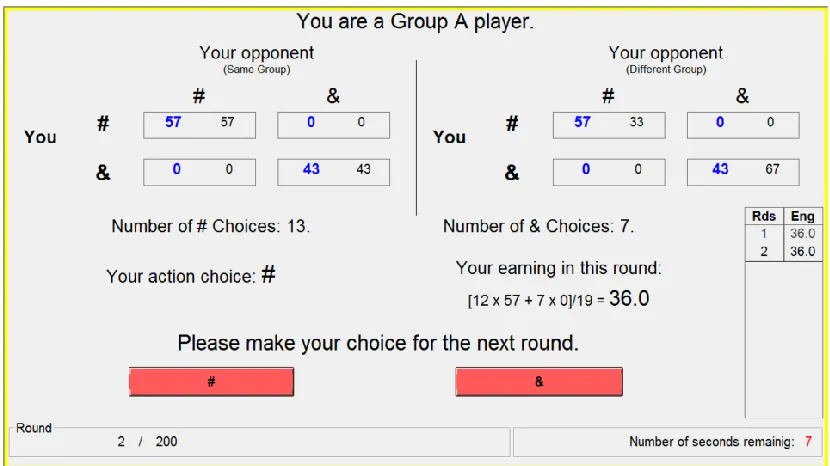
Screen Shots of Z-tree
Figure 6: Member A’s Decision Screen
References
Arthur, W. B. (1989): “Competing Technologies, Increasing Returns, and Lock-In
by Historical Events,” Economic Journal, 99(394), 116–131.
Blume, L. E. (1993): “The Statistical Mechanics of Strategic Interaction,” Games and Economic Behavior, 5(3), 387 – 424.
(2003): “How noise matters,” Games and Economic Behavior, 44(2), 251 –
271.
Burchardi, K. B., and S. P. Penczynski (2014): “Out of your mind: Eliciting
individual reasoning in one shot games,” Games and Economic Behavior, 84, 39 –
57.
Ellison, G. (1993): “Learning, Local Interaction, and Coordination,” Econometrica,
61(5), 1047–1071.
Farrell, J., and G. Saloner(1985): “Standardization, Compatibility, and
Innova-tion,” RAND Journal of Economics, 16(1), 70–83.
Foster, D., and P. Young(1990): “Stochastic evolutionary game dynamics,” The-oretical Population Biology, 38, 219–232.
Kandori, M., and R. Rob (1995): “Evolution of Equilibria in the Long Run: A
General Theory and Applications,” Journal of Economic Theory, 65(2), 383–414.
Katz, M. L., and C. Shapiro (1985): “Network Externalities, Competition, and
Compatibility,”American Economic Review, 75(3), 424–440.
Morris, S.(2000): “Contagion,” Review of Economic Studies, 67(1), 57–78.
Morris, S., and H. S. Shin (2003): “Global Games: Theory and Applications,” in in “Advances in Economics and Econometrics, the Eighth World Congress”,
Dewa-tripont, Hansen and Turnovsky, Eds.
Myatt, D. P.,and C. C. Wallace(2004): “Adaptive play by idiosyncratic agents,” Games and Economic Behavior, 48(1), 124–138.
Amer-Peski, M. (2010): “Generalized risk-dominance and asymmetric dynamics,” Journal of Economic Theory, 145(1), 216–248.
Samuelson, L.,andJ. Zhang(1992): “Evolutionary stability in asymmetric games,” Journal of Economic Theory, 57(2), 363–391.