Chemistry is the study of
matter
,
its
properties
,
the
changes
that matter undergoes,
and
the
energy
associated with these changes.
Definitions
Matter
anything that has both mass and volume
-
the “stuff” of the universe: books, planets,
trees, professors, students
Composition
the types and amounts of simpler
substances that make up a sample of
matter
• All measured quantities consist of
– a
number
and a
unit
.
• Units are manipulated like numbers:
– 3 ft x 4 ft = 12 ft2
–
Chemical Problem Solving
350 mi
7 h
= 50 mi
1 h
Conversion Factors
1 mi
5280 ft =
5280 ft 5280 ft
A
conversion factor
is a ratio of equivalent quantities
used to express a quantity in different units.
The relationship 1 mi = 5280 ft
gives us the conversion factor:
A conversion factor is chosen and set up so that all
units cancel except those required for the answer.
PROBLEM: The height of the Angel Falls is 3212 ft. Express this quantity in miles (mi) if 1 mi = 5280 ft.
1 mi
5280 ft = 0.6083 mi 3212 ft x
PLAN: Set up the conversion factor so that ft will cancel and the answer will be in mi.
Table 1. 2 SI Base Units
Physical Quantity (Dimension)
Unit Name Unit Abbreviation
Mass kilogram kg
Length meter m
Time second s
Temperature kelvin K
Electric Current ampere A
Amount of substance mole mol
Table 1.4 Common SI-English Equivalent Quantities
Quantity SI to English Equivalent English to SI Equivalent
Length 1 km = 0.6214 mile
1 m = 1.094 yard 1 m = 39.37 inches 1 cm = 0.3937 inch
1 mi = 1.609 km 1 yd = 0.9144 m 1 ft = 0.3048 m 1 in = 2.54 cm
Volume 1 cubic meter (m3) = 35.31 ft3
1 dm3 = 0.2642 gal
1 dm3 = 1.057 qt
1 cm3 = 0.03381 fluid ounce
1 ft3 = 0.02832 m3
1 gal = 3.785 dm3
1 qt = 0.9464 dm3
1 qt = 946.4 cm3
1 fluid ounce = 29.57 cm3
Mass 1 kg = 2.205 lb
1 g = 0.03527 ounce (oz)
Sample Problem 1.5 Converting Units of Mass
PROBLEM: Many international computer communications are carried out by optical fibers in cables laid along the ocean floor. If one strand of optical fiber weighs 1.19 x 10⁻³ lb/m, what is the
mass (in kg) of a cable made of six strands of optical fiber, each long enough to link New York and Paris (8.94 x 10³
km)?
PLAN: The sequence of steps may vary but essentially we need to find the length of the entire cable and convert it to mass.
1 km = 103 m
length (km) of fiber
length (m) of fiber
1 m = 1.19 x 10⁻³ lb
6 fibers = 1 cable
mass (lb) of fiber
Mass (kg) of cable mass (lb) of cable
Sample Problem 1.5
SOLUTION:
8.84 x 103 km x 103 m = 8.84 x 10⁶ m
1 km
8.84 x 106 m x 1.19 x 10 = 1.05 x 10⁴ lb -3 lb
1 m
= 6.30 x 10⁴ lb/cable
6 fibers 1 cable 1.05 x 10⁴ lb
1 fiber x
= 2.86 x 10⁴ kg/cable
1 kg 2.205 lb 6.30 x 10⁴ lb
Significant Figures
Every measurement includes some
uncertainty
. The
rightmost
digit of any quantity is always
estimated
.
The recorded digits, both certain and uncertain, are called
significant figures
.
Determining Which Digits are Significant
All digits are significant
-
except zeros that are used only to position the
decimal point.
• Make sure the measured quantity has a decimal point.
• Start at the left and move right until you reach the first nonzero
digit.
• Zeros that end a number are significant
– whether they occur before or after the decimal point – as long as a decimal point is present.
• 1.030 mL has 4 significant figures.
• 5300. L has 4 significant figures.
• If no decimal point is present
– zeros at the end of the number are not significant.
Sample Problem 1.8 Determining the Number of Significant Figures
PLAN: We determine the number of significant figures by counting digits, paying particular attention to the position of zeros in relation to the decimal point, and underline zeros that are significant.
PROBLEM: For each of the following quantities, underline the zeros that are significant figures (sf), and determine the number of significant figures in each quantity. For (d) to (f),
express each in exponential notation first.
(b) 0.1044 g
(a) 0.0030 L (c) 53,069 mL
(e) 57,600. s
Sample Problem 1.8
SOLUTION:
(a) 0.0030 L has 2 sf (b) 0.1044 g has 4 sf
(c) 53,069 mL has 5 sf
(d) 0.00004715 m = 4.715x10⁻⁵ m has 4 sf
(e) 57,600. s = 5.7600x10⁴ s has 5 sf
= 23.4225 cm
3=
23 cm
39.2 cm x 6.8 cm x 0.3744 cm
1.
For multiplication and division
.
The answer contains
the same number of significant figures as there are in the
measurement with the fewest significant figures.
Rules for Significant Figures in Calculations
Rules for Significant Figures in Calculations
2.
For addition and subtraction
.
The answer has
the
same number of decimal places as there are in
the measurement with the fewest decimal places.
106.78 mL =
106.8
mL
Example: subtracting two volumes
863.0879 mL =
863.1
mL
865.9 mL
-
2.8121 mL
Example: adding two volumes
83.5 mL
Rules for Rounding Off Numbers
1. If the digit removed is
more than 5
, the preceding
number increases by 1.
5.379 rounds to 5.38 if 3 significant figures are retained.
2. If the digit removed is
less than 5
, the preceding
number is unchanged.
3. If the digit removed
is 5 followed by zeros or
with no following digits
, the preceding number
increases by 1 if it is odd and remains unchanged if
it is even.
17.75 rounds to 17.8, but 17.65 rounds to 17.6.
4. Be sure to carry two or more additional significant
figures through a multistep calculation and round off
the
final
answer
only
.
If the
5 is followed by other nonzero digits
, rule 1
is followed:
The measuring device used determines the number of significant digits possible.
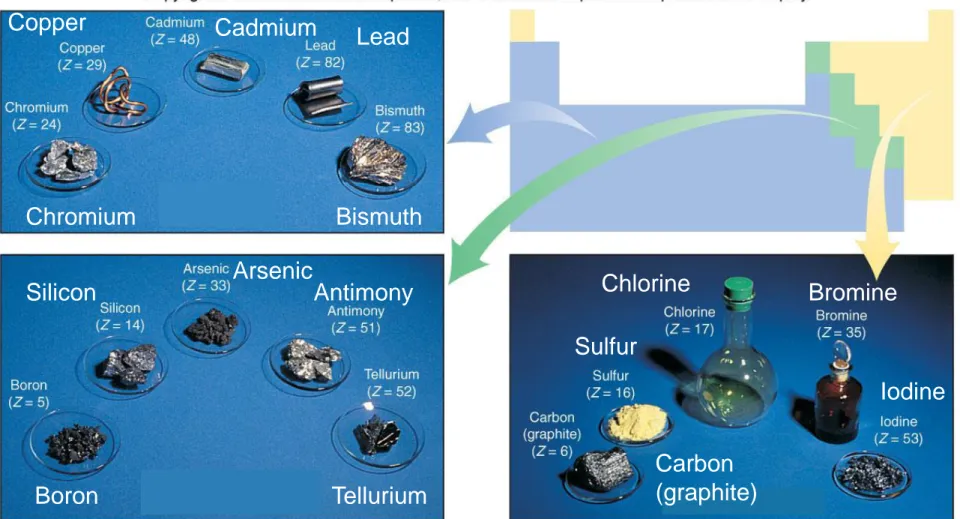
Figure 2.10 Some metals, metalloids, and nonmetals.
Chromium
Copper Cadmium
Lead
Bismuth
Boron
Silicon ArsenicAntimony
Tellurium
Carbon (graphite) Sulfur
Chlorine Bromine
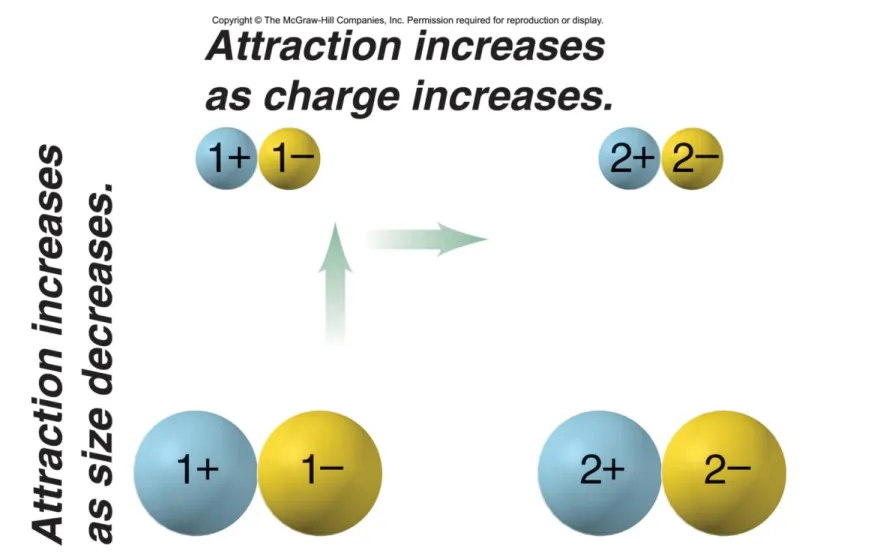
Figure 2.11
The formation of an ionic compound.
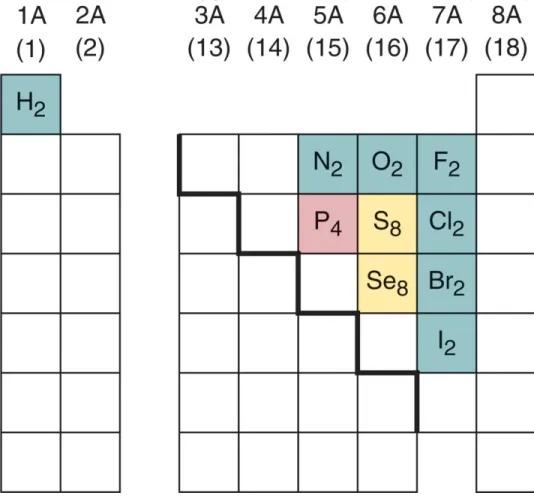
Formation of a covalent bond between two H atoms. Figure 2.14
Molecules and Ions
Ion
– a single atom or covalently bonded group of
atoms that has an overall electrical charge.
There are
no molecules
in an ionic compound.
Molecule
– the basic unit of an element or covalent
compound, consisting of two or more atoms bonded
by the sharing of electrons.
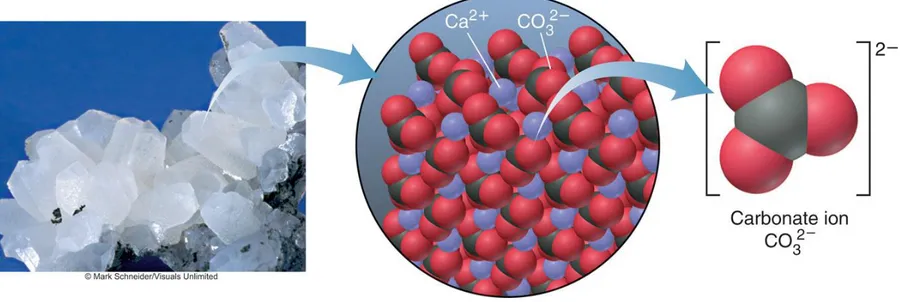
A polyatomic ion consists of two of more atoms covalently bonded together and has an overall charge.
In many reactions the polyatomic ion will remain together as a unit.
Chemical Formulas
• A chemical formula consists of
– element symbols with – numerical subscripts.
• The chemical formula indicates the
Naming Binary Ionic Compounds
The name of the cation is the
same
as the name of
the metal. Many metal names end in -ium.
The anion is named by adding the suffix
-ide
to the root
of the nonmetal name.
Calcium and bromine form calcium bromide.
For
all
ionic compounds, the name and formula lists the
cation
first and the
anion
second.
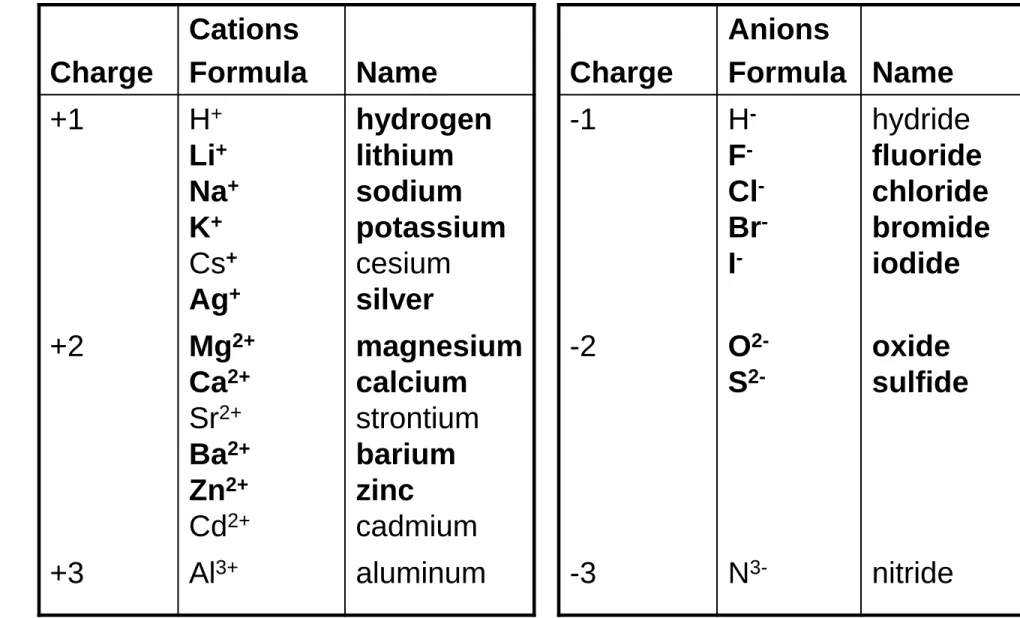
Table 2.3 Common Monatomic Ions*
Charge
Cations
Formula Name Charge
Anions
Formula Name
+1 H+
Li+ Na+ K+ Cs+ Ag+ hydrogen lithium sodium potassium cesium silver
-1 H
-F -Cl -Br -I -hydride fluoride chloride bromide iodide
+2 Mg2+
Ca2+ Sr2+ Ba2+ Zn2+ Cd2+ magnesium calcium strontium barium zinc cadmium
-2 O
2-S
2-oxide sulfide
+3 Al3+ aluminum -3 N3- nitride
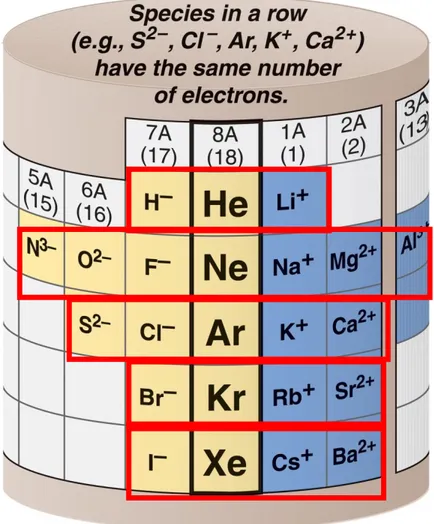
Figure 2.17 Some common monatomic ions of the elements.
Sample Problem 2.7 Naming Binary Ionic Compounds
PROBLEM: Name the ionic compound formed from each of the
following pairs of elements:
(a) magnesium and nitrogen
SOLUTION:
PLAN: Use the periodic table to decide which element is the metal and which the nonmetal. The metal (cation) is named first and the suffix-ide is added to the root of the non-metal name.
(b) iodine and cadmium
(c) strontium and fluorine (d) sulfur and cesium
(a) magnesium nitride (b) cadmium iodide
Sample Problem 2.8 Determining Formulas of Binary Ionic Compounds
SOLUTION:
PLAN: A compound is neutral. We find the smallest number of
each ion that will produce a neutral formula. These numbers appear as right subscripts to the relevant element symbol.
(a) Mg2+ and N3-; three Mg2+(6+) and two N3-(6-); Mg
3N2
(b) Cd2+ and I-; one Cd2+(2+) and two I-(2-); CdI
2
(c) Sr2+ and F-; one Sr2+(2+) and two F-(2-); SrF
2
(d) Cs+ and S2-; two Cs+(2+) and one S2-(2-); Cs
2S
PROBLEM: Write empirical formulas for each of the compounds named in Sample Problem 2.7.
(a) magnesium nitride (b) cadmium iodide
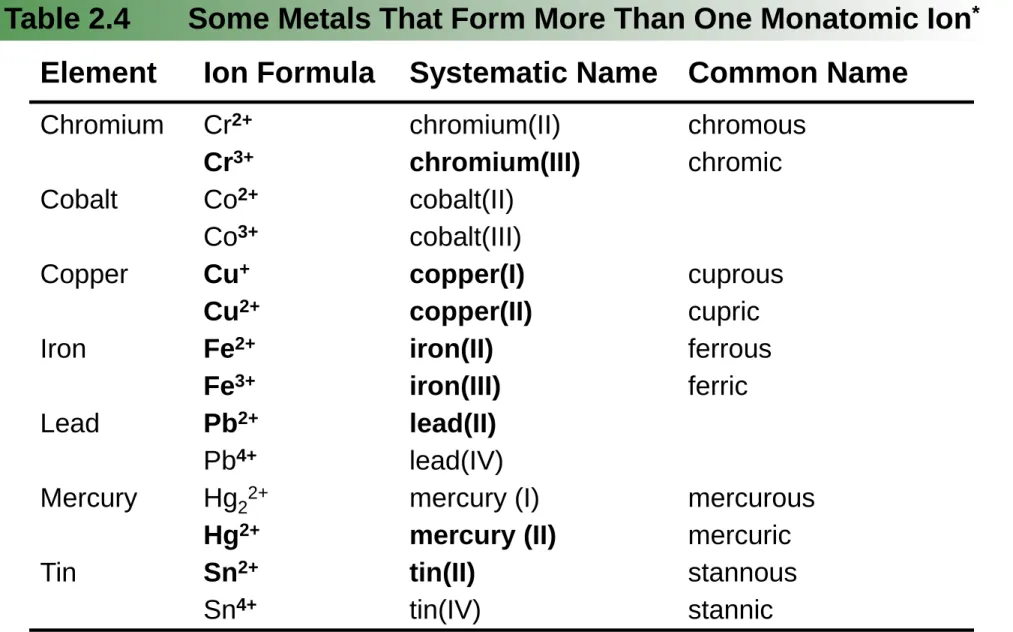
Table 2.4 Some Metals That Form More Than One Monatomic Ion*
Element Ion Formula Systematic Name Common Name
Chromium Cobalt Copper Iron Lead Mercury Tin Cr2+ Cr3+ Co2+ Co3+ Cu+ Cu2+ Fe2+ Fe3+ Pb2+ Pb4+
Hg22+
Hg2+ Sn2+ Sn4+ chromium(II) chromium(III) cobalt(II) cobalt(III) copper(I) copper(II) iron(II) iron(III) lead(II) lead(IV) mercury (I) mercury (II) tin(II) tin(IV) chromous chromic cuprous cupric ferrous ferric mercurous mercuric stannous stannic
Sample Problem 2.9 Determining Names and Formulas of
Ionic Compounds of Elements That Form More Than One Ion
SOLUTION:
PLAN: Find the smallest number of each ion that will produce a neutral formula.
PROBLEM: Give the systematic name for each formula or the formula for each name for the following compounds:
(a) tin(II) fluoride (b) CrI3 (c) ferric oxide (d) CoS
(a) Tin(II) is Sn2+; fluoride is F-; so the formula is SnF
2.
(b) The anion I- is iodide; 3I- means that Cr (chromium) is +3. CrI 3 is
chromium(III) iodide.
(c) Ferric is a common name for Fe3+; oxide is O2-; therefore the formula
is Fe2O3.
(d) Co is cobalt; the anion S2- is sulfide; the compound is cobalt(II)
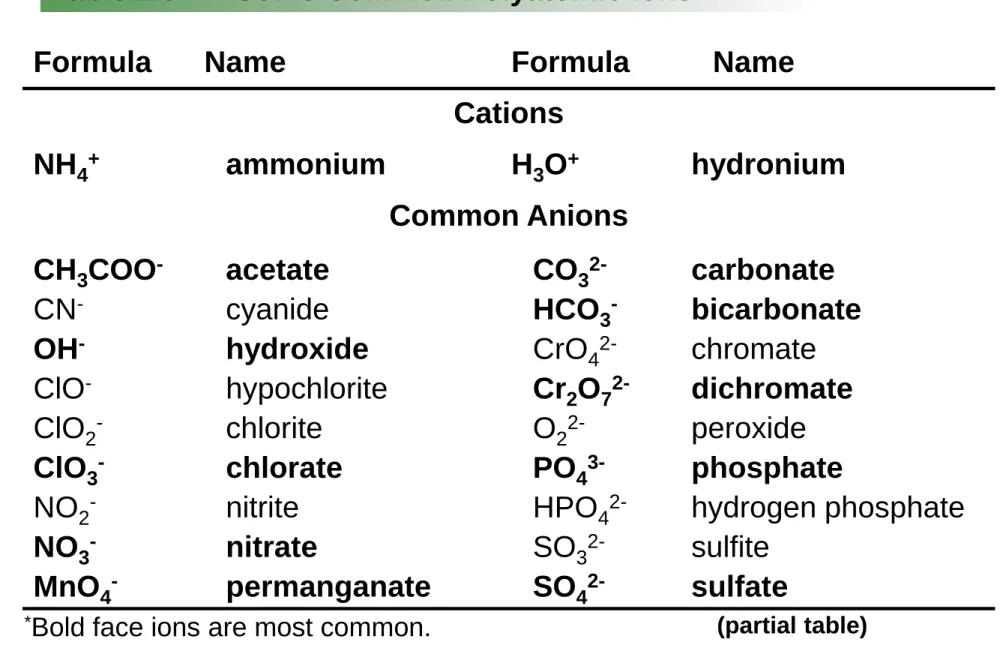
(partial table) Table 2.5 Some Common Polyatomic Ions*
Formula Name Formula Name
Cations
NH4+ ammonium H
3O+ hydronium
Common Anions
CH3COO
-CN
-OH
-ClO
-ClO2
-ClO3
-NO2
-NO3
-MnO4
-acetate cyanide hydroxide hypochlorite chlorite chlorate nitrite nitrate permanganate
CO3
2-HCO3
-CrO4
2-Cr2O7
2-O2
2-PO4
3-HPO4
2-SO3
2-SO4
Naming oxoanions Figure 2.18
Prefix Root Suffix Example
root
per ate ClO
4- perchlorate
ate
root ClO
3- chlorate
ite
root ClO
2- chlorite
ite
hypo root ClO- hypochlorite
No.
of
O
Table 2.6 Numerical Prefixes for Hydrates and Binary Covalent Compounds
Number Prefix Number Prefix Number Prefix
1
mono-2
di-3
tri-4
tetra-5
penta-6
hexa-7
hepta-8
octa-9
deca-Sample Problem 2.10 Determining Names and Formulas of Ionic Compounds Containing Polyatomic Ions
SOLUTION:
PLAN: Remember to use parentheses when more than one unit
of a particular polyatomic ion is present in the compound.
(a) ClO4- is perchlorate; Fe must have a 2+ charge since
there are 2 ClO4- ions. This is iron(II) perchlorate.
(b) The anion sulfite is SO32-; therefore you need 2 Na+ for
each sulfite. The formula is Na2SO3.
(c) The ionic compound is barium hydroxide. When water is included in the formula, we use the term “hydrate” and a prefix that indicates the number of molecules of H2O. This compound is barium hydroxide octahydrate.
PROBLEM: Give the systematic name for each formula or the formula for each name for the following compounds:
Sample Problem 2.11 Recognizing Incorrect Names and Formulas of Ionic Compounds
SOLUTION:
(a) The charge of Ba2+ must be balanced by two C
2H3O2- ions. The
prefix “di” is not required and is not used in this way when naming ionic compounds. The correct name is simply barium acetate.
(b) An ion of a single element does not need parentheses, and sulfide is S2-, not SO
32-. The correct formula is Na2S.
PROBLEM: There is an error in the second part of each statement. Provide the correct name or formula in each case.
(a) Ba(C2H3O2)2 is called barium diacetate.
(b) Sodium sulfide has the formula (Na)2SO3.
(c) Iron(II) sulfate has the formula Fe2(SO4)3.
(c) Sulfate or SO42- has a 2- charge, and only one Fe2+ is needed to
form a neutral compound. The formula should be FeSO4.
(d) The parentheses are unnecessary, since only one CO32- ion is
present. The correct formula is Cs2CO3.
Naming Acids
1)
Binary acid
solutions form when certain gaseous
compounds dissolve in water.
For example, when gaseous hydrogen chloride (HCl) dissolves in water, it forms a solution called hydrochloric acid.
Prefix hydro- + anion nonmetal root + suffix -ic + the word acid -hydro + chlor + ic + acid
hydrochloric acid
2) Oxoacid names are similar to those of the oxoanions,
except for two suffix changes:
-ate in the anion becomes –ic in the acid
-ite in the anion becomes –ous in the acid
The oxoanion prefixes hypo- and per- are retained. Thus, BrO4- is perbromate, and HBrO
4 is perbromic acid;
IO2- is iodite, and HIO
Sample Problem 2.12 Determining Names and Formulas of Anions and Acids
SOLUTION:
PROBLEM: Name the following anions and give the name and formula of the acid derived from each:
(a) Br- (b) IO
3 - (c) CN - (d) SO42- (e) NO2
-(a) The anion is bromide; the acid is hydrobromic acid, HBr.
(b) The anion is iodate; the acid is iodic acid, HIO3.
(c) The anion is cyanide; the acid is hydrocyanic acid, HCN.
(d) The anion is sulfate; the acid is sulfuric acid, H2SO4.
Naming Binary Covalent Compounds
A binary covalent compound is typically formed by the
combination of two non-metals.
Some of these compounds are very common and have trivial
names, eg., H2O is water.
For a binary covalent compound, the element with the
lower
group number in the periodic table is
first
in the
name and formula. Its name remains unchanged.
Sample Problem 2.13 Determining Names and Formulas of Binary Covalent Compounds
SOLUTION:
PROBLEM: (a) What is the formula of carbon disulfide?
(c) Give the name and formula of the compound whose
molecules each consist of two N atoms and four O atoms.
(b) What is the name of PCl5?
(a) Carbon is C, sulfide is sulfur S and di-means two; the formula is CS2.
(b) P is phosphorous, Cl is chloride, the prefix for 5 is penta-. This is phosphorous pentachloride.
Sample Problem 2.14 Recognizing Incorrect Names and
Formulas of Binary Covalent Compounds
SOLUTION:
(a) The prefix mono- is not needed if there is only one atom of the first element, and the prefix for four is tetra-. So the name is
sulfur tetrafluoride.
(b) Hepta- means 7; the formula should be Cl2O7.
(c) The first element is given its elemental name so this is
dinitrogen trioxide.
(a) SF4 is monosulfur pentafluoride.
(c) N2O3 is dinitrotrioxide.
(b) Dichlorine heptaoxide is Cl2O6.
Naming Straight-Chain Alkanes
Hydrocarbons
are compounds that contain only
carbon and hydrogen atoms.
Alkanes
are the simplest type of hydrocarbon.
The mole (mol)
is the amount of a substance that
contains the same number of entities as there are
atoms in exactly 12 g of carbon-12.
One mole (1 mol) contains 6.022x10
23entities (to
four significant figures).
This number is called Avogadro’s number and is
abbreviated as
N.
The Mole
The term “entities” refers to atoms, ions, molecules,
One mole (6.022x10²³ entities) of some familiar
Chemical Equations
A chemical equation uses formulas to express the identities and
quantities of substances involved in a physical or chemical change.
Figure 3.6
A three-level view of the reaction between magnesium and oxygen.
Features of Chemical Equations
Mg + O
2MgO
Reactants are written on the left.
A yield arrow points from reactants to products.
Products are written on the right.
translate the statement
balance the atoms using coefficients;
formulas cannot be changed
specify states of matter adjust coefficients if necessary
check that all atoms balance
Balancing a Chemical Equation
magnesium and oxygen gas react to give magnesium oxide:
Mg + O2 → MgO
2Mg + O2 → 2MgO
translate the statement
Sample Problem 3.12 Balancing Chemical Equations
PROBLEM:
PLAN: SOLUTION:
balance the atoms
specify states of matter
Within the cylinders of a car’s engine, the hydrocarbon
octane (C8H18), one of many components of gasoline, mixes with oxygen from the air and burns to form carbon dioxide and water vapor. Write a balanced equation for this
reaction.
adjust the coefficients
check the atoms balance
C8H18 + O2 CO2 + H2O
2C8H18 + 25O2 16CO2 + 18H2O
2C8H18 + 25O2 16CO2 + 18H2O
2C8H18(l) + 25O2 (g) 16CO2 (g) + 18H2O (g) C8H18 + O25 2 8 CO2 + 9 H2O
Molecular Scene
The molar mass
(
M
) of a substance is the mass per
mole of its entites (atoms, molecules or formula units).
For
monatomic elements
, the molar mass is the
same as the atomic mass in grams per mole. The
atomic mass is simply read from the Periodic Table.
The molar mass of Ne = 20.18 g/mol.
Table 3.1 Information Contained in the Chemical Formula of Glucose C6H12O6 ( M = 180.16 g/mol)
Carbon (C) Hydrogen (H) Oxygen (O)
Atoms/molecule of compound
6 atoms 12 atoms 6 atoms
Moles of atoms/mole of compound
6 mol of atoms 12 mol of atoms 6 mol of atoms
Atoms/mole of compound
6(6.022x10²³) atoms 12(6.022x10²³) atoms 6(6.022x10²³) atoms
Mass/molecule of compound
6(12.01 amu) = 72.06 amu
12(1.008 amu) = 12.10 amu
6(16.00 amu) = 96.00 amu
Mass/mole of compound
Stoichiometric Calculations
• The coefficients in a balanced chemical equation
– represent the relative number of reactant and product particles – and the relative number of moles of each.
• Since moles are related to mass
– the equation can be used to calculate masses of reactants and/or products for a given reaction.
Table 3.4 Information Contained in a Balanced Equation
Viewed in Terms of
Products
3 CO2(g) + 4 H2O(g)
Amount (mol)
Mass (amu)
3 molecules CO2 + 4 molecules H2O
3 mol CO2 + 4 mol H2O
132.03 amu CO2 + 72.06 amu H2O Reactants
C3H8(g) + 5 O2(g)
Molecules 1 molecule C3H8 + 5 molecules O2
1 mol C3H8 + 5 mol O2
44.09 amu C3H8 + 160.00 amu O2
Mass (g) 44.09 g C3H8 + 160.00 g O2 132.03 g CO2 + 72.06 g H2O
Summary of amount-mass-number relationships in a chemical equation.
Sample Problem 3.16 Calculating Quantities of Reactants and Products: Mass to Mass
PROBLEM: During the roasting of copper(I) sulfide, how many kilograms of oxygen are required to form 2.86 kg of copper(I) oxide?
PLAN:
divide by M of oxygen
mass of oxygen
mol of oxygen
mass of copper(I) oxide
multiply by M of copper(I) oxide
mol of copper(I) oxide
= 0.959 kg O2
= 20.0 mol Cu2O
SOLUTION: 2 Cu2S (s) + 3 O2 (g) → 2 Cu2O (s) + 2 SO2 (g)
Sample Problem 3.16
2.86 kg Cu2O x 103 g 1 kg
1 mol Cu2O
143.10 g Cu2O x
1 kg
103 g 20.0 mol Cu2O x 3 mol O2
2 mol Cu2O
32.00 g O2
1 mol O2
1. All common compounds of Group 1A(1) ions (Li+, Na+, K+, etc.) and
ammonium ion (NH4+) are soluble.
2. All common nitrates (NO3-), acetates (CH
3COO- or C2H3O2-) and most
perchlorates (ClO4-) are soluble.
3. All common chlorides (Cl-), bromides (Br-) and iodides (I-) are soluble,
except those of Ag+, Pb2+, Cu+, and Hg
22+. All common fluorides (F-) are
soluble except those of Pb2+ and Group 2A(2).
1. All common metal hydroxides are insoluble, except those of Group 1A(1) and the larger members of Group 2A(2)(beginning with Ca2+).
2. All common carbonates (CO32-) and phosphates (PO
43-) are insoluble,
except those of Group 1A(1) and NH4+.
3. All common sulfides are insoluble except those of Group 1A(1), Group 2A(2) and NH4+.
Soluble Ionic Compounds
Insoluble Ionic Compounds
4. All common sulfates (SO22-) are soluble, except those of Ca2+, Sr2+, Ba2+,
Ag+, and Pb2+.
1. For an atom in its elemental form (Na, O2, Cl2, etc.): O.N. = 0 2. For a monoatomic ion: O.N. = ion charge
3. The sum of O.N. values for the atoms in a compound equals zero. The sum of O.N. values for the atoms in a polyatomic ion equals the ion’s charge.
General rules
Rules for specific atoms or periodic table groups
1. For Group 1A(1): O.N. = +1 in all compounds
2. For Group 2A(2): O.N. = +2 in all compounds
3. For hydrogen: O.N. = +1 in combination with nonmetals
4. For fluorine: O.N. = -1 in combination with metals and boron
6. For Group 7A(17): O.N. = -1 in combination with metals, nonmetals (except O), and other halogens lower in the group 5. For oxygen: O.N. = -1 in peroxides
O.N. = -2 in all other compounds(except with F)
Steps in the Half-Reaction Method
• Divide the skeleton reaction into two half-reactions, each
of which contains the oxidized and reduced forms of one
of the species.
• Balance the atoms and charges in each half-reaction.
– First balance atoms other than O and H, then O, then H.
– Charge is balanced by adding electrons (e-) to the left side in
the reduction half-reaction and to the right side in the
oxidation half-reaction.
• If necessary, multiply one or both half-reactions by an
integer so that
– number of e- gained in reduction = number of e- lost in oxidation
• Add the balanced half-reactions, and include states of
Balancing Redox Reactions in Acidic Solution
Cr2O72-(aq) + I-(aq) → Cr3+(aq) + I
2(s) Step 1: Divide the reaction into half-reactions.
Cr2O72- → Cr3+
I- → I
2
Step 2: Balance the atoms and charges in each half-reaction.
Cr2O72- → 2Cr3+
Balance atoms other than O and H:
Balance O atoms by adding H2O molecules:
Cr2O72- → 2Cr3+ + 7H
2O
Balance H atoms by adding H+ions:
14H+ + Cr
2O72- → 2Cr3+ + 7H2O
Balance charges by adding electrons:
6e- + 14H+ + Cr
2O72- → 2Cr3+ + 7H2O
Balance atoms other than O and H:
There are no O or H atoms, so we balance charges by adding electrons: For the I-/I
2 half-reaction:
2I- → I 2
2I- → I
2 + 2e
-This is the reduction half-reaction. Cr2O72- is reduced, and is the
oxidizing agent. The O.N. of Cr decreases from +6 to +3.
This is the oxidation half-reaction. I- is oxidized, and is the reducing
Step 3: Multiply each half-reaction, if necessary, by an integer so that the number of e- lost in the oxidation equals the number of e- gained
in the reduction.
6e- + 14H+ + Cr
2O72- → 2Cr3+ + 7H2O
3(2I- → I
2 + 2e-)
The reduction half-reaction shows that 6e- are gained; the oxidation
half-reaction shows only 2e- being lost and must be multiplied by 3:
6I- → 3I
2 + 6e
-Step 4: Add the half-reactions, canceling substances that appear on both sides, and include states of matter. Electrons must always cancel.
6I- → 3I
2 + 6e
-6I-(aq) + 14H+(aq) + Cr
Balancing Redox Reactions in Basic Solution
An acidic solution contains H
+ions and H
2
O. We use H
+ions to balance H atoms.
A basic solution contains OH
-ions and H
2
O. To balance
H atoms, we proceed as if in acidic solution, and then
add one OH
-ion to
both
sides of the equation.
For every OH
-ion and H
+ion that appear on the
same
side of the equation we form an H
2O molecule.
Sample Problem 4.13 Finding the Amount of Reducing Agent by Titration
PROBLEM: To measure the Ca2+ concentration in human blood, 1.00 mL
of blood was treated with Na2C2O4 solution to precipitate the Ca2+ as CaC
2O4. The precipitate was filtered and dissolved in
dilute H2SO4 to release C2O42-, which was titrated with
KMnO4 solution. The solution required 2.05mL of 4.88x10⁻⁴ M
KMnO4 to reach the end point. The balanced equation is
2 KMnO4 (aq) + 5 CaC2O4 (s) + 8 H2SO4 (aq)
→
2 MnSO4 (aq) + K2SO4 (aq) + 5 CaSO4 (s) + 10 CO2 (g) + 8 H2O (l)
Sample Problem 4.13
PLAN: Calculate the mol of KMnO4 from the volume and molarity of the solution. Use this to calculate the mol of C2O42- and hence the
mol of Ca2+ ion in the blood sample.
convert mL to L and multiply by M
molar ratio
ratio of elements in formula
mol of CaC2O4
mol of Ca2+
mol of KMnO4
1.00x10⁻⁶ mol KMnO
4 x 5 mol CaC2O4
2 mol KMnO4
Sample Problem 4.13
SOLUTION:
= 1.00x10⁻⁶ mol KMnO 4
= 2.50x10⁻⁶ mol CaC 2O4
2.50x10⁻⁶ mol CaC
2O4 x 1 mol Ca
2+
1 mol CaC2O4
= 2.50x10⁻⁶ mol Ca+2
2.05 mL soln x 1 L
103 mL
4.88x10⁻⁴ mol KMnO 4
1L soln
Figure 10.11 The four steps in converting a molecular formula to a molecular shape
Molecular Formula
Count all e- groups
around central atom (A).
Step 2
Electron-group arrangement
Molecular shape (AXmEn)
Step 4 Count bonding and nonbonding e- groups
separately.
Lewis structure
Draw Lewis structure.
Step 1
Note positions of any lone pairs and double bonds.
Step 3
Sample Problem 10.6 Examining Shapes with Two, Three, or Four Electron Groups
PROBLEM: Draw the molecular shape and predict the bond angles (relative to the ideal bond angles) of (a) PF3 and (b) COCl2.
SOLUTION:
(a) For PF3, there are 26 valence electrons. The Lewis structure is
There are four electron groups around P, giving a tetrahedral electron-group arrangement. The ideal bond angle is therefore 109.5°.
Sample Problem 10.6
(b) For COCl2 there are 24 valence e-. The
Lewis structure is
Sample Problem 10.6
Figure 11.22
Calculating
Δ
H
for an overall process
•
Identify the target equation, the step whose D
H
is
unknown.
– Note the amount of each reactant and product.
•
Manipulate each equation with known D
H
values so
that the target amount of each substance is on the
correct side of the equation.
– Change the sign of DH when you reverse an equation. – Multiply amount (mol) and DH by the same factor.
•
Add the manipulated equations and their resulting D
H
values to get the target equation and its D
H
.
Sample Problem 6.8 Using Hess’s Law to Calculate an Unknown ΔH
PROBLEM: Two gaseous pollutants that form in auto exhausts are CO and NO. An environmental chemist is studying ways to convert them to less harmful gases through the following reaction:
CO(g) + NO(g)
→
CO2(g) + ½N2(g) DH = ?Given the following information, calculate the unknown DH:
Equation A: CO(g) + ½ O2(g)
→
CO2(g) DHA = -283.0 kJEquation B: N2(g) + O2(g)
→
2NO(g) DHB = 180.6 kJSample Problem 6.8
SOLUTION:
Multiply Equation B by ½ and reverse it:
DHrxn = -373.3 kJ
CO(g) + NO(g)
→
CO2(g) + ½ N2(g)Equation A: CO(g) + ½ O2(g)
→
CO2(g) DH = -283.0 kJ NO(g)→
½ N2(g) + ½ O2(g); DH = - 90.3 kJAdd the manipulated equations together:
Sample Problem 6.10 Calculating ΔH°rxn from ΔH°f Values
PROBLEM: Nitric acid, whose worldwide annual production is about 8 billion kilograms, is used to make many products, including fertilizer, dyes, and explosives. The first step in the
industrial production process is the oxidation of ammonia:
4NH3(g) + 5O2(g)
→
4NO(g) + 6H2O(g) Calculate DH°rxn from DH°f values.PLAN: Use the DH°f values from Table 6.3 or Appendix B and apply the equation
Sample Problem 6.10
SOLUTION:
DHrxn = [4(DHo
f of NO(g) + 6(DHof of H2O(g)]
- [4(DH of NH3(g) + 5(DH of O2(g)]
= (4 mol)(90.3 kJ/mol) + (6 mol)(-241.8 kJ/mol) –
[(4 mol)(-45.9 kJ/mol) + (5 mol)(0 kJ/mol)] = -906 kJ
DHrxn = -906 kJ
Table 8.3 Partial Orbital Diagrams and Electron Configurations*
for the Elements in Period 4.
Table 8.3 Partial Orbital Diagrams and Electron Configurations*
for the Elements in Period 4.
Sample Problem 3.23 Calculating Mass of Solute in a Given Volume of Solution
PROBLEM: How many grams of solute are in 1.75 L of 0.460 M
sodium monohydrogen phosphate buffer solution?
volume of solution
moles of solute
grams of solute
multiply by M
multiply by M
SOLUTION:
PLAN: Calculate the moles of solute using the given molarity and volume.
Convert moles to mass using the molar mass of the solute.
1.75 L x 0.460 moles
1 L = 0.805 mol Na2HPO4
0.805 mol Na2HPO4 x 141.96 g Na2HPO4
Laboratory preparation of molar solutions. Figure 3.14
A
•Weigh the solid needed.
•Transfer the solid to a
volumetric flask that contains about half the final volume of solvent.
B Dissolve the solid thoroughly by swirling.
Sample Problem 3.24 Preparing a Dilute Solution from a Concentrated Solution
PROBLEM: “Isotonic saline” is a 0.15 M aqueous solution of NaCl. How would you prepare 0.80 L of isotonic saline from a 6.0 M
stock solution?
PLAN: To dilute a concentrated solution, we add only solvent, so the
moles of solute are the same in both solutions. The volume and molarity of the dilute solution gives us the moles of solute.
Then we calculate the volume of concentrated solution that contains the same number of moles.
volume of dilute soln
moles of NaCl in dilute soln = mol NaCl in concentrated soln
L of concentrated soln
multiply by M of dilute soln
Mdil x Vdil = # mol solute = Mconc x Vconc
SOLUTION:
= 0.020 L soln
0.12 mol NaCl x 1 L soln 6.0 mol NaCl 0.80 L soln x 0.15 mol NaCl
1 L soln
= 0.12 mol NaCl
Sample Problem 3.24
Using the volume and molarity for the dilute solution:
Using the moles of solute and molarity for the concentrated solution: