R E S E A R C H
Open Access
Genetic variation in Tanis was associated with
elevating plasma triglyceride level in Chinese
nondiabetic subjects
Ying Gao
1†, Xiang Xie
1†, Yi-Tong Ma
1*, Yi-Ning Yang
1, Xiao-Mei Li
1, Zhen-Yan Fu
1, Ying-Ying Zheng
1, Xiang Ma
1,
Bang-Dang Chen
2, Fen Liu
1and Ying Huang
1Abstract
Background:The association of genetic polymorphisms of Tanis with triglyceride concentration in human has not been thoroughly examined. We aimed to investigate the relationship between triglyceride concentrations and Tanis genetic polymorphisms.
Methods:All participants (n=1497) selected from subjects participating in the Cardiovascular Risk Survey (CRS) study were divided into two groups according to ethnicity (Han: n=1059; Uygur: n= 438). Four tagging SNPs (rs12910524, rs1384565, rs2101171, rs4965814) of Tanis gene were genotyped using TaqMan® assays from Applied Biosystems following the manufacturer’s suggestions and analyzed in an ABI 7900HT Fast Real-Time PCR System.
Results:We found that the SNP rs12910524 was associated with triglyceride levels by analyses of a dominant model (P<0.001), recessive model (P<0.001) and additive model (P< 0.001) not only in Han ethnic but also in Uygur ethnic group, and the difference remained significant after the adjustment of sex, age, alcohol intake, smoking, BMI and plasma glucose (GLU) level (AllP< 0.001). However, this relationship was not observed in rs1384565, rs2101171, and rs4965814 before and after multivariate adjustment (All P > 0.05). Furthermore, there were significant interactions between rs12910524 and GLU on TG both in Han (P=0.001) and Uygur population (P=2.60×10⁻⁴).
Conclusion:Our results indicated that the rs12910524 in theTanisgene was associated with triglyceride concentrations in subjects without diabetes in China.
Keywords:Genetics, Tanis, Triglyceride, Diabetes, Polymorphisms
Background
Elevating triglycerides (TG) level, an essential component of the metabolic syndrome, is independently associated with coronary artery disease (CAD) [1]. High levels of fasting plasma TG are caused by not only environmental factors such as smoking[2-4], high-fat diet and alcohol in-take [5,6], but also genetic factors including single nucleo-tide polymorphisms (SNPs). However, till date, only several candidate genes involving lipid metabolism [7-10] and CAD [11-14] have been discovered, and these genes
only explain a small fraction of the total interindividual variation in plasma TG levels [15-17].
Tanis, a novel discovered membrane protein, has been suggested to be involved in the development of diabetes and dyslipidemia [18,19]. In a polygenic animal model of type 2 diabetes model-Psammomys obesus, the Tanis was found to be positively correlated to circulating TG con-centrations [19]. However, the association of genetic poly-morphisms of Tanis with plasma TG concentration in humans has not been thoroughly examined. In addition, Tanis was identified as a newly found receptor of amyloid A-1 (SAA1), which is not only an inflammatory marker but also an apolipoprotein [20]. In the previous study [20,21], we found that SAA1 gene polymorphisms were associated with dyslipidemia in Chinese subjects. Tanis, as * Correspondence:[email protected]
†Equal contributors
1
Department of Cardiology, First Affiliated Hospital of Xinjiang Medical University, Urumqi 830011, P.R. China
Full list of author information is available at the end of the article
a receptor of SAA1, also called SELS, located on chro-mosome15q26.3, encodes selenoprotein S which partici-pates in the retro-translocation of misfolded proteins from the endoplasmic reticulum (ER) to the cytosol for their degradation [22]. Several previous studies indicated that the variations in Tanis gene were associated with pro-inflammatory cytokines such as interleukin (IL)-6, IL-1β and TNF-α[23] and cardiovascular disease [24] and meta-bolic factors [25]. However, the relationships between Tanis gene and lipid profile have not been thoroughly in-vestigated. Xinjiang is part of the ancient Silk Road and borders eight countries including Russia, Kazakhstan, Kirghizastan, Tajikistan, Pakistan, Mongolia, India, and Afghanistan. There are more than 13 ethnic groups living in this area. Among them, the Uygur people account for 46%, and Han account for 40%. In this study, we aimed to observe the associations of tagging SNPs in Tanis gene with fasting plasma TG levels in Chinese Han and Uygur population in Xinjiang, the western China.
Results and discussion
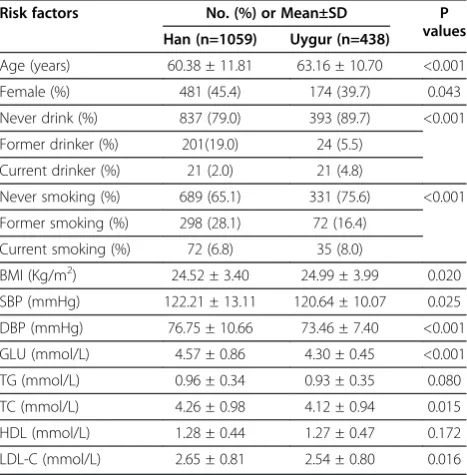
This study consists of two ethnic groups (Han: n=1059; Uygur: n= 438). The clinical and metabolic characteristics of the study population are shown separately for Han and Uygur in Table 1.
All genotyped SNPs were in Hardy-Weinberg equilib-rium (allP>0.05, data not shown). Table 2 shows detailed information for each SNP as well as the allele frequencies.
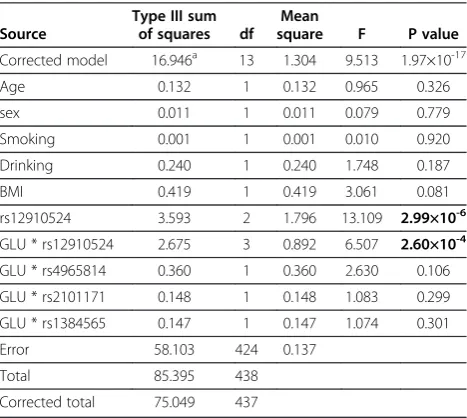
Both in Chinese Han and Uygur populations, we found that the rs12910524 was significantly associated with plasma TG levels in a dominant model, additive model, or recessive model before (All P <0.001) and after multivari-ate adjustment (All P <0.001; Table 3). However, these as-sociations were not found in rs1384565, rs2101171, and rs4965814 before and after adjustment of confounders. Furthermore, using the general linear model analysis, we found that the GLU level was significantly associated with TG level both in Han (P=0.001) and Uygur populations (P=2.99×10⁻⁶). And, we also found significant interactions between rs12910524 and GLU on plasma TG both in Han (P=0.012; Table 4) and Uygur populations (P=2.60×10⁻⁴; Table 5). However, we did not find any interaction be-tween rs1384565, rs2101171, and rs4965814 and GLU level (Table 4, Table 5).
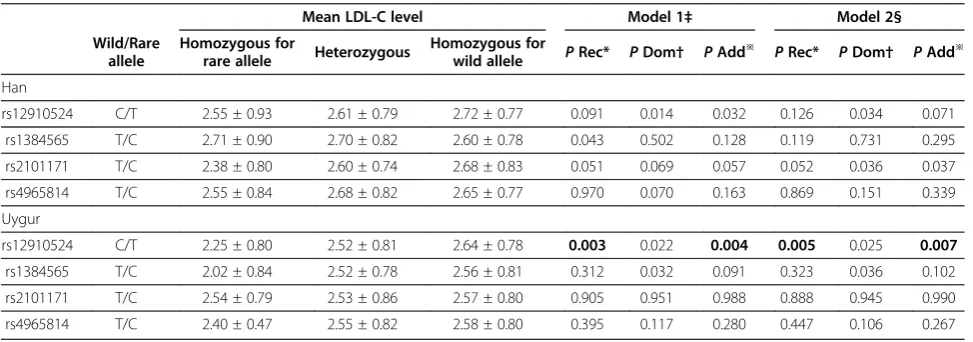
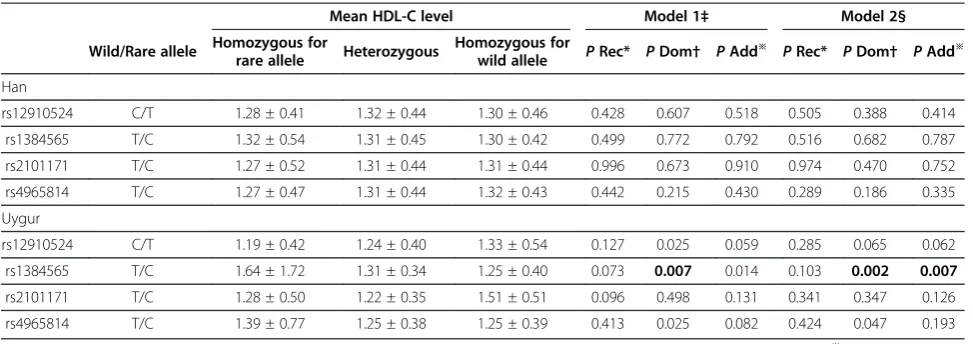
In Chinese Uygur population, we found that the rs12910524 was significantly associated with plasma TC levels in a dominant model, additive model, or recessive model before (All P <0.01) and after multivariate adjust-ment (All P <0.01; Table 6). And we also found that the rs12910524 was significantly associated with plasma LDL-C level in a recessive model and an additive model before (All P <0.01) and after multivariate adjustment (All P <0.01; Table 7). In addition, we found the rs1384565 was signifi-cantly associated with plasma HDL-C level in a dominant model and in an additive model after multivariate adjust-ment (both P<0.01; Table 8). However, we did not find any association of Tanis genetic polymorphisms with plasma TC, HDL-C, and LDL-C levels in Chinese Han population.
In this study, we observed that variation in the Tanis gene was associated with plasma TG levels in Chinese subjects. Individuals with the C allele of rs12910524 had significantly higher plasma TG levels when compared with TT genotype carriers. To our knowledge, this is the
Table 1 Demographic and risk profile of the study population
Risk factors No. (%) or Mean±SD P
values Han (n=1059) Uygur (n=438)
Age (years) 60.38 ± 11.81 63.16 ± 10.70 <0.001
Female (%) 481 (45.4) 174 (39.7) 0.043
Never drink (%) 837 (79.0) 393 (89.7) <0.001
Former drinker (%) 201(19.0) 24 (5.5)
Current drinker (%) 21 (2.0) 21 (4.8)
Never smoking (%) 689 (65.1) 331 (75.6) <0.001
Former smoking (%) 298 (28.1) 72 (16.4)
Current smoking (%) 72 (6.8) 35 (8.0)
BMI (Kg/m2) 24.52 ± 3.40 24.99 ± 3.99 0.020
SBP (mmHg) 122.21 ± 13.11 120.64 ± 10.07 0.025
DBP (mmHg) 76.75 ± 10.66 73.46 ± 7.40 <0.001
GLU (mmol/L) 4.57 ± 0.86 4.30 ± 0.45 <0.001
TG (mmol/L) 0.96 ± 0.34 0.93 ± 0.35 0.080
TC (mmol/L) 4.26 ± 0.98 4.12 ± 0.94 0.015
HDL (mmol/L) 1.28 ± 0.44 1.27 ± 0.47 0.172
LDL-C (mmol/L) 2.65 ± 0.81 2.54 ± 0.80 0.016
Note:HDLhigh-density lipoprotein,LDLlow-density lipoprotein,SBPSystolic blood pressure,DBPDiastolic blood pressure,TGTriglycerides,TCCholesterol, BMIBody mass index, GLU Glucose.
Table 2 Distributions of SNPs of Tanis gene in Han and Uygur population
SNPs Genotypes Ethnic P
value Han, n (%) Uygur, n (%)
rs12910524 TT 158 (14.9) 62 (14.2) 0.406
TC 486 (45.9) 188 (42.9)
CC 415 (39.2) 188 (42.9)
rs1384565 CC 74 (7.0) 11 (2.5) <0.001
CT 442 (41.7) 102 (23.3)
TT 543 (51.3) 325 (74.2)
rs2101171 CC 30 (2.8) 10 (2.3) <0.001
CT 320 (30.2) 109 (24.9)
TT 709 (66.9) 319 (72.8)
rs4965814 CC 182 (17.2) 68 (15.5) 0.034
CT 517 (48.8) 190 (43.4)
first study to investigate the common allelic variant in Tanis gene and its association with plasma TG levels.
The human Tanis gene is located at 15q26.3. Although this region has not been previously identified in genome-wide linkage scans for diabetes-related phenotypes in hu-man populations, previous studies [25] indicated that the Tanis gene expression was positively correlated to BMI, plasma levels of TG and HDL cholesterol, insulin, and blood glucose levels. Also, several studies suggested that the variations in Tanis gene were associated with inflam-mation [23], coronary heart disease (CHD) and ischemic stroke [24], and metabolic disease [25].
The plasma triglyceride level is known to be in-fluenced by a large number of factors, including age, sex, hypertension, diabetes, smoking and alcohol intake. Our
findings show that rs1291054 is an independent determin-ant of triglyceride level, and does not influence the level by modulating some confounding factors such age, sex, smoking, BMI, and alcohol intake. Walder et al. [19] de-scribed the biological characteristics of Tanis first. In their study, they found that Tanis gene expression was in-creased 2.2-fold after a 24-h fast inP. obesus,a polygenic animal model of type 2 diabetes and metabolic syndrome. Also, they found that there was a positive correlation be-tween Tanis expression and circulating TG concentrations (Pearson r = 0.593, P = 0.007); as well as blood glucose (Spearman r = 0.378, P = 0.010) and insulin concentra-tions (Spearman r = 0.416, P = 0.004). However, subse-quently multiple linear regression analysis indicated that only the change in blood glucose concentration was
Table 3 Association ofTanisSNPs with log-transformed TG value in Han and Uygur population
Mean log-transformed TG level Model 1‡ Model 2§
Wild/rare allele Homozygous for
rare allele Heterozygous
Homozygous for
wild allele PRec* PDom† PAdd
※ PRec* PDom† PAdd※
Han
rs12910524 C/T -0.32 ± 0.45 -0.11 ± 0.39 -0.02 ± 0.33 <0.001 <0.001 <0.001 <0.001 <0.001 <0.001
rs1384565 T/C -0.11 ± 0.46 -0.12 ± 0.38 -0.98 ± 0.39 0.337 0.955 0.595 0.222 0.967 0.452
rs2101171 T/C -0.26 ± 0.41 -0.09 ± 0.40 -0.11 ± 0.38 0.902 0.038 0.094 0.864 0.019 0.048
rs4965814 T/C -0.09 ± 0.41 -0.12 ± 0.38 -0.10 ± 0.39 0.649 0.585 0.688 0.509 0.492 0.510
Uygur
rs12910524 C/T -0.50 ± 0.49 -0.15 ± 0.41 -0.05 ± 0.32 <0.001 <0.001 <0.001 <0.001 <0.001 <0.001
rs1384565 T/C -0.30 ± 0.53 -0.16 ± 0.45 -0.15 ± 0.40 0.547 0.233 0.471 0.485 0.212 0.431
rs2101171 T/C -0.17 ± 0.41 -0.12 ± 0.42 -0.14 ± 0.47 0.928 0.272 0.537 0.778 0.295 0.494
rs4965814 T/C -0.23 ± 0.43 -0.15 ± 0.43 -0.13 ± 0.39 0.351 0.097 0.237 0.366 0.066 0.179
§Analysis of covariance adjusted for sex, age, smoking, alcohol drinking, and GLU;‡Unadjusted model; *recessive model;†dominant model;※additive model.
Table 4 Interactions between SNPs of Tanis and GLU on TG levels in Chinese Han population
Source
Type III sum of squares df
Mean
square F Sig.
Corrected model 15.139a 13 1.165 8.322 3.50×10⁻¹⁶
Age 0.051 1 0.051 0.365 0.546
Sex 0.030 1 0.030 0.216 0.642
Smoking 0.012 1 0.012 0.085 0.771
Drinking 0.117 1 0.117 0.838 0.360
BMI 0.028 1 0.028 0.202 0.653
rs12910524 2.036 2 1.018 7.273 0.001
GLU * rs12910524 0.933 3 0.311 2.222 0.012
GLU * rs4965814 0.283 1 0.283 2.021 0.155
GLU * rs2101171 0.232 1 0.232 1.658 0.198
GLU * rs1384565 0.312 1 0.312 2.227 0.136
Error 146.240 1045 0.140
Total 173.988 1059
Corrected total 161.380 1058
a
R Squared = 0.094 (Adjusted R Squared =0.083).
Table 5 Interactions between SNPs of Tanis and GLU on TG levels in Chinese Uygur population
Source
Type III sum of squares df
Mean
square F P value
Corrected model 16.946a 13 1.304 9.513 1.97×10⁻¹⁷
Age 0.132 1 0.132 0.965 0.326
sex 0.011 1 0.011 0.079 0.779
Smoking 0.001 1 0.001 0.010 0.920
Drinking 0.240 1 0.240 1.748 0.187
BMI 0.419 1 0.419 3.061 0.081
rs12910524 3.593 2 1.796 13.109 2.99×10⁻⁶
GLU * rs12910524 2.675 3 0.892 6.507 2.60×10⁻⁴
GLU * rs4965814 0.360 1 0.360 2.630 0.106
GLU * rs2101171 0.148 1 0.148 1.083 0.299
GLU * rs1384565 0.147 1 0.147 1.074 0.301
Error 58.103 424 0.137
Total 85.395 438
Corrected total 75.049 437
a
independently associated with Tanis gene expression. This result suggests that the association of Tanis gene expression with TG level can be modified by blood glucose level. Therefore, in this study, we excluded the diabetic patients when we selected participants at the beginning of the study, and we found that in nondiabetic subjects, the rs12910524 was independ-ently associated with plasma TG level, and this rela-tionship was not modified by the fasting blood glucose level. And this association was observed not only in Chinese Han but also in Chinese Uygur population. We also analyzed the associations of Tanis genetic polymorphisms with plasma TC, HDL-C, and LDL-C levels. In Chinese Uygur population, we found that the rs12910524 was significantly associated with plasma TC levels and plasma LDL-C levels. And, we also found that the rs1384565 was significantly associated with plasma HDL-C levels. However, we did not find any association of Tanis genetic polymorphisms with
plasma TC, HDL-C, and LDL-C levels in Chinese Han population. This discrepancy may be explained by the different distributions of Tanis genetic polymorphisms and some confounders between Chinese Han and Uygur population.
In addition, some published data indicated that inflam-matory genes may regulate fasting TG levels [26]. And previous studies also indicated that Tanis gene was asso-ciated with inflammatory cytokines [23]. In the present study, we found Tanis genetic polymorphism was associ-ated with TG level. However we have no evidences to demonstrate whether this association was related to in-flammation because of the absence of some inflamma-tory cytokines parameters. Otherwise, because of the absence of some confounders such as plasma HOMA-IR or HbA1c levels, eating habits, working pressure and the social disparities in our database, we did not include these variables in the multivariate analysis. This fact is a limitation of our study.
Table 6 Association ofTanisSNPs with TC in Han and Uygur population
Mean TC level Model 1‡ Model 2§
Wild/Rare allele
Homozygous for
rare allele Heterozygous
Homozygous for
wild allele PRec* PDom† PAdd
※ PRec* PDom† PAdd※
Han
rs12910524 C/T 4.11 ± 1.13 4.24 ± 0.95 4.34 ± 0.92 0.047 0.034 0.042 0.062 0.107 0.10
rs1384565 T/C 4.26 ± 1.01 4.30 ± 0.99 4.22 ± 0.99 0.265 0.998 0.510 0.493 0.761 0.692
rs2101171 T/C 4.09 ± 1.01 4.24 ± 0.95 4.26 ± 0.97 0.479 0.330 0.553 0.529 0.142 0.328
rs4965814 T/C 4.17 ± 1.03 4.29 ± 0.98 4.26 ± 0.92 0.955 0.184 0.362 0.757 0.274 0.549
Uygur
rs12910524 C/T 3.62 ± 0.99 4.13 ± 0.93 4.28 ± 0.89 <0.001 0.003 <0.001 <0.001 0.005 <0.001
rs1384565 T/C 3.59 ± 1.19 4.15 ± 0.93 4.13 ± 0.94 0.731 0.058 0.163 0.655 0.079 0.213
rs2101171 T/C 4.13 ± 0.94 4.06 ± 0.94 4.38 ± 1.05 0.391 0.622 0.530 0.498 0.535 0.570
rs4965814 T/C 4.08 ± 1.03 4.09 ± 0.97 4.18 ± 0.88 0.310 0.689 0.597 0.361 0.526 0.625
§Analysis of covariance adjusted for sex, age, smoking, alcohol drinking, and GLU;‡Unadjusted model; *recessive model;†dominant model;※additive model.
Table 7 Association ofTanisSNPs with LDL-C in Han and Uygur population
Mean LDL-C level Model 1‡ Model 2§
Wild/Rare allele
Homozygous for
rare allele Heterozygous
Homozygous for
wild allele PRec* PDom† PAdd
※ PRec* PDom† PAdd※
Han
rs12910524 C/T 2.55 ± 0.93 2.61 ± 0.79 2.72 ± 0.77 0.091 0.014 0.032 0.126 0.034 0.071
rs1384565 T/C 2.71 ± 0.90 2.70 ± 0.82 2.60 ± 0.78 0.043 0.502 0.128 0.119 0.731 0.295
rs2101171 T/C 2.38 ± 0.80 2.60 ± 0.74 2.68 ± 0.83 0.051 0.069 0.057 0.052 0.036 0.037
rs4965814 T/C 2.55 ± 0.84 2.68 ± 0.82 2.65 ± 0.77 0.970 0.070 0.163 0.869 0.151 0.339
Uygur
rs12910524 C/T 2.25 ± 0.80 2.52 ± 0.81 2.64 ± 0.78 0.003 0.022 0.004 0.005 0.025 0.007
rs1384565 T/C 2.02 ± 0.84 2.52 ± 0.78 2.56 ± 0.81 0.312 0.032 0.091 0.323 0.036 0.102
rs2101171 T/C 2.54 ± 0.79 2.53 ± 0.86 2.57 ± 0.80 0.905 0.951 0.988 0.888 0.945 0.990
rs4965814 T/C 2.40 ± 0.47 2.55 ± 0.82 2.58 ± 0.80 0.395 0.117 0.280 0.447 0.106 0.267
Conclusions
In conclusion, our results indicate that the Tanis gene rs12910524 polymorphism is an important and clinically relevant determinant of plasma TG levels in the Chinese subjects without diabetes.
Subjects and methods
Subjects
This study was approved by the Ethics Committee of the First Affiliated Hospital of Xinjiang Medical University and was conducted according to the standards of the Declaration of Helsinki. Written informed consent was obtained from the participants. All the participants were selected from the Cardiovascular Risk Survey (CRS) study which was described in the previous studies [27,28]. From these subjects participating in CRS (n=14 618), we selected 1821 participants who were free from diabetes, hypertension, any history of CAD, or any his-tory of taking lipid-lowering drugs. We defined diabetes by using the American Diabetes Association (ADA) 2009 criteria as described previously [29] (fasting plasma glucose ≥7.0 mmol/L [≥126 mg/dL]) or self-reported current diabetes treatments in the survey. Among these 1821 participants, only 1740 (Han: n= 1251; Uygur: n= 489) participants consented to providing blood samples for DNA analysis. We excluded 243 hypertriglyceridemia (fasting plasma TG ≥1.7 mmol/L) patients during the analysis. The analysis presented in this study was based on 1 497 subjects (Han: n= 1059; Uygur: n= 438) who had passed the eligibility criteria and had complete data on Tanis genotype.
Biological and lifestyle measurements
Height, body weight, and blood pressure were measured as described previously [27,28]. Smoking and drinking status was self-reported by study questionnaire as de-scribed previously [27,28]. We measured the fasting
plasma concentration of total cholesterol, triglyceride (TG), low-density lipoprotein (LDL), high-density lipopro-tein (HDL) and glucose using an equipment for chemical analysis (Dimension AR/AVL Clinical Chemistry System, Newark, NJ) employed by the Clinical Laboratory Depart-ment of the First Affiliated Hospital of Xinjiang Medical University as described previously [27-31].
Tanis single-nucleotide polymorphism genotyping
There are 190 SNPs for the human Tanis gene listed in the National Center for Biotechnology Information SNP database (http://www.ncbi.nlm.nih.gov/ SNP).
We also screened the data for the Tag SNPs on the International HapMap Project website (http://www. hapmap.org/). Using the Haploview 4.2 software and the HapMap phrase II database, we obtained four tagging SNPs (rs12910524, rs1384565, rs2101171, and rs4965814) for Chinese Han using minor allele frequency (MAF) ≥ 0.05 and linkage disequilibrium patterns with r2≥0.8 as a cutoff.
Genomic DNA was extracted from the peripheral blood leukocytes using a DNA extraction Kit (Beijing Bioteke Co. Ltd, China). Genotyping was confirmed using TaqMan® as-says from Applied Biosystems following the manufacturer’s suggestions and analyzed in an ABI 7900HT Fast Real-Time PCR System. To ensure the results to be verified, of the genotyped samples, 10% were duplicated and there was at least one positive and one negative control per 96-well DNA plate in our assays. The accuracy of the genotyping was determined by the genotype concordance between du-plicate samples. We obtained a 100% concordance between the genotyped duplicate samples.
Statistical analysis
All analyses were carried out using SPSS version 17.0 (SPSS Inc., Chicago, IL, USA). The Hardy-Weinberg equilibrium was assessed using chi-square analysis. The
Table 8 Association ofTanisSNPs with HDL-C in Han and Uygur population
Mean HDL-C level Model 1‡ Model 2§
Wild/Rare allele Homozygous for
rare allele Heterozygous
Homozygous for
wild allele PRec* PDom† PAdd
※ PRec* PDom† PAdd※
Han
rs12910524 C/T 1.28 ± 0.41 1.32 ± 0.44 1.30 ± 0.46 0.428 0.607 0.518 0.505 0.388 0.414
rs1384565 T/C 1.32 ± 0.54 1.31 ± 0.45 1.30 ± 0.42 0.499 0.772 0.792 0.516 0.682 0.787
rs2101171 T/C 1.27 ± 0.52 1.31 ± 0.44 1.31 ± 0.44 0.996 0.673 0.910 0.974 0.470 0.752
rs4965814 T/C 1.27 ± 0.47 1.31 ± 0.44 1.32 ± 0.43 0.442 0.215 0.430 0.289 0.186 0.335
Uygur
rs12910524 C/T 1.19 ± 0.42 1.24 ± 0.40 1.33 ± 0.54 0.127 0.025 0.059 0.285 0.065 0.062
rs1384565 T/C 1.64 ± 1.72 1.31 ± 0.34 1.25 ± 0.40 0.073 0.007 0.014 0.103 0.002 0.007
rs2101171 T/C 1.28 ± 0.50 1.22 ± 0.35 1.51 ± 0.51 0.096 0.498 0.131 0.341 0.347 0.126
rs4965814 T/C 1.39 ± 0.77 1.25 ± 0.38 1.25 ± 0.39 0.413 0.025 0.082 0.424 0.047 0.193
characteristics of the study population were expressed as the mean ± standard deviation or as a ratio. Fasting tri-glycerides were log-transformed using natural logarithms for analysis. General linear model analysis was undertaken to test for associations between SNP genotypes and TG levels after adjusting for confounding variables. Single-SNP effects with continuous variables were analyzed using linear regression using three models. These were the additive (common allele homozygotes coded as 1, heterozygotes as 2, and recessive allele homozygotes as 3); dominant (com-mon allele homozygotes coded as 1 and heterozygotes and recessive allele homozygotesas 2); and recessive (common allele homozygotes and heterozygotes coded as1 and reces-sive allele homozygotes as 2) models as described previ-ously [16]. Normality was assessed by plotting the residuals. To assess the association of each SNP with TG level, we used a Bonferroni correction to control for the number of variants tested; this was 4, so the probability value, 0.0125, was considered to be significant.
Abbreviations
SNP:Single nucleotide polymorphisms; CAD: Coronary artery disease; SAA: Serum amyloid A; TG: Triglycerides; TC: Total cholesterol; HDL-C: High-density lipoprotein; LDL-C: Low-High-density lipoprotein.
Competing interests
The authors declare that they have no competing interests.
Authors’contributions
YG and XX carried out the molecular genetic studies and drafted the manuscript.YNY, ZYF and XML carried out the genotyping. XM, YC, and BDC participated in the design of the study and performed the statistical analysis. YTM, YH, FL and YYZ conceived of the study and participated in its design and coordination and helped to draft the manuscript. All authors read and approved the final manuscript.
Acknowledgements
This work has been supported financially by grants from the Natural Science Foundation of Xinjiang (2011211B32).
Author details
1
Department of Cardiology, First Affiliated Hospital of Xinjiang Medical University, Urumqi 830011, P.R. China.2Xinjiang Key Laboratory of
Cardiovascular Disease Research, Urumqi 830011, P.R. China.
Received: 16 May 2013 Accepted: 29 June 2013 Published: 5 July 2013
References
1. Cullen P:Evidence that triglycerides are an independent coronary heart disease risk factor.Am J Cardiol2000,86:943–949. 1.
2. Park E, Kang MH:Smoking and high plasma triglyceride levels as risk factors for oxidative DNA damage in the Korean population.Ann Nutr Metab2004,48(1):36–36.
3. Sentí M, Elosua R, Tomás M, Sala J, Masiá R, Ordovás JM,et al:Physical activity modulates the combined effect of a common variant of the lipoprotein lipase gene and smoking on serumtriglyceride levels and high-density lipoprotein cholesterol in men.Hum Genet2001,109(4):385–392. 4. Waterworth DM, Talmud PJ, Bujac SR, Fisher RM, Miller GJ, Humphries SE:
Contribution of apolipoprotein C-III gene variants to determination of triglyceride levels and interaction with smoking in middle-aged men.
Arterioscler Thromb Vasc Biol2000,20(12):2663–2669.
5. Zhong W, Zhao Y, Tang Y, Wei X, Shi X, Sun W,et al:Chronic alcohol exposure stimulates adipose tissue lipolysis in mice: role of reverse
triglyceride transport in the pathogenesis of alcoholic steatosis.Am J Pathol2012,180(3):998–1007.
6. Pieters M, de Lange Z, Hoekstra T, Ellis SM, Kruger A:Triglyceride concentration and waist circumference influence alcohol-related plasminog en activator inhibitor-1 activity increase in black South Africans.Blood Coagul Fibrinolysis2010,21(8):736–743.
7. Ivanova R, Puerta S, Garrido A, Cueto I, Ferro A, Ariza MJ,et al:ANGPTL4 variants E40K and T266M are associated with lower fasting triglyceride levels in Non-Hispanic White Americans from the Look AHEAD Clinical Trial.Hepatobiliary Pancreat Dis Int2012,11(1):96–101.
8. Smart-Halajko MC, Kelley-Hedgepeth A, Montefusco MC, Cooper JA, Kopin A, McCaffrey JM,et al:Look AHEAD Study.BMC Med Genet2011,12:89. 9. Coassin S, Schweiger M, Kloss-Brandstätter A, Lamina C, Haun M, Erhart G,
et al:Investigation and functional characterization of rare genetic variants in the adipose triglyceride lipase in a large healthy working population.PLoS Genet2010,6(12):e1001239.
10. Sáez ME, González-Pérez A, Martínez-Larrad MT, Gayán J, Real LM, Serrano-R íos M,et al:WWOX gene is associated with HDL cholesterol and triglyceride levels.BMC Med Genet2010,11:148.
11. Lv X, Zhang Y, Rao S, Qiu J, Wang M, Luo X, Zuo X, Su D, Feng X, Yang Y, Ouyang P, Chen Y, Li X, Xiao Y, Ling W:Joint effects of genetic variants in multiple Loci on the risk of coronary artery disease in chinese han subjects.Circ J2012,76(8):1987–1992.
12. Virani SS, Brautbar A, Lee VV, MacArthur E, Morrison AC, Grove ML, Nambi V, Frazier L, Wilson JM, Willerson JT, Boerwinkle E, Ballantyne CM:
Chromosome 9p21 single nucleotide polymorphisms are not associated with recurrent myocardial infarction in patients with established coronary artery disease.Circ J2012,76(4):950–956.
13. Takeuchi F, Isono M, Nabika T, Katsuya T, Sugiyama T, Yamaguchi S, Kobayashi S, Ogihara T, Yamori Y, Fujioka A, Kato N:Confirmation of ALDH2 as a Major locus of drinking behavior and of its variants regulating multiple metabolic phenotypes in a Japanese population.
Circ J2011,75(4):911–918.
14. Imaizumi S, Navab M, Morgantini C, Charles-Schoeman C, Su F, Gao F, Kwon M, Ganapathy E, Meriwether D, Farias-Eisner R, Fogelman AM, Reddy ST:
Dysfunctional high-density lipoprotein and the potential of
apolipoprotein A-1 mimetic peptides to normalize the composition and function of lipoproteins.Circ J2011,75(7):1533–1538.
15. Kathiresan S, Melander O, Guiducci C, Surti A, Burtt NP, Rieder MJ,et al:Six new loci associated with blood low-density lipoprotein cholesterol, high-density lipoprotein cholesterol or triglycerides in humans.Nat Genet
2008,40:89–197.
16. Kathiresan S, Willer CJ, Peloso GM, Demissie S, Musunuru K, Schadt EE,et al:
Common variants at 30 loci contribute to polygenic dyslipidemia.
Nat Genet2009,41:56–65.
17. Willer CJ, Sanna S, Jackson AU, Scuteri A, Bonnycastle LL, Clarke R,et al:
Newly identified loci that influence lipid concentrations and risk of coronary artery disease.Nat Genet2008,40:161–169.
18. Gao Y, Walder K, Sunderland T, Kantham L, Feng HC, Quick M,et al:
Elevation in Tanis expression alters glucose metabolism and insulin sensitivity in H4IIE cells.Diabetes2003,52(4):929–934.
19. Walder K, Kantham L, McMillan JS, Trevaskis J, Kerr L, De Silva A,et al:Tanis: a link between type 2 diabetes and inflammation?Diabetes2002,51(6):1859–1866. 20. Xie X, Ma YT, Yang YN, Fu ZY, Li XM, Huang D,et al:Polymorphisms in the
SAA1/2 gene are associated with carotid intima media thickness in healthy Han Chinese subjects: the Cardiovascular Risk Survey.PLoS One
2010,5(11):e13997.
21. Xie X, Ma YT, Yang YN, Fu ZY, Li XM, Ma X,et al:Association of genetic polymorphisms of serum amyloid protein A1 with plasma high density lipoproteins cholesterol.Zhonghua Yi Xue Za Zhi2010,90(26):1824–1826. 22. Ye Y, Shibata Y, Yun C, Ron D, Rapoport TA:A membrane protein complex
mediates retro-translocation from the ER lumen into the cytosol.
Nature2004,429:841–847.
23. Curran JE, Jowett JB, Elliott KS, Gao Y, Gluschenko K, Wang J,et al:Genetic variation in selenoprotein S influences inflammatory response.Nat Genet
2005,37:1234–1241.
24. Alanne M, Kristiansson K, Auro K:Variation in the selenoprotein S gene locus is associated with coronary heart disease and ischemic stroke in two independent Finnish cohorts.Hum Genet2007,122:355–365. 25. Olsson M, Olsson B, Jacobson P, Thelle DS, Björkegren J, Walley A,et al:
tissue and SELS genotype are associated with metabolic risk factors.
Metabolism2011,60(1):114–120.
26. Delgado-Lista J, Garcia-Rios A, Perez-Martinez P, Solivera J, Yubero-Serrano EM, Fuentes F, Parnell LD, Shen J, Gomez P, Jimenez-Gomez Y, Gomez-Luna MJ, Marin C, Belisle SE, Rodriguez-Cantalejo F, Meydani SN, Ordovas JM, Perez-Jimenez F, Lopez-Miranda J:Interleukin 1B variant -1473G/C (rs1143623) influences triglyceride and interleukin 6 metabolism.J Clin Endocrinol Metab2011,6(5):E816–E820.
27. Xie X, Ma YT, Yang YN, Li XM, Liu F, Huang D,et al:Alcohol consumption and ankle-to-brachial index: results from the Cardiovascular Risk Survey.
PLoS One2010,5(12):e15181.
28. Xie X, Ma YT, Yang YN, Fu ZY, Li XM, Zheng YY,et al:Polymorphisms in the SAA1 gene are associated with ankle-to-brachial index in Han Chinese healthy subjects.Blood Press2011,20(4):232–238.
29. Yang Y-N, Xie X, Ma Y-T, Li X-M, Fu Z-Y,et al:Type 2 Diabetes in Xinjiang Uygur Autonomous Region, China.PLoS One2012,7(4):e35270. 30. Xie X, Ma YT, Yang YN, Fu ZY, Ma X, Huang D,et al:Alcohol consumption
and carotid atherosclerosis in China: the Cardiovascular Risk Survey.Eur J Prev Cardiol2012,19(3):314–321.
31. Xie X, Ma YT, Yang YN, Fu ZY, Li XM, Huang D,et al:Interaction between COX-2 G-765C and smoking in relation to coronary artery disease in a Chinese Uighur population.Clin Chem Lab Med2011,49(1):55–60.
doi:10.1186/1476-511X-12-97
Cite this article as:Gaoet al.:Genetic variation in Tanis was associated with elevating plasma triglyceride level in Chinese nondiabetic subjects. Lipids in Health and Disease201312:97.
Submit your next manuscript to BioMed Central and take full advantage of:
• Convenient online submission
• Thorough peer review
• No space constraints or color figure charges
• Immediate publication on acceptance
• Inclusion in PubMed, CAS, Scopus and Google Scholar
• Research which is freely available for redistribution