EFFECT OF CATHA EDULIS FORESK (KHAT) EXTRACTS ON
FEMALE RAT SEXUAL BEHAVIOR
Mohammedberhan Abdulwaheb1*, Eyasu Makonnen1, Asfaw Debella2
1Department of pharmacology, Faculty of medicine, Addis Ababa University, P .O. Box 9086, Fax: 251-1- 513099, email: [email protected],
[email protected], Addis Ababa, Ethiopia.
2 Drug research department, Ethipian Health and Nutrition Research Institute, P. O. Box 1242/5654, Fax 251-1-752533/754744, email: [email protected].
*
corresponding authorSummary
Khat chewing is a widespread habit that has a deep-rooted socio-cultural tradition in East Africa and in the Middle East. Although a number of investigations have been carried out using cathinone, the psychoactive component of khat, these may not wholly reflect the behavioral effects observed after administering khat in a dosage similar to those used traditionally. The aim of the present study was to evaluate the effect of sub-chronically administered khat extract with or without alcohol on sexual behavior in female rats. Adult albino female rats were administered either with khat extracts (100, 200, 400mg/Kg), amphetamine (1mg/Kg), ethanol (2, 10%), or a combination of khat and ethanol (2%+10%) by intra-gastric gavage orally for 15 days. Both (200, 400mg/Kg) doses of khat extract treated female rats demonstrated a statistically significant decrease in both receptivity and proceptivity behavior. Although low dose of the extract increased female sexual behavior, it was not statistically significant. Similar results were obtained when khat extract (200mg/Kg) followed after 30 minutes by ethanol (10%) was administered despite the inhibitory effect observed when each drug was administered alone. From the present study it can concluded that higher doses of the extract inhibit sexual behavior in female rats.
Catha edulis Forsk (Celastraceae), an evergreen shrub or tree grows in certain areas of
East Africa and Arabian Peninsula. It belongs to the suborder Rosidae and family Celastraceae. Catha edulis, commonly known as “Chat” in Ethiopia but consistently
referred to in the literature as khat, is both socially and economically one of the most important plants not only to many countries of Eastern Africa but also for the Middle – East. In Ethiopia, khat is widely grown not only for local use but also for export, which provides millions of United States dollars per year to the national economy. The Khat plantations occupy scarce arable land, and they compete, for example, with coffee for the well-irrigated terraces (1). Khat chewing is commonly practiced by high school and university students as well as some sector of the population (2). A recent study by N Taffa et.al (3) in Addis Ababa, Ethiopia revealed that engagement in sexual activity
among young people was associated with khat consumption and alcohol use.
Habitual khat chewing is mainly a male activity but it has become increasingly popular among women. Khat chewing during pregnancy is on the increase among women of reproductive age and questions have been raised on the potential effects of khat on fetal development. Eriksson and co-workers found out that a khat-chewing mother produces less milk than chewers. In another study comparing pregnant khat chewers and non-chewers, it was observed that there was no difference in the rates of stillbirth or congenital malformation (4). It was shown that administration of khat to female pregnant guinea pigs resulted in the birth of smaller pups, which was attributed to decreased blood flow to the uterus (5). The concentration of norpseudoephedrine in pregnant guinea pig urine was found to be directly related to the amount of khat extracts consumed. Khat chewing in the third trimester of pregnancy was also found to significantly reduce the maternal weight gain (6). A study performed by Adeoya-Osiguwa et al showed that
moderate levels of cathine and norephedrine could have a positive effect on natural fertility in females (7).
Though the effect of khat extracts on the sexual behavior of male rats was studied (8), the effect on that of female rats is not yet known. Moreover, Khat and the concurrent use of Khat and alcohol have been implicated to be associated with increased incidence of HIV (3). It is therefore worthwhile to study the effects of khat on sexual behavior in female rats, and also to establish the associations between khat consumption and alcohol intake on sexual behavior for some khat chewers take alcohol after chewing in order to neutralize the stimulant action of khat by the central inhibitory effect of alcohol.
Materials and methods
Drugs and chemicals:
Norethindrone(Primolut®N), Schering, Germany;Olive Oil, consul, Zydus Alidac, India;Tween 80, Aldrich.
Plant material collection and preparation:
Bundles of Catha edulis Forsk (Celestraceae) shoots and small branches were purchased
fresh at a local market in Belechie, in its natural habitat, 290 Km South of Addis Ababa, Ethiopia. The specimens were transported in an icebox to the laboratory. It was authenticated by a taxonomist (Herbarium number CE-2080) in Ethiopian Health and Research Institute (EHNRI) Department of Drug Research.
Organic solvents were used to extract the bioactive material from khat leaves (9). Fresh leaves were finely shopped on glass plates, weighed and placed in a flask containing reagent grade chloroform and diethyl ether in a 1:3 v/v ratio. The volume of extractant was 100ml chloroform and 300ml diethyl ether for every 100g of minced leaves where there was nearly 200ml of extractant more than needed to cover the minced leaves in a 1-liter capacity Erlenmeyer flask. With the flask stoppered, the contents were stirred continuously with an electrical stirrer at room temperature for 24 hours. The extractant was decanted, filtered with whatman no.1 filter paper, and then dried under reduced pressure using rotavapour. The dry extract was weighed by analytical balance and were kept in tightly sealed glass vials and kept in a refrigerator until used. The extraction ratio of leaf-to-extract was about 100 to 0.58.
Khat extract was then weighed, mixed with tween 80 (3% v/v) in water to a predetermined concentration, stirred continuously while filling the syringe. Amphetamine sulphate, was weighed and dissolved in tween 80 (3% v/v) in water, where as the alcohol was diluted to 2% and 10% by the same vehicle media. All drugs and extracts were administered in the volume of 2ml/300gm and the control animals received the same volume of the vehicle media by oral gavages.
The female rats were randomly assigned to one of the following treatment groups (n = 6 per group): (a) khat extract 100mg/Kg, (b) khat extract 200mg/Kg, (c) khat extract 400mg/Kg, (d) khat extract 200mg/Kg +ethanol 10%, 2ml/Kg (e) amphetamine 1mg/Kg, (e) ethanol 2% , 2ml/Kg (g)ethanol 10%, 2ml/Kg, (h) tween 3%(v/v) in water.
Animal preparation:
a. Type of animal, breeding and acclimatization
on a 12/12-hour light/dark cycle. The rats were 4 months old weighing 250-300g (males) and 200-250g (females). They were fed on commercial pellet and water was available ad libitum.
b. Ovariectomizing of female rats
Females were anesthetized with light diethyl ether anesthesia. With the female in a prone position, a medial dorsal incision, about 1.5 cm, long was made midway between the last rib and the knee. The skin was then pulled about 1cm to the left and a second incision was made through the muscle layer into the peritoneal cavity. The ovaries were located through visualization of the peri-ovarian fat, prior to removal. The fat was withdrawn, the ovary was separated and the oviduct legated with silk 4/0. The ovary was cut away and the incision sutured. The ovary on the opposite side was then removed similarly through a separate incision wound closure included cut gut 4/0 for (internal) and 2/0 for (external) (10).
Evaluation of female sexual behavior
The ovariectomized rats were allowed a resting period of two weeks. They were then tested for feminine sexual behavior after priming with estradiol valerate (100μg/rat) and norethindrone (0.5mg/rat) subcutaneously 52 and 4 hours before the sexual behavioral studies, respectively, following drug treatment on 15 days.
Testing was performed during the period of darkness in a silent room. Male rat that was permitted two intromissions with an ovariectomized stimulus female rat (non experimental) to ensure sexual vigor was used as a stimulus. The experimental female was presented to the stimulus male and was allowed to perform 10 mounts with or without intromissions. A lordiosis quotient was computed by dividing the number of lordiosis (dorisiflexion of the back in response to a mount) with the total number of mounts or intromissions and multiplying this ratio by 100. Besides lordiosis, the number of hop/darting and ear wiggling in response to male mounting or intromission were registered in accordance with the method employed by Vega Matuszczyk et al., (11).
Data analysis
Results
The doses of khat extracts administered to rats were chosen following preliminary experiments with cathinone, the psychostimulant constituent of khat (12). The dose used for amphetamine and ethanol were chosen following previous similar studies in the male rats (13, 14, 15). Female sexual behavior was observed in rats that were subchronically treated with vehicle, extracts, ethanol, or amphetamine for 15 days.
Figure 1. High doses of khat extract (200, 400mg/Kg) significantly reduced both lordiosis response (A) and ear wiggling number (B) in hormone-primed ovarictomized female rats. All data are expressed as the mean ± S.E.M; N=6 (*P<0.001; **P< 0.05).
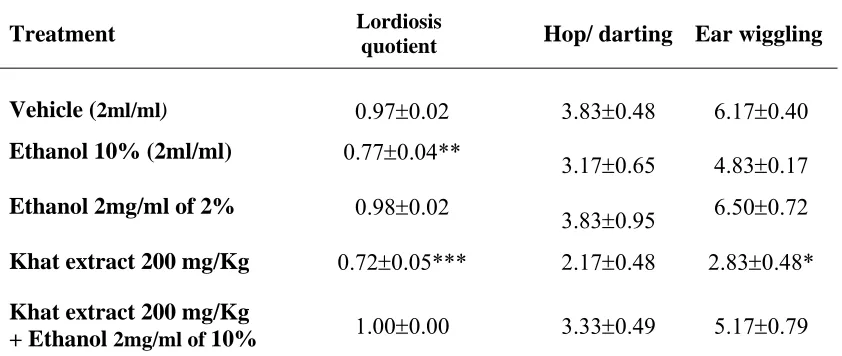
As seen in Table 1, 200mg/kg of khat extract and ethanol 10% administered alone showed a statistically significant reduction in lordiosis behavior. In contrast, administration of 200mg/kg of khat extract followed after 30 min by ethanol 10% showed a tendency of increment of lordiosis behavior though not statistical significant.
Table 1. Influence of ethanol on the effect of Khat extract on female sexual behavior
***P<0.001, **P<0.01 and *P<0.05, statistically significant relative to Vehicle (N=6) Treatment Lordiosis
quotient Hop/ darting Ear wiggling
Vehicle (2ml/ml) 0.97±0.02 3.83±0.48 6.17±0.40
Ethanol 10% (2ml/ml) 0.77±0.04** 3.17±0.65 4.83±0.17
Ethanol 2mg/ml of 2% 0.98±0.02 3.83±0.95 6.50±0.72
Khat extract 200 mg/Kg 0.72±0.05*** 2.17±0.48 2.83±0.48*
Khat extract 200 mg/Kg
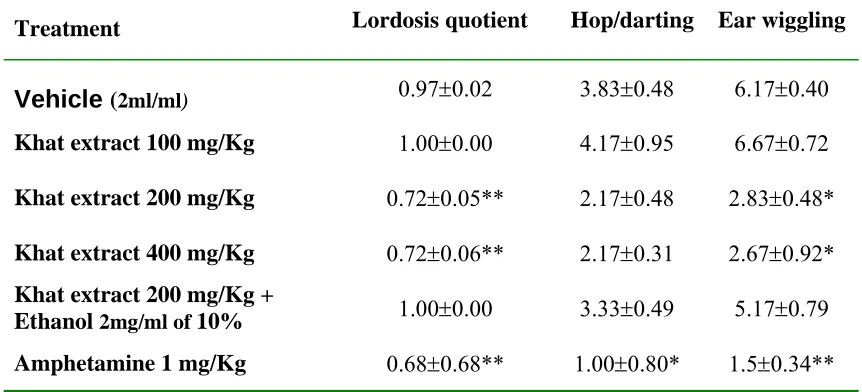
There was a significant effect of treatment on lordosis quotient as well as proceptive behaviors with amphetamine (1mg/kg) compared with vehicle-treated rats (Table 2). Similarly, 200 and 400mg/kg of khat extracts were also shown to significantly reduce the lordiosis behavior in addition to ear wiggling but unlike to amphetamine the number of hops and darts, did not differ statistically significantly as compared to vehicle-treated rats.
Table 2 Comparison of the effect of khat extract and amphetamine on female sexual behavior
Treatment Lordosis quotient Hop/darting Ear wiggling
Vehicle (2ml/ml) 0.97±0.02 3.83±0.48 6.17±0.40 Khat extract 100 mg/Kg 1.00±0.00 4.17±0.95 6.67±0.72
Khat extract 200 mg/Kg 0.72±0.05** 2.17±0.48 2.83±0.48*
Khat extract 400 mg/Kg 0.72±0.06** 2.17±0.31 2.67±0.92* Khat extract 200 mg/Kg +
Ethanol 2mg/ml of 10% 1.00±0.00 3.33±0.49 5.17±0.79
Amphetamine 1 mg/Kg 0.68±0.68** 1.00±0.80* 1.5±0.34** **P<0.001 and *P<0.05, statistically significant relative to vehicle (N=6)
DISCUSSION
The present findings show the ability of the crude extract of khat, Catha edulis Forsk, to
extracts 200 and 400mg/kg were found to have similar effects as amphetamine (1mg/kg) on both behavioral items i.e. receptivity and proceptivity.
Female rat sexual behavior is characterized by two main components that consist of a receptive (lordiotic) behavior and a soliciting (proceptive) behavior (16). The number of hop/dart and ear wiggling episodes are usually scored and considered as a measure of sexual motivation. The receptive behavior (lordiosis) is instead characterized by the posture of the female in response to the male mount or intromission. Its determination is considered a measure of sexual performance and is often measured by the “lordiosis ratio” (i.e., the quotient obtained by dividing the number of twines the female is mounted by the male). This quotient is considered a sensitive index of female receptivity (16).
Although most studies suggest the facilitatory role of dopamine in the expression of male rat sexual behavior, its role in female rat sexual behavior is controversial (16). Indeed, dopamine agonists and antagonists have been reported to have both inhibitory and stimulatory influences on female receptivity, measured as the lordiotic response of female rats treated with estrogen and progesterone, to mounts by a sexually potent male. Lordiosis is strictly dependent on sexual steroids, since it is abolished by ovariectomy but easily reversed by estrogen followed after an appropriate time interval by progesterone (16). In the present study khat extracts 200 and 400mg/kg had an inhibitory role, perhaps, by increasing the release of dopamine. Other studies using dopamine agonists or drugs that increase dopamine activity (e.g. amphetamine) suggested similar inhibitory role of dopamine (17). In contrast, the result of other studies supported a facilitatory role of dopamine in female receptivity. Accordingly, apomorphine was found to be able to increase the lordiotic response of ovariectomized estrogen and progesterone – treated female by 200% when given systemically (18). A similar increase in receptivity was observed with low doses of the khat extract (100mg/Kg), although not statistical significant.
Taking into consideration the potential effects of large doses of khat extracts on the release of serotonin, the inhibitory effects of high doses of khat extracts (200 and 400mg/kg) may partly be explained by higher concentration of serotonin in the presynaptic space in the CNS. There are studies showing that subchronic administration of fluoxetine (SSRI) reduced receptivity in ovariectomized rats primed with estradiol benzoate plus progesterone (11).
REFERENCES
1. Kalix P, Braenden O. Pharmacological Aspects of the Chewing of Khat Leaves. Pharmacological Reviews 1985; 37: 149-163.
2. Belew M., Kassaye M., Enquoselassie F. The magnitude of khat use and its association with health, nutrition and social economic status. Ethiopian Medical Journal 2000; 38: 11-26.
3. Taffa N., Klepp KI., Sund by J., Bjune G. psycho-social determinants of sexual activity and condom use intention among youth in Addis Ababa, Ethiopia. International Journal of STD and AIDS 2002; 13: 714-719.
4. Eriksson M., Ghani N.A., Kristiansson B. Khat chewing during pregnancy-effect upon the offspring and some characterstics of the chewers. East African Medical Journal 1991; 68: 106-111.
5. Mwenda J.M., Arimi M.M., Kyama M.C., Langat D.K. Effects of khat consumption on reproductive functions. East African Medical Journal 2003; 80: 318-323.
6. Dalu A. Impact of long-term consumption of khat on public health. The Sudama Concern 2000; 5: 15-16.
7. Adeoya-Osiguwa SA; Fraser LR. Cathine and norephedrine regulate mammalian sperm function in biologically significant ways. Human Reproduction 2004, 19(Suppl 1), 19.
8. Mohammedberhan Abdulwuhab, Eyasu Makonnen, Asfaw Debella.Effect of
Catha edulis forsek(khat) extracts on male rats sexual behavior. Journal of
EthnoPharmacology (2006), In Press.
9. Connor J., Makonnen, E., Rostom, A. Comparison of analgesic effects of khat (Catha edulis Forsk) extract, D-amphetamine and ibuprofen in mice. Journal of
Pharmacy and Pharmacology 1999; 52: 107-110.
11.Vega Matuszczyk J., Larsson K., Eriksson E. Subchronic administration of fluoxetine impairs estrous behavior in intact female rats. Neuropsychopharmacology 1998; 19: 492-498.
12.Taha S.A., Ageel A.M., Islam M.W., Ginawi OT. Effects of (-) - cathinone, a psychoactive alkaloid from khat (Catha edulis) and caffeine on sexual behavior in
rats. Pharmacological Research 1995; 31: 299-303.
13.Ellingsen E., Ågmo A. Sexual-incentive motivation and paced sexual behavior in female rats after treatment with drugs modifying dopaminergic neurotransmission. Pharmacology, Biochemistry and Behavior 2004; 77: 431-445.
14.Ferrari F., Ottani A., Giuliani D. Influence of sildenafil on central dopamine mediated behavior in male rats. Life Sciences 2002; 70: 1501-1508.
15.Cagiano R. , Tattoli M. , Mazzoccoli M. , Govoni S. and Cuomo V. Effects of chronic low-dose ethanol intake on sexual behavior in rats. Alcohol 1998; 16: 135-138.
16.Melis MR., Argiolas A. Dopamine and sexual behavior. Neuroscience Biobehavioral Review 1995; 19: 19-38.
17.Michanek A., Meyerson BJ. Influence of estrogen and progesterone on behavioral effects of apomorphine and amphetamine. Pharmacology, Biochemistry and Behavior 1982; 16: 875-879.