The University of San Francisco
USF Scholarship: a digital repository @ Gleeson Library |
Geschke Center
Master's Theses Theses, Dissertations, Capstones and Projects
3-13-1998
Vestry Retreats and Organizational Change in the
Episcopal Diocese of California
Catherine Taylor-Skarica University of San Francisco
Follow this and additional works at:https://repository.usfca.edu/thes
This Thesis is brought to you for free and open access by the Theses, Dissertations, Capstones and Projects at USF Scholarship: a digital repository @ Gleeson Library | Geschke Center. It has been accepted for inclusion in Master's Theses by an authorized administrator of USF Scholarship: a digital
Recommended Citation
Taylor-Skarica, Catherine, "Vestry Retreats and Organizational Change in the Episcopal Diocese of California" (1998).Master's Theses. 1138.
The author of this thesis has agreed to make available
to the University community and the public a copy of this dissertation project.
Unauthorized reproduction of any portion of this dissertation is prohibited.
The quality of this reproduction is
contingent upon the quality of the original copy submitted.
University of San Francisco Gleeson Library/Geschke Center
2130 Fulton Street
Vestry Retreats and Organizational Change in the Episcopal Diocese of California
A THESIS SUBMITTED
by
Catherine Taylor-Skarica
In Partial Fulfillment of the Requirements
for the Degree of
Master of
Nonprofit Administration
The University of San Francisco
Vestry Retreats and Organizational Change in the Episcopal Diocese of California
This Thesis Written by
Catherine Taylor-Skarica
This Thesis written under the guidelines of the Faculty Advisory Committee, and approved by all its members, has been accepted in partial fulfillment of the requirements for the degree of:
Master of Nonprofit Administration
at the
The University of San Francisco
II
---
flhp
~~
43tf-~6
(fog~ Director
~-~~·_..,__.~
__
+h
/1~
i ·,
G: I t
\
""
__, .) ' .
1
TABLE OF CONTENTS
Abstract . . . iv
Vita Auctoris ... . vi
Ackn.owled.g.m.ents. . . . vii
List of Tables. . viii list of Appendices. . . .. ix
Chapter One: Introduction. . . 1
Chapter Two: Review of Related. Literature . . . 14
Chapter Three: Methodology ... 48
Chapter Four: Results ... 60
Chapter Five: Summary and Conclusions ... 89
ABSTRACT
A questionnaire was mailed to board officers of churches in the
Episcopal Diocese of California asking about retreats, teamwork, and
change. The central hypothesis was that officers whose vestries
(boards) had gone on retreats in the prior year would report higher
teamwork satisfaction and more organizational changes in that year
than officers whose vestries had not gone on retreats. If supported,
this might point to teamwork as a possible mechanism by which
retreats promote change.
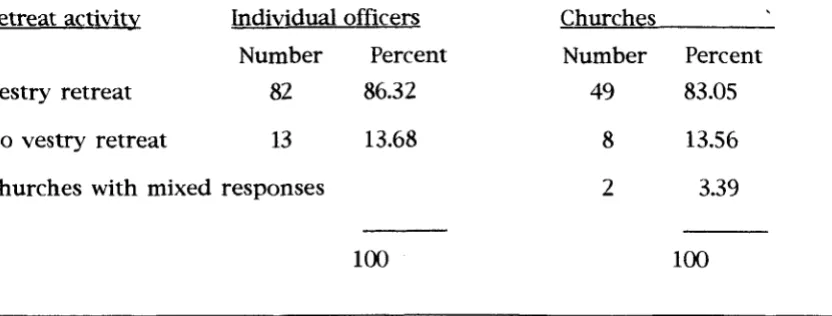
Most vestries from which responses were received (86.32%)
held vestry retreats within the year before the responses, and most
of these were held away from the site of their own church and with
no outside facilitator.
Regarding organizational change, officers whose vestries had
gone on retreats in the past year reported significantly greater
numbers of changes (p<.OS) in 24 church management topic areas
listed in the questionnaire than did officers who indicated their
vestries had not gone on retreats. (Whether reported changes were
regarded as positive was considered separately from their
occurrence, and for several management areas significantly more
positiveness was reported by officers whose vestries did not go on
retreats.) Responses about whether retreats contributed to change
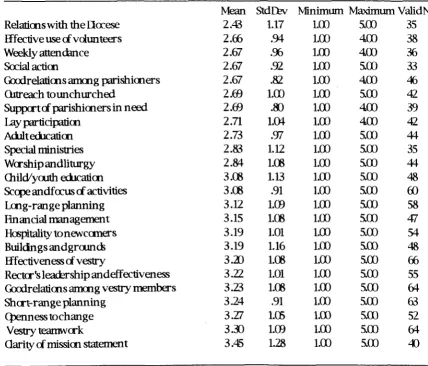
varied widely but the means for the 24 church management areas
ranged around the middle of a five-point Likert scale, i.e. "to some
extent." Thus, the fmdings lend support to the theory that retreats
negotiate the current rapidly changing societal environment is an
issue of central importance to nonprofit and other organizations
today.
Regarding teamwork, reported satisfaction with vestry
teamwork compared to the prior year did not show significant
associations with the number of church management areas in which
change was reported, or with reports of change in individual church
management areas. Also, teamwork satisfaction reports did not
differ significantly between officers whose vestries had gone on
retreats and officers whose vestries had not. Thus, the fmdings do
not lend support to the theory that improved teamwork is a
mechanism by which retreats promote change. A preliminary
discussion of church management topic areas addressed in retreats
that might serve as intervening mechanisms promoting change
focuses on clarity of mission statement, short-range planning,
Name:
Date of Birth:
High School:
Graduated:
VITA AUCTORIS
Catherine Taylor-Skarica
May 11, 1953
Alhambra High School Maninez,California
1971
Bachelor of Arts Degree: University of California Berkeley, California
ACKNOWLEDG:tviENTS
Many have contributed to and supported my completion of this
project-my family, church, USF faculty and students, coworkers, and
friends. For your input and patience, especially to my husband and
LIST OF TABLES
Table 1 Responses per Church 61
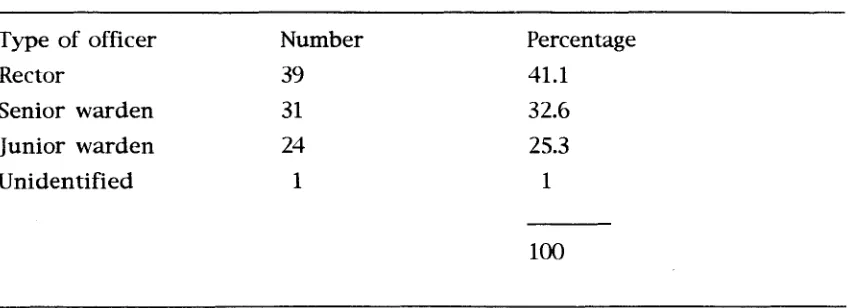
Table 2 Responses per Type of Vestry Officer 62
Table 3 Vestry Retreats Reported 63
Table 4 Instances of Change Reported in Responses
to Questions 3a-x 67
Table 5 Officers' Reports of Change in Clarity
of Mission Statement 68
Table 6 Chi-Squares for Change Reports-Retreat
vs. No Retreat 70
Table 7 Mean Reports of Retreats Contributing
to Change 73
Table 8 Retreat Activity Types and Satisfaction
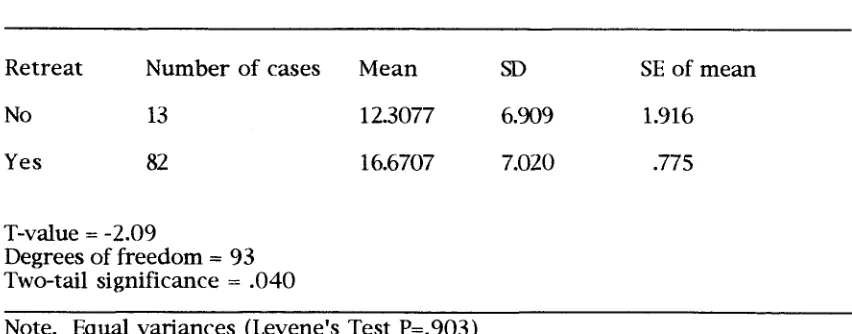
with Vestry Teamwork 77
Table 9 Satisfaction with Vestry Teamwork
Related to Change Reports 80
Table 10 Positiveness Reports Regarding Change 84
Table 11 Participation of Retreat Facilitator and
Reports Regarding Rector 86
Table 12 Change Reports of Officers from
LIST OF APPENDICES
Appendix A Questionnaire on Vestry Retreats 113
Appendix B Enclosure Letters Mailed with Questionnaire 122
Appendix C First Reminder (Postcard) 124
Appendix D Second Reminder (Letter) 125
CHAPTER ONE: INTRODUCfiON
This study examines the relationship among retreats,
organizational change, and teamwork, as seen by church leaders. For
those like this author who have partidpated in retreats of church
leadership, or have felt there was an impact from such a retreat,
there is a sense of the interconnectedness of these topics. Some
background that may help account for this sense is briefly presented
below, and a formulation is made of the issue of study. How the
research approaches the issue is also outlined, including a description
of the subjects in the research, the questions put to them, and the
importance and limitations of the study.
Background of the Issue
Change is an area of great concern to organizations today,
particularly because of the need to adapt to the rapidly changing
sodetal environment. This applies to the nonprofit sector, including
churches, as well as to the business and public sectors.
In church tradition, "retreating"-in other words, "a prayerful
going apart" -has long been looked to as a means of seeking
individual, spiritual transformation (Geunther, 1993). Recently
churches and many other types of organizations have looked to
retreats, or departures from their usual schedules and/ or settings, as
an activity to promote organizational change or transformation (see
Chapter Two below). Whether deriving from the church tradition or
from the findings and theories of organizational behavior and
assumption that departing from the group's usual schedule of
activities and setting will contribute to the achievement of hoped-for
goals.
Although any member of an organization may be involved in a
change or feel its impact, top leadership's role can be seen as critical.
Bryson (1988, p. 214), for example, sets large responsibility for the
following areas on "transformative" leadership: "redefinition of
purpose, the embodiment of new purposes into structures and
systems, the establishment of new defenses in light of the new
purposes, and the reordering of internal conflict." In churches of
various denominations during the past several decades, an important
change has occurred regarding the question of where top leadership
resides: There is more shared leadership between clergy and laity
now than in the past (lindgren & Shawchuck, 1988, pp. 13-14;
McKinney, 198 7, pp. 2-8). In the church context studied
here-Episcopal churches of the Diocese of California-an important place
where this sharing of leadership occurs is the vestry, or board. The
vestry is composed of lay members with the rector as an ex officio
voting member (Bowan, 1983, p. 3; Diocese of California, 1995, p. 29).
It is held that retreats of the vestry may contribute to such
pertinent matters for organizational change as mutual understanding
among members, team functioning, and the examination of a parish
and its goals (Bowan, 1983, pp. 19-20). By polling the rectors and
lay leaders (senior and junior wardens) of Episcopal vestries
study seeks to gain insight into joint efforts within the board which
embody their sharing of leadership powers and responsibilities.
Statement of the Issue
Many writers who are organizational consultants suggest or cite
the use of retreats in change strategies (e.g., Argyris, 1993; Eadie,
1993; consultants discussed in Fletcher, 1990; Senge, 1991). In some
writings, a belief in the effectiveness of retreats may be inferred by
their very inclusion in plans for organizational change. Other writers
explicitly state that retreats are a particularly effective tool when
issues related to change are on the agenda (e.g., Bader, 1991).
Among the types of activities that may occur in church-related
management retreats are prayer and meditation, team-building and
group process activities, and work on church management tasks and
goals.
The purpose of this study is to inquire whether the usefulness
of retreats and retreat activities in promoting change that is asserted
in the literature on this subject would be confirmed by questionnaire
responses of retreat participants from a specified population
(Episcopal vestry officers). Since some writings point to an
association between team building and retreats, and team building is
also frequently seen as contributing to change efforts and processes,
the association of teamwork with retreats and change was also
examined. Satisfaction with 24 specific areas of organizational
concern to churches was also investigated, since satisfaction may also
The quantitative approach of this study differs from
approaches emphasized in much of the literature reviewed here.
This occurred not by selection of nonquantitative material, but
because the predominance of literature found by the author on the
topic of retreats and change focused on testimonials or case studies.
Many of those reporting about retreats were consultants who led the
retreats on which they based their findings; they were not ongoing
members of the groups or organizations involved.
By contrast, this study inquires whether questionnaire
responses of multiple participants in different retreats (but with
similar roles as vestry officers and ongoing involvement in similar
organizations) will support the conclusion that retreats are an
effective tool for promoting organizational change.
Relevant Variables and Normative Definitions
The major variables to be examined are: vestry retreats, vestry
teamwork, and organizational change, as reported by the
questionnaire respondents. The unit of analysis with respect to
which the variables are considered is the individual vestry officer.
The term church was used for parishes (which are financially
self-sufficient) and missions (which receive financial support from
the diocese), as well as for Grace Cathedral, the Episcopal cathedral
which is located with the offices of the Diocese of California in San
Francisco. The churches included in the study were the 88 units of
the Diocese of California, geographically located in the wider Bay
the individuals polled from the churches were three officers of each
vestry, the rector, senior warden and junior warden. The term
vestry refers to the lay board of a church, and in this study is used
generally for all such boards, although some boards may officially
bear other names, such as "Bishop's Committee" for mission churches
that receive special financial support from the diocese, and the Board
of Trustees of Grace Cathedral (Bowan, 1983, pp. 1-6; Diocese of
California, pp. 20-21, 28-29).
The term retreat is used here to mean the practice of
organizational groups setting aside a day or more for activities
different from their usual routines, often in a place different from
the usual site of their meetings. Events fitting this description are
usually called retreats in this church context. From the wider
organizational literature, the labels "laboratory experience" or
"training" as well as other nomenclatures (see Chapter Two below)
may also apply. Dictionary definitions of retreat are applicable,
including both the general "the act of withdrawing, as into safety or
privacy" and the more specifically church-related "a retirement or
period of retirement for religious exercises and meditation" provided
in Websters College Dictionary (Costello, 1995, p. 1150).
A vestry retreat is thus defined and presented in this study
and in the questionnaire on which its findings are based as "a
meeting especially for vestry members at least one work-day long
and with a different agenda sequence than ... regular vestry
Vestry teamwork is the teamwork, or cooperative effort, of the
members of the vestty. The term is used verbatim in questionnaire
items regarding satisfaction, change, and retreats.
Organizational change can be defined according to common
usage as change of or in an organization. A question that might
then be posed is: What is it about the organization that changes
when there is organizational change? In different readings, different
specific areas of change may be cited, such as internal
communication (Argyris, 1993), or personnel (Schaller, 1993,
pp. 119-124 ). In this study, questions are asked about change in 24
specific areas of church management. Results concerning change in
these areas are discussed both individually and compositely as an
overview of all reported changes. Change is noted whether or not it
is viewed positively, and questions are posed regarding the
positiveness or negativity of change. This questioning allows for the
possibility that participants in organizational change(s) may not
regard change(s) as improvements.
Much church and general management literature further
refines the concept of organizational change by discussing different
"orders" of change (see Chapter Two below), which depend
essentially on how far-reaching and radical the changes in question
are. The questionnaire and analysis for this study do not attempt to
specifically defme or distinguish orders of change. There is,
however, an underlying assumption that a high-order or radical
organizational change may be manifested as many smaller order
In order to ascertain whether there may have been many or
broad changes in a church, this study asked questions about change
in many specific areas of church management. The church
management areas included in the questionnaire were: worship and
liturgy, clarity of mission statement, weekly attendance, adult
education, child/youth education, openness to change, outreach to
"unchurched" (persons not currently affiliated with or attending a
church), scope and focus of activities, short-range planning,
long-range planning, buildings and grounds, effective use of volunteers,
social action, special ministries, hospitality to newcomers, financial
management, relations with the diocese, lay participation,
effectiveness of vestry, vestry teamwork, good relations among
vestry members, rector's leadership and effectiveness, support of
parishioners in need, and good relations among parishioners. How
this list was formulated is discussed in Chapter Two.
Specification of the Hypothesis and Research Questions
The hypothesis of this study was that officers whose vestries
had gone on retreat in the past year would report higher ratings of
teamwork and more organizational change (i.e., change in more
church management areas) during that time than those officers
whose vestries had not gone on retreat. Here the vestry retreat is
the independent variable. It is dichotomous, i.e., each vestry will
have either conducted retreat(s) during the past year or not. A
hypothesis is that retreats promote organizational change by the
mechanism of improving vestry teamwork. This can be pictured as a
three-variable model:
Independent Variable Whether a vestry----> officer attended
a retreat (a dichot-omous variable)
Intervening Variable Dependent Variable positive reports ---> reports of change regarding teamwork
Data supporting the hypothesis would provide validation of the time,
energy and cost devoted to vestry retreats.
Research Questions
The questions that follow were formulated and data pertaining
to them were collected from questionnaire responses in order to shed
light on the hypothesis that officers whose vestries had gone on
retreat in the past year would give higher ratings of teamwork and
organizational change than others whose vestries had not gone on
retreats.
I. Will officers of vestries that went on retreat(s) in the past year
report change in more church management areas during that year
than officers of vestries that did not go on retreat(s) in the past
year? (This pertains to the "organizational change" portion of the
II. Will officers of vestries that went on retreat( s) in the past year
indicate that, for those areas where they reported change in the past
year, the retreat(s) contributed to bringing about the change? (To
clarify whether vestry officers perceive any reported association as
reflecting a causal relationship.)
III. Will officers of vestries that went on retreat(s) in the past year
report increased satisfaction with teamwork at a higher level in that
year than officers of vestries that did not go on retreat(s) in the past
year? (This pertains to the "teamwork" portion of the hypothesis.)
N. Will there be a positive correlation between satisfaction with
teamwork and reports of change in church management areas?
Importance of the Study
Learning whether retreats are positively associated with
reported teamwork and change can be helpful to church boards and
others who go on retreats in the hopes of impacting these results. It
can help validate the practice by giving those who plan and host
retreats a more conscious knowledge of whether the reasons and
rationale for doing so are supported. Also, learning about variations
associated with elements of retreat organization that are investigated
here-specifically percent attendance, the activities and focus of a
retreat, whether a retreat was on- or off-site, and whether or not an
outside facilitator attended-may help such groups make more
If the research results point away from retreats being a factor
promoting teamwork and organizational change, this in itself will be
of interest, and conclusions about other factors that promote or
hinder change may emerge for the enlightenment of church leaders.
As mentioned above, the general climate of societal change has
implications specifically for churches (Bowan, 1983, p. 5). But today
nonprofit organizations generally, like other, for-profit and public
organizations, as well as individuals, are faced with a context of rapid
external change (e.g., as described in Drucker, 1994; Fletcher, 1990;
Scott-Morgan,1994; and Theobold,1994). Experiences from the
nonprofit sphere (which includes churches) can be looked to by
others for information about adaptation to change and how to
survive the current turbulent environment; in other words, findings
about the degree of success with which nonprofits have applied
techniques and practices relevant to the question of change are of
interest both to the nonprofits engaging in such techniques and
practices and to other sectors. Nonprofits already have an
established history and tradition of exhibiting much flexibility within
tight economic constraints, and of focusing on community and
vision-i.e., the purpose for a nonprofit organization's existence
(Coolidge, 1995; Drucker,1994). These two concepts of community
and vision, which relate to teamwork, are seen by some writers in
the for-profit sphere as critical to dealing with the current, rapidly
changing environment (Senge, 1991; Theobold, 1994).
Board functioning is also an area of high interest for nonprofit
organizational literature, the board is seen as a crucial locus for
organizational change (e.g., Eadie, 1993, pp. 3-4). This study, with
its focus on board (vestry) retreats, provides information of interest
in the study of boards of trustees.
Limitations of the Study
Some methodological considerations and limitations of this
study are the following: What respondents report in their
questionnaire responses as having happened at a retreat, or with
subsequent organizational changes and conditions, may not be
accurate because responses may be colored by memory gaps or by
personal biases. The highly specific wording of the questionnaire
attempted to compensate for this as much as possible. A research
design which included investigation of groups before, during, and
after their retreats would better avoid these questions of skewing
and memory, but was logistically beyond the scope of this thesis.
In spite of individual responses being kept confidential through
number coding of questionnaires, a degree of collaboration was
received from the diocese (provision of their mailing list and a cover
letter from the executive officer introducing the study and
encouraging responses to the questionnaire) and may have colored
responses. This might happen, for example, if priests felt a need to
be politic in relations with the diocese, or if lay vestry officers
exercised similar considerations with respect to priests and the
hierarchy, or a fear that individual responses could somehow come to
light, may also be reflected in the results.
Logistic difficulties may have hampered reaching all those
individuals to whom the questionnaire was addressed, because the
diocesan mailing list does not include lay officers by name but only
in terms of their title and church. Also, responding to the
questionnaire was voluntary, as are all activities undertaken by the
vestry officers. Sanctions or enforcements were not available to
encourage responses as they might be for some subjects, for example
in a paid work environment.
Separating out significant factors and drawing causal
inferences, in this project, and in such research generally, involves
difficulties because of all the different elements that may be
involved in the decision to have a retreat and in the outcomes of
teamwork and organizational change after a retreat. The complex
and long-term sequences of events of which retreats form a part are
difficult to probe in the brief questionnaire format used for this
study. Also, each retreat studied here occurred within a specific
organizational context, having its own characteristics which may be
operative factors in the findings or limit their applicability in other
contexts. It can only be stated whether associations found in the
results fit logically with the hypothesis, thus tending to support it, or
not, and whether respondents perceive retreats as contributing to
change.
Finally, the question of backtracking from changes once they
by Stjomberg and Philips, 1993), is important but could not be dealt
with in the scope of this thesis. This is because the research design is
essentially cross-sectional, dealing with a one-year span, and not
longitudinal. Also in this connection, as pointed out in a comment
from one respondent, some change outcomes may take more than a
CHAPTER TWO: REVIEW OF THE LITERATURE
That today's rapidly changing societal environment leads to an
emphasis on the capacity for organizational change is evident from
both general writings and specifically church-related writings. The
headline to Peter Drucker's cover article in the November 1994
Atlantic Monthly, for example, states: "A farsighted social
philosopher argues that we are in the midst of the most extreme
societal changes in recorded history." In the article, Drucker explores
"the need for social and political innovation," including in this focus
the role and functioning of organizations. Regarding churches,
Iindgren and Shawchuck (1984, p. 18) state that
Working with God to achieve His mission and ours in a local church has always been a serious and complex matter. This task, however, is now much complicated by changes in the environment, which demand more changes in the
organizational structures and polity of the church than ever before.
Reporting on an organizational consultation, E. Miller (1993, p.
108) seconds the challenges of the social environment when he
writes: "the Church ... is required to maintain a belief in
institutional, social and natural order, in dependability and
continuity, in the face of the actual social realities of discontinuity,
rapid change, and disorder."
The need for organizational capacity to change thus being
Recognizing Organizational Change
What do we mean by organizational change? Discussion of this
question often centers around differentiation among levels of change.
Different authors use varying terminology, but the common thread is
the distinction between adjustments and modifications that (a) do
not essentially change an organization's ways of going about its
business, and those that (b) do change the fundamental core of an
organization in terms of its modes of perception and action. Fletcher
( 1990, pp. 8-9, 89) provides several examples of terms used by
different authors to distinguish (a) and (b), including for (a) "change"
(plain and simple), "first-order change," "minor change," and for (b)
"transformation," "second-order change," "fundamental change,"
"qualitative discontinuous change" and "major paradigm shift."
Sometimes three or more levels of change are distinguished with the
"third order" indicating more radical or sustained change than the
second order. In a church context specifically, Schaller (1993, pp.
90-91) defines by example three levels of change, with the first level
entailing basic improvements of the current set-up (e.g., through
increased funding), the second level entailing some structural
changes (e.g., from individual to group teaching), and the third or
"radical" level calling for "big departures from the status quo" (e.g., a
voucher system for schools).
The popularity of such discussion may hark back-whether or
not the credit is explicitly assigned-to Thomas Kuhn's seminal book
The Structure of Scientific Revolutions (1962,1970). In that book
history of science. Applying the same concept to organizational
change, Porras and Silvers (1991, p. 57) refer to Kuhn when they
discuss "gamma change" in organizations, a third-order type of
change which they say is a "paradigm shift" in organization members'
mental constructs.
Kuhn ( 1962, 1970) provides historical examples of paradigm
shifts, or revolutions in thought, such as the Copernican model or
relativity in physics. But for an observer in the present moment to
know or distinguish what level of change an organization is
undergoing may be more difficult. As Porras and Silvers note ( 1991,
p. 74) regarding the field of organizational transformation (OT):
"Paradigms are a key concept in OT work, but no clear
conceptualization or research strategy for them has been developed."
The lack of a consensus or clear conceptualization about paradigmatic
change (qualitatively distinguished levels of change) as distinguished
from a continuum of change (amount of change or number of
changes), argues against using the terminology of paradigms in
questionnaire items or analysis. It is possible to simply account each
report of change in an organization value as worthy of observation.
Regardless of the level of change each report might singly constitute,
changes in multiple areas could be thought of as multiple changes.
Multiple changes in multiple areas of an organization might be
thought of as possible signs of a move toward transformative or
paradigmatic change. This would follow the logic put forward by
Schaller (1993, pp. 97-98) that many lower level changes may
he cites in which a "large number of first and second level changes
eventually added up to third level transformation." But whether or
not multiple changes do point to different orders of change, in and of
themselves they constitute multiple changes.
To sum up the question of levels of change, although there is
much discussion and proposed terminology about qualitatively
distinguished levels of change, there is no consensus about the
concept of such levels or what to call them. The present study does
not rely upon such qualitative distinctions.
The Stages of Change
It is possible to outline generalized stages in the planning and
institution of change, in spite of variations in the change process,
according to specific contexts, practices, and approaches used by
promoters of change. Note that these promoters may be at the upper
or lower levels of an organization (as discussed in Klein and Ritti,
1984, pp. 575-579), and may include change agents or practitioners
brought in from the outside (as Argyris ( 199 3) or the practitioners
discussed in Fletcher ( 1990)).
Klein and Ritti (1984, pp. 575-577) provide one proposed
abstracted outline for the process of change, at least in those cases
promoted by management from the top down. Klein and Ritti's
model of change includes information coming to light which poses
pressure for a solution involving change, a diagnosis of what is
occurring in the situation, action planning on what steps to take, the
Klein and Ritti cite "Patterns of Organizational Change," a 1970 article
by L. E. Greiner which emphasizes the need for an eventual sharing
of power at some stage by all those "touched by" the pertinent area
of change, even when the initiation for change may come from the
top. The need for such sharing of power is also a main theme of
Power & Change in Parish Ministry by Jinkins and Jinkins ( 1991),
which holds that in most cases (but not all), it is preferable to share
power by seeking consensus about change from the outset.
Some church authors also offer step-by-step "how-to's" for
getting started in changing an organization and carrying the process
through to implementation. Two examples follow.
Jinkins and Jinkins ( 1991) distinguish two broad types of
change as problem-solving or adaptive. Then, citing the work of
P. Watzlawick, J. H. Weakland, and R. Fisch (1974) in Change:
Principles of Problem Formation and Problem Resolution, they
proceed to outline four sequential steps for problem-solving change.
These four steps are: define the problem; look at past solution
attempts; define the desired change; and formulate and implement a
plan with its included parts.
Schaller (1993), after defining different levels of change (pp.
91-92), names different steps for change (pp. 92-100). These are:
existence of a prior condition for change (such as a future vision, or
discontent with the status quo); creation of an initiatory group;
building of support; approval and implementation; and
institutionalization of change. Schaller's steps focus on the
In formulating their different sequences for the steps of
change, the above authors are not necessarily contradicting each
other. Rather, they have selected different emphases; they have
considered the steps from initiation through implementation of
change from different angles.
It is important to keep in mind the varying ways change plays
out in real, specific contexts when considering conceptualizations of
sequential change steps. Fletcher, for example, sets out summary
descriptions of the stages of change according to several writers of
the "organizational transformation" school ( 1990, pp. 11-14). Citing a
seven-step model by K. W. Buckley and D. Perkins on the metaphor
of death and rebirth, Fletcher notes that for an organization to move
through each stage in a smooth, linear manner is rare. The stages of
change proposed by Buckley and Perkins focus largely on mental
processes within an organization, particularly the processing of
information that points to a need for change and the acceptance of a
vision for that change. This then leads to the "embodiment" of
change and its integration into the organization. Buckley and
Perkins' proposed stages of change are: the unconscious stage
("organization unconsciousness that builds a readiness for change");
the awakening stage (in which "awareness and surfacing symptoms"
point to the need for change); the reordering stage (in which past
assumptions are challenged); the translation stage (in which
information, images and visions of the prior stages are integrated);
the commitment stage (commitment to implementation of a new
vision into "day-to-day operations"); and the integration stage (in
which embodiment of the new vision becomes widespread).
Teamwork
One of the reasons for studying teamwork in connection with
organizational change is the frequent mention of team building as an
organizational transformation or organization development
intervention. For example, according to one of Fletcher's
interviewees (1990, p. 115), team building can be seen as an
important element in organizational interventions to remedy
conflicts and gain consensus about vision and mission. Moore ( 197 8,
p. 479), in his discussion of a way to assess teamwork, points out that
organizations often apply team building as a planned change or
organizational development intervention. Liebowitz and DeMeuse
(1982, pp. 1-2) note that team building is an organizational strategy
applied to develop work group effectiveness, and further specify
that: "Team building is considered one viable intervention strategy
for improving an organization's ability to cope with change [in
technology and sodety]."
The purpose of team building, according to Liebowitz and
DeMeuse (1982, p. 2) is to increase [work groups'] skills for effective
teamwork. Team building thus targets improved teamwork as its
goal. One can logically infer that when team building is applied as
suggested in the above-referenced literature, the resulting improved
teamwork is regarded as a variable that may lead to conflict
relevance to the present study-good team functioning in changing
external and organizational environments.
Regarding team building and work effectiveness, past research
lends a degree of support to the belief that team-building
interventions and positive teamwork qualities lead to improved
performance by teams and/ or by individuals viewed as members of
teams. For example, the meta-analysis of journal articles from 1985
to 1989 about organization development and transformation by
Porras and Silvers ( 1991) cites four studies on the topic of team
building. Porras and Silvers conclude that: "It appears that narrowly
focused team building interventions have a positive effect on
performance" (p. 64). In another meta-analysis, Evans and Dion
( 1991) analyzed 16 studies relating to group cohesion and
performance (group cohesion being a commonly cited characteristic
of effective teams per Mcintyre and Salas (1995)) and found, based
on these studies, that a moderately strong correlation existed
between group cohesion and effectiveness of the group.
Regarding changes within teams, Mcintyre and Salas ( 1995)
point out that teamwork itself changes over time. They cite a 1988
paper by Mcintyre, Morgan, Salas, and Glickman, ("Teamwork from
team training: New evidence for the development of teamwork skills
during operational training") comparing changes in more effective
and less effective teams. The cited study found different patterns of
change in the training phases of these more and less effective groups.
Members of more effective teams succeeded in clarifying their roles
exchanges, and mutual assistance were based on this clarity. Their
skills kept developing indefinitely, and in later phases they sought
feedback and guidance from each other. Members of less effective
teams struggled longer with ambiguity about their roles, assisting
each other in early stages when their roles were not clear. In later
phases, they were less likely to continue developing their skills, and
less likely to seek mutual feedback and help.
Mcintyre and Salas ( 1995) also note that a component of
teamwork is adapting to [i.e., changing in response to] circumstances
in order to achieve desired goals (p. 33). Of course, adapting to
circumstances in order to achieve desired goals is a need of the wider
organizations of which teams form a part, as discussed previously in
the introduction to this chapter. In this connection, Guzzo and
Dickson ( 1996) note a possible significance of teams for their wider
organizations. They point out that when one considers that teams
are components embedded in larger organizations it leads to the
conclusion that "changes in team effectiveness can ... have
consequences for change in the entire organization" (p. 327). An
anecdotal statement by Beer ( 1994) supports the idea of the critical
importance of teamwork for change in a whole organization. Citing a
success story of "strategically aligned change" (i.e., planned change
focused on the problems an organization faces), Beer states that
"collaborative process ... [w]orking together on the quality problem
spurred the plant manager and her staff to develop a commitment to
teamwork and to learn how to work as a team," and that this impact
in the plant" (pp. 38-39). On the other hand, a 1994 study by D. H.
Harris ("Organizational linkages: Understanding the productivity
paradox") cited in Guzzo and Dickson ( 1996), indicates that it could
be wrong to assume that improvements in organization components (e.g., individuals, teams) will lead to improvements
organization-wide, because the evidence does not always support this (p. 327).
Based on the above literature, the overall statement can be
made that it is valid to consider whether improvements and/ or
changes in organization components such as teams may have
consequences for an entire organization, but not to assume that this
will be the case.
Another interesting point of possible relationship between
team building and change is apparent from the stages of team
building put forth by Iiebowitz and DeMeuse (1982). These are:
"collection of data, diagnosis of problems, feedback to the work
group, discussion of the data by the work group, action planning, and
action" (p. 3). These stages closely parallel the stages of change
outlined by Klein and Ritti ( 1984). The question may be posed
whether this parallel points to co-occurrence or connection between
team-building and change.
Liebowitz and DeMeuse's ( 1982) general definition of the
team-building approach is a good fit when applied to vestry retreats, if the retreats are seen as part of a team-building program (because
vestries meet throughout the year in addition to special retreats), in
that team-building involves an intact work group and is a long-term
that follow-up is needed to maintain the accomplishments of a
one-time retreat. Examination of an organization's "purposes, norms,
values and interpersonal dynamics" (p. 2) is included in the
team-building process, and such examination has also been included in this
author's experience of vestry retreats (see "Episcopal Vestry
Retreats" section at the conclusion of this chapter). Some
questionnaire items in this research, particularly regarding clarity of
mission statement, vestry teamwork, good relations among vestry
members, and good relations among parishioners, pertain to these
areas.
Porras' ( 1979) definition of team building includes
"task-oriented laboratory trainings," which focus on task-related issues,
although human process problems may be dealt with in the course of
them (p. 158). Porras distinguishes such trainings from human
process-oriented laboratory trainings, and states that the
task-oriented trainings are shown in his meta-analysis to be more
effective than other organizational development methods for
developing group process (p. 163). However, Porras qualifies his
conclusion by noting the small number of studies in his analysis.
Human process-oriented trainings are another way of working
with teams when organization development goals are sought.
Attempts in this area have perhaps not been as productive as team
building with a task focus. Klein and Ritti (1984, p. 625) cite a 1977
study by Bowers and Hausser ("Work group types and intervention
effects in organizational development") and a 1975 study by Bowers,
interventions in O.D.: A systemic approach") which found that mainly
negative changes were produced, on dependent variables including
group processes, by the two process-focused types of intervention
that Klein and Ritti term "task process consultation" (analyzing how
people go about working setting objectives) and "laboratory
trainings" (dealing with the feelings of people who are members of
the group)(p. 616).
The multiplicity of terminologies and lack of agreement in
some of the results discussed above may not be surprising. Beer and
Walton (1987) remark that organizational development and change
results are not conclusive because of several methodological deficits,
including imprecision in the depth of descriptions of interventions
and situations. One thing that can be confirmed, however, is that
there is much discussion involving a possible association of
teamwork factors with organizational change, and much discussion of
teamwork factors with reference to intervention techniques applied
where change is sought. This leads to the interest in the present
study in questioning whether improved teamwork may be an
intervening variable resulting from retreats and leading to change.
Satisfaction
If changes in satisfaction regarding teamwork and other
organizational factors are found to be associated with retreats, this could be of interest for several reasons, based on the literature cited
The significance of satisfaction with the church organization
may be particularly high for lay vestry members because of their
voluntary involvement in the vestry. The importance for voluntary
associations of "normative and affective inducements for stimulating
member commitment and resource contributions" is a major
emphasis of Knoke and Prensky ( 1984) and satisfaction is one such
affective inducement (pp. 4-6). It follows then that if satisfaction
declines, the volunteer commitment of lay vestry members might
also decline. On a parallel note, in organizational behavior research,
according to Staw ( 1984), lack of satisfaction has been linked with
job absenteeism and turnover (p. 631). (To allow a comparison
between Staw's conclusions and those of Knoke and Prensky, one
may logically infer that absenteeism and turnover relate to lowered
or ended commitment to the job.) The implications of such
organizational research may extend to both the volunteer lay vestry
members and also to rectors for whom a role in the vestry role is
part of the job. It is evident that from the standpoint of possible
impacts on commitment and involvement in the vestry, lowered
satisfaction could be disadvantageous. Thus, if steps toward an
advantageous change goal caused a disadvantageous drop in
satisfaction, the steps toward change would not lead to a positive
outcome overall.
Another reason for studying satisfaction is a possible positive
association between satisfaction and effectiveness. From the
literature about nonprofit boards, Houle (1989) asserts that
promoting effective board spirit. According to Houle, board
satisfaction can result from many causes including strong belief in
the mission, and good personal relationship and interaction among
board members (pp. 120-121).
Houle's ( 1984) assertions of a connection between satisfaction
and board effectiveness are paralleled by past organizational
behavior research presuming a link between job satisfaction and
productivity (Staw, 1984, pp. 630-31). However, just what the
association might be is a matter of debate. For example, does
satisfaction lead to productivity, or does productivity lead to
satisfaction? Are mediating variables the key, or do some other
relations apply? It is also debatable whether any association has
been confirmed by research findings (Schwab & Cummings, 1970;
Staw, 1984). In any event, from the standpoint of any possible
positive association between satisfaction and effectiveness,
satisfaction of vestry officers lowered because of change could once
again be disadvantageous because it could be associated with a
lowering of the vestry's effectiveness.
In addition to implications for commitment and effectiveness,
satisfaction may also have implications for the initiation of attempts
to achieve organization change. Here lowered satisfaction (in other
words, a shift on the continuum from relative satisfaction toward
dissatisfaction) may be an advantageous rather than
disadvan-tageous factor in promoting change. As Staw (1984) notes,
"Dissatisfaction with the organization may ... be the spark that alters
(1993) proposition that "discontent with the status quo" may be a
prior condition for change (pp. 92-100), and with Porras and Silvers'
(1991) reference to Beer's 1987 work, "Revitalizing organizations:
Change process and emergent mode," examining "three cases of
organizational transformation where successful change included the
concurrent development of a vision of the future and heightened
dissatisfaction with the status quo throughout the whole
organization" (pp. 70-71).
The examples from the above paragraph regarding initiation of
change argue that lowered satisfaction could be advantageous where
change is being sought. Regarding maintenance of change, on the
other hand, Klein and Ritti ( 1984) raise the possibility that lowered
satisfaction or dissatisfaction as a result of changes in a program may
undermine the program, in that these changes may bring into
question whether to proceed with the program (pp. 563-609).
Teamwork and retreats are additional points to which
satisfaction may particularly pertain, according to the meta-analysis
of 126 studies on organizational development interventions carried
out by Neuman, Edwards, and Raju (1989). The intervention types in
the studies included team-building (which relates to teamwork) and
laboratory trainings (four to five days long and attended by all
members of a work group, i.e., within the definition of a retreat for
the present study), as well as participation in decision making, goal
setting, management by objectives, realistic job previews, grid OD,
and survey feedback. Grid OD is a subtype of team building focusing
supervisory leadership level (p. 464). Neuman, Edwards, and Raju
found team-building and laboratory trainings to be the most
effective single-faceted organization development methods for
modifying satisfaction, according to this meta-analysis. Although
these authors themselves point out difficulties in their meta-analysis
which may negatively impact the value of their results (e.g., different
moderating effects in different studies and different supervisory
levels of subjects), they also describe their efforts at methodological
rigor to help offset these difficulties (e.g., by the use of multiple
raters and sophisticated statistical techniques). Whatever one makes
of their findings, their inclusion of satisfaction as a main topic of
study in connection with these intervention techniques demonstrates
the continuing research interest in satisfaction in connection with
overall retreat outcomes, commitment, effectiveness, initiation of
change attempts, and teamwork.
To sum up, satisfaction is an important concept for the present
study because it may have a role in encouraging volunteer
commitment, an association with effectiveness, and/or a role in the
inception and acceptance of change. Additionally, it is a continuing
topic of organizational development research interest, and retreats
and teamwork may be of special import for satisfaction, as suggested
by the results of Neuman, Edwards, and Raju (1989). It is not
surprising to find contradictory statements of findings and
implications regarding satisfaction, given that there is a lack of
consensus between studies, and disagreement about what
pp. 421-25; Staw, 1984, p. 63). Nevertheless, satisfaction is worthy
of attention in the present study because of prior research inquiry
and discussion relating satisfaction to pertinent subject matter.
Therefore, a section of the questionnaire inquires about subjects'
satisfaction with church management areas compared to their
satisfaction level a year ago. Its purpose is to inquire into any
associations between altered satisfaction and retreats, teamwork, or
change.
Retreats and the Practice of Organizational Change
While there are apparent parallels in different authors'
respective formulations of the stages of change, each writer seems to
have her /his particular emphasis when relating experiences or
giving advice on how to promote situationally appropriate change.
Fletcher (1990) notes that consultant practitioners acknowledge their
disagreement on how to go about promoting organizational
transformation (p. 138). Regarding practices for promoting change,
the matter of particular importance for this study is whether an
approach includes a suggestion of a leadership group going on a
retreat. If an approach does include such a suggestion, it may also be
of interest what stage(s) of organizational change the retreat focuses
on or occurs at, and what team-building and change goals are
especially looked for as a result of the retreat. Some examples
follow.
Fletcher (1990, pp. 109-124) asked 14 organizational
consultant in a hypothetical case. The case involved a company in
need of change, whose main decision-making body was a board of
directors. Of the 14 practitioners, three specified that they would
include events meeting the definition of a retreat used here. One
stated he would begin the change process "with at least two days
off-site with [the] top management group" to examine how outsiders and
subgroups of employees view a company, and how their actual views
may differ from the company's desired image. Change goals would
presumably emerge from defining "how we want them to see us."
Although the problems of the hypothetical case to be addressed
included conflicts and in-fighting in the organization, this
intervention proposal is mute on team building within the board. It
does, however, include analysis of the reciprocal views of subgroups
within the organization. Its focus probably corresponds to the early
diagnosis stage of change (realizing discrepancies between actual and
desired views of a company and its subgroups), as proposed by Klein
and Ritti (1984). Klein and Ritti's outline of stages of change is
referred to throughout this discussion of retreats whenever a
reference is made to stages in the change process. To review, the
stages outlined by Klein and Ritti are: information coming to light
which poses pressure for a solution involving change, a diagnosis of
what is occurring in the situation, action planning on what steps to
take, the taking of action, and feedback regarding the results of such
action.
A second practitioner's retreat proposal (in Fletcher, 1990) is
information gathering and diagnosis about internal and external
constituencies before a three-to-four-day retreat of the board of
directors off the company site. The main purposes of this retreat
would be strategic planning, team building, and perhaps work on
race and gender issues. The team-building process would focus on
participants' putting forward their values and their visions for the
organization, and formulation of sufficient "alignment with the
vision" to proceed. A third practitioner's proposed use of a retreat
for the "top team" of the firm essentially agrees with such use of a
retreat at the action planning stage, in that it follows prior
information gathering by the practitioner and includes not only
definition of vision, but also the setting of strategic goals that can be
measured.
It is worth noting that while the other transformation
practitioners interviewed by Fletcher do not specify retreats in their
proposed plans, there is a common emphasis on working to develop
positive board characteristics such as clarity of roles, teamwork, and
especially shared vision. These are areas that are often subjects of
focus at retreats.
Chris Argyris, in Knowledge for Action: A Guide to Overcoming
Barriers to Organizational Change (1993), gives an "action research"
account (i.e., the researcher was a participant in the process) of
change attempts in a firm. The approach included a two-day "case
discussion seminar" for the firm's directors (pp. 135-149). Argyris
does not call it a retreat or specify whether it took place on or off the
with the entire board, the case discussion falls within the definition
of a retreat for the present study. The goal was to help the directors
become aware of discrepancies between their desired ways of
business interaction and their actual defensive routines which
produced "undiscussable barriers to progress." Argyris states that
another result of the seminar was a new group commitment to the
change program. The former element of the seminar probably places
it mostly in the diagnosis stage of the change process, and the latter
element appears to be a team-building result. Thus, as a result of
the seminar, change goals (removal of barriers to progress) and
team-building goals (group commitment to program goals) were both
addressed.
Also at a diagnostic stage, Michael Beer ( 1994) proposes
holding a meeting, with workers and management assigned to task
forces to discuss problems and propose solutions. The meeting is
recommended to be "unhurried, and away from the day-to-day
pressures" of company work (p. 42). In the next stage, specific
change goals are to be defined based on information from the
meeting. The meeting is intended to create the needed environment
for management to take in the feedback from the task forces. To
expand on this, departure from the work routine is apparently seen
as a method to promote an "unhurried, open, and contemplative
discussion" necessary for this step in the change process. Precisely
what this method contributes, or by what mechanism it facilitates
In his booklet about board change and growth specifically in
the nonprofit sector, Eadie (1993) presents an outline for an annual
planning cycle (based on past usefulness to "many nonprofit boards")
that includes two retreats for the board and staff. One of these is a
"strategic retreat" to identify and select strategic issues of focus,
which Klein and Ritti would probably categorize as the diagnosis
stage. The other "operational planning retreat" probably corresponds
to the action planning stage (pp. 17-18).
Shawchuk and lindgren ( 1984) give an example of a weekend
planning retreat of church leaders at which a problem was discussed
that had arisen from a prior change. Here the steps in the problem
analysis and the search for the cause of the problem would again fall
mostly within Klein and Ritti's diagnosis stage of change. Further
planning and action after the retreat did lead to change in the area of
concern.
McKinney ( 198 7) proposes a particular religious approach
corresponding to Klein and Ritti's diagnosis stage of change as an
alternative to secular models of decision making which she sees as
ill-suited to the church context. This approach involves the
discernment of God's will and submission of one's own will. In the "discernment" approach, decisions by lay leaders are made through a
largely consensus-based process. In discussing retreats attended by
church committee members, McKinney makes a statement pertaining
to teamwork that "there is a dynamic involved in such a day of
prayer, a bonding that takes place" (p. 82). She also states that it is
usual place of meeting," but does not explain in detail why she
considers this best (p. 82).
To conclude and summarize, it can be seen that retreats, as
defined here, are indeed sometimes used in change efforts. In the
examples cited, retreats are used at various stages in pursuing
change through situational diagnosis, action planning, and team
building. Regarding the use of retreats as distinguished from other
meeting formats, some references are made to the retreat format
having special attributes or benefits, as when Beer ( 1994) proposes a
meeting that is "unhurried, and away from day-to-day pressures"
(p. 42), and when McKinney ( 1987) notes the "dynamic involved in
such a day of prayer" (p. 82). However, such statements may not be
accompanied with a detailed explanation by the authors of why the
retreat format should work especially well, or what evidence has
shown that it works.
Shared Vision
Looking back at the above discussions of events falling within
this study's defmition of retreats, another common retreat activity in
addition to team building or teamwork is frequently the creation
among participants of a shared view of their organization and/ or
vision of its next steps. Regarding organizational vision, Theobald
( 1994) makes a statement with interesting implications when he
emphasizes that shared overall vision is adaptive to times of change
so rapid that objectives and plans at more specific levels may quickly
Also pertinent to shared vision is an approach to measuring
teamwork by examining agreement among team members on
questions about their roles and responsibilities, as suggested by
Moore (1978). In taking this approach, Moore notes that various
definitions of team building concur as to the importance of
agreement on roles and responsibilities. His understanding of
responsibilities encompasses agreement about work goals. Moore's
concepts correspond closely to the reasons for vestry retreats put
forward by Bowan ( 1983) including "to clarify relationships and
create the common understanding needed to function smoothly as a
team," and "re-examination of parish goals" {pp. 19-20). In terms of
the 24 church management areas focused on in the present study,
one can infer that goal-setting must involve short-term and
long-term planning, and that common understandings among team
members may include common vision expressed in a clear mission
statement.
A Note on Applicability to the Nonprofit Sector
In applying for-profit sector or public sector organizational
literature, such as some of the citations above, to nonprofit groups
such as churches, differences in institutional settings must of course
be considered, as noted at length by Knoke and Prensky ( 1984). Two
differences, for example, are the hierarchical command structure of
for-profit entities, and material survival reasons for remaining in the
organization (i.e., in the for-profit world, leaving or losing one's job
of the business sector, but less so of the groups examined here. Exit
from the Episcopal church is often exercised, as is evidenced by low
strength of affiliation and attendance figures found for Episcopal
churches by Iannoccone ( 1994). For a lay member to leave the
vestry or the church does not mean a loss of income. Since the
inducements to stay on the vestry and with the church are not
monetary (for lay members this is a voluntary commitment),
affective inducements may have particular importance, as touched
upon earlier in the discussion of satisfaction.
In comparison with other American churches, the Episcopal
denomination can be seen as relatively hierarchical (Schaller 1993,
p. 63). The priest and diocesan structure have authority in specific
areas. Still, Episcopal lay board members, and the congregation itself,
have power in the day-to-day workings of each church, and in the
selection of priests (Bowan, 1983).
Because of the specific attributes regarding shared power in
the hierarchy and incentives for continuing involvement, top-down
exercise of power without power-sharing further down the hierarchy
could be less than optimal in Episcopal and other churches. Jinkins
and Jinkins ( 1983) highlight an anecdote supporting this proposition
about failed initiation of change concerning a new pastor in another
American protestant denomination. The new pastor made some
changes in the worship service without consulting or involving lay
leaders in the decision. The changes were resisted, not because they
lacked merit, but because they were seen as expressions of pastoral
was consequently undermined (pp. 51-52). Such an experience
points out how issues like teamwork and the sharing of power may
be particularly important in this nonprofit context.
Methodological discussions and quantitative knowledge about
organizational change and interventions such as retreats are to a
large extent based on criteria applicable to work-for-pay
environments. Some of these criteria may have limited relevance to
the church nonprofit context. For example, Nicholas and Katz ( 1985)
promote studying "hard criteria" as distinguished from more
subjective criteria in examining organizational change and
interventions (p. 740). These "hard criteria" include turnover,
absenteeism, grievances, profit, sales, and quantity of work output, in
other words, elements with meanings that do not apply to nonprofits
(e.g., profit, sales), or are quite different in the nonprofit sector as
compared with, say, a for-profit environment. For example,
absenteeism from intermittent volunteer meetings and events may
have different implications than absenteeism from a day-to-day paid
job. In spite of such limitations of applicability, however, it is still
important to consider information from sectors other than nonprofits,
especially since as Knoke and Prensky ( 1984) point out, "virtually all
existing [organizational] models were developed from and tested on
work organizations (firms) or government agencies (bureaus)" (p. 3).
Management Areas in the Church Context
Many church management books are structured around
elements, rather than the array of elements themselves. In other
words, approaches to management rather than the organizational
areas to be managed are the central subject. Such books provide
useful information, although not in the form most readily applicable
to the present research, as discussed below.
lambert, for example, organizes his book Managing Church
Groups ( 197 5) in terms of the management process. The particular
management approach he promotes, which he states is especially
useful in times of change, he calls "church management by objectives
and results" (p. 9). The basic steps include identifying what is to be
achieved, creating a program to achieve it, and measuring results ( cf.
stages of change in Klein and Ritti (1984) discussed above). Although
lambert's discussions do bring up many components of church
organizations to which his management approach can apply (e.g.,
buildings and grounds on pp. 39-40, finances on pp. 41 and 77,
education on pp. 40 and 77, social action on p. 77, and volunteers on
pp. 55 and 68-69), these components are not organizing points of his
discussion. The organizing point, rather, is the church management
by objectives and results approach.
Lindgren and Shawchuck ( 1984) similarly present a systems
approach for church management, and organize their discourse
around concepts of systems theory. They do provide a broadly
conceived overview of church concerns, stating what every pastor
knows are his/her responsibilities to provide church members, i.e.,
"Spiritual growth and renewal .... setvice and stewardship of one's