The Polyphonic Effects of Technological
Changes in Public Sector Organizations: A
System Theoretical Approach
Niels Thyge Thygesen and Niels Åkerstrøm Andersen∗
If New Public Management (NPM) offers new tools for managing public sector organizations, then we must also attempt to observe the effects of these tools and address these observations to managers. This is the ambition of this article, which tries to shed light on some of the perennial problems associated with New Public Management. To this end it offers an approach based on Luhmann’s system theory that directs attention toward organizational polyphony as an effect of technology. Using an illustrative case of goalsteering (MBO), it reveals how this technology constitutes a diversity of antagonistic images of the organization in relation to its environment. This effect, which challenges the very assumption of unity, has not been addressed within NPM, nor has it attracted much attention among the governance traditions. Each in their own way, these tend to emphasize unity and not polyphony. The contribution of the paper is therefore twofold; it is a proposed supplement to the governance traditions and an articulation of the crucial challenges of management in terms of the NPM paradigm. These two contributions are not conclusive, nor even fully elaborated hypotheses about organizational polyphony. This is an explorative essay. It is an attempt at the articulation of an approach for further development and a strong hypothesis in the need of further investigation.
Introduction
New Public Management (NPM) has established itself as the paradigm to watch when it comes to understanding changes in the public sector. It is generally agreed that the normative purpose of NPM is to improve the market orientation, public choice, competition, and cost efficiency of public administration (Lane, 2003; Ferlie et al.,
1996; Dunleavy and Hood, 1994; Bozeman, 1993). In order to achieve this purpose, NPM normally emphasises new steering technologies, largely adapted from the private sector and guided by the tautological maxim that “managers must manage” (Ferlie et al., 1996: 9). What is called New Public Management, then, is the meeting of a
particular set of normative ends with a specific set of technical means handled by
managers who know how to manage. This causal set-up has undoubtly contributed to
__________
the general acceptance of both means and ends since overcoming the obstacles can now be conceived of as relatively straightforward matters of implementing efficient technologies. The constitutive effects of these technologies upon the organization, however, are not adequately addressed in this causal set-up. This is only reinforced by the prevalent belief that technologies cause a strong unification in terms of, e.g., an increased correspondence between task and structure and an increased degree of adaptability in terms of market orientation. As noted by Scheytt (2005: 388) technologies are seen as neutral tools in the hands of strong managers which neither distort an organization’s reality nor intervene in the context in which they are applied. What must be recovered is the sense in which the social effects of these steering technologies – specifically the array of technologies that travel under the banner ‘management by objectives’ (MBO) – pose new challenges for management, rather than being simply a set of technical means of achieving normative ends.1
In order to move the discussion beyond a merely technical conception of MBO we will first characterize the anticipated function of technologies in terms of three traditional approaches to the question of ‘governance’: governance, government and governmentality. What unites these well recognized approaches is how they all direct attention toward the technologies and the formation of organizational unity: the unity of a strong public body (government), the unity of dynamic networks (governance), and the unity of conditions for action (governmentality). Thus, while these three approaches have the effect of shifting our attention towards the vital role of technologies, they tend to suppress the increasing polyphony of organizational life. Ultimately, they end up concealing what this article identifies as the most important consequences of MBO for management itself.
The main problem, then, is that the technical conception provided by NPM, along with the anticipated functions provided by the three governance traditions, fails to address polyphony as an effect of the new technologies and thus glosses over this too easily managerial challenge. In an attempt to recover the difficulty, this article first addresses the limitations of the three traditional approaches of government, governance and governmentality; second, specifies the contribution of an approach based on Luhmann’s system theory; and, third, illustrates the potential of systems theory by providing a provisional analysis of the use of MBO in a Danish context. In short, what is offered here is a systems theoretical approach to the study of steering technologies and their polyphonic effects.
Before proceeding into the three approaches to the question of ‘governance’, it is important to note that the concept of organizational polyphony is not entirely new, and is related to other appeals to the variety of social experience. As such, modern living is often described as ‘polyvocal’, ‘polycontextual’ and ‘polycentrical’. ‘Poly’ of course invokes ‘the many’ as opposed to ’the common’, ’the collective’ or ’the unitary’. It has been referred to within a body of post-modern studies that derive largely from the work of Lyotard (1984), Bakhtin (1984), Ricoeur (1983) and Deleuze (1988). These rich
__________
1 This idea was first popularized by Peter Drucker in his book The Practice of Management (1954),
contributions have been emphasising polyphony as formation and fragmentation of power and knowledge (e.g. Miller and Rose, 1990), as multi-voices (e.g. Rhodes, 2000), as different narratives (e.g. Boje, 2002) and as the polyphony of polyphonies (Deleuze, 1988). But little has been done to relate organizational polyphony to the presence of steering technologies. Nor have we seen attempts to unfold this constitutive relation with reference to systems theory, despite the fact that this theoretical framework put emphasis on system-differentiation and systemic closures.2
From Steering Technologies Follows Unity
This discussion will address what is lacking in each of the interpretations performed by the three traditional approaches in regard to organizational polyphony. Special emphasis will be put on steering technology and the challenge of management.
Government
Government comprises the tradition of present political science (e.g. Hague and Harrop, 2004) and administrative law (e.g. Peters, 2001) which draws upon the strong
ideological principles of Montesquieu and Tocqueville. In this context the function of steering technologies serves an integrative function. Especially the steering aspect of technologies draws upon the predictability of the calculus, which in recent administrative and political terms has been conceptualized as the parliamentary chains of control ensuring the unity of a strong political body. As such, the effect of steering technologies upon the organization is expected to manifest either as a consolidation or an improvement of the chains of control in which the manager is firmly positioned. The challenge of management, then, has been construed as a matter of prediction and control or, more specifically, as the causal connecting point between ‘chains’. This challenge is not compromised by the recent celebration of liberalization through means of decentralization. It is merely extended, as management takes on a purpose so as to ensure a regulation of deregulation. Due to a firm belief in the integration of a strong public body, the recognition of organizational polyphony has remained almost absent as this (dis-)order is treated as a deviation from the sound norm of strong government. One should think that a critical opposition to this school would emphasize polyphony as a strong alternative as this opposition focuses strongly on resistance and emancipation on behalf of a deeper human rationality (Adorno and Horkheimer, 1969; Marx, 1962/ 1966; Marcuse, 1991; Habermas, 1982).3 Despite the fact that these grand analyses do
not directly deal with the manager on a micro-level they have surely had a tremendous impact on politics and power holders, and have developed into normative principles of public management (e.g. Eriksson, 1999). The cost, however, seems to be a strong reification of the government approach bordering on paradox: in the act of constructing
__________
2 One exception is Andersen (2003), which develops the hypothesis of polyphony in regard to system differentiation
the critique, this body of critical literature acknowledges the object of criticism, that is, a strong unity based on prediction and control enabled by an instrumental regime of technologies and ensured by managerial authorities. Hence polyphony only becomes a remote wish if it is recognized at all.
Governance
While government conceives of the unity as a chain of controlled and controlling processes guided by a structural set-up, governance aims to observe the opposite, that is, the processes out of which the uniting structure of a network emerges (Kooiman, 2003, 1999; Kooiman, Vliet and Jentoft, 1999). Research, then, is pursuing the presumed fact that public boundaries cannot be taken for granted because networks emerge and demarcate themselves as new cross boarder processes. Probably the most complex, as well as the most encompassing notion of networks, has been developed within the traditions of Actor Network Theory (ANT) and The Social Shaping of Technology (SST). The former notably known to includes humans as well as the objects to be actants on an equal basis (Latour, 2005).
When it comes to the function of steering technologies they are considered to be an important contribution to the social shaping and dynamics of networks as opposed to predictability and control. To be more exact, technology performs a dual function of both being the media and effect of networks, thus enabling the circulation of ideas extending the manager from being an individual into being an arrangement of social ordering. Management is, so to speak, extended, spread out and distributed through the arrangements of technologies in the networks (Munro, 1999; Law, 1997). Along the same line, the steering aspect no longer conforms to the calculus as it is replaced with retrospect ascriptions of intentions. However, the unfortunate effect of this rich approach is that it fails to recognize organizational polyphony in a more radical sense. To recognize networks strictly foreign to each other might occur but it undermines the inclusive concept of network itself. Instead Bijker et al propose the notion of “A seamless web of society” (Bijker et al., 1989: 3). Along the similar line Latour
emphasize “the world-building capacities of social actors” (Latour, 1999: 20). However conflicting it might sound, this approach does not neglect the notion of successful management, despite the fact that the effects of management can neither be predicted nor guaranteed. With this proviso in mind, the challenge of management is presumed to be a matter of mobilization through enrolment and interessement. As Murdoch and
Marsden suggest, the power of management is not a matter of how much one has, but to the number of actors that are involved in its composition (Murdoch and Marsden, 1995: 372).
Governmentality
In this context the function of steering technologies are considered to perform this structuring function. While the Foucault’s analysis operates on a more grand scale – revealing how technologies as disciplinary arrangements links action to rationalized ideologies (Foucault, 1991), steering-technologies are often understood and analyzed as objectifying machines that leave subjects open for intervention and control. This approach, then, neither confines the analysis to the chains of control (government), nor to the translating and distributing processes within a network (government). On a generalized level the subject becomes the study of subjectivation while factual objects are turned into the study of objectification dealing with the question of how we are constituted as subjects who exercise or submit to power relations. This concept has been especially influential, illuminating a variety of different constitutive effect of steering-technologies upon organizations (e.g. Law, 1991).
Again, we are faced with unity, and not polyphony, but this time it turns up as the unifying conditions of different actions. One might think that some insight into organizational polyphony was within reach considering the great differences between the constitutive effects of technologies. However, the study of co-existing technologies is recently taking another direction, moving toward the intertwining of managerial practices. Unity, then, seems only to emerge on another level, especially as this intertwining is comprehended as relays, assemblages and apparatuses (dispostifs), all
serving as the unifying mechanisms of the (intertwining of) patterns of practices (e.g.. Raffnsøe, 2006, 2003; Townley, 2004; Lemke, 2001). This approach is without a doubt not an attempt to address the challenges of management, as it operates with an explorative, descriptive or critical ambition in mind. Nevertheless, we have seen attempts to do so in ways strongly relating to the reflexive competencies of management and what Weick (1995: 114) calls “premise control”. That is, the control of assumptions and definitions that are taken for granted and guides practices.
Unity on behalf of polyphony
Two questions were posed in order to address the limits of the governance traditions: How does each approach observe the function of steering technologies upon the organization and, accordingly, address the challenge of management? And what is lacking in each of these interpretations in regard to organizational polyphony? The following figure reflects these questions.
The function of steering-technologies
Assumed effect upon the organization
The challenge of management?
Government Integrative function Position
Authorization of the unit’s positions
Calculation & control
Governance Processual function Relation
The social shaping of networks
Enrolment & interessement
Governmentality Constitutive function Condition
The emergence of new domains of control
What seems to unite the government, governance and governmentality approaches is the way steering technologies serve as a uniting mechanism. That is, the function of chaining a strong public body together on predictability (government); the function of mediating and structuring processes eventually emerging into networks (governance); and the function of setting out new and unifying conditions for action (governmentality). Each approach, in other words, fails to address polyphony as the effect of technologies and thus bring this important matter to light as a managerial challenge. An approach based on systems theory is an attempt to do so.
A Systems Approach
Systems theory perceives the differentiation of social formation in terms of closed systems and hence offers a way to observe the nature of polyphony. Within this context, polyphony is defined as the co-existence of systems within organizations that remain closed to each other, while steering technology is observed as to how they constitute this formation of polyphony.
Systems theory
Before proceeding into the two leading concepts of the proposed approach – technology and steering – a brief account of Luhmann’s theory of social systems theory will be offered. Our account here draws on Social Systems (1995) and the concept of
‘differentiation’ (1982, 1990a), but it inscribes itself in, as well as draws upon, existing introductions recently offered by Seidl (2005), Seidl and Becker (2005), Bakken and Hernes (2002) and Kneer and Nassehi (1993).
Luhmann makes a sharp distinction between social systems and psychic systems: social
systems reproduce themselves on the basis of communication while psychic systems
refer to human beings and reproduce themselves on the basis of thoughts. This, however, does not exclude concepts such as ‘mind’, ‘person’ and ‘action’, but exactly allow these constructs to emerge as different ascriptions performed by the communication of systems. Luhmann also suggests that we speak of autopoiesis
(2005, chapter 17), the ultimate point of reference is either constructed as the outside (legitimacy and resemblance) or the inside (uniqueness and core competence). By no means does system theory claim a deterministic relation between communication and action. Lots of organizational practices do not correspond with the expectations set out by programmes. But expectations are exactly what enable the recognition of accepted behaviour as opposed to deviating behaviours and hence allow steering, control and sanctions to take place on a communicative basis. Third of all, communication is an act of observation as any communication is the indication within a distinction.
Communication is, so to speak, not able to communicate without this basic operation, thus systems are operationally closed but cognitively open. This leads to the recognition of how systems construct their own environment in the act of communication. This is to
say, that the environment is not an ontologically given state of affairs outside the system. On the contrary, systems each in their own way indicate the environment according to a distinction, which could have been different. As we recall the technologies of benchmarking and SWOT just mentioned, the construct of an environment emerged relative to each technology in use. In relation to the concept of organizational polyphony, one might state, there are as many environments as there are systems. Fourth of all, organization is a social system consisting of decision communication of which one of the functions is the ability to decide upon the premises for further decisions. It will exceed the aim of this article to proceed with the consequences to be drawn from this definition of organization. What is important to note is how the function of decisions allows for the observation of technologies in two ways and that this article looks at the latter. Either the observation of how decisions organize the appearance of various technologies. Or how present technologies, and the related programmes, works as highly different premises for further decisions. This has become a familiar distinction (Scheytt, 2005: chapter 18), i.e., how technologies can be considered as constitutive of, as well as constituted by, the decisions of the organization.
Finally, we use the distinction between first and second order observation as a guide: if one observes in the first order mode, one puts oneself in the position of the organization and tries to observe what it observes while observing. In contrast to that, the mode of second order observation implies a critically distanced position towards the organizational observations. The researcher observes the way in which the observational, and hence communicational premises are programmed due to the presence of (various) technologies. The aim is to observe what systems cannot observe due to the specific way in which they observe. In other words, the blind spots of social systems.4
Technology and steering
Drawing on these basic notions of a systems-oriented approach, two concepts are proposed in order to observe the polyphonic organization: ‘technology’ and ‘steering’. These were originally proposed by Niklas Luhmann, who defined ‘steering’ and
__________
‘technology’ in relation to observation and suggested a strong interconnectedness between the two concepts.
From the perspective of second order observation, technology is a selection of specific causes and effects … These considerations strongly suggests reformulating the concept of steering. It cannot mean to produce the intended state of the system, certainly not in the long run. Instead, it means (in the sense of cybernetic control) to reduce the difference between a real and a preferred state of specific variables (for example, the rate of unemployment) ([Luhmann, 1989]). But reducing differences also means producing differences. You never get a system which no longer deviates from expected values … In this sense, steering seems to be a selfsustaining business. (Luhmann, 1990a: 228, emphasis modified)
Systems theory can help us to understand technology because it gives an account of how the causal relation between system and environment emerge on the basis of technologies. When it comes to steering, systems theory provides us with an account of how to observe the reproductive closure of systems by guiding observation toward the reduction of deviations from the calculus provided through the systemic mechanisms of feedback. That is, the concepts of technology and steering enable the observation of multiple systems caused by the presence of multiple technologies, hence the formation of polyphony.
Technology
“Seen from the point of view of second order observation,” Luhmann notes, “technology rests on the attribution of causality, on the selection of some out of many causes and some out of many effects” (Luhmann, 1990a: 228). This selection and connection forms a causal setup that is basic to management, and highly dependent on which technology is being used. If we consider the widely recognized technology of value-based management, which in a Danish context has been realized under the heading ‘value-based steering’, the ambition is to a great extent to establish a causal connection between the inner character of employees and their external performance (e.g. McKinlay and Taylor, 1998; Townley, 1998). This is why character and motivation become so important. The interesting issue, however, is not to what extent it happens or not. The inside of the employee is unobservable anyway. The important contribution of systems theory is the insight that this particular technology structures the observation of management, and hence communication, as it makes the inside of subjects visible as objects of outside control. In short, technologies work by constructing a calculable reality for managers to be observed.
value-based management) brings the question of personal character to the fore and turns it into one of the most important objects of calculation. Both examples illustrate how the connection between cause and effect is contingent to each technology.
This calculus is not only expected to be reliable but also repetitive, and technologies have therefore become especially attractive among managers as a means to relieve the burden of decision under complex conditions. Institutional theory has used this notion to explain the diffusion and isomorphic traits of management and organizations. The systems-theoretical point, however, is different, as the repetition of functions works as an enhancer of expectations into solid premises of communication and simultaneously makes new technologies worth referring to. Technology neither exposes a proven relation between cause and effect nor is the repetition of the calculus proven. Instead, technologies relate to expectations of communications (Luhmann, 1990a, 1993). It is for the very same reason, that technologies simplify the complexity in ways that seem manageable. This is the case as technologies offers the possibility of relating recognized effects to previous decisions or present decisions to anticipated effects. In other words, this structuring of expectations enables the ascription of decisive action to persons if not managers in particular, as opposed to, e.g., ecological changes, which takes place within a longer timespan (Luhmann, 1993). Technology, then, is a time-compressor, and this might be one of the reasons management so often celebrates itself as the cause of organizational success by referring to technified measures. Technology, then, offers the observation of management as expectations and in particular expectations of having a high impact upon the organization.
Steering
Causality has so far been treated as the defining trait of managerial technologies. This leaves the environment of the system to be observed, and thus spoken and acted upon, in a manner that is open to intervention. The perception of causality is the expectation of an opportunity for intervention. But how does technology enable management to continue on its own terms? How is the reproduction of the system enabled? As we will propose, the system theoretical concept of steering helps us to observe this self enforcing feature of technologies.
deviations according to the related ideals. Steering is the minimizing of a difference between calculation and deviation.
Does systems theory then remain aloof to the issues of resistance to hegemonic order that governmentality approaches so rightly emphasise (e.g. McKinlay and Starkey, 1998: 8)? The shorts answer is that it does not. Since the context is produced within the system, the observation of resistance along with other deviances only underscores the need for further steering. Resistance, so to speak, neither erodes managerial accomplishments nor expresses a failure of steering. On the contrary, resistance feeds management, as it provides the basis of further reproduction. And in fact, still more refined feedback procedures such as control, evaluation and auditing surely add to this reproductive process. They enforce the fiction of the calculation while in fact producing observations of deviations that push the steering process into ever more refined reproductive loops. This concept is very much in line with Hughes, who states: “A crucial function of people in technological systems is to complete the feedback loop between system performance and system goal and in so doing to correct errors in system performance” (1989: 54). Steering, in other words, takes us deep into the reality of management and shows us one of the core reproductive features of this discipline.
Steering, then, is the reproductive process of managerial communication.
Systems, finally, are operationally closed. The decisive discovery within traditional cybernetics, with its paradigm of a thermostat, was the feedback mechanism that steers the system by comparing inputs with principal goals. Systems theory does not leave this basic notion, but emphasises the reproduction of the system as the regulation of what is outside by the internal distinction between system and environment. Thus, steering becomes a self-effecting mechanism or, as Luhmann puts it, “steering is always selfsteering” (Luhmann, 1997a: 46). System theory, then, builds the limits of steering into its account because order cannot be understood as the result of steering, nor do systems have the capacity to affect other systems according to a specific purpose.
Instead, systems theory exposes the full potential of observing the selfsteering possibilities of systems foreign to each other.
Observing polyphony
There are now two important issues to address. One is how these concepts of technology and steering together add to the observation of organizational polyphony by means of observing differentiation and reproductive closure. The other is how they allow this relatively abstract observation to take place in a very concrete manner, as the presence of steering technologies is the lead to follow. This suggested approach is displayed in the following table:
Concept Technology Steering
Function Selection and connection of
cause and effect (calculus)
Reduction of a difference
Observation Cause/effect Calculus/deviation
The concepts of technology and steering can ground the observation of polyphony. The
is co-constructed through the concepts that are being put to use. Any observation must leave out other observations, which could possibly offer other insights. In this case one important matter has been left out that would nevertheless change the object of analysis and the scope of the article. This is the issue of how systems of management act as co-constructers of polyphony deciding upon the variety of technological premises for further decisions. This reflexive, or strategic capacity is left out of the picture in order to specifically follow the lead of present steering technologies and uncover the constitutive and polyphonic effects.
The function serves as the operational definition of these two concepts. As touched
upon, polyphony is observed as a matter of systems relating to their own environments by means of different technologies. This situation is observed as each technology offers a different calculus, that is, the formation of different expectations to the environment. And the steering aspect inherent in each technology offers the mechanisms of reproductive closure though registration and minimization of deviances from this calculus.
Observation is a condensation of the concept as an indication within a distinction.
Technology offers the observation of how cause and effect are related and hence point out the way in which the system relates to its own environment. Steering operates with the distinction calculus/deviation and hence points out the way in which the system reproduces itself. This suggested programme, then, observes how polyphony follows the differentiation of steering technologies.
Goalssteering – a case of organizational polyphony
We have now arrived at a more systematic and empirical illustration of the proposed approach, that is, how steering and technology direct attention toward organizational polyphony as an effect of goalsteering as opposed to the anticipated function that is promoted by the three traditional approaches to government and not at least the instrumental character proposed by the NPM paradigm. This case of goal steering draws upon the Danish PhD case study conducted by Thygesen (2002), a recent anthology on the development of the public sector (Pedersen, 2004) as well as the work of Andersen (2003, 2005, 2006) and Renninson (2007).
Goal-based technologies structure observation according to the distinction between present and future. Goals are expressed in the present but refer to a future state, hence goals serve as present futures. This distinction is not only one of observation but of causality (technology) and minimization (steering). Goals based steering offer a causal construct in which elements of the present is treated as a means to future ends. Steering is a matter of minimizing this difference, on the assumption that elements of today should resemble tomorrow as much as possible.
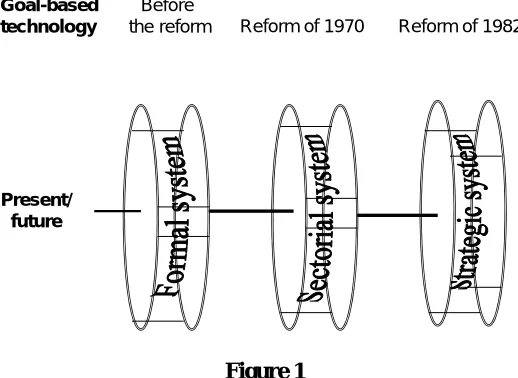
enterprises acting strategically while determining which means to put into use. The third stage is meant to set out binding premises for the choice, configuration and use of other technologies, that is, an attempt at re-unification to support a present effort toward a common future. However, the simultaneous presence of each stage construes the organization mono-contextually, and therefore, taken together, constitutes a polyphonic order. This is to say that the environments emerge differently within each system as references accordingly are directed toward 1) an iron cage of rules, 2) a sectorial whole in which you are an active/integrated part, and 3) a re-entry in so far as you are expected to cause yourself as an effect. There is, so to speak, neither a single subject, nor a supreme technology present or capable of bridging, reducing or transforming this diversity into a unity; hence, the growing polyphony of the organization. What follows is a brief account of each stage.
Three stages
Before the Danish public reform in 1970, technologies of goal assessments were already
considered to be the prime technology. Goals and means were set by the central administration and the municipalities were expected to act accordingly, that is, to show rule-following behaviour. This was the case for pensions, social welfare, assessment of taxes, etc. In effect, planning involved no social expectations of the clerk to transform customer needs into organizational change. In fact, they relieved organizational pressure and complexity as the function of the clerk was evaluated by reference to rules to be followed, not rules to be changed.
Technologies of goal assessed planning thus erected a cage of causality around the clerk. The town clerk and the local municipality were expected to be the media of decisions already taken and calculations already conducted. One might conclude, then, that the process of steering remains absent. However, this is not entirely true according to systems theory. Steering became a matter of reducing the difference between set rules and own practices in order to achieve correspondence. This sets out a dynamic of reproduction where rules not only caused deviations to be observed as practices, but in particular practices imbued with such common human traits as innovation, learning, ethics etc. Hence the self imposed need for more rules.
ends. Accordingly, steering was a matter of reducing the difference between part and whole. And this practise was fed as well as accelerated heavily by a growing number of controls, evaluations and audits; all providing feedback loops and hence a massive load of information to be handled only by adding the need for enhanced steering. As an effect, coordination between all levels – and coordination of coordination – became the preferred means to prevent any single body to take any private strategic direction, not least accounted for by the infinite number of meetings and planning sessions. Not surprisingly the semantics of communication changed in line with the change of social expectations. The ‘town clerk’ became ‘the chief executive’ and was now expected to be the causal connecting point between whole (sector) and part (municipalities). The manager became the ‘meeting manager’, so to speak, among other ‘meeting managers’ or, as system theory would have it, the social expectation of communications was to engage in more communication.
The second Danish reform of the public sector took place in the mid 1980s. In this case the number of municipalities was not reduced. Critics were now concerned about the growing bureaucracy caused by coordination accelerating into coordination of coordination. Again, goal-based steering was reprogrammed. Technologies of empowerment were introduced and this ‘enforced liberation’ was a matter of defining means according to own goals. In fact, the increase of self technologies gained momentum throughout Scandinavia and England from the beginning of the 1980s and was sustained by the ideal of a public sector showing adaptability on all levels. Again, this change of programmes within goal based technologies provided a shift in the very semantics of communication as ‘institutions’ became ‘firms’ now stressing the strategic capability of each; as ‘meeting’ turned into ‘dialogue’ maintaining freedom on each side and as ‘coordination’ became ‘vision’ now being considered the prime principle of integration. The environment, now seen from the perspective of each ‘firm’, changed from the overall and encompassing sectors toward causing one self as an effect. This shift from an outside reference (sector) toward self-reference is what Mitchell Dean (1995) also calls “the obligation to freedom”.
This change of technology sets out new conditions for causality and steering, and hence reproduction of communication. Before the reform, the notion of causality was linear. But the ‘self’ of the technologies has turned causality into a circular matter as the organization, or any other actor performing the art of management, is expected to take responsibility for own future goals, own present means and derived matters of self control. In effect, the common organizational division between authority and authorized, or formulation of goals and execution of means, has vanished and now evolved into an integrated matter within the notion of empowerment and self management. This introduces what might be called the schizo-dynamic of management, which is now both expected to imagine what is in the light of what to become, and to become what it will become in the light of what is.
believable/fixed reality causing the demand for immediate action and new goals to follow. The other was a reproduction process according to yet another configuration of time. Logically, the social expectations of being “proactive” is nonsense as it set out demands of being ahead of future or, commonly phrased, ahead of time. But the performativity of this steering cannot be underestimated as it accelerates self-transformations of organizations toward being ahead of what cannot be achieved. In any case, one might term this reproduction the ‘self-positioned organization’, as each institution mirrors itself as an organization-to-come and the environment as future changes to be acted upon.
The three system-stages of goal based steering – 1. order, reflexive and 2. order – are displayed in the following figure.
Present/ future
Before
the reform Reform of 1970 Reform of 1982 Goal-based
technology
Figure 1
Two effects merit attention in relation to polyphony: first, the way the presence of each system remains closed to the others (technology) and in the way the reproduction of operations are enabled through feed back mechanisms (steering); and, second, the way polyphony eventually leads into the polyphony of polyphony due to an increase of subtechnification. Each effect will be elaborated in the following.
Closed systems
expected to reflect and decide upon itself as a contingent mean to achieve fixed sectorial goals. This happens when the communication selects between what might be our means and what is not. In this process the boundary of the system is implicitly (re-)arranged. But still, questions concerning the whole are perceived of as deviations while questioning the function of how to be an effective and contributing part now emerges as an expected communication. This leads us to the operations of 3) the strategic system where it becomes a distinct feature that the system is able to reflect upon and (re)configure as strategy covers a re-entry of the system within the system in order to perform this expected self-transformation.
Taking the different ways in which the configurations of boundaries takes place, one organization, in the classical sense, is not equal to one system believed to integrate the parts within a whole. On the contrary, observed from the point of view of systems theory, they each cause the organization to emerge as different images. In particular, it compromises the pressure and importance put upon management by NPM when considering the apex as the ultimate cause of this integration to happen. From a systems theoretical point of view, this is not the case, as steering only adds to the autonomy of different systems and not to the predictability of the manager.
This is not to say that relations between systems do not take place. Luhmann speaks of ‘structural couplings’ because systems cannot talk to each other but only speak of each
other (Luhmann, 1997b: Chapter 6). The formal system shows features of ignorance or responds to the other systems in terms of rejection or irritation. Contingent goals of others cannot contribute to a system largely guided by what is right and what is wrong. But the strategic system commonly observes the former as a strategic resource, that is, as a means to its own ends. This happens, for instance, when certain rules are either interpreted or singled out in order to legitimate and enhance the achievement of own goals. In this case, the relational capacity of systems does not correspond with the modern belief in consensus so commonly expressed by managers. On the contrary it shows the incommensurability of systems, as they relate to each other according to their own logics.
Subtechnification
The strategic system consists of social expectations causing multiple futures to emerge according to the differences between strategic choices. As such, the system displays a self-imposed dynamic of being in a state of becoming, that is, leaving itself as a present state while yet not turning into what it is set out to be.
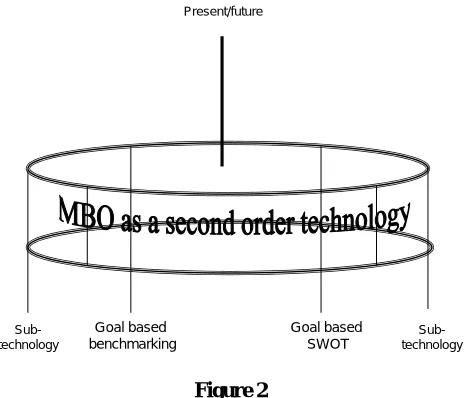
configurations of a diversity of sub-technologies. This includes, among many other things, the use of goal-based benchmarking and goal-based SWOT. Taken these two technologies into consideration, two different environments emerge on behalf of an observation that values each side of the distinction collective/unique, that is, one observation decoding the environment as a space of collective acceptance and another one as a battle among uniquely marked positions. Futures, then, relate to such opposing ideas as achieving collective acceptance among friends (logic of appropriateness) as opposed to engagement into war like situations with enemies (logic of competitiveness). The figuration between system and environment, and not at least the reproduction performed by mechanisms of steering in each case construes the relation between the organization and environment mono-contextually and therefore, taken together, constitutes and reproduce a diversity of antagonistic images of the organization and its relation to environment. In effect, polyphony presently seems to accelerate in the name of unity as the desire of one achievable future not only multiplies into futures but also relates to further system differentiation caused by the multiple technologies offering different distinctions of observation, different causal configurations between system-environments, and different ways of reproductions. The stages subtechnification is displayed in the following figure:
Goal based benchmarking
Goal based SWOT
Present/future
Sub-technology
Sub-technology
Figure 2
The simultaneous presence of three developmental stages, ultimately supplemented by this stage of subtechnification, indicates how the penetration of a single technology (MBO) neither unites the organization nor is a technical means to achieving normative ends; rather, it constitutes and diversifies the organization to such an extend, that it leads to the emergence and differentiation of systems. The analysis of goalsteering shows that this paradox does not cause the organization to freeze when faced with a merely logical impossibility. On the contrary, the productivity of this paradox is evident
it is meant to do. It is has produced complexity and hence the need for its own reprogramming. This has not only lead to the development and incommensurability of systems, it also calls the assumption that managers are at in control of a governing body into question. Could it be that control itself emerges as a bi-product of goalsteering?
Conclusion
The systems theoretical approach allows for the observation of the polyphonic effects of technologies upon organizations, rather than presuming a formation of unity. From the brief analysis of MBO that has been offered, we can draw two general conclusions. First, the historicity of the organization is not necessarily to be conceived of as a linear and successive string of events leading toward an even stronger unification of the organization, but as the present existence of systems derived from the progressive stages of MBO, hence the formation of polyphony. Second, this progression eventually leads to subtechnification, causing polyphony to accelerate in a quest for unity. But it is the very presumption of unity or one existing organization that must be questioned as each technical leap removes the limits of the once unknown and convert this domain into new observable environments.
It is tempting to think, then, that this approach is announced as the counter-concept to unity. But this is only partly true. In the quest for polyphony, systems theory only reverses the relation between the parts and the whole; that is, the organization is represented as an image in each system leaving the governmental body as a contingent choice of systemic communication. The governing approaches all seek to explain how technologies unite the parts into a corpus and it is the contribution of systems theory to observe this relation reversed.
New managerial challenges now emerge that compromise, not least, the NPM notion of technologies as means to achieve normative purposes once they are put into the hands of strong managers. In the future, two problems must be addressed. How is it possible to manage 1) as polyphony sets out the conditions of steering and 2) the whole emerging within each part? In this context, this would at least force NPM to consider a managerial leap away from ‘management by technologies’ toward ‘management of technologies’.
The latter referring to the observation of how the observations (and reproductions) of different systems in relation to the environment is made possible by each technology that is put into use. This tentative contribution should not be confused with a critique of NPM. The proposed approach is meant as a feedback loop as it observes the constitutive effects of new steering technologies upon the organization and is thus meant to feed implications of polyphony into this paradigm as a crucial challenge for management.
operational level this approach provides comprehensive insights in how technologies affect patterns of communications in organizations and hence, how reality emerge contingent to the presence of technologies into multi factual areas of communication.
However, as Vos notes (2005: chapter 17), the fact that social systems fail to see through their existence does not imply that self knowledge is impossible. It merely indicates that self-observation is a highly contingent affair, in the sense that the identity of a social system is something that appears to be entirely dependent on the way the system identifies itself. In this case technology has been proposed as the point of entry.
Adorno, T.W. and M. Horkheimer (1969) Dialektik der Aufklärung: Philosophische Fragmente.
Frankfurt am Main: Suhrkamp Verlag.
Andersen, N.Å. (2006) ‘Diskursive analytische Strategien in der Verwaltungswissenschaft’, in J. Bogumil, W. Jann und F. Nullmeier (eds.) Politik und Verwaltung, PVS – Politische Vierteljahresschrift, Sonderheft 37/2006, 97-120.
Andersen, N.Å. (2005) ‘Political administration’, in D. Howard and J. Torfing (eds.) Discourse Theory in European Politics: Identity, Policy and Governance. New York: Palgrave Macmillan.
Andersen, N.Å. (2003) Discursive analytical strategies: Understanding Foucault, Koselleck, Laclau, Luhmann. Bristol: Policy.
Andersen, N.Å. (2003) ‘Polyphonic organisations’, in T. Hernes and T. Bakken (eds.) Autopoietic Organization Theory. Oslo: Abstakt, Liber, Copenhagen Business School Press.
Andersen N.Å. and A. Born (2000) ‘Complexity and change: Two semantic tricks in the triumphant oscillating organization’, in System Practice and Action Research, 13(3).
Bakken, T. and T. Hernes (2002) Autopoeitic Organization Theory: Drawing on Niklas Luhmann´s Social Systems Perspective. Copenhagen: Copenhagen Business School Press.
Bakhtin, M. (1984) Problems of Dostoyevsky’s Poetics. Minnesota: University of Minnesota Press.
Bijker, W.E., T.P. Hughes, and T.J. Pinch (1989) The Social Construction of Technological Systems: New Directions in the Sociology and History of Technology. Cambridge, MA: The MIT Press.
Boje, D. M. (2002) ‘Stories of the storytelling organization: A postmodern analysis of disney as “Tamara-Land”’, in Clegg, S. (ed.) Central Currents in Organization Studies, 7.
Bozeman, B. (1993) Public Management: The state of art. San Francisco: Jossey Bass Publishers.
Dean, M. (1995) ‘Governing the unemployed self in an active society’, Economy and Society, 24(4):
559-83.
Dean, M. (1996a) ‘Putting the technological into government’, History of Human Science, 9(3): 47-68.
Dean, M. (1996b) ‘Foucault, government and the enfolding of authority’, in A. Barry, T. Osborne and N. Rose (eds.) Foucault and political reason. London: UCL Press.
Dean, M. (1999) Governmentality. London: Sage.
Dean, M. (2002) ‘Liberal government and authoritarism’, Economy and Society, 31(1): 37-61.
Deleuze, G. (1988) Le Pli: Leibniz et la Baroque. Paris: Minuit.
Dunleavy, P. and C. Hood (1994) ‘From old public administration to New Public Management’, Public money & management, 14(3): 9-16.
Drucker, P. F. (1954) The Practice of Management. New York: Harper & Row.
Eriksson, E. O. (1999) Kommunikativ ledelse. Bergen-Sandviken: Fagboklaget.
Ferlie, E., L. Ashburner, L. Fitzgerald and A. Pettigrew (1996) The New Public Management in Action.
Oxford: Oxford University Press.
Foucault, M. (1997) Ethics, subjectivity and truth, vol. 1, ed. P. Rabinow. New York: The New Press.
Foucault, M. (1983) ‘Afterword: The subject and power’, in H.L Dreyfus and P. Rabinow (eds.) Beyond structuralism and Hermeneutics. Chicago: The University of Chicago Press.
Foucault, M. (1991) Studies in governmentality: With two lectures by and an interview with Michel Foucault. Chicago, IL: The University of Chicago Press.
Habermas, J. (1982) Theorie des kommunikativen Handelns. Frankfurt am Main: Suhrkamp.
Hague, R. and M. Harrop (2004) Comparative Government and Politics. London: Palgrave.
Hughes, T. P. (1989) ‘The evolution of large technological systems’, in W. Bijker et al. (eds.) The Social Construction of Technological Systems. Cambridge: MIT Press.
Kneer, G. and A. Nassehi (1993) Niklas Luhmanns Theorie sozialer Systeme: Eine Einführung. München:
Wilhelm Fink Verlag.
Knights, D. (1992) ‘Changing Spaces: The disruptive impact of a new epistemological location for the study of management’, Academy of Management Review, 17(3): 514-536.
Kooiman, J. (1993) Modern governance: new government-society interactions. London: Sage.
Kooiman (2003) Governing as Governance. London: Sage.
La Cour (2006) ‘The concept of environment in systems theory’, Cybernetics & Human Knowing, 13(2):
41-55.
Lane, J. E. (2000) New Public Management. London: Routledge.
Latour, B. (2005) Reassembling the Social. An introduction to Actor-Network-Theory. New York: Oxford
University Press.
Latour, B. (1999) ‘On recalling ANT’, in Law, J. and J. Hassard (eds.) Actor Network Theory and After.
Oxford: Blackwell.
Law, J. (1997) ‘The manager and his powers’ [http://www.comp.lancs.ac.uk/sociology/ stslaw1.html]. Law, J. (1991) A Sociology of monsters. London: Routledge
Lemke, J. L. (2001) ‘Discursive technologies and the social organisation of meaning’, Societas Linguistica Europaea, 1-2: 79-96.
Luhmann, N. (1997a) ‘Limits of steering’, Theory, Culture & Society, 14(1): 41-57.
Luhmann, N. (1997b) DieGesellschaft der Gesellschaft. Frankfurt am Main: Suhrkamp.
Luhmann, N. (1995) Social Systems. California: Stanford University Press.
Luhmann, N. (1993) Risk: A Sociological Theory. New York: Walter de Gruyter.
Luhmann, N. (1990a) ‘The paradox of system differentiation and the evolution of society’, in Alexander & Colomy (eds.) Differentiation Theory and Social Change. New York: Colombia University
Press.
Luhmann, N. (1990b) ‘Technology, environment and social risk: A system perspective’, Industrial Crisis Quarterly, 4(3): 223-231.
Luhmann, N. (1982): ‘The self-thematization of society’, The Differentiation of Society. New York:
Columbia University Press.
Marx, K. (1962 – 1966) Das Kapital I-III. Berlin: Dietz Verlag.
Marcuse, H. (1991) One-dimensional Man: Studies in the Ideology of Advanced Industrial Society, 2nd
edition. London: Routledge.
McKinlay, A. and P. Taylor (1998) ‘Through the looking glass: Foucault and the politics of production’, in McKinlay, A. and K. Starkey (eds.) Foucault, Management and Organization Theory. London:
Sage.
Munro, R. (1999) ‘Power and discretion: Membership work in the time of technology’, Organization,
6(3): 429-450.
Murdoch, J. and T. Marsden (1995) ‘The spatialization of politics: Local and national actor-spaces’,
Environmental Conflict, Transactions of The Institute of British Geographers, New Series, 20(3):
368-380.
Lyotard, J-F (1984) The Postmodern Condition: A Report on Knowledge, trans. Geoff Bennington and
Brian Massumi. Minneapolis: University of Minnesota
Miller, P. and Rose, N. (1990) ‘Governing economic life’, Economy and Society, 19(1): 1-31.
Pedersen, D. (2004) Offentlig ledelse i managementstaten. Copenhagen: Samfundslitteratur.
Raffnsøe, S. (2006) The Problematic of the Current Social Bond, working paper, Copenhagen Business
School.
Raffnsøe, S. (2003) The Rise of Network Society, working paper, Copenhagen Business School.
Renninson. B (2007) ‘Cash, codes and complexity: New adventures in the public management of pay scales’, Scandinavian Journal of Management (forthcoming).
Rhodes, C. (2000) ‘Doing knowledge at work: dialogue, monologue and power in organizational learning’, in J. Garrick & C. Rhodes (eds.) Research and Knowledge at Work: Perspectives, Case Studies and Innovative strategies. London: Routledge.
Riceur, P. (1984) Time and Narrative. Chicago: The University of Chicago Press
Rose, N. (2001) ‘The politics of life itself’, Theory, Culture & Society, 18(6): 1-30.
Rose, N. (1999) Governing the soul. London: Free Association Books.
Seidl, D. and D. Becker (2005) Niklas Luhmann and Organization Studies. Copenhagen: Liber &
Copenhagen Business School Press.
Seidl, D. (2005) ‘The basic concepts of Luhmann’s theory of social systems’, in D. Seidl & K.H. Becker (ed.) Niklas Luhmann and Organizational Studies. Copenhagen: Liber & Copenhagen Business
School Press.
Scheytt, T. (2005) ‘Management accounting from a systems-theoretical perspective’, in D. Seidl & K. H. Becker (ed.) Niklas Luhmann and Organization Studies. Copenhagen: Liber & Copenhagen
Business School Press.
Stacey, R. D. (2000) Strategic Management & Organizational Dynamics: The Challenge of Complexity.
Harlow: Prentice Hall.
Townley, B. (2004) ‘Managerial technologies, ethics and managing’, Journal of Management Studies,
41(3): 425-445.
Thygesen, N. (2002) Målstyret Ledelse, PhD thesis, Copenhagen Business School. Copenhagen:
Samfundslitteratur.
Vos, J.P. (2005) ‘Strategic management from a systems-theoretical perspective’, in D. Seidl & K. H. Becker (ed.) Niklas Luhmann and Organization Studies. Copenhagen: Liber & Copenhagen
Business School Press.
Weick, C. (1995) Sensemaking in Organizations. Thousand Oaks: Sage.
Weick, C. (1987) ‘Substitutes for coorporative strategy’, in D.J. Teece (ed.) The Competitive Challenge: Strategies for Industrial Innovation and Renewal. Cambridge: Balling Publishing Organization.
Niels Thyge Thygesen is Associate Professor at the Department of Management, Politics and Philosophy, Copenhagen Business School. He is a well known lecturer in a Danish context and is occupied with the following three thematics in relation to public management: Trust, Technology and Time. International articles within each theme are in review. The theoretical foundation of his work relies on a communicative approach in general and system theory in particular. The combination between empirical phenomena and the appliance of theoretical perspectives is fundamental for his research. This ‘applied science’ is both a matter of developing the basics of theories into observational programmes, as was the intention behind the present article, as well as contributing with new insights of relevance to a broader audience than science itself.
E-mail: [email protected]
Niels Åkerstrøm Andersen is Professor at the Department of Management, Politics and Philosophy, Copenhagen Business School. He is a well known lecturer in a Danish context and has contributed to the development of system theory when adapting it into a program of second order observation (Discursive Analytical Strategies, 2003). He is treating different empirical themes related to the Danish Public Sector through thorough analysis. Such themes are the development of policies, love as a powerful mean of transformation, and most recently contractual relations and partnerships (The Constractrualisation of the Citizen – on the transformation of obligation into freedom, 2004).