AUT J. Mech. Eng., 3(1) (2019) 107-112 DOI: 10.22060/ajme.2018.14283.5719
Optimization of Hot Metal Gas Forming by Taguchi Method for Production
Step-tubes from AA6063
M. Rajaee, S. J. Hosseinipour*, H. Jamshidi Aval
Advanced Material Forming Research Center, Faculty of Materials and Industrial Engineering, Babol Noshirvani University of Technology, Babol, Iran
ABSTRACT: The applications of aluminum alloys are limited due to the low formability at ambient temperature. To overcome such limitations, hot metal gas forming is developed as a new process. In this paper, the hot metal gas forming for production of cylindrical step tubes from 6063 aluminum alloy is studied experimentally. For this purpose, Taguchi method of experimental design was used to optimize the process parameters such as axial feed, forming temperature and gas pressure. Seamless tubes with an outer diameter of 25 mm and 1.3 mm thickness were used. After deformation, the specimens were cut and the die filling and thickness distribution were measured. At a constant temperature, with increasing pressure at low axial feed, the specimens burst, while with increasing axial feed at low pressure the specimens were wrinkled. The results indicate that if the axial feed increases in proportion to the pressure, the risk of bursting and wrinkling decreases. The analysis of variance indicated that from the three parameters studied, the effect of axial feeding on filling percentage was of prime importance. The main effects plots for signal-to-noise ratio showed that the optimum arrangement of parameters were at 580°C, 0.6 MPa and an axial feed of 14 mm. In this condition, the die filling of 92% and maximum thinning less than 10% were achieved.
Review History: Received: 5 April 2018 Revised: 17 June 2018 Accepted: 7 September 2018 Available Online: 1 October 2018
Keywords:
Hot metal gas forming Step tubes
AA6063 Optimization Taguchi method
1- Introduction
The use of lightweight structures such as tubular parts from aluminum and magnesium alloys are desired in the automotive and aerospace industries to reduce fuel consumption. However, due to low formability of these alloys at ambient temperature, the researchers focused on high-temperature forming. Hot Metal Gas Forming (HMGF) is a new metal forming process that suggested to form tubular components from these alloys. In this process, the tube is first heated in the die to a temperature above half the melting point in Kelvin, and then the tube is formed into different shapes by applying the internal pressure with an inert gas [1,2].
Kigler et al. [3] produced a tube part of 5182 aluminum alloy by gas forming process using nitrogen gas at 450 °C without axial feeding. Nazzal et al. [4] carried out finite element simulations to investigate the superplastic tube forming process of AZ31 alloy at 400 °C without axial feeding. They showed the pressure profile is what causes the difference between tube and sheet metal gas forming. Lin et al. [5] investigated the formability of AZ31B alloy tube up to 480 °C by nitrogen gas blowing process without axial feeding. They concluded the forming temperature should be lower than 420 °C. He et al. [6] examined the formability of AA6061 tube through free bulging test at temperatures ranging from 350 °C to 500 °C. They showed the burst pressure dropped sharply with increasing temperature and that the maximum expansion ratio was 86% at 450 °C. Maeno et al. [7] investigated the effects of the initial internal pressure on the expansion ratio in hot gas bulging of the aluminum alloy tube with and without the axial feeding. They found the the expansion ratio can be controlled by heating without control of internal
pressure during forming. Pavel and Strano [8] developed an innovative process of hot tube metal gas forming and hot press hardening to investigate the influence of process variables on the hardening phenomenon of two different kinds of steel tubular components. Paul et al. [9] produced an exhaust gas component made of titanium alloy by means of HMGF process. Mosel et al. [10] described a novel process chain for the HMGF process to produce exhaust gas components in ferritic stainless steel.
Most of studies on the HMGF with or without axial feeding have been limited to examine the tube formability through hot free bulging tests for different alloys. Very few studies have been conducted to produce tubular parts with various sections in the closed die. On the other hand, the traditional experimental design to study the process parameters is costly and takes a lot of time, and does not consider the interactions of parameters. Design of experiments is a powerful analysis tool for modelling and analyzing the influence of control factors on performance output. This technique reduces the number of experiments and considers the interaction effects [11,12]. The aim of this study is to investigate and determine the optimum combination of the process parameters including axial feeding, forming temperature and gas pressure for production step tubes from AA6063. For this purpose, Taguchi experimental design method is used.
2- Experiments
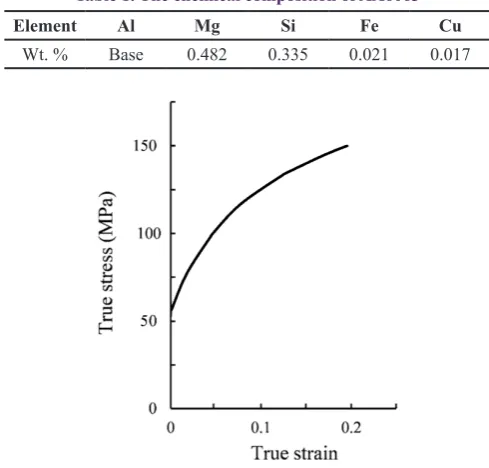
6063 aluminum alloy tubes with a diameter of 25 mm and thickness of 1.3 mm were used. The chemical composition of the material is shown in Table 1. The mechanical properties of the tube examined by ASTM E8 tensile test are shown in Fig. 1.
A mold set with a diameter of 32 mm and a deformation length of 60 mm was designed to produce a step tube as shown in Fig. 2. The axial feeding from both sides was performed through displacement of two bushes connected to the tube. Resistance heaters were applied inside the die and tube to create uniform heating.
Fig. 3 illustrates the equipment for hot metal gas forming process. A step motor controller board adjusted the amount of axial feed. An air compressor with a maximum capacity of 1 MPa was used to apply internal pressure. The temperature was controlled by a thermocouple connected to the tube surface. After the experiments, the tubes were cut in the longitudinal direction, as shown in Fig. 4, and the die filling percentage as well as the thickness of specimens were measured.
After the experiments, the tubes were cut in the longitudinal direction, and the thickness of specimens as well as the die filling percentage were measured. Fig. 4 shows a cut specimen in which A represents the flange region, B represents the corner area of the die, and C represents the die cavity area.
3- Design of Experiments with Taguchi Method
Taguchi method is introduced as an experimental technique that reduces the number of experiments and optimizes the process parameters. In this method an appropriate orthogonal array is selected depending on the total Degrees of Freedom (DF) [13]. In this paper, Taguchi method of experimental design was used to optimize the HMGF parameters. Three levels were considered for each of the three process parameters including forming temperature, gas pressure and axial feed. The levels of the process parameters were chosen based on previous reports from the literature [14] as presented in Table 2. According to the standard tables, the L9 standard orthogonal array (Table 3) was selected to evaluate the impact of the parameters on the filling percentage of the die.
Taguchi method used the Signal-to-Noise (S/N) ratio in data analysis as a measurable value of the quality characteristics. There are three categories for the analysis of the S/N ratio, i.e., smaller-the-better, larger-the-better, and nominal-the-best. In this study, the maximum die filling percentage was the objective function, and the level of factors with the larger S/N ratio was the optimal one that was calculated according to the following equation [13]:
2 1
1 1
/ 10 n
i i
S N log
n = y
= −
∑
(1)where yi is the value of the ith experiment and n is the number of tests. ANalysis Of VAriance (ANOVA) was implemented using MINITAB to discuss the relative influence of each parameter on the average die filling percentage.
4- Results and Discussion
4- 1- Investigating the impact of parameters
All experiments were conducted with the arrangement of test levels according to Table 3. Fig. 5 shows the die filling percentage of specimens. As can be seen, the highest die filling Element Al Mg Si Fe Cu
Wt. % Base 0.482 0.335 0.021 0.017
Table 1. The chemical composition of AA6063
Fig. 1. True stress-strain curves of AA6063
Fig. 2. Schematic of mold set designed
Fig. 3. The HMGF process equipment
Fig. 4. A cut specimen after forming
Parameters Level 1 Level 2 Level 3
Forming Temperature (oC) 530 550 580
Gas Pressure (MPa) 0.3 0.6 0.9
Axial Feed (mm) 0 7 14
percentage was obtained in specimens 3 and 5 with 81% and 83%, respectively. Fig. 6 shows the tubes after forming. In the state with no axial feed, no deformation occurred in specimen 1 due to the low temperature and pressure, while specimens 6 and 8 burst in the free bulging stage. In the axial feed of 7 mm, however, specimen 2 formed well, and its die filling percentage remained low. While specimen 4 was wrinkled, specimen 9 burst by increasing pressure. In axial feed of 14 mm, sound pieces were obtained in specimens 3 and 5, while specimen 7 was wrinkled due to the low pressure.
The comparison of specimen 6 with 8 and the specimen 3 with 5 shows the interaction between the gas pressure and forming temperature in tube deformation. Despite the lower pressure in specimens 8 and 5, the die filling percentage was higher due to increasing temperature. The comparison of specimen 4 with 6 and the specimen 7 with 8 shows the interaction between the gas pressure and axial feed. With increasing pressure at low axial feed, the specimens burst, while with increasing axial feed at low pressure the specimens were wrinkled. Fig. 6 shows the process parameters window. The results indicate that if the axial feed increases in proportion to the pressure, the risk of bursting and wrinkling decreases.
Fig. 5. The die filling percentage for specimens after deformation
No. 1
No. 2
No. 3
No. 4
No. 5
No. 6
No. 7
No. 8
No. 9
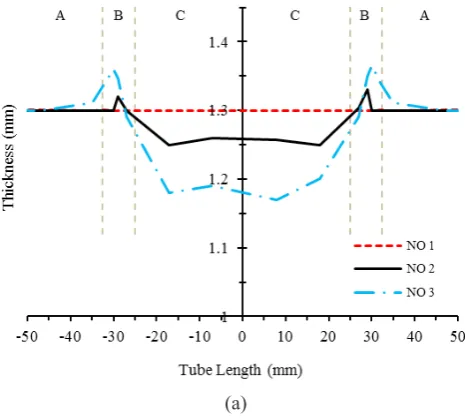
Fig. 8 shows the thickness distribution of specimens after deformation. It is observed that in the wrinkled specimens (No. 4 and 7), the thickness was increased in the die cavity area (C) due to axial feeding at low pressure. For specimens that burst (No. 6, 8 and 9), the maximum reduction in thickness occurred in the die cavity area (C), and there was a thinning in the region of the die corner (B). In specimens 2, 3 and 5 that formed well, the greatest reduction in thickness occurred in the die cavity area (C), while an increase in thickness in the
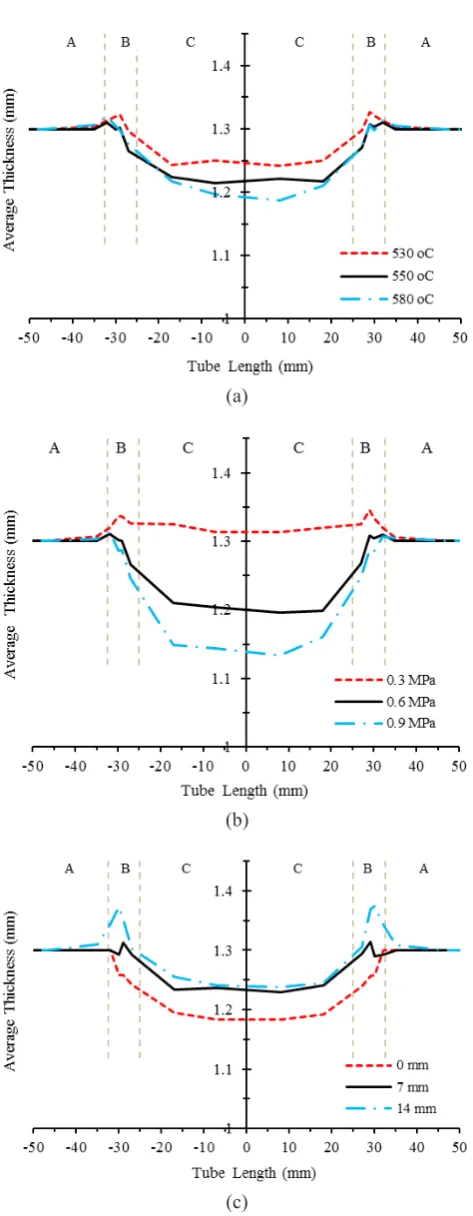
die corner region (B) was observed. To investigate the effect of parameters on the thickness distribution, the average thickness distribution of specimens were calculated. Fig. 9 shows the average thickness distribution at various temperatures, pressures and axial feeds. It is observed that with increasing temperature and pressure, the amount of thinning was increased due to decreases in material strength and increases in deformation. While with increasing axial feed due to the transfer of material from the flange region of the tube (A), the thinning in the die cavity area (C) decreased, and the thickness in the corner region of the die (B) increased. The amount of increases in thickness in these areas is influenced by the interaction with other parameters. For example, in specimen 9 (Fig. 8), despite applying axial feed, the thickness in the die corners area (B) decreased due to the high pressure.
4- 2- The optimum combination of parameters
To study the significance of process parameters which influence the die filling, ANOVA was performed in Table 4. The results show that the parameters affecting the die filling in decreasing order are axial feed, gas pressure and forming temperature. The contribution percentage is the part of the total
Fig. 7. The HMGF process parameters window
Test No. Temperature (Forming oC) Gas Pressure (MPa) Axial Feed (mm)
1 530 0.3 0
2 530 0.6 7
3 530 0.9 14
4 550 0.3 7
5 550 0.6 14
6 550 0.9 0
7 580 0.3 14
8 580 0.6 0
9 580 0.9 7
Table 3. The arrangement of tests levels based on L9 orthogonal array
(a)
(b)
(c)
range identified in the experiments related to each important HMGF parameter [13]. From Table 4, the axial feeding significantly affected the average die filling percentage of 54.56%, and also the contribution rate of gas pressure and tube temperature were 32.37% and 8.39% respectively. Also,
F-ratio was used to determine a significant effect. Large F-ratio shows the process parameter has a significant effect on the quality characteristics. The experimental error was only 4.68 % of the variance that denoted the experimental design was successful.
The main effects plots for S/N ratio are shown in Fig. 10. Main effect plots show how each factor affects the response characteristic. According to the main effects plots the best arrangement of HMGF parameters were 580 °C, 0.6 MPa and an axial feed of 14 mm, to achieve maximum die filling.
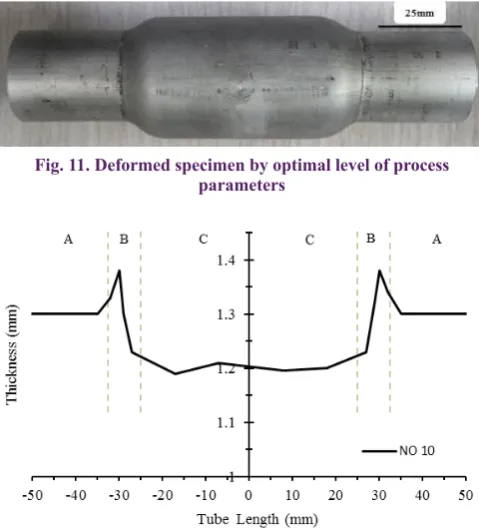
This arrangement was not present in any of the experiments, therefore a test with this level of parameters was performed. The specimen of the test is shown in Fig. 11 in which the die fill percentage increased to 92%. It is noteworthy that in the optimal level of process parameters the uniformity of thickness distribution in the die cavity area (C) was improved and the maximum thinning is less than 10%, as seen in Fig. 12.
5- Conclusions
In this paper, Taguchi method of experimental design was used to investigate and optimize parameters including temperature, pressure and axial feed in HMGF for production of step tubes from AA6063. The results show that;
• The deformed specimens indicated the interaction between the parameters of gas pressure, temperature and axial feed. At a constant temperature, with increasing pressure at low axial feed, the specimens burst, while with increasing axial feed at low pressure the specimens were wrinkled. In the state with no axial feed, the specimens burst in both of the following conditions; low temperature, high pressure and high temperature, low pressure.
(a)
(b)
(c)
Fig. 9. The average thickness distribution at various a) temperatures b) pressures, and c) axial feeds
Source DF Seq SS Adj MS F-ratio Contribution (%)
Temperature 2 48.88 24.44 1.79 8.39
Pressure 2 188.73 94.37 6.91 32.37 Axial feeding 2 318.12 159.06 11.62 54.56
Error 2 27.37 13.69 4.68
Total 8 583.1 100
Table 4. ANOVA for die filling percentage
• The thickness distribution of specimens showed that with increasing temperature and pressure, the tube thickness decreased in the die cavity area (C). However, with increasing axial feed the tube thickness increased. • ANOVA demonstrated that the significant factors
affecting the die filling were the axial feed, gas pressure and forming temperature respectively. The main effects plots for S/N ratio indicated that the optimum arrangement to achieve maximum die filling were 580 °C, and 0.6 MPa with an axial feed of 14 mm. In this condition, a die filling of 92% was achieved and the uniformity of thickness distribution was improved.
Acknowledgements
The authors would like to appreciate the office of the Vice President for Research of Babol Noshirvani University of Technology for the financial support.
References
[1] B. Dykstra, G.D. Pfaffmann, X. Wu, Hot metal gas forming-the next generation process for manufacturing vehicle structure components, 0148-7191, SAE Technical
Paper, 1999.
[2] X. Wu, H. Hao, Y. Liu, F. Zhu, J. Jiang, R. Krishnamurthy, S. Wang, P. Smith, W. Bland, G. Pfaffmann, Elevated temperature formability of some engineering metals for gas forming of automotive structures, 0148-7191, SAE
Technical Paper, 2001.
[3] M. Keigler, H. Bauer, D. Harrison, A.K. De Silva, Enhancing the formability of aluminium components via temperature controlled hydroforming, Journal of
Materials Processing Technology, 167(2-3) (2005)
363-370.
[4] M.A. Nazzal, F.K. Abu-Farha, Finite element modeling of superplastic forming of tubular shapes, in: Key Engineering Materials, Trans Tech Publ, 2010, pp. 179-184.
[5] Y.-L. Lin, Z.-B. He, S.-J. Yuan, W. Jia, Formability determination of AZ31B tube for IHPF process at elevated temperature, Transactions of Nonferrous Metals
Society of China, 21(4) (2011) 851-856.
[6] Z.-b. He, X.-b. Fan, S. Fei, K.-l. Zheng, Z.-b. Wang, S.-j. Yuan, Formability and microstructure of AA6061 Al alloy tube for hot metal gas forming at elevated temperature,
Transactions of Nonferrous Metals Society of China, 22
(2012) s364-s369.
[7] T. Maeno, K.-i. Mori, K. Fujimoto, Hot gas bulging of sealed aluminium alloy tube using resistance heating,
Manufacturing Review, 1 (2014) 5.
[8] A. Paul, M. Strano, The influence of process variables on the gas forming and press hardening of steel tubes,
Journal of Materials Processing Technology, 228 (2016)
160-169.
[9] A. Paul, M. Werner, R. Trân, D. Landgrebe, Hot metal gas forming of titanium grade 2 bent tubes, in: AIP Conference Proceedings, AIP Publishing, 2017, pp. 050009.
[10] A. Mosel, J. Lambarri, L. Degenkolb, F. Reuther, J.L. Hinojo, J. Rößiger, E. Eurich, A. Albert, D. Landgrebe, H. Wenzel, Novel process chain for hot metal gas forming of ferritic stainless steel 1.4509, in: AIP Conference Proceedings, AIP Publishing, 2018, pp. 160019.
[11] M. Moradi, O. Mehrabi, T. Azdast, K.Y. Benyounis,
Enhancement of low power CO2 laser cutting process for injection molded polycarbonate, Optics & Laser
Technology, 96 (2017) 208-218.
[12] M. Moradi, A. MohazabPak, Statistical Modelling
and Optimization of Laser Percussion Microdrilling of Inconel 718 Sheet Using Response Surface Methodology (RSM), Lasers in Engineering (Old City Publishing), 39 (2018).
[13] M.A. Ansari, R.A. Behnagh, M. Narvan, E.S. Naeini,
M.K.B. Givi, H. Ding, Optimization of friction stir extrusion (FSE) parameters through taguchi technique,
Transactions of the Indian Institute of Metals, 69(7)
(2016) 1351-1357.
[14] M. Hajinejad Sorkhi, S.J. Hosseinipour, H. Jamshidi
Aval, Formability of 6063 aluminum alloy tube at high temperature using multi-bulge test by hot metal gas forming process, Modares Mechanical Engineering, 16(3) (2016) 185-192.
Fig. 12. The thickness distribution of specimen at optimal level of process parameters
Pleasecitethisarticleusing:
M. Rajaee, S. J. Hosseinipour, H. Jamshidi Aval, Optimization of Hot Metal Gas Forming by Taguchi Method for Production Step-tubes from AA6063, AUT J. Mech. Eng., 3(1) (2019) 107-112.
DOI: 10.22060/ajme.2018.14283.5719