Research article
International Journal of Heterocyclic Chemistry, Vol. 5, No. 1, pp. 1-40 (2015 )
© Islamic Azad University, Ahvaz Branch
http://ijhc.iauahvaz.ac.ir
Nanoparticles Poly Ethylene Imine-Functionalized MCM- as a
Solid Catalyst for Multi-Component Reactions
Hosein Hamadi,*1 Maryam Gholami,1Mehdi Khoobi2
1Department of Chemistry, College of Science, ShahidChamran University,
Ahvaz, Iran,
[email protected]
2Department of Medicinal Chemistry, Faculty of Pharmacy and
Pharmaceutical Sciences Research Center, Tehran University of Medical
Sciences, Tehran 14176, Iran
Abstract:
A novel magnetically immobilized polyethyleneimine (PEI) fabricated by covalently anchoring on MCM-41 (MCM-41@PEI) was prepared. The synthesized catalyst was characterized by Fourier transform infrared (FT-IR), thermogravimetric analysis (TGA), X-ray powder diffraction (XRD), scanning electron microscopy (SEM) and transmission electron microscopy (TEM). The immobilized PEI was shown to be an efficient heterogeneous catalyst for the synthesis of spiro-oxindole and benzopyranes derivatives via multi-component reaction (MCR), in ethylene glycol as a green solvent. No leaching problem was observed after several runs, while the catalyst can be recovered and reused without loss of reactivity under the described reaction conditions.
Research article
14 ::
Introduction
Solid-supported catalysts are an important and growing arena in heterogeneous catalysis which has attracted increased attention in organic transformation due to their easy separation from the reaction mixture and possible reuse and has become strategically vital for the efficient and ecofriendly organic transformations over the past few decades [1-5].Surface fictionalization allows a number of groups to introduce onto the surfaces through co-condensation or post-synthesis. The advancement of heterogenized catalysis by Solid-supported catalysts, such as various organic/inorganic polymer-Solid-supported catalysts, zeolites, mixed metal oxides, hydrotalcites, mesoporous siliceous molecular sieve, resins, etc combine the advantages of both homogeneous and heterogeneous catalytic systems.
In the last few decades, mesoporous materials have received much attention in the field of catalysis, especially for their use as solid supports. One of the well-ordered mesoporous solid structures is MCM-41 that has some interesting properties such as high surface area, uniform pore size (20–100A˚) and relatively hydrophobic nature [6]. The MCM-41 in pure silica form exhibits only weak hydrogen bonding [7, 8] and hasenormous specific surface area.It can be easily modified with organic groups and metal complexes to form discreteand uniform active sites for substrates [9, 10].
In recent years, functionalization of MCM-41 by using the reaction with the surface silanol groups, to form MCM-supported catalysts, have been successfully deployed in organic synthesis for a variety of important reactions such as heteropolyacids (HPW) [11–13] and other mineral acids (H3PO4, H2SO4) supported on MCM-41 [14–16],
pyridine-functionalized MCM-41 [17], SO3H-MCM-41 [18, 24].
Polyethyleneimine (PEI) or polyaziridine is a branched polymer and an available synthetic polycation with a high-density amine group. Linear PEIs contain all secondary amines, in contrast to branched PEIs which contain primary, secondary and tertiary amino groups by ratio 1:2:1. The branched PEIs have a strong protonation capacity and they are liquids at all molecular weights. It has been widely used in drug/gene delivery [26-28], CO2 adsorption [29], nucleic acid precipitation, protein coagulation/flocculation
[30], nucleotide, cell and enzyme immobilization as well as modified surface agent of nanoparticles [31-34].
International Journal of Heterocyclic Chemistry, Vol. 5, No. 1, pp. 1-40 (2015 ) :: 15
O Ar
CN
NH2
N
N H
O O
O
OCN NH2
N H
O
O CN
NH2 O
R
R
Scheme 1.
Experimental
Preparation of MCM-41 and MCM-41@PEI
MCM-41 was prepared according the previous work [41]. Briefly, Cetyltrimethylammonium bromide (CTAB) (13.0 g) was dissolved in deionized water (167.0 mL). Then, aqueous ammonia (163.7 mL) and absolute ethanol (131.5 mL) were added to the surfactant solution, and stirred for 15 min. Subsequently, tetraethyl orthosilicate (TEOS) (24.8 mL) was added to the mixture. After 2 h of vigorous stirring at 1500 rpm and subsequent filtration, the white precipitate was washed with deionized water and dried at 60 °C for 24 h. The prepared MCM-41 was successfully calcinated under oxygen atmosphere by heat treatment at a rate of 1 °C.min-1 up to 600 °C. This temperature was maintained for 6 h.
PEI was grafted onto the prepared MCM-41 as follows. [3-(2,3-epoxypropoxy) propyl] trimethoxysilane (EPO) (1.0 mmol) was added to PEI solution (3.0 mmol) in dry toluene (150 mL). The resultant mixture was allowed to react at 80 °C for 24 h. The calcined MCM-41 (2.5 g) and ethanol (25 mL) were added to the mixture and then stirred at 80 °C for 24 h. The produced PEI@MCM-41 was filtered and washed several times with deionized water and ethanol. It was subsequently Soxhleted with ethanol for 24 h to remove physically bonded compounds, filtered, and dried at 5 0 °C for several days [42] (Scheme 2).
Catalytic experiments
Research article
16 ::
Scheme 2. Schematic representation of the formation of MCM-41@PEI
Prior to reaction, Benzaldehyde (Merck, 1.0 mmol), Malononitrile (MN, Merck, 1.2 mmol), 3-(dimethylamino) phenol (Merck, 1.0 mmol) and freshly activated MCM-41@PEI catalyst (0.1 g, 100 ◦C, 20 min) in PEG were loaded into a reactor. The reaction was realized in the microwave oven (ETHOS 1600, Milestone) with a power of 300 W.After completion of the reaction, the reaction mixture was allowed to cool at room temperature and diluted with ethyl acetate and the catalyst was easily separated bycentrifuge and washed twice with ethyl acetate. The combined organic layers were concentrated and the residue was purified by recrystallization from ethanol.
Characterization of PEI@MCM-41
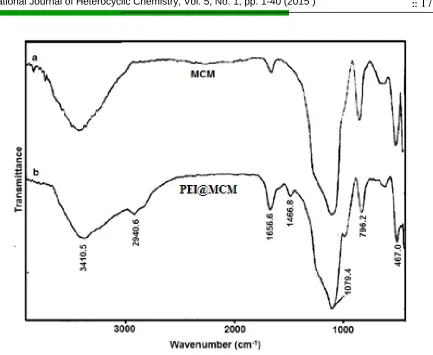
The as-synthesized PEI@MCM-41catalyst was characterized by various techniques. The FT-IR spectra of MCM and PEI@MCM-41 are shown in Figs. 1a and 1b. The FT-IR spectrum of the PEI@MCM-41, shows weak peaks at 1079, 796, and 467 cm-1 assigned to the dissymmetry, symmetry, and bending vibration of the Si-O-Si group, respectively [48] and The strong peaks at 3410 cm-1 attributed to the stretching and bending vibration of OH, indicate the presence of a large number of hydroxyl groups and H2O molecules on
International Journal of Heterocyclic Chemistry, Vol. 5, No. 1, pp. 1-40 (2015 ) :: 17
Figure 1. FT-IR spectra of the prepared (a) MCM-41 and (b) PEI@MCM-41
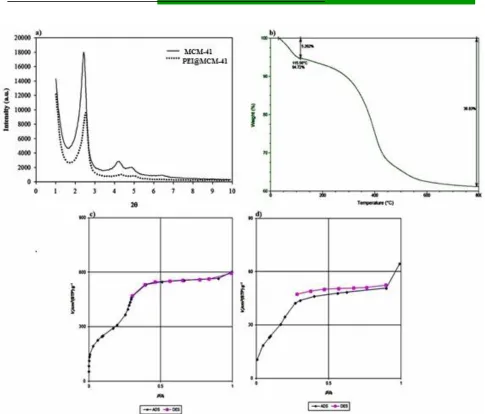
The ordered mesoporosity of MCM-41 solids was determined by XRD analysis. The XRD pattern of calcined MCM-41 exhibits an intense signal at 2θ= 2.2◦ corresponding to (1 0 0) plane and three small signals between 3.5◦ and 6.5◦ due to (1 1 0), (2 0 0) and (2 1 0) planes which confirms the presence of well-defined hexagonal MCM-41 (Fig. 2a) [49].
Research article
18 ::
Figure 2. (a) XRD spectra of MCM and PEI@MCM-41, (b) TGA for PEI@MCM-41, and Nitrogen sorption isotherm obtained at 77 K for (c) MCM and (d) PEI@MCM-41.
International Journal of Heterocyclic Chemistry, Vol. 5, No. 1, pp. 1-40 (2015 ) :: 19
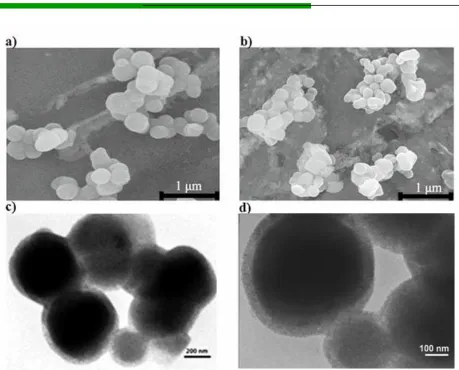
Figure 3. SEM images of the (a) MCM, (b) PEI@MCM-41; TEM image of the core-shell structure of PEI@MCM-41 (c) low magnification and (d) high magnification
Catalytic study
The reaction was caused by the 3-(dimethylamino) phenol which resulted in the formation of 4H-benzo[b]pyran derivatives in excellent yields. Thus the PEI@MCM-41 as a catalyst by microwave irradiation shows excellent procedure for preparation of 4H-benzo[b]pyran derivatives (Table 1).
Research article
20 ::
Table 1. Synthesis of Chromene derivatives usingPEI@MCM-41
Ar H
O CN
CN N OH
+ O Ar CN NH2 N + PEI@MCM-41 PG, MW
Entry Ar Yielda m.pb Entry Product Yield a m.p.b(οC) 1 4-NO2-C6H4 94 224-226 7
2,4-di-Me-C6H3
89 155-157
2 3-Br-C6H4 91 194-196 8
2,3-di-Cl-C6H3
85 220-222
3 3-F-C6H4 88 163-166 9 4-F-C6H4 87 174-178
4 3-CF3-C6H4 92 214-218 10 4-Br-C6H4 89 212-214
5 2,3-di-OMe-C6H3
86 158-160 11 2,6-di-Cl-C6H3
83 >250
6 3-NO2-C6H4 93 207-209 12 2-OMe-C6H3 82 182-184 a
Isolated yield
b
literature m.p. [43-47]
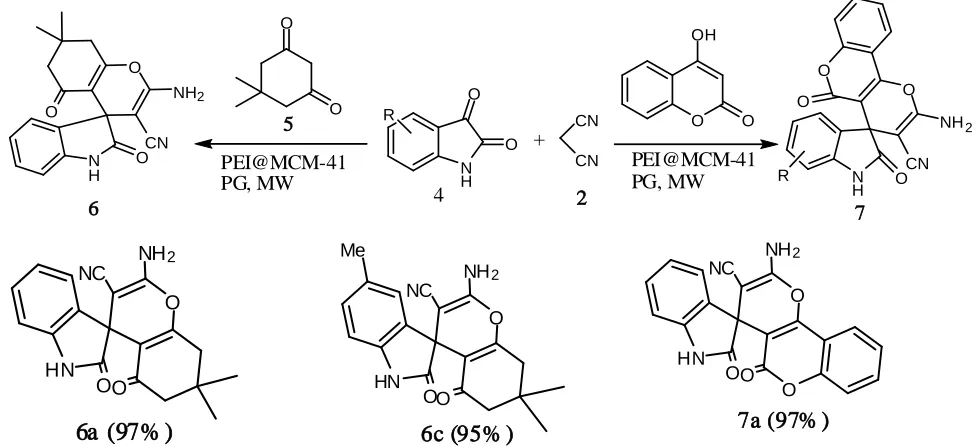
In continuation to this research, a simple and an efficient one pot synthetic approach was used for the preparation of biologically interesting spirooxindole derivatives by means of three-component reactions of isatin, malononitrile, and dimedone or 4-hydroxycoumarin catalyzed by mentioned catalytic system in PG (Scheme 5).
PEI@MCM-41
PG, MW NH
R O O CN CN O O OH O O N H O O O OCN NH2 N H O OCN NH2 O R + PEI@MCM-41 PG, MW 2 4 5 6 7 HN O O O NC NH2
6a (97% )
HN O O O NC NH2 Me
6c (95% )
HN O O O O NC NH2
International Journal of Heterocyclic Chemistry, Vol. 5, No. 1, pp. 1-40 (2015 ) :: 21
HN O
O
O NC
NH2
Br
6b (95% )
HN O
O
O O NC
NH2
Br
7b (92% )
Scheme 5. PEI@MCM-41 catalyzed three-component synthesis of spirooxindole derivatives
Conclusions
Research article
22 ::
References
[1] N. T. S. Phan, C. S. Gill, J. V. Nguyen, Z. J. Zhang and C. W. Jones, Angew. Chem., Int. Ed., 2006, 45, 2209–2212.
[2] S. Shylesh, V. Schunemann, W.R. Thiel, Angew. Chem. Int. Ed. 2010, 49, 3428. [3] A. Kong, P. Wang, H. Zhang, F. Yang, S.P. Huang, Y. Shan, Appl. Catal. 2012, A 417, 183.
[4] A. Baiker, Chem. Rev., 1998, 99, 453–474. [5] H. Hamadi, M. kooti,
[6] C.T. Kresge, M.E. Leonowicz, W.J. Roth, J.C. Vartuli, J.S. Beck, Nature. 1992,359, 710–712.
[7] W. Zhang, T.R. Pauly, T.J. Pinnavaia, Chem. Mater. 1997, 9,2491–2498. [8]E.P. Ng, S. Mintova, Micropor. Mesopor. Mater. 2008, 114,1–26.
[9] Beck J. S., Vartuli J. C., Roth W. J., Leonowicz M. E., Kresge C. T., Schmitt K. D., Chu C. T. W., Olson D. H., Sheppard E. W., McCullen S. B., Higgins J. B., Schlenker J. L., J. Am. Chem. Soc., 1992, 114, 10834—10843.
[10] Song C. E., Lee S. G., Chem. Rev., 2002, 102, 3495-3524. [11] P. Selvam, S.E. Dapurkar, Catal. Today,2004, 96, 135–141.
[12] J.C. Juan, J. Zhang, M.A. Yarmo, J. Mol. Catal. A: Chem. 2007, 267,265–271. [13] G. Karthikeyan, A. Pandurangan, J. Mol. Catal. A: Chem. 2009, 311,36–45.
[14] E.-P. Ng, H. Nur, K.-L. Wong, M.N.M. Muhid, H. Hamdan, Appl. Catal. A: Gen. 2007,323, 58–65.
[15] D.P. Sawant, A. Vinu, F. Lefebvre, S.B. Halligudi, J. Mol. Catal. A: Chem. 2007, 262, 98–108.
[16] N.E. Poh, H. Nur, M.N.M. Muhid, H. Hamdan, Catal. Today. 2006, 114,257–262. [17] A. Shaabani, M. Mohammadpour, S. Ghasemi, R. Ghadari, A. H. Rezayan, Y. Fazaeli, S. Feizi, Chem. Pharm. Bull. 2010, 58, 270—272.
[18] J.-P. Dacquin, H.E. Cross, D.R. Brown, T. Duren, J.J. Williams, A.F. Lee, K. Wilson, Green Chem. 2010, 12, 1383–1391.
[19] X. Sheng, J. Gao, L. Han, Y. Xia, W. Sheng, Micropor. Mesopor. Mater. 2011, 143, 73–77.
[20] S. Shylesh, P.P. Samuel, C. Srilakshmi, R. Parischa, A.P. Singh, J. Mol. Catal. A: Chem. 2007, 274, 153–158.
[21] F. Adam, K.M. Hello, T.H. Ali, Appl. Catal. A: Gen.2011, 399, 42–49.
International Journal of Heterocyclic Chemistry, Vol. 5, No. 1, pp. 1-40 (2015 ) :: 23
[24] R.V. Hangarge, S.A. Siddiqui, S.R. Shengule, M.S. Shingare, Mendeleev Commun. 2002, 12, 209–210.
[25] K-Z. Hossain, C. M. Monreal, A. Sayari,Colloids and Surfaces B: Biointerfaces, 2008, 62, 42–50
[26] C. Rudolph, J. Lausier, S. Naundorf; RH. Müller, J. Rosenecker, J. Gene. Med.,2000, 4, 269.
[27] B. Chertok, A. E. David, V. C. Yang, Biomat. 2010, 31, 6317.
[28] A. Barnard, P. Posocco, S. Pricl, M. Calderon, R. Haag, M. E. Hwang, V. W. T. Shum, D. W. Pack, D. K. Smith, J. Amr. Chem. Soc, 2011, 133, 20288.
[29] S. Satyapal, T. Filburn, J. Trela, J. Strange, Energy & Fuels, 2001, 15, 250. [30] J.J. Karimpil, J.S. Melo, S.F. D’Souza, Int. J. Biol. Macromol. 2012, 50, 300. [31] C. T. Chen, L. Y. Wang, Y. P. Ho, Anal Bioanal Chem. 2011, 399, 2795. [32] W-J. Song, J-Z. Du, T-M. Sun, P.-Z. Zhang, J. Wang, Small. 2010, 6, 239.
[33] H. J. Lee, S. G. Lee, E. J. Oh, H. Y. Chung, S. I. Han, E. J. Kim, S. Y. Seo, H. D. Ghim, J. H. Yeum, J. H. Choi, Coll. Surf B Biointerfaces. 2011, 88, 505.
[34] X. Wang, L. Zhou, Y. Ma, X. Li, H. Gu, Nano Res. 2009,2, 365. [35] X. Wang, L. Zhou, Y. Ma, X. Li; H. Gu, Nano Res.2009,2, 365. [36]A. J. Amali, R. K. Rana, Green Chem. 2009, 11,1781.
[37] S. M. Ribeiro, A. C. Serra, A.M. d’A. Rocha Gonsalves, App. Catal. 2011, A 399, 126. [38] Z. Shen, Y. Chen, H. Frey, S-E. Stiriba, Macromol. 2006, 39, 2092.
[39] Y. Chi, S. T. Scroggins, E. Boz, J. M. J. Fre´chet, J. Ame.Chem. Soc, 2008,130, 17287. [40]M-L. Wang, T-T. Jiang, Y. Lu, H-J. Liu, Y. Chen, J. Mater. Chem. A, 2013,1, 5923-5933. [41] L. Martins, W. Hölderich, P. Hammer, D. Cardoso,J Catal.2010,271,220-227.
[42] D. Zois, C. Vartzouma, Y. Deligiannakis, N. Hadjiliadis, L. Casella, E. Monzani, J Mol Catal A: Chem.261 (2007) 306-317.
[43] M. Khoobi, L. Ma’mani, F. Rezazadeh, Z. Zareie, A. Foroumadi, A. Ramazani, A. Shafiee, J. Mol. Catal A: Chem. 2012,359, 74– 80.
[44] D. Zois, C. Vartzouma, Y. Deligiannakis, N. Hadjiliadis, L. Casella, E. Monzani, M. Louloudi, J. Mol. Catal. A: Chem. 2007,261, 306.
[46] D. Fang, H.B. Zhang, Z.L. Liu, J. Heterocycl. Chem. 2010,47, 63.
[47] D. Kumar, V.B. Reddy, B.G. Mishra, R.K. Rana, M.N. Nadagouda, R.S. Varma,
Tetrahedron, 2007,63, 3093.
[48] J.M. Khurana, B. Nand, P. Saluja, Tetrahedron, 2010, 66, 5637.
[49] Z. Deng, J. Wei, X. Xue, J. Wang, L. Chen, J Porous Mater. 2001,8, 37-42. [50] P. Tartaj, Chem Commun. 2011,47, 256-258.