* Corresponding author Tel: +989138437797. E-mail address: [email protected] (Gh. Lashkaripour).
Journal Homepage: ijmge.ut.ac.ir
Investigating the Development of Kerman’s Soil Structure and its Effect
on the Collapsibility index
Iman Aghamolaie
a, Gholamreza Lashkaripour
a, *, Mohammad Ghafoori
a, Nasser Hafezi
aaDepartment of Geology, Faculty of Science, Ferdowsi University of Mashhad, Mashhad, Iran
ABSTRACT
Kerman and its surrounding towns consist of a flat alluvial plain of fine silt and clay materials. In morphological aspects, these sediments have a very gentle slope with the main infrastructure of the city built on them. Generally, the structure of undisturbed soils is developed over time due to the influence of environmental factors. Geological factors in the Kerman fine-grained alluviums have caused the formation of some structures after their deposition. In this research, in order to investigate the soil structure and determine the collapsibility index, 40 samples were collected from different parts of the city. Next, the engineering properties of Kerman’s soil (e.g., mineralogy and collapsibility), development of soil structure, and sensitivity of the soil structure were studied. To determine the sensitivity and structural coefficient of these soils, Schmertmann’s criteria and Liu and Carter’s model were applied, respectively. Moreover, scanning electron microscopy (SEM) images and energy-dispersive X-ray spectroscopy (EDS) method were used to study Kerman’s deposits. Mineralogy results of Kerman’s plain soils reveal that there are minerals such as illite, chlorite, smectite, and calcite in these deposits. The SEM images confirmed the consolidated and compressed structure of the soil grains in most of the samples. Furthermore, the results showed that the soils of Kerman were often compressed and over-consolidated. The collapsibility index showed a quite direct relationship with the structure development, as the collapsibility was low in the samples with low destructuring coefficient while it was high in the samples that had a structure.
Keywords : Soil structure; Collapsibility index; Consolidation; Kerman; Engineering geology
1.
Introduction
Identification of fine-grained soils, as materials with widespread geotechnical characteristics is necessary for planning and construction purposes. Fine-grained soils are formed in a special sedimentary basin wherein the sedimentary environment and the time factors influence their engineering parameters. The role of depositional environment on geological and geotechnical characteristics of soils is an issue that must be carefully addressed. Many studies have been carried out to assess the in-situ mechanical behavior of undisturbed sedimentary soils [1, 2, 3,]. It has been widely recognized that undisturbed sedimentary soils behave differently from the reconstituted soils due to the effect of soil structures
[4, 5]. Burland (1990) [1] introduced the concept of ‘‘intrinsic properties’’ to describe the strength and compressibility characteristics of reconstituted clays. The properties of these reconstituted clays were termed as ‘‘intrinsic’’ since they were thought to be inherent to the soil and independent of the undisturbed state and should not be influenced by the soil structure (fabric and bonding).
Gasparee (2005) [6] studied clay soils in London and discussed the effect of structure and geological history on mechanical properties of fine-grained soils by comparing reconstituted soils and undisturbed soils. Gasparee (2005) concluded that the behavior in both compression and shearing dominated by the structure of the clay as well as by its nature, so that clay from units having a more packed and orientated structure showed a stiffer response and higher strengths than the clay from units with a more open structure. Amirsoleymani (1994, 1995) [7, 8] studied the impact of sedimentation on the deformation behavior of partially saturated silts and unsaturated soils and showed that the sedimentation mode (i.e., wind or water deposition) and compression
and vibration of sediments can affect their mechanical behaviors. Baransky (2008) [9] studied the geological engineering properties of tills from the Vilnius Płock area, described their mechanical behavior considering their structures and microstructures, and tested and compared the effects of the soil structure on its compressibility, resistance, and hardness for and reconstituted soils. He showed that the till structure substantially influences the behavior during the one-dimensional consolidation test. It is possible to forecast the course of compressibility of intact tills on the strength of tests carried out on the reconstituted till samples. The influence of structure on the characteristics obtained from strength tests is very small. Vital differences concern only Young’s modulus. In contrast to the strength parameters, pre-failure behavior depends on the soil structure.
Kerman has a wide range of fine-grained soils. Mineralogy, shape, particle size distribution, and engineering characteristics of the fine-grained soils are different in the Kerman plain. The reason for such a difference is the influence of geological properties such as bedrock mineralogy, sediment transport media (wind, water, glacial), transport distance, sediments age, grains morphology, weathering, and faulting on the geotechnical characteristics of these soils. Hence, the sedimentary environment factors control the engineering parameter of fine-grained soils. Although some general studies and investigations have been conducted on the geotechnical and geological engineering of fine-grained soils, the relationship between these characteristics and the geological history and the sedimentary basin have been less explored. Accordingly, there is no scientific research performed on the influence of sedimentary basin on the engineering properties of the fine-grained soils in Kerman. In this research, the sensitivity of soil structures, development of soil structure and collapsibility index of Kerman’s soil are studied.
Article History:
circumferential reverse faults. It is worth mentioning that all assessments and analyses in this research have been carried out in the Kerman city.
gently toward the north-northwest direction [10].
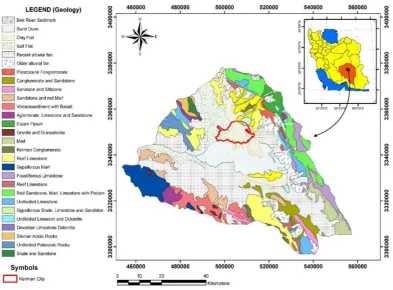
Fig. 1. Situation and Geological sedimentary basin map of the Kerman area.
3.
Materials and Methods
In this research, geological engineering properties of Kerman soils, development of soil structure, and sensitivity of soil structures are
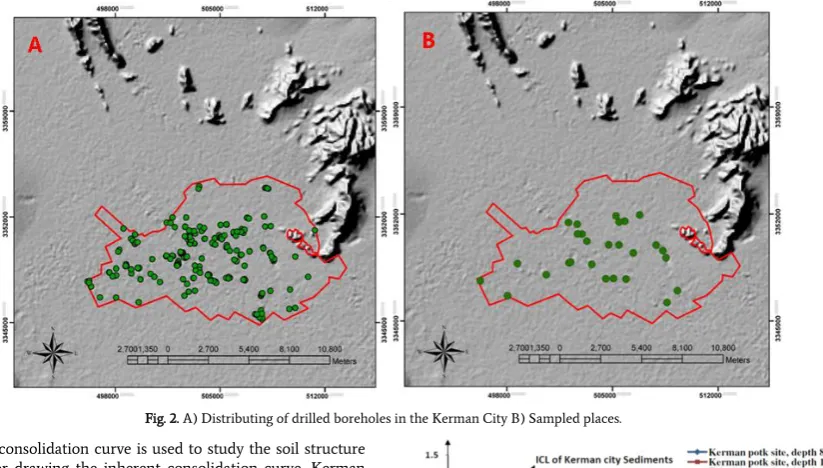
studied. To study the engineering properties of Kerman soils, we used geotechnical information from formerly drilled boreholes. To perform the necessary experiments in this research, sampling was done from several newly drilled locations. The location of boreholes and sampling points are shown in Fig. 2 and Table 1.
Table 1. Abbreviation code and Location of sampling points.
code X Y code X Y code X Y
K1 498050 3346650 K11 505520 3347958 K21 508621 3347253
K2 505425 3349972 K12 506796 3351940 K22 510178 3346846
K3 500607 3348023 K13 507183 3351530 K23 501437 3346846
K4 508017 3353909 K14 508517 3347346 K24 502661 3351331
K5 502981 3350686 K15 501433 3351621 K25 501440 3347935
K6 502330 3352324 K16 505069 3347781 K26 504062 3345909
K7 506375 3349452 K17 505811 3351533 K27 502643 3347064
K8 496250 3347636 K18 505229 3351874 K28 504545 3345823
K9 506632 3347872 K19 508331 3349602 K29 509795 3346108
Fig. 2. A) Distributing of drilled boreholes in the Kerman City B) Sampled places.
Soil inherent consolidation curve is used to study the soil structure development. For drawing the inherent consolidation curve, Kerman sediments were reconstituted with the moisture contents 1.25 to 1.5 times higher than the liquid limit (wl). Schmertmann’s criteria were
used to study the soil structure sensibility and to determine the friability factor, which indicates the soil structure development. The friability factor was used to investigate the consolidation behavior of the soil in undisturbed mode compared to reconstituted mode.
The destructuring coefficient is an indicator to determine the levels of fabric development, structure, and cementation in fine-grained soils. In this research, the required tests were conducted to determine the destructuring index of fine-grained deposits in Kerman. For evaluating the destructuring coefficient of these soils, the models presented by Liu and Carter (2000) [11] were applied. Recently, there have been important developments in formulating the constitutive models incorporating the influence of soil structure, such as those proposed by Gens and Nova (1993) [12], Rouainia and Muir Wood (2000)[13], and Kavvadas and Morosi (2000) [14].
In the models presented by Liu and Carter (1999 and 2000), consolidation curves of undisturbed and reconstituted soils were compared with each other. At first, the consolidation curves of all reconstituted soils were normalized by the void index (IV) proposed by Burland (1990) (That IV = (e – e*100) / (e*100 – e*1000) in which e*100 and
e*1000 are the mean intrinsic void ratios corresponding to the values of effective stress σ′v = 100 kPa and σ′v = 1,000 kPa, respectively. The intrinsic compression index Cc* is defined as e*100 - e*1000), and then, the intrinsic compression line (ICL) of Kerman sediments was extracted (Fig. 3 and 4). Finally, the corresponding parameters of each method were extracted and destructuring coefficient was calculated for each soil sample. Consolidation tests of undisturbed soils were performed in the Soil Mechanics and Technical Laboratory of the Kerman Province. For models proposed by Liu and Carter (1999 and 2000), a spatial comparison between intrinsic and undisturbed compression curves (e-logσ'v) was performed. The destructuring coefficient of soils and cementation phenomena were estimated based on the distance between the sedimentation compression curves (SCCs) and the intrinsic compression line (ICL) (Fig. 5).
When the cementation process occurs and continues in the initial stage of sedimentation, by adding the upper surcharge to the upper soil, the distance between the sedimentation compression curves to the intrinsic compression line increases. However, if the bonds between the particles are formed after the primary sedimentation process without applying the upper surcharge, the distance between SCCs and ICL will be negligible and may even intersect each other.
Fig. 3. Extraction of intrinsic compression curves of the Kerman city sediments in Iv-Log(σ`v) space.
Fig. 4. Comparison of Burland (1990) intrinsic compression line to the Kerman city sediments-ICL.
4.
Results and Discussion
Fig. 5. Relationship between Iv0 and log σv0' for many of the normally consolidated clays
.
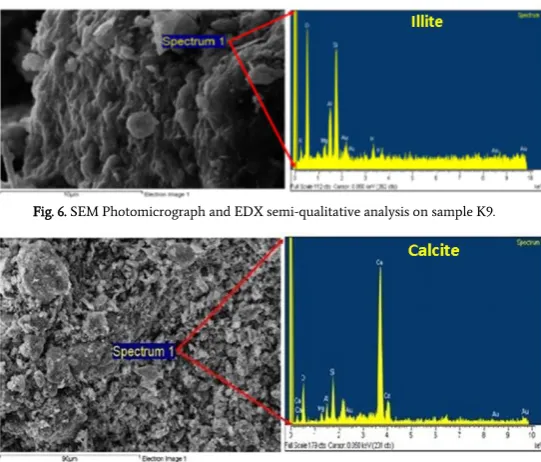
In this work, SEM images and the EDS method were used to study the effect of the Kerman deposits behavior and their geological history on the structure and fabric of the considered soil (Fig. 6 to 8). SEM
developed; however, in some thin sections a trace of cement is observed between the grains, which are mostly compressed and contacted with each other. Moreover, nodular calcite particles exist in the matrix of some of the soil samples. Overall, the source of a major part of Kerman soils is detrital carbonate rocks.
4.1.Evaluation of destructuring coefficient of Kerman deposits The destructuring coefficient of a soil is an index that represents the development level of the fabric and structure of the soil as well as the difference between over-consolidated soils and the soils with unstable or metastable structures. In order to estimate the destructuring coefficient, compressibility of soil samples was compared in undisturbed and reconstituted states. For this purpose, undisturbed sedimentary compressibility lines in (SCLs) Kerman were compared with inherent compressibility line (ICL). The destructuring coefficient of soils and cementation can then be estimated based on the distance between SCL and ICL.
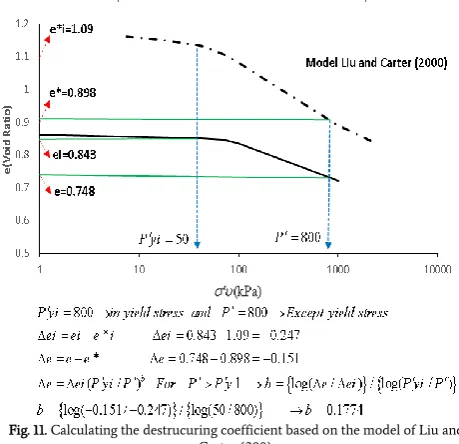
To determine the destructuring index of Kerman soils using the Liu and Carter model (2000), the undisturbed and intrinsic compression curves were drawn in an e-Log (σ'v) space and compared with each other for every soil samples. The model parameters include Δei (difference between the void ratio in undisturbed and reconstituted soils in yield stress state), Δe (difference between the void ratio in undisturbed and reconstituted soils in a stress level except the yield stress), P'yi (the mean effective stress at yield stress), and P′ (the mean effective stress except the yield stress), which were obtained for each sample and the destructuring coefficient (b) in equation (1) was calculated according to the Liu and Carter (2000) model. A calculation example based on the Liu and Carter (2000) model is shown in Fig. 11
and the other results are presented in Table 2.
(log( e/ ei)) / (log(p yi/ p ))
b (1)
Fig. 6. SEM Photomicrograph and EDX semi-qualitative analysis on sample K9.
Fig. 8. SEM Photomicrograph and EDX semi-qualitative analysis on sample K3.
Fig. 9. Photomicrograph of intact sample a) sample K11 b) sample K1.
Fig. 10. Photomicrograph of intact sample a) sample K28 b) sample K22.
Where p' is the mean effective stress, p'y,i is the mean effective stress at which virgin yielding of the structured soil begins, Δei, is the additional voids ratio at p´= p´y,i, where virgin yielding begins, and Δe, the difference of the void ratio for a structured soil with the reconstituted soil in ever stresses without the yield stress.
4.2.Stress sensitivity criteria for Kerman deposits
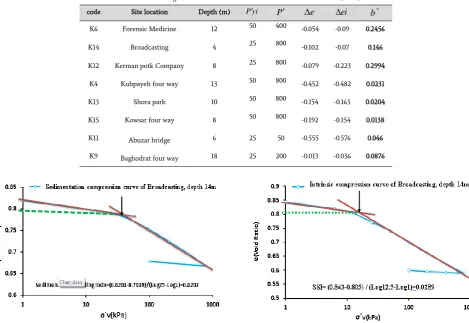
Connections between particles (carbonate component, iron oxides, etc.) and the structure created during and after the sedimentation prevent the soil from swelling unless the soil is mechanically disturbed and its structure is destroyed. Hence, the soil structure can be estimated considering the difference between the soil swelling in an undisturbed and a reconstituted state [15]. The ratio of the swelling index of clay soils in reconstituted and undisturbed states (Cs*/Cs) at low stresses (after the yield point) is called the swell sensitivity [5].
It has to be noted that the compression index (Cc) represents the slope of the curve of the void ratio versus the logarithm of the effective pressure when exceeding the maximum past effective stress. In addition, the swell index (Cs) represents the slope of the rebound curve of the void ratio versus the logarithm of the effective pressure. Compression index and swelling index are conventionally determined by laboratory Oedometer tests and are used for calculation of consolidation settlement of over-consolidated fine-grained soils. The soil structure can be identified based on the difference between the soil swelling of undisturbed and reconstituted samples. Hence, the swelling index is used to estimate the consolidation settlement for over-consolidated fine-grained soils [16].
Fig. 11. Calculating the destrucuring coefficient based on the model of Liu and Carter (200).
Table 2. Destructuring coefficient result based on the model of Liu and Carter (2000). *
b
ei
e
P P yiDepth (m) Site location code 0.2456 -0.09 -0.054 400 50 12 Forensic Medicine K6 0.146 -0.07 -0.102 800 25 4 Broadcasting K14 0.2994 -0.223 -0.079 800 25 8
Kerman potk Company K12 0.0231 -0.482 -0.452 800 50 13
Kuhpayeh four way K4 0.0204 -0.163 -0.154 800 50 10 Shora park K13 0.0138 -0.154 -0.192 800 50 8
Kowsar four way K15 0.046 -0.576 -0.555 50 25 6 Abuzar bridge K11 0.0876 -0.036 -0.013 200 25 18
Baghodrat four way K9
Fig. 12. Sedimentation Swelling Index of the Broadcasting site, depth 14 m. Fig. 13. Intrinsic Swelling Index of the Broadcasting site, depth 14 m.
Table 3. Swelling Sensitivity of the Kerman city fine-grained soils.
Swelling sensitivity criteria Natural swelling index Intrinsic swelling index Depth (m) Site location No 2.731 0.01410 0.03851 12 Forensic Medicine K6 1.155 0.0282 0.03258 4 Broadcasting K14 1.395 0.02077 0.02898 14 Broadcasting K10 1.294 0.02059 0.02665 8
Kerman potk Company K12
2.823 0.00740
0.02091 13
Kuhpayeh four way K4 1.942 0.00948 0.01842 10 Shora park K13 1.791 0.01473 0.02639 8
Kowsar four way K15
2.084 0.02426
0.05058 18
Baghodrat four way K9
4.3.Collapsibility index
The microstructure of collapsible soils can be analyzed in terms of four factors, i.e. particle pattern, contact relation, pore form and bonding material. Among these factors, pore form and bonding material are suggested as the two dominant factors that have more influence on the collapse behavior. Different particle patterns and contact relations result in different pore forms. Pores in loess soils were divided into macropores, spaced pores, intergranular pores and intragranular pores
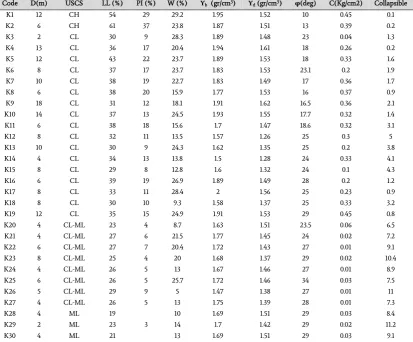
effective stress in the soil with high suction would lead to limited changes. Decreasing the soil suction while the soil is moistened causes collapsibility [18]. To measure the collapsibility index, we performed a consolidation experiment according to the ASTM D5333 standard, with results shown in Table 4. In central parts of the city, as the destructuring coefficient and swell sensitivity results showed, the soils are generally over-consolidated and unstructured. In addition, the collapsibility results in this part indicate (Samples K1 to K19) that the soils are
generally noncollapsible or partially collapsible. Most of the collapsibility is in the south or southwest parts of the city (samples K20
to K30), where soils have certain structures and are wind sourced at the
surface (Fig. 14). As mentioned earlier, soils in some cases have calcite cement or minerals such as halite or gypsum that fill the spaces between the soil particles, and sometimes have been dissolved and leave behind empty spaces. These pores can create settlement because of applied surcharges (Fig. 15).
Fig. 14. Collapsibility index zoning in the Kerman city.
Table 4. Results of collapsibility experiment according to the ASTM D5333 code.
Code D(m) USCS LL (%) PI (%) W (%) ϒb (gr/cm3) ϒd(gr/cm3) φ(deg) C(Kg/cm2) Collapsible
K1 12 CH 54 29 29.2 1.95 1.52 10 0.45 0.1
K2 6 CH 61 37 23.8 1.87 1.51 13 0.39 0.2
K3 2 CL 30 9 28.3 1.89 1.48 23 0.04 1.3
K4 13 CL 36 17 20.4 1.94 1.61 18 0.26 0.2
K5 12 CL 43 22 23.7 1.89 1.53 18 0.33 1.6
K6 8 CL 37 17 23.7 1.83 1.53 23.1 0.2 1.9
K7 10 CL 38 19 22.7 1.83 1.49 17 0.36 1.7
K8 6 CL 38 20 15.9 1.77 1.53 16 0.37 0.9
K9 18 CL 31 12 18.1 1.91 1.62 16.5 0.36 2.1
K10 14 CL 37 13 24.5 1.93 1.55 17.7 0.32 1.4
K11 6 CL 38 18 15.6 1.7 1.47 18.6 0.32 3.1
K12 8 CL 32 11 13.5 1.57 1.26 25 0.3 5
K13 10 CL 30 9 24.3 1.62 1.35 25 0.2 3.8
K14 4 CL 34 13 13.8 1.5 1.28 24 0.33 4.1
K15 8 CL 29 8 12.8 1.6 1.32 24 0.1 4.3
K16 6 CL 39 19 26.9 1.89 1.49 28 0.2 1.2
K17 8 CL 33 11 28.4 2 1.56 25 0.23 0.9
K18 8 CL 30 10 9.3 1.58 1.37 25 0.33 3.2
K19 12 CL 35 15 24.9 1.91 1.53 29 0.45 0.8
K20 4 CL-ML 23 4 8.7 1.63 1.51 23.5 0.06 6.5
K21 4 CL-ML 27 6 21.5 1.77 1.45 24 0.02 7.2
K22 6 CL-ML 27 7 20.4 1.72 1.43 27 0.01 9.1
K23 8 CL-ML 25 4 20 1.68 1.37 29 0.02 10.4
K24 4 CL-ML 26 5 13 1.67 1.46 27 0.01 8.9
K25 6 CL-ML 26 5 25.7 1.72 1.46 34 0.03 7.5
K26 5 CL-ML 29 9 5 1.47 1.38 27 0.01 11
K27 4 CL-ML 26 5 13 1.75 1.39 28 0.01 7.3
K28 4 ML 19 10 1.69 1.51 29 0.03 8.4
K29 2 ML 23 3 14 1.7 1.42 29 0.02 11.2
Fig. 15. A) Fine-grained clay and sand sequence B) Soils with solvable holes and collapsible C) Windy sands with high collapsibility property.
5.
Conclusions
Mineralogical studies of Kerman soils revealed that in these deposits there were minerals such as illite, chlorite, smectite, and calcite. Electron microscopy (SEM) images confirmed a consolidated and compressed structure of the soil grains in most of the studied samples. The destructuring coefficient values for fine-grained soils of Kerman were different for different samples and depths. A lower destructuring coefficient implied an undeveloped structure and fabric of the soil. According to the results of the present work, Kerman is covered with fine-grained soils with an uncollapsible and has a destructuring coefficient less than 1 due to the high consolidation and processes that destroyed the structure of its soils. Swell sensitivity study of Kerman soils indicated that the soils had a developed structure and fabric and often were compressed and over-consolidated. In the samples with a higher destructuring coefficient, calcium carbonates among soil particles probably acted as a cementing agent and created some structures in the soil. Hand specimen and field study of samples indicated that lime nodules constituted a major share of calcium carbonate soils. These nodules were concentrated at one point and generally did not act as a cementing agent. Results of collapsibility experiments showed a quite direct relationship with the structure development; i.e., collapsibility was low in the samples with a low destructuring coefficient and vice versa.
REFRENCES
[1] Burland J B (1990) On the compressibility and shear strength of natural clays, Geotechnique, 40(3): 329-378.
[2] Lerouil S, Vaughan PR (1990) The important and congruent effects of structure in natural soil and weak rocks, Geotechnique, 3: 467-488.
[3] Cotecchia F, Chandler RJ (2000) A general framework for the mechanical behaviour of clay, Géotechnique, 50(4): 431-447.
[4] Liu M D, Carter J P (1999) Virgin compression of structured soils, Geotechnique, 49(1): 43-57.
[5] Schmertmann J h (1969) Swell sensitivity, Geotechnique,
19(41): 530-533.
[6] Gasparee A (2005) Advanced laboratory characterization of London clay, Thesis for the degree of doctor of philosophy, University of London (Imperial College London), Department of Civil and Environmental Engineering, 598 pages.
[7] Amirsoleymani T (1994) Deposition and behavior of partially saturated silt. Proc. of 1st International Symposium on Engineering Characteristics of Arid Soils, London. 207-214.
[8] Amirsoleymani T (1995) Influence of deposition on deformation of Unsaturated Soils. Proc. of the first International Conference on unsaturated soils, 2: 687-694. [9] Barański M (2008) Engineering-geological properties of
normally consolidated tills from Vilnius. Płock area, Geologija. 50: 40–48.
[10] Qajar M H, Nazemzadeh M, Azizan H, Rowshanravan J (1996) The history of Kerman Basin during the Neogene and Quaternary, GSI, Regional Center for S.E.Iran (Kerman), 74 pages.
[11] Liu M D, Carter J P (2000) Modelling the destructuring of soils during virgin compression, Geotechnique, 50(4): 479-483.
[12] Gens A, Nova R (1993) Conceptual bases for a constitutive model for bonded soils and weak rocks, Proc. Int. Symp. on Geotech. Engere. of hard soils-soft rock, the Netherlands, and Balkema, Rotterdam 1: 485-494.
[13] Rouainia M, Muir Wood D (2000) A kinematic hardening model for natural clays with loss of structure, Géotechnique, 50(2):153–164.
[14] Kavvadas M, Amorosi A (2000) A constitutive model for structured soils, Géotechnique, 50(3): 263–273.
[16] Nihan S I (2009) Estimation of swell index of fine grained soils using regression equations and artificial neural networks. Scientific Research and Essay, 4: 1047-1056. [17] Yang YL (1988) Study on collapsible mechanism of loess
soils. Science in China: Series; 7: 756-66 (in Chinese).