DOI: 10.22075/JRCE.2017.11853.1202
Journal homepage: http://civiljournal.semnan.ac.ir/
Reliability and Sensitivity Analysis of Structures Using
Adaptive Neuro-Fuzzy Systems
A. Ghorbani1 and M.R. Ghasemi2
1. Assistant Professor, Department of Civil Engineering, Payame Noor University(PNU), 19395-3697 Tehran, I.R. of Iran
2. Professor of Civil Engineering,University of Sistan and Baluchestan,Zahedan, Iran
Corresponding author:[email protected]
ARTICLE INFO ABSTRACT
Article history: Received:11 July 2017 Accepted:31 October 2017
In this study, Adaptive Neuro-Fuzzy Inference System (ANFIS) and Monte Carlo simulation are utilized for reliability analysis of structures. The drawback of Monte Carlo Simulation is the amount of computational efforts. ANFIS is capable of approximating structural response for calculating probability of failure, letting the computation burden at much lower cost. In fact, ANFIS derives adaptively an explicit approximation of the implicit limit state functions. For this purpose, a quasi-sensitivity analysis based on ANFIS was developed for determination of dominant design variables, led to the approximation of the structural failure probability. Preparation of ANFIS however, was preceded using a relaxation based method developed by which the optimum number of training samples and epochs was obtained. That was introduced to more efficiently reduce the computational time of ANFIS training. The proposed methodology was considered using some illustrative examples.
Keywords: Reliability, Monte Carlo, Quasi Sensitivity, Fuzzy Systems.
1. Introduction
Assessment of structural responses for safe design of structures is inevitable [1,2].
Reliability analysis has a key role for structural design. The probability of failure (Pf), is usually obtained using standard reliability analysis methods such as Monte Carlo Simulation (MCS) techniques, the First Order Reliability Methods (FORM) and
Second Order Reliability Methods (SORM) [3,4].
structures and their nonlinear behavior, MCS call for enormous structural model [5]. Approximate structural responses could be a noble idea to overcome this drawback of methods based on simulations.
Neural Network (NN) models are proposed for such purposes, recently [7,8]. The combination of NN and MCS can improve the MCS performance [9,10]. On the other hand, both knowledge extraction and knowledge representation are problematic in neural networks. An advanced system, namely, Fuzzy Inference System (FIS) can deal with this type of problem and can model the qualitative characteristics of human data utilizing if-then rules. These systems have to capture the fuzziness of the reasoning process without using accurate numerical analysis. Consequently, merging these two methodologies constructs Artificial Neural Fuzzy Interference System (ANFIS) [11]. ANFIS has been widely utilized for different purposes such as extrapolation, data discovery and healing [12-15]. In civil engineering, ANFIS has employed to increase the decision-making speed in structural control [16]. ANFIS network was also developed and applied to MCS, improving optimum design of truss structures with probability constraints [17]. Here an attempt is to be performed to merge a modified ANFIS with MCS for sensitivity analysis and structural reliability.
An appropriately trained ANFIS may let the resolve of the structural responses more quickly rather than exact structural analysis. As the number of training samples and epochs for training the ANFIS affects the time and accuracy of the trained network, a relaxation-based method is introduced to
reach to the optimum number variables for ANFIS.
Sensitivity analysis is executed to recognize the most important parameters affecting safety. The derivative-based approach of sensitivity has the attraction of being very efficient in computer time [18,19]. Derivatives for explicit limit state functions could be easily computed. However, for complex structures, they are not available readily. Using neural networks, some studies were made to surmount this limitation [20]. In this work however, to determine the most influential design variables, a Quasi Sensitivity Analysis (QSA) in the presence of uncertain inputs using neuro-fuzzy systems is proposed. This approach will then be utilized to estimate Pf with only a certain number of design variables.
2. Reliability Analysis by Monte
Carlo Simulation
A reliability problem is normally expressed using a failure function which is called a Limit State Function (LSF),g X( ) where
1 2
{ , ,..., n}
X x x x is a random vector of design variables. Violation of the LSF is defined by the conditiong X( )0. Pf is
presented by the following expression [21]:
1 2
( ) 0
[ ( ) 0] ... ( ) d d ...d
f X n
g X
P P g X f X x x x
(1)
( )
X
f X is the joint probability density function.
Estimation of Pf via MCS can be given by:
1
1
( )
N
f
i
P I X
N
(2)1 if ( ) 0 ( )
0 if ( ) 0
g X I X
g X
(3)
According to Eq. (2), N represents the number of independent sets of random design variables. Therefore, Pf is achieved by:
H f
N P
N
(4)
where NH is the total number of cases where
LSF would be negative and failure of the structure has occurred.
3. ANFIS Structure
The ANFIS normally consists of a feed-forward network that uses back-propagation learning algorithms and fuzzy reasoning to map inputs into an output. A typical ANFIS architecture with only two inputs leading to four rules and one output for the first order Sugeno fuzzy model is expressed here. Such architecture can be simply adjusted according the problem characteristics.
Each input requires two associated Membership Functions (MFs). The MF of a fuzzy set is a generalization of the indicator function in classical sets. In fuzzy logic, it represents the degree of truth as an extension of valuation [22].
A typical rule set with four fuzzy if–then rules that is to say Sugeno fuzzy model can be expressed as [23,24]:
1 1 11 11 11 11
1 2 12 12 12 12
2 1 21 21 21
Rule 1: if is A and is B then f Rule 2: if is A and is B then f Rule 3: if is A and is B then f
x y p x q y r
x y p x q y r
x y p x q
21
2 2 22 22 22 22
Rule 4: if is A and is B then f
y r
x y p x q y r
(5) where A1, A2 are labels representing MFs for the input x. Similarly, B1 and B2 are labels for input y. Also, pij, qij and rij (i, j = 1, 2) are parameters of the output MFs.
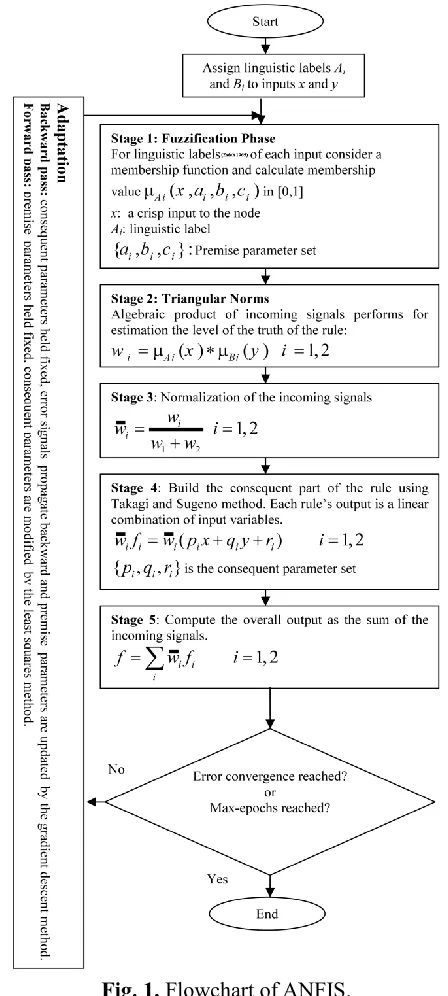
Fig. 1. Flowchart of ANFIS.
An adaptive network is a multi-layer feed forward network in which each node performs a particular function on received signals. Figure 1 illustrates ANFIS architecture as a special configuration of adaptive networks.
ANFIS output match the desired output. For this purpose, a two-step process is carried out; the backward pass and the forward pass under a so-called hybrid learning algorithm [25]. In the backward pass, the output MF parameters or consequent parameters
(p q ri, i, )i are held fixed, the error signals
propagate backward and the input MF parameters or the premise parameters
( , , )a b ci i i are updated by the gradient descent method. In the forward pass, premise parameters are held fixed up to stage 4, where the consequent parameters are updated by the least squares method.
4. Quasi Sensitivity Study for
Reliability Analysis
Sensitivity analysis may be used to answer the questions of the type ‘which of the input factors is more important in determining the uncertainty in the output of interest?’ Or if we could exclude the uncertainty in one of the input elements, which factor should we choose to mostly diminish the change of the output?’ [26].
In traditional sensitivity methods, usually the derivatives of the output with respect to the distribution parameters of inputs are considered. For most structures, the LSF is an implicit function of design variables. Thus, aiming for reliability analysis of complicated structures in particular; derivatives of the LSFs are not readily available.
One major aim of the present study is to ask ourselves whether it is possible to determine probability of failure with participation of just some of the input variables. If so, which inputs are most inflectional in Pf prediction?
To answer the question above, a hybrid ANFIS-MCS methodology, followed then by reliability analysis is innovated. The proposed technique undertakes three main objectives; (1) since the number of training samples and epochs are two essential parameters affecting the accuracy and training time of ANFIS, the first aim is to introduce a relaxation-based scheme through which optimum numbers for training samples and epochs are performed. (2) To focus merely on the most influential design variables, a QSA approach presented here. (3) To allow for the determination of the structural failure probability in a considerable reduction of computational time by merging QSA-based ANFIS with MCS, considering the numerous amounts of analyses encountered the crude MCS.
4.1. Training of the ANFIS
Firstly, the number of epochs is kept fixed to one while the number of training samples is allowed to vary from one to a point where the process may be halt due to some relaxation criteria. Thus, for each training sample, adjustable parameters of ANFIS are modified only once. Using test samples then, the Mean Relative Percentage Error (MRPE) for each set of training samples will be calculated as in Eq. (6):
1 1
100 ( )
t n
i i
i
t i
p a MRPE
n a
(6)where aiand pirepresent actual and predicted
values of structural response respectively, and ntis the number of testing samples.
The variation of MRPE will then relax to a value which indicates a minimum number of training samples required.
epochs is allowed to vary and the corresponding MRPE values are recorded. The convergence history will then be studied through which the minimum number of epochs required will be obtained.
4.2. Determination of Most Influential Design Variables of Structure
The step by step summery of the algorithm for determining the ni influential design
variables from nd candidates in predicting the
LSF, leading thus to the prediction ofPf , is as follows:
a) AInitial parameters of structure are established and niis set to 1.
b) Some structures are randomly generated.
c) The structural responses for all members are evaluated using conventional finite element analysis. d) Structural samples are split into
training and testing samples.
e) For each combination of ni variables
from ndcandidates one ANFIS model is
built and trains. This leads to a number of na ANFIS models where:
( )!
( )! !
d d
a
i i d i
n n
n
n n n n
(7)
f)Using test samples, MRPE for each model is computed. The variable with relatively minimum MRPE possesses the most influence among all the individual variables. It will then be recorded.
g)The outcome of step (f) will then be combined with a second variable from the list one by one, the minimum MRPE of which will be recorded and thus the corresponding two most influential variables.
h)Step (g) will be repeated adding more variables, until no further considerable reduction of MRPE is observed. Therein, we say a relaxation of the global minimum MRPE is taken place. i) End of algorithm.
5. Examples
In this section, two high nonlinear examples as explicit and implicit LS functions are considered.
5.1. Example 1
A bumpy multidimensional LSF [27,28] is attempted in the first example, where:
6
1 2 3 4 5 6
1
( ) 2 2 5 5 0.001 sin(1000. i)
i
g X x x x x x x x
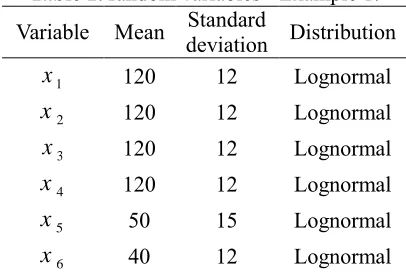
(8) The statistics of the related six random variables are listed in Table 1.
Table 1. random variables - Example 1.
Variable Mean deviation Standard Distribution
1
x 120 12 Lognormal
2
x 120 12 Lognormal
3
x 120 12 Lognormal
4
x 120 12 Lognormal
5
x 50 15 Lognormal
6
x 40 12 Lognormal
5.1.1. Determination of Relaxed Number of Training Samples and Epochs – Example 1
In this example, the design variable vector
1, 2, 3, 4, 5, 6
calculating the membership value of the linguistic labels.
2
1 ( )
1 ( )
Li
i
i
bi
x
x c a
(9)
whereLi and { ,a b ci i, }i are the membership
function for ith linguistic label and premise parameters set, respectively. Two rules for each MF are considered.
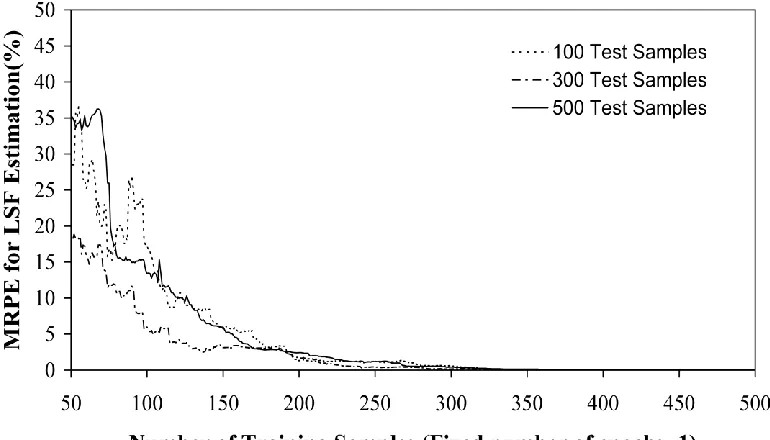
According to the expressions in section 4.1, training of ANFIS was attempted using different number of samples. The reason was to study relaxation of MRPE for a certain number of test samples. In other words, although the ANFIS could be trained using any number of training samples as small as 50; however, the test samples may not be satisfied as far as the MRPE is concerned.
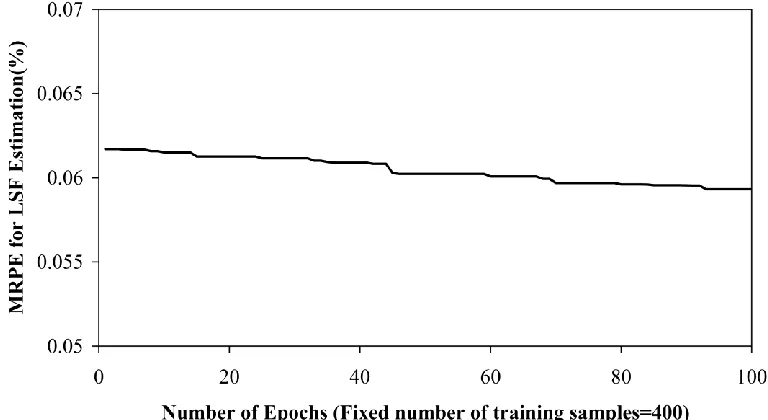
Therefore, a thorough investigation was made to obtain the least amount of training samples for which any number of test samples could result satisfactorily. As a result, two figures are produced. In Fig. 2, relaxation for number of training samples using different number of test samples is presented. It is found that MRPE variations are converged to a relax number of 400 training samples with the corresponding MRPE of 0.061%. By fixing the training samples to 400, number of epochs was allowed to vary. Figure 3 shows that by increasing the number of epochs from 1 to 100, MRPE does not change considerably and only drops off from 0.061% to 0.059%. Therefore, number of training samples and epochs were fixed to relaxed values of 400 and 1, respectively, for ANFIS model.
Fig. 3. MRPE versus epochs - Example 1.
5.1.2. Determination of Most Influential Design Variables - Example 1
Here, the idea is to investigate whether it is possible to eliminate the least important design variables. Therefore a QSA technique, described in section 4.3 is implemented. For this purpose, from the total of 6 candidates, various combinations of design variables from 1 to a maximum of 6 were attempted. It was observed that among 6 variables, x5 is
mostly influences the LSF. This is clearly shown in Table 2 where the corresponding QSA has the least MRPE. The verification of what accomplished was made using the
sigma-normalized derivatives based on Eq.
(10) where:
.
i
xi
x
g i
g S
x
(10)
As listed in Table 2, the results obtained show that x5 is most dominant, considering
that a cosine function alters between -1 and 1.
Furthermore, by studying the MRPE in Table 2, it can be deduced that the order of importance of the design variables is
5 6 3 2 1 4
x x x x x x which is in agreement with the traditional sensitivity analysis results using Eq. (10).
Table 2. Results for QSA - Example 1.
Design variable MRPE (QSA) Sxi
x1 72.45% 1 1
12
[1 cos(1000 )]
x g
S x
x2 70.81% 2 2
12
[2 cos(1000 )]
x g
S x
x3 70.79% 3 3
12
[2 cos(1000 )] x
g
S x
x4 72.98% 4 4
12
[1 cos(1000 )] x
g
S x
x5 46.45% 5 5
15
[ 5 cos(1000 )]
x g
S x
x6 50.64% 6 6
12
[ 5 cos(1000 )] x
g
S x
The QSA depended MRPE results for different combinations of Design Variables (D.V.) are listed in Table 3, where a smooth convergence history was detected while removing the least important D.V. of 1. Final results for calculating the probability of failure has been summarized in Table 4. It is shown that the number of LSF evaluation is reduced drastically in comparison with crude MCS. On the other hand, reduction in input space of ANFIS to only 5 variables, decreased the computing time to a relative reduction of 15.8%. As listed, the Pf drifts are
negligible in proposed methods shown in rows 4 and 5 of Table 4, compared to the crude MCS of row 1. Additionally, a comparison between results of the proposed method and those by Cheng (2007)[28] were made and documented in that table. As can be seen, ANFIS based methods using less training samples matched more closely the MCS results listed as Reference values.
Table 3. Results for predicting most influential variables - Example 1.
Number of variables from 6 candidates
Optimal
combination MRPE
1 5 46.45%
2 5,6 16.65%
3 5,6,3 13.73%
4 5,6,3,2 8.58%
5 5,6,3,2,4 4.19%
6 5,6,3,2,4,1 0.30%
Table 4. Final results for reliability analysis - Example 1.
Method
Number of LSF
evaluation f
p Error
Crude MCS[27] 100000 0.0121 –
GA–ANN [28] 2600 0.00845 30.2% –
GA–ANN–MCSIS
[28] 1050 0.0124 2.5%
MCS–ANFIS - all
variables 400 0.0123 1.65%
MCS–ANFIS - 5
influential variables 400 0.0126 4.13%
5.2. Example 2
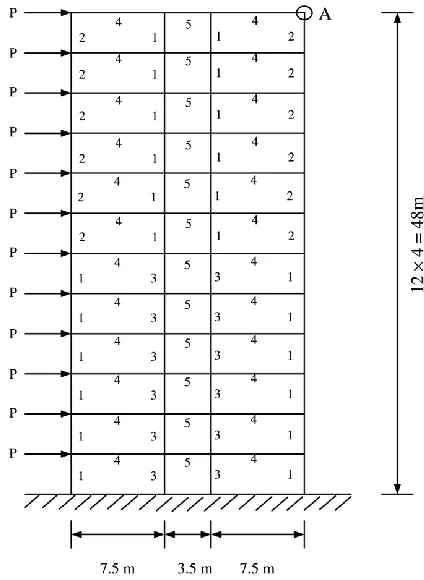
A two-dimensional frame as shown in Fig. 4 is considered [28]. This example as an implicit LSF is selected in order to show the efficiency of the proposed approach to apply for a wide range of the actual structures.
Fig. 4. Linear portal frame - Example 2.
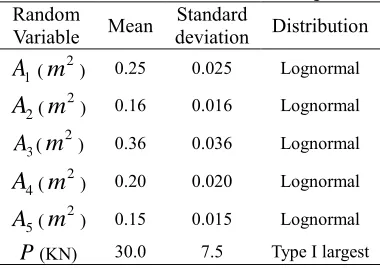
Different cross sectional areasAi and
horizontal load Pare treated as independent random variables. The probabilistic distribution of their design variables are listed in Table 5. The sectional moments of
inertia are expressed as 2
i i i A
I (
1 2 3 0.08333, 4 0.26670, 5 0.2000
). The Young’s modulusE is treated as deterministic being equal to 7 2
A
u at node A, exceeds 0.096 m. Therefore, one could express the LSF as:
) , , , , , ( 096 . 0 ) , , , , ,
(A1 A2 A3 A4 A5 P u A1 A2 A3 A4 A5 P
g A
(11) Table 5. random variables - Example 2.
Random
Variable Mean deviation Standard Distribution
1
A (m2) 0.25 0.025 Lognormal
2
A (m2) 0.16 0.016 Lognormal
3
A (m2) 0.36 0.036 Lognormal
4
A (m2) 0.20 0.020 Lognormal
5
A (m2) 0.15 0.015 Lognormal
P(KN) 30.0 7.5 Type I largest
5.2.1. Determination of Relaxed Number of Training Samples and Epochs – Example 2
In this example, the design variable vector
for the frame structure
1 2 3 4 5
{ , , , , , }
X A A A A A P is selected as the input for the ANFIS. Displacement of node A
is considered as the output. Like Example 1, bell type MF is used in ANFIS models. In Figure 5, the MRPE variation versus the increment of number of training samples is recorded, while keeping number of epochs equal to one. As illustrated in the figure, one realizes that after 300 training samples, the
MRPE is independent of the number of test samples. This indicates a relaxation on the least number of training samples after which the exceeded number of training samples is just ineffective as far as the accuracy of LSF estimation is concerned.
Having fixed the number of training samples to 300 then, the variation of number of epochs was studied aiming for minimum sufficiency. The history of convergence of MRPE for LSF prediction against number of epochs is shown in Figure 6, where the epoch number is relaxed to 80, after which no reduction of MRPE is recorded.
Fig. 6. MRPE versus epochs - Example 2.
Training of ANFIS model for reliability and sensitivity analysis was therefore processed using 300 training samples with 80 epochs.
5.2.2. Determination of Most Influential Design Variables - Example 2
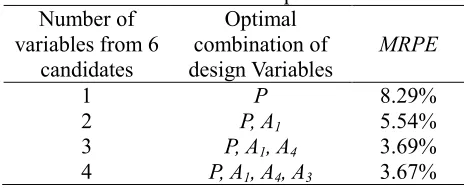
The study results of combined most influential variables are given in Table 6. Using QSA, valued statistics about the status of the design variables is in hand. It was found that the lateral load P is the most influential variable in this example. Bottom corner columns are the next important parameters which is meaningful in practice. This could be due to their key role in lateral resistance in a flexural frame. Also, beams with A4 cross sectional areas covering most
of the elements in the frame are in the third level of importance.
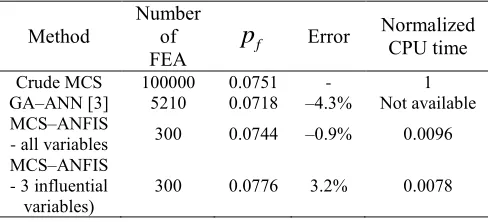
As shown in Table 6, the 3th combination has been relaxed to a 3.69% MRPE value, after which a negligible reduction on its value is observed. So reliability analysis using MCS-ANFIS method was performed using only the 3 most important design variables being P, A1
and A4.
The structural failure probability was then obtained through the ANFIS. The results were then compared with those of crude MCS and GA-ANN [28] as listed in Table 7. The normalized CPU time shown in Table 7 indicates a numerous computational time reduction using the proposed method. It is inferred that ANFIS-MCS method can derive a well-intentioned estimate of the implicit LSF through only few training samples. By using ANFIS, the approximation function written in an explicit form, once found, will be directly used instead of conducting deterministic Finite Element Analysis (FEA). The calculation of an explicit function requires only a fraction of a second compared to FEA requiring relatively extensive computational time.
Table 6. Results for predicting most influential variables - Example 2.
Number of variables from 6
candidates
Optimal combination of design Variables
MRPE
1 P 8.29%
2 P, A1 5.54%
3 P, A1, A4 3.69%
Table 7. Final results for reliability analysis - Example 2.
Method Number of
FEA pf Error
Normalized CPU time
Crude MCS 100000 0.0751 - 1
GA–ANN [3] 5210 0.0718 –4.3% Not available
MCS–ANFIS
- all variables 300 0.0744 –0.9% 0.0096
MCS–ANFIS - 3 influential variables)
300 0.0776 3.2% 0.0078
6. Conclusion
An effective methodology is accessible for reliability analysis of structures employing MCS and ANFIS. The approximate concepts that are innate in reliability analysis motivated the use of ANFIS.
The computational efforts involved in the crude MCS come to be too much in large scale problems because of the massive sample size and the computing time required for each MCS run. The use of ANFIS can practically diminish any constraint on the scale of the problem. Also, the sample size used for MCS provided that the predicted LSF, corresponding to different simulations, fall within acceptable tolerances. It was also inferred that, contrary to neural network applications in other field of computational structural mechanics, the present application showed a considerable robustness with regard to selection of training samples and epochs in estimating the probability of failure. The selection criterion involved a relaxation method to be introduced to extract the operational number of samples and epochs for training ANFIS. The proposed method confirmed to be independent on the type of structure or the type of the required analysis.
A sensitivity method based on ANFIS called quasi sensitivity analysis was developed and
validated to discover most influential variables and compute probability of failure using a reduced vector of input variables. The power behind this method was found to be in ANFIS abilities for nonlinear function estimation.
The numerical examples illustrated the application and the effectiveness of the proposed method. Comparisons were made possible with an analytic method based on derivatives of the LSF. It was shown through some examples that the performed method provided accurate results and was computationally efficient for estimating the failure probability of structures.
REFERENCES
[1] Shen J., Seker O., Akbas B., Seker P., Momenzadeh S. and Faytarouni M. (2017), “Seismic performance of concentrically braced frames with and without brace buckling”, Eng. Struct., 141, 461-481. [2] Momenzadeh, S., Kazemi M.T., Asl M.H.,
(2017), “Seismic performance of reduced web section moment connections”, Int. J. St. Struct., 17(2), 413-425.
[3] Ditlevsen, O. and Madsen, H.O. (1996), Structral reliability methods, John Wiley & Sons Inc., England.
[4] Haldar, A. and Mahadevan, S. (2000), Probability, reliability and statistical methods in engineering design, John Wiley & Sons, Inc., England.
[5] Nowak, A. S. and K. R. Collins (2000), Reliability of Structures, McGraw-Hill, Singapore.
[6] Lemieux, C. (2009), Monte Carlo and Quasi-Monte Carlo Sampling, Springer Science, Waterloo, Canada.
[8] Ba datli, S.M., Özkaya, E., Özyi it, H.A. and Tekin, A. (2009), "Nonlinear vibrations of stepped beam systems using artificial neural networks", Struct. Eng. Mech., 33(1), 11-24.
[9] Papadrakakis, M., Papadopoulos, V. and Lagaro, N. (1996), "Structural reliability analysis of elastic-plastic structures using neural networks and Monte Carlo simulation", Comp. Meth. Appl. Mech. Eng., 63, 136-145.
[10] Cardoso, J.B., Almeida, J.R., Dias, J.M. and Coelho, P.G. (2007), "Structural reliability analysis using Monte Carlo simulation and neural networks", Comp. Struct., 39(1), 503-513
[11] Godjevac, J. (1993), "State of the art in the neuro fuzzy field", Ecole Polytechnique Fédérale de Lausanne, Département d’Informatique, Laboratoire de Microinformatique, Technical report, 93.25, 1-18.
[12] Fu, J.Y., Li, Q.S. and Xie, Z.N. (2006), "Prediction of wind loads on a large flat roof using fuzzy neural networks", Eng. Struct., 28, 153-161.
[13] Fonseca, E. T. and Vellasco, P. C. G. (2007), "A neuro-fuzzy evaluation of steel beams patch load behavior", Adv. Eng. Soft., 39, 558-572.
[14] Topcu, I. E. and Sardemir, M. (2007), "Prediction of rubberized concrete properties using artificial neural network and fuzzy logic" Constr. Build. Mat., 22, 532-540.
[15] Topcu, I. E. and Sardemir, M. (2008), "Prediction of compressive strength of concrete containing fly ash using artificial neural networks and fuzzy logic", Comp. Mat. Sci., 41, 305-311.
[16] Faravelli, L. and Yao, T. (1996), "Use of adaptive networks in fuzzy control of civil structures", Microcomp. Civil Eng., 11, 67-76.
[17] Ghorbani, A. and Ghasemi, M.R. (2009), "Reliability based optimization of truss structures using neuro-fuzzy systems", Proceedings of 8th World Congress on
Structural and Multidisciplinary Optimization, Lisbon, Portugal, June. [18] Melchers, R. E. and Ahmed, M. (2004), "A
fast approximation method for parameter sensitivity estimation in Monte Carlo structural reliability", Comp. Struct, 82, 55-61.
[19] Song, J. and Kang, W.H. (2009), "System reliability and sensitivity under statistical dependence by matrix-based system reliability method", Struct. Safety, 31, 148-156.
[20] Marseguerra, M., Masini, R., Zio, E. and Cojazzi, G. (2003), "Variance decomposition-based sensitivity analysis via neural networks", Reliab. Eng. Syst. Safe., 79, 229-238.
[21] Mahadevan, S. (1996), Monte Carlo Simulation in Reliability-Based Mechanical Design, Marcel Dekker, NY. [22] Zadeh, L.A. (1965), "Fuzzy sets", Inf.
Contr., 8(3), 338-353.
[23] Sugeno, M. (1985), Industrial applications of fuzzy control, Elsevier Science Pub. Co. [24] Wang, Y. M. and Elhag, T. (2008), "An
adaptive neuro-fuzzy inference system for bridge risk assessment", Expert Syst. Appl., 34, 3099-3106.
[25] Jang, J.S.R. (1993), "ANFIS: Adaptive-network-based fuzzy inference systems", IEEE, Trans. Syst. Man Cyber., 23, 665– 685.
[26] Saltteli, A., Tarantola, S., Compolongo, F. and Ratto, M. (2004), Sensitivity analysis in practice, John Wiley & Sons Inc., England.
[27] Kiureghian, A. D., Lin, H. Z., and Hwang, S. J. (1987), "Second-order reliability approximations", J. Eng. Mech., ASCE, 113(8), 1208-1225.