two methods RULA and OCRA
Babak Fazli1, Zahra Sharif Poor2, Marzieh Noorani3, Amir Hooshang
Mehrparvar4, Sayed Mohammad Jafari5
Abstract
Bank employees are at risk of musculoskeletal problems because of the physical and mental requirements of the job. Studies show that more than 60 percent of bank employees have been directly or indirectly involved in many factors, such as personal characteristics, conditions and workstations, stress and repetitive movements. The aim of this study was to evaluate the RULA and OCRA methods of risk factors for musculoskeletal disorders in the bank staff. This study was carried out in order to assess the physical status of 80 the bank employees using two methods: RULA and OCRA. According to the results, the average score RULA and OCRA are 4.13±1.14 and 0.300±0.088, respectively.
Statistically significant t - tests show differences between RULA
and OCRA assessment methods. The RULA scores for the three
age groups were also not significantly different, as they also apply
to the OCRA score. Though, there are similarities between the two methods especially in assessment of repetitive motion in upper limb, but OCRA method propose as appropriate method to MSDs risk evaluate, so is not recommended to use two method instead of each other.
Keywords: Bank, Evaluation, Musculoskeletal Disease, Postures Journal of Research & Health
Social Development & Health Promotion Research Center
Vol. 9, No.3, May & Jun 2019 Pages: 212- 219 DOI: 10.29252/jrh.9.3.212
Original Article
1. Health Promotion Research Center, School of Health, Zahedan University of Medical Sciences, Zahedan, Iran
2. Social Health Determinants Research Center, Department of Health Education, School of Health, Shahr-e-Kord University of Medical Sciences, Shahr-e-Kord, Iran
3. Correspondence to: Department of Occupational Health, School of Para Medicine, Shahid Sadoughi University of Medical Sciences, Abarkouh, Iran
Email: [email protected]
4. Department of Occupational Medicine, School of Medical, Shahid Sadoughi University of Medical Sciences, Yazd, Iran 5. Department of Occupational Health and Safety, Faculty of Medicine, Khatam-al-Nabieen University, Kabul, Afghanistan
Received: 28 Apr 2014 Accepted: 4 Jan 2015
How to cite this article: Fazli B, Sharif Poor Z, Noorani M, Mehrparvar AH, Jafari SM. Evaluation the posture of bank employees using two methods RULA and OCRA. J Research & Health2019; 9(3): 212- 219.
Introduction
Professional banking using paper and pencil; with the rapid advancements in technology, especially in the use of electronic data by displaying information at the Visual Discomfort Terminal (VDT), workers and the environment affected the work. Inappropriate body condition and prolonged sitting in front of this terminal can cause many health risks, including eye pressure, fatigue, and musculoskeletal disorders. The complaints of the musculoskeletal system are addressed separately to bankers with different risk factors, including
Musculoskeletal Disorders (MSDS) are considered as one of the most common occupational and debilitating injuries in industrialized and developing countries. According to available statistics, the share of musculoskeletal disorders from the total disease Job in Finland is 31% and
in the United States is 44% [4-8]. Research has
shown that, unlike the progressive growth of
automated and mechanized processes,
Work-related Musculoskeletal Disorders (WMSDs) and the resulting pain and discomfort, the main cause of labor damage, waste of working time and increased costs is recognized as one of the greatest health problems in industrialized countries [9]. Various risk factors are involved in the occurrence of these injuries, which can be subdivided into physical risk factors such as inappropriate posture and repetitive work [10,11] mental, organizational,
and individual [12-14]. A recent report by the
National Academy of Science (NCAA) has shown that: Ergonomic risks in the workplace lead to musculoskeletal disorders, but appropriate interventions will prevent these disorders [10]. So far, there have been many bankers around the world facing the physical and emotional problems. A study by Wong and Yu in 1996 examined musculoskeletal problems among Visual Display Unit (VDU) workers (visual
discomfort unit) at a Hong Kong bank. The study
of musculoskeletal problems in users showed that complaints in parts of the upper nerves, including the neck, back, shoulders, wrist and arms, on users with continuous work with VDU, could be due to personality, postural discomfort, repetitive movement And the design workstation [15]. In
another study, Zafir et al reviewed the issues of
ergonomics and its relationship with stress in bankers, saying that the relationship between
post office posture and the unsatisfactory work station design with work-related stress has been
proven [16]; while research other 21% of the illnesses and 49% of early retirement reported in most users that there were psychological disorders [17]. The study by Lees Esther et al. shown that pain in low back and neck, hand and wrists was paid among telephone operators who had been responding to the phone for 6 hours is prevalence. In the meantime, the prevention of
musculoskeletal disorders among operators has
an integrated and codified program, including
improving the design workstation, the thermal comfort of the environment, and having a rest program between the work [18]. In our country, musculoskeletal disorders are among the most common occupational complications [9]; according to the medical commission of the Tehran provincial social insurance organization, 14 percent of other diseases are from malnutrition to musculoskeletal disorder [19]. Among the factors affecting musculoskeletal disorders caused by overweight, poor postures are one of the most important ones. While according to the Iranian center healthcare, 76% of the workforce is undesirable [9]. Hence, in many ways to evaluate the risk of musculoskeletal disorders, the postural analysis is evaluated as the axis and basis [20]. The displacement of the head, trunk, and body member in space is called the body or posture when performing work [11].
Improvement in body posture is effective on improving health, reducing stress and reducing discomfort during work, and also an important
factor in terms of labor efficiency and job
performance [21]. However, according to studies, the study is limited in this regard [22]. Banking is among the businesses sitting with the use of computers and is transferring money and exposing the banker with stress and ergonomic problems [23]. Studies show that poor postures and constant status of employees of the bank are considered as a risk factor for the development of musculoskeletal problems [3]. Employees of the bank as having an occupational group with physical and mental needs in their work tasks are subject to numerous problems such as musculoskeletal disorders [24]. Considering the importance of bankers' health and the role of musculoskeletal disorders in physical and mental conditions and ultimately creating job
well-being and preventing human errors in
occurrence of such disorders. In this regard, and in this study, in order to achieve the above objective, the evaluation of the postures of bank employees by using Rapid Upper Limb Assessment (RULA) and Occupational Repetitive Actions (OCRA) methods as posture evaluation methods for the above organs.
Method
In this study, the evaluation of the physical condition of 80 employees of the bank of Yazd city was investigated using RULA and OCRA methods. In order to implement the mentioned project, a number of banks were randomly selected from among the banks in Yazd city and their employees were evaluated. The sampling of branches was done in a cluster among the banks in Yazd. To this end, a selection of staff was randomly selected and entered into the study. With
a confidence level of 95% and a power of 80%,
according to the cluster selection of individuals (each branch of a cluster), 80 participants
were considered necessary. At first, a checklist
of demographic information of participants including age, sex, job title, working hours and work experience was distributed among the
participants and completed by self-report. Then,
working conditions, body condition during work, and signs of musculoskeletal disorders and its prevalence were evaluated using posture RULA and OCRA. The evaluation method was the paper pen, direct viewing and interviewing the staff. RULA method is a method for rapid evaluation of upper limb condition. The term RULA stands for Rapid Upper Limb Evaluate, which means a quick
evaluation of the upper limbs. In this method, for analyzing work postures, each body part is evaluated based on the amount of displacement from the natural state, so that in accordance with the increase in the deviation of that part of the condition A natural number is assigned as a postcard code. The organs are divided into two groups (including the wrists, arm, fore arm) and group B (including the neck, trunk, and legs). After combining the codes obtained for different parts of the body and estimating external and muscular forces through the
relevant tables the value of the final code, which
indicates the severity of the posture and the level of urgency of the correction, is determined [25]. The term OCRA stands for Actions index Occupational Repetitive, an indicator useful for evaluating exposure to repetitive upper limbs. In other words, this indicator is an instrumental tool that determines the relationship between the number of daily movements practically performed by the upper limbs in repetitive tasks and the number of recommended movements. The number of recommended movements
based on the constant coefficient (30 moves
per minute), which can be reduced from one a situation to another according to the function of the occurrence and the characteristics of other risk factors, are calculated. This method is used to evaluation the occupations and the work in which people with discomfort and upper limb disorders such as shoulder, elbow, wrists and
hands and fingers are exposed [26].
The functional levels of the two methods are presented in Table 1.
Table 1 Performance levels in OCRA and RULA
Row Performance level RULA
1 Acceptable 1-2
2 Need for possible changes 2-4
3 Need for changes and improvements soon 5-6
4 Need for changes and improvements as soon as possible 7 and more
Row Performance level OCRA
1 Lack of danger 1≥ OCRA
2 Risk of insignificance 2≥ OCRA>1
3 Low and low risk 4≥ OCRA>2
Data were analyzed using SPSS-16 and spearman correlation statistics sample T-Test and one-Way ANOVA with significance level of p<0.05.
Results
In this study, 80 employees of the Bank, which included 11 women and 69 men, were
examined. Table 2 shows the demographic data of the participants studied. Participants
were aged 27-50 years with an average
of 5.5±5.9 years and these people's work
experience was 5 - 26 years with an average
of 14.16±17.1, the majority (83.8 percent)
were right-handed.
Table2 Frequency of demographic information
Age category N(%)
Less than 30 years 10 (12.5%) 30 to 40 years 41 (51.25%) More than 40 years 29 (36.25%) Work Experience
Less than 10 years 27 (32.8%) 10 to 20 years 35 (43.7%) More than 20 years 18 (22.5%) Sex
Man 69 (86.3%)
Female 11 (13.7%)
The results of the data analysis using the RULA method indicated that the prevalence of disorders in the shoulder, wrist, neck and trunk (56.3, 93.8, 73.8 and 67.5 percent) in group 2 (the need for possible changes), while the majority (67.5 percent and 53.8 percent) are in
the first group and are in an acceptable condition
in the forearm and legs. In sum, the highest body condition in accordance with RULA
standard was estimated at range 3-4 (requiring
possible changes to existing conditions). However, the results of the evaluation using the OCRA method showed that approximately
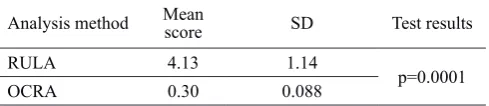
100% of participants were in a desirable and acceptable situation. The mean scores of both RULA and OCRA evaluation methods were 4.13±1.14 and 0.308±0.88, according to Table 3. Regarding the results of the Paired Samples
Test, there was a significant difference between
the two methods of evaluating RULA and OCRA (p<0.05).
As shown in Table 4, the RULA and OCRA scores are divided by work experience in the fourth issue and generally indicate that the scores of both evaluation methods differ from
work experience (p>0.05).
Table 3 Results of both RULA and OCRA methods and comparing the results of the two methods
Analysis method Mean score SD Test results
RULA 4.13 1.14
p=0.0001
OCRA 0.30 0.088
Table 4 Results from two RULA and OCRA evaluate methods based on work experience
Work Experience
Method RULA Method OCRA
Number Mean deviationStandard p Number Mean deviationStandard p
1 27 4.26 1.19
0.45
27 0.29 0.1
0.62
2 33 4.18 1.21 33 0.31 0.08
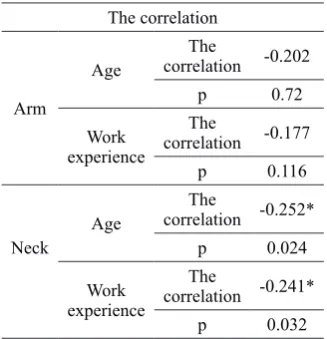
Table 5 Determining the correlation between demographic variables and the prevalence of disorders
The correlation
Arm
Age correlationThe -0.202
p 0.72
Work experience
The
correlation -0.177
p 0.116
Neck
Age correlationThe -0.252*
p 0.024
Work experience
The
correlation -0.241*
p 0.032
Discussion
The results of the statistical test in this study
showed a significant difference between the
two methods of evaluating RULA and OCRA. This is despite the fact that the results of the
RULA study on the basis of the final scores of
physical posture estimation indicate the need for possible changes in the conditions of most work stations and the results of the evaluation by using the OCRA method indicate a desirable and suitable condition. Accepting about 100% of people.
Studies show that the main factors in the assessment of ergonomic errors, posture tests or physical conditions are studied. There are many ways to determine and evaluation posture, particularly in the upper limbs. These
methods are quantitative and semi-quantitative
and are used in different stations to evaluation posture [27]. Among the available methods, two methods of RULA and OCRA have been
identified as methods for evaluating upper
limb posture and have been used in various
studies [15,27-29]. A similar study by Wong
and colleagues among VDU workers at a Hong
Kong bank could be mentioned. The RULA
evaluation results of this study showed that this difference was the most disturbance in the neck region. The employees reported our review of the involvement of wrists [15]; Maybe the
reason for this difference is the variety of jobs and workstations examined in this study, which have resulted in inconsistent results due to the overall similarity of both studies. In the study of the authors of the present study, in the
Khayantan of Yazd, the results of the postural
evaluation using the RULA method were 6.9 or urgent to correct the workstation [30]. What is noteworthy is the type of involvement of the upper limb, especially the hands and the waist circumference of the tailor, which, despite the obvious difference with the type of administrative work in banking has a work station and injury of approximately the same organs, and a curved waist at the time .The task in the heath can be attributed to the increased prevalence of disturbance in the trunk and a higher score and a worse condition than the banker.
On the other hand, the results of the study of Fallah et al. With the aim of evaluating the physical condition of OCRA method as a method for analyzing the actual risk factors, such as recurrence, force, physical condition, additional factors affecting the upper limb evaluation, and subsequent preventive measures among the potters, indicate an
increased risk of skeletal disorders - Muscle
in 70% of the community of potters studied. Statistical analysis shows that among
The scholar's reason for this was the working conditions and the handy of most of the tasks in this type of the workshop than other businesses. On the other hand, the body's high mobility in the performance of the task or the need for a job is elegant and precise, and as a result, the bending of the back and neck, other causes of the situation's deterioration and the difference in results can be regarded as an optimal condition for bankers [28]. Noorani et al In the study of the physical condition of the assembly of gas turbines, with the involvement of upper extremities, most OCRA workstations were assisted. The results showed that the most disturbances in the wrist and shoulder region
are in connection Mechanical-Biological waste Treatment- Mixed Bed Polisher (MBT-MBP)
post. The researcher says the reason for the deteriorating situation and the high prevalence of musculoskeletal disorders, in addition to the inappropriate physical condition is the lack of
layout and sufficient space for the function of
individuals, with the difference that the work stations at the turbine assembly stations are
significantly different from most of the work
stations in the bank [29].
However, the results obtained from the comparison of the two evaluation methods in the present study also indicate that there is no linear correlation between the results
of two methods (p>0.05). In addition, the results of the reliability analysis with α=0.005
for the complete results of the two methods indicate that there is no consistency between the two methods. Perhaps the reasons for the discrepancy between the two methods can be summarized as follows:
Scoring in the OCRA method is based on the number of daily movements, while in the RULA method, the amount of limb movement is considered to be normal. In the RULA method, unlike the OCRA method, which examines only the upper extremity, the leg the position is also involved in the evaluation. Considering that in administrative jobs such as banking, in addition to the involvement of upper organs with repetitive motions, it seems that the OCRA method is more appropriate to
evaluation the risk of these occupations. Among the study limitations, the potential condition (improvement) of employees during the study and evaluation and the history of musculoskeletal disorders in the subjects can be highlighted. It is therefore suggested that the incidence and prevalence of musculoskeletal disorders should be investigated in the study of physical conditions.
Conclusion
Evaluating risk factors in complex work
environments are difficult. In this context, a
wide range of posture evaluation methods are known. The main challenge is to choose the appropriate method or to combine the methods according to the position of application or use. Based on the results obtained in the two methods, the RULA method expresses the level of performance in the second category, requiring possible changes. While the OCRA
method shows this level on the first floor,
it is quite acceptable. Despite the overall similarity to the results obtained from the two evaluation methods, the OCRA method is appropriate and more accurate and is recommended to evaluation of upper limbs in
office jobs such as banking. Therefore, these
two methods can’t be used in evaluations. However, more extensive studies should be undertaken for the sake of certainty.
Acknowledgments
The authors of the paper believe that Mellat Bank's dear manager and all Mellat Bank Branches staff are grateful to us for their main objectives of improving the level of safety and health in this place. This article is the result of a research project with code number 2467 approved by the Yazd university of medical sciences.
Conflict of Interest
"The authors declare that they have no competing interests."
Funding
for the research, authorship and/or publication of this article.
References
1- Warikoo D, Sharma M. Evaluating the Level of Disability,
Deep Cervical Flexor Endurance and Fear Avoidance Beliefs in Bankers with Neck Pain. Online J Health Allied Sci2013; 12(2).
2- Lacerda EM, Nácul LC, Da S Augusto LG, Olinto MTA,
Rocha DC, Wanderley DC. Prevalence and associations of symptoms of upper extremities, repetitive strain injuries
(RSI) and'RSI-like condition'. A cross sectional study of
bank workers in Northeast Brazil. BMC Public Health2005; 5(1): 107.
3- Naqvi M, Zehra M, Nizami GN. Association of
prolong sitting with common musculoskeletal disorders among private and public sector bankers. Pak J Rehabilitation2013;2(2):48-56.
4- Shahnavaz H. Workplace injuries in the developing
countries. Ergonomics1987; 30(2): 397-404.
5- Genaidy A, Al-Shedi A, Shell R. Ergonomic risk
assessment: preliminary guidelines for analysis of repetition, force and posture. J Hum Ergol (Tokyo)1993; 22(1): 45-55. 6- Kemmlert K. Prevention of occupational
musculo-skeletal injuries. Labour Inspectorate investigation. Scand J Rehabil Med Suppl1996; 35: 1-34.
7- Smith DRDR, Sato M, Miyajima T, Mizutani T, Yamagata Z. Musculoskeletal disorders self-reported by female nursing students in central Japan: a complete
cross-sectional survey. Int J Nurs Stud2003; 40(7): 725-9. 8- Maul I, Läubli T, Klipstein A, Krueger H. Course of low
back pain among nurses: a longitudinal study across eight years. Occup Environ Med2003; 60(7): 497-503.
9- Mattila M, Vilki M, Karwowski W, Marras W. OWAS
methods. The O ccupational ergonomics handbook. USA: CRC press LLC; 1999.
10- Bernard BP. Musculoskeletal disorders and workplace
factors: a critical review of epidemiologic evidence for
work-related disorders of the neck, upper extremities, and
low back. Washington, US: NASA; 1997.
11- Kee D, Karwowski W. LUBA: an assessment technique
for postural loading on the upper body based on joint motion discomfort and maximum holding time. Appl Ergon2001;
32(4): 357-66.
12- Linton SJ, Kamwendo K. Risk factors in the psychosocial
work environment for neck and shoulder pain in secretaries. J Occup Med1989; 31(7): 609-13.
13- Carter J, Banister E. Musculoskeletal problems in VDT
work: a review. Ergonomics1994; 37(10): 1623-48.
14- Weiser S. Psychosocial aspects of occupational
musculoskeletal disorders. Musculoskeletal Disorders in the Workplace: Principles and Practice New York, NY: CV Mosby Co; 1997.
15- Yu I, Wong T. Musculoskeletal problems among VDU workers in a Hong Kong bank. Occup Med (Lond)1996;
46(4): 275-80.
16- Makhbul ZKM, Alam SSh, Azmi ShM, Abu Talib N.
Ergonomics and work stress issues in banking sector. Aust J Basic Appl Sci2011; 5(9): 1301-1309.
17- Silva LS, Barreto SM. Adverse psychosocial working
conditions and minor psychiatric disorders among bank workers. BMC Public Health2010; 10: 686.
18- Rocha LE, Glina DMR, Marinho MdF, Nakasato
D. Risk factors for musculoskeletal symptoms among call center operators of a bank in Sao Paulo, Brazil. Ind Health2005; 43(4): 637-46.
19- Nasl SJ, ghafari Setoubadi M, Shahtaheri S. Survey of
correlation between two evaluate method of work related musculoskeletal disorders risk factors REBA& RULA. Iran Occupational Health Journal2006;3(2): 25-32. 20- Li G, Buckle P. Current techniques for evaluating physical exposure to work-related musculoskeletal risks, with emphasis on posture-based methods.
Ergonomics1999; 42(5): 674-95.
21- Choobineh A. Posture evaluation methods in
occupational ergonomics. Tehran: Fanavaran publication Co: 2007.
22- Makhbul ZM, Hasun FM. Gender responses to stress
outcomes. J Glob Manage2011; 1(1): 48-56.
23- Seaton A. Banks and bankers. QJM: An International Journal of Medicine2010; 103(8): 631-2.
24- Roelofs A, Straker L. The experience of
musculoskeletal discomfort amongst bank tellers who just sit, just stand or sit and stand at work. Ergonomics SA2002; 14(2): 11-29.
25- Lueder R, editor. A proposed RULA for computer
users. Proceedings of the ergonomics summer workshop, UC berkeley center for occupational & environmental health continuing education program, San Francisco; 1996.
26- Stanton NA, Hedge A, Brookhuis K, Salas E, Hendrick
HW. The occupational repetitive action (OCRA) methods: OCRA index and OCRA checklist. Handbook of human factors and ergonomics methods. USA:CRC press; 2004.
pp: 171-87.
27- Jafari SM, Fazli B, Noorani M, Sharifpoor Z, Soltani
gerfaramarzi R. Risk assessment of musculoskeletal disorders by RULA method and assessing the effect of ergonomic training on the working postures of the tailors. Occup Med2013; 5(2): 43-50.
28- Fallah H, Khani Jazani R, Barkhordari A, Lahmi M, Halvani G, Movahedi M. Assessment of risk factors for
upper extremity musculoskeletal disorders by OCRA index in Meybod potters in 2009. Occupational Medicine Quarterly Journal2012; 4(1): 34-41.
29- Nurani M, Mehrparvar A, Fazli B, Jafari SM, Taefeh
software in assembly workers of a power station gas turbine manufacturing industry and assessment of ergonomics training effect on reduction of risk level. Journal of Health2014; 4(4): 304-11.
30- David G. Ergonomic methods for evaluating exposure
to risk factors for work-related musculoskeletal disorders.
Occup Med2005; 55(3): 190-9.
31- Colombini D, Grieco A, Occhipinti E. Occupational musculo-skeletal disorders of the upper limbs due to
mechanical overload. Ergonomics1998; 41(9).
Copyright© 2016 ASP Ins. This open-access article is published under the terms of the Creative Commons Attribution-NonCommercial 4.0
International License which permits Share (copy and redistribute the material in any medium or format) and Adapt (remix, transform, and build