Application of Polypyrrole Coated Stainless-Steel Wire to
the Headspace Solid-Phase Microextraction
of Aliphatic Amines
M. Kaykhaii
1,*and F. Saffari
21Department of Chemistry, Faculty of Sciences, Sistan & Balouchestan University, Zahedan 98135-674, Islamic Republic of Iran 2Food, Drug and Hygienic Laboratory, Zahedan University of Medical
Sciences, Zahedan, Islamic Republic of Iran
Abstract
The electrochemical coating technique was used for the preparation of a
polypyrrole coating on a stainless-steel wire, and applied as a fibre for solid phase
microextraction (SPME). The polypyrrole fibre was employed for analyzing four
volatile aliphatic amines (ethylamine, propylamine, butylamine and pentylamine)
in water by headspace SPME using gas chromatography-flame ionization
detection (GC-FID). Results showed that this fibre coating is suitable for the
successful extraction of the target analytes. The effects of the extraction
parameters including exposure time, sampling temperature, salt concentration, and
stirring rate on the extraction efficiency was optimized. Relative standard
deviations (RSDs) was determined
≤
4.3%. The correlation coefficient was
satisfactory (r
2> 0.98) for the studied analytes. Detection limits were between 0.9
and 1.6 µg.L
−1. Good recoveries (99-106 %) were obtained when spiked water
and wastewater samples were analyzed.
Keywords: Capillary gas chromatography; Headspace solid phase microextraction; Volatile aliphatic amines; Polypyrrole coating
*
Corresponding author, Tel.: +98(541)2446413, Fax: +98(541)2446888, E-mail: [email protected] 1. Introduction
Solid-phase microextraction (SPME), as a universal tool for isolation and preconcentration of pollutants from different matrices, was introduced and developed by Pawliszyn and co-workers in the last decade [1]. It uses a fused-silica fibre coated with a sorbent to extract samples and pass analytes directly into a heated injector for gas chromatography (GC) or with a solvent into a high performance liquid chromatography interface.
interactions between water and polar analytes. In this case, polar compounds can be determined by either converting them to less polar, non-ionized forms by pH adjustment or derivatizing them to non-polar species [3,4]. Moreover, Silica fibres are fragile and must be handled with great care. So, more robust SPME fibres with a long life and relative low cost are highly desired.
In recent years, intrinsic conducting polymers with conjugated double bonds have attracted much attention as advanced materials. Since pyrrole and some of its derivatives are commercially available and their stable polymer films can be conveniently prepared on various substrate materials from organic or aqueous media by electrochemical or chemical methods, one of the most studied conducting polymers is polypyrrole (PPy) [5]. In addition, the polymer film can be coated directly on the metal wires. Preparation of conducting polymers coating on metal wires by electrochemical or chemical method is very attractive and will broaden the application of SPME.
Short-chain aliphatic amines are presented widely in the aquatic environment due to their wide spread use in several industrial, chemical and manufacturing applications. These compounds are generated in the production process of plastics, dyes, drugs, textiles, anti-oxidants and by the petrochemical industry [6]. Production of some amines in Western Europe exceeds 100,000 t per year [7]. Aliphatic amines are also common components of biological systems as degradation products of organic materials such as amino acids and proteins. In addition to hygienic problems due to stinging smell, these compounds may be hazardous to human health as they are sensitizers and irritants to skin, eyes, mucus membranes and respiratory tract. Consequently, there is increasing interest in the detection of aliphatic amines in various matrices [8]. To date, a number of approaches have been employed to determine them, including gas chromatography (GC) [9-12], gas sensitive resistor [13], liquid chromatography [14-17], capillary electrophoresis [18], spectrofluo-rimetry [19], spectrophotometry [20] and quartz crystal microbalance sensor [21].
All these methods mentioned above usually need expensive instruments, or involve a number of complicated steps such as derivatization, which is a popular method for overcoming some of the above problems by the formation of less polar compounds, but results in an increase of analysis time and easily leads to side effects [22].
In the present study, polypyrrole film was prepared on the surface of a stainless-steel wire by electro-chemical polymerization and used for the determination of four aliphatic amines in aqueous samples using
headspace SPME process coupled with gas chromato-graphy-flame ionization detection (GC-FID).
2. Material and Methods
2.1. Reagents
Pyrrole (Acros Organics, Belgium) was distillated and stored in refrigerator prior to use. The four aliphatic amines, ethylamine, propylamine, butylamine and pentylamine were obtained from BDH (UK). All other reagents were of analytical grade (Merck, Germany) and used with no further purification. A stock aqueous standard solution (1.0 g.L−1) of each amine was prepared and refrigerated. Working solutions were obtained by gradually diluting the stock solution using de-ionized water before measurement. Glassware was washed by liquid detergent and then with tap water and finally rinsed three times with de-ionized water, to prevent the polar analytes from being adsorbed onto the glass wall.
2.2. Apparatus
A CP-3800 GC system (Varian Inc., USA) equipped with a split injector and a flame ionization detection system was used. The analytes were separated on an CP-Sil 8 CB fused-silica capillary column (30 m × 0.32 mm, 1 µm in film thickness), purchased from the same company (cat. no. 7596). For good resolution of all four aliphatic amines, the oven temperature was initially held at 40°C, programmed at 10°C.min−1 to the temperature of 140°C, held for 5 min. The injector and detector temperature were set at 210 and 250°C, respectively. High purity helium (99.99%) was used as the carrier gas and column head pressure was kept at 11.26 psi. Hydrogen and air were maintained at flow rates of 30 and 300 mL.min−1, respectively. Nitrogen (99.99%) was used as make-up gas at a flow rate of 30 mL.min−1. A SPME holder was purchased from Supelco (USA). Stirring and heating was performed on a MR Hei-Tec™ stirrer purchased from Hydolph (Germany) with a PTFE-coated magnetic stir bar.
2.3. Preparation of SPME Fibre
The stainless steel wire was used as the working electrode and a platinum wire wound into cylindrical shape was utilized as the counter electrode. A double junction saturated calomel electrode was employed as the reference electrode. Electrochemical polymerisation of pyrrole was carried out in nitrogen purged aqueous solution containing 0.05 M pyrrole. A constant deposition potential of +0.8 V was applied for 20 min. After electro-polymerisation, the polymer-coated working electrode was rinsed with de-ionized water, then with methanol for 3 min and dried under nitrogen protection at room temperature. After then, it was preheated at 100°C for 20 min, and finally conditioned at 200°C in a GC injection port under carrier gas protection for an hour before it was used for SPME experiments.
2.4. Headspace Extraction Procedure
A 10-mL aliquot of aqueous solution containing 1.0 µg.mL−1 of each of the target analytes was extracted with PPy fibre using the headspace SPME mode. Samples were placed in 25 mL glass vial with a PTFE-silicon septum during the extractions and were thermostated using a conventional water bath. The fibre was exposed to the headspace over the stirring liquid sample for 5-50 min, depending on the experiment. After extraction, the fibre was transferred to the GC injection port for analytes desorption and further analysis. There are several parameters that control the optimum performance of the extraction such as desorption time and temperature, rate of sample agitation, ionic strength and temperature of the solution, sampling time and pH value of the aqueous samples. The effect of each parameter on extraction was examined. Between each two extraction the fibre was conditioned at 200°C for 10 min to remove the carryover on the fibre.
3. Results and Discussion
3.1. Optimization of Extraction Procedure
3.1.1. Extraction Time
Repeatability and sensitivity of the headspace SPME method highly depends on the status of an analyte distribution between the headspace and the polymeric phase. The extraction time affects the achievement of the equilibrium and therefore was studied. Ten milliliters of a mixture of standard aqueous solutions (1.0 µg.mL−1) were extracted at room temperature (∼25°C) under stirring for a series of the exposure time
from 5 to 50 min. The peak height of each compound was plotted with the corresponding extraction time (Fig. 1). The peak heights increased with the length of the extraction time. However, this increase was quite small except for the first 15 min. For routine rapid analysis, a 20 min extraction was sufficient if constant operation conditions were maintained.
3.1.2. Desorption Time
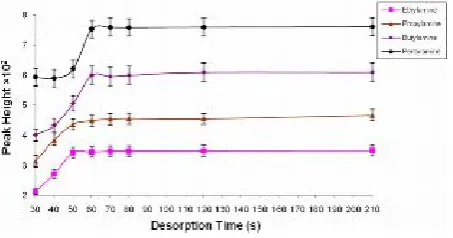
Desorption time determines when analytes are completely released to GC column. This parameter was studied by a similar experimental procedure as described in the previous section. The tested desorption time was in the range of 30 s to 3.5 min. Figure 2 shows the effect of desorption time on peak height. As can be seen, at first, peak heights increase with the increase of desorption time and then approach a plateau, where the exhaustive desorption was reached. Hence, 1 min was chosen as desorption time.
Figure 1. The effect of extraction time on the extraction efficiency.
3.1.3. Sampling Temperature
The effect of stirring temperature was studied by exposing PPy fibre for 15 minutes in the headspace at 15-55°C. Measurements were performed on aqueous solution containing 1.0 µg.mL−1 of each analyte. The extraction curves showed that except ethylamine, the amount of analyte absorbed, increases with increase in temperature up to 45°C (Fig. 3). For ethylamine, however, this temperature is 40°C. This can be explained by the fact that at higher temperatures, the vapor pressure of the analytes and hence their concentrations in headspace increase. Above the temperature mentioned, the amounts of analytes extracted decreases, probably due to a decreased partition coefficient of analytes between headspace and fibre, because adsorption is generally an exothermic process [24]. Therefore, the optimum sampling temperature for a fixed extraction time of 15 minutes was 45°C.
3.1.4. Stirring Rate
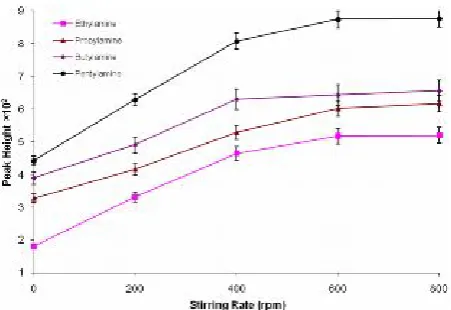
Sampling agitation enhances extraction process and reduces extraction time because the equilibrium between the aqueous and vapor phases can be achieved more rapidly [25]. Mass transfer in the headspace is assumed to be a fast process, because diffusion coefficients in the gas phase are typically ~104 times greater than corresponding diffusion coefficients in condensed phase [8]. Furthermore, convection is induced in the headspace by the stirring of the aqueous phase. For the purpose of the present study, three replicate analyses were taken at five different stirring rates: 0 (static case), 200, 400, 600 and 800 rpm. The results show clearly that stirring produces a dramatic increase in the analytical signal when compared to the stagnant case. As can be seen in Figure 4, the peak heights of all analytes increase with increase in the stirring rates up to 600 rpm. At 600 rpm the peak heights of the analytes remain almost constant; hence a stirring rate of 600 rpm was chosen for further works.
3.1.5. Ionic Strength of Solution and pH
The pH of the donor phase is important to some extent in headspace SPME. Due to the basic nature of the analytes, the sample pH should be sufficiently alkaline to keep the analytes in the molecular form. Thus, the base potassium hydroxide was added in the donor phase to evaluate its effect. Extractions were done on 1.0 µg.mL−1 concentrations of each analyte at 600 rpm stirring speed at 45°C. A plot of peak height versus extraction time showed that the best results were obtained for an extraction pH of 8.5 (Fig. 5). As can be seen, high pH value did not enhance the sensitivity. This
might be explained by assuming that the addition of base may prolong the extraction time because diffusion and adsorption of the analytes were slower than in pure water [26].
The salting-out effect has been used universally in SPME. Generally, addition of salt decreases the solubility of analytes in the sample matrix, allowing more analyte to move to the sample headspace and thus enhancing the extraction efficiency [27]. The effect of increasing the ionic strength of the water sample was evaluated by adding NaCl. An amount between 0.15 and 0.35 g.mL−1 of NaCl was added to the spiked water samples at a concentration level of about 1.0 µg.mL−1 for the analytes studied. Figure 6 shows the dependence
Figure 3. Influence of the temperature on the signal intensity of the aliphatic amines' extraction.
of analytes signals versus salt concentration. It is evident from the figure that the optimum NaCl concentration for the extraction of the analytes was considered to be 0.35 g.mL−1 (close to saturation) and so it was adopted in subsequent experiments.
3.2. Quantitative Analysis
The analytical performance characteristics of the headspace SPME procedure, under optimum conditions, were evaluated and are shown in Table 1. To determine the repeatability, seven replicate experiments were carried out by extracting a spiked water sample (500.0 µg.L−1) of each compound. The relative standard deviations (RSDs) were between 3.6 and 4.3%. The linearity of the method was tested using target aliphatic amines in the concentration range of 90-1600 µg.L−1. For each level, three replicate extractions and determinations were performed. This method showed a good linear behavior in the tested range, with correlation coefficients ranging between 0.981 and 0.991. The enrichment factor, defined as the ratio of peak heights after extraction and that before extraction [28], was calculated using the average of the three trials obtained for 500.0 µg.L−1 concentration level. The enrichment factors of the proposed method ranged from 170 to 234. Limits of detection (LODs) calculated as three times the baseline noise, were in the range of 0.9-1.6 µg.L−1 (Table 1).
3.3. Real Sample Analysis
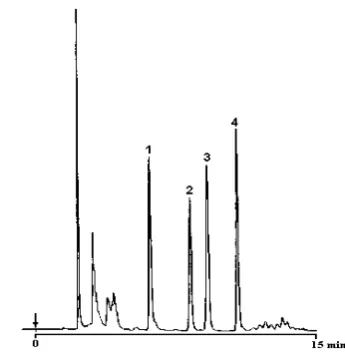
The described method was applied to the analysis of tap and wastewater samples. Wastewater was collected at sewage outfall of wastewater treatment of the university. Samples were spiked to produce 500.0 µg.L−1 concentration, in order to check the matrix effect on determination. Unspiked samples were also processed. The chromatograms obtained for the spiked samples are similar to those obtained for standard solutions and no interferences were observed from other compounds potentially present in the sample (e.g., ammonia). Figure 7 presents a chromatogram of a wastewater sample by GC–FID following headspace SPME with PPy fibre. The four amines were identified according to their retention times. None of the amines investigated were detected in the tested samples. The concentrations for the spiked samples calculated and the recovery results are summarized in Table 2. Acceptable recoveries (99-106 %) were obtained for all analytes in the two tested samples. This reveals the reliability and feasibility of the proposed method.
Figure 5. Effect of the pH change on extraction efficiency.
6.5 7.5 8.5 9.5 10.5 11.5
0.00 0.15 0.20 0.25 0.30 0.35
NaCl (g.mL-1
)
P
e
ak
H
ei
g
ht
×10
2
Ethylamine
Butylamine
Propylamin e Pentylamin e
Figure 6. Effect of ionic strength on the extraction of target analytes.
Table 1. Validation data for the analysis of short chain aliphatic amines with headspace-SPME-GC-FID using PPy fiber
Compound LOD
(µg.L−1)
Linear range (µg.L−1)
RSD (%) n = 7 (500.0 µg.L−1)
r2 Enrichment factor (%)
(500.0 µg.L−1)
Ethylamine 1.6 90-1600 3.9 0.981 202
Propylamine 1.4 100-1500 4.3 0.984 234
Butylamine 1.1 100-1500 3.5 0.989 196
Pentylamine 0.9 150-1400 3.4 0.991 170
Table 2. Recoveries of aliphatic amines from tap and wastewater, spiked with 500.0 µg.L−1 of each analyte (n = 5)
Compound Tap water Wastewater
Found Recovery (%) Found Recovery (%)
Ethylamine No detection 98 No detection 99
Propylamine No detection 101 No detection 105
Butylamine No detection 108 No detection 106
Pentylamine No detection 102 No detection 102
Polypyrrole-coated SPME fibre can be used for the simultaneous extraction of several aliphatic amines in a sample. The proposed method has advantages such as simplicity, good accuracy and precision, relatively short extraction time, low cost, large preconcentration factors and no organic solvent consumption. Comparison of the present work with the latest studies on simultaneous determination of aliphatic amines in water samples by various extraction techniques, i.e., ion-pair extraction [29], solid-phase extraction [30], headspace single-drop microextraction [8,31]; and derivatization techniques [9], using gas chromatography, shows that the method described in this study has satisfactory accuracy and good reproducibility for the qualitative and quantitative determination of the target analytes and the detection limits (S/N = 3) for all methods are in the same range.
References
1. Arthur C.L. and Pawliszyn J. Solid phase microextraction with thermal desorption using fused silica optical fibres.
Anal. Chem.,62: 2145-2153 (1990).
2. Pawliszyn J. Applications of Solid Phase Microextraction. The Royal Society of Chemistry, United Kingdom, 656 p. (1999).
3. Wu J. and Pawliszyn J. Preparation and applications of polypyrrole films in solid-phase microextraction. J. Chromatogr., A 909: 37-52 (2001).
4. Wu J. and Pawliszyn J. Polypyrrole-Coated Capillary Coupled to HPLC for In-Tube Solid-Phase Microextraction and Analysis of Aromatic Compounds in Aqueous Samples.Anal. Chem.,73: 55-63 (2001). 5. Cortina-Puig M., Munoz-Berbel X., del Valle M., Munoz
F.J., and Alonso-Lomillo M.A. Characterization of an
ion-selective polypyrrole coating and application to the joint determination of potassium, sodium and ammonium by electrochemical impedance spectroscopy and partial least squares method. Anal. Chim. Acta, 597: 231-237 (2007).
6. Abalos M., Bayona J.M., and Ventura F. Development of a Solid-Phase Microextraction GC-NPD Procedure for the Determination of Free Volatile Amines in Wastewater and Sewage-Polluted Waters. Anal. Chem., 71: 3531-3537 (1999).
7. Namiesnik J., Jastrzebska A., and Zygmunt B. Determination of volatile aliphatic amines in air by solid-phase microextraction coupled with gas chromatography with flame ionization detection;J. Chromatogr.,A1016: 1-9 (2003).
8. Kaykhaii M., Nazari S., and Chamsaz M. Determination of aliphatic amines in water by gas chromatography using headspace solvent microextraction.Talanta, 65: 223-228 (2005).
9. Zhao Y.Y., Jing Z.Z., Wang H., Zhang H.S., and Yu J.X. N-Hydroxysuccinimidyl phenylacetate as a novel derivatizing reagent for aliphatic amines in gas chromatography. Anal. Chim. Acta,468: 255-361 (2002). 10. Pan L., Chong J.M., and Pawliszyn J. Determination of
amines in air and water using derivatization combined with solid-phase microextraction.J. Chromatogr., A 773: 249-260 (1997).
11. Sacher F., Lenz S., and Brauch H.J. Analysis of primary and secondary aliphatic amines in waste water and surface water by gas chromatography-mass spectrometry after derivatization with 2,4-dinitrofluorobenzene or benzenesulfonyl chloride.Ibid., A764: 85-93 (1997). 12. Zhao Y.Y., Cai L.S., Jing Z.Z., Wang H., Yu J.X., and
13. Costello B.P.J.D., Evans P., and Ratcliffe N.M. Preparation of polypyrrole composites and the effect of volatile amines on their electrical properties. Analyst, 121: 793-797 (1996).
14. Sahasrabuddhey B., Jain A., and Verma K.K. Determination of ammonia and aliphatic amines in environmental aqueous samples utilizing pre-column derivatization to their phenylthioureas and high performance liquid chromatography.Analyst,124: 1017-1021 (1999).
15. Misiego A.S., Gil E.P., and Lomba J.R.G. Determination of aliphatic amines by high performance liquid chromatography with amperometric detection after derivatization with phenylisothiocyanate. Electroanalysis, 12: 459-464 (2000).
16. Meseguer Lloret S., Molins Legua C., and Campins Falcó P. Preconcentration and dansylation of aliphatic amines using C18 solid-phase packings: Application to the
screening analysis in environmental water samples. J. Chromatogr., A978: 59-69 (2002).
17. Meseguer Lloret S., Molins Legua C., Verdú Andrés J., Campins Falcó P. Sensitive determination of aliphatic amines in water by high-performance liquid chromatography with chemiluminescence detection.Ibid.,
A 1035: 75-82 (2004).
18. Dabek-Zlotorzynska E., and Maruszak W. Determination of dimethylamine and other low-molecular-mass amines using capillary electrophoresis with laser-induced fluorescence detection. Ibid., B714: 77-85 (1998). 19. Cao L.W., Wang H., Liu X., and Zhang H.S.
Spectrofluorimetric determination of aliphatic amines using a new fluorigenic reagent: 2,6-dimethylquinoline-4-(N-succinimidyl)-formate. Talanta,59: 973-979 (2003). 20. Siddiqi Z.M., and Pathania D. Rapid, selective and direct
spectrophotometeric determination of aliphatic amines with m-dinitrobenzene. Talanta,60: 1197-1203 (2003). 21. Mirmohseni A., and Oladegaragoze A. Construction of a
sensor for determination of ammonia and aliphatic amines using polyvinylpyrrolidone coated quartz crystal microbalance.Sens. Actuators, B89: 164-172 (2003). 22. Li X., Zeng Z., Zhou J., Gong S., Wang W., and Chen Y.
Novel fiber coated with amide bridged-calix[4]arene used for solid-phase microextraction of aliphatic amines.Ibid., A1041: 1-9 (2004).
23. Deng Z., Stone D.C., and Thompson M. Characterization of Polymer Films of Pyrrole Derivatives for Chemical Sensing by Cyclic Voltammetry, X-ray Photoelectron Spectroscopy and Vapour Sorption Studies.Analyst,122: 1129-1138 (1997).
24. Kaykhaii M. and Rahmani M. Headspace Liquid Phase Microextraction (HS-LPME) for Quantitation of Hexanal in Potato Crisps Using Gas Chromatography.J. Sep. Sci., 30: 573-578 (2007).
25. Kaykhaii M., and Moradi M. Direct screening of water samples for benzene hydrocarbon compounds by headspace liquid phase microextraction - gas chromatography. J. Chromatogr. Sci., 46: 413-418 (2008).
26. Buchholz K.D., and Pawliszyn J. Determination of phenols by solid-phase microextraction and gas chromatographic analysis. Eviron. Sci. Technol., 27: (1993) 2844-2848.
27. Nagaraju D., and Huang S. Determination of triazine herbicides in aqueous samples by dispersive liquid-liquid microextraction with gas chromatography-ion trap mass spectrometry.J. Chromatogr.,A1161: 89-97 (2007). 28. Melwanki M.B., Hsu W., and Huang S. Determination of
clenbuterol in urine using headspace solid phase microextraction or liquid-liquid-liquid microextraction.
Anal. Chim. Acta,552: 67-75 (2005).
29. Mehmet M., and Ata S., Simultaneous determination of aliphatic and aromatic amines in water and sediment samples by ion-pair extraction and gas chromatography-mass spectrometry. J. Chromatogr., A 1129: 88-94 (2006).
30. Sanjeev S., Singh V., Jain A., and Krishna K. Verma K.K. Simultaneous determination of ammonia, aliphatic amines, aromatic amines and phenols at mg l21 levels in environmental waters by solid-phase extraction of their benzoyl derivatives and gas chromatography-mass spectrometry.Analyst,126: 1663-1668 (2001).