Copyright © 2008 Pearson Education, Inc., publishing as Pearson Benjamin Cummings
PowerPoint® Lecture Presentations for
Biology
Eighth EditionNeil Campbell and Jane Reece
Lectures by Chris Romero, updated by Erin Barley with contributions from Joan Sharp
Chapter 17
Chapter 17
Overview: The Flow of Genetic Information
• The information content of DNA is in the form
of specific sequences of nucleotides
• The DNA inherited by an organism leads to
specific traits by dictating the synthesis of proteins
• Proteins are the links between genotype and
phenotype
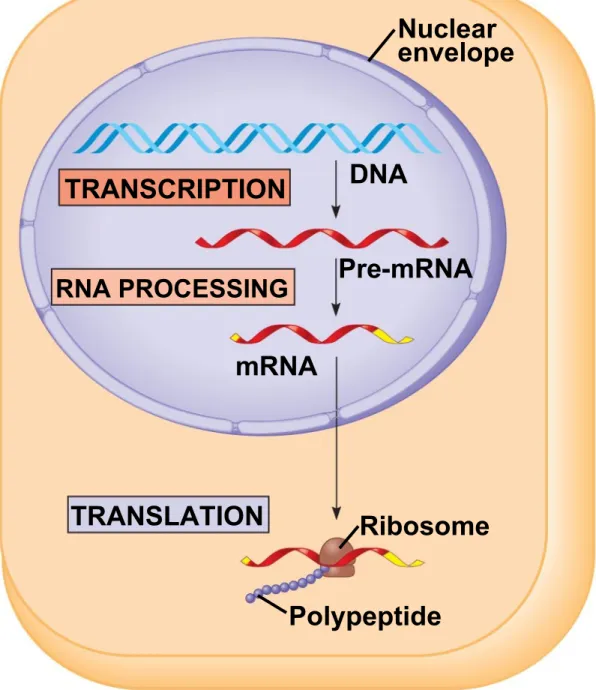
• Gene expression, the process by which DNA directs protein synthesis, includes two stages: transcription and translation
Concept 17.1: Genes specify proteins via transcription and translation
• How was the fundamental relationship between
genes and proteins discovered?
Evidence from the Study of Metabolic Defects
• In 1909, British physician Archibald Garrod first
suggested that genes dictate phenotypes through enzymes that catalyze specific chemical reactions
• He thought symptoms of an inherited disease
reflect an inability to synthesize a certain enzyme
• Linking genes to enzymes required
understanding that cells synthesize and degrade molecules in a series of steps, a metabolic pathway
Nutritional Mutants in Neurospora: Scientific Inquiry
• George Beadle and Edward Tatum exposed
bread mold to X-rays, creating mutants that
were unable to survive on minimal medium as a result of inability to synthesize certain
molecules
• Using crosses, they identified three classes of
arginine-deficient mutants, each lacking a different enzyme necessary for synthesizing arginine
• They developed a one gene–one enzyme
hypothesis, which states that each gene dictates production of a specific enzyme
The Products of Gene Expression: A Developing Story
• Some proteins aren’t enzymes, so researchers
later revised the hypothesis: one gene–one
protein
• Many proteins are composed of several
polypeptides, each of which has its own gene
• Therefore, Beadle and Tatum’s hypothesis is
now restated as the one gene–one polypeptide
hypothesis
• Note that it is common to refer to gene
products as proteins rather than polypeptides
Basic Principles of Transcription and Translation
• RNA is the intermediate between genes and
the proteins for which they code
• Transcription is the synthesis of RNA under
the direction of DNA
• Transcription produces messenger RNA
(mRNA)
• Translation is the synthesis of a polypeptide, which occurs under the direction of mRNA
• Ribosomes are the sites of translation
• In prokaryotes, mRNA produced by
transcription is immediately translated without more processing
• In a eukaryotic cell, the nuclear envelope
separates transcription from translation
• Eukaryotic RNA transcripts are modified
through RNA processing to yield finished
mRNA
• A primary transcript is the initial RNA transcript from any gene
• The central dogma is the concept that cells are
governed by a cellular chain of command: DNA
RNA protein
Fig. 17-3b-3
(b) Eukaryotic cell
TRANSCRIPTION
Nuclear envelope
DNA
Pre-mRNA
RNA PROCESSING
mRNA
TRANSLATION Ribosome
The Genetic Code
• How are the instructions for assembling amino
acids into proteins encoded into DNA?
• There are 20 amino acids, but there are only
four nucleotide bases in DNA
• How many bases correspond to an amino
acid?
Codons: Triplets of Bases
• The flow of information from gene to protein is
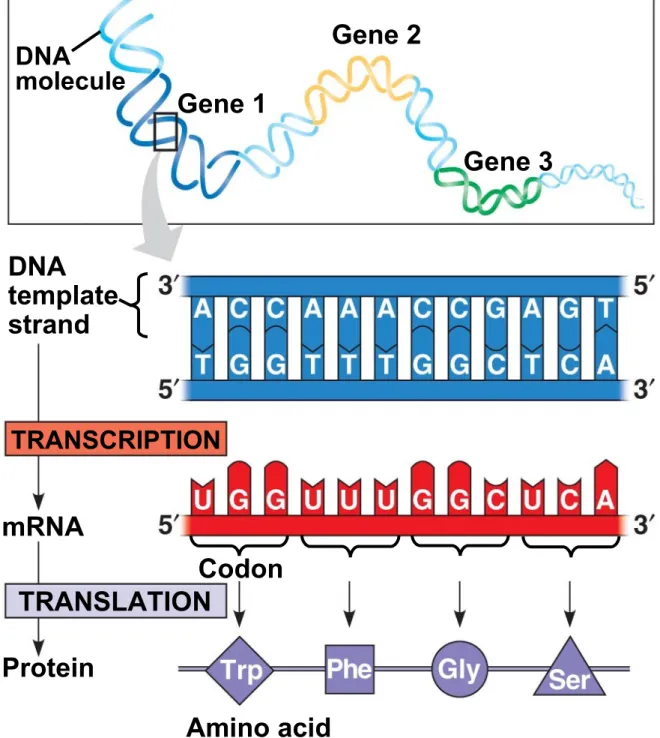
based on a triplet code: a series of
nonoverlapping, three-nucleotide words
• These triplets are the smallest units of uniform
length that can code for all the amino acids
• Example: AGT at a particular position on a
DNA strand results in the placement of the
amino acid serine at the corresponding position of the polypeptide to be produced
• During transcription, one of the two DNA
strands called the template strand provides a
template for ordering the sequence of nucleotides in an RNA transcript
• During translation, the mRNA base triplets,
called codons, are read in the 5 to 3 direction
• Each codon specifies the amino acid to be
placed at the corresponding position along a polypeptide
• Codons along an mRNA molecule are read by translation machinery in the 5 to 3 direction
• Each codon specifies the addition of one of 20
amino acids
Fig. 17-4
DNA
molecule
Gene 1
Gene 2
Gene 3
DNA
template strand
TRANSCRIPTION
TRANSLATION mRNA
Protein
Codon
Cracking the Code
• All 64 codons were deciphered by the
mid-1960s
• Of the 64 triplets, 61 code for amino acids; 3
triplets are “stop” signals to end translation
• The genetic code is redundant but not
ambiguous; no codon specifies more than one amino acid
• Codons must be read in the correct reading
frame (correct groupings) in order for the specified polypeptide to be produced
Fig. 17-5
Second mRNA base
Evolution of the Genetic Code
• The genetic code is nearly universal, shared by
the simplest bacteria to the most complex animals
• Genes can be transcribed and translated after
being transplanted from one species to another
Concept 17.2: Transcription is the DNA-directed synthesis of RNA: a closer look
• Transcription, the first stage of gene
expression, can be examined in more detail
Molecular Components of Transcription
• RNA synthesis is catalyzed by RNA
polymerase, which pries the DNA strands
apart and hooks together the RNA nucleotides
• RNA synthesis follows the same base-pairing
rules as DNA, except uracil substitutes for thymine
• The DNA sequence where RNA polymerase
attaches is called the promoter; in bacteria,
the sequence signaling the end of transcription
is called the terminator
• The stretch of DNA that is transcribed is called
a transcription unit
Copyright © 2008 Pearson Education Inc., publishing as Pearson Benjamin Cummings
Animation: Transcription
Fig. 17-7a-4
Promoter Transcription unit
DNA Start point RNA polymerase 5 5 3 3 Initiation
3 3
1
RNA transcript 5
5 Unwound DNA Template strand of DNA 2 Elongation Rewound DNA 5
5 5
3 3 3
RNA transcript
3 Termination
5
5
5
3 3
3
Fig. 17-7b
Elongation
RNA
polymerase
Nontemplate strand of DNA
RNA nucleotides
3 end
Direction of transcription
(“downstream”) Template
strand of DNA Newly made
RNA
3
5
Synthesis of an RNA Transcript
• The three stages of transcription:
– Initiation
– Elongation
– Termination
RNA Polymerase Binding and Initiation of Transcription
• Promoters signal the initiation of RNA
synthesis
• Transcription factors mediate the binding of RNA polymerase and the initiation of
transcription
• The completed assembly of transcription
factors and RNA polymerase II bound to a
promoter is called a transcription initiation
complex
• A promoter called a TATA box is crucial in
forming the initiation complex in eukaryotes
Fig. 17-8
A eukaryotic promoter includes a TATA box
3
1
2
3
Promoter
TATA box Start point
Template Template DNA strand 5 3 5 Transcription factors
Several transcription factors must bind to the DNA before RNA
polymerase II can do so.
5
5
3 3
Additional transcription factors bind to the DNA along with RNA polymerase II,
forming the transcription initiation complex. RNA polymerase II
Transcription factors
5
5 5
3 3
Elongation of the RNA Strand
• As RNA polymerase moves along the DNA, it
untwists the double helix, 10 to 20 bases at a time
• Transcription progresses at a rate of 40
nucleotides per second in eukaryotes
• A gene can be transcribed simultaneously by
several RNA polymerases
Termination of Transcription
• The mechanisms of termination are different in
bacteria and eukaryotes
• In bacteria, the polymerase stops transcription
at the end of the terminator
• In eukaryotes, the polymerase continues
transcription after the pre-mRNA is cleaved from the growing RNA chain; the polymerase eventually falls off the DNA
Concept 17.3: Eukaryotic cells modify RNA after transcription
• Enzymes in the eukaryotic nucleus modify
pre-mRNA before the genetic messages are dispatched to the cytoplasm
• During RNA processing, both ends of the
primary transcript are usually altered
• Also, usually some interior parts of the
molecule are cut out, and the other parts spliced together
Alteration of mRNA Ends
• Each end of a pre-mRNA molecule is modified
in a particular way:
– The 5 end receives a modified nucleotide 5 cap
– The 3 end gets a poly-A tail
• These modifications share several functions:
– They seem to facilitate the export of mRNA
– They protect mRNA from hydrolytic enzymes
– They help ribosomes attach to the 5 end
Fig. 17-9
Protein-coding segment Polyadenylation signal 3
3 UTR 5 UTR
5
5 Cap Start codon Stop codon Poly-A tail
Split Genes and RNA Splicing
• Most eukaryotic genes and their RNA
transcripts have long noncoding stretches of nucleotides that lie between coding regions
• These noncoding regions are called
intervening sequences, or introns
• The other regions are called exons because
they are eventually expressed, usually translated into amino acid sequences
• RNA splicing removes introns and joins exons, creating an mRNA molecule with a continuous coding sequence
Fig. 17-10
Pre-mRNA
mRNA
Coding segment
Introns cut out and exons spliced together
5 Cap
Exon Intron 5
1 30 31 104
Exon Intron 105 Exon 146 3 Poly-A tail Poly-A tail 5 Cap
• In some cases, RNA splicing is carried out by spliceosomes
• Spliceosomes consist of a variety of proteins
and several small nuclear ribonucleoproteins (snRNPs) that recognize the splice sites
Fig. 17-11-3
RNA transcript (pre-mRNA)
Exon 1 Intron Exon 2
Protein snRNA
snRNPs
Other proteins 5
5
Spliceosome
Spliceosome components
Cut-out intron mRNA
Ribozymes
• Ribozymes are catalytic RNA molecules that function as enzymes and can splice RNA
• The discovery of ribozymes rendered obsolete
the belief that all biological catalysts were proteins
• Three properties of RNA enable it to function as an enzyme
– It can form a three-dimensional structure because of its ability to base pair with itself
– Some bases in RNA contain functional groups
– RNA may hydrogen-bond with other nucleic acid molecules
The Functional and Evolutionary Importance of Introns
• Some genes can encode more than one kind of
polypeptide, depending on which segments are treated as exons during RNA splicing
• Such variations are called alternative RNA
splicing
• Because of alternative splicing, the number of
different proteins an organism can produce is much greater than its number of genes
• Proteins often have a modular architecture
consisting of discrete regions called domains
• In many cases, different exons code for the
different domains in a protein
• Exon shuffling may result in the evolution of
new proteins
Fig. 17-12
Gene DNA
Exon 1 Intron Exon 2 Intron Exon 3
Transcription
RNA processing
Translation
Domain 2
Domain 3
Domain 1
Concept 17.4: Translation is the RNA-directed synthesis of a polypeptide: a closer look
• The translation of mRNA to protein can be
examined in more detail
Molecular Components of Translation
• A cell translates an mRNA message into
protein with the help of transfer RNA (tRNA)
• Molecules of tRNA are not identical:
– Each carries a specific amino acid on one end
– Each has an anticodon on the other end; the anticodon base-pairs with a complementary codon on mRNA
Copyright © 2008 Pearson Education Inc., publishing as Pearson Benjamin Cummings
BioFlix: Protein Synthesis
Fig. 17-13
Polypeptide
Ribosome
Amino acids
tRNA with amino acid attached
tRNA
Anticodon
Trp
Phe Gly
Codons 3
5
The Structure and Function of Transfer RNA
A C C
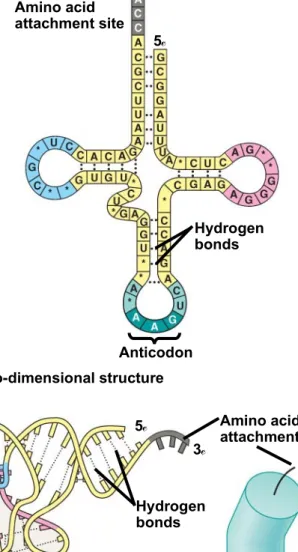
• A tRNA molecule consists of a single RNA
strand that is only about 80 nucleotides long
• Flattened into one plane to reveal its base
pairing, a tRNA molecule looks like a cloverleaf
Fig. 17-14 Amino acid attachment site 3 5 Hydrogen bonds Anticodon (a) Two-dimensional structure
Amino acid attachment site 5 3 Hydrogen bonds
3 5
Anticodon Anticodon
• Because of hydrogen bonds, tRNA actually twists and folds into a three-dimensional
molecule
• tRNA is roughly L-shaped
• Accurate translation requires two steps:
– First: a correct match between a tRNA and an amino acid, done by the enzyme aminoacyl-tRNA synthetase
– Second: a correct match between the tRNA anticodon and an mRNA codon
• Flexible pairing at the third base of a codon is
called wobble and allows some tRNAs to bind
to more than one codon
Fig. 17-15-4
Amino acid Aminoacyl-tRNA synthetase (enzyme)
ATP
Adenosine
P P P
Ribosomes
• Ribosomes facilitate specific coupling of tRNA
anticodons with mRNA codons in protein synthesis
• The two ribosomal subunits (large and small)
are made of proteins and ribosomal RNA
(rRNA)
Fig. 17-16
Growing
polypeptide Exit tunnel
Large subunit Small subunit tRNA molecules E PA mRNA
5 3
(a) Computer model of functioning ribosome
P site (Peptidyl-tRNA binding site)
E site (Exit site)
A site (Aminoacyl-tRNA binding site)
E P A Large subunit mRNA
binding site Smallsubunit
(b) Schematic model showing binding sites
Amino end Growing polypeptide Next amino acid to be added to polypeptide chain
mRNA E tRNA3
5 Codons
• A ribosome has three binding sites for tRNA:
– The P site holds the tRNA that carries the
growing polypeptide chain
– The A site holds the tRNA that carries the next
amino acid to be added to the chain
– The E site is the exit site, where discharged
tRNAs leave the ribosome
Building a Polypeptide
• The three stages of translation:
– Initiation
– Elongation
– Termination
• All three stages require protein “factors” that
aid in the translation process
Ribosome Association and Initiation of Translation
• The initiation stage of translation brings
together mRNA, a tRNA with the first amino acid, and the two ribosomal subunits
• First, a small ribosomal subunit binds with
mRNA and a special initiator tRNA
• Then the small subunit moves along the mRNA
until it reaches the start codon (AUG)
• Proteins called initiation factors bring in the
large subunit that completes the translation initiation complex
Fig. 17-17 3 3 5 5 U U A A C G Met GTP GDP Initiator tRNA mRNA
5 3
Start codon
mRNA binding site
Small
ribosomal subunit
5
P site
Elongation of the Polypeptide Chain
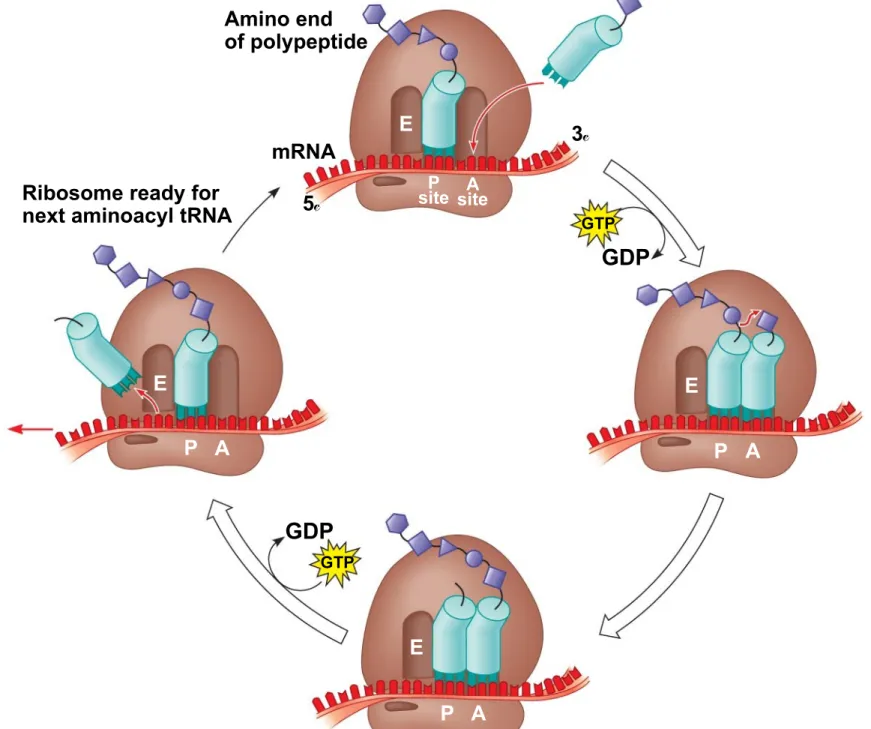
• During the elongation stage, amino acids are
added one by one to the preceding amino acid
• Each addition involves proteins called
elongation factors and occurs in three steps:
codon recognition, peptide bond formation, and translocation
Fig. 17-18-4 Amino end of polypeptide mRNA 5 3 E P site siteA
GTP GDP E P A E P A GDP GTP Ribosome ready for
next aminoacyl tRNA
E
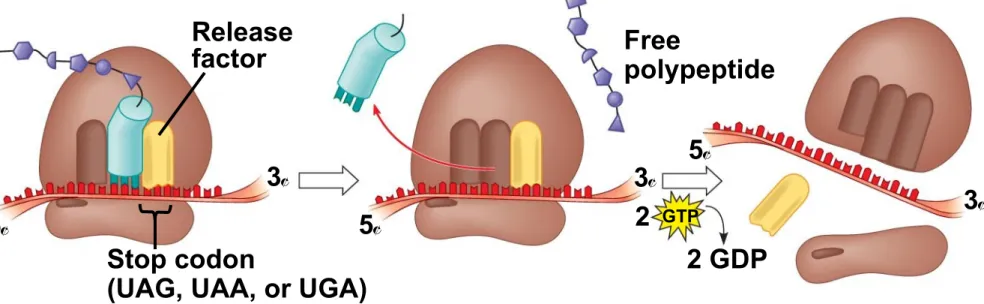
Termination of Translation
• Termination occurs when a stop codon in the
mRNA reaches the A site of the ribosome
• The A site accepts a protein called a release
factor
• The release factor causes the addition of a
water molecule instead of an amino acid
• This reaction releases the polypeptide, and the
translation assembly then comes apart
Copyright © 2008 Pearson Education Inc., publishing as Pearson Benjamin Cummings
Animation: Translation
Fig. 17-19-3
Release factor
3 5
Stop codon
(UAG, UAA, or UGA) 5
3
2 Free
polypeptide
2 GDP
GTP
5
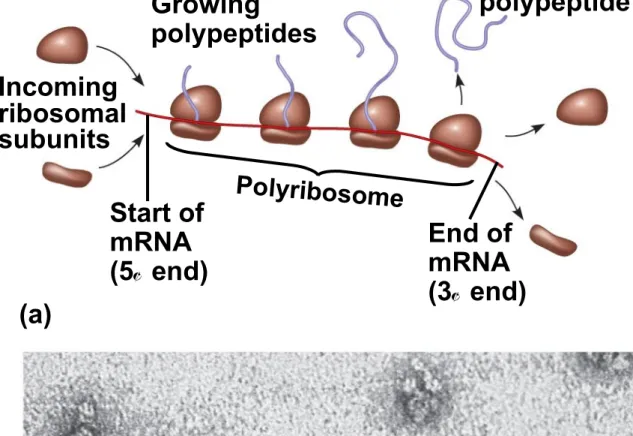
Polyribosomes
• A number of ribosomes can translate a single
mRNA simultaneously, forming a
polyribosome (or polysome)
• Polyribosomes enable a cell to make many
copies of a polypeptide very quickly
Fig. 17-20
Growing
polypeptides
Completed polypeptide
Incoming ribosomal subunits
Start of mRNA (5 end)
Polyribosome
End of mRNA (3 end) (a)
Ribosomes
mRNA
Completing and Targeting the Functional Protein
• Often translation is not sufficient to make a
functional protein
• Polypeptide chains are modified after
translation
• Completed proteins are targeted to specific
sites in the cell
Protein Folding and Post-Translational Modifications
• During and after synthesis, a polypeptide chain
spontaneously coils and folds into its three-dimensional shape
• Proteins may also require post-translational
modifications before doing their job
• Some polypeptides are activated by enzymes
that cleave them
• Other polypeptides come together to form the
subunits of a protein
Targeting Polypeptides to Specific Locations
• Two populations of ribosomes are evident in
cells: free ribsomes (in the cytosol) and bound ribosomes (attached to the ER)
• Free ribosomes mostly synthesize proteins that
function in the cytosol
• Bound ribosomes make proteins of the
endomembrane system and proteins that are secreted from the cell
• Ribosomes are identical and can switch from
free to bound
• Polypeptide synthesis always begins in the cytosol
• Synthesis finishes in the cytosol unless the
polypeptide signals the ribosome to attach to the ER
• Polypeptides destined for the ER or for
secretion are marked by a signal peptide
• A signal-recognition particle (SRP) binds to the signal peptide
• The SRP brings the signal peptide and its
ribosome to the ER
Concept 17.5: Point mutations can affect protein
structure and function
• Mutations are changes in the genetic material of a cell or virus
• Point mutations are chemical changes in just one base pair of a gene
• The change of a single nucleotide in a DNA
template strand can lead to the production of an abnormal protein
Fig. 17-22
Wild-type hemoglobin DNA
mRNA
Mutant hemoglobin DNA
mRNA 3 3 3 3 3 3 5 5 5 5 5 5
C T T C T
T
G A A G A
A
A A G A
G U
Normal hemoglobin Sickle-cell hemoglobin
Types of Point Mutations
• Point mutations within a gene can be divided
into two general categories
– Base-pair substitutions
– Base-pair insertions or deletions
Fig. 17-23e
Wild type DNA template
strand 53 mRNA Protein 5 Amino end Stop Carboxyl end 5 3 3 missing missing 3 3 3 5 5 5
Substitutions
• A base-pair substitution replaces one
nucleotide and its partner with another pair of nucleotides
• Silent mutations have no effect on the amino
acid produced by a codon because of redundancy in the genetic code
• Missense mutations still code for an amino acid, but not necessarily the right amino acid
• Nonsense mutations change an amino acid
codon into a stop codon, nearly always leading to a nonfunctional protein
Insertions and Deletions
• Insertions and deletions are additions or losses of nucleotide pairs in a gene
• These mutations have a disastrous effect on
the resulting protein more often than substitutions do
• Insertion or deletion of nucleotides may alter
the reading frame, producing a frameshift
mutation
Mutagens
• Spontaneous mutations can occur during DNA
replication, recombination, or repair
• Mutagens are physical or chemical agents that can cause mutations
Concept 17.6: While gene expression differs among the domains of life, the concept of a gene is universal
• Archaea are prokaryotes, but share many
features of gene expression with eukaryotes
Comparing Gene Expression in Bacteria, Archaea, and Eukarya
• Bacteria and eukarya differ in their RNA
polymerases, termination of transcription and ribosomes; archaea tend to resemble eukarya in these respects
• Bacteria can simultaneously transcribe and
translate the same gene
• In eukarya, transcription and translation are
separated by the nuclear envelope
• In archaea, transcription and translation are
likely coupled
Fig. 17-24
RNA polymerase
DNA
Polyribosome
mRNA
0.25 µm Direction of
transcription
DNA RNA
polymerase
Polyribosome
Polypeptide (amino end)
Ribosome
What Is a Gene? Revisiting the Question
• The idea of the gene itself is a unifying concept
of life
• We have considered a gene as:
– A discrete unit of inheritance
– A region of specific nucleotide sequence in a
chromosome
– A DNA sequence that codes for a specific polypeptide chain
Fig. 17-25 TRANSCRIPTION RNA PROCESSING DNA RNA transcript 3
5 RNApolymerase
Po ly-A Poly-A RNA transcript (pre-mRNA) Intron Exon NUCLEUS Aminoacyl-tRNA synthetase
• In summary, a gene can be defined as a region of DNA that can be expressed to produce a
final functional product, either a polypeptide or an RNA molecule
You should now be able to:
1. Describe the contributions made by Garrod,
Beadle, and Tatum to our understanding of the relationship between genes and enzymes
2. Briefly explain how information flows from
gene to protein
3. Compare transcription and translation in
bacteria and eukaryotes
4. Explain what it means to say that the genetic
code is redundant and unambiguous
5. Include the following terms in a description of transcription: mRNA, RNA polymerase, the promoter, the terminator, the transcription unit, initiation, elongation, termination, and introns
6. Include the following terms in a description of
translation: tRNA, wobble, ribosomes, initiation, elongation, and termination