ISSN 2324-805X E-ISSN 2324-8068 Published by Redfame Publishing URL: http://jets.redfame.com
Improving Disciplinary Practices in an Urban School: Solving the Problem
of Practice
Cean R. Colcord1, Sarup R. Mathur2, Stanley H. Zucker2 1Department of Education and Child Development, Whittier College, Whittier, CA, USA
2Division of Educational Leadership and Innovation, Arizona State University, Tempe, AZ, USA
Correspondence: Sarup R. Mathur, Division of Educational Leadership and Innovation, Arizona State University, Tempe, AZ., 85287, USA.
Received: August 16, 2016 Accepted: August 22, 2016 Online Published: August 30, 2016
doi:10.11114/jets.v4i10.1811 URL: http://dx.doi.org/10.11114/jets.v4i10.1811
Abstract
In this article, the authors share a case study of a special educator who worked closely with a leadership team in an urban elementary school to establish universal behavior expectations for all students. The special educator was a behavior coach in the urban elementary school located in a southwestern school of the United States of America. Following an action research framework, the special educator also the lead author worked closely with the leadership team to solve the issue of high office disciplinary referrals (ODRs) for aggressive behaviors. The aggressive behaviors included actions that harm others, such as assault, bullying, hitting, etc. The methodology included the team establishing universal expectations within the school-wide positive behavior supports framework taking into consideration parental feedback and university colleagues’ input. To evaluate the effectiveness of universal expectations, the team tracked the number of ODRs for two years. Findings indicate that the adoption of schoolwide behavior expectations resulted in the overall reduction of ODRs by 47% and ODRs for aggressive behaviors reduced by 50% from Year 1 to 2. These findings have implications for educators serving students in urban schools settings.
Keywords: parent involvement, universal expectations, office disciplinary referrals, university involvement 1. Understanding the Problem of Practice
1.1 Introduce the Problem
School success is optimized when supportive environments are established to facilitate student learning and positive behavior. In a positive social climate in schools, students become more engaged in school activities and less engaged in disruptive behaviors (Cardillo, Freiber, & Pickeral, 2013). To help reduce student behavior infractions in urban schools, positive universal expectations for student conduct have been widely used as part of a larger School-wide Positive Behavior Supports (SWPBS) program (Bradshaw, Reinke, Brown, Bevans, & Leaf, 2008). The three tiers of SWPBS have been recognized as a move away from reactive management to establish positive, proactive approaches to discipline and expectations for conduct in the school. SWPBS provides a systemic framework that takes into account the unique make up of a school’s student population through the design of universal strategies combined with targeted and responsive individualized strategies for achieving important social and learning outcomes for all students (Lane, Kalberg, & Menzies, 2009).
behavioral challenges are likely to get effective interventions in a timely manner and all students experience the overall improvements in school climate leading to positive academic and social outcomes (McIntosh, Chard, Boland, & Horner, 2006; Nelson, Benner, Neill, & Stage, 2006)
1.2 Importance of the Problem
Towards the end of the previous school year, the school leadership team met to plan and schedule improvements and professional development for the upcoming school year. The school’s principal discussed student behavior by sharing student discipline data that showed high numbers of ODRs for aggressive behaviors such as assault, inappropriate language, hitting, bullying and non-aggressive behaviors that included theft, lying, property damage, etc. The behaviors referenced in the ODRs affected the school climate and exhausted important time and resources of the administration. The principal shared with the team that classroom teachers were using different sets of classroom rules and behavior management practices. For example, a second grade teacher’s classroom rules were to follow directions, keep your hands, feet, and objects to yourself and work and play in a safe manner. However, another second grade teacher’s rules were to be safe, be respectful, and to be responsible. The principal stressed the need for consistency in expectations and rules to streamline behavior management practices across grade levels and teachers.
The lead author, who was a special educator and behavior coach, took the responsibility of presenting an action plan to the leadership team. As a behavior coach, he was responsible for providing support and mentoring to teachers in behavior management. He shared the critical elements of SWPBS and research that supported the framework with the school leadership team. After seeing the presentation, the team considered the creation of universal (campus-wide) behavior expectations for all students, an important component of SWPBS (Sugai & Horner, 2006). The team identified six practices that were viewed important in the design and implementation of universal expectations: (a) using an action plan to solve the problem of practice; (b) involving the leadership team in creating and implementing universal expectations; (c) including parents in the creation of behavior expectations by recognizing different cultural practices, values, and ideas; (d) providing professional development; (e) teaching and reinforcing desired behaviors; and (f) accessing continuous advisement and guidance from university colleagues on the implementation and evaluation of SWPBS.
2. Method
2.1 Participants
The participating inner-city school was located in a southwestern state of the United States and served students from minority populations; 93% of students were from Spanish speaking families. Total enrollment was 784 students and 765 students for Years 1 and 2 respectively, and everyone was taught universal expectations. 77 (9%) of the 784 students during Year 1 and 69 (9%) of the 765 students during Year 2 of the implementation were identified as students with disabilities.
2.2 Procedure
The procedure of implementation consisted of the following six best practices in the design and delivery of universal expectations.
2.2.1 Developing an Action Plan
After the principal of the school shared behavior data and office and discipline referrals, the lead author took the initiative, sought training in the essential components of SWPBS, and created an action plan aimed at adopting universal behavior expectations for the school. The action plan included a timeline towards implementing the behavior expectations. The plan also called for the leadership team to use the Implementation Blueprint and Self-Assessment for Positive Behavioral Interventions and Supports created by the Technical Assistance Center on Positive Behavior Interventions and Supports and the United States Department of Education, Office of Special Education Programs (Office of Special Education Programs Center on Positive Behavior Support, 2004). The action plan was presented to the school leadership two weeks before the start of school. The team reviewed the plan and voted in favor of the initiative.
2.2.2 Working Closely with Leadership
Table 1. Timeline for Implementing Behavior Expectations
Timeline Tasks Accomplished
Early Summer Created an action plan
Early Summer Created a behavior team
Late Summer Fall
Developed school expectations Conducted poster contest/rallies
Fall and Spring Facilitated professional development seminars Conducted fidelity checks on implementation
Provided support to staff and faculty in parent involvement Communicated with university colleagues on a regular basis 2.2.3 Including Parents
The team felt that it was important to include families in the creation of the school-wide expectations. The team recognized that each family might have different expectations for their children. Therefore, the team created a ballot (in Spanish and English) that included seven different expectations such as being safe, respectful, responsible, accountable, timely, honest, and positive with a blank space so parents could include an expectation that was not in the list but was important to them. Parents were instructed to indicate their expectations for their children or fill in an expectation that may not be presented.
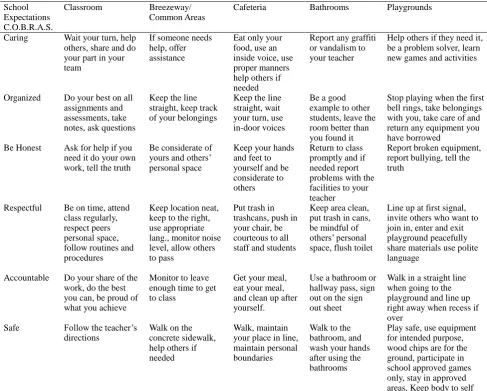
Two weeks after the ballots were sent home, they were returned and counted, and the expectations with the highest number of votes were selected. The results of the ballot led to the identification of the expectations that would be used as the school’s behavior expectations for all students. Students, parents, families, and the leadership team collaboratively selected the expectations and created a mnemonic that aligned with the school mascot, COBRAS: Caring, Organized, Be Honest, Respectful, Accountable, and Safe. Each of these expectations was further defined in the context of routines and settings.
To celebrate the school’s collaboration with families and students during the creation of the universal expectations, the leadership team held a contest in which students across grade levels could design a poster with their families for a chance to win a new bicycle along with additional prizes. The poster contest created an opportunity for families to work together to define the expectations that would be used across the campus. Many of the posters were created in Spanish, which also promoted ownership and shared decision-making among parents and students. The posters submitted served as official school-wide expectation posters. They were placed in classrooms around the campus, in the cafeteria, on school buses, and in the front office. The entire leadership team, including the grade-level chairs and school administrator were invested in the changes to the school environment. The poster contest was developed as a means for promoting the school-wide expectations and took place in the first month of school. In that time, students and their families had turned in over 100 posters and four grade level rallies were scheduled. The leadership team created a grading rubric for the posters and shared it with parents, students, and teachers on campus, and was used to identify the winner of the contest.
During these rallies, the principal announced the poster contest winners and new school-wide expectations were presented to students and their families. Community members, such as local Lucha Libre wrestlers, whose wrestling history is closely intertwined with the history of Mexico, business owners, and political leaders also attended the rallies and spoke about the need for students to meet the behavior expectations. The grade level rallies were considered a huge morale booster for the entire school.
The second two rallies were held after school so that parents, governing board members, and special guests could attend. The office staff and teachers made phone calls informing families that a rally was being held to introduce and review the new school-wide behavior expectations. Food and drink were served at no cost. Over 100 parents attended the after school rallies, and many of the parents were excited to hear of the new school-wide expectations. The leadership team made copies of the new expectations in Spanish and English and created magnetic leaflets of the expectations created by the leadership team. These rallies allowed the parents to take the plan home and discuss and review the expectations with their children.
2.2.4 Providing Professional Development
settings across the school’s campus. The school’s principal agreed to pay teachers one hour beyond their contract pay to attend the seminars.
2.2.5 Teaching and Reinforcing Expectations
Taking the time to teach students each expectation and what each expectation looks like in different settings of the school was essential for the success of the SWPBS program with the students. During the school year, teachers and staff used the Teaching Matrix to teach and reinforce these expectations in various school settings and routines (see Table 2).
Table 2. Teaching Matrix
School Expectations C.O.B.R.A.S.
Classroom Breezeway/ Common Areas
Cafeteria Bathrooms Playgrounds
Caring Wait your turn, help others, share and do your part in your team
If someone needs help, offer assistance
Eat only your food, use an inside voice, use proper manners help others if needed
Report any graffiti or vandalism to your teacher
Help others if they need it, be a problem solver, learn new games and activities
Organized Do your best on all assignments and assessments, take notes, ask questions
Keep the line straight, keep track of your belongings
Keep the line straight, wait your turn, use in-door voices
Be a good example to other students, leave the room better than you found it
Stop playing when the first bell rings, take belongings with you, take care of and return any equipment you have borrowed
Be Honest Ask for help if you need it do your own work, tell the truth
Be considerate of yours and others’ personal space
Keep your hands and feet to yourself and be considerate to others
Return to class promptly and if needed report problems with the facilities to your teacher
Report broken equipment, report bullying, tell the truth
Respectful Be on time, attend class regularly, respect peers personal space, follow routines and procedures
Keep location neat, keep to the right, use appropriate lang., monitor noise level, allow others to pass
Put trash in trashcans, push in your chair, be courteous to all staff and students
Keep area clean, put trash in cans, be mindful of others’ personal space, flush toilet
Line up at first signal, invite others who want to join in, enter and exit playground peacefully share materials use polite language
Accountable Do your share of the work, do the best you can, be proud of what you achieve
Monitor to leave enough time to get to class
Get your meal, eat your meal, and clean up after yourself.
Use a bathroom or hallway pass, sign out on the sign out sheet
Walk in a straight line when going to the playground and line up right away when recess if over
Safe Follow the teacher’s directions
Walk on the concrete sidewalk, help others if needed
Walk, maintain your place in line, maintain personal boundaries
Walk to the bathroom, and wash your hands after using the bathrooms
Play safe, use equipment for intended purpose, wood chips are for the ground, participate in school approved games only, stay in approved areas, Keep body to self Students were taught what the expectation looked like within a routine and were provided examples and non-examples of rule-following within the routine. Teachers provided students with time to practice the new expectations across the school campus. Once a student demonstrated a new expectation, the student was immediately reinforced with specific verbal praise such as, “you have done an amazing job at being respectful!” Classroom teachers often modeled behavior expectations, and students were then encouraged to demonstrate these expectations in different settings throughout the school. If a student demonstrated respect to another person, the student’s behavior was reinforced through positive phrase, or different types of tangible reinforcers, such as stickers or raffle tickets. Happy Grams were given to a student that demonstrated appropriate behaviors consistent with SWPBS expectations. Happy Grams were little notes that teachers used to write the student’s name and specific behavior demonstrated by the student. Happy Grams had a white cover sheet and a yellow carbon copy. The students turned in their yellow carbon copy into the office drop box, which automatically included the student in the weekly raffle for prizes and recognition. The white copy went home with the student so that he or she could show it to his or her parents and celebrate the achievement at home.
2.2.6 Seeking Continuous Advisement from Colleagues from University
guided the implementation process. These coaches were knowledgeable about effective instruction, behavior and classroom management strategies that motivate students, use of data analysis systems, and Applied Behavior Analysis methodology (Lewis, Barrett, Sugai, & Horner, 2010).
The school behavior analysis team worked closely with university coaches as they went through the list of ODRs and categorized them as aggressive and nonaggressive. Aggressive ODRs were viewed as verbal or nonverbal act that caused physical or psychological harm to a student, teacher, or staff member. Examples include assault, BB gun and/or knife possession, hitting, intimidation, physical and verbal sexual harassment, and provocation. Behaviors such as classroom disruption, defiance, disorderly conduct, inappropriate language, lying, noncompliance, policy violations, theft, and vandalism were identified as being nonaggressive.
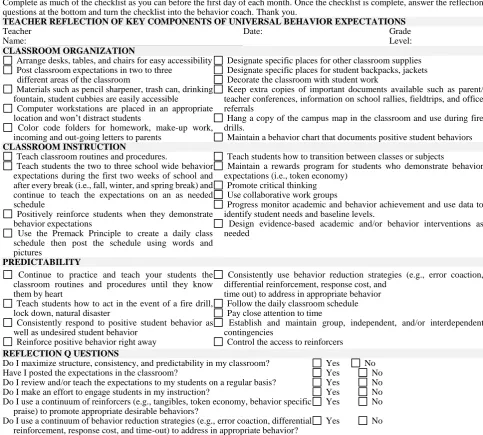
In addition, the external coaches assisted the team in (a) identifying and examining the critical factors that underlie disciplinary issues, practices, and the school’s traditions, (b) developing and implementing an action plan for reforming disciplinary practices to create a positive culture change (Kozleski & Huber, 2010, and (c) ensuring that SWPBS was implemented with consistency and integrity. The external coaches assisted the behavior coach, the lead author, in creating a checklist consisting of a self-reflection component for participating teachers (see Table 3).
Table 3. Teacher Reflections
DIRECTIONS
Complete as much of the checklist as you can before the first day of each month. Once the checklist is complete, answer the reflection questions at the bottom and turn the checklist into the behavior coach. Thank you.
TEACHER REFLECTION OF KEY COMPONENTS OF UNIVERSAL BEHAVIOR EXPECTATIONS
Teacher Name:
Date: Grade
Level:
CLASSROOM ORGANIZATION
Arrange desks, tables, and chairs for easy accessibility Post classroom expectations in two to three
different areas of the classroom
Materials such as pencil sharpener, trash can, drinking fountain, student cubbies are easily accessible
Computer workstations are placed in an appropriate location and won’t distract students
Color code folders for homework, make-up work, incoming and out-going letters to parents
Designate specific places for other classroom supplies Designate specific places for student backpacks, jackets Decorate the classroom with student work
Keep extra copies of important documents available such as parent/ teacher conferences, information on school rallies, fieldtrips, and office referrals
Hang a copy of the campus map in the classroom and use during fire drills.
Maintain a behavior chart that documents positive student behaviors
CLASSROOM INSTRUCTION
Teach classroom routines and procedures.
Teach students the two to three school wide behavior expectations during the first two weeks of school and after every break (i.e., fall, winter, and spring break) and continue to teach the expectations on an as needed schedule
Positively reinforce students when they demonstrate behavior expectations
Use the Premack Principle to create a daily class schedule then post the schedule using words and pictures
Teach students how to transition between classes or subjects
Maintain a rewards program for students who demonstrate behavior expectations (i.e., token economy)
Promote critical thinking Use collaborative work groups
Progress monitor academic and behavior achievement and use data to identify student needs and baseline levels.
Design evidence-based academic and/or behavior interventions as needed
PREDICTABILITY
Continue to practice and teach your students the classroom routines and procedures until they know them by heart
Teach students how to act in the event of a fire drill, lock down, natural disaster
Consistently respond to positive student behavior as well as undesired student behavior
Reinforce positive behavior right away
Consistently use behavior reduction strategies (e.g., error coaction, differential reinforcement, response cost, and
time out) to address in appropriate behavior Follow the daily classroom schedule Pay close attention to time
Establish and maintain group, independent, and/or interdependent contingencies
Control the access to reinforcers
REFLECTION Q UESTIONS
Do I maximize structure, consistency, and predictability in my classroom? Yes No Have I posted the expectations in the classroom? Yes No Do I review and/or teach the expectations to my students on a regular basis? Yes No Do I make an effort to engage students in my instruction? Yes No Do I use a continuum of reinforcers (e.g., tangibles, token economy, behavior specific
praise) to promote appropriate desirable behaviors?
Yes No
Do I use a continuum of behavior reduction strategies (e.g., error coaction, differential reinforcement, response cost, and time-out) to address in appropriate behavior?
Yes No
additional supports for the teachers and paraprofessionals. The behavior coach also offered one on one assistance to the participants in behavior management practices, if they so desired.
The process of implementation continued for two years. At the end of each of the two school years, the leadership team met to review the results of adopting universal expectations. The ODRs were compared from Year 1 to Year 2.
3. Results
An initial analysis of data collected at the end of the second year showed a significant decline in the number of ODRs (see Table 4).
Table 4. Years 1 and 2 ODRs by Grades
Year 1 Student Behaviors
K 1 2 3 4 5 Total Year 2
Student Behaviors
K 1 2 3 4 5 Total
Aggressive behaviors
0 3 32 24 21 8 88 Aggressive
behaviors
1 5 14 5 13 6 44
Non-aggres sive behaviors
1 1 21 9 10 1
2 54
Non-aggres sive behaviors
2 1 6 12 4 6 31
Total ODRs 1 4 53 33 31 2
0
142 Total ODRs 3 6 20 17 17 12 75
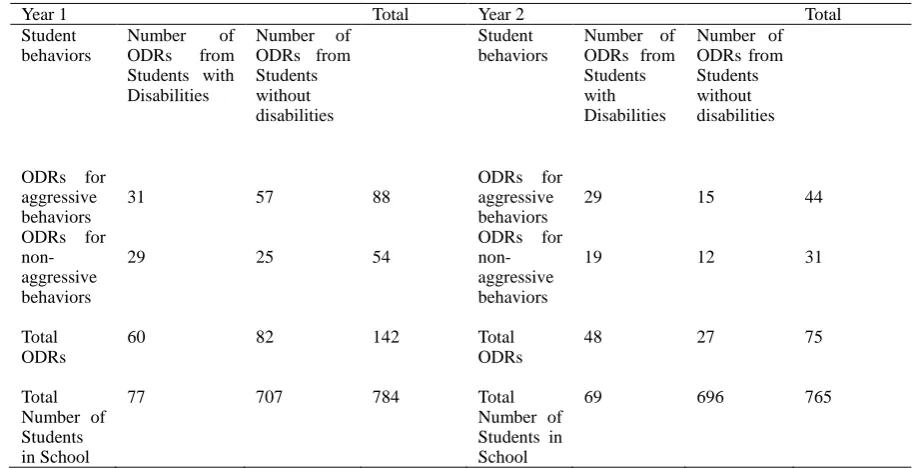
ODRs for aggressive behaviors reduced by 50% from 88 in Year 1 to 44 in Year 2. ODRs for aggressive behaviors were for assault, BB gun and/or knife possession, hitting, intimidation, physical and verbal sexual harassment, and provocation. ODRs for nonaggressive behaviors reduced by 57% from 54 in Year 1 to 31 in Year 2. The nonaggressive behaviors included classroom disruption, defiance, disorderly conduct, inappropriate language, lying, noncompliance, policy violations, theft, and vandalism. The overall rate of ODRs per student decreased from 18% in Year 1 to 9% in Year 2. By the end of Year 1, 10% students enrolled were involved in receiving ODRs indicating 90% students responded to Tier 1 expectations. By the end of the second year of implementation, only 6% students enrolled in the school were involved in receiving ODRs suggesting 94% students responded to Tier 1 expectations. The team determined that the adoption of school behavior expectations effectively reduced ODRs by 47%, from 142 to 75 in two years. Another finding was that students with disabilities were receiving ODRs at a much higher rate than students without disabilities (see Table 5).
Table 5. Number of ODRs Years 1 and 2 for Students with and without Disabilities
Year 1 Total Year 2 Total
Student behaviors
Number of ODRs from Students with Disabilities
Number of ODRs from Students without disabilities
Student behaviors
Number of ODRs from Students with Disabilities
Number of ODRs from Students without disabilities
ODRs for aggressive behaviors
31 57 88
ODRs for aggressive behaviors
29 15 44
ODRs for non- aggressive behaviors
29 25 54
ODRs for non- aggressive behaviors
19 12 31
Total ODRs
60 82 142 Total
ODRs
48 27 75
Total Number of Students in School
77 707 784 Total
Number of Students in School
69 696 765
4. Discussion
This action research took place in an urban elementary school that had high levels of disruptive and aggressive student behavior. The lead author was a graduate student working with professors and colleagues who had extensive knowledge and experience in the areas of urban schools, responsive practice, behavior, and multi-tiered systems of supports who guided him through the process of implementation of SWPBS. Through this exposure to SWPBS, he was motivated by concern for his students that were engaged in aggression towards other students and disrespectful behavior towards administration. Finally, the inclusion of parents, guardians, and students in the selection and adoption of behavior expectations deconstructed barriers that may have created opportunity gaps for some students. Family support was viewed as an integral part of SWPBS. Regular meetings, rallies, and informal opportunities of communication with parents and family members assisted in developing positive relationship with families. Several changes in disciplinary practices were implemented in the first two years of the study. Teachers went from creating their own sets of classroom rules during the first year to adopting and teaching school-wide behavior expectations. Teacher posted positively stated behavior expectations in classrooms and throughout the school. They taught the students the expectations and reviewed them periodically. Teachers and staff were also trained to use positive reinforcement, and practiced reinforcing student behavior when an expectation was demonstrated. Finally, teachers and staff contacted parents on a more consistent basis to share positive information about their son or daughter’s adherence to expectations. Furthermore, by including parents and students in establishing expectations, the relationship between the school and the community was strengthened, and the voices and opinions of students and their families were valued. The lead author’s motivation and dedication and his personal investment in the implementation process assisted in accomplishing disciplinary changes in the school. As a behavior coach, he was also providing support to teachers and staff members needing additional assistance. With the assistance of members in the leadership team and university colleagues, by using observation protocols and assessments, he ensured that faculty and staff were implementing the school expectations with integrity. The intent of this case study was to describe the program that was implemented in an urban school and to demonstrate how a special educator could work with the leadership team and implement the program. Additional research is needed to investigate student outcomes associated with change in climate using more sophisticated statistical techniques.
5. Conclusion
The implementation of universal expectations resulted in reducing the number of ODRs in an urban school that was serving students primarily from minority populations. This case study highlighted the need for developing more targeted and personalized interventions for students with disabilities (Banks et al., 2005). The leadership team was responsive to the need and implemented social skills training and check-in/check-out programs for students who were at-risk for behavioral challenges. The school continues to use the SWPBS framework incorporating parents in the process to allow for success as a school, and individual progress for each student. Although the findings of this case study are unique to the school, they are beneficial for educators who would like to implement universal expectations in their schools.
References
Banks, J., Cochran-Smith, M., Moll, L., Richert, A., Zeichner, K., LePage, P., & McDonald, M. (2005). Teaching diverse learners. In L. Darling-Hammond & J. Bransford (Eds.), Preparing teachers for a changing world (pp. 232-274). San Francisco, CA: Jossey-Bass.
Bradshaw, C. P., Reinke, W. M., Brown, L. D., Bevans, K. B., & Leaf, P. J. (2008). Implementation of School-Wide Positive Behavioral Interventions and Supports (PBIS) in elementary schools: Observations from a randomized trial. Education & Treatment of Children, 31, 1–26. http://dx.doi.org/10.1353/etc.0.0025
Cardillo, R., Freiberg, J., & Pickeral, T. (2013). School climate and engaging students in the early grades. A School Climate Practice Brief, Number 2, New York, NY: National School Climate Center.
Kozleski, E. B., & Huber, J. J. (2010). Systemic change for RTI: Embedding change within a critical framework. Theory into Practice, 49, 258-264. http://dx.doi.org/10.1080/00405841.2010.510696
Lane, K. L., Kalberg, J. R., & Menzies, H. M. (2009). Developing school-wide programs to prevent and manage problem behaviors: A step-by-step approach. New York: Guilford Press.
Lewis, T. J., Barrett, S., Sugai, G., & Horner, R. H. (2010). Blueprint for school-wide positive behavior support training and professional development. Eugene, OR.
McIntosh, K., Chard, D. J., Boland, J. B., & Horner, R. H. (2006). Demonstration of combined efforts in school-wide academic and behavioral systems and incidence of reading and behavior challenges in early elementary grades.
behavior, and academic fluency and their impact on the academic skills of students with EBD. Journal of Emotional and Behavioral Disorders, 14, 209-216. http://dx.doi.org/10.1177/10634266060140040401
Office of Special Education Programs Center on Positive Behavior Support. (2004). School-wide positive behavior support: Implementers blueprint and self-assessment. Eugene: University of Oregon.
Sugai, G., & Horner, R. (2006). A promising approach for expanding and sustaining school-wide positive behavior support. School Psychology Review, 35, 245–259.