784
Copyright © 2011-15. Vandana Publications. All Rights Reserved.
Volume-5, Issue-2, April-2015
International Journal of Engineering and Management Research
Page Number: 784-795
Nutrientional Management Study of Working Women
Krutika C. Gangde1, Kalpana S. Jain2 1
M.Sc II (Home Science – Food Science & Nutrition), Smt. RDG College for Women, Akola (MS), INDIA 2
Professor, Department of Home Science, Smt. RDG College for Women, Akola (MS), INDIA
ABSTRACT
The present investigation has been formulated for the management aspect diet and nutrientional aspect of working women in the Akola district of Maharashtra state. The working women in general were 31 to 40 years age , having more than graduate degree, belonged to small nuclear families with no child of upto 15 year. The working women in general were from 31 to 40 years age holding graduate degree, belonging small nucler families without any child below 15 years age with their husband as family head , having family monthly income uopt Rs.25,000 and spending between Rs5001 to 15,000/- on various items in a month. The majority of them were vegetarian in diet following three time meal pattern of breakfast, lunch and dinner. They possess medium knowledge but their nutritional practices use was high and had a remarkable inclination towards the nutritional practices. The intake of calories, carbohydtates and fats was in excess but that of proteins, calcium and vitamins was deficient. Most of the women were normal in height weight and BMI. Clinically they were normal .The majority problem they were facing were harassment and depression. The characteristic of the working women, namely, age, education and attitude towards nutritional practices were formed to be significiantly associated and determining the nutritional intake of the working women. The working women were formed to be aware about the nutritional practices for their age and type of work. It is essential and create awareness among their group of women through mass media. The intake of proteins, calcium and vitamins was less than the RDA again they should be aware and convinced to include more proteins, calcium rich and vitamin supplying food in their diet. The working women were coming across with the problem of dipression and harassment at work place. The employer therefore try to provide congenial and conducive atmosphere for the discharge of their duties.
I.
INTRODUCATION
Employment for women has become a need in 21th century. Although the working and employment is accepted by the family members in urban area, however they are not ready to accept the changing pattern of life. Women are participating in many skilled jobs, advance
science and technology area and improving the quality of life. The women don’t want to leave the job as it is not only her economic but also psychological need leading to personality development. Because of this she faces physical as well as mental stress. The working women who is not able to balance her office and home stress, and bring personal stress to office and work stress of office to the home, become irritated and angry in nature. Measures aimed at improving eating habits inculcation of desirable nutritional practices improved and scientific utilization of available food material and the effective popularization of improved cooking practices have to be implemented as food is the basic requirement for survival. Present study is an attempt to know the management aspect of nutrient in working women. The findings will help in suggesting way and means for introducing changes and modification in the nutritional profile of working women.
II.
METHODOLOGY
The major imphasis of the present study was on nutritional profile and health of women working in sedentary jobs. Various factors are affecting the nutritional profile of working women. It is therefore, essential to identify and to investigate the nutritional profile and life style pattern of working women.
Profile of working women is as the physical fitness to perform within house and outside duties within stipulated time and having normal nutritional profile without any medical problem or deficiency. The ethods and procedure developed and adopted in the present investigation are described under the following sub head.
III.
RESEARCH DESIGN
785
Copyright © 2011-15. Vandana Publications. All Rights Reserved.
IV.
STUDY LOCATION
The present study was conducted in Akola city.
V.
SELECTION OF AREA FOR
STUDY
For the selection of some women working in sedentary jobs from various areas in Akola city Kaulkhed, Jatharpeth, Gaurakshan road Adarsha Colony,Sant Tukaram Hospital Square were the arrows where schools, colleges, bank, tuition, classes and parlors etc were in maximum number. Hence this area was considered for study.
VI.
SELECTION OF THE SAMPLE
A sample of 120 women working in sedentary jobs in the age group of 25 to 50 years was selected for the study.
The major occupational categories considered were 1. Education institutes
2. Women working in the different offices government and non-government offices. 3. Women working in different banks The women
working from each category were selected for the present study to formulate a sample 120 working women.
VII.
TOOLS AND TECHNIQUE USED
FOR DATA COLLECTION
For achieving the object of the study appropriate data collecting technique were devised and used for data collection. The observation and interview were the techniques employed for collection of data for this purpose intentional and observation schedules density to study objectives were developed and used for collection of data.
Interview method –
Interview schedule was developed specifically in light of study objectives and used for data collection. The interview schedules were personally filled by the investigator by interviewing the working women in their homes.
Observation method -
This method was adopted to collect the reliable information about anthropometric measurements. The measurement of height in cm and weight in Kg. of the selected working women in schools, colleges, banks, government and private jobs were taken with the help of measuring tape and weighing machine. The clinical examination is the simplest and right method to get information about nutritional profile of individual women working in sedentary jobs. The clinical observation of various body organ were taken by the investigater and recorded in observation schedule
Study of variables, their measurement and categorisation.
The present study was related to women working in sedentary jobs. The following variables related to them were studied
Personal Characteristics
1. Age – It is the chronological age of the working women at the time of interview in completed year. On the basis of working women actual age they were classified as under-
2. Education – Education was defined as the formal standard of schooling passed by the respondent. On the basis of formal education the sample respondent were categorized as below-
3.Type of job- It was taken as the means of livelihood and the women were categorized. Into goverement, and private jobs.
4. Total hours of work – The total hours of work is length of time duration in hours. The categorization on work duration was made as under.
Characteristics of family-
1. Type of family- It is the pattern of living together by family members and divided into two categories as joint and nuclear.
2. Size of family – The size of family is dependent upon the type of family . Size of family is the total number of members living together in the family. On the basis of number of members in the family their categories were formed as small (up to 4), medium (5 to 6) and large (More than 6)
3. Number of children - It is taken as total number of childrenbelow 15 year in the family of the respondent. They were grouped into three categories, namely, none, 1to 2 and above 3.
4. Monthly income of family - The total earning of all family members monthly in rupees.
786
Copyright © 2011-15. Vandana Publications. All Rights Reserved.
5 Monthly expenditure of family – It is taken as the amount of money in rupees spend by family on various things in a month. The monthly expenditure is categorized into three different levels.
Diet and meal pattern
1. Type of diet – It is defined as the type of food consumed by the family members of the working women. On the basis the of food habits working women were categorized into three groups.
2. Dietary pattern - The pattern of food taken by the working women consecutively for three days was recorded and on the basis of meal pattern the working women were classified in the following categories.
Knowledge of nutrition
The knowledge in the present study was defined as the understood information possessed by working women about nutritional practices. The knowledge was ascertained with the help of knowledge test developed for the purpose. The knowledge test included 11 questions related to nutrition practices. The response to each question was obtained from working women. The responses were correct and incorrect with a score of one and zero and categorized in to three groups.
Nutritional practices –
The nutritional practices in the present study was defined as the nutritional practices followed by working women. It was studied with the help of test developed for the purpose. The nutritional practice test included 10 questions related to nutritional practices, having responses as always, sometimes and never and scored as 3,2 and 1. On the basis of total score three categories were formed.
Attitude towards nutritional practices.
The attitude of working women towards nutritional practices was studied with the help of the scale. It included 9 statement related to attitude towards nutritional practices having responses as Agree, Undecided and Disagree. They were scored as 3,2and 1 for positive and 1,2 and 3 for negative statement. The total score of all statements were summed up and categorized as under
Nutritional Intake –
The responses of the working women on quantity of daily food intake was obtained from daily food consumption the intake in terms of calories, carbohydrates, proteins, fats, minerals and vitamins were worked out. It was compared with the RDA for sedentary working women and categorized in three groups.
Anthropometric Measurement
The anthropometric measurements relates to the measurements of body characteristic of the subject the working women. The anthropometric counts of the working women in respect of height, weight and BMI (Body mass Index) were actually taken.
1. Height –
Height measurements is very essential . Height is the actual measurements of body length with the help of measuring scale or non-stretchable tape. The height was measured and categorized as under.
2. Weight –
787
Copyright © 2011-15. Vandana Publications. All Rights Reserved.
3. BMI
Form the measured height and weight the BMI was calculated by the formula.
Clinical Examination
Clinical examination is the most essential part of nutritional studies. It is the simplest and practical means of ascertaining status of a group of individuals. Standard survey forms or schedule have been devised covering all area of the body i.e. Eye, Vision, Hair Colour, Nails, Skin, Teeth, Physical appearance, Appetite etc. Clinical examination was conducted with special reference to the nutritional deficiency signs by the investigator. The examination of hair, hair colour, eyes, nails, skin, teeth, tongue, physical appearance vision and illness was done and the observations were recorded.
Health problem
The health problem in the present study was defined as the actual problems of health encountered by working women. Health problem included Hypertension, Diabetes, Low B.P, Anemia, Asthma, Allergy etc.
Physical, mental and social problem
Physical, mental and social problems included fatigueless, exhaust, depress, loss of interest, mental tension, quarrel with husband, quarrel with family members, over burdened with household and office work, lack in care of children, lack inuse of family members, lack of attention on education of children, non co-operation from family members, lack of time for participating in social activates, problem of sharing household work, lack of co-operation from co-workers, Harassment at work place, harassment from family members etc.
Analysis of Data -
The categorization and classification of the data in tables was undertaken. The frequencies and percentages in each class was worked out for interpretation of the findings. The chi-square analysis was undertaken to ascertain the association, if any, between the selected characteristics of the working women and their nutritional profile.
So as to as certain the association between personal and family characteristics of women working is sedentary jobs and their nutritional intakes the
chi-square(X2 ) analysis was undertaken by using the following formula.
The calculated value of Chi-Square was tested for significance against the table value at (r – 1) (c – 1) degrees of freedom.
VII.
RESULTS & DISCUSSIONS
In the present study the Health and nutritional profile of sedentary working women was studied out to see the nutritional profile of working women. For this study survey method was used. Data were collected with the help of interview and observation schedule. The information about sedentary working women and their family, meal patterns, knowledge and use of nutritional practices, dietary intake, antropometric measurements, clinical assessments health and social problems of sedentary working women was collected.
Personal characteristics:
a) Age -
The selected sedentary women working women were classified according to their chronological age and presented in the Table 1. The distribution according to age indicated that about half of the selected working women (48.33%) were 31 to 40 years age. As much is 24.16 per cent were in the age group of above 41to 50 year. Working women between 31 to 40 year of age group dominated the age wise distribution.
Education -
Education is an important factor
788
Copyright © 2011-15. Vandana Publications. All Rights Reserved.
Selected sedentary working women were classified according to their educational level Table 2 contains distribution according to their educational level . It is revealed from the table that women having low educational level were meager in service, out of total selected working women having educational qualification up to under graduate + D.ed were 12.57 percent while 87.53 percent working women engaged as teachers, lectures, clearks in banks were having qualification of graduate and above. The results thus indicate that working class of women was dominated by qualified and highly qualified women.
Family charactristic 1 Type of family
Migration for earning has become continues process and it has affected the concept of joint family and given rise to nuclear family (Table 3). The selected respondents were classified in two groups according to family type as nuclear and joint family. The selected respondendts belonging to nuclear families were comparatively less. The women having joint families were in majority (58.33%).
2.Size if Family
Job opportunities and strategies for survival had compelled the women to move from one place to the other (Table 4) .This mobility has compelled to form nuclear families and restrict the family size. The majority (64.16%) of women expressed that the size of their family was restricted upto 4 adults. As much as 27.5% women expressed that their family size included 5 to 6 adults and only 8.33% women expressed that their family is compered of more than 6 members.
3. Number of children :
Now a days people have restricted families for their betterment. Sedentary working women were classified according to the number of children in the
family. From table 5. It was revealed that 4.16% of the women were having above three children and 29.17% had 1 to 2 and majority (66.67 %) had no children below the age of 15 years in their family. It is concluded that the working class of women were able in controll the family size with one or two children having below 15 years of age.
4. Head of family
Table 6 show the distribution of working women according to their head of the family.
It is revealed from table 6 that 70.84 percent of the women pointed out that the head of family is husband and 10.83 percent working women expressed that herself being the only senior person in the family occupy the position of family head.
5. Family income
Family income is an important part for the family life to spend sufficient and adequate money available as per requirement is need of the day. With this object most of the family member try to earn for their family. The selected working women were grouped according to their family income and presented in table 7.
It is seen from the Table 7 that selected women (50.84%) women were having their family income upto Rs. 25000/- more than one third (38.33%) women were having family income in between Rs. 25001/- to Rs. 50000/-and only 10.85 percent were having family income above Rs. 50,000.
6- Monthly expenditure of family .
789
Copyright © 2011-15. Vandana Publications. All Rights Reserved.
Selected working women were classified according to expenditure on various items and food and result are given in table 8. It reveals that more than one third 37.5% women were having their monthly food expenditure less than Rs 5000/-. As much as 53.33 percent women had family expenditure on food in between Rs 5001 to Rs 15000/- per month and only 9.16 percent working women had their expenditure on good and various items more than Rs 15000/- monthly.
Food habits and diet pattern 1) Type of food (food habit)
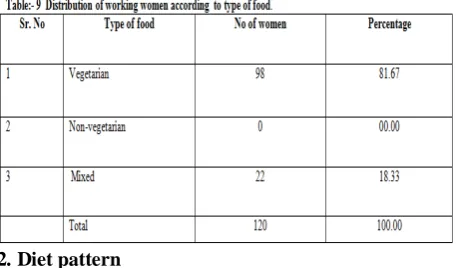
Food habit is mostely dominated by religion and the surrounding . Selected women were classified according to their food habits. It was noted that 88.67 percent had their liking towards vegetarian food (table no 9) 18.33% prefer ocassionally non-veg food and hence their liking was of mixed type None of the respondents prefer non-veg food .
2. Diet pattern
Nutrition of individual is based on
quality of food consumed and dietary pattern followed. Nutritional studies are always based on the fact that the recommended dietary pattern is followed by an individual or not.
In this view , selected sedentary working women were asked about dietary pattern and classified on the basis as per pattern observed and presented in
table 10. The finding show that dietary pattern was dominated by lunch and dinner, as 40.83 women were following the lunch and dinner pattern. As much as 27.50 percent women had their dietary pattern as lunch, breakfast and dinner . Nearly one-forth( 24.17%) were following the diet pattern of breakfast, lunch, snaks and dinner. Only 7.5 percent had three time meal as lunch, snakes and dinner.
Working women were following gemerally the lunch, snacks and dinner pattern and only 24.17 % working women were following the recommended dietary pattern ie.. breakfast, lunch, snacks and dinner which is a matter of concern.
Nutrition knowledge
The information about the knowledge about nutrition practices in table 11 shows that majority of the women (49.17%) had medium knowledge .It was followed by 18.33 parent women with high knowledge. Remaining medium 49.16% and low 32.50 percent were poorly equipped with knowledge about nutritional practices and were observed in low category of knowledge. The hypothesis that the nutritional knowledge of working women is adequate therefore does not had good.
Nutritional practices –
The information about nutritional practices in table 12 indicate that majority of working women (54.17) used to followed recommended nutritional practices to higher extent nearly 30 percent were in medium category remaining 16.16 percent had low adoption nutritional practices. In the above findings therefore leads to the acceptance of hypothesis formed earlier that there is adequate use of nutritional practices of working women.
Nutrition intake :
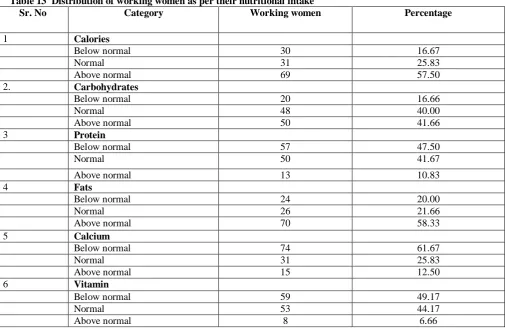
The intake of total calories, carbohydrates, proteins, fats, calcium and vitamin by sedentary working women were ascertained and the findings are presented in Table 13.
1. Calorie
790
Copyright © 2011-15. Vandana Publications. All Rights Reserved.
percent had normal intake and 16.67 percent had below normal intake than RDA. The hypothesis that the nutritional intake of working women is adequate is hence accepted
2. Carbohydrates
The nutrition intake was distributed in three group according to their carbohydrates intake and data are presented in table 13. The below normal intake was noted in 16.66 percent, 40percent had there carbohydrates intake as normal and Above normal consumption was noted in 41.66 percent respondents.
3. Proteins
The nutrition intake was distributed in three categories according to protein intake and the data are presented in Table 13 . The below normal intake was noted as 47.5 percent. As much as 41.67 percent had
their protein intake as normal . Above normal intake was 10.83% observated in 10.83 percent working women.
4. Fats
The nutrition intake was categorised in three categories according to intake of fats and the data are presents in Table 13. Above normal intake of fats was observed in case 58.33 percent working women. Nearly about one fifth each had normal and below normal intake of fats than R.D.A.
5. Calcium
The calcium intake shows that majority of the working women (61.67%) had below normal calcium intake. As much as 25.83 percent had normal intake of calcium. Only 12.50 percent above normal calcium intake. Deficiency of calcium causes weakness of the bones. So awareness is essential for the normal intake of calcium in working women.
Table 13 Distribution of working women as per their nutritional intake
Sr. No Category Working women Percentage
1 Calories
Below normal 30 16.67
Normal 31 25.83
Above normal 69 57.50
2. Carbohydrates
Below normal 20 16.66
Normal 48 40.00
Above normal 50 41.66
3 Protein
Below normal 57 47.50
Normal 50 41.67
Above normal 13 10.83
4 Fats
Below normal 24 20.00
Normal 26 21.66
Above normal 70 58.33
5 Calcium
Below normal 74 61.67
Normal 31 25.83
Above normal 15 12.50
6 Vitamin
Below normal 59 49.17
Normal 53 44.17
Above normal 8 6.66
6. Vitamins
The nutrition intake was grouped in three
categories according to vitamins intake and the data are given in Table 13. Normally the working women in majority (49.17%) had below normal intake . As much as 44.17 percent had their vitamins intake as normal. Above normal of vitamins intake was noted in case of 6.66 percent working women.
Anthropometric Measurement
The pattern of growth and the physical status of the body though genetically determined yet is profoundly influnced by diet and nutrition. The
anthropometric measurements with regard to height, weight and body mass index of the working women were taken and the findings are depicted in Table 14.
1. Height –
It is evident from Table 14 that majority of the respondents (75.83%) belong to about 166 to175 cm height category. Only 7.5 percent are between 156 cm to 165 cm and remaining 16.66 percent were below 155 cm in height.
2. Weight –
791
Copyright © 2011-15. Vandana Publications. All Rights Reserved.
percent are above 70 kg. Remaining 52.50percent were in between 36 to 70 kg in body weight group.
3. BMI :
On the basis of height and weight the BMI was worked out and the distribution of the respondents is
presented in Table 14. It is seen that 16.67 percent working women had BMI up to 19. In one third (19.01 to 24) category there were 50.00% and in remaining BMI category that is above 33.33% working women
were observed.
Table 14- Distribution of working women as per their anthropometric measurements .
Sr. No Category Working women Percentage
1 Height (cm)
Upto 155 cm 20 16.67
156 to 165 cm 9 7.50
166 to 175 cm 91 75.83
2. Weight (kg)
Upto 35 43 35.83
36 to 70 63 52.50
Above 70 14 11.66
3 Body Mass Index (BMI)
Upto 19 20 16.67
19.01 to 24 60 50.00
Above 25 40 33.33
Clinical Examination :
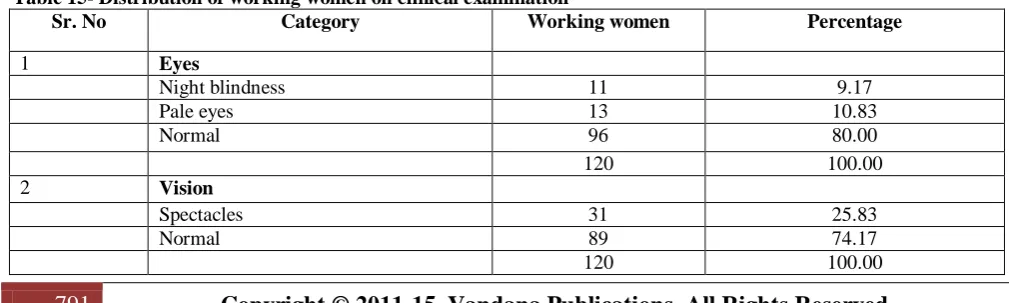
The clinical examination in respect of hair, hair colour, eyes, nails, skin, lips, teeth, tongue, oedema, physical appearance and vision was under taken and the result are given in Table 15.
1. Eyes
The examination of eyes of working women
indicated that two-third of working women (80.00%) had normal eyes. The night blindness was observed in case of 9.16% working women. As much as 10.83% working women had pale eyes
2. Vision –
It was observed that majority of the working women(74.16%) had normal vision had (74.16%) very less percentage abnormal vision
3. Hair colour
The colour of hair in case of great majority of working women (83.33%) was found to be normal black. White or brown colour hair were seen in few cases of working women.
4. Nails
The clinical examination of nails reveal that 54.16 percent working women had pale nails. Losses
nails was in 37.5percent, and Dark spot 5.83percent . Very few had pink colour nails.
5. Skin
It is most important in human body. It helps in regulation and protection of body. Tight skin was noted 91.66 percent and loose skin in 8.33percent working women.
6. Teeth
The clinical examination of teeth used that only 8.33percent women had creed normally dentally carries. More than three fourth women (70.84%) had normal teeth
7. Physical appearance :
Physical aplperance is of two type. Dullness was 9.17% and freshness of 90.83 percent had working women.
8. Appetite
Appetite is the desire to eat food, feel as hungery. Appetite has a relationship with every individuals behavior. Normal appetite was seen in 94.17percent and 5.83 percent had observed appetite
Table 15- Distribution of working women on clinical examination
Sr. No Category Working women Percentage
1 Eyes
Night blindness 11 9.17
Pale eyes 13 10.83
Normal 96 80.00
120 100.00
2 Vision
Spectacles 31 25.83
Normal 89 74.17
792
Copyright © 2011-15. Vandana Publications. All Rights Reserved.
3. Hair color
Black 100 83.33
White 15 12.50
Brown 5 4.17
120 100.00
4. Nails
Pale 65 54.17
Losses 45 37.50
Dark spot 7 5.83
Pink 3 2.50
120 100.00
5. Skin
Tight 110 91.67
Loose 10 8.33
120 100.00
6. Teeth
Dental carries 10 8.33
Chalky white 25 20.83
Normal 85 70.84
120 100.00
7. Physical Appearance
Dullness 11 9.17
Freshness 109 90.83
120 100.00
8 Appedite
Normal 113 94.17
Abnormal 7 5.83
120 100.00
Health problems –
It is observed from Table 16 that about one fourth (25.83%) working women were suffering from hypertension. As much as 20.83 percent reported that
they feel exhausted.A small percentage of working women had the problem of diabetis, low B.P, Anamia, back pain and overweight.
Physical, mental and social problems
It could be observed from table 17 that a small percentage of working women expressed the problem of loss of interest (2.50%), mental tension (3.33%). quarrel with husband (8.33%) loss of sleep (4.16%) can not take care of children (2.5%) harassment from family
793
Copyright © 2011-15. Vandana Publications. All Rights Reserved.
Associational analysis
Chi-square test can be used to study goodness of fit and association between the attributes. In the present study an attempt was made to study the association of some selected attributes with the nutritional intake by working women and the results are presented in table 18. Significance of Chi-square values indicate that attributes are dependent.
Association between age and nutritional intake
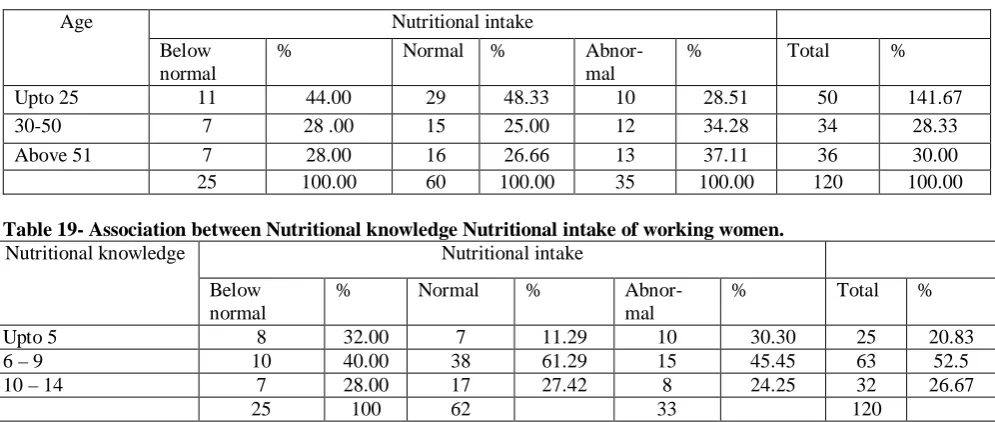
To study the association of age and nutritional intake was recorded for all 120 working women and classified as below normal / normal / Above normal nutritional intake. The classification of working women on the basis of age category and nutritional intake along with chi-square value is given in Table 18 & 19.
Table 18- Association between age and nutritional intake of working women.
Table 19- Association between Nutritional knowledge Nutritional intake of working women.
Nutritional knowledge Nutritional intake
Below normal
% Normal %
Abnor-mal
% Total %
Upto 5 8 32.00 7 11.29 10 30.30 25 20.83
6 – 9 10 40.00 38 61.29 15 45.45 63 52.5
10 – 14 7 28.00 17 27.42 8 24.25 32 26.67
25 100 62 33 120
χ2
IX.
CONCLUSIONS
= 8.77 ; Significant at 0.00 level of probability
Food is basic necessity of life. Body building foods are especially important at time when body is growing. Food are also needed mainly for repair and maintenance of the body. Now a days nutrition are the constituents of food which help us to maintain our body functions, to grow and protect our organs. Health means the well being of an individual in physical , emotional and social condition Working women teacher have a special position in society. Teacher role are closely related to students . If women have knowledge of nutrition than they can impart this knowledge very well to their family. The present investigation
“Nutritional profile of sedentary working women” has therefore been undertaken. Following conclusion could be drawn;
1. About 31 to 40 year age grou working women were having their qualification graduate and above.
2. The majority of working women 100.58% belonged to nuclear families.
3. The working women families in majority consist of upto 4 member (64.17%) with no child below the age of 15 years (66.67%)
4. In great majority of families of working women the husband (70.87%) occupy the position of family head.
Age Nutritional intake
Below normal
% Normal %
Abnor-mal
% Total %
Upto 25 11 44.00 29 48.33 10 28.51 50 141.67
30-50 7 28 .00 15 25.00 12 34.28 34 28.33
Above 51 7 28.00 16 26.66 13 37.11 36 30.00
794
Copyright © 2011-15. Vandana Publications. All Rights Reserved.
5. Incase of 50.83 percent working women the family income was upto Rs 25000/- per month. 6. The monthly expenditure on food in case of
53.33 percent families ranged between Rs.5001 to Rs. 1500.
7. Selected group of respondents were vegetarian dominated(81.67%).
8. As much as 40.83percent working women were preferring dietary pattern of lunch+dinner and 27.5percent working women preferred dietary pattern of B+L+D.
9. The knowledge about nutritional practices of 49.17 percent working women was medium. 10.There is high adoption of nutritional practices
(54.17%) by working women.
11.The total calories, carbohydrates, and fats intake were noted be more than RDA but the intake of proteins, calcium and vitamins were less than RDA in maximum percentage of working women.
12.The working women in majority belonged to body height group of 166 to 175 cm(75.83%) weight category of 36 to 70 kg (52.50) and BMI of 19.01 to 24.00(50.00).
13.An higher percentage of working women had normal eyes (80.00%), normal vision (74.17%), black hair (83.33%), pale nails(54.17%), thight skin (51.67%), normal teeth(70.84%), fresh physical appearance and normal appetite.
14.An higher percentage of working women
expressed that they had the health problem of hypertension (25.84%)
15.A percentage of working women were formed to come across with the problem of depression(4.00%) and harressment at work place(25.83%).
16.The education and attitude towards nutrition of working women were formed to be significantly associated with the nutritional intake of working women.
BIBLIOGRAPHY
[1] Baby Bevaki, P. (2001) : Nutritional status with special reference to iron of women construction workers in relation to work performance, Home Science Association of India, Delhi Chapter, P.P. 36.
[2] Bereznyak, LV. A.V. Istomin, V.N. Kagirov, E.A., Stadukhikova, T.I. Tikhomirova and T.V. Poelis. (1986) : Working condition nutrition and health of women workers at a dairy farm, Nutrition Abstracts and Reviews, Series A, Human and Experimental, Vol. 56, (1): 236.
[3] Career Women. Com, (2004); The top five reasons for women change jobs. Femina, October 2nd , P. P. 128.
[4] Fletcher, J. and N.F. Coghill, (1976) : Food intake of hospital nurses under rationing and Pay-as-you-eat. Nutrition Abstracts and Reviews, Series A, Human and Experimental, Vol. 46, (9) : 776.
[5] Geissler C. A., T.A. Brun, I. Mirbagheri, A. Soheli, A. Naghibi, and A. Hedayat. (1983) : The energy expenditure of female carpet weavers and rural women in Iran, Nutrition and Abstracts and Reviews, Series A, Human and Experimental, Vol. 53,.(4),.299.
[6] Giacchero, A., A, Graziani, D. Chiti, F. DI. Giorgio, and A. Gacosa. (1987) : Eating habits of a working population in Liguria, Nutrition and Abstracts and Reviews, Series A, Human and Experimental Vol. 57,(8):602.
[7] Hanumantha Rao M., (1990) : Employment of the wife and husbands participation in house work, The Indian Journal of Social Work, Vol. 50 : 447-455. [8] Harpinder Kaur, M.K. Dhillon and Harnek Singh. (2001) : Employed women - their satisfaction at home and work. Home Science Association of india, Delhi Chapter, P.P. 49-50.
[9] Harshala Rajkumar and S. Premakumari. (2000) : Health and nutritional status of working women in Coimbatore and exposure to occupational hazards, The Indian Journal of Nutrition and Dietetics, Vol.37, (11) : 350-358.
[10] Harshpinder, et. al., (2003); Effect of stress on women Analysis of stressors and management techniques prevalent among Ludhiana working and nonworking women,, The Home Science Association of India, Nagpur Chapter,P.P.21.
[11] Hemalatha, G., Usha Chandrashekhar and M. Sylvia. (2000) : Iron profile of working women in comparison with housewives, The Indian Journal of Nutrition and Dietetics, Vol. 37,(10): 319-324.
[12] Hemalatha, P. and M. Suryanarayana, (1990) : Married working women: A study on their role interactions, The Indian Journal of Social Work, Vol. 51: 153156.
[13] Honda, T., M. Koyama and Y. Hatcho. (1975) : Problems of working housewives and their dietary life (The actual state of irregular working hours and the effect on their diet), Nutrition Abstracts and Reviews, Series A, Human and Experimental, Vo 1.45,(8): 706. [14] Jain, D. and N. Banerjee, (1988): Investigative essays on women's work, Nutrition Abstracts and Reviews, series a, Human and Experimetal, Vo 1.5.8, (9) : 746.
[15] Jain, H. and N. Singh. (2003) : A study on the nutritional status of women in the age group of 25- 30yrs. working in sedentary job in Jaipur City, The Indian Journal of Nutrition and Dietetics, Vol. 40, No.(3): 92-98.
[16] Joshi, Shubhangini,(2002): Nutrition and Dietetics, Second Edition, Tata McGraw Hill Publishing Company Limited, P.P. 536.
[17] Konyae, Steven. (2004) : Apani Karyakshmata Badahai, Gruhashobha, October, P.P. 34-35.
795
Copyright © 2011-15. Vandana Publications. All Rights Reserved.
[19] Lukjan, H., A. Szpak, D. Rose, M. Bielawiec, J. Saaricka, J. Gedrojc, M. Wojtukiewicz and K. Krupinski. (1990) : Some determinants of anemia of working women in the region of Bialystok with special reference to dietary habits, Nutrition Abstracts and Reviews, Series A, Human and Experimental, Vol. 60, (12): 1132.
[20] Mane, Shakuntala (2001): Food facts and principles, Second Edition, New Age International Publishers, P.P. 502.
[21] Osato. S.; I. Nagayama, H. Kora, Y. Wada and N. Wakahara. (1982) : State and examination of differentials by sex and work type on mild drinking habit in Kyushu, Nutrition Abstracts and Reviews, Series A, Human and Experimental, Vol. 62, (7): 605.
[22] Quanine, J., (1990) : Women and Nutrition ; The Gramin Bank experience, Nutrition Abstracts and Reviews, Series A, Human and Experimental, Vol. 60,(7): 1095.
[23] Reames, U. and Burnett., M.F. ,(1992): weight management Practice of black paraprofessional women, Nutrition Abstracts and Reviews, Series A, Human and Experimental, Vol. 62, (6) : 518
[24] Reynaud, J. et. al. (1990) : Impact of a women’s garden project on nutrition and income in Senegal, Nutrition Abstracts and Reviews, Series A, Human and Experimental, Vol. 60, (12): 1095.
[25] Sharan, Sunanda and Shashikala Puttaraj, (2001) : Somatic status of :employed women, Nutrition Society of India, Bhopal, P.P.87.
[26] Shiralkar, M.V., Pranita Kakde, (2001.) :.The problems of working women in Amravati, Home science Association-of Indian, Delhi Chapter, P.P. 66-67.- [27] Shrilakshmi, B.(1999): Nutrition Science, New Age International Publishers, P.P. 1-2.
[28] Smith-Sreen, Poonam and John Smith-Sreen, (1992) : Constraints faced by women daily farmers in
India and strategies to overcome them, The Indian Journal of Social work, Vol. 53, P.P. 105-114.
[29] Sovtic, P. Bevc, Z., (1997) : Energy expenditure of women working in cotton mill, Nutrition Abstracts and Reviews, Series A, Human and Experimental, Vol. 47,( 6):577.
[30] Subramanian, Ramaa and Manoroma Mishra, (2001): Problems and problem solving strategies of women enterprenures in performing the dual role, Home Science Association of India, Delhi Chapter, P.P. 56. [31] Tidke, Anita and Asha Mane, (2003) : Personal characteristics and job satisfaction of Anganwadi workers, The Home Science Association of India, Nagpur Chapter, P.P. 12.
[32] Torun, B., J. Mcguire and R.D. Mendoza. (1993) : Energy cost of activities and task of women from rural region of Guatemala, Nutrition Abstracts and Reviews, Series A, Human and Experimental, Vol.53, (1): 38. [33] Vankhanen, V.D., G.Y., Goncharov, 0.1. Mukukha, A.A. Artemov. (1984) : Energy expenditure and requirements in women employed in the cotton spinning and weaving industries Nutrition Abstracts and Reviews, Series A, Human and Nutritional, Vol. 54, ( 4): 299. [34] Vardhini, Piyush. (2004) : Dilemma of non-working professional women, Women's Era, Octomber 2nd, P.P. 80-81.
[35] Verma Subhashini and Khera Gursimran, (1999) : Impact of diet counseling on the risk factors of CHD among working women, The Home Science Association of India, Jabalpur chapter, P.P. 20.
[36] Vijayanthimala, K.; (2001) : Women with multiple roles: A comparative study of stress of working women of India and Indian women at U.S.A. Home Science Association of India, Delhi Chapter, P.P. 79.